Market Snapshot
Middle bar: base-year value × (1 + CAGR), rounded to two decimals. This is a calculated illustration, not a separately researched annual estimate.
The India automotive aftermarket accessories market reached a valuation of USD 15.80 billion in 2025 and is projected to expand to USD 18.41 billion by 2030, registering a compound annual growth rate (CAGR) of 3.10% across the 2026–2030 forecast period. The sector is transitioning from an unorganised, price-led trading structure toward a technology-enabled, premiumised, and standards-governed retail ecosystem. Growth is attributed to a large and ageing vehicle parc, which exceeds 300 million active two-wheelers and 40 million passenger vehicles, and to compressed ownership cycles that have fallen below four years among urban and semi-urban buyers.
Demand is increasing owing to the next-generation tax reforms introduced under the GST 2.0 framework, effective 22 September 2025. The reform rationalised the rate on standard automotive accessories and spare parts to a uniform 18%, replacing the earlier multi-tiered 28%-plus-cess structure and lowering retail prices on premium upgrades such as alloy wheels, ambient lighting, and high-resolution infotainment units. India’s domestic automotive aftermarket reached approximately Rs 99,948 crore in financial year 2024–25, growing 6% year-on-year, per industry reviews compiled by the Automotive Component Manufacturers Association of India (ACMA).
The market is supported by the rapid rollout of direct-to-consumer (D2C) online marketplaces and the formalisation of exchange-led retail networks. Interior accessories account for the dominant share of passenger-car accessory spending by value, while two-wheelers represent the largest segment by volume across a fleet exceeding 200 million active units. North India remains the largest regional market, whereas West India records the fastest regional growth across the forecast period.
A robust new-vehicle pipeline reinforces this expansion. Monthly passenger-vehicle retail registrations ranged between roughly 3.2 lakh and 5.6 lakh units across FY2026, establishing a forward supply base of vehicles that enter the accessory and replacement cycle within 24 to 36 months of sale. As the average age of used cars sold in India declines toward 3.7 years, consumers increasingly purchase nearly-new pre-owned vehicles and apply aftermarket upgrades to match premium new-car styling, comfort, and electronic specifications, deepening per-vehicle accessory spend across both organised and independent retail channels.
Key Takeaways
Market Overview & Analysis
Report Summary
The India automotive aftermarket accessories market comprises vehicle-specific aesthetic, convenience, electronic, and performance products fitted after the original sale of a vehicle, spanning passenger cars, two-wheelers, three-wheelers, and commercial vehicles. The sector functions as an indicator of discretionary spending power and digital lifestyle adoption across the Indian middle class, supported by a domestic internet base exceeding 895 million connections. Over the past decade, accessory retail has shifted from a commodity-based spare-parts trading model toward a consumer-centric, brand-led ecosystem.
Value creation within India’s borders has deepened materially. Gross Value Added from the manufacture of motor-vehicle parts and accessories crossed Rs 1,13,358 crore, according to the Annual Survey of Industries, reflecting a maturing domestic component base. This localised manufacturing capacity, combined with the vehicle-scrappage policy administered by the Ministry of Road Transport and Highways and tightening Bharat NCAP safety norms, sustains a policy-mandated demand floor for certified, quality-assured accessories. The simultaneous expansion of organised D2C distribution has compressed traditional distributor layers and widened the addressable consumer base.
The forecast assumes stable macroeconomic conditions, with India’s real GDP expanding near 6.5% annually and retail inflation stabilising around 3.5%. Sustained public funding under the Smart Cities Mission and production-linked incentive (PLI) programmes further underpins demand for connected and premium accessories through 2030. Within this environment, the market is projected to grow from USD 15.80 billion in 2025 to USD 18.41 billion by 2030 at a steady CAGR of 3.10%.
Structural maturation is reinforced by the digitisation of procurement across the supply chain. ARAI-certified and ISO-compliant Tier-1 production now feeds D2C digital marketplaces, which in turn enable doorstep professional installation through predictive booking and verified fitment. B2B-focused component aggregators and manufacturer D2C portals are capturing high-margin revenue by eliminating fragmented distributor layers, supplying independent garages and end consumers with real-time catalogue lookups, guaranteed price transparency, and verified parts compatibility. Concurrent demand from commercial leasing and agricultural equipment segments sustains resilient B2B volume pools across Tier-3 and Tier-4 towns.
The regulatory framework reinforces a policy-mandated demand floor for certified accessories. Mandatory AIS-140 compliance requires commercial taxis, goods trucks, school buses, and corporate cabs to carry ARAI-certified vehicle location tracking devices with emergency panic buttons linked to the centralised Vahan database. The Bureau of Indian Standards Scheme X under the Omnibus Technical Regulation standardises quality certification for components and electrical motors, obliging domestic manufacturers and importers to secure certification before placing parts on the Indian market and curbing the flow of substandard imports. Alongside the uniform 18% GST on accessories, these measures shift demand from the unorganised tier toward warranty-backed, quality-assured products, strengthening organised market share through the forecast period.
Market Dynamics
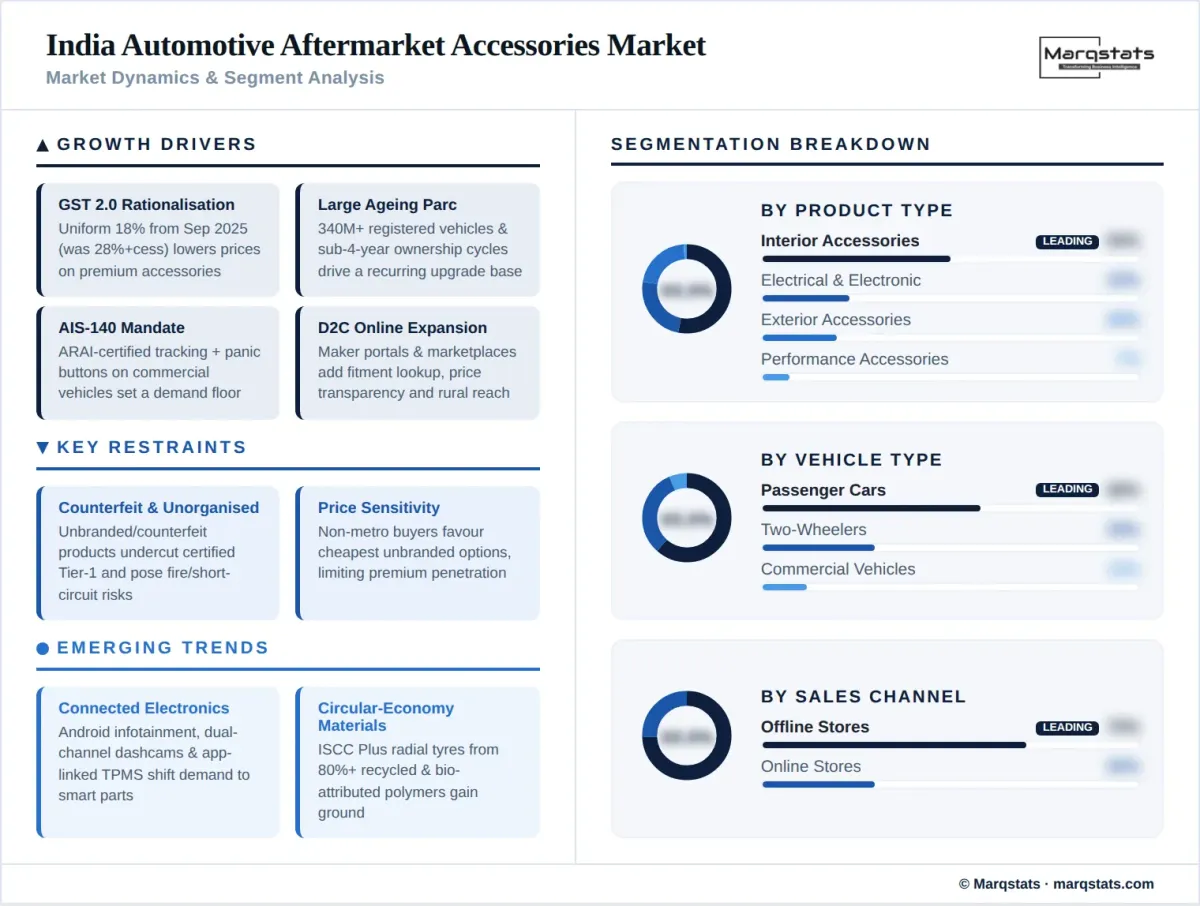
Key Drivers
- GST 2.0 rate rationalisation to a uniform 18%, implemented after the 56th GST Council meeting on 22 September 2025, lowered retail pricing thresholds on premium accessories previously taxed at 28% plus cess, simplifying invoicing for organised retailers.
- Rising household disposable incomes and rapid urbanisation are driving vehicle personalisation, with congested urban commutes of up to three hours daily reframing the cabin as an extension of personal living space.
- A vehicle parc exceeding 340 million registered units, combined with ownership cycles below four years, generates a recurring replacement and upgrade base that anchors aftermarket accessory demand.
- Mandatory AIS-140 compliance for commercial and public-transport vehicles creates a policy-mandated demand floor for ARAI-certified vehicle location tracking devices and integrated panic-button safety systems.
- Expansion of D2C online marketplaces and manufacturer portals improves parts-compatibility lookup, price transparency, and rural reach, accelerating the formalisation of a historically opaque market.
- The accelerating consumer shift toward sport utility vehicles raises the average accessory basket value per sale, lifting demand for premium alloy wheels, body styling kits, and large-format infotainment systems.
Key Restraints
- Dominance of unorganised players and counterfeit products creates severe pricing pressure on certified Tier-1 manufacturers and exposes consumers to safety risks such as short-circuits and vehicle-fire hazards.
- Extreme price sensitivity among non-metro buyers limits the geographic penetration of high-margin, warranty-backed premium accessories, with rural buyers frequently opting for the cheapest unbranded alternatives.
- Fragmented distribution and inconsistent quality certification across thousands of small retail outlets constrain organised brand expansion beyond Tier-1 and Tier-2 cities.
- Limited consumer awareness of certification standards in semi-urban markets slows the migration from unbranded products toward warranty-backed, BIS-certified accessories.
Key Trends
- Connected electronics — Android-based infotainment, GPS dual-channel dashcams, and app-linked tyre-pressure monitoring systems — are reshaping demand toward smart, software-enabled accessories.
- Circular-economy materials are gaining ground, exemplified by passenger-car radial tyres certified under the ISCC Plus framework and built from over 80% recycled and bio-attributed polymers.
- Dealership groups are converting used-car exchange departments into organised business units featuring data-backed vehicle grading, refurbished-part standards, and transparent trade-in pricing.
- Acoustic-comfort and thermal-insulation technologies are emerging as competitive frontiers, with embedded sound-absorbing fabrics and foam layers reducing cabin noise levels by up to 9 dB(A).
- Doorstep professional installation, predictive booking, and bundled fitment services are formalising the last mile, converting accessory retail from a product sale into an end-to-end service experience.
Market Segmentation
Interior accessories form the largest product segment, accounting for approximately 65% of passenger-car accessory spending in 2025. The segment comprises premium fabric and leather seat covers, customised 3D and 5D floor carpets, dashboard protectors, cabin organisers, and steering covers. Growth is driven by rising consumer preference for in-cabin comfort, personalisation, and affordable, easy-to-install upgrades. As commuters spend longer periods in dense urban traffic, demand for ergonomic seat cushions, specialised cabin air purifiers, and ambient lighting continues to broaden the segment’s addressable base across passenger and premium vehicle owners.
Exterior accessories represent a high-margin segment spanning custom alloy wheels, chrome body styling kits, roof carriers, crash guards, and window-tinting films. Demand is driven by the national consumer shift toward sport utility vehicles and aspirational exterior customisation, particularly across urban metros. The GST 2.0 rationalisation has lowered effective pricing on premium upgrades such as alloy wheels, improving conversion among aspirational buyers who previously deferred high-value exterior purchases.
Electrical and electronic accessories form the fastest-growing product segment, comprising high-resolution Android touchscreen infotainment systems, GPS dual-channel dashcams, parking-assist sensors, and wireless charging mounts. Growth is attributed to rising smartphone penetration, secure digital payments, and consumer demand for connected in-cabin experiences. Manufacturers are developing capacitive multi-touch infotainment units with real-time vehicle diagnostics and voice-command integration, while NavIC-enabled vehicle location tracking devices serve a policy-mandated commercial base.
Performance accessories cater to automotive enthusiasts and include high-flow exhaust systems, performance air filters, and suspension-tuning kits. The segment remains niche, concentrated among premium, turbocharged, and luxury vehicle owners seeking enhancement after the warranty period expires. Professional installation through specialist performance workshops captures the majority of segment value, with direct enthusiast purchases and online retailers accounting for the remainder.
Passenger cars constitute the largest segment by value, supported by an on-road base exceeding 40 million units and premiumisation trends across urban metros. Accessory spend per vehicle is highest in this category, reinforced by robust new-vehicle dispatches that feed the aftermarket within 24 to 36 months of sale. The category captures the bulk of interior, infotainment, and exterior styling demand, and benefits most directly from the GST 2.0 reduction on premium components previously taxed at the highest slab.
Two-wheelers represent the largest segment by volume, addressing a fleet exceeding 200 million active motorised units. Helmet sales, protective frames, and rider safety gear dominate accessory demand, with rising compliance awareness and BIS certification supporting organised volumes. Commuter motorcycles up to 350cc moved to the 18% GST slab under the September 2025 reform, improving affordability across mass-market accessory categories and supporting volume growth in semi-urban and rural markets.
Commercial vehicles form a specialised segment driven by fleet operators and logistics companies that require rugged, high-durability replacement parts and AIS-140-compliant tracking systems. Tightening telematics mandates sustain steady demand for location-tracking and safety hardware, while the standardisation of commercial-vehicle taxation to 18% supports fleet renewal and accessory retrofitting across the logistics sector.
Offline stores remain the dominant channel, commanding roughly 70% of market share through multi-brand retail outlets, authorised dealer networks, and service centres across Tier-1 and Tier-2 cities. Installation support, immediate product availability, and established trust relationships reinforce the channel’s lead, particularly for products requiring professional fitment such as alloy wheels, infotainment units, and tracking systems.
Online stores form the fastest-growing channel, driven by rising smartphone penetration, secure digital payments, and the launch of manufacturer D2C portals offering verified parts compatibility. Annual e-commerce accessory dispatches expand by 35–40%, supported by doorstep delivery, transparent pricing, and product reviews. Manufacturer-operated marketplaces and large horizontal platforms together broaden brand reach well beyond major metropolitan clusters into Tier-3 and Tier-4 towns. Features such as alloy-wheel visualisers, easy returns, and integrated installation booking further raise online conversion, narrowing the historical preference gap with offline retail.
By Geography
North India
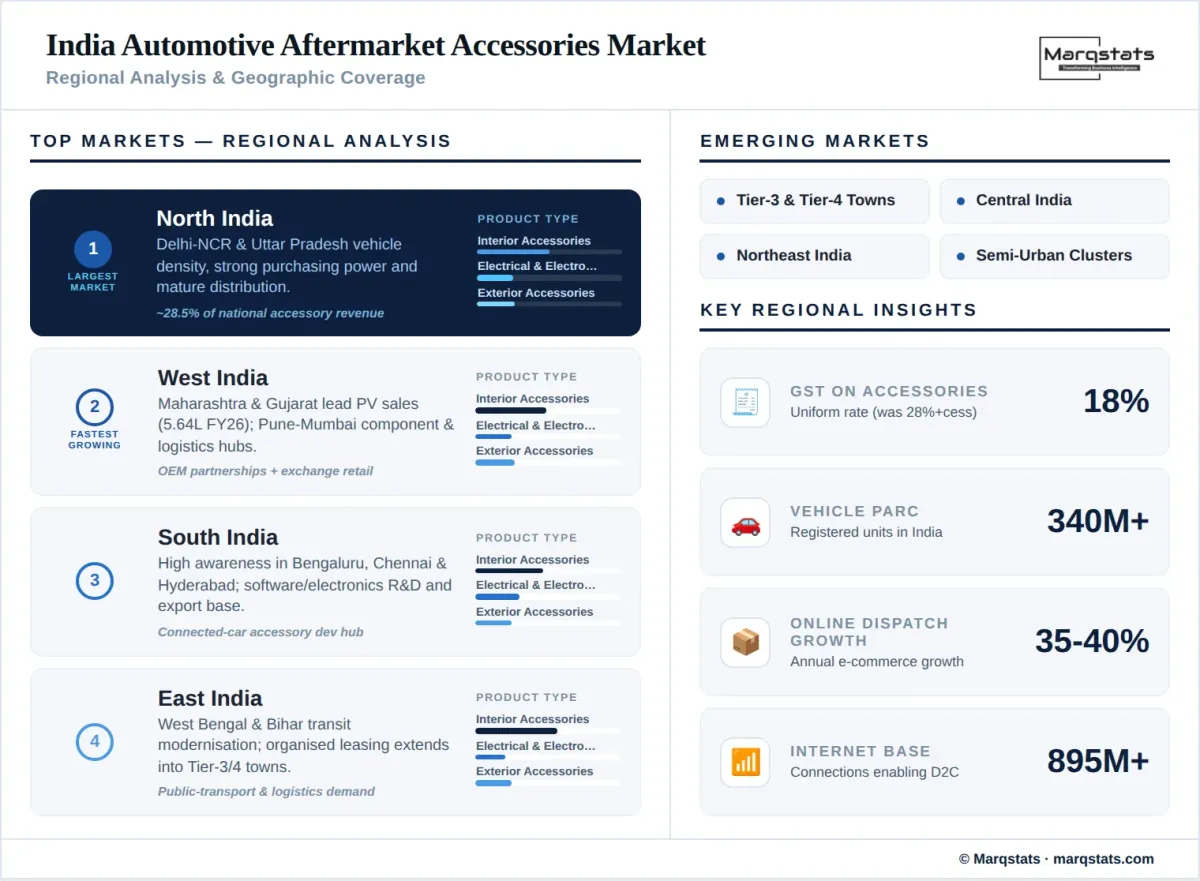
North India is the largest regional market, accounting for approximately 28.5% of national accessories revenue in 2025. High vehicle density across Delhi-NCR and Uttar Pradesh, strong consumer purchasing power, and mature aftermarket distribution networks support this position. Strict emissions regulations and the central vehicle-scrappage policy encourage commercial and logistics operators to modernise fleets with connected accessories and compliant tracking hardware, reinforcing demand for both premium passenger upgrades and commercial-grade safety systems.
West India
West India is the fastest-growing regional market, anchored by Maharashtra and Gujarat, which together lead national passenger-vehicle sales with over 5.64 lakh units recorded in FY2026. Pune and Mumbai host dense concentrations of automotive component manufacturing and logistics hubs, facilitating close OEM partnerships for engineering and product testing. The region also accounts for a substantial share of used and shared-vehicle transactions, sustaining demand for refurbishment-linked accessory fitment and exchange-led retail.
South India
South India records strong growth, driven by high consumer awareness in Bengaluru, Chennai, and Hyderabad. Karnataka and Tamil Nadu host concentrations of software and electronics research centres, positioning the region as a hub for tech-integrated connected-car accessory development. The South also serves as a centre for export-oriented manufacturing, shipping low-rolling-resistance tyres and premium seating systems to European and North American markets, which strengthens local engineering and quality-certification capacity.
East India
East India represents an emerging growth corridor, characterised by public-transport modernisation and state-level infrastructure deployment across West Bengal and Bihar. Expansion of automated fare-collection systems and organised leasing networks into Tier-3 and Tier-4 towns supports aftermarket conversion and micro-mobility adoption. Rising commercial-vehicle activity tied to logistics and public-transport initiatives underpins steady demand for replacement parts and tracking accessories.
How Competition Is Evolving
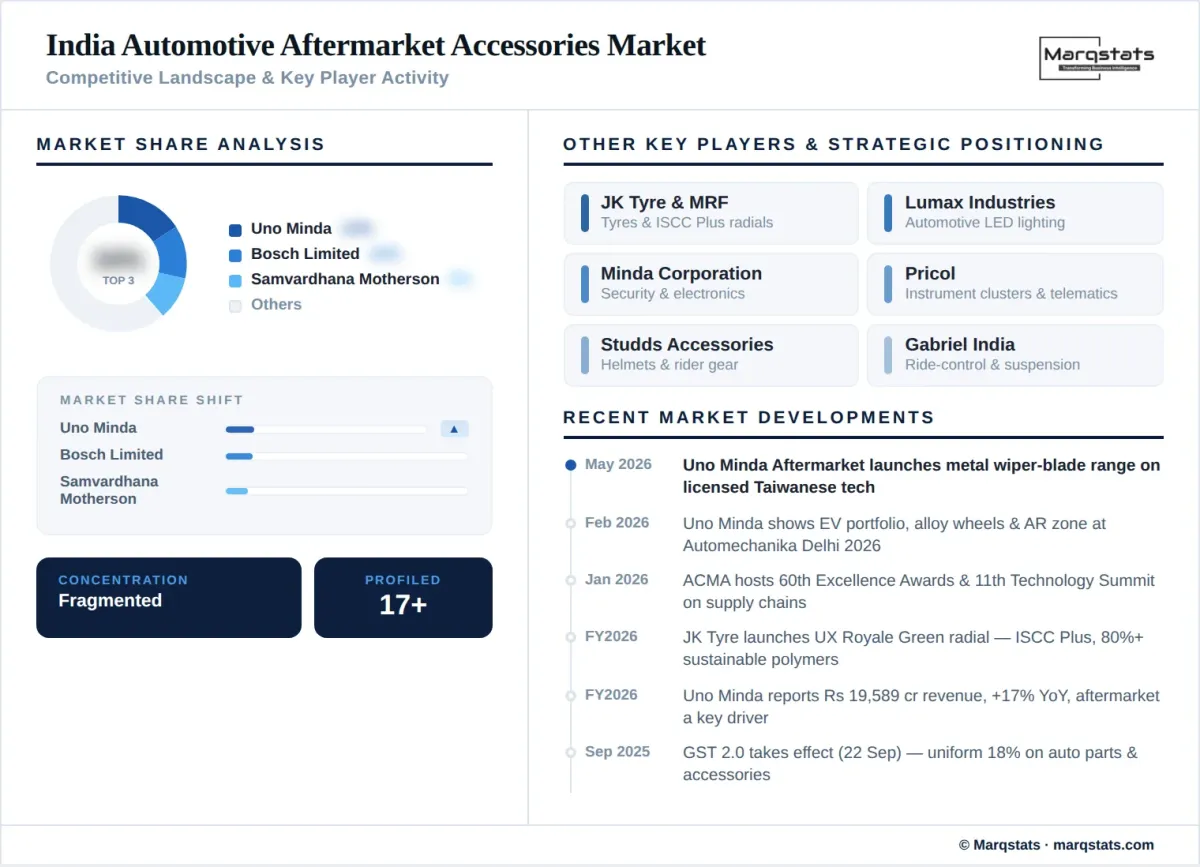
The India automotive aftermarket accessories market is fragmented, with a large unorganised tier of small retailers operating alongside a consolidating set of certified domestic and multinational manufacturers. Organised players utilise localised research and development centres to co-develop ARAI-certified safety, comfort, and electronics systems for both OEM-fit and independent retail channels.
Competition centres on product certification, digital distribution reach, and price transparency. D2C portals and B2B component aggregators are capturing high-margin revenue by disintermediating fragmented distributor networks, offering independent garages and consumers real-time catalogue lookups and verified parts compatibility. Premium-tier manufacturers compete through advanced infotainment platforms, sustainable tyre materials, premium seating, and connected telematics, supported by extensive sales-engineer and retailer networks spanning hundreds of districts.
Strategic activity includes the formalisation of exchange-led used-car retail, expansion of authorised installation and braking-care workshop chains, and acquisition of audio and horn technologies to broaden premium portfolios. One prominent manufacturer reported consolidated FY2026 revenue of Rs 19,589 crore, up 17% year-on-year, while operating a D2C platform offering more than 5,000 SKUs across over 30 product categories. The study profiles more than 15 companies across product, vehicle, and channel categories.
Differentiation increasingly rests on technology integration and sustainability credentials. Tier-1 suppliers are securing OEM and aftermarket orders for Android-based infotainment platforms developed by in-house research centres, with one such infotainment programme carrying an annual peak order value of around Rs 600 crore. Tyre manufacturers are advancing circular-economy positioning through ISCC Plus-certified radial tyres built from recycled and bio-attributed polymers, while lighting specialists are capturing share as automakers integrate LED headlamps, tail lamps, and auxiliary lighting across vehicle segments. Distribution depth remains decisive: market positions are reinforced by networks spanning hundreds of districts, thousands of business partners, and tens of thousands of retailers built over decades of OEM and aftermarket presence.
Consolidation is advancing through structured partnerships between full-stack digital platforms and dealer associations, which have established data-backed vehicle grading, refurbished-part standards, and transparent trade-in pricing. The conversion of dealership used-car exchange departments into organised, profit-centre business units illustrates the broader migration of value from informal trading toward standardised, certified retail. Omnichannel operators that combine direct B2B institutional sales with high-volume B2C marketplace trading are expanding their certified-client base rapidly, signalling sustained formalisation across the forecast period.
Companies Covered
Companies covered in the report include:
Recent Market Activity
Table of Contents
Coverage & Segmentation
This report analyses the structural dynamics of the India automotive aftermarket accessories market, providing value-backed forecasts from 2026 through 2030 against a 2025 base year and a 2021–2025 historical period. Coverage spans product type, vehicle type, sales channel, and four regional clusters (North, South, East, and West India), with segment-level and regional revenue forecasts. The study draws on certified production and sales dispatches reported by the Automotive Component Manufacturers Association of India, retail registration statistics tracked by the Federation of Automobile Dealers Associations (FADA), and policy data from the Ministry of Heavy Industries and the Ministry of Road Transport and Highways.
Findings were validated through 45+ primary interviews with industry stakeholders, including Tier-1 component manufacturers, authorised dealership accessory managers, and e-commerce distribution heads. Quality and compliance benchmarks reference the Bureau of Indian Standards Scheme X under the Omnibus Technical Regulation (BIS), which standardises certification for components placed on the Indian market.