Market Snapshot
Middle bar: base-year value × (1 + CAGR), rounded to two decimals. This is a calculated illustration, not a separately researched annual estimate.
Market Size (2025, Base Year): USD 398.00 Million (PHP 22.89 Billion)
Estimated Value (2026): USD 414.72 Million
Forecast Value (2030): USD 492.20 Million
CAGR: 4.34% | Forecast Period: 2026 – 2030
Growth — Absolute: USD 94.20 Million
Physical Volume: 75.81 Million Litres (2025) to 90.22 Million Litres (2030), Volume CAGR 3.54%
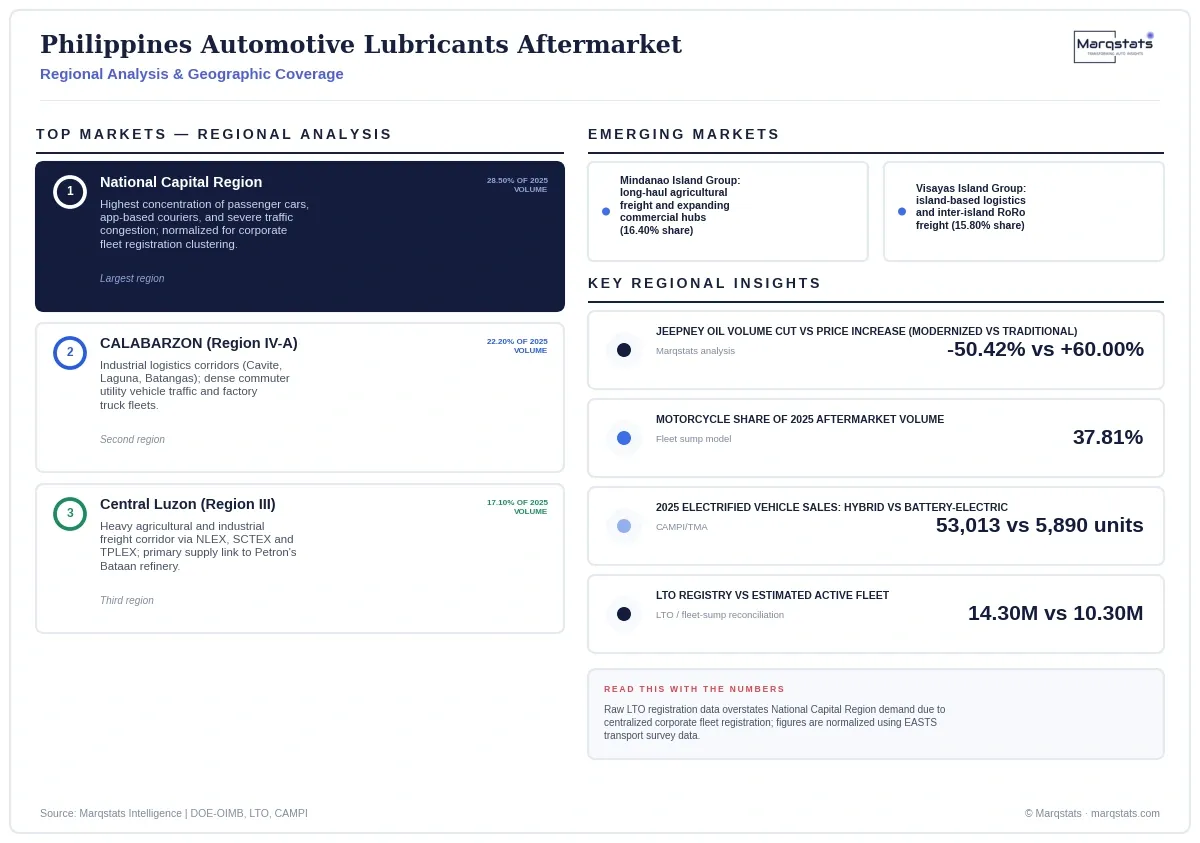
Largest Market: National Capital Region (28.50% of 2025 volume)
Fastest Growing: Motorcycle Engine Oils (37.81% to 39.50% share, 2025-2030)
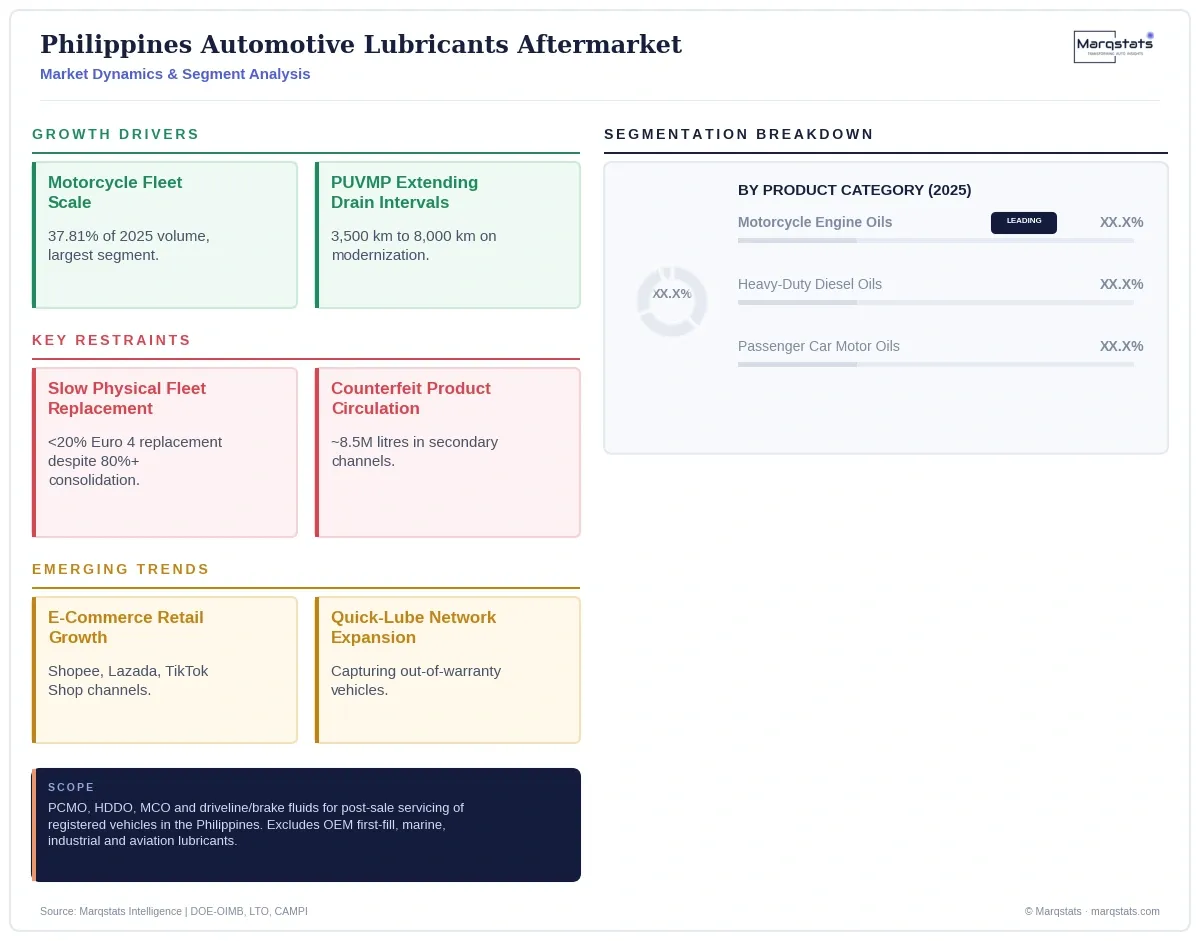
Dominant Segment: Motorcycle Engine Oils (37.81% of 2025 volume)
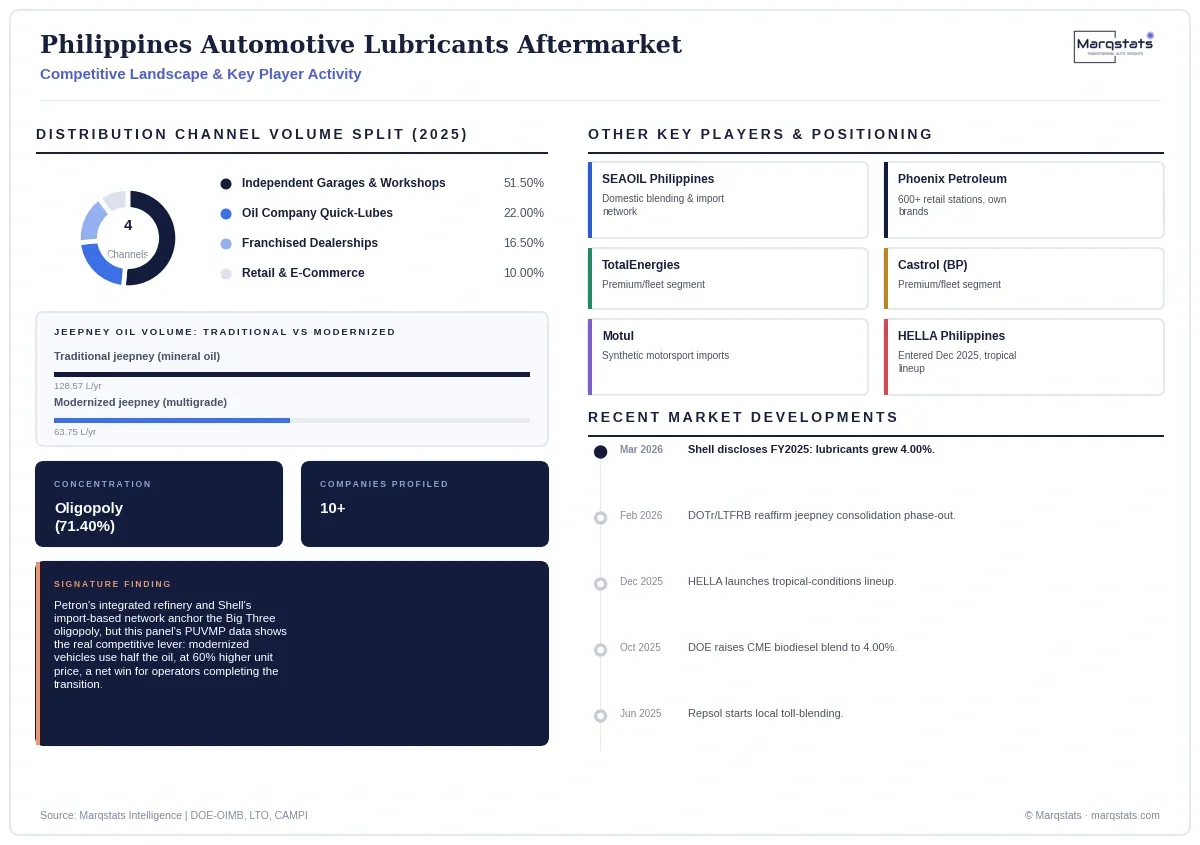
Market Concentration: Oligopoly (Big Three Control 71.40% of Volume)
Base Year: 2025 | Historical Period: 2021 – 2025 | Forecast Period: 2026 – 2030
Units Considered: Value (USD Million)
Segments Covered: 4 | Regions Covered: 5 | Companies Profiled: 10
Report Pages: 165 | Deliverables: PDF, Excel, PPT
Key Takeaways
Market Overview & Analysis
Report Summary
The Philippine lubricants aftermarket is shaped by three forces pulling in different directions at once: a public transport modernization program that halves oil volume per vehicle even as it raises unit oil prices, a motorcycle fleet that dominates volume and keeps growing, and an electrification wave that is overwhelmingly hybrid rather than battery-electric, which preserves crankcase oil demand rather than eliminating it.
The analysis measures the value of engine oils, driveline fluids and greases bought for post-sale servicing of registered on-road vehicles: USD 398.00 million in 2025. It excludes OEM factory first-fill and marine, industrial and aviation lubricants.
A substantial share of the market's headline sizing traces to a single downstream industry compendium Marqstats could not independently verify; this is disclosed prominently below and in the accompanying verification log, not omitted.
The analysis is written for four readers: a blender deciding how to weight motorcycle-oil shelf space against passenger-car formulations, a workshop group planning around the jeepney modernization program's economics, a distributor tracking counterfeit-product risk in secondary channels, and an investor assessing three regulatory scenarios.
A Vehicle That Uses Half the Oil, at 60% Higher Cost Per Litre
Vehicle modernization programs usually raise both technical requirements and running costs together. In the Philippines' public transport sector, one just cut the operator's total bill instead.
A traditional jeepney running a remanufactured Isuzu 4HF1 diesel on SAE 40 mineral oil needs 7.5 litres every 3,500 km, at PHP 250 a litre, for an annual consumption of 128.57 litres and a PHP 32,142 (USD 559) yearly oil bill over a standard 60,000 km duty cycle. A modernized Euro 4 unit on API CI-4/CK-4 15W-40 multigrade needs 8.5 litres every 8,000 km, at PHP 400 a litre, for 63.75 litres a year and a PHP 25,500 (USD 443) bill. The modern oil costs 60% more per litre, but the extended drain interval cuts volume by 50.42%, netting a 20.66% reduction in the operator's total annual lubricant spend. For a sector where the Public Utility Vehicle Modernization Program has consolidated over 80% of operators into cooperatives but replaced less than 20% of the physical fleet, largely due to unit costs of PHP 2.4 to 2.8 million, this is the clearest economic argument for completing the transition.
Motorcycles, Not Cars, Carry the Volume
In most lubricants markets, passenger cars anchor the volume base. In the Philippines, motorcycles do.
Motorcycle and tricycle engine oils are 37.81% of 2025 aftermarket volume, 28.66 million litres, ahead of passenger car motor oil by 9.56 million litres, and the segment is also the fastest-growing, projected to reach 39.50% of volume by 2030. Stop-and-go congestion, high ambient tropical temperatures, and the expansion of app-based delivery platforms compress real-world drain intervals to roughly 2,000 to 2,500 km across 10.3 million active two- and three-wheelers, concentrating over half of distributor gross margin in small-pack 800-millilitre and 1-litre bottles rather than bulk commercial drums.
Electrification That Doesn't Cut Crankcase Volume
Across many of the markets in this vertical, vehicle electrification removes crankcase oil demand. In the Philippines, in 2025, it mostly didn't.
Electrified vehicle sales surged 142% in 2025 to 58,903 units under the Electric Vehicle Industry Development Act, but roughly 90% of those, 53,013 units, were hybrids rather than battery-electric, which totalled only 5,890 units. Hybrid powertrains still run an internal combustion engine requiring regular crankcase lubrication, typically ultra-low-viscosity 0W-16 and 0W-20 formulations, so this wave of electrification preserves crankcase lubricant volume while shifting the product mix toward higher-value synthetic grades, the opposite of the volume-displacement pattern this vertical's more BEV-heavy markets show.
A 24-to-36-Month Lag Between Showroom Sales and Workshop Demand
New-vehicle sales figures can mislead anyone reading the aftermarket off them directly.
New passenger car sales fell 23.00% in 2025 to 92,924 units, while commercial vehicle sales rose 7.00% to 370,722 units. Despite the passenger car sales contraction, aftermarket passenger car motor oil consumption grew 3.1% over the same year, because service-fill demand tracks the cumulative operating parc, 1.4 million active passenger cars and 2.8 million active utility vehicles, rather than new registrations, and a downturn in showroom sales takes 24 to 36 months to work through to workshop volumes.
A Registry That Overstates the Active Fleet by 4 Million Units
Administrative vehicle counts and operational reality diverge meaningfully in the Philippines.
The LTO's registry counts 14.30 million motor vehicles, but the pack's cross-sectional fleet-sump reconciliation estimates only 10.30 million as operationally active, a 4.00-million-unit gap of non-renewed, lapsed or rural-informal vehicles that remain on paper. National Capital Region registrations, in particular, are distorted by corporate fleet operators registering centrally at Metro Manila offices rather than where their vehicles actually operate. Sizing distribution or inventory purely off raw LTO registry data risks misallocating supply to peripheral provinces by up to 28%.
A Counterfeit Problem Concentrated in Two Regions
Not every litre of oil sold in the Philippines is what its label claims.
Roughly 8.5 million litres of re-refined and counterfeit motor oil are estimated to circulate in secondary retail channels across Central Luzon and the Visayas. Substandard 4T motorcycle oils lacking JASO MA2 wet-clutch friction certification are linked to premature clutch slippage and accelerated engine wear within as little as 5,000 km of road use, a meaningful risk given how much of this market's volume runs through small-pack motorcycle-oil channels.
What the Evidence Does and Does Not Show
Not every figure in this sizing chain carries the same evidentiary weight.
The pack itself states that 95.24% of the 2025 baseline volume derives from a single downstream industry compendium that Marqstats could not independently corroborate; this figure, and by extension every segment, channel and regional split that partitions it, carries that same limitation. The bottom-up fleet-sump cross-check (76.12 million litres against the 75.81 million-litre top-down anchor) is independently derived and offers some corroboration, though it is not a fully independent data source. Individual company market shares in the competitive landscape section are likewise not independently confirmed for most named players; see the accompanying verification log.
A Refiner and an Importer, Competing on Different Cost Structures
The country's two largest lubricant marketers compete from structurally different supply positions, and that gap shapes how each prices and where each invests.
Petron Corporation operates the Philippines' sole remaining crude refinery, in Limay, Bataan, at 180,000 barrels per day, feeding an integrated Lube Oil Blending Plant in Tondo, Manila, that runs at twice the capacity of its decommissioned Pandacan facility. Shell Pilipinas closed its Tabangao refinery in 2020 and pivoted entirely to an import-based model, bringing in finished, pre-packaged lubricants from Shell's regional blending hub in Singapore. An integrated refiner-blender captures margin at every stage from crude to crankcase; an import-based distributor instead competes on logistics reach and brand programs, which is why Shell has leaned hard into e-commerce partnerships with Shopee, Lazada and TikTok Shop and its Shell Helix Oil Change+ service-centre network rather than blending infrastructure.
A Tariff Rule That Favours the Import Model It Was Not Designed to Favour
Trade policy is not neutral between these two competitive structures, even though it was not written with lubricants in mind.
Under ASEAN Trade in Goods Agreement rules, finished packaged lubricants blended in Singapore, Thailand or Malaysia enter the Philippines duty-free. Domestic blenders importing the chemical additive packages needed to formulate oil locally, by contrast, face most-favoured-nation tariffs of 3% to 5% when those additives originate outside ASEAN, typically Europe or the United States. The result is a tariff inversion: it is cheaper to import a finished litre of oil from a regional blending hub than to import the additive chemistry needed to blend that same litre domestically, compressing gross margins for non-integrated local blenders relative to multinational importers who can route finished product through ASEAN hubs.
Market Dynamics
Key Drivers
- A large, growing motorcycle fleet with short real-world drain intervals sustains the market's largest and fastest-growing volume segment.
- The Public Utility Vehicle Modernization Program is extending drain intervals and shifting volume toward higher-value multigrade oils as jeepneys convert to Euro 4 powertrains.
- Hybrid-led electrification preserves rather than displaces crankcase oil demand, unlike battery-electric-led markets elsewhere in this vertical.
- Mandatory CME biodiesel blending, rising to 5% in October 2026, accelerates oxidation and soot loading, shortening drain intervals for conventional mineral-oil users by 12% to 15%.
- A structural shift from conventional mineral to semi-synthetic and fully synthetic base stocks is expanding value faster than volume, supported by tighter modern-engine tolerances.
Key Restraints
- Physical fleet replacement under the PUVMP has reached less than 20% of the active jeepney fleet despite over 80% operator consolidation, due to high per-unit capital costs of PHP 2.4 to 2.8 million, limiting the pace of volume-per-vehicle decline.
- A 24-to-36-month lag between new-vehicle sales and workshop service volume means near-term new-car sales weakness does not immediately translate to aftermarket softness, but also that any recovery takes time to reach workshop demand.
- Counterfeit and re-refined product circulating at an estimated 8.5 million litres undermines genuine-brand volume and creates warranty and safety risk in secondary retail channels.
- A tariff inversion under ASEAN ATIGA rules lets finished imported lubricants enter duty-free while domestic blenders face 3% to 5% tariffs on imported additive packages, compressing margins for non-integrated local blenders.
Key Trends
- E-commerce platforms, including Shopee, Lazada and TikTok Shop, are becoming meaningful retail and DIY lubricant channels alongside traditional auto parts retailers.
- Oil company-branded quick-lube networks (Petron Car Care Centers, Shell Helix Oil Change+) are expanding to capture out-of-warranty vehicles exiting three-year OEM dealer coverage.
- Group III semi-synthetic oils are capturing consumer trade-ups at an accessible price point between conventional mineral and premium synthetic products, at gross blending margins above 30%.
- Ultra-low-viscosity 0W-16 and 0W-20 formulations are gaining share as hybrid powertrains, which dominate the country's electrification wave, require them.
Strategic Implications
- Blenders should prioritise motorcycle-oil shelf space and small-pack formats, since this is the market's largest and fastest-growing segment, while building out multigrade heavy-duty lines ahead of accelerating PUVMP-driven fleet conversion.
- Distributors and retailers should tighten authentication and channel controls in Central Luzon and the Visayas, where counterfeit and re-refined product circulation is concentrated.
- Workshop groups should position for the shift toward longer-interval, higher-value synthetic servicing as hybrid vehicles and modernized commercial fleets both push in that direction.
- Investors should track LTFRB franchise-consolidation enforcement and CME biodiesel mandate implementation, the two triggers separating the three forecast scenarios, and should treat the headline sizing and company-share figures with the caution disclosed in the evidence section above, pending independent verification.
Outlook
The underlying research presents three scenarios tied to named regulatory and macroeconomic triggers.
Under the Base Case (Managed Fleet Growth & Phased Modernization), GDP growth averages 5.5% to 6.0% annually, the active motorcycle fleet grows 4.5% a year, the Public Utility Vehicle Modernization Program reaches 50% physical replacement of traditional jeepneys by 2030, and the DOE enforces its 5% CME biodiesel blend mandate in October 2026. Volume reaches 90.22 million litres, a 3.54% CAGR, and value reaches USD 492.20 million (PHP 28.30 billion), a 4.34% CAGR.
Under Scenario A (Accelerated Fleet Modernization & Infrastructure Buildout), the LTFRB strictly revokes unconsolidated public-transport franchises by end-2026, compelling rapid replacement of 150,000 traditional jeepneys, while national infrastructure investment stays above 5.5% of GDP. Volume reaches 94.85 million litres, a 4.58% CAGR, and value reaches USD 531.16 million (PHP 30.54 billion), a 5.94% CAGR, as heavy soot loading in common-rail engines boosts multigrade replacement volume.
Under Scenario B (Macroeconomic Stagflation & Biofuel Blend Moratorium), persistent inflation and peso depreciation past PHP 63.00 per USD dampen consumer purchasing power, the DOTr extends provisional jeepney operating authorities through 2028, and the DOE suspends its B5 biodiesel mandate. Volume reaches only 85.10 million litres, a 2.34% CAGR, and value reaches USD 442.52 million (PHP 25.44 billion), a 2.14% CAGR, as commercial fleets extend oil change intervals 25% to 30% and mineral monograde oils hold a 65% volume share.
Market Segmentation
28.66 million litres (37.81% share) in 2025, moving to 35.64 million litres (39.50% share) by 2030. JASO MA/MA2 wet-clutch and JASO MB scooter CVT formulations; the largest and fastest-growing segment, exceeding passenger car oil demand by 9.56 million litres.
23.88 million litres (31.50% share) in 2025, moving to 27.25 million litres (30.20% share) by 2030. API CK-4, CJ-4, CI-4, CF-4 and monograde SAE 40; commercial trucks, buses and public utility jeepneys.
19.10 million litres (25.20% share) in 2025, moving to 22.10 million litres (24.50% share) by 2030. API SP, SN PLUS, ILSAC GF-6A, 0W-20 to 10W-40; grew 3.1% in 2025 despite a 23% fall in new car sales.
4.17 million litres (5.50% share) in 2025, moving to 5.23 million litres (5.80% share) by 2030. ATF Dexron VI, Mercon V, CVT fluids, API GL-5 gear oils, DOT 3/4 brake fluids, NLGI 2 lithium greases.
28.66 million litres (37.81% share) in 2025, moving to 35.64 million litres (39.50% share) by 2030.
25.02 million litres (33.00% share) in 2025, moving to 29.77 million litres (33.00% share) by 2030.
12.13 million litres (16.00% share) in 2025, moving to 14.44 million litres (16.00% share) by 2030.
10.00 million litres (13.19% share) in 2025, moving to 10.37 million litres (11.50% share) by 2030.
45.49 million litres (60.00% share) in 2025, moving to 46.91 million litres (52.00% share) by 2030.
21.23 million litres (28.00% share) in 2025, moving to 28.87 million litres (32.00% share) by 2030.
9.09 million litres (12.00% share) in 2025, moving to 14.44 million litres (16.00% share) by 2030.
39.04 million litres (51.50% share) in 2025, moving to 45.11 million litres (50.00% share) by 2030. Roadside mechanics, multi-brand repair garages, vulcanizing shops; the dominant installation channel, highly fragmented and cash-based.
16.68 million litres (22.00% share) in 2025, moving to 21.65 million litres (24.00% share) by 2030. Dedicated bays at retail forecourts, including Petron Car Care Centers and Shell Helix Oil Change+; expanding to capture out-of-warranty vehicles.
12.51 million litres (16.50% share) in 2025, moving to 13.98 million litres (15.50% share) by 2030. Authorised OEM workshops (Toyota, Mitsubishi, Isuzu, Honda); captures vehicles during the warranty period, with sharp retention drop-off after three years.
7.58 million litres (10.00% share) in 2025, moving to 9.48 million litres (10.50% share) by 2030. Auto parts retailers, sari-sari supply stores, and DIY online sales via Shopee, Lazada and TikTok Shop.
By Geography
National Capital Region (NCR)
21.61 million litres (28.50% share) in 2025.
CALABARZON (Region IV-A)
16.83 million litres (22.20% share) in 2025.
Central Luzon (Region III)
12.96 million litres (17.10% share) in 2025.
Mindanao Island Group
12.43 million litres (16.40% share) in 2025.
Visayas Island Group
11.98 million litres (15.80% share) in 2025.
Registration Distortion
Raw LTO registration data overstates the National Capital Region's true operational demand, since corporate fleets and government agencies register centrally at Metro Manila offices; operational allocations are normalised using EASTS transport survey data and DOE regional fuel distribution profiles, redistributing activity toward CALABARZON, Central Luzon and Mindanao.
How Competition Is Evolving
The Philippine finished lubricants market is an oligopoly. The "Big Three" integrated oil majors, Petron Corporation, Shell Pilipinas Corporation and Chevron Philippines, control a combined 71.40% of the domestic market (independently sourced), leveraging proprietary retail forecourts, established commercial relationships and nationwide depot infrastructure. Individual company market-share percentages beyond this combined figure are withheld here; see the verification log for sourcing detail.
Petron Corporation leads the domestic market as the operator of the country's sole remaining crude refinery, in Limay, Bataan (180,000 bpd rated capacity), giving it an integrated downstream supply chain. Petron manufactures its Rev-X (HDDO), Ultron (PCMO) and Sprint 4T (MCO) lines at its Lube Oil Blending Plant in Tondo, Manila, and distributes through more than 1,800 service stations and 45 dedicated Petron Car Care Centers.
Shell Pilipinas Corporation pivoted to an import-based distribution model after closing its Tabangao refinery in 2020, now importing finished lubricants from Shell's regional manufacturing hub in Singapore into Batangas, Mariveles and Davao supply hubs, and distributing via about 1,150 mobility stations and roughly 500 branded Shell Helix Oil Change+ centres. Shell's lubricants business grew volume 4.00% in 2025, aided by Shell Advance motorcycle oil expansion and e-commerce partnerships with Shopee, Lazada and TikTok Shop.
Chevron Philippines markets under the Caltex brand (Delo commercial diesel, Havoline passenger car lines), importing finished formulations into its Batangas terminal. Independent players include SEAOIL Philippines, Phoenix Petroleum (Acceleron, Zoelo and Cyclomax brands, distributed through more than 600 retail stations), and multinational specialists TotalEnergies, Castrol, Motul and Repsol targeting premium and high-performance segments. HELLA Philippines entered the market in December 2025 with a complete tropical-conditions lubricant lineup.
Companies Covered
Companies covered in the report include:
Recent Market Activity
Table of Contents
Coverage & Segmentation
The analysis measures passenger car motor oils, heavy-duty diesel engine oils, motorcycle engine oils, and driveline, brake and grease products bought for post-sale servicing of registered on-road vehicles in the Philippines, for a 2025 base year and a 2026 to 2030 forecast, in United States dollars at the BSP 2025 annual average exchange rate of PHP 57.50 per USD. Values incorporate customs duties, 12% VAT and downstream supply-chain margins. OEM factory first-fill, marine, industrial and aviation lubricants are excluded.
The analysis covers four segmentation dimensions, product category, vehicle category, base oil technology and distribution channel, a five-region geographic split, and ten profiled entities. A substantial share of the headline sizing and of individual company market shares traces to a single source Marqstats could not independently verify; see the verification log for full disclosure.