Market Snapshot
Middle bar: base-year value × (1 + CAGR), rounded to two decimals. This is a calculated illustration, not a separately researched annual estimate.
Market Size (2025, Base Year): USD 9.35 Billion (EUR 8.65 Billion)
Estimated Value (2026): USD 11.36 Billion
Forecast Value (2030): USD 24.70 Billion
CAGR: 21.44% | Forecast Period: 2026 – 2030
Growth — Absolute: USD 15.35 Billion
SDV Fitment on New Registrations: 42.50% (2025) to 82.5% (2030)
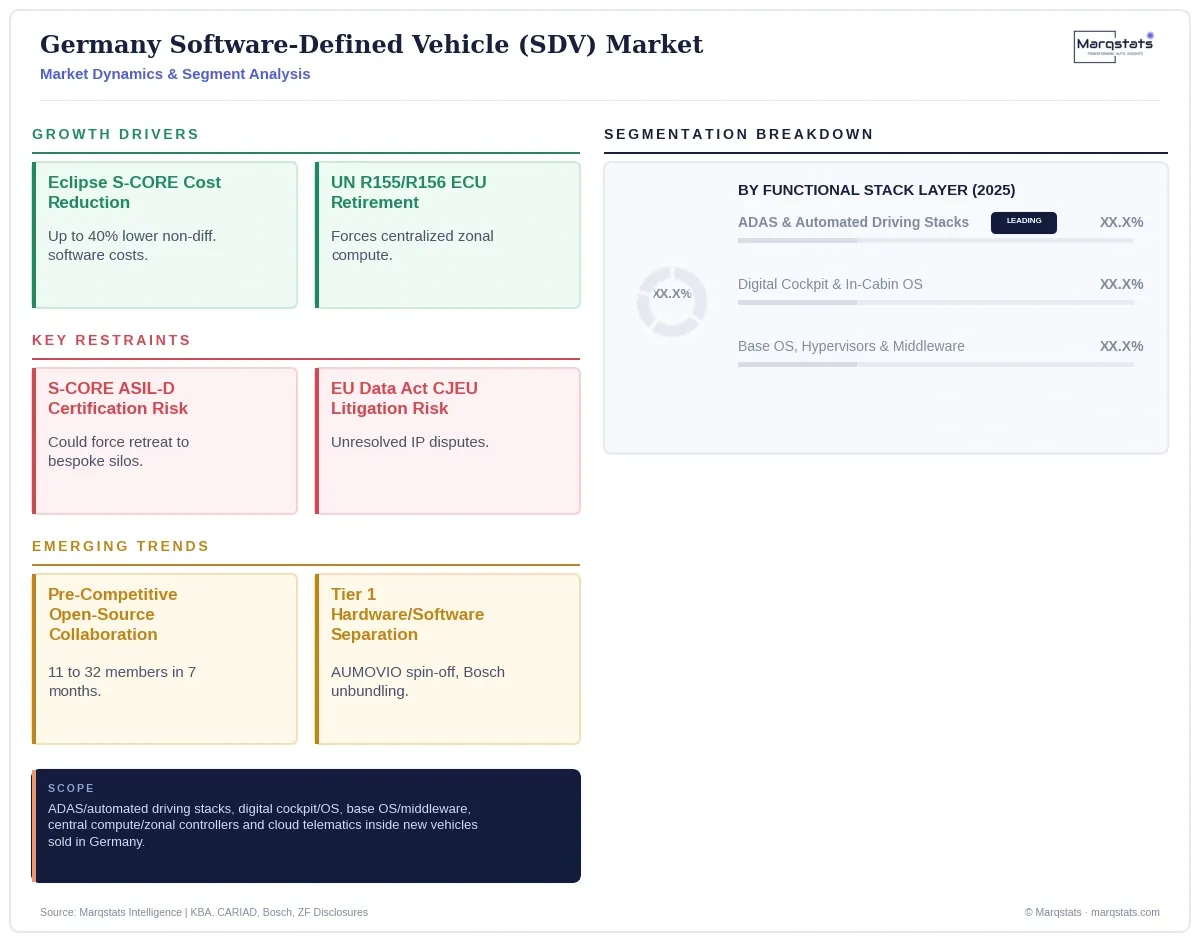
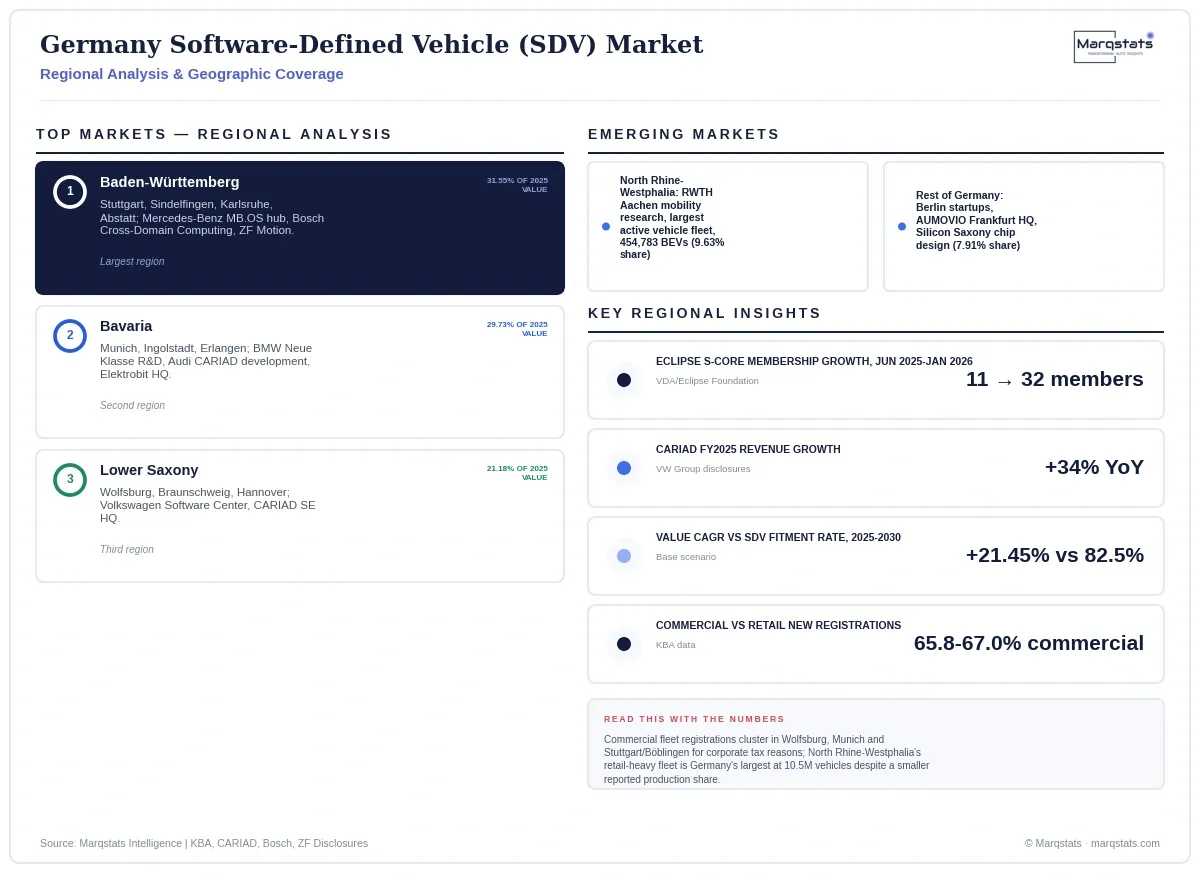
Largest Market: Baden-Württemberg (31.55% of 2025 value)
Fastest Growing Segment: ADAS & Automated Driving Stacks (23.44% CAGR, 2025-2030)
Dominant Layer: ADAS & Automated Driving Stacks (34.97% of 2025 value)
Market Concentration: Moderately Concentrated (CARIAD, Bosch, ZF, Continental Lead)
Base Year: 2025 | Historical Period: 2021 – 2025 | Forecast Period: 2026 – 2030
Units Considered: Value (USD Billion)
Segments Covered: 3 | Regions Covered: 5 | Companies Profiled: 8
Report Pages: 165 | Deliverables: PDF, Excel, PPT
Key Takeaways
Market Overview & Analysis
Report Summary
Germany's software-defined vehicle market is being reshaped by an unusual industrial decision: the country's fiercest automotive rivals concluded that building non-differentiating vehicle software separately was wasting billions, and started building it together instead.
The analysis measures the value of ADAS and automated driving stacks, digital cockpit and in-cabin OS, base OS/hypervisors/middleware, central compute and zonal controllers, and cloud telematics/connected services inside new vehicles sold in Germany: USD 9.35 billion (EUR 8.65 billion) in 2025, growing to USD 24.70 billion by 2030.
The core sizing and segmentation chain traces to a source Marqstats could not independently verify; this is disclosed prominently below and in the accompanying verification log, not omitted.
The analysis is written for four readers: an OEM deciding how much proprietary software investment to redirect toward the Eclipse S-CORE consortium, a Tier 1 supplier managing the post-spin-off transition to standalone software licensing, a regulator or compliance officer tracking Level 3 type-approval and EU Data Act rollout, and an investor tracking three consortium-anchored forward scenarios.
Germany's combination of premium-OEM engineering depth, a globally significant Tier 1 supplier base now restructuring around standalone software licensing, and a genuinely novel pre-competitive open-source consortium model makes it the structural bellwether for how legacy automakers, not just EV-native entrants, can compete on SDV architecture, a template other established automotive nations are already watching closely.
An Industry That Chose Cooperation Over Competition, on Purpose
Germany's automakers spent years trying to out-build each other's software divisions. The Eclipse S-CORE consortium is a formal admission that approach failed, and a genuinely fast pivot to the opposite strategy.
The Safe Open Vehicle Core initiative began in June 2025 at the Automotive Electronics Congress when 11 founding signatories, including CARIAD, BMW, Mercedes-Benz, Robert Bosch, Continental and ZF, signed an initial memorandum of understanding. By January 2026 at CES, membership had grown to 32 enterprises, adding Stellantis, Traton Group, Schaeffler, Infineon Technologies and Qualcomm. That is seven months to nearly triple a founding coalition of direct competitors, a pace that only makes sense once you accept the underlying premise: non-differentiating vehicle software, board support packages, device drivers, OS kernels, standardized communications protocols, was never actually a source of competitive advantage, just an expensive one to build alone. Project partners calculate the alignment will cut non-differentiating software costs by up to 40% and compress time-to-market for new digital features by up to 30%, freeing engineering capacity for the cabin features and driving characteristics that actually do differentiate one brand from another.
A Loss That Shrank Because the Business Model Changed, Not Because Spending Fell
CARIAD's improving financials tell a more interesting story than 'losses narrowing.' The company got smaller and more focused at the same time its core product finally started shipping at scale.
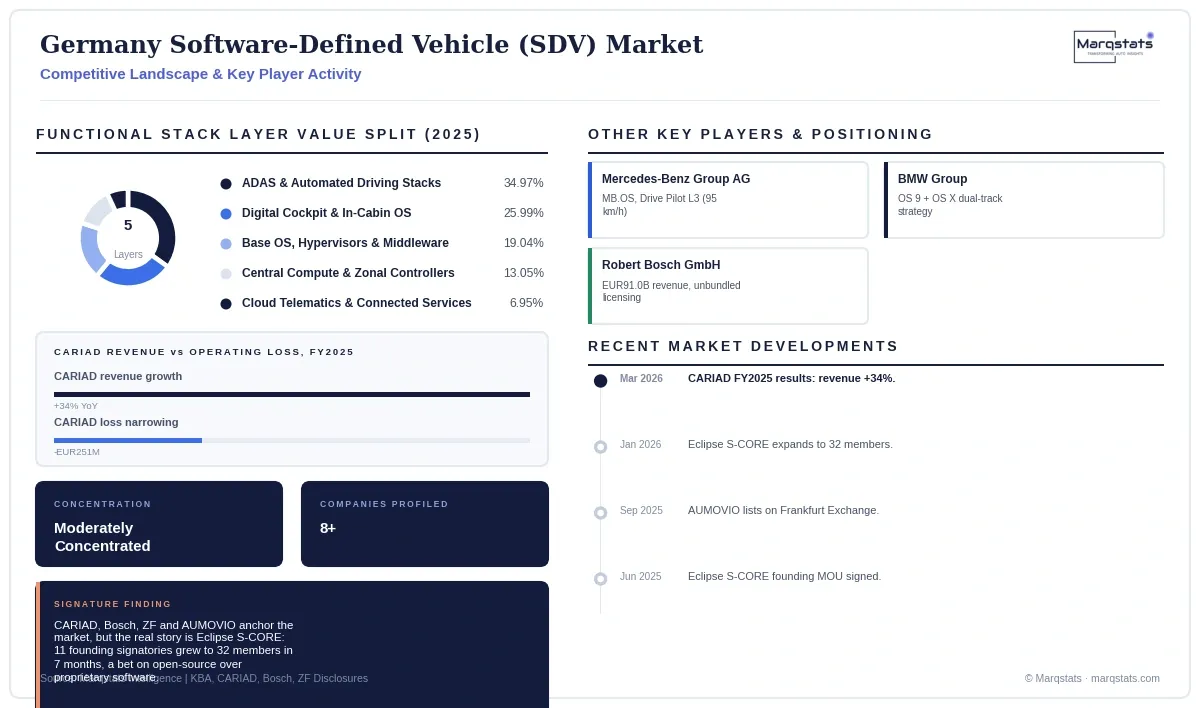
CARIAD's FY2025 external revenue rose 34% to EUR 1.80 billion, while operating losses narrowed by EUR 251 million to -EUR 2.20 billion, under a restructuring that cut organizational layers by roughly 30%. That combination, revenue growth plus deliberate headcount and layer reduction, is a different kind of improvement than simply spending less: it reflects the E3 1.1 and E3 1.2 architectures and One.Connected Infotainment actually reaching series production across eight vehicle lines, turning years of development investment into shipping product. Volkswagen's parallel decision to commit up to USD 5.8 billion to a Rivian joint venture for the next-generation E3 2.0 architecture suggests the group still sees real risk in building the next platform generation entirely alone, even after CARIAD's turnaround.
Why North Rhine-Westphalia Matters More Than Its Production Numbers Suggest
Germany's SDV story is usually told through Stuttgart, Munich and Wolfsburg. NRW's role gets missed because it shows up in a completely different kind of statistic.
Baden-Württemberg, Bavaria and Lower Saxony capture 82.46% of national SDV stack value because that is where engineering, R&D and corporate headquarters concentrate. But North Rhine-Westphalia, which the pack notes maintains a standard proportion of retail buyers rather than corporate fleets, holds the country's largest active vehicle fleet at 10.5 million total passenger cars, including 454,783 battery-electric vehicles. That makes NRW Germany's densest environment for actual over-the-air payload delivery, connected mobility usage and third-party telematics activity under the EU Data Act, not because software gets built there, but because more of it actually gets used and updated there. A company measuring only production and R&D concentration would miss where the operational SDV activity, the update cycles, the data access requests, the telematics traffic, genuinely happens.
A Regulatory Approval That Only Means What the Speed Limit Says It Means
Mercedes-Benz's Level 3 certification is a genuine milestone. It is also narrower than headlines about 'autonomous driving in Germany' tend to suggest.
The KBA granted Mercedes-Benz expanded type-approval under UN Regulation No. 157 for its Drive Pilot system, permitting hands-off automated operation on German autobahns at speeds up to 95 km/h in suitable traffic conditions. That is a real, commercially meaningful regulatory milestone, and precisely the kind of approval the Upside scenario here assumes will extend further, to 130 km/h operation, if it materializes. But it is bounded: specific speed threshold, specific road type, specific traffic conditions. It is not a general Level 3 approval for German roads, and treating it as one would overstate how close broader autonomous operation actually is. The gap between this specific, conditional approval and the Upside scenario's broader 130 km/h trigger is exactly the kind of regulatory increment worth tracking closely rather than assuming away.
A Sensitivity Number That Shows How Thin the Empirical Ice Actually Is
This market's own methodology section names, with unusual precision, exactly how much of its headline figure rests on an assumption rather than an audited statement.
53.8% of the 2025 baseline valuation is directly supported by published statutory filings, corporate segmental balance sheets, and verifiable registration shares from KBA, CARIAD, Bosch, AUMOVIO and ZF. The remaining 46.2% is modelled through architectural conversion rates tracking the replacement of legacy mechatronic components. Because no statutory agency audits the software bill-of-materials of finished vehicles, the model posits an average blended software-compute value of EUR 2,185 across all registered SDV units, and sensitivity testing shows a marginal EUR 100 shift in that single assumption alters the 2025 baseline by EUR 121.34 million, compounding to EUR 278.00 million by 2030. Anyone using this market's headline number for planning purposes should treat it as a carefully reasoned construction, not a figure any single German institution has directly published and certified.
Two Premium Brands, Two Genuinely Different Bets on Compute Architecture
BMW is running two software operating systems in parallel on purpose, a choice that looks inefficient until you see what each one is actually protecting against.
BMW Operating System 9, built on an Android Open Source Project base, runs across the company's current volume production lines, giving BMW a stable, third-party-app-compatible platform for vehicles shipping today. BMW Operating System X and the Panoramic iDrive interface, reserved for the dedicated Neue Klasse electric portfolio, centralize computing into four high-performance 'Super-Brain' domain computers delivering twenty times the compute throughput of predecessor systems. Running both simultaneously lets BMW modernize what is already selling without betting the entire current lineup on an architecture that has not yet proven itself at scale, a hedge Mercedes-Benz, which moved its MB.OS architecture directly into series production on the MMA platform starting with the CLA-Class, chose not to make in the same way.
Market Dynamics
Key Drivers
- The Eclipse S-CORE consortium's rapid membership growth is lowering the cost of non-differentiating software development industry-wide, freeing proprietary engineering capacity for genuinely differentiating features.
- Mandatory UN R155/R156 compliance is accelerating the retirement of legacy distributed ECU architectures in favor of centralized zonal compute capable of supporting cryptographic authentication and update traceability.
- CARIAD's operational turnaround, growing revenue while narrowing losses, demonstrates that scaled in-house software investment can reach commercial viability given sufficient time and organizational discipline.
- Tier 1 restructuring toward standalone software licensing, exemplified by AUMOVIO's spin-off and Bosch's unbundled commercial agreements, is creating new revenue streams independent of physical hardware sales.
- The EU Data Act's design-by-default data-access rules are catalyzing third-party software and telematics ecosystems, particularly in high-density operational regions like North Rhine-Westphalia.
Key Restraints
- Failure of Eclipse S-CORE to achieve ISO 26262 ASIL-D certification on schedule would force OEMs back toward bespoke software silos, the Downside scenario's central trigger.
- Unresolved intellectual-property disputes under the EU Data Act could trigger litigation before the European Court of Justice, delaying third-party data-access ecosystem development.
- Commercial fleet registration clustering in Wolfsburg, Munich and Stuttgart distorts regional demand data relative to where vehicles actually operate, complicating accurate territory-level planning.
- Elevated Tier 1 supplier debt and margin pressure, particularly at ZF Friedrichshafen following historic acquisitions, could constrain the capital available for continued software-platform investment.
Key Trends
- Pre-competitive open-source collaboration on non-differentiating software is displacing proprietary in-house development as the default industry approach, following Eclipse S-CORE's rapid membership growth.
- Tier 1 suppliers are formally separating hardware manufacturing from software engineering, following Continental's AUMOVIO spin-off and Bosch's unbundled licensing shift.
- Dual-track software architecture strategies, exemplified by BMW's parallel Operating System 9 and Operating System X programmes, are letting OEMs modernize volume platforms while building dedicated next-generation architectures.
- Zonal E/E architecture with centralized compute is overtaking domain-centralized controllers as the dominant topology, eliminating substantial wiring-harness weight in the process.
Strategic Implications
- OEMs should redirect proprietary engineering investment away from non-differentiating baseline software and toward the Eclipse S-CORE consortium, reserving in-house development capacity for brand-differentiating cabin experiences and driving characteristics that actually justify separate investment.
- Tier 1 suppliers should accelerate the transition to standalone software licensing decoupled from physical hardware sales, following Bosch's and AUMOVIO's models, since commoditizing baseline runtime software makes bundled hardware-software pricing increasingly difficult to sustain.
- Telematics and connected-services providers should prioritize North Rhine-Westphalia and similar high-retail-density regions for EU Data Act-enabled third-party service deployment, since production and R&D concentration in the south does not predict where operational SDV activity actually occurs.
- Investors should track Eclipse S-CORE's Release 1.0 delivery timeline and KBA's Level 3 speed-threshold expansion progress, the two named regulatory and technical triggers separating the Downside, Base and Upside scenarios, and should treat the headline sizing and segmentation figures here with the caution disclosed in the evidence section.
Outlook
Three scenarios are tested, each anchored to a distinct, named trigger tied to Eclipse S-CORE delivery and KBA Level 3 type-approval progress rather than differing growth-rate assumptions applied to the same story.
Under the Base Case (Pragmatic Industrial Convergence), production-grade Eclipse S-CORE 1.0 delivers on schedule in late 2026, the Volkswagen-Rivian joint venture deploys functional zonal architecture by 2028, and UN R155/156 compliance stabilizes. Value reaches USD 24.70 billion (EUR 22.85 billion), a 21.44% CAGR, with new-vehicle fitment reaching 82.5%.
Under the Upside Case (Accelerated Open Platform Scaling), the KBA grants broad Level 3 type-approval for operation up to 130 km/h, and early compliance with EU Data Act design-by-default rules in September 2026 catalyzes third-party software ecosystems. Value reaches USD 31.25 billion (EUR 28.91 billion), a 27.29% CAGR, with fitment reaching 94.0%.
Under the Downside Case (Fragmented Retrenchment), Eclipse S-CORE fails ISO 26262 ASIL-D certification, OEMs retreat to bespoke software silos, and unresolved EU Data Act IP disputes trigger CJEU litigation. Value reaches only USD 18.40 billion (EUR 17.02 billion), a 14.50% CAGR, with fitment reaching only 68.0%.
Market Segmentation
USD 3.27 billion (34.97% share) in 2025, moving to USD 9.38 billion (37.98% share) by 2030, a 23.44% CAGR.
USD 2.43 billion (25.99% share) in 2025, moving to USD 6.05 billion (24.49% share) by 2030, a 20.02% CAGR.
USD 1.78 billion (19.04% share) in 2025, moving to USD 4.45 billion (18.02% share) by 2030, a 20.11% CAGR.
USD 1.22 billion (13.05% share) in 2025, moving to USD 3.33 billion (13.48% share) by 2030, a 22.24% CAGR.
USD 0.65 billion (6.95% share) in 2025, moving to USD 1.49 billion (6.03% share) by 2030, a 17.96% CAGR.
USD 5.70 billion (60.96% share) in 2025, moving to USD 7.90 billion (31.98% share) by 2030.
USD 2.48 billion (26.52% share) in 2025, moving to USD 15.56 billion (63.00% share) by 2030.
USD 1.17 billion (12.52% share) in 2025, moving to USD 1.24 billion (5.02% share) by 2030.
USD 5.89 billion (62.99% share) in 2025, moving to USD 13.83 billion (55.99% share) by 2030.
USD 2.62 billion (28.02% share) in 2025, moving to USD 8.65 billion (35.02% share) by 2030.
USD 0.84 billion (8.99% share) in 2025, moving to USD 2.22 billion (8.99% share) by 2030.
By Geography
Baden-Württemberg
USD 2.95 billion (31.55% share) of national SDV value in 2025.
Bavaria
USD 2.78 billion (29.73% share) of national SDV value in 2025.
Lower Saxony
USD 1.98 billion (21.18% share) of national SDV value in 2025.
North Rhine-Westphalia
USD 0.90 billion (9.63% share) of national SDV value in 2025.
Rest of Germany
USD 0.74 billion (7.91% share) of national SDV value in 2025.
Commercial Fleet Registration Distortion
Between 65.8% and 67.0% of all monthly new passenger car registrations in Germany represent commercial and legal-entity registrations (gewerbliche Zulassungen), concentrated centrally in corporate districts such as Wolfsburg, Munich, and the Stuttgart/Böblingen districts, even though the vehicles are immediately deployed and operated elsewhere; North Rhine-Westphalia, with a standard proportion of retail buyers, holds Germany's largest active vehicle fleet at 10.5 million passenger cars including 454,783 battery-electric vehicles.
How Competition Is Evolving
Germany's SDV competitive landscape spans Volkswagen Group's CARIAD, Mercedes-Benz, BMW, and a Tier 1 supplier base restructuring around standalone software licensing, alongside the pre-competitive Eclipse S-CORE consortium spanning the broader industry.
CARIAD SE, Volkswagen Group's software subsidiary, achieved an operational turning point in fiscal 2025: external revenue rose 34% to EUR 1.80 billion (1.95 billion), while operating losses narrowed by EUR 251 million to -EUR 2.20 billion, following a reorganization under CEO Peter Bosch that cut organizational layers by roughly 30%. CARIAD delivered its E3 1.2 architecture to the Audi Q6 e-tron and Porsche Macan EV, and Volkswagen committed up to USD 5.8 billion to a joint venture with Rivian for next-generation zonal architecture.
Mercedes-Benz Group structures its software transformation around the Mercedes-Benz Operating System (MB.OS), spanning Infotainment, Automated Driving, Body and Comfort, and Driving and Charging domains, introduced on the modular MMA platform led by the CLA-Class; its Drive Pilot Level 3 system received expanded KBA type-approval under UN Regulation No. 157 for hands-off autobahn operation up to 95 km/h. BMW Group operates a dual-track strategy: BMW Operating System 9 (Android Open Source Project base) across current volume lines, and BMW Operating System X with the Panoramic iDrive interface for the dedicated Neue Klasse portfolio, centralizing compute into four 'Super-Brain' domain computers with twenty times prior compute throughput.
Continental AG completed the spin-off of its Automotive Technologies sector as AUMOVIO SE in September 2025, listed on the Frankfurt Stock Exchange, employing approximately 87,000 people globally including 29,000 R&D engineers, and retaining full ownership of Elektrobit Automotive (EB corbos, EB tresos). Robert Bosch GmbH recorded EUR 91.0 billion in consolidated fiscal 2025 revenue with EUR 7.9 billion in R&D spend, shifting toward unbundled software licensing of vision algorithms and control firmware. ZF Friedrichshafen generated EUR 38.8 billion in total fiscal 2025 sales (EUR 35.6 billion automotive), restructuring around its cubiX motion-orchestration platform.
The Eclipse S-CORE (Safe Open Vehicle Core) consortium, governed by the Eclipse SDV Working Group under the VDA and Eclipse Foundation, began in June 2025 with 11 founding signatories including CARIAD, BMW, Mercedes-Benz, Bosch, Continental and ZF, and expanded to 32 member enterprises by January 2026, adding Stellantis, Traton Group, Schaeffler, Infineon Technologies and Qualcomm. Version 0.5 released November 2025, with Release 1.0 targeted for late 2026.
Companies Covered
Companies covered in the report include:
Recent Market Activity
Table of Contents
Coverage & Segmentation
The analysis measures ADAS and automated driving stacks, digital cockpit and in-cabin OS, base OS/hypervisors/middleware, central compute and zonal controllers, and cloud telematics/connected services inside new vehicles sold in Germany, for a 2025 base year and a 2026 to 2030 forecast, in United States dollars and euros at the official 2025 ECB average exchange rate.
The analysis covers three segmentation dimensions, functional stack layer, E/E architecture topology and vehicle application class, a five-region federal-state split, and eight profiled entities. The core sizing/segmentation chain carries a sourcing flag; the KBA registration/fitment anchor and CARIAD's disclosed revenue do not. See the verification log for full disclosure.