Market Snapshot
Key Takeaways
Market Overview & Analysis
Report Summary
The Egypt automotive wiring harness market covers ignition and wiring harnesses and related vehicle electrical distribution assemblies manufactured in Egypt, for export and for local original equipment supply. The measurement lens is manufacturing output value rather than domestic consumption, and that choice is forced by the structure of the industry rather than chosen for convenience. Egypt exported USD 538.9 million of wiring sets in 2024 against USD 17.2 million of imports. A domestic-consumption lens would measure a fraction of the activity and would misdescribe what the country actually does in this category.
The base year figure departs from the research pack and the departure is deliberate. The pack derives a 2025 output value of USD 595 million by applying the 7.5% growth rate recorded for automotive component exports overall to the 2024 harness export base. Harness exports did not grow at 7.5%. Egyptian electrical wiring exports reached approximately USD 752 million in 2025 on reported growth of 29%, and applying that rate to the trade-verified 2024 base of USD 538.9 million gives roughly USD 695 million of exports before any domestic supply is added. An output value of USD 595 million would sit below the export figure alone, which is not possible.
The corrected 2025 estimate is USD 720 million, comprising approximately USD 695 million of exports on the trade-anchored path plus a domestic original equipment allowance of about USD 25 million against local assembly of 99,600 vehicles. Growth rates from the pack are retained unchanged; only the level is corrected. The revised sizing range for 2025 runs from USD 680 million to USD 780 million, and the correction is disclosed rather than absorbed because a reader comparing this page against the underlying trade data would otherwise find the discrepancy themselves.
Wiring Harness Manufacturing Output Value in Egypt
Manufacturing output value rises from USD 720 million in 2025 to USD 1,260 million in 2030, an 11.84% compound annual growth rate and an absolute increase of USD 540 million. The indicative 2031 endpoint is approximately USD 1,396 million. The 2026 estimate of USD 835 million reflects LEONI's Badr expansion and Yazaki's Fayoum project execution without assuming that every announced plant reaches full utilisation immediately, giving a 2026 to 2030 rate of 10.84%.
Output weight rises from approximately 17.15 million kilograms in 2025 to 25.20 million by 2030, a compound annual growth rate of 8.00% and an increase of 8.05 million kilograms. Egypt exported 12.88 million kilograms of wiring sets in 2024 at an implied unit value of USD 41.84 per kilogram, and that unit value rises to about USD 50.00 by 2030. Weight is the honest physical measure of harness activity because a harness is largely copper and insulation, and tracking it separately prevents value growth from being mistaken for volume growth.
The divergence between the two series is where electrification shows up. Value compounds at 11.84% while weight compounds at 8.00%, a gap of nearly four percentage points that accumulates into a 19% rise in value per kilogram across five years. High-voltage and battery harnesses carry shielding, connectors, sensing and safety engineering that low-voltage body looms do not, and they command higher prices per unit of copper. A plant that grows tonnage without shifting mix captures the weaker of the two rates.
The relationship with Egypt's wider component measures needs stating because three figures circulate that look interchangeable and are not. Egypt's automotive components market measures DOMESTIC DEMAND at USD 2.10 billion in 2025 and explicitly excludes export manufacturing output. This market measures OUTPUT VALUE at USD 720 million, of which roughly USD 695 million is exported and about USD 25 million enters that domestic demand pool. Automotive component exports overall exceeded USD 1 billion in 2025, so harness alone is somewhere near half of Egypt's automotive component export business. Only the USD 25 million of domestic supply appears in both measures; the rest of this market sits entirely outside the components demand figure.
Market Dynamics
Key Drivers
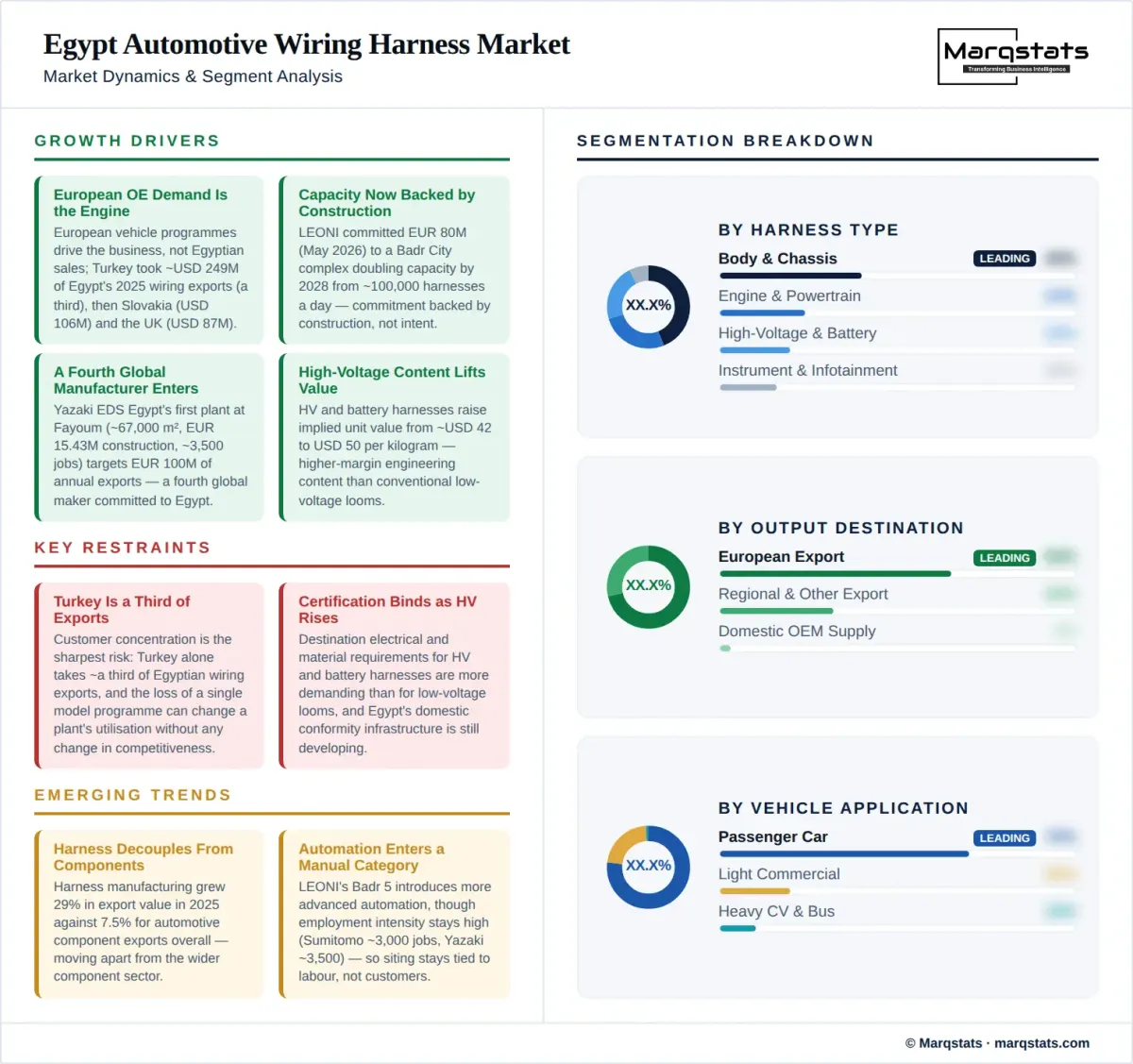
- European original equipment demand is the primary engine rather than Egyptian vehicle sales, with Turkey taking approximately USD 249 million of Egypt's electrical wiring exports in 2025, roughly a third of the total, followed by Slovakia at USD 106 million and the United Kingdom at USD 87 million.
- Capacity commitments are accelerating and are now backed by construction rather than intent, with LEONI committing EUR 80 million in May 2026 to a Badr City complex intended to double capacity by 2028 from a current base near 100,000 harnesses a day.
- A fourth global manufacturer is entering, with Yazaki EDS Egypt's first Egyptian plant at Fayoum covering about 67,000 square metres on an initial EUR 15.43 million construction contract and an originally announced investment near EUR 30 million, 3,500 jobs and an export ambition of EUR 100 million annually.
- Free-zone treatment is material to plant economics for an export-oriented industry, and both LEONI's Badr operations and DRÄXLMAIER's proposed Fayoum facility of roughly 20,000 to 40,000 square metres are structured under free-zone arrangements.
- High-voltage content raises value per vehicle and per kilogram, lifting implied unit value from about USD 42 to USD 50 per kilogram across the forecast period and creating higher-margin engineering content than conventional low-voltage looms.
Key Restraints
- Export customer concentration is the sharpest risk in the category, since Turkey alone accounts for roughly a third of Egyptian electrical wiring exports and the loss of a single model programme can materially change a plant's utilisation without any change in Egyptian competitiveness.
- Testing, accreditation and traceability capability becomes a binding constraint as high-voltage content rises, because destination-market electrical and material requirements for battery and high-voltage harnesses are more demanding than for low-voltage looms and Egypt's domestic conformity infrastructure is still developing.
- Domestic original equipment pull is small against export demand, contributing roughly USD 25 million of the USD 720 million 2025 output value on local assembly of 99,600 vehicles, so local-content incentives cannot substitute for export nominations in plant economics.
- The industry is labour-intensive and its cost position depends on wage and currency movements that sit outside manufacturer control, which is why Egypt's competitive benchmark is European labour productivity and logistics cost rather than Egyptian vehicle demand.
Key Trends
- Harness manufacturing is decoupling from the wider component sector, growing 29% in export value during 2025 against 7.5% for automotive component exports overall across the first nine months of that year.
- Capacity is concentrating in three named clusters rather than dispersing, with LEONI at Badr, Sumitomo Electric's SE Wiring Systems on a 150,000 square metre site at 10th of Ramadan City, and Yazaki with DRÄXLMAIER both selecting Fayoum.
- Automation is entering a category built on manual assembly, with LEONI's Badr 5 plant introducing more advanced automation for wiring system manufacturing alongside the roughly 35,000 square metres of production space the Badr 4 and Badr 5 pair provides.
- Employment intensity remains high even as automation arrives, with the Sumitomo Electric facility expected to support roughly 3,000 direct jobs and the Yazaki Fayoum project 3,500, which keeps siting decisions tied to labour availability rather than to customer proximity.
Market Segmentation
The largest type by weight and the foundation of Egypt's export position, covering lighting, door, roof and floor looms that carry high copper content at modest value per kilogram. It anchors the roughly 17.15 million kilograms of 2025 output and grows closer to the 8.00% weight rate than to the 11.84% value rate, because its content per vehicle changes little as powertrains electrify.
The type most exposed to powertrain transition, since a combustion engine harness has no direct equivalent in a battery electric vehicle. Egyptian plants supplying European programmes face gradual displacement rather than an abrupt loss, and the offsetting high-voltage content carries higher accreditation demands than the looms it replaces. The trade is favourable on value: replacement content lifts implied output value from about USD 42 to USD 50 per kilogram, so a plant converting powertrain capacity to high-voltage assemblies grows value at 11.84% while its tonnage grows at 8.00%.
The fastest-growing type and the reason value per kilogram rises from about USD 42 to USD 50 by 2030. High-voltage harnesses carry shielding, specialised connectors, current sensing and safety interlocks that low-voltage looms do not, and they command materially higher prices per unit of copper. LEONI's May 2026 Badr commitment explicitly covers wiring for conventional and electric vehicles rather than combustion programmes alone.
The type carrying the highest data content and the closest link to vehicle electronics architecture, growing with connectivity feature content rather than with powertrain. It is smaller by weight than body and chassis looms within the roughly 17.15 million kilograms of 2025 output but carries higher value density, tracking closer to the 11.84% value rate than to the 8.00% weight rate, and it is the segment where engineering content rather than assembly labour determines margin.
The dominant application and the destination for most of the USD 538.9 million exported in 2024, reflecting the European passenger vehicle programmes that Egyptian plants supply. Turkey, Slovakia and the United Kingdom together took approximately USD 442 million of Egypt's USD 752 million of 2025 electrical wiring exports, and all three are passenger car assembly bases.
A secondary application with harness architectures closely related to passenger cars, benefiting from shared platforms in European van programmes. It offers Egyptian plants programme diversification against the concentration risk created by Turkey's USD 249 million, or roughly one third, of Egypt's USD 752 million of 2025 electrical wiring exports, and its content per vehicle typically exceeds passenger car looms by a modest margin on longer routing runs.
The smallest application by volume but the one with the highest harness content per vehicle, given longer routing runs and greater electrical complexity. Egypt's domestic bus assembly base, which sold 11,343 units in 2025, provides a limited local original equipment pull within the roughly USD 25 million of domestic supply.
The core of the business and the reason the market is measured on output value at all, with Slovakia at USD 106 million and the United Kingdom at USD 87 million among named 2025 destinations and Turkey at USD 249 million serving as both a market and a gateway to European assembly. Egypt's proposition here is labour productivity and logistics proximity benchmarked against European plants, not against Egyptian demand.
Destinations beyond Europe and Turkey, accounting for the balance of the approximately USD 752 million exported in 2025. The segment matters as diversification against the concentration risk that arises when a single destination takes roughly a third of output, and it grows with the broader engineering export push targeting USD 10 billion by 2030.
The smallest destination at roughly USD 25 million of the USD 720 million 2025 output value, supplying local assembly of 99,600 vehicles. It grows faster than exports in percentage terms as assembly output rises toward 206,000 units by 2030, but it remains a rounding difference in plant economics and cannot substitute for export nominations.
The dominant structure for export-oriented harness plants, covering LEONI's Badr Free Zone operations and DRÄXLMAIER's proposed Fayoum facility of roughly 20,000 to 40,000 square metres under the special free-zone system. Free-zone treatment removes customs friction on imported copper, connectors and insulation, which matters disproportionately in a category where imported inputs are a large share of cost.
Plants sited in conventional industrial zones, including Sumitomo Electric's SE Wiring Systems facility on a 150,000 square metre site at 10th of Ramadan City opened in May 2025 at a cost of EUR 22 million. Inland siting trades customs advantage for labour availability and existing infrastructure, and is more common where a plant serves domestic original equipment alongside export.
By Geography
Badr City and the Badr Free Zone
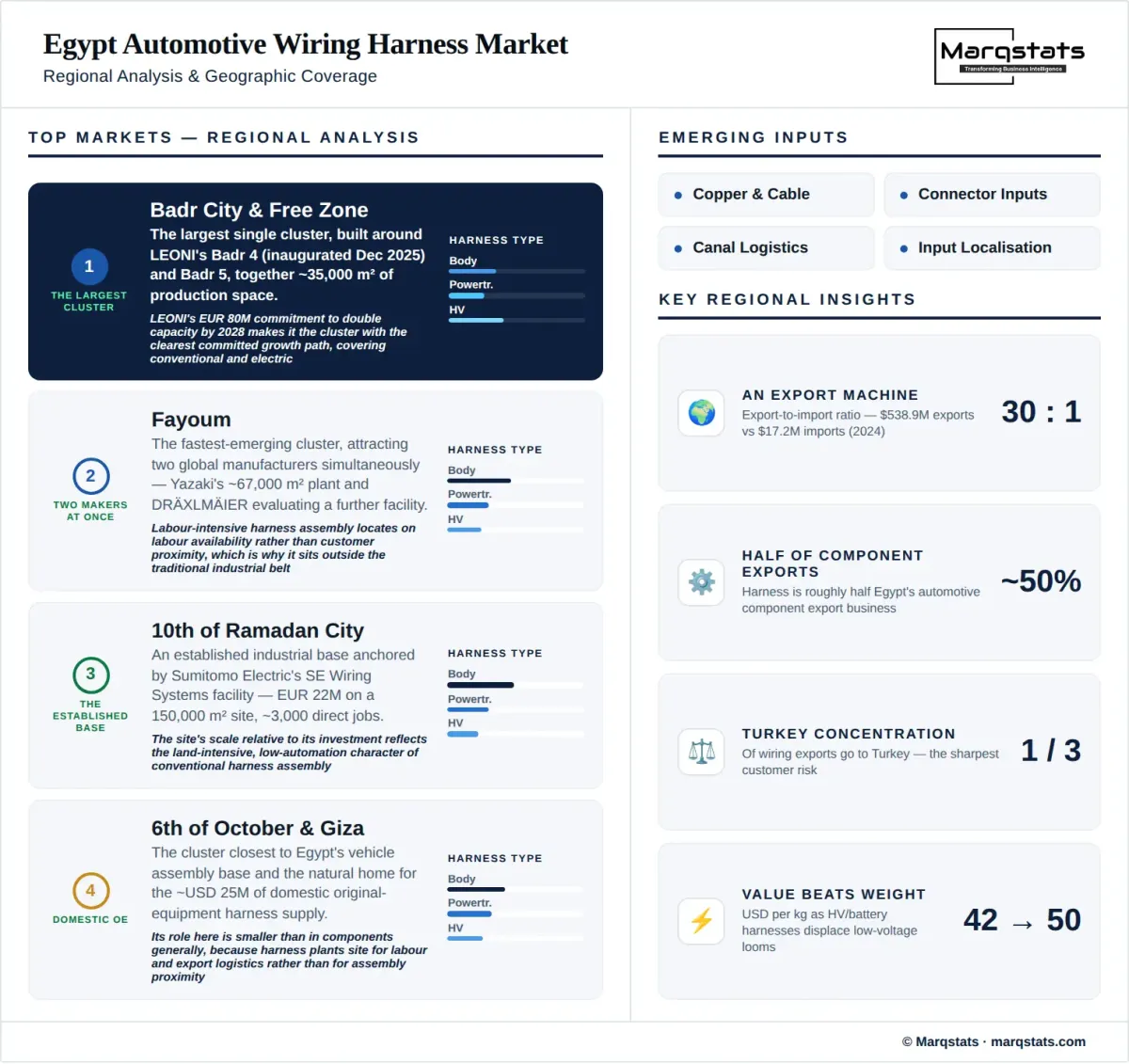
The largest single cluster, built around LEONI's Badr 4 facility inaugurated in December 2025 and Badr 5 which broke ground alongside it, together providing roughly 35,000 square metres of production space. The May 2026 commitment of EUR 80 million to a further Badr complex intended to double capacity by 2028 makes this the cluster with the clearest committed growth path in the country.
Fayoum
The fastest-emerging cluster and the one attracting two global manufacturers simultaneously, with Yazaki EDS Egypt building a 67,000 square metre plant on an initial EUR 15.43 million construction contract and DRÄXLMAIER evaluating a further facility of roughly 20,000 to 40,000 square metres. Harness assembly locates on labour availability rather than customer proximity, which is why Fayoum sits outside Egypt's traditional industrial belt.
10th of Ramadan City
An established industrial base anchored by Sumitomo Electric's SE Wiring Systems facility, opened in May 2025 at EUR 22 million on a 150,000 square metre site and expected to support roughly 3,000 direct jobs. The site's scale relative to its investment reflects the land-intensive, low-automation character of conventional harness assembly.
6th of October City and Giza
The cluster closest to Egypt's vehicle assembly base and therefore the natural home for the roughly USD 25 million of domestic original equipment harness supply. Its role in this category is smaller than its role in components generally, because harness plants site for labour and export logistics rather than for proximity to the assembly lines they might also serve.
Suez Canal Economic Zone and the Delta
A supporting cluster rather than a harness manufacturing centre, providing copper wire, cable and insulation inputs alongside canal export logistics. Its relevance rises with upstream localisation, since a category importing most of its copper and connector content has an input cost position that domestic supply could materially change.
How Competition Is Evolving
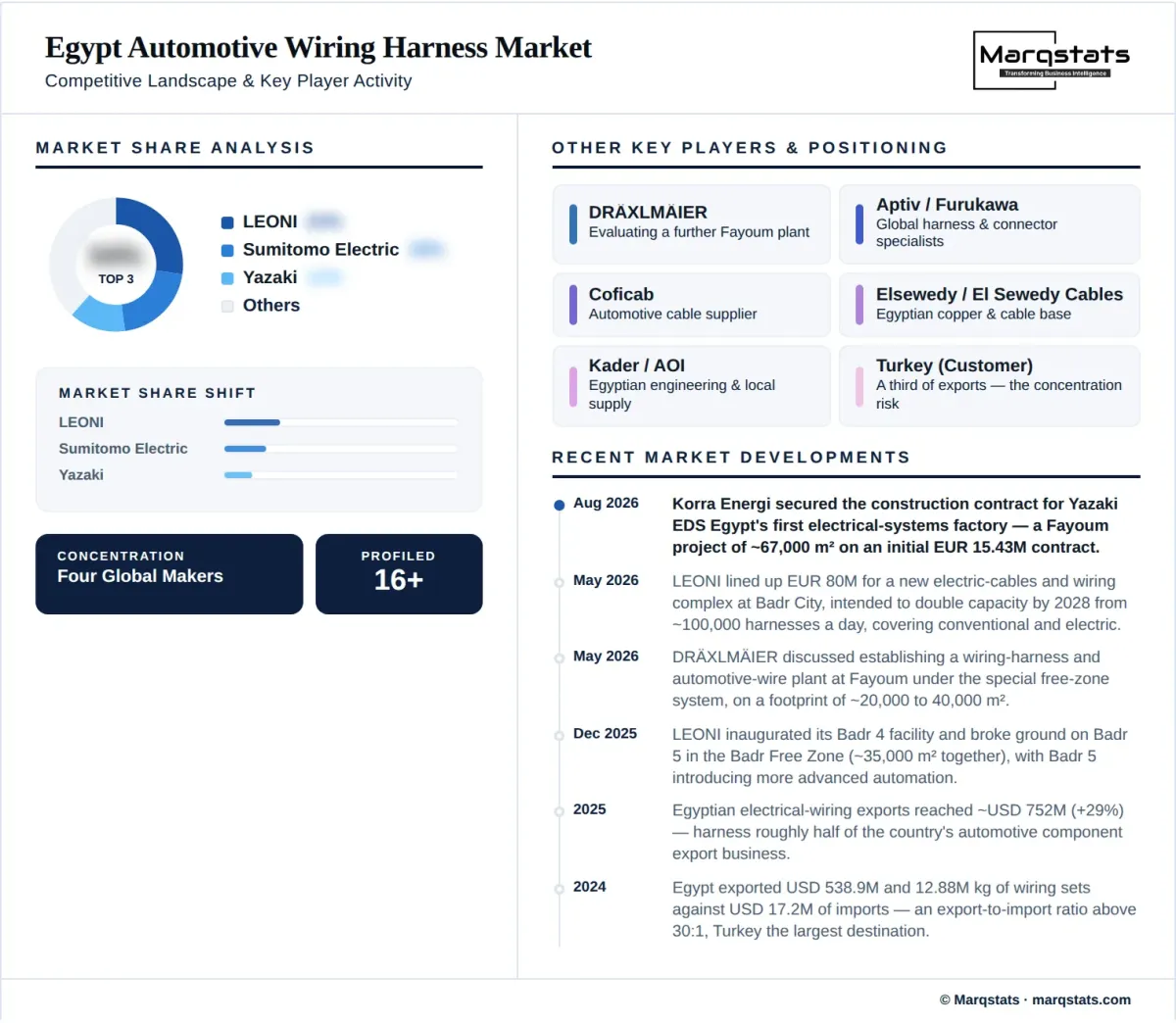
Four global harness manufacturers now hold Egyptian positions and none of them competes for Egyptian customers. LEONI operates the largest footprint at Badr with roughly 100,000 harnesses a day and a committed path to doubling it by 2028. Sumitomo Electric's SE Wiring Systems opened at 10th of Ramadan City in May 2025. Yazaki is building its first Egyptian plant at Fayoum. DRÄXLMAIER has discussed a further Fayoum facility. Their competition takes place in European nomination rounds, and their Egyptian plants compete against each other principally for skilled assembly labour and for the same free-zone and investment incentives.
Competitive position rests on labour productivity, currency cost and logistics against European alternatives rather than on anything Egyptian buyers do. Egypt exported USD 538.9 million of wiring sets in 2024 while importing USD 17.2 million, a ratio above thirty to one that describes an industry whose customers are almost entirely elsewhere. The practical implication for a new entrant is that the sequence runs customer nomination first, capacity second: a greenfield harness plant without an offtake agreement is a bet on winning a programme rather than a platform for serving a market.
The risk profile is unusual for a growing industry because concentration sits on the demand side rather than the supply side. Turkey took approximately USD 249 million of Egypt's USD 752 million of 2025 electrical wiring exports, roughly a third, with Slovakia at USD 106 million and the United Kingdom at USD 87 million. Losing a single European model programme can idle a plant regardless of Egyptian cost competitiveness, and the mitigation available to manufacturers is programme diversification rather than market development. That is also why the shift toward high-voltage content matters strategically as well as commercially: it raises value per kilogram from about USD 42 to USD 50 and moves plants up a capability curve competitors cannot follow on labour cost alone.
The strategic question for a client is whether Egypt's position survives the powertrain transition, and the evidence points to yes on unusual terms. Combustion engine harnesses have no direct equivalent in a battery electric vehicle, so a plant tied to powertrain looms faces displacement. But the replacement content is worth more per kilogram of copper, which is why implied value rises from about USD 42 to USD 50 while weight grows more slowly, and why LEONI's EUR 80 million Badr commitment covers conventional and electric applications together rather than hedging between them. The plants that lose are those that grow tonnage without moving up the voltage and engineering curve; the plants that win convert the same labour base into higher-value assemblies. Egypt's advantage in that transition is that its cost position buys time to build accreditation and traceability capability that competitors on labour cost alone will not fund.
Companies Covered
The report profiles 16+ companies with full strategy and financials analysis, including:
Recent Market Activity
Table of Contents
Coverage & Segmentation
The study covers automotive ignition and wiring harnesses and related vehicle electrical distribution assemblies manufactured in Egypt across the 2021 to 2025 historical period and the 2026 to 2030 forecast period, with 2025 as the base year and an indicative 2031 endpoint. The measurement lens is manufacturing output value, covering both export and domestic original equipment supply, rather than domestic consumption alone. That choice follows the structure of the industry: exports of USD 538.9 million against imports of USD 17.2 million in 2024 mean a consumption lens would measure a fraction of Egyptian activity.
The base year departs from the underlying research pack and the departure is stated rather than absorbed. The pack derives USD 595 million for 2025 by applying the 7.5% growth recorded for automotive component exports overall to the trade-verified 2024 harness base. Harness exports grew far faster, with Egyptian electrical wiring exports reaching approximately USD 752 million in 2025 on 29% growth, and a 595 million output figure would fall below the export figure alone. The corrected estimate is USD 720 million, comprising roughly USD 695 million of exports on the trade-anchored 29% path plus about USD 25 million of domestic original equipment supply. Growth rates are retained from the pack unchanged and only the level is corrected. The revised 2025 sizing range is USD 680 million to USD 780 million.