Market Snapshot
Key Takeaways
Market Overview & Analysis
Report Summary
The Megawatt Charging System market sits at the intersection of heavy-duty vehicle electrification, high-power DC charging infrastructure, and grid integration. Unlike conventional Combined Charging System (CCS) fast charging that typically tops out around 350 kW, MCS is engineered to deliver megawatt-scale DC power, enabling Class 6, 7, and 8 commercial vehicles, electric buses, port trucks, mining vehicles, and large-battery off-highway equipment to recharge during operational breaks rather than losing several hours of duty time. Mercedes-Benz Trucks states that MCS enables charging power of up to 1,000 kW, allowing the eActros 600 to recharge from 20% to 80% in around 30 minutes.
The technical specification supports up to 1,250 V DC and 3,000 A per CharIN Megawatt Charging System technical requirements, implying a theoretical maximum of 3.75 MW. Current commercial deployments are typically in the 700 kW to 1.2 MW range, with ABB MCS1200 marketed at 1.2 MW continuous, Alpitronic HYC1000 supporting up to 1,000 kW with simultaneous DC charging for up to eight vehicles and MCS charging up to 1,500 A, and Siemens SICHARGE FLEX positioned for a wide power range from 480 kW to over 1.68 MW using modular increments. The 700 kW to 1.2 MW band represents the current commercial sweet spot, while 1.2 MW to 2 MW deployments are scaling fast through 2026–2030.
Component value distribution across an MCS site spans the visible charging dispenser (approximately 38% of 2025 market revenue), power cabinets and conversion systems, liquid-cooled connectors and cable assemblies, vehicle-side inlets, thermal management modules, energy management software, battery energy storage integration for grid buffering, and installation and uptime services. Geographic demand is concentrated in Europe and North America for early public corridors, with Chinese heavy-duty truck adoption scaling within the domestic ecosystem and electric truck deployment within the India E-Truck Market positioning South Asia for follow-on MCS infrastructure investment as electric truck volume scales beyond pilot deployment.
Market Dynamics
Key Drivers
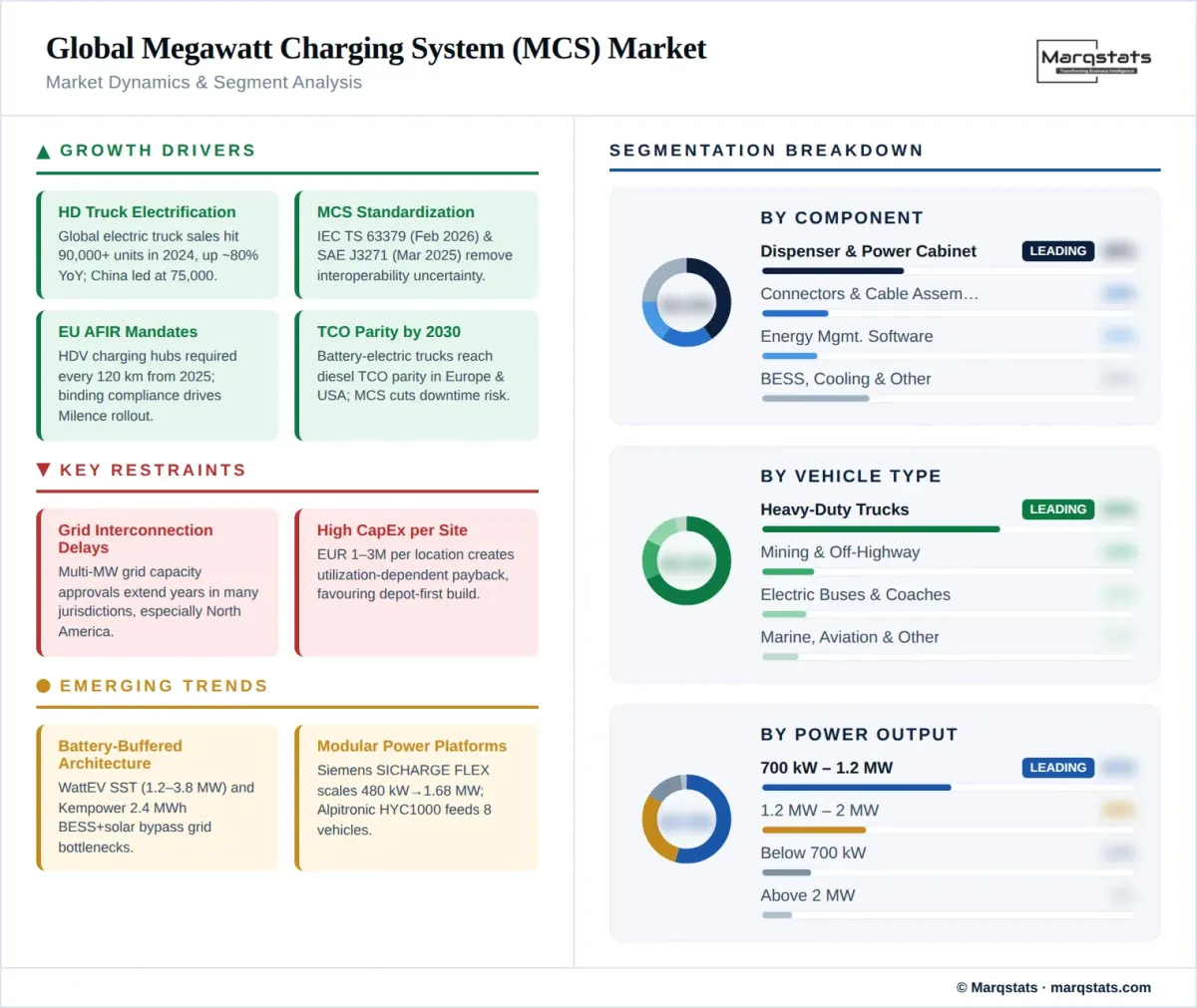
- Electric heavy-duty truck adoption is accelerating. Global electric medium- and heavy-duty truck sales exceeded 90,000 units in 2024, up almost 80% year-on-year, expanding the addressable MCS-compatible vehicle base. China accounted for over 80% of global electric truck sales at approximately 75,000 units, while Europe and North America are positioning for accelerated growth from 2026 onward.
- MCS standardization removes interoperability uncertainty. IEC TS 63379 published in February 2026 defines connectors, vehicle inlets, and cable assemblies for conductive DC charging at megawatt power levels. SAE J3271 published in March 2025 covers system-level charging equipment and control elements. Both standards reduce OEM and fleet operator hesitancy on multi-million-dollar infrastructure commitments.
- EU Alternative Fuels Infrastructure Regulation (AFIR) creates binding deployment targets. Heavy-duty vehicle charging hubs with minimum total power output are required every 120 kilometers from 2025, with requirements increasing through 2030. The mandate transforms public-corridor MCS deployment from voluntary commercial decision to regulatory compliance investment for European logistics operators.
- Total cost of ownership economics support fleet conversion. Battery-electric trucks are expected to reach TCO parity with diesel for long-haul operations in Europe and the United States by 2030, with MCS central to the equation by reducing vehicle downtime and increasing asset utilization. High-utilization fleets in port drayage, regional logistics, and dedicated freight corridors are converting first.
- Public funding programs accelerate infrastructure rollout. The EU Alternative Fuels Infrastructure Facility (AFIF) provides EUR 111.5 million for the Milence MILES project covering 284 MCS points and 264 CCS points across 71 locations in 10 EU member states. CALSTART EnergIIZE in California provides USD 10 million MCS funding for medium- and heavy-duty zero-emission vehicle infrastructure. The US National Zero-Emission Freight Corridor Strategy guides charging and hydrogen deployment from 2024 to 2040.
Key Restraints
- Grid interconnection delays constrain site activation timelines. MCS sites can require multi-megawatt grid capacity, with utility approval extending several years in many jurisdictions. The constraint is most acute in North America where utility processes lag European deployment timelines, slowing early commercial corridor activation.
- Capital expenditure intensity raises early-stage payback risk. MCS sites require chargers, transformers, switchgear, civil works, and frequently battery energy storage systems for grid buffering. Site-level investment in the EUR 1–3 million range per location creates utilization-dependent payback economics, supporting depot-first deployment ahead of public corridor commitment.
- Vehicle-side readiness lags charger availability. Not all electric trucks in the operational fleet are MCS-compatible, creating a transitional window where infrastructure runs ahead of vehicle adoption. The mismatch resolves through 2026–2028 as MAN eTGX and eTGS, Daimler eActros 600, Volvo FH Aero Electric, and Scania commercial deliveries scale.
- Competition from CCS and depot charging limits MCS-only investment. Many medium-duty fleet applications, urban delivery operations, refuse trucks, and city buses remain well-served by 150 kW to 350 kW CCS depot charging. The constraint is genuine but does not threaten MCS demand for long-haul, port, mining, and large-battery applications where CCS is operationally insufficient.
Key Trends
- Modular power architecture is becoming standard. Charger OEMs are deploying modular power cabinets that distribute power across multiple dispensers, supporting both 700 kW to 1.2 MW current applications and 1.2 MW to 2 MW next-generation deployments. Siemens SICHARGE FLEX and Alpitronic HYC1000 anchor the modular-architecture approach.
- Battery-buffered MCS sites address grid bottlenecks. WattEV launched its Solid-State Transformer (SST) in October 2025 supporting 1.2 to 3.8 MW from 12–15 kV utility lines in a single integrated cabinet. Kempower has demonstrated 2.4 MW grid connections paired with 2.4 MWh battery storage and solar integration. The architecture enables faster site activation under grid-constrained conditions.
- Tier-1 component suppliers are scaling MCS-specific portfolios. MAHLE won its first series order for cooling modules supporting up to 3.75 MW MCS in February 2025, with production starting end-2025 at Námestovo, Slovakia. Schaltbau expanded its Eddicy contactor portfolio in May 2025 with C305/C805 1,500 A and C330/C830 3,000 A bidirectional contactors for MCS Level 2 and Level 3 deployment.
- Truck OEMs treat MCS as strategic platform requirement. Daimler Truck announced January 2026 testing of two MCS-compatible eActros 600 vehicles across a 2,400 km route covering Germany, the Netherlands, Belgium, Denmark, and Sweden. Volvo Trucks announced the FH Aero Electric with 700 km range and MCS support in April 2026. Scania committed to MCS truck orders from early 2026 following its EVS38 unveiling in June 2025.
- Plug-and-Charge authentication and communication controllers are productizing. Hubject partnered with Windrose Technology in March 2026 for Plug&Charge authentication on global MCS networks. Vector Informatik commenced series production of vSECC.MCS communication controller in May 2025 supporting up to 3.75 MW with ISO 15118-20 and IEC TS 63379 compliance, followed by the vCTS.performance HIL test system in November 2025 supporting 3.84 MW with 96% regenerative efficiency.
Market Segmentation
Charging dispensers and power cabinets hold the largest revenue share at approximately 38% of the Megawatt Charging System market in 2025, anchored by visible end-equipment investment in early commercial deployments. Energy management software and digital services represent the fastest-growing component segment, expanding at approximately 52% CAGR during 2026–2030, supported by ISO 15118-20 Plug&Charge adoption, fleet management integration, depot energy optimization, and battery-buffering control software requirements. Connectors and cable assemblies, power electronics, cooling modules, vehicle inlets, battery energy storage integration, and installation and uptime services together represent the remaining component value pool.
The charging dispenser is the visible MCS unit installed at fleet depots, highway corridors, and port hubs. ABB MCS1200 delivers 1.2 MW continuous at 1,500 A, Alpitronic HYC1000 supports up to 1,000 kW with multi-vehicle simultaneous charging, Kempower Mega Satellite anchors the modular-pedestal approach, and Siemens SICHARGE FLEX scales from 480 kW to over 1.68 MW. Modular power cabinets in the back-end distribute high-voltage DC power across multiple dispensers, supporting site scalability as fleet utilization expands. The combined dispenser and power-cabinet category anchors current commercial revenue concentration.
Stäubli is a CharIN-listed MCS connector and inlet supplier with rated current up to 2,000 A and limited cooling needs. Phoenix Contact, TE Connectivity, HUBER+SUHNER, Amphenol, and ITT Cannon participate in high-power connector and cable supply. Liquid-cooled cable assemblies are essential at MCS power levels because of resistive heating constraints; cable cooling typically uses recirculating coolant integrated with the dispenser thermal management system. The category benefits from IEC TS 63379 publication in February 2026 which formalizes connector, vehicle inlet, and cable assembly specifications.
The vehicle-side inlet is integrated into the MCS-compatible truck or bus and mates with the charger-side connector during high-power transfer. Stäubli supplies inlet hardware alongside connector solutions. Truck OEM platforms including Daimler eActros 600, MAN eTGX/eTGS, Scania MCS-equipped trucks (orders from early 2026), and Volvo FH Aero Electric integrate MCS inlets as part of their long-haul electric platform architecture.
Power electronics convert grid AC into the high-voltage DC required for MCS charging. The category includes rectifiers, switchgear, isolated DC-DC stages, and increasingly silicon carbide (SiC) power semiconductors that enable higher efficiency and power density. WattEV Solid-State Transformer technology launched in October 2025 collapses traditional step-down transformers, switchgear, and rectifiers into a single liquid-cooled cabinet connecting directly to 12–15 kV utility lines, supporting 1.2 to 3.8 MW output.
Liquid cooling is essential for cable assemblies, connectors, and power electronics at MCS power levels. MAHLE won its first series order for an MCS cooling module in February 2025 supporting fast-charging capacities up to 3.75 MW with waste heat up to 8 kW per station, approved for ambient temperatures from -35°C to +50°C without performance loss. The module also supports up to 500 kW fast-charging for passenger cars and light commercial vehicles, providing dual-application revenue capture.
Energy management software coordinates load balancing across multiple dispensers, manages depot energy budgets, integrates renewable generation and battery storage, handles billing and authentication, and supports fleet management integration. Hubject and Windrose Technology partnered in March 2026 for Plug&Charge authentication on MCS networks. The category is the fastest-growing component segment because software value scales with site count, vehicle population, and operational complexity rather than only with hardware shipments.
Battery energy storage systems (BESS) buffer MCS sites against grid demand peaks, support peak shaving, defer grid upgrades, and integrate renewable generation. The architecture is becoming critical for sites where multi-megawatt grid connections face delays. Kempower demonstrated 2.4 MW grid + 2.4 MWh BESS + 400 kW solar configurations at MCS Live Winter Days events. The category captures incremental revenue per site while solving genuine grid-constraint bottlenecks.
Installation, civil works, commissioning, maintenance, uptime contracts, and remote monitoring together represent a substantial recurring-revenue component. Multi-million-euro per-site installation contracts include transformer placement, switchgear installation, civil engineering, dispenser commissioning, and ongoing service-level agreements. The category supports differentiated competitive positioning where charger-OEM hardware quality is matched by execution capability and uptime guarantee performance.
The 700 kW to 1.2 MW band holds the largest share at approximately 51% of the 2025 Megawatt Charging System market, representing the current commercial sweet spot anchored by ABB MCS1200, Alpitronic HYC1000, and early Scania MCS deployments at 750 kW. The 1.2 MW to 2 MW band represents the fastest-growing power category, expanding at approximately 45% CAGR during 2026–2030, supported by next-generation truck platform power requirements and Vector Informatik vSECC.MCS controller scaling to 3.75 MW capability. Below-700 kW transitional systems and above-2 MW high-power applications anchor the remaining volume.
Systems below 700 kW serve as the transitional bridge between conventional CCS fast charging and full MCS deployment. The category covers MCS-ready 350 kW to 600 kW dispensers that allow operators to deploy infrastructure ahead of MCS-compatible vehicle availability and upgrade later. The segment is concentrated in early public corridor projects and depot installations serving mixed CCS-and-MCS fleet operations.
The 700 kW to 1.2 MW band represents the volume anchor through 2030. ABB MCS1200 delivers 1.2 MW continuous, Scania trucks support 750 kW MCS for sub-30-minute 20–80% charging during driver rest breaks, and most Milence corridor deployments fall in this band. The segment combines proven technology, mature supplier portfolios, and vehicle-side compatibility, supporting the largest absolute deployment count through the forecast period.
The 1.2 MW to 2 MW band scales fast as next-generation truck platforms and high-power depot applications come online. Daimler eActros 600 supports MCS charging at up to 1,000 kW with 30-minute 20–80% charging. MAN and ABB validated 1,000 A sessions with peak power of 740 kW in September 2025 testing, with MAN factory-floor demonstrations reaching 1.2 MW. The segment is positioned for the highest growth rate as OEM platforms commit to higher power thresholds.
Above-2 MW deployments are concentrated in mining, port heavy-duty, marine, and emerging high-utilization applications where battery sizes exceed 800 kWh and downtime cost is acute. WattEV Solid-State Transformer supports up to 3.8 MW. Vector vCTS.performance HIL test system launched in November 2025 supports up to 3.84 MW. The segment remains specialty-application through 2030 with material long-term growth potential as ultra-heavy-duty applications electrify.
Heavy-duty trucks hold the largest share at approximately 64% of the 2025 Megawatt Charging System market, the core MCS use case anchored by long-haul logistics, regional freight, and Class 6–8 commercial vehicle adoption. Mining and off-highway vehicles represent the fastest-growing vehicle segment, expanding at approximately 49% CAGR during 2026–2030, supported by closed-site high-utilization economics, very large battery packs, and controlled operational environments. Medium-duty trucks, electric buses and coaches, marine vessels, and aviation ground support together represent the remaining addressable base.
Heavy-duty trucks anchor MCS demand through Class 6, 7, and 8 commercial vehicle deployment. Daimler eActros 600, MAN eTGX/eTGS, Scania MCS-equipped trucks, Volvo FH Aero Electric (700 km range, MCS-enabled 20–80% in approximately 50 minutes), Tesla Semi, BYD heavy-duty trucks, and emerging Chinese OEM platforms drive segment volume. Long-haul applications benefit most from MCS owing to driver rest-break charging alignment and the operational impossibility of CCS-only long-haul operation.
Medium-duty electric trucks (Class 4–6) represent a transitional segment where some applications remain well-served by 350 kW CCS depot charging while others scale toward MCS for regional delivery and high-utilization fleet operations. The segment is concentrated in regional logistics, food distribution, and dedicated fleet applications where mid-shift charging supports extended duty cycles.
Urban transit buses with depot charging architectures often do not require MCS power levels, however intercity coaches, long-distance bus operations, and high-utilization tour bus applications can benefit from MCS for fast turnaround. The segment captures incremental MCS deployment in select operator networks where vehicle utilization and route distance support megawatt-class infrastructure investment.
Mining trucks, large hauling vehicles, and heavy off-highway equipment have very large battery packs (often exceeding 1,000 kWh), high asset utilization, and operate in controlled private sites where grid and infrastructure can be planned holistically. The segment is the fastest-growing vehicle category because operational economics are compelling, downtime cost is acute, and site-level grid planning avoids public-corridor delays. The category captures premium per-site MCS investment.
Electric ferries, port operation vessels, and short-range marine applications scale with port electrification programs, particularly in Nordic markets, European ports, California ports, and Chinese coastal hubs. MCS-derived high-power DC charging architectures align with marine battery sizes and turnaround-time requirements. The segment captures incremental deployment as port electrification scales from pilot to commercial operation.
CharIN identifies light electric aircraft as an extended MCS application. Aviation ground support equipment, electric airport tugs, baggage handlers, and emerging light electric aircraft applications represent a small but technically significant segment. The category remains specialty deployment through 2030 with development timelines tied to certification milestones for electric aviation platforms.
Fleet depot charging holds the largest share at approximately 47% of the 2025 Megawatt Charging System market, supported by high-utilization fleet economics, predictable route patterns, controlled site planning, and faster grid connection timelines compared with public corridor sites. Highway and corridor charging represents the fastest-growing location segment, expanding at approximately 56% CAGR during 2026–2030, supported by EU AFIR mandate-driven public network buildout, Milence corridor deployment, and US National Zero-Emission Freight Corridor Strategy programs. Port and logistics hubs, truck stops, mining and industrial sites, and public charging hubs together represent the remaining location categories.
Private fleet depots represent the largest near-term commercial opportunity owing to high-utilization economics, predictable operations, and controlled site planning. Logistics fleets, food distribution operators, beverage distributors, port drayage operators, and dedicated long-haul carriers anchor depot deployment. Site-level energy management software and battery-buffered configurations are particularly relevant for depot installations where total energy budget can be optimized across vehicle and facility loads.
Public highway and corridor charging is the fastest-growing location segment supported by EU AFIR mandate requirements for HDV charging hubs every 120 kilometers from 2025. Milence has committed to 284 MCS points across 71 locations in 10 EU countries by 2027, anchored by EUR 111.5 million AFIF funding. Active corridors include the 700 km Barcelona-Lyon route with hubs in Perpignan, Béziers, and Malataverne, and emerging routes from Rennes to the Netherlands, Stockholm to Gothenburg, and Stockholm to Malmö.
Port electrification programs anchor the segment owing to repeatable vehicle routes, emissions regulation pressure, and centralized charging locations. Milence deployed its first MCS solution at the Port of Antwerp-Bruges with 22 charging bays, 4 MW of CCS capacity, and 2.8 MW of MCS capacity. California ports under CARB emissions regulation, European port hubs, and emerging Chinese port electrification anchor demand. The segment supports premium per-site MCS investment given asset utilization and operational predictability.
Truck stop MCS deployment serves long-haul drivers requiring mid-shift recharge during mandatory rest breaks. The segment is anchored by traditional fuel station operators converting to multi-fuel zero-emission infrastructure. DAF Trucks signed a memorandum of understanding with TotalEnergies in February 2025 for MCS development including a pilot project, charging network access, and roaming services for DAF customers.
Mining sites, large industrial facilities, and dedicated heavy-equipment operations represent a high-value private deployment segment. Site operators control grid planning end-to-end, eliminating utility-interconnection delays that constrain public corridor activation. The segment captures premium per-site investment supported by very large battery sizes, high asset utilization, and predictable operational duty cycles.
Public charging hubs combining MCS for heavy-duty vehicles with high-power CCS for passenger and light commercial applications anchor the multi-purpose deployment model. Operators including IONITY, Shell Recharge, EnBW, and emerging multi-fuel operators are scaling hub deployments. The segment supports utilization smoothing across vehicle classes while capturing both premium MCS revenue and high-volume CCS throughput.
By Geography
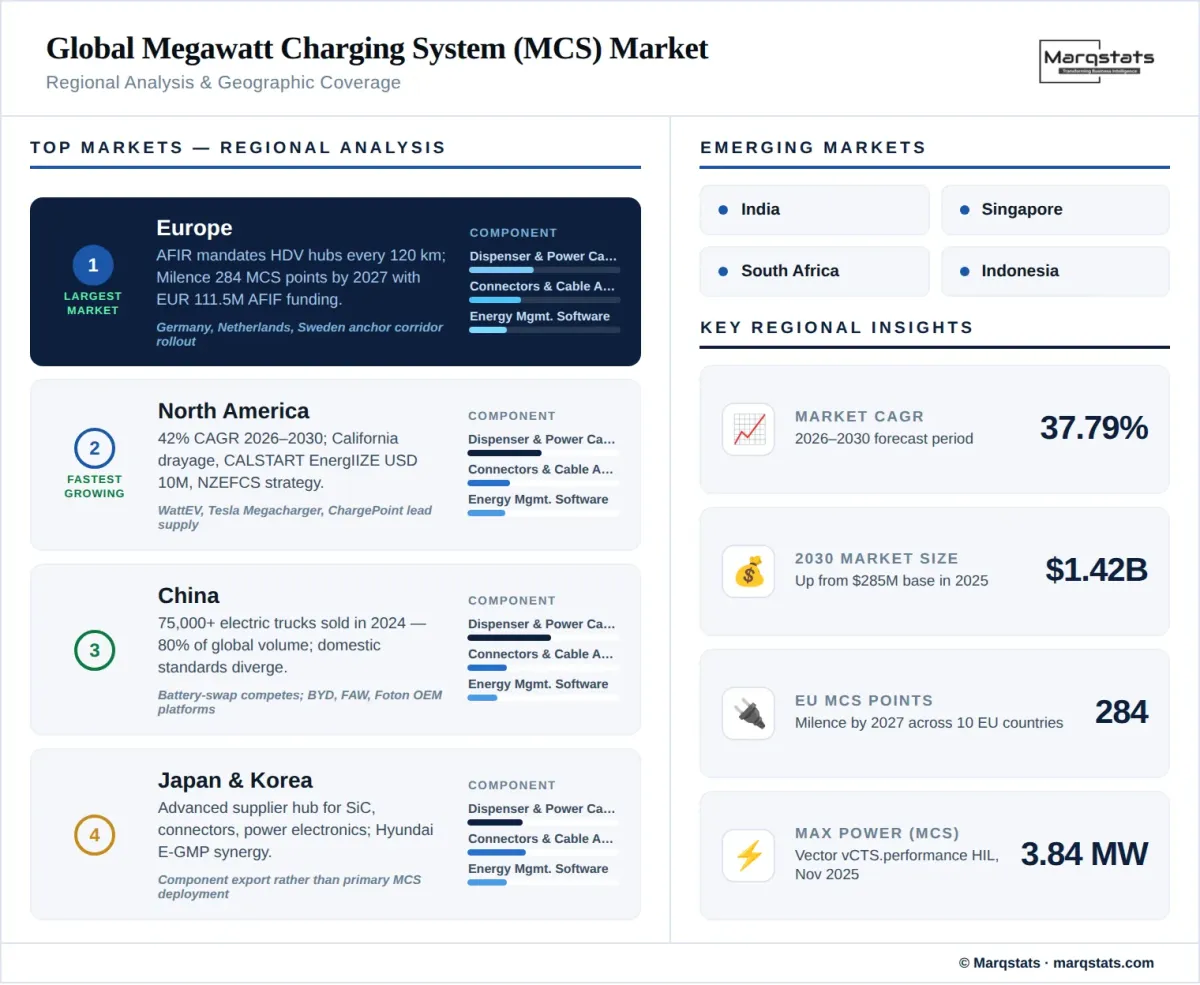
Europe holds the largest regional share of the 2025 Megawatt Charging System market, anchored by EU AFIR binding deployment mandates, Milence corridor commitments, and OEM activity from Daimler Truck, MAN, Volvo Trucks, and Scania. North America represents the fastest-growing regional cluster expanding at approximately 42% CAGR during 2026–2030, supported by California drayage and port electrification, the US National Zero-Emission Freight Corridor Strategy, CALSTART EnergIIZE funding programs, and accelerating utility-side grid investment. China, Japan-Korea, and Rest of World together represent the remaining regional demand pool.
Europe
Europe leads public corridor MCS deployment supported by binding infrastructure targets under the EU Alternative Fuels Infrastructure Regulation (AFIR). Heavy-duty vehicle charging hubs with minimum total power output are required every 120 kilometers from 2025, with requirements increasing through 2030. Germany, the Netherlands, Belgium, Sweden, Denmark, France, Italy, and the UK anchor regional deployment. Milence will install 284 MCS points across 71 locations in 10 EU countries by 2027 with EUR 111.5 million AFIF funding. Scania (Sweden), Volvo Trucks (Sweden), Daimler Truck (Germany), and MAN (Germany) anchor regional OEM activity.
North America
North America anchors the fastest-growing regional cluster supported by California drayage regulation, port electrification programs, and federal infrastructure investment. The US National Zero-Emission Freight Corridor Strategy guides medium- and heavy-duty charging deployment from 2024 to 2040. CALSTART EnergIIZE funding programs provide USD 10 million MCS deployment support for medium- and heavy-duty zero-emission vehicle infrastructure. Tesla Megacharger (Tesla Semi network), WattEV (Solid-State Transformer technology), and ChargePoint anchor regional supply. Forum Mobility and emerging multi-fuel operators are scaling commercial deployment.
China
China dominates electric truck volume with approximately 75,000 electric trucks sold in 2024 representing over 80% of global electric truck sales. The Chinese high-power charging ecosystem operates under domestic standards that may not map directly to Western MCS specifications. Battery swapping is a significant alternative architecture in China, particularly for state-owned fleet operators and selected commercial vehicle applications. Chinese MCS deployment scales through 2030 in tandem with electric truck volume but with regional standardization choices that diverge from European AFIR-aligned deployment.
Japan and South Korea
Japan and South Korea position as advanced supplier markets for connectors, power electronics, semiconductors, thermal systems, and vehicle platforms rather than the largest early MCS deployment markets. Japanese suppliers support semiconductor (silicon carbide), high-voltage cable, and power conversion supply chains. Korean OEM Hyundai Motor Group with E-GMP architecture provides parallel high-voltage platform capability that translates into commercial vehicle high-power charging investment over the forecast horizon.
Rest of World
Rest of World, including India, Southeast Asia, Latin America, the Middle East, and Africa, captures selective MCS deployment in ports, mining, and high-utilization freight corridors. India electric truck adoption is scaling through Tata Motors, Ashok Leyland, and emerging OEM platforms. Southeast Asian port electrification in Singapore, Malaysia, Thailand, and Indonesia supports follow-on MCS infrastructure investment. South Africa already shows solar-powered heavy-duty truck charging activity along freight routes, though deployments remain early and not always full MCS-standard.
How Competition Is Evolving
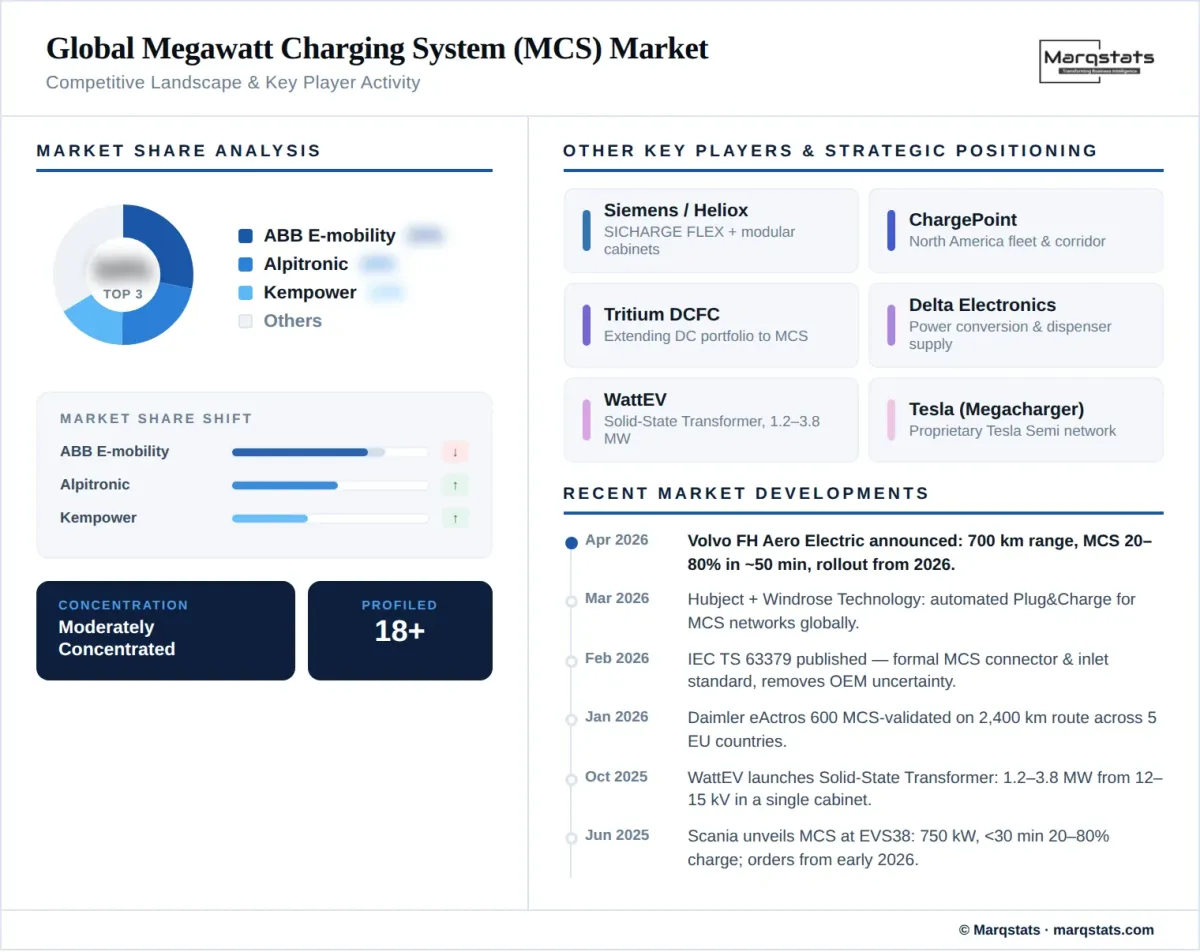
The Megawatt Charging System market is moderately concentrated at the charging-hardware specialist level and broadly distributed across truck OEMs, infrastructure operators, and Tier-1 component suppliers. ABB E-mobility (MCS1200), Alpitronic (HYC1000), Kempower (Mega Satellite), Siemens (SICHARGE FLEX), and ChargePoint anchor the charging-hardware tier. Tritium, Heliox, and Delta participate as established DC fast-charging suppliers extending into megawatt-class capability. Tesla operates the proprietary Megacharger network for Tesla Semi.
Connector and cable suppliers including Stäubli (CharIN-listed MCS connector with rated current up to 2,000 A), Phoenix Contact, TE Connectivity, HUBER+SUHNER, Amphenol, and ITT Cannon supply the high-power interconnect layer. Tier-1 thermal and component suppliers including MAHLE (cooling modules), Schaltbau (Eddicy contactors), and Vector Informatik (vSECC.MCS communication controller, vCTS.performance HIL test system) supply the broader supply-chain infrastructure. Truck OEMs including Daimler Truck, MAN, Scania, Volvo Trucks, Tesla, BYD, FAW, Foton, and Hyundai integrate MCS-compatible vehicles into their commercial platforms.
Public infrastructure operators including Milence (anchored by EUR 111.5 million AFIF funding for 284 MCS points by 2027), IONITY, WattEV, Truck Charging Networks, Shell Recharge, and EnBW are building the public-corridor and depot deployment base. Strategic partnerships including the Hubject-Windrose Plug&Charge collaboration (March 2026) and DAF Trucks-TotalEnergies MoU (February 2025) demonstrate the cross-industry integration model. The competitive landscape will be defined less by peak charger rating and more by delivered power under real-world thermal conditions, interoperability across truck OEMs, uptime and service network depth, grid-integration capability, and battery-buffering and energy-management software.
Companies Covered
The report profiles 18 company profiles+ companies with full strategy and financials analysis, including:
Recent Market Activity
Table of Contents
Coverage & Segmentation
The Global Megawatt Charging System (MCS) Market report analyzes the high-power DC charging infrastructure opportunity for heavy-duty electric vehicles, electric buses, port and drayage trucks, mining vehicles, marine vessels, and emerging aviation ground support applications for the period 2021 to 2030. The report covers historical data for 2021–2025, with 2025 as the base year, and forecasts spanning 2026–2030. Market sizing is conducted in USD millions with parallel unit-volume tracking by component category. The study examines MCS charging dispensers, MCS connectors and cable assemblies, vehicle inlets, power cabinets and conversion systems, cooling and thermal management, energy management software, battery energy storage integration, and installation and uptime services.
The scope evaluates competing application economics across heavy-duty trucks, medium-duty trucks, electric buses and coaches, mining and off-highway vehicles, marine vessels, and aviation ground support segments. Power output bands covered include below-700 kW transitional systems, 700 kW to 1.2 MW current commercial deployments, 1.2 MW to 2 MW next-generation systems, and above-2 MW high-power applications. Charging location categories include fleet depot, highway and corridor, port and logistics hub, truck stop, mining and industrial site, and public charging hub. Regulatory frameworks evaluated include CharIN MCS technical requirements, IEC TS 63379 (February 2026), SAE J3271 (March 2025), ISO 15118-20 communication standard, EU AFIR binding deployment mandates, and the US National Zero-Emission Freight Corridor Strategy.