Market Snapshot
Key Takeaways
Market Overview & Analysis
Report Summary
This report sizes the Europe battery-electric train market — battery-electric multiple units delivered to European operators, measured at vehicle manufacturer level. A battery-electric multiple unit collects current from the overhead line on electrified sections, charges its traction batteries while doing so, and runs on stored energy across the unwired gap. It is a solution to a specific European problem: a network that is 57.6% electrified, where the remaining 42.4% is mostly rural, lightly used and impossible to justify wiring on passenger volumes alone.
Germany created this market and still dominates it. Schleswig-Holstein ordered 55 Stadler FLIRT Akku units that began entering service in October 2023 and now cover eleven lines carrying about 40% of the state's rail traffic, displacing roughly ten million litres of diesel a year. Siemens has taken 148 Mireo Plus B units across seven orders, of which only seven — for a Danish operator — sit outside Germany. CAF holds 76 units for two North Rhine-Westphalia authorities, originally 60 in 2021 and expanded to 76, entering service from December 2027.
The technology has already won the argument it was expected to lose. Hydrogen fuel-cell trainsets were the presumptive answer for unelectrified regional lines, and one German network took 27 of them in 2022 and 2023, but a 25 kV electric multiple unit converts three to five times as much source energy into motion as a hydrogen train, and battery units charge from infrastructure that already exists. The competition that matters now is not hydrogen and not diesel. It is the catenary itself.
Market Dynamics
Key Drivers
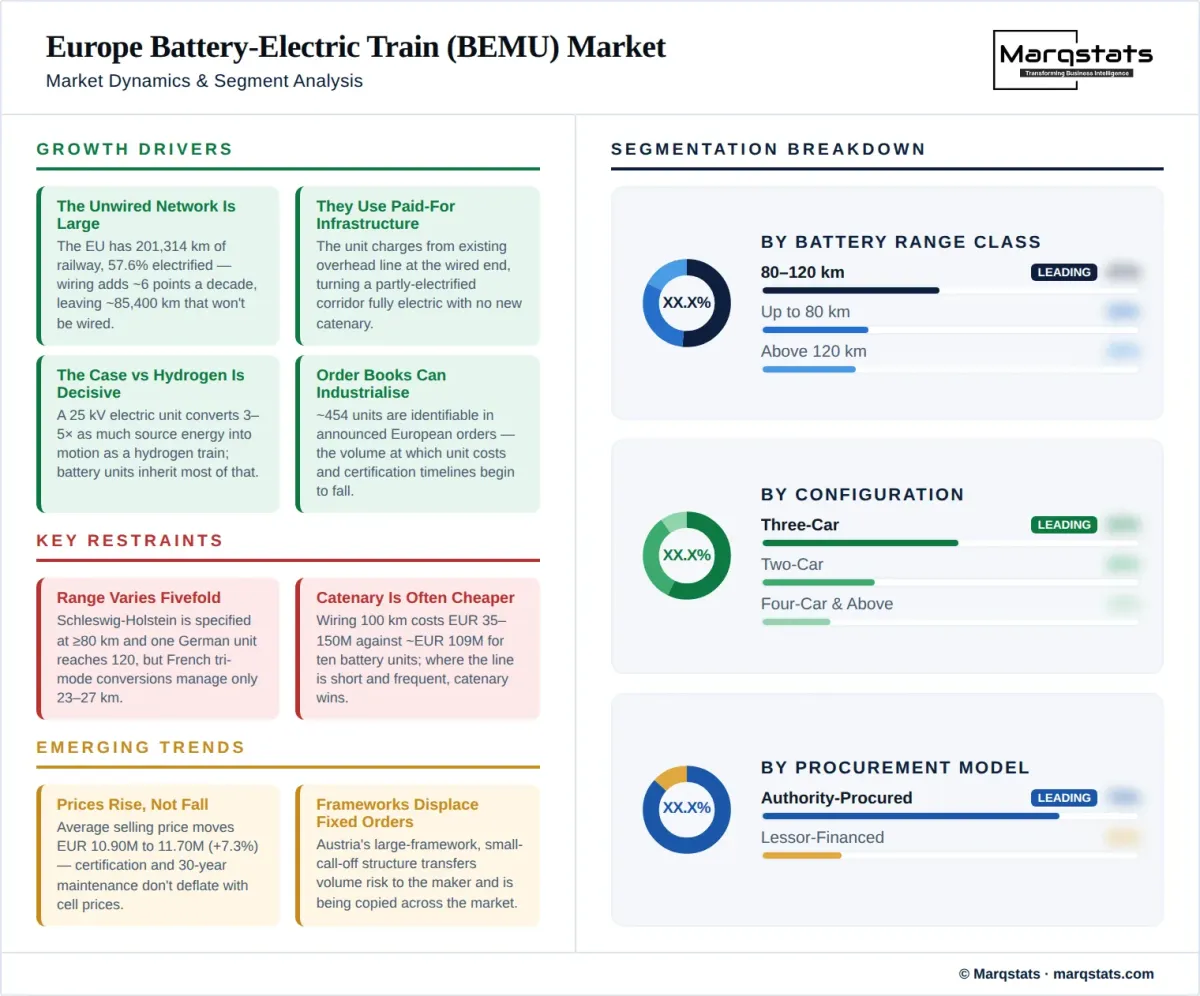
The unwired network is large, defined and shrinking slowly. The European Union has 201,314 kilometres of railway of which 57.6% was electrified in 2024, up from 39.9% in 1990 — an increase of 17.7 percentage points across three decades, or roughly six points a decade, which leaves about 85,400 kilometres that will not be wired on current trajectories.
Battery units exploit infrastructure that is already paid for. Because the trainset charges from existing overhead line at the electrified end of its route, a battery fleet converts a partially electrified corridor into a fully electric operation without a metre of new catenary, which is why discontinuous electrification has become the default design assumption.
The efficiency case against hydrogen is decisive. A 25 kV electric multiple unit converts three to five times as much of its source energy into motion as a hydrogen train, whose fuel-cell stack manages 55% to 60% in ideal conditions and 45% to 50% net of losses, and battery units inherit most of that advantage.
Order books are now large enough to industrialise. Roughly 454 units are identifiable in announced European orders — 148 Siemens, 120 in the Austrian framework, 76 from CAF, 55 in Schleswig-Holstein and the balance across Czech, Lithuanian and smaller procurements — which is the volume at which unit costs and certification timelines begin to fall.
Lessor capital is entering the market. Rolling-stock funds now finance about a fifth of deliveries, including a 61-unit German order placed in September 2025 for service from December 2029, which lets authorities procure fleets whose 30-year life exceeds any political cycle they can underwrite.
Key Restraints
Range varies by a factor of five and the low end is unusable. Schleswig-Holstein's fleet is specified at a minimum 80 kilometres in passenger service and one German unit is quoted at 120 kilometres without overhead line, but French tri-mode regional conversions achieve only 23 to 27 kilometres on battery, which covers almost no real unwired gap.
Electrification is the competing investment and it is often cheaper. At EUR 0.35 million to EUR 1.5 million per kilometre, wiring 100 kilometres costs EUR 35 million to EUR 150 million, against roughly EUR 109 million for ten battery units at 2025 prices. Where the line is short and the service frequent, catenary wins outright.
The largest order in Europe has barely been drawn down. The Austrian framework covers up to 120 units at about EUR 1.3 billion but only 23 have been called off in nearly three years, 16 in September 2023 and seven in March 2026, so most of the headline European order book is an option rather than a commitment.
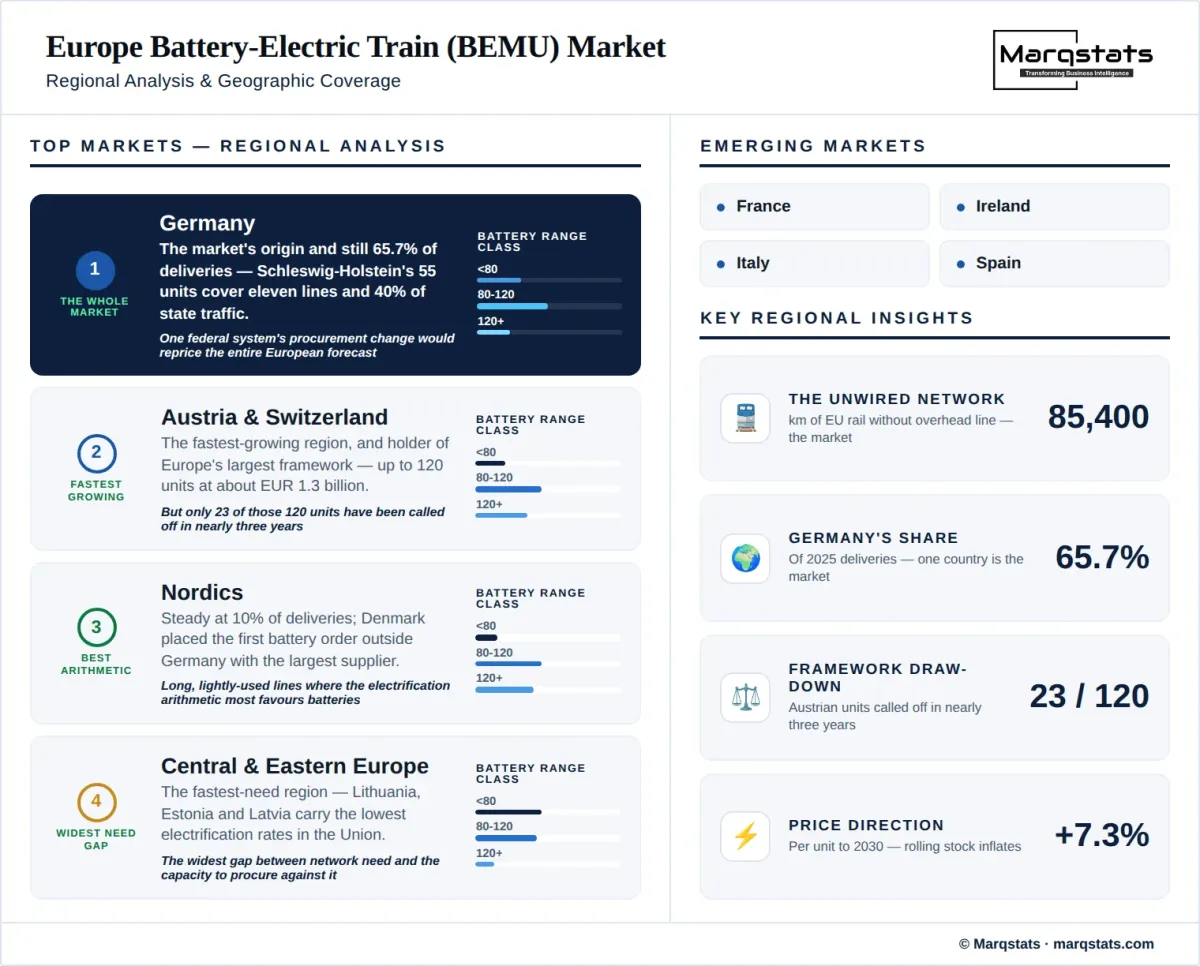
The market is one country. Germany takes 65.7% of 2025 deliveries, and of 148 units ordered from the largest single supplier only seven are outside Germany. A procurement policy change in one federal system would reprice the entire European forecast.
Key Trends
Range classes are migrating upward. Units specified above 120 kilometres grow at 45.99% and rise from 14% of deliveries to 25%, while the sub-80-kilometre class falls from 46% to 28%, as authorities learn that specifying to the shortest gap on the network leaves no operational margin.
Prices rise rather than fall. Average selling price moves from EUR 10.90 million to EUR 11.70 million, up 7.3%, because rail rolling stock carries certification, homologation and 30-year maintenance obligations that do not deflate with battery cell prices.
Framework agreements are displacing fixed orders. The Austrian contract structure — a large framework with small periodic call-offs — transfers volume risk to the manufacturer and is being copied, which makes announced order totals a poor guide to deliveries.
The market is dispersing out of Germany. Austria and Switzerland grow at 48.96% and Central and Eastern Europe at 46.72%, taking Germany's share from 65.7% to 48.1% even as German volumes nearly triple in absolute terms.
Market Segmentation
The entry class and the only one losing share, falling from 46% of 2025 deliveries to 28% by 2030 at 17.72%. Schleswig-Holstein's 55-unit fleet sits at the top of this band, specified at a minimum 80 kilometres in passenger operation. The class exists because early procurements sized the battery to the specific gap being crossed, which works until the timetable changes.
The volume class, rising from 40% of deliveries to 47% and growing at 34.27%. This is the range at which a battery unit can cover an unwired branch and return without intermediate charging, and it is where most current German procurement now specifies. One German operator's units are quoted at up to 120 kilometres without overhead line, with charging both in motion and at standstill.
The fastest-growing class at 45.99%, rising from 14% of deliveries to 25%. Longer range buys timetable resilience and diversionary capability rather than new route coverage, and it is what authorities specify once they have operated a first fleet. It carries the highest battery cost per unit and is the main reason the average selling price rises across the forecast.
Around a third of deliveries, easing from 34% to 30% at 26.80%. Two-car units suit the lightly-used rural branches where the battery case is strongest, but they carry the least seating against a largely fixed traction and battery cost, which makes their cost per seat the worst in the market.
The dominant configuration, steady at 52% of deliveries throughout and growing at 30.01% in line with the market. The North Rhine-Westphalia CAF units are specified at 140 kilometres per hour with either 122 or 160 seats depending on layout, which is the typical envelope for this class.
The smallest but fastest-growing configuration at 36.71%, rising from 14% to 18% of deliveries. Longer sets appear where battery operation is extended onto suburban services with real passenger volumes rather than rural branches, and they carry the largest battery installations in the market.
Still the majority at 79% of 2025 deliveries, falling to 62% by 2030 and growing at 23.86%. German transport authorities and state railways buy fleets outright and tender operation separately, which is how Schleswig-Holstein and the North Rhine-Westphalia authorities procured theirs.
The fastest-growing procurement route at 46.38%, rising from 21% of deliveries to 38%. A rolling-stock fund financed the 61-unit order placed in September 2025 for service from December 2029. The model matters because a battery fleet is a 30-year asset with an unproven mid-life battery replacement cost, and a lessor prices that risk where a transport authority cannot.
By Geography
Germany
The market's origin and still 65.7% of 2025 deliveries, falling to 48.1% by 2030 while nearly tripling in absolute volume at 22.13%. Schleswig-Holstein runs 55 units across eleven lines carrying about 40% of the state's rail traffic and saving roughly ten million litres of diesel a year. Brandenburg, Baden-Württemberg, Leipzig, Hesse and North Rhine-Westphalia have all procured fleets, with the 76-unit CAF order entering service from December 2027.
Austria and Switzerland
The fastest-growing region at 48.96%, rising from 8.6% of deliveries to 16.9%. Austria's federal railway holds the largest framework agreement in Europe, up to 120 units for about EUR 1.3 billion signed in July 2023, with 16 called off in September 2023 and a further seven in March 2026 for delivery in 2028 and service from the 2029 timetable. The first unit entered certification testing in August 2026.
Nordics
Steady at 10% of deliveries throughout, growing at 30.01% in line with the market. Denmark provided the first battery multiple unit order placed outside Germany with the largest German supplier — seven units for a regional operator — and the Nordic case rests on long, lightly-used lines where the electrification arithmetic is most favourable to batteries.
Central and Eastern Europe
Growing at 46.72% from 7.1% of deliveries to 13.1%, and the region with the widest gap between network need and procurement capacity. Lithuania took its first battery-electric trains as part of a combined order, the Czech national operator tendered for 15 units, and electrification rates across the region are among the lowest in the European Union — Lithuania at 8.1%, Estonia at 12.0% and Latvia at 13.7%.
Western Europe and Others
Rising from 8.6% of deliveries to 11.9% at 38.88%. France has pursued tri-mode conversions of existing regional trainsets rather than new battery units, achieving only 23 to 27 kilometres on battery, and its December 2025 order was for 22 conventional electric multiple units. Ireland, at 2.6% electrification, has the largest unwired network share in the Union and the smallest current programme.
How Competition Is Evolving
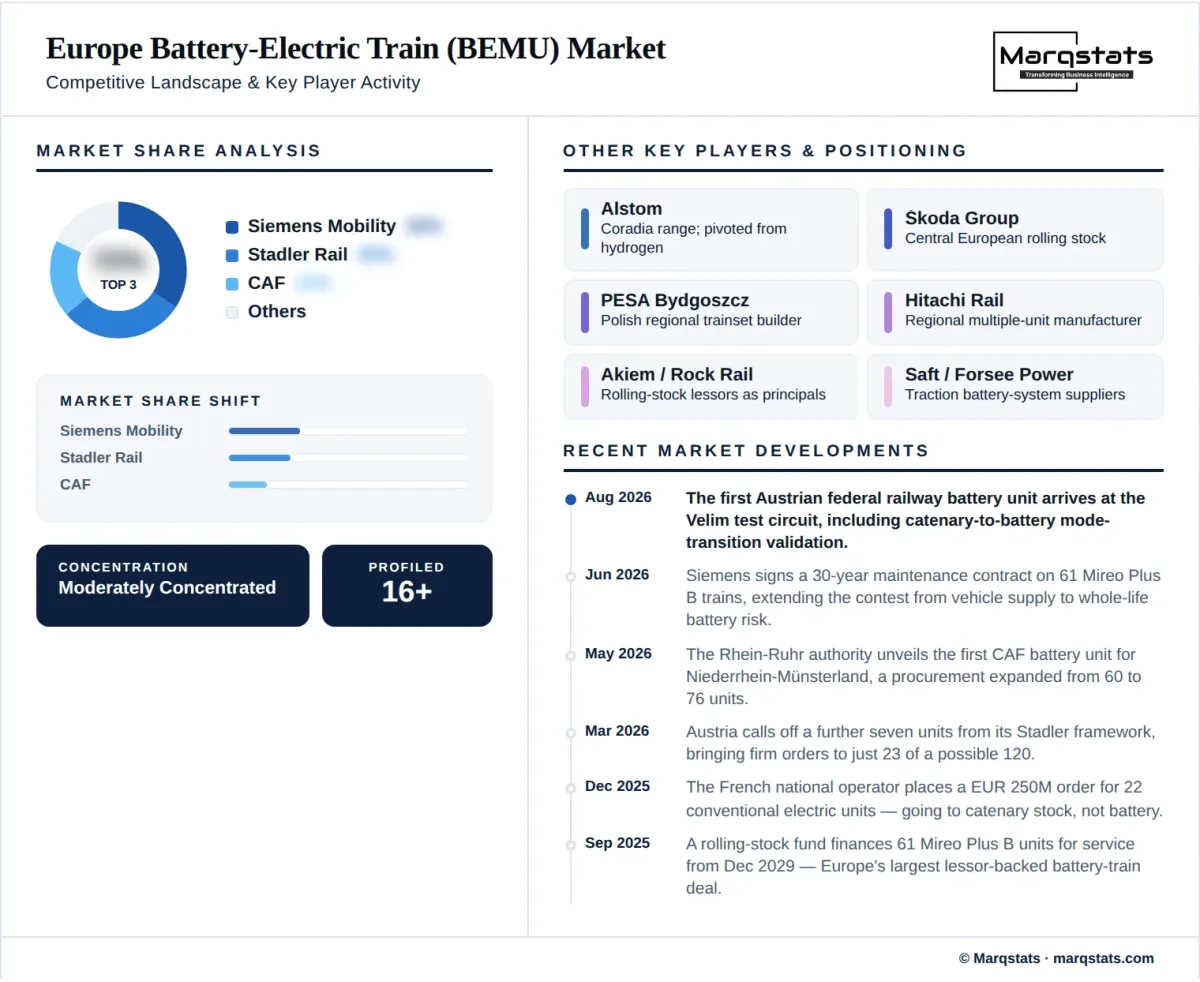
The market is moderately concentrated around three European rolling-stock manufacturers, and their positions come from different strategies. Siemens Mobility leads on announced units with 148 Mireo Plus B vehicles across seven orders, but that book is almost entirely German — a Danish operator's seven units are the only ones placed outside Germany, which makes Siemens's position strong and geographically narrow. Stadler holds the two headline contracts: the 55-unit Schleswig-Holstein fleet that proved the concept in service from October 2023, and the Austrian framework for up to 120 units worth about EUR 1.3 billion.
CAF has taken the largest single German fixed order, 76 units for two North Rhine-Westphalia authorities, originally 60 units in 2021 and expanded by a further 16. The units are specified at 140 kilometres per hour with 122 or 160 seats and enter service from December 2027, with maintenance contracted for 30 years from delivery. Those 30-year maintenance agreements are becoming the real competitive battleground, because they price the mid-life battery replacement that nobody in this market has yet had to perform.
Two structural features distinguish this from a conventional rolling-stock market. The first is that the framework agreement has displaced the fixed order at the top end: Austria has called off 23 of a possible 120 units in nearly three years, so headline order totals overstate committed volume substantially. The second is the arrival of rolling-stock lessors as principals rather than financiers — a rolling-stock fund stands behind the 61-unit order placed in September 2025 — which changes who bears residual and battery-degradation risk and is why that procurement route grows at 46.38% against 23.86% for direct authority purchase.
Companies Covered
The report profiles 16+ companies with full strategy and financials analysis, including:
Recent Market Activity
Table of Contents
Coverage & Segmentation
This study covers battery-electric multiple units delivered in Europe across 2021 to 2030, measured at vehicle manufacturer level in US dollars with a parallel euro series. Segmentation runs across three battery range classes, three vehicle configurations, two procurement models and five geographies. Bi-mode diesel-battery hybrids are excluded because they consume diesel; hydrogen fuel-cell trainsets, battery shunting and mainline locomotives, tram-trains and metro stock are excluded as separate vehicle classes with different duty cycles and procurement routes.
Both currency series are published because the underlying contracts are denominated in euros and Swiss francs while the reported market value is in dollars. The euro series grows at 31.86% against 33.62% in dollars, so 1.76 points of the dollar growth is the euro strengthening from 1.0950 to 1.1700 rather than any change in demand. Readers comparing this report against euro-denominated procurement data should use the euro series.