Market Snapshot
Middle bar: base-year value × (1 + CAGR), rounded to two decimals. This is a calculated illustration, not a separately researched annual estimate.
The China electric wheel loader market size is estimated at USD 2.15 billion in 2025 and is projected to reach USD 6.95 billion by 2030, at a CAGR of 26.39%. Sales reached 29,771 units in 2025, up 165%, taking 23.24% of all Chinese loader sales and 43.7% of domestic sales. By May 2026 electric machines were 64.78% of domestic loader sales in the month. Volumes cross 100,000 units by 2030, and battery demand rises from 10.1 GWh to 39.1 GWh.
Market size and forecast figures are generated using Marqstats' proprietary estimation framework, updated as of August 2026.
This is the fastest electrification of any construction equipment category anywhere in the world, and it happened in four years. Electric wheel loaders were 1,160 units and 0.94% of Chinese loader sales in 2022. They were 3,595 units in 2023, 11,220 in 2024 and 29,771 in 2025. Domestically the crossover has already happened: electric machines passed half of Chinese domestic loader sales in December 2025, at 51.4%, and peaked at 64.78% in May 2026. Chinese trade press projects more than 50,000 electric loaders in 2026; the association itself has issued no forecast.
The market is concentrated in one machine class and one set of duty cycles. The five-tonne ZL50 platform was 55.1% of electric loader sales in December 2025 and the six-tonne class a further 30.1%; together they were 85.2% of the market. Buyers are steel mills, coal mines, cement plants, aggregate yards and ports — fixed sites running two or three shifts, where a machine covers 3,000 to 5,700 hours a year, charges on the owner's own land and never leaves the charger's range. Independent case work puts payback at 0.7 to 2.7 years across three deployments, the fastest a three-shift cement plant. That is the entire explanation for the adoption curve.
What the penetration number hides is that electrification has not grown this market. It has taken it over from the inside. Chinese domestic loader sales fell from roughly 106,500 units in 2021 to 54,326 in 2024 as the property cycle turned, before recovering to 66,330 in 2025. Strip out the electric machines and domestic diesel loader sales fell from about 106,500 in 2021 to 37,343 in 2025 — a 65% collapse — and this study forecasts them at 11,180 by 2030, close to 90% below peak. For a manufacturer without an electric product, the Chinese domestic loader market has already lost two-thirds of its volume and is on course to lose nine-tenths.
The second thing the headline hides is that this is still overwhelmingly a domestic phenomenon. Electric machines were 43.7% of Chinese domestic loader sales in 2025 and 1.27% of exports. In the first half of 2026 the gap was 57% against roughly 4% — a fourteen-fold difference. Chinese manufacturers are building electric loaders at scale for a market whose economics are peculiar to China: a wide diesel-to-electricity price gap, captive high-utilisation industrial sites and, since December 2022, a China IV emission standard that made the diesel baseline more expensive and more complicated. Export penetration is rising steeply from a very low base, and that is where the competitive question for the rest of the world sits.
Key Takeaways
Market Overview & Analysis
Report Summary
China's wheel loader market has been through two shocks at once. The first is cyclical: domestic sales fell from roughly 106,500 units in 2021 to 56,552 in 2023 and 54,326 in 2024 as the property downturn worked through construction demand. The second is technological, and it arrived while the market was at its weakest. Electric loaders went from 1,160 units in 2022 to 29,771 in 2025, and by the first half of 2026 they were 57% of everything sold domestically.
The reason is arithmetic rather than policy. A five-tonne diesel loader burns around 20 litres an hour; the electric equivalent draws about 45 kWh. At 3,000 operating hours a year and Chinese industrial tariffs, published calculators put the annual energy saving between RMB 244,400 and RMB 420,700 depending on the electricity price assumed, with maintenance costs roughly halved on top. Against a purchase premium that has fallen to somewhere near RMB 150,000 to 200,000, those calculators return a payback of well under a year. The measured record is slower and should be preferred: independent case work across three loader deployments found 0.7 to 2.7 years, the fastest a three-shift cement plant running well above 5,000 hours. The gap between the two is roughly threefold, and it is the cost of everything the calculators leave out — charging infrastructure and any grid upgrade, charging windows lost from the shift, a reserve against battery replacement, uncertain residual values, and actual contracted tariffs rather than assumed ones. Even on the slower figures the machine pays for itself inside a normal replacement cycle, which is the only thing the buyer needs to be true.
That arithmetic only works where utilisation is high and the site is fixed, which is why adoption is concentrated where it is. Steel mills, coal mines and coke plants, cement works, aggregate yards, concrete batching plants and ports appear in every account; municipal contractors and itinerant construction firms do not. A machine at 1,200 hours a year would see payback stretch to several years on the same inputs, and no operator has published a low-utilisation case. The regulatory backdrop matters but is not the driver: China IV non-road emission standards took effect on 1 December 2022, requiring selective catalytic reduction, particulate filters and telematics reporting on machines above 37 kW, which raised the cost and complexity of the diesel baseline. No study quantifies its effect on electric adoption, but the inflection follows it.
Marqstats sizes the China electric wheel loader market at USD 2.15 billion in 2025, rising to USD 6.95 billion in 2030 at a CAGR of 26.39%. Units grow faster than value — 29,771 to 101,550 at 27.81% — because blended average selling prices continue to fall, from RMB 520,000 to RMB 448,000. In renminbi the market compounds at 24.06%; the 2.33-point difference is currency translation. Price is the live commercial question in this market: the electric loader sold at above RMB 800,000 in 2023 and near RMB 500,000 by 2025, and the manufacturer with the largest disclosed position has said publicly that electric loader gross margins started above diesel and have since declined sharply under competition, with the number of manufacturers falling from dozens.
Two structural facts should temper any reading of the growth rate. The first is that this is a substitution story, not an expansion story: total Chinese loader sales in 2025 were still below 2021, and domestic sales 37% below. The second is that it is domestic. Electric was 1.27% of Chinese loader exports in 2025 and roughly 4% in the first half of 2026, against 57% domestically. Overseas buyers are reported to prefer low-cost, easily-maintained diesel machines, and the charging infrastructure that makes the Chinese case work does not exist at most overseas sites. The export curve has begun to bend — a record 411 electric loader export sales registered in June 2026 — but from a base near zero.
Market Dynamics
Key Drivers
A diesel-to-electricity price gap that pays back the machine in months. Published cost calculators put annual energy spend at RMB 299,800 to 522,000 for a five-tonne diesel loader against RMB 55,400 to 101,300 for the electric equivalent at 3,000 hours, a saving of RMB 244,400 to 420,700 a year. Maintenance falls from about RMB 30,400 to RMB 15,300.
Captive, high-utilisation industrial sites. Adoption is concentrated in steel mills, coal mines, cement plants, aggregate yards and ports where machines run 3,000 to 5,700 hours a year on a fixed site. Charging is a one-time capital item on the owner's own land, and the machine never leaves its range.
A diesel baseline made more expensive by regulation. China IV non-road standards took effect on 1 December 2022, requiring selective catalytic reduction, particulate filters, sub-10ppm fuel and telematics on machines above 37 kW, with manufacturers required to clear China III stock beforehand. Electric loader penetration went from 0.94% to 23.25% over the three years that followed.
Falling machine prices and a battery cost structure that keeps falling with them. The electric five-tonne machine has come down from above RMB 800,000 in 2023 to around RMB 500,000, with batteries accounting for 40% to 50% of production cost. Charging has kept pace — 240 to 300 kW fast charging delivers a full charge in one to one and a half hours, sized so one charge covers a shift.
National policy has moved from permission to endorsement. The carbon peaking action plan issued on 5 July 2026 explicitly commits to promoting new-energy conversion of non-road mobile machinery at construction sites, mines, ports, airports and logistics parks — the first national-plan-level endorsement naming the exact segments already buying.
Key Restraints
The addressable duty cycle is narrow. The economics require roughly 2,000 hours a year or more; at 1,200 hours the same inputs stretch payback beyond three and a half years, past anything in the measured record. No operator has published a low-utilisation case, and no published split of the market by application exists — the sector lists are qualitative in every source.
Margins are being competed away. The manufacturer with the largest disclosed electric position has said publicly that electric loader gross margins started above diesel and have declined sharply, and that the number of electric loader manufacturers has fallen from dozens. Product homogenisation and price competition are the stated cause.
Residual values and battery warranties are unpriced. No published second-hand price series exists for Chinese electric loaders, and no manufacturer publishes battery warranty terms in years, hours, cycles or state-of-health threshold. The one available opinion suggests a diesel machine retains about half its value at five years against near-scrap value for an electric one — a 2022 view, single-sourced and speculative, but nothing has replaced it.
There is no national purchase subsidy. Construction machinery is excluded from China's national equipment renewal and trade-in programme, which covers industry, energy, transport, logistics, environmental infrastructure and several other categories but not non-road machinery. Support is municipal and patchy — Beijing offered up to RMB 210,000 for a new-energy loader above 350 kWh, but that scheme closed in December 2024.
Exports do not yet work. Electric was roughly 4% of Chinese loader exports in the first half of 2026 against 57% domestically. Overseas buyers prefer low-cost, easily-maintained diesel machines and the charging infrastructure is absent; the utilisation rates and electricity-to-diesel price ratios that drive the Chinese payback do not hold in most export markets.
Key Trends
The mix is moving up in tonnage. The five-tonne class fell from 66.3% of electric loader sales in 2024 to 55.1% in December 2025 while the six-tonne class rose to 30.1% — together 85.2% of the market — and machines below three tonnes went from nothing to 72 units in a single month. Eight-tonne and larger machines exist in series production but ran at about six units a month.
Incumbents won, electric-native challengers lost. The one pure-play with published market-share figures fell from third place and 11.6% share in 2023 to seventh and 3.8% in 2024 while its own unit volume fell, and it has remained loss-making through a Hong Kong listing in May 2025. Distribution, service networks and balance sheets beat first-mover advantage.
Manufacturing is moving offshore. XCMG's first overseas new-energy plant entered production in Indonesia on 27 July 2026 with an electric loader as the first machine off the line, and SANY delivered 40 electric loaders to a Thai customer in July 2026 with a further 50 on order. Export penetration remains low but the production and delivery footprint is being built ahead of it.
The joint-venture era in Chinese construction machinery is closing. Volvo Construction Equipment agreed in June 2025 to sell its entire 70% holding in SDLG and completed the sale on 1 September 2025 for around SEK 8 billion, ending a nineteen-year joint venture. Volvo retains a Chinese technical centre and premium-branded production; the volume business is now wholly Chinese-owned.
Charging, not swapping, has won. Swap variants exist across the range — XCMG offers a battery-swap version of its six-tonne machine and LiuGong claims a fifteen-minute pack exchange — but the mainstream is on-site direct-current fast charging sized to a shift. No published split by energy architecture exists, so no share should be quoted.
Market Segmentation
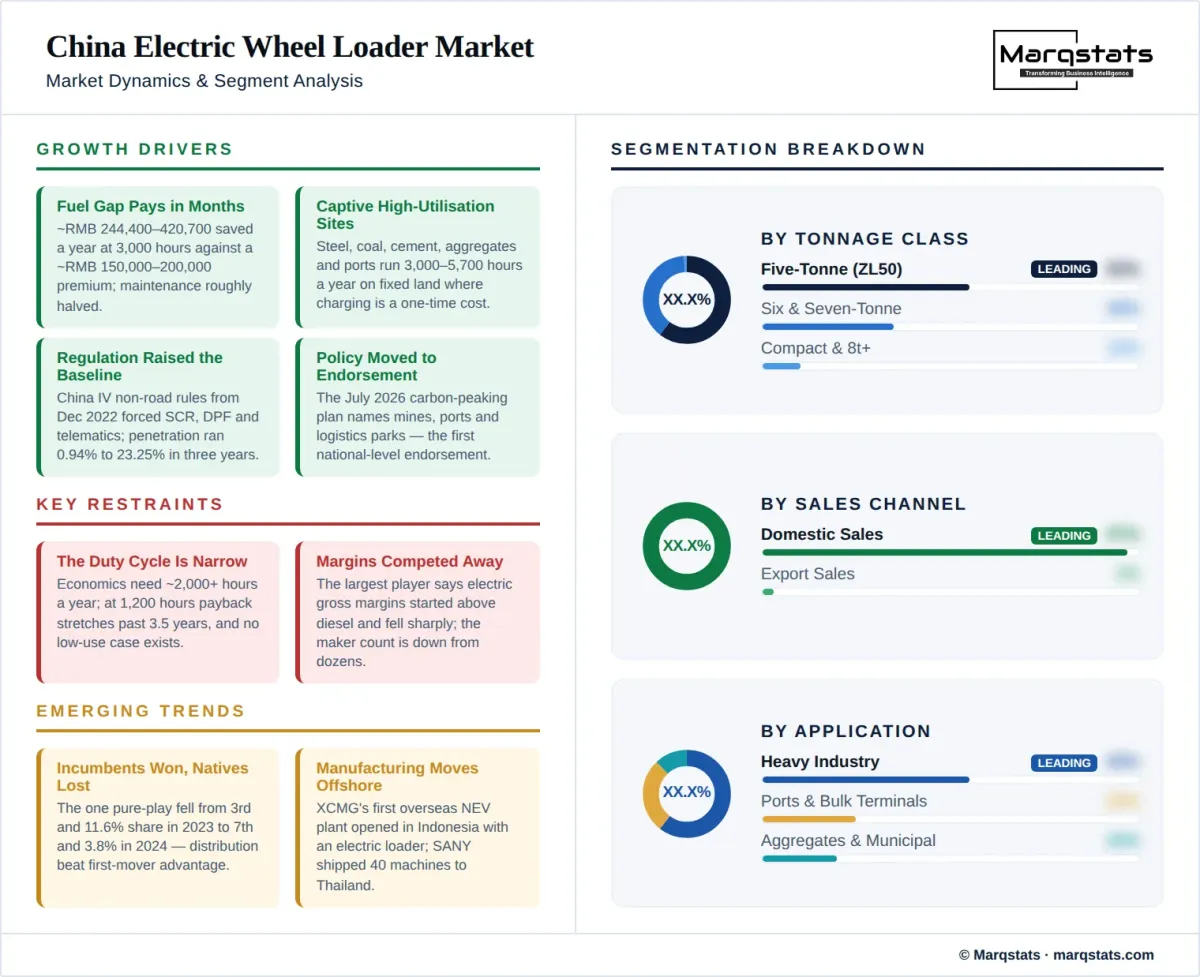
The five-tonne ZL50 platform is the market. It accounted for 55.1% of electric loader sales in December 2025, and it is the class where the diesel fleet's volume has always sat, which means it is where the fixed-site, multi-shift industrial customers are. Typical machines carry batteries of 282 to 432 kWh — SDLG's five-and-a-half-tonne machine at 282 kWh, LiuGong's 856H-E MAX at 432 kWh, charging to full in ninety minutes or less on a 300 kW charger. The class is losing relative share as the mix moves up, but it remains the volume base of the market throughout the forecast.
The six-tonne class is the growth band, rising from 23.3% of electric loader sales in 2024 to 30.1% in December 2025, with seven-tonne machines a further 4.7%. XCMG's six-tonne machine carries 352 kWh, a 280 kW tri-motor driveline with no gearbox, dual-gun fast charging and six to eight hours of run time on a stated five-year or 30,000-hour battery warranty — one of the few warranty disclosures anywhere in this market. Larger machines are where the incremental demand from mining and steel duty cycles is going, and where average selling prices and battery content per machine are both higher.
Machines of four tonnes and below were 9.7% of electric loader sales in December 2025, up from effectively nothing, driven by municipal and township work where an electric compact machine can operate inside urban low-emission zones. At the other end, eight-tonne and larger electric loaders exist in series production — XCMG lists one and LiuGong launched an eleven-tonne machine in 2025 — but the association recorded around six units a month across both classes in late 2025. Published commentary attributes the ceiling to the motor and battery mass required to sustain breakout force at higher payloads.
Domestic sales are 97.4% of the market today and 73.7% of it by 2030. Electric machines took 43.7% of Chinese domestic loader sales in 2025, passed half in December 2025 and peaked at 64.78% in May 2026. This study forecasts domestic penetration at 87% by 2030 against a domestic loader market that recovers to roughly 86,000 units — well below the 106,500 of 2021. Domestic electric volumes compound at 20.88% to 74,820 units, the slower of the two channels precisely because the domestic conversion is already most of the way done.
Exports are where the growth rate sits and where almost nothing has happened yet. Electric was 1.27% of Chinese loader exports in 2025 and roughly 4% in the first half of 2026, with a record 411 machines registered as export sales in June 2026. This study forecasts export penetration reaching 27% by 2030 on 26,730 units, a compound annual growth rate of 102.55% and a rise from 2.6% to 26.3% of all Chinese electric loader sales. The constraint is not the machine but the operating context — overseas buyers prefer low-cost diesel, charging infrastructure is absent, and the utilisation rates that drive the Chinese payback are not typical elsewhere.
Steel mills, coal mines and coke plants and cement works are the founding customers and remain the core. They combine continuous multi-shift operation, fixed haul patterns inside a fenced site, an existing high-voltage supply and, in the steel sector, environmental performance ratings that restrict production during pollution episodes for lower-rated mills. The single fastest payback in the independent case record — 0.7 years — is a three-shift cement plant. No published percentage split of the market by application exists, so this ordering reflects the frequency with which sectors appear in the source record rather than a measured share.
Ports are the clearest institutional buyer. Shandong Port Group tendered for 32 electric loaders across the 2026 and 2027 procurement years — seven seven-tonne machines, fourteen six-tonne and eleven five-tonne, all with sweeper buckets — with bids opening in August 2026. The figures come from the tender notice; no award has been confirmed. Port duty cycles suit the technology for the same reasons heavy industry does, and port operators are among the state-owned enterprises most exposed to the national carbon peaking plan's explicit naming of ports as a target for non-road machinery electrification.
Aggregate yards, concrete batching plants and logistics parks form the third tier, and municipal engineering, township infrastructure and water conservancy are the newest — trade reporting through 2026 describes adoption spreading outward from core enclosed settings into these applications. This is also where the economics are weakest, because utilisation falls and the site may not be fixed. It is the segment to watch for whether Chinese electric loader adoption broadens beyond the duty cycles that made it work.
By Geography
North China — Hebei, Shanxi and Inner Mongolia
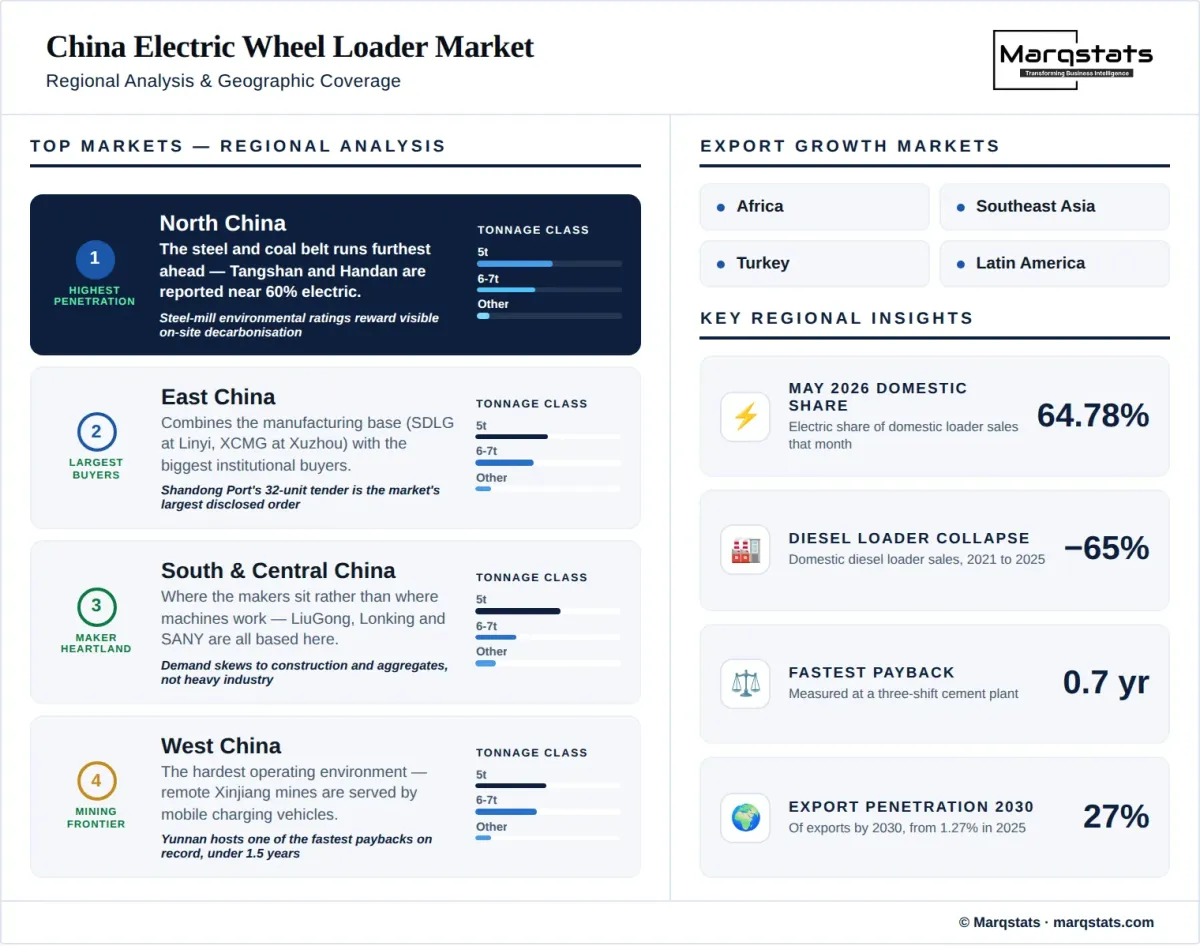
North China's steel and coal belt is where electric loader penetration runs furthest ahead of the national average. Trade reporting puts Tangshan and Handan in Hebei at around 60% electric penetration of local loader sales, though the figure is single-sourced and states no denominator. The mechanism is most likely the environmental performance rating system applied to steel mills, which restricts output during pollution episodes for lower-rated plants and therefore rewards visible decarbonisation of on-site equipment — but no source establishes that causal link directly. XCMG reported in March 2025 having delivered more than 300 loaders cumulatively to a single north-China steel group, of which more than a hundred are battery-electric and the remainder liquefied-natural-gas or hybrid machines — more than a third of that customer's loader fleet. The claim is XCMG's own and is not independently corroborated.
East China — Shandong, Jiangsu and the Coastal Ports
East China combines the manufacturing base with the largest institutional buyers. Shandong is the home province of SDLG at Linyi and Jiangsu of XCMG at Xuzhou, the two largest loader-manufacturing provinces. The association publishes no provincial export split, and the customs series that does is not comparable with the member-manufacturer basis used here. Shandong Port Group's 32-unit electric loader tender in 2026 is the largest disclosed institutional order in the market. The region also hosts the densest cluster of aggregate and cement customers along the Yangtze corridor.
South and Central China — Guangxi, Fujian and Hunan
South and central China is where the manufacturers sit rather than where the machines work. LiuGong is headquartered at Liuzhou in Guangxi and produced its 600,000th wheel loader there on 31 May 2026; Lonking's operating business is in Fujian; SANY's electric loader range was launched at Huzhou in Zhejiang in March 2025 and its parent is Hunan-based. Domestic demand in these provinces is weighted toward construction and aggregates rather than heavy industry, which is why penetration is reported lower here than in the northern steel belt, though no provincial penetration series is published.
West China — Xinjiang, Yunnan and the Mining Provinces
West China is the frontier for the technology and the hardest operating environment. Remote mine sites in Xinjiang have been served by mobile charging vehicles rather than fixed grid connections, documented for large mining excavators at a Hami coal mine — itself evidence that grid connection is not always available, and the clearest published brake on adoption in the region. Yunnan hosts one of the fastest paybacks in the independent case record, under 1.5 years for a continuous mining operation using a battery-swap machine. Altitude field trials were running on the Yunnan-Guizhou plateau in August 2026, though the machine under test is a hybrid and therefore outside this study's scope.
Export Markets
Chinese loader exports reached 61,737 units on the association's member-manufacturer basis in 2025, up 14.6%, and exports have grown from about a quarter of loader volume in 2021 to roughly half in 2025. Named growth destinations for new-energy construction machinery include Africa, on mining demand; Turkey; Southeast Asia; Latin America; and Europe. Electric machines remain a small fraction of that flow. A separate customs series reports far larger export volumes with the United States as the largest destination — that series uses a tariff code sweeping in compact and skid-steer machines and is not comparable with the association figures used in this study.
How Competition Is Evolving
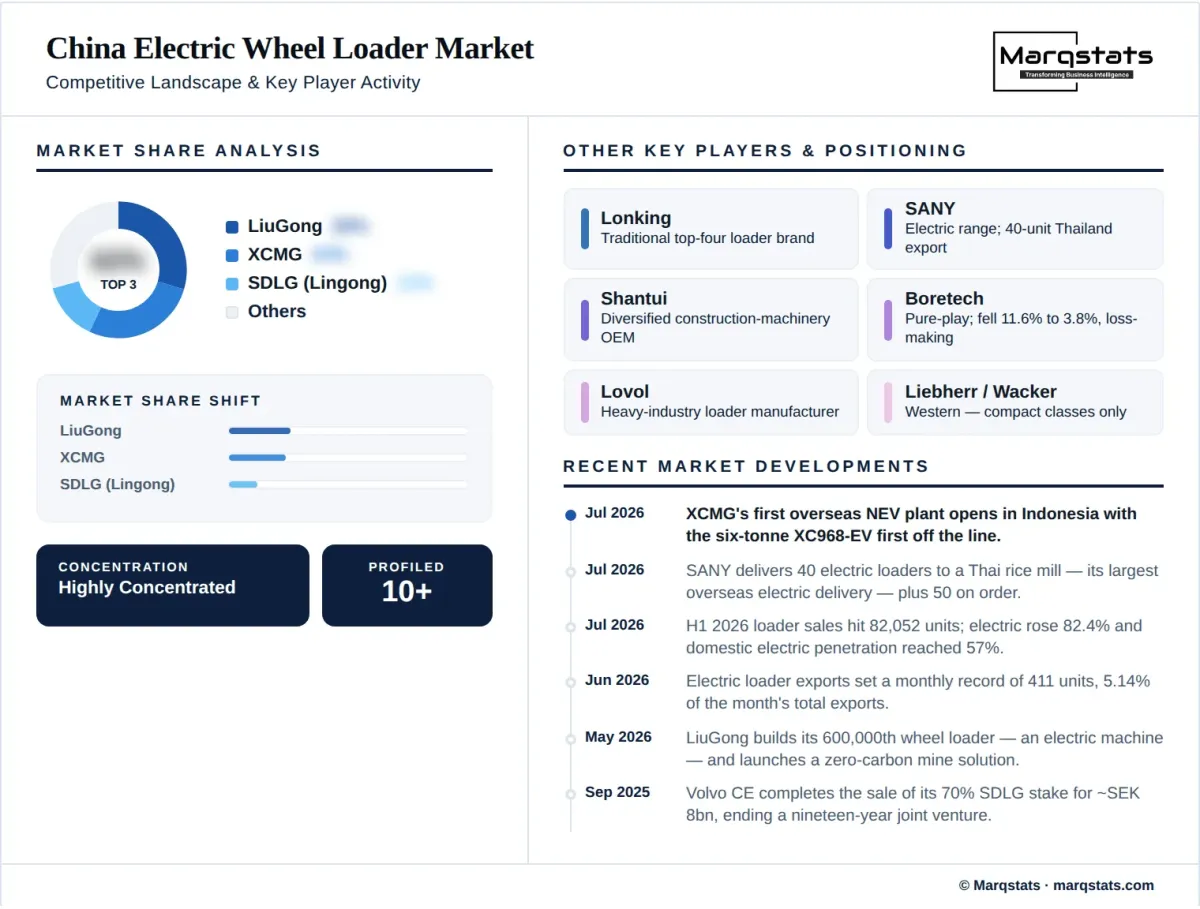
The Chinese loader market is highly concentrated and electrification has not changed who leads it. The traditional top four — LiuGong, XCMG, SDLG and Lonking — still lead the total loader market, though no brand-level share table is published for it and any percentage in circulation is an estimate. Independent estimates put LiuGong and XCMG together at roughly half of Chinese battery-electric loader production, on a production rather than a sales basis. Both claim the number one position in electric loaders and neither claim is independently corroborated, so they are best described as co-leaders with the ranking contested. LiuGong reported FY2025 revenue of RMB 33.144 billion, up 10.25%, with international sales at 47.65% of the total; XCMG Construction Machinery reported RMB 100.823 billion, up 8.37%, with new-energy product revenue up 23.6% and its full loader line designated a national manufacturing single champion.
The most instructive competitive fact in this market is what happened to the challengers. The one electric-native pure-play with published share figures ranked third with 11.6% of the Chinese new-energy loader market in 2023 and seventh with 3.8% in 2024, while its own unit volume fell from about 507 to 450. It listed in Hong Kong in May 2025, closing its first session up around 48%, and has remained loss-making — RMB 318 million of net loss in 2025 on revenue of RMB 779 million. Electrification opened a window for new entrants and the window closed inside two years. The incumbents' distribution networks, service coverage and balance sheets proved decisive, and the number of electric loader manufacturers is reported to have fallen from dozens.
Three structural changes are reshaping the field around that stable top four. Volvo Construction Equipment agreed in June 2025 to sell its entire 70% stake in SDLG and completed the sale on 1 September 2025 for around SEK 8 billion, ending a nineteen-year joint venture and leaving the volume business wholly Chinese-owned; Volvo retains premium-branded Chinese production and its Jinan technical centre. Manufacturing is moving offshore, with XCMG's Indonesian new-energy plant starting production in July 2026 on an electric loader. And Western manufacturers remain concentrated in the compact classes — the electric wheel loader offerings from Liebherr, Wacker Neuson and others sit well below the five-tonne band where China's volume is, and no Western manufacturer has a directly comparable five-tonne electric machine at volume.
Companies Covered
Companies covered in the report include:
Recent Market Activity
Table of Contents
Coverage & Segmentation
This study covers battery-electric wheel loaders manufactured and sold by Chinese manufacturers, across all tonnage classes, reported on the China Construction Machinery Industry Association's member-manufacturer basis. Both domestic sales and exports are in scope and are reported separately, because they behave as two structurally different businesses inside one statistic. Hybrid and range-extended loaders, skid-steer and backhoe loaders, track loaders, underground load-haul-dump machines, excavators and diesel machines are out of scope except as the comparison base. Market value is measured at manufacturer selling price in renminbi and converted to United States dollars at annual average exchange rates, with both series reported because they diverge by 2.33 percentage points over the forecast period. The base year is 2025, the historical period 2021 to 2025 and the forecast period 2026 to 2030.
Three data conventions govern the figures and should be read before they are used. First, every penetration figure in this study states its denominator: the association's headline rate divides electric units by total loader sales including exports, which gives 23.24% as published for 2025 and 23.25% on recomputation, while the domestic-only rate for the same year is 43.70%. The two are routinely quoted interchangeably and differ by more than twenty points. Second, the association began publishing the domestic and export split of electric loader sales monthly only from January 2026, the one earlier observation being December 2025; domestic penetration for 2022 to 2025 is a Marqstats derivation from the published all-channel totals and the published export penetration rate, and is identified as derived throughout. Third, Chinese customs data under the relevant tariff code reports export volumes roughly 2.4 times the association's figures, because the code sweeps in compact and skid-steer machines — the two series are never mixed here, and any figure showing the United States as China's largest loader export market is customs data and is not comparable.