Market Snapshot
Key Takeaways
Market Overview & Analysis
Report Summary
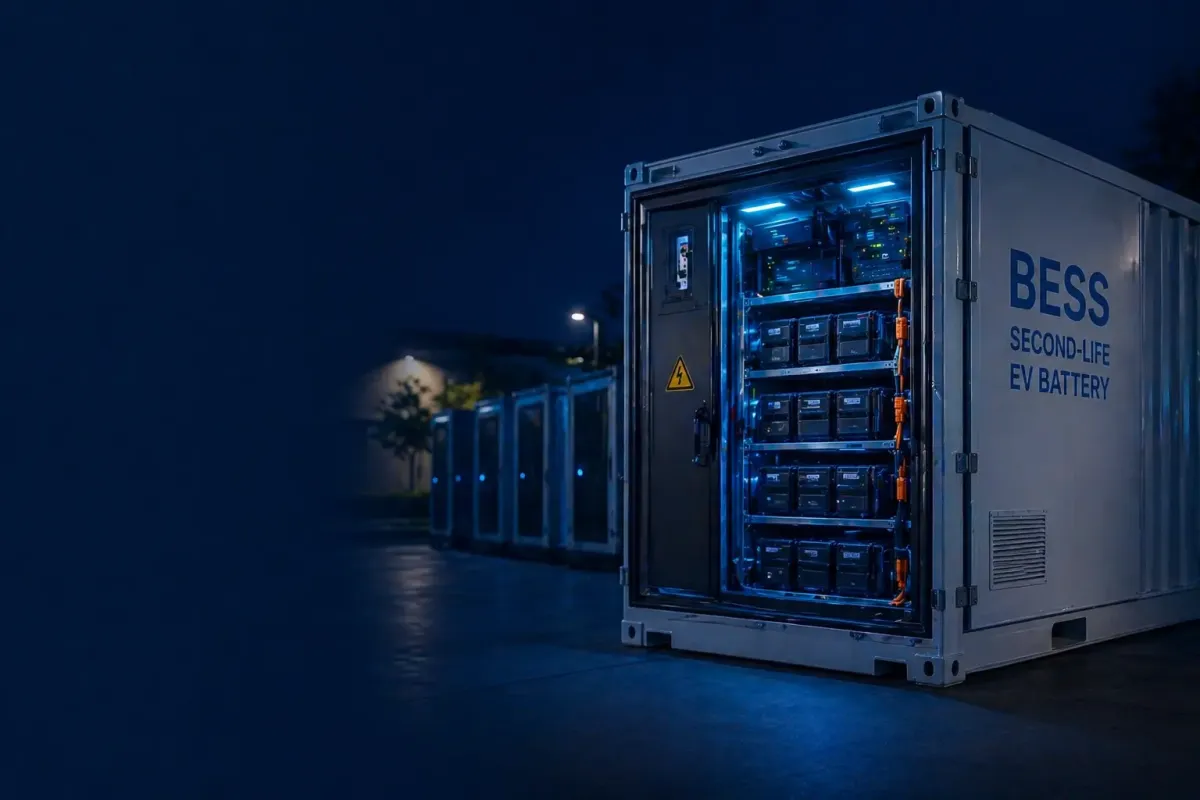
The Europe Second-Life EV Battery Energy Storage Market sits at the intersection of EV battery retirement, stationary storage scale-up, and binding circular-economy regulation. Europe is one of the most credible regional second-life battery markets globally because the EU has serious battery storage demand pull, formal traceability infrastructure under the EU Battery Regulation, OEM circular-economy involvement, and early commercial projects from Mercedes-Benz Energy, Renault, BMW, Connected Energy, Enel, and ADR. The market is shifting from demonstration projects toward early grid-scale commercialization, supported by EU regulation, OEM-integrator partnerships, and rising BESS demand pull, though constrained by limited near-term retired battery supply, cheap new LFP battery competition, safety certification cost, and project bankability.
The regulatory architecture provides Europe-specific tailwind unmatched in other regions. Under the EU Battery Regulation 2023/1542 (in force since 17 August 2023), sustainability, collection, recycling, and repurposing requirements span the entire battery lifecycle. The Battery Passport requirement effective 18 February 2027 mandates electronic registration for EV batteries, LMT batteries, and industrial batteries above 2 kWh placed on the EU market, including QR-code-accessible data on chemistry, age, cycle history, state of health, accident history, and dismantling instructions. The data architecture directly supports second-life selection, valuation, integration, and warranty structuring.
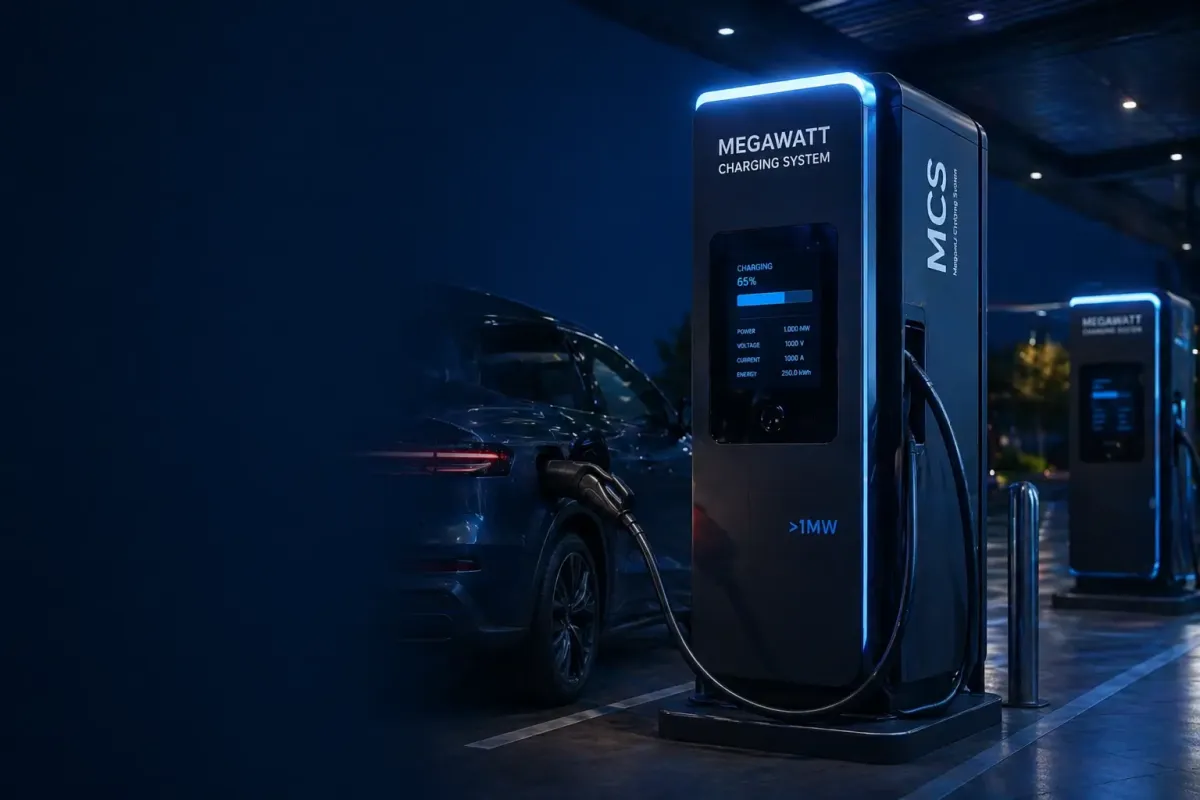
Application demand pulls span grid frequency regulation, primary control reserve, renewable smoothing, peak shaving, intraday arbitrage, solar self-consumption, EV charging buffering, fleet depot storage, and airport energy systems. EV charging support represents particularly attractive economics, where second-life BESS reduces grid-upgrade requirements at high-power charging sites; the architecture is especially relevant at megawatt-class deployments within the Global Megawatt Charging System (MCS) Market where multi-megawatt grid connection delays are a primary deployment constraint, and battery-buffered MCS sites support faster activation than full grid-upgrade timelines.
Market Dynamics
Key Drivers
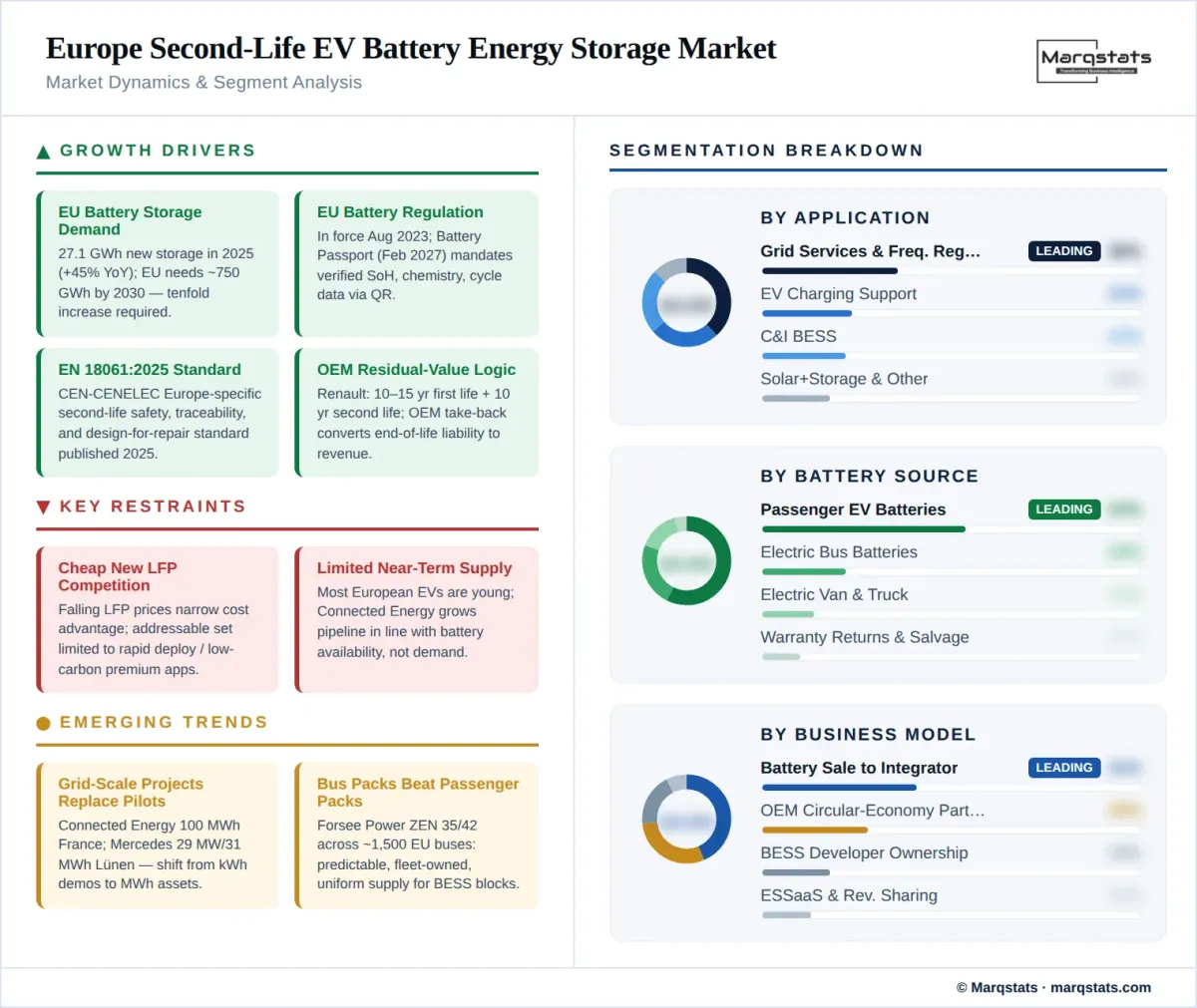
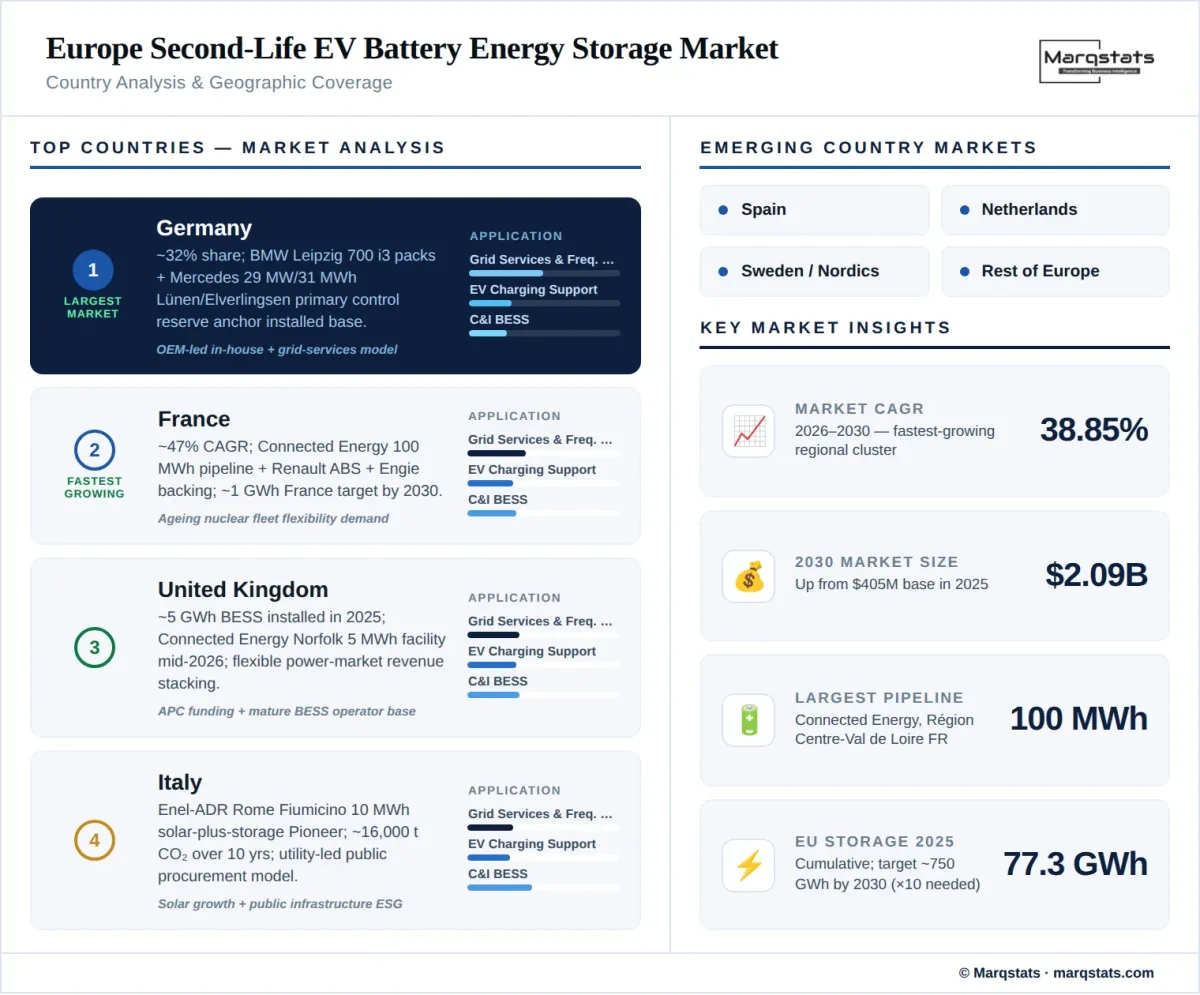
- European battery storage demand is scaling at unprecedented pace. The EU installed 27.1 GWh of new battery storage capacity in 2025, up 45% year-on-year and the 12th consecutive record year, with cumulative capacity expanding tenfold from 7.8 GWh in 2021 to 77.3 GWh in 2025. The EU target of approximately 750 GWh by 2030 requires another tenfold increase, creating substantial demand pull for any safe lower-cost storage source including second-life systems.
- EU Battery Regulation 2023/1542 anchors the global circular-economy regulatory framework. The regulation entered into force on 17 August 2023 covering sustainability, collection, recycling, and repurposing across the battery lifecycle. The mandate creates traceability infrastructure, ownership clarity, lifecycle data transparency, and circular-economy positioning support that second-life specialists in other regions do not have.
- Battery Passport requirement effective 18 February 2027 transforms second-life selection economics. Mandatory electronic registration with QR codes, chemistry data, age, cycle history, state of health, accident history, and dismantling instructions for EV and industrial batteries above 2 kWh removes the largest historical second-life adoption barrier: lack of reliable battery health data.
Europe-specific second-life standard infrastructure further differentiates the regional regulatory tailwind. Under the EN 18061:2025 standard from CEN-CENELEC, developed by CEN/TC 301 “Road Vehicles”, clear rules for the safe repair, reuse, and preparation for repurposing of batteries and modules originally designed for EV applications apply, including safety requirements for high-voltage systems, prevention of unintentional reconnection, PPE specifications, storage and transport requirements, and design-for-repair principles. Adjacent UL 1974 international standard, UL 1973 for stationary applications, UL 9540 and UL 9540A for energy storage system safety, and IEC 62619 industrial lithium battery safety together complete the safety certification architecture.
- OEM residual-value monetization creates supply-side commercial logic. Renault notes that an EV battery’s first life can last 10–15 years with 75% capacity retention or higher remaining, with second life able to extend another 10 years of useful service. The architecture converts an end-of-life liability into a revenue-generating asset, supporting OEM circular-economy program formalization.
- Public funding programs accelerate infrastructure development. Connected Energy is supported by Engie investment for the France 100 MWh project pipeline. The Advanced Propulsion Centre UK supports Connected Energy’s £2 million Norfolk testing facility scheduled for mid-2026 commissioning. EU Innovation Fund and Battery Booster initiatives provided EUR 1 billion in grants and EUR 1.5 billion in loans to the broader battery ecosystem in 2025.
Key Restraints
- Cheap new LFP battery competition compresses second-life pricing power. New LFP battery prices continue to fall, with EU LFP battery production scaling toward stationary storage applications. Falling new-battery costs reduce the cost advantage of second-life systems, narrowing the addressable application set to deployments where rapid deployment, lower embodied carbon, or circular-economy positioning carries premium value.
- Limited near-term retired battery supply constrains scale. Most European EVs are still young and many years from typical retirement age. Connected Energy explicitly states it intends to grow its pipeline in line with second-life battery availability rather than market demand. The supply constraint pushes the market toward warranty returns, manufacturing rejects, fleet retirements, and accident salvage feedstock through 2030, with the larger end-of-life passenger EV wave materializing post-2030.
- Pack heterogeneity raises integration cost and complexity. Different OEM pack designs in chemistry, format, BMS architecture, cooling, and mechanical interface require differentiated integration hardware and software. The constraint pushes the market toward closed-loop OEM-controlled supply pathways and standardized fleet pack programs (electric bus, electric truck) with predictable design uniformity.
- State-of-health uncertainty limits warranty and bankability. Without reliable verified data, project financiers prefer standardized new BESS systems with known performance and OEM warranty backing. The Battery Passport requirement effective February 2027 directly addresses this constraint, however Q1 2025 to Q1 2027 deployments must work without the formal data infrastructure.
- Permitting and insurance constraints slow deployment. Permitting authorities and insurers may treat second-life systems with greater caution than new battery systems, particularly given fire safety considerations. The constraint affects project timelines and adds cost to commercial deployment.
- Recycling competition under high battery metal prices. Damaged packs, low-state-of-health packs, packs covered by OEM contracts requiring direct recycling, and feedstock with high lithium-nickel-cobalt content may bypass second-life entirely. The competitive constraint is most acute when battery metal prices are elevated.
Key Trends
- Shift from small pilots toward grid-scale BESS projects. Earlier second-life projects were small demonstrators using Nissan Leaf packs for buildings, BMW i3 modules for backup, and bus battery trials. The market has moved toward grid-connected projects with Connected Energy 100 MWh in France anchoring the largest announced pipeline scale, alongside Mercedes-Benz Energy / Mobility House 29 MW / 31 MWh Lünen and Elverlingsen, and Enel-ADR Rome Fiumicino 10 MWh.
- Airports, C&I sites, and solar-plus-storage emerge as early commercial sweet spots. Rome Fiumicino Airport Pioneer project demonstrates the model with 10 MWh second-life BESS storing energy from an airport solar farm using 762 packs and modules from Nissan, Mercedes-Benz, and Stellantis, with expected CO2 reduction of approximately 16,000 tonnes over ten years. Airports combine solar rooftop and land availability, large predictable load profiles, ESG sustainability goals, and resilience requirements that match second-life economics well.
- OEM-specialist partnership architecture becomes the dominant business model. Second-life storage requires OEM battery access, diagnostic capability, integration capability, software for grid-market participation, and recycling exit pathway. The Renault and Connected Energy partnership combines Renault battery supply and lifecycle strategy with Connected Energy E-STOR commercial deployment. The architecture supports retained OEM ownership models that monetize battery residual value over second-life period.
- Bus and commercial vehicle batteries become more important than passenger EV packs. Passenger EV packs are fragmented across model, chemistry, format, and ownership patterns. Electric bus and truck packs are larger, fleet-owned, better-tracked, and replaced on more predictable cycles. Connected Energy and Forsee Power jointly develop containerized BESS blocks using ZEN 35 and ZEN 42 battery packs already deployed in approximately 1,500 electric buses across Europe.
- Battery testing and digital diagnostics become competitive differentiators. Connected Energy is developing a £2 million UK testing facility at Scottow Enterprise Park in Norfolk supported by Advanced Propulsion Centre UK, scheduled for mid-2026 commissioning with 5 MWh BESS using batteries from multiple bus and truck manufacturers including Forsee Power as initial supplier. The architecture combines battery diagnostics with grid-scale asset ownership, signaling market maturation beyond simple pack repackaging.
Market Segmentation
Grid services and frequency regulation hold the largest application share at approximately 36% of the 2025 Europe Second-Life EV Battery Energy Storage Market, anchored by Mercedes-Benz Energy / Mobility House 29 MW / 31 MWh Lünen and Elverlingsen primary control reserve installations and Connected Energy France pipeline targeting frequency regulation, peak shaving, and renewable integration. EV charging support represents the fastest-growing application segment, expanding at approximately 54% CAGR during 2026–2030, supported by grid-upgrade-cost-avoidance economics at high-power charging hubs and depot fleet operations. C&I storage, solar-plus-storage, fleet depot, airport and public infrastructure, telecom backup, and residential applications together represent the remaining application pool.
Grid services anchor the largest 2025 application owing to revenue-stacked European power-market participation including frequency regulation, primary control reserve, balancing energy, intraday arbitrage, and capacity mechanisms. Mercedes-Benz Energy with GETEC ENERGIE and The Mobility House extended the lifecycle of Lünen and Elverlingsen stationary storage systems after requalification for primary control reserve, using more than 2,000 repurposed battery modules to deliver 29 MW of power and 31 MWh of energy. The architecture demonstrates the OEM-trader-aggregator partnership model that anchors European grid-services second-life deployment.
EV charging support represents the fastest-growing application segment owing to grid-upgrade-cost-avoidance economics. Second-life BESS at fleet depots, highway DC fast chargers, bus depots, logistics hubs, airports, and parking operator sites enables charging from grid or solar with rapid discharge to vehicles, eliminating costly transformer and grid-connection upgrades. The architecture supports premium per-kWh pricing relative to passive storage applications. The segment particularly benefits from megawatt charging system deployment where battery buffering is essential for site activation under grid-constrained conditions.
C&I deployment anchors the second-largest application share supported by peak shaving, demand charge reduction, solar self-consumption optimization, backup power, and sustainability reporting requirements. Strong-fit C&I sectors include factories, warehouses, logistics hubs, ports, supermarkets, public buildings, and EV fleet depots where moderate cycling profiles align well with used-battery characteristics. The segment supports diverse OEM circular-economy partnerships and rapid-deployment commercial pilots.
Solar-plus-storage applications support renewable energy integration at industrial sites, airports, factories, logistics centers, and public infrastructure. The Rome Fiumicino Airport Pioneer project anchors the model, with 10 MWh second-life BESS storing energy from an airport solar farm and reducing CO2 emissions by approximately 16,000 tonnes over ten years. The architecture aligns well with second-life cost economics where buyer values lower capex, circular-economy credentials, and reduced embodied carbon over absolute energy density.
Fleet depot second-life storage represents a high-potential closed-loop business model where the same operator controls both battery source and stationary storage application. Electric bus operators repurpose retired bus batteries into depot BESS for charging optimization, peak shaving, and backup power. The architecture combines predictable feedstock supply, vertically integrated economics, and direct operational benefit. Forsee Power ZEN 35 and ZEN 42 battery packs from approximately 1,500 European electric buses anchor the segment supply base.
Airports and public infrastructure represent a high-attractiveness early commercial segment combining solar rooftop and land availability, large predictable load profiles, ESG sustainability goals, and resilience requirements. The Enel-ADR Rome Fiumicino Pioneer project anchors the segment with 10 MWh installed using 762 battery packs and modules from Nissan, Mercedes-Benz, and Stellantis. The architecture supports premium per-deployment value and demonstrates the public-sector second-life procurement model.
Telecom backup represents a mature use case in selected geographies owing to lower cycling intensity, predictable operational profiles, and reliability premium. The segment supports smaller per-deployment footprint and integration complexity. The category is concentrated in selected European telecom operator networks and weak-grid regional deployments where backup reliability commands material premium relative to capital cost.
Residential second-life storage faces stricter safety, certification, warranty, installer trust, and insurance requirements than commercial applications. New LFP residential batteries are generally easier to finance, certify, and sell than second-life systems. The segment remains a smaller share through 2030 with growth potential post-passport-implementation when verified state-of-health data simplifies residential customer adoption.
Passenger EV batteries hold the largest source share at approximately 54% of the 2025 Europe Second-Life Market, anchored by Renault, BMW, Mercedes-Benz, Volkswagen Group, Stellantis, and Nissan European fleet warranty returns and early retirements. Electric bus batteries represent the fastest-growing source segment, expanding at approximately 44% CAGR during 2026–2030, supported by predictable fleet retirement cycles, larger pack sizes, fleet operator-controlled supply, and Forsee Power-anchored supply network. Electric van and truck batteries, warranty returns, manufacturing rejects, and accident salvage batteries together represent the remaining feedstock pool.
Passenger EV battery feedstock anchors the largest source share supported by Renault Zoe, ZE40, and ZE50 platforms, BMW i3 packs (BMW Leipzig integrates up to 700 i3 batteries for plant energy management), Mercedes EQ family, Volkswagen Group ID family, Stellantis e-CMP and STLA platforms, Nissan Leaf legacy, and Tesla European deliveries. The category benefits from diverse chemistry composition (NMC dominant historically, LFP emerging) and supports varied second-life integration architectures.
Electric bus battery feedstock represents the fastest-growing source segment owing to predictable retirement cycles, larger pack sizes, fleet operator-controlled supply, and concentrated geographic deployment. Forsee Power ZEN 35 and ZEN 42 battery packs deployed in approximately 1,500 European electric buses anchor the supply base. Connected Energy partnerships with Forsee Power, Volvo Group as investor, and joint development of containerized BESS blocks enable scalable second-life integration. The segment supports closed-loop OEM-fleet supply contracts.
Electric van and truck battery feedstock scales with European commercial vehicle electrification under the EU CO2 standards for new HDVs. Renault Master E-Tech, Mercedes eSprinter, Volkswagen ID.Buzz Cargo, Daimler eActros, MAN eTGX/eTGS, Volvo FH Electric, and Scania commercial truck platforms anchor the feedstock pool. Heavy-duty trucks operate at high utilization with very large battery packs, accelerating retirement timelines relative to passenger BEV.
Warranty-returned packs and manufacturing rejects represent important near-term feedstock with often-higher state of health than retired packs. Manufacturing scrap is expected to account for a large share of recycling feedstock through 2030 with overlap into second-life selection where pack health permits. The segment supports closed-loop OEM-Tier-1 partnerships and rapid-deployment commercial pilots particularly relevant for European OEM platforms.
Accident-damaged or salvage vehicle batteries with intact battery packs provide an important feedstock stream in selected projects. Insurance carriers, salvage operators, and OEM warranty channels supply the segment. Porsche pre-series vehicle dismantling and similar OEM-controlled programs support the architecture. State-of-health verification, safety certification, and provenance documentation are particularly critical given pack history uncertainty.
Full pack reuse holds the largest form share at approximately 49% of the 2025 Europe Second-Life Market, anchored by lower labor cost, accelerated deployment timeline, and improved safety relative to disassembly approaches. Module-level reuse represents the fastest-growing form segment, expanding at approximately 41% CAGR during 2026–2030, supported by Connected Energy and Mercedes-Benz Energy module-level integration architectures, Forsee Power containerized BESS blocks, and increasing OEM design-for-repair compliance under EN 18061:2025.
Full pack reuse uses entire EV battery packs as deployed BESS modules with intelligent pack-level controls. The architecture reduces labor cost, accelerates deployment, improves safety, and supports faster project timelines. BMW Leipzig integrates up to 700 BMW i3 batteries for plant energy management. Connected Energy E-STOR units deploy full packs in containerized BESS configurations. The form supports closed-loop OEM-controlled supply where pack provenance and design uniformity simplify integration.
Module-level reuse disassembles packs to module level, enabling more granular state-of-health grading, mixed-vintage integration, and pack reconfiguration for specific application power and energy profiles. Mercedes-Benz Energy / Mobility House Lünen and Elverlingsen sites use over 2,000 repurposed battery modules. Forsee Power and Connected Energy jointly develop module-based containerized BESS blocks combining ZEN 35 and ZEN 42 battery packs. The architecture supports diverse OEM source pack integration and design-for-repair principles per EN 18061:2025.
Cell-level reuse fully dismantles batteries to individual cells for sorting, regrading, and rebuild into new BESS module configurations. The form provides maximum flexibility but highest labor cost and slowest deployment timeline. The segment is small but technically significant for selected applications where heterogeneous source packs must be unified into uniform deployment configurations.
Mixed architecture deployments combine full packs, modules, and selectively rebuilt assemblies depending on source feedstock state of health and target application power and energy profile. The Enel-ADR Rome Fiumicino Pioneer project uses 762 battery packs and modules from Nissan, Mercedes-Benz, and Stellantis in mixed configuration. Connected Energy and Forsee Power containerized blocks combine multi-battery-type integration. The form supports flexible scaling and adaptive integration of multi-vintage source feedstock.
NMC chemistry holds the largest share at approximately 62% of the 2025 Europe Second-Life Market by chemistry, anchored by the European passenger BEV and PHEV fleet that has historically deployed nickel-manganese-cobalt cells. LFP chemistry represents the fastest-growing chemistry segment, expanding at approximately 46% CAGR during 2026–2030, supported by accelerating LFP adoption in Chinese OEM passenger BEVs entering Europe and global commercial vehicle platforms that will shift second-life feedstock chemistry composition through the forecast horizon.
Nickel-manganese-cobalt (NMC) batteries dominate current European second-life feedstock owing to historical passenger BEV and PHEV deployment dominance. BMW i3, Mercedes EQ family, Volkswagen Group ID family, Renault Zoe, and Stellantis e-CMP platforms historically deployed NMC. SolarPower Europe data indicates around 70% of European production capacity remains nickel-rich (NMC and NCA) chemistry as of 2025, supporting strong NMC second-life feedstock through the forecast horizon.
Lithium iron phosphate (LFP) chemistry feedstock is the fastest-growing chemistry source as Chinese OEM passenger BEVs entering Europe (BYD, Geely, MG, Nio, XPeng) and European commercial vehicle platforms increasingly deploy LFP. The chemistry offers superior cycle life and thermal stability, particularly well-suited to high-cycling stationary applications including grid storage, EV charging support, and renewable integration. SolarPower Europe data shows approximately 29% of European cell capacity is LFP in 2025, with the share rising through the forecast horizon.
Nickel-cobalt-aluminum (NCA) batteries appear primarily in Tesla legacy European deliveries and selected high-energy-density applications. The chemistry retains useful capacity for second-life deployment but represents a smaller and declining share of overall feedstock as OEM platforms transition to NMC and LFP for new vehicle deployment.
Lithium manganese oxide (LMO) blends and other lithium-ion chemistries appear in selected legacy European passenger BEV and early commercial EV platforms. The category supports niche second-life applications and provides chemistry-mix diversity in heterogeneous feedstock streams. The segment is small but technically significant for selected deployment configurations.
Battery sale to integrator holds the largest business model share at approximately 41% of the 2025 Europe Second-Life Market, anchored by direct OEM-to-specialist transactions where automakers sell retired packs to second-life integrators for repackaging and deployment. OEM circular-economy partnership represents the fastest-growing business model, expanding at approximately 47% CAGR during 2026–2030, owing to retained-ownership models where OEMs monetize batteries over second-life period before recycling, supporting residual-value optimization and lifecycle emissions reduction.
Direct OEM-to-specialist battery sales anchor the largest current business model. Automakers sell retired packs to second-life integrators including Connected Energy, Mercedes-Benz Energy, The Mobility House, and Allye Energy for testing, repackaging, and BESS deployment. The architecture supports rapid second-life specialist scale-up but does not optimize OEM residual-value capture beyond initial sale price.
Battery leasing and OEM retained-ownership models represent the fastest-growing business model architecture. Connected Energy explicitly cites OEM partner preference for retaining battery ownership throughout second life. The architecture supports OEM residual-value optimization, longer-term revenue capture, and lifecycle emissions accounting. Renault Mobilize and similar OEM-finance entities anchor the model.
Energy-storage-as-a-service models charge customers for storage capacity, power, or energy throughput rather than upfront battery system purchase. The architecture supports lower customer adoption barriers and recurring-revenue economics for second-life specialists. The segment is concentrated in C&I and EV charging support customer segments where moderate cycling profiles align well with second-life economics.
Grid-service revenue sharing arrangements split frequency regulation, primary control reserve, and capacity mechanism revenues between battery owners and BESS operators. Mercedes-Benz Energy / GETEC ENERGIE / The Mobility House Lünen and Elverlingsen architecture demonstrates the model. The segment supports OEM-trader partnerships and aligns incentives across battery supply, BESS operation, and grid-market participation.
OEM circular-economy partnerships formalize second-life pathways within OEM lifecycle programs, supporting battery take-back obligations under EU Battery Regulation, residual-value optimization, lifecycle emissions reduction, and brand sustainability positioning. Renault and Connected Energy, BMW Leipzig in-house deployment, and Mercedes-Benz Energy programs anchor the model.
BESS developer ownership models position second-life integrators as grid-scale asset owners and operators rather than only project developers. Connected Energy is transitioning from delivering systems for third parties to owning and operating grid-scale storage assets, with the Norfolk Scottow facility serving as the first wholly owned BESS site. The architecture supports long-term recurring revenue capture and grid-market participation.
By Geography
By Application
Grid services and frequency regulation hold the largest application share at approximately 36% of the 2025 Europe Second-Life EV Battery Energy Storage Market, anchored by Mercedes-Benz Energy / Mobility House 29 MW / 31 MWh Lünen and Elverlingsen primary control reserve installations and Connected Energy France pipeline targeting frequency regulation, peak shaving, and renewable integration. EV charging support represents the fastest-growing application segment, expanding at approximately 54% CAGR during 2026–2030, supported by grid-upgrade-cost-avoidance economics at high-power charging hubs and depot fleet operations. C&I storage, solar-plus-storage, fleet depot, airport and public infrastructure, telecom backup, and residential applications together represent the remaining application pool.
Grid Services and Frequency Regulation
Grid services anchor the largest 2025 application owing to revenue-stacked European power-market participation including frequency regulation, primary control reserve, balancing energy, intraday arbitrage, and capacity mechanisms. Mercedes-Benz Energy with GETEC ENERGIE and The Mobility House extended the lifecycle of Lünen and Elverlingsen stationary storage systems after requalification for primary control reserve, using more than 2,000 repurposed battery modules to deliver 29 MW of power and 31 MWh of energy. The architecture demonstrates the OEM-trader-aggregator partnership model that anchors European grid-services second-life deployment.
EV Charging Support
EV charging support represents the fastest-growing application segment owing to grid-upgrade-cost-avoidance economics. Second-life BESS at fleet depots, highway DC fast chargers, bus depots, logistics hubs, airports, and parking operator sites enables charging from grid or solar with rapid discharge to vehicles, eliminating costly transformer and grid-connection upgrades. The architecture supports premium per-kWh pricing relative to passive storage applications. The segment particularly benefits from megawatt charging system deployment where battery buffering is essential for site activation under grid-constrained conditions.
Commercial and Industrial (C&I) BESS
C&I deployment anchors the second-largest application share supported by peak shaving, demand charge reduction, solar self-consumption optimization, backup power, and sustainability reporting requirements. Strong-fit C&I sectors include factories, warehouses, logistics hubs, ports, supermarkets, public buildings, and EV fleet depots where moderate cycling profiles align well with used-battery characteristics. The segment supports diverse OEM circular-economy partnerships and rapid-deployment commercial pilots.
Solar-Plus-Storage and Renewable Integration
Solar-plus-storage applications support renewable energy integration at industrial sites, airports, factories, logistics centers, and public infrastructure. The Rome Fiumicino Airport Pioneer project anchors the model, with 10 MWh second-life BESS storing energy from an airport solar farm and reducing CO2 emissions by approximately 16,000 tonnes over ten years. The architecture aligns well with second-life cost economics where buyer values lower capex, circular-economy credentials, and reduced embodied carbon over absolute energy density.
Fleet Depot Storage
Fleet depot second-life storage represents a high-potential closed-loop business model where the same operator controls both battery source and stationary storage application. Electric bus operators repurpose retired bus batteries into depot BESS for charging optimization, peak shaving, and backup power. The architecture combines predictable feedstock supply, vertically integrated economics, and direct operational benefit. Forsee Power ZEN 35 and ZEN 42 battery packs from approximately 1,500 European electric buses anchor the segment supply base.
Airports and Public Infrastructure
Airports and public infrastructure represent a high-attractiveness early commercial segment combining solar rooftop and land availability, large predictable load profiles, ESG sustainability goals, and resilience requirements. The Enel-ADR Rome Fiumicino Pioneer project anchors the segment with 10 MWh installed using 762 battery packs and modules from Nissan, Mercedes-Benz, and Stellantis. The architecture supports premium per-deployment value and demonstrates the public-sector second-life procurement model.
Telecom Backup
Telecom backup represents a mature use case in selected geographies owing to lower cycling intensity, predictable operational profiles, and reliability premium. The segment supports smaller per-deployment footprint and integration complexity. The category is concentrated in selected European telecom operator networks and weak-grid regional deployments where backup reliability commands material premium relative to capital cost.
Residential Storage
Residential second-life storage faces stricter safety, certification, warranty, installer trust, and insurance requirements than commercial applications. New LFP residential batteries are generally easier to finance, certify, and sell than second-life systems. The segment remains a smaller share through 2030 with growth potential post-passport-implementation when verified state-of-health data simplifies residential customer adoption.
By Battery Source
Passenger EV batteries hold the largest source share at approximately 54% of the 2025 Europe Second-Life Market, anchored by Renault, BMW, Mercedes-Benz, Volkswagen Group, Stellantis, and Nissan European fleet warranty returns and early retirements. Electric bus batteries represent the fastest-growing source segment, expanding at approximately 44% CAGR during 2026–2030, supported by predictable fleet retirement cycles, larger pack sizes, fleet operator-controlled supply, and Forsee Power-anchored supply network. Electric van and truck batteries, warranty returns, manufacturing rejects, and accident salvage batteries together represent the remaining feedstock pool.
Passenger EV Batteries
Passenger EV battery feedstock anchors the largest source share supported by Renault Zoe, ZE40, and ZE50 platforms, BMW i3 packs (BMW Leipzig integrates up to 700 i3 batteries for plant energy management), Mercedes EQ family, Volkswagen Group ID family, Stellantis e-CMP and STLA platforms, Nissan Leaf legacy, and Tesla European deliveries. The category benefits from diverse chemistry composition (NMC dominant historically, LFP emerging) and supports varied second-life integration architectures.
Electric Bus Batteries
Electric bus battery feedstock represents the fastest-growing source segment owing to predictable retirement cycles, larger pack sizes, fleet operator-controlled supply, and concentrated geographic deployment. Forsee Power ZEN 35 and ZEN 42 battery packs deployed in approximately 1,500 European electric buses anchor the supply base. Connected Energy partnerships with Forsee Power, Volvo Group as investor, and joint development of containerized BESS blocks enable scalable second-life integration. The segment supports closed-loop OEM-fleet supply contracts.
Electric Van and Truck Batteries
Electric van and truck battery feedstock scales with European commercial vehicle electrification under the EU CO2 standards for new HDVs. Renault Master E-Tech, Mercedes eSprinter, Volkswagen ID.Buzz Cargo, Daimler eActros, MAN eTGX/eTGS, Volvo FH Electric, and Scania commercial truck platforms anchor the feedstock pool. Heavy-duty trucks operate at high utilization with very large battery packs, accelerating retirement timelines relative to passenger BEV.
Warranty Returns and Manufacturing Rejects
Warranty-returned packs and manufacturing rejects represent important near-term feedstock with often-higher state of health than retired packs. Manufacturing scrap is expected to account for a large share of recycling feedstock through 2030 with overlap into second-life selection where pack health permits. The segment supports closed-loop OEM-Tier-1 partnerships and rapid-deployment commercial pilots particularly relevant for European OEM platforms.
Accident Salvage Batteries
Accident-damaged or salvage vehicle batteries with intact battery packs provide an important feedstock stream in selected projects. Insurance carriers, salvage operators, and OEM warranty channels supply the segment. Porsche pre-series vehicle dismantling and similar OEM-controlled programs support the architecture. State-of-health verification, safety certification, and provenance documentation are particularly critical given pack history uncertainty.
By Battery Form
Full pack reuse holds the largest form share at approximately 49% of the 2025 Europe Second-Life Market, anchored by lower labor cost, accelerated deployment timeline, and improved safety relative to disassembly approaches. Module-level reuse represents the fastest-growing form segment, expanding at approximately 41% CAGR during 2026–2030, supported by Connected Energy and Mercedes-Benz Energy module-level integration architectures, Forsee Power containerized BESS blocks, and increasing OEM design-for-repair compliance under EN 18061:2025.
Full Pack Reuse
Full pack reuse uses entire EV battery packs as deployed BESS modules with intelligent pack-level controls. The architecture reduces labor cost, accelerates deployment, improves safety, and supports faster project timelines. BMW Leipzig integrates up to 700 BMW i3 batteries for plant energy management. Connected Energy E-STOR units deploy full packs in containerized BESS configurations. The form supports closed-loop OEM-controlled supply where pack provenance and design uniformity simplify integration.
Module-Level Reuse
Module-level reuse disassembles packs to module level, enabling more granular state-of-health grading, mixed-vintage integration, and pack reconfiguration for specific application power and energy profiles. Mercedes-Benz Energy / Mobility House Lünen and Elverlingsen sites use over 2,000 repurposed battery modules. Forsee Power and Connected Energy jointly develop module-based containerized BESS blocks combining ZEN 35 and ZEN 42 battery packs. The architecture supports diverse OEM source pack integration and design-for-repair principles per EN 18061:2025.
Cell-Level Reuse
Cell-level reuse fully dismantles batteries to individual cells for sorting, regrading, and rebuild into new BESS module configurations. The form provides maximum flexibility but highest labor cost and slowest deployment timeline. The segment is small but technically significant for selected applications where heterogeneous source packs must be unified into uniform deployment configurations.
Mixed Pack and Module Architecture
Mixed architecture deployments combine full packs, modules, and selectively rebuilt assemblies depending on source feedstock state of health and target application power and energy profile. The Enel-ADR Rome Fiumicino Pioneer project uses 762 battery packs and modules from Nissan, Mercedes-Benz, and Stellantis in mixed configuration. Connected Energy and Forsee Power containerized blocks combine multi-battery-type integration. The form supports flexible scaling and adaptive integration of multi-vintage source feedstock.
By Chemistry
NMC chemistry holds the largest share at approximately 62% of the 2025 Europe Second-Life Market by chemistry, anchored by the European passenger BEV and PHEV fleet that has historically deployed nickel-manganese-cobalt cells. LFP chemistry represents the fastest-growing chemistry segment, expanding at approximately 46% CAGR during 2026–2030, supported by accelerating LFP adoption in Chinese OEM passenger BEVs entering Europe and global commercial vehicle platforms that will shift second-life feedstock chemistry composition through the forecast horizon.
NMC Chemistry
Nickel-manganese-cobalt (NMC) batteries dominate current European second-life feedstock owing to historical passenger BEV and PHEV deployment dominance. BMW i3, Mercedes EQ family, Volkswagen Group ID family, Renault Zoe, and Stellantis e-CMP platforms historically deployed NMC. SolarPower Europe data indicates around 70% of European production capacity remains nickel-rich (NMC and NCA) chemistry as of 2025, supporting strong NMC second-life feedstock through the forecast horizon.
LFP Chemistry
Lithium iron phosphate (LFP) chemistry feedstock is the fastest-growing chemistry source as Chinese OEM passenger BEVs entering Europe (BYD, Geely, MG, Nio, XPeng) and European commercial vehicle platforms increasingly deploy LFP. The chemistry offers superior cycle life and thermal stability, particularly well-suited to high-cycling stationary applications including grid storage, EV charging support, and renewable integration. SolarPower Europe data shows approximately 29% of European cell capacity is LFP in 2025, with the share rising through the forecast horizon.
NCA Chemistry
Nickel-cobalt-aluminum (NCA) batteries appear primarily in Tesla legacy European deliveries and selected high-energy-density applications. The chemistry retains useful capacity for second-life deployment but represents a smaller and declining share of overall feedstock as OEM platforms transition to NMC and LFP for new vehicle deployment.
LMO Blends and Other Chemistries
Lithium manganese oxide (LMO) blends and other lithium-ion chemistries appear in selected legacy European passenger BEV and early commercial EV platforms. The category supports niche second-life applications and provides chemistry-mix diversity in heterogeneous feedstock streams. The segment is small but technically significant for selected deployment configurations.
By Business Model
Battery sale to integrator holds the largest business model share at approximately 41% of the 2025 Europe Second-Life Market, anchored by direct OEM-to-specialist transactions where automakers sell retired packs to second-life integrators for repackaging and deployment. OEM circular-economy partnership represents the fastest-growing business model, expanding at approximately 47% CAGR during 2026–2030, owing to retained-ownership models where OEMs monetize batteries over second-life period before recycling, supporting residual-value optimization and lifecycle emissions reduction.
Battery Sale to Integrator
Direct OEM-to-specialist battery sales anchor the largest current business model. Automakers sell retired packs to second-life integrators including Connected Energy, Mercedes-Benz Energy, The Mobility House, and Allye Energy for testing, repackaging, and BESS deployment. The architecture supports rapid second-life specialist scale-up but does not optimize OEM residual-value capture beyond initial sale price.
Battery Leasing and Retained Ownership
Battery leasing and OEM retained-ownership models represent the fastest-growing business model architecture. Connected Energy explicitly cites OEM partner preference for retaining battery ownership throughout second life. The architecture supports OEM residual-value optimization, longer-term revenue capture, and lifecycle emissions accounting. Renault Mobilize and similar OEM-finance entities anchor the model.
Energy-Storage-as-a-Service
Energy-storage-as-a-service models charge customers for storage capacity, power, or energy throughput rather than upfront battery system purchase. The architecture supports lower customer adoption barriers and recurring-revenue economics for second-life specialists. The segment is concentrated in C&I and EV charging support customer segments where moderate cycling profiles align well with second-life economics.
Grid-Service Revenue Sharing
Grid-service revenue sharing arrangements split frequency regulation, primary control reserve, and capacity mechanism revenues between battery owners and BESS operators. Mercedes-Benz Energy / GETEC ENERGIE / The Mobility House Lünen and Elverlingsen architecture demonstrates the model. The segment supports OEM-trader partnerships and aligns incentives across battery supply, BESS operation, and grid-market participation.
OEM Circular-Economy Partnership
OEM circular-economy partnerships formalize second-life pathways within OEM lifecycle programs, supporting battery take-back obligations under EU Battery Regulation, residual-value optimization, lifecycle emissions reduction, and brand sustainability positioning. Renault and Connected Energy, BMW Leipzig in-house deployment, and Mercedes-Benz Energy programs anchor the model.
BESS Developer Ownership Model
BESS developer ownership models position second-life integrators as grid-scale asset owners and operators rather than only project developers. Connected Energy is transitioning from delivering systems for third parties to owning and operating grid-scale storage assets, with the Norfolk Scottow facility serving as the first wholly owned BESS site. The architecture supports long-term recurring revenue capture and grid-market participation.
How Competition Is Evolving
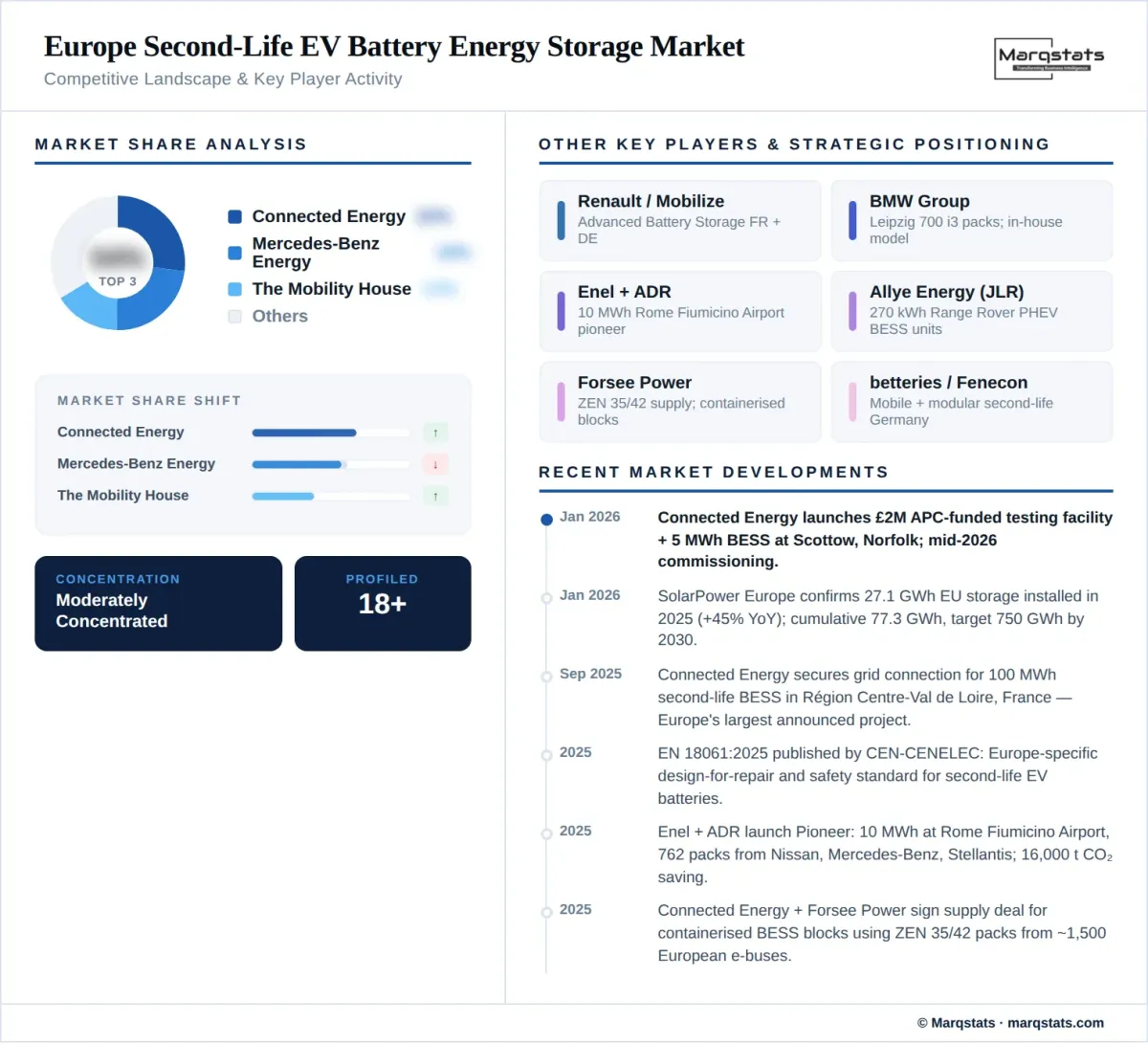
The Europe Second-Life EV Battery Energy Storage Market is moderately concentrated at the dedicated specialist level and broadly distributed across automaker circular-economy programs, energy traders, BESS developers, and Tier-1 battery suppliers. Connected Energy anchors the largest announced pipeline scale with the 100 MWh France project and approximately 1 GWh France target by 2030. Mercedes-Benz Energy with The Mobility House operates the largest installed grid-services deployment at Lünen and Elverlingsen. Renault Group via Mobilize and the Advanced Battery Storage program anchors OEM-led lifecycle strategy. BMW Group integrates second-life batteries at Leipzig plant energy management.
Specialized integrators and developers including The Mobility House (Germany energy trading and BESS operation), Allye Energy (UK, JLR partnership), Forsee Power (France, electric bus battery supplier), betteries (Germany, mobile and modular second-life systems), Fenecon (Germany, battery storage integration with Renault ABS participation), and Volvo Energy (Europe, exploring second-life BESS with Connected Energy) populate the broader specialist supplier base. Battery analytics and lifecycle management firms including Circunomics (Germany battery marketplace), TWAICE, and ACCURE provide the digital infrastructure that supports state-of-health assessment, valuation, and warranty structuring.
Battery recyclers including Umicore, Eramet, Li-Cycle Europe, and the broader European recycling ecosystem operate at the boundary between second-life and direct recycling, with selection logic depending on battery state of health, application demand, and metal pricing. The competitive landscape will be defined less by used-battery cost arbitrage and more by control over battery sourcing from OEMs, fleets, and salvage networks; state-of-health diagnostics using BMS data and analytics; safe integration into certified BESS architectures aligned with EN 18061:2025 and EU Battery Regulation; bankable warranties; grid-market software for revenue stacking; and recycling exit pathways after second-life period.
Companies Covered
The report profiles 18 company profiles+ companies with full strategy and financials analysis, including:
Recent Market Activity
Table of Contents
Coverage & Segmentation
The Europe Second-Life EV Battery Energy Storage Market report analyzes the repurposed battery stationary storage opportunity across grid services and frequency regulation, EV charging support, commercial and industrial BESS, solar-plus-storage and renewable integration, fleet depot storage, airports and public infrastructure, telecom backup, and residential storage applications for the period 2021 to 2030. The report covers historical data for 2021–2025, with 2025 as the base year, and forecasts spanning 2026–2030. Market sizing is conducted in USD millions with parallel GWh capacity tracking. The study examines retired EV battery packs, modules, and cells repurposed into stationary BESS configurations across passenger EV, electric bus, electric van and truck, warranty return, manufacturing reject, and accident salvage feedstock streams.
The scope evaluates competing chemistry economics across NMC, LFP, NCA, LMO blends, and emerging lithium-ion chemistries. Battery form factors include full pack reuse, module-level reuse, cell-level reuse, and mixed-architecture configurations. Business models covered include battery sale to integrator, battery leasing and retained ownership, energy-storage-as-a-service, grid-service revenue sharing, OEM circular-economy partnership, and BESS developer ownership models. Country coverage includes Germany, France, United Kingdom, Italy, Spain, Netherlands, Nordics, and Rest of Europe. Regulatory frameworks evaluated include EU Battery Regulation 2023/1542, EU Battery Passport effective February 2027, EN 18061:2025 second-life EV battery standard, UL 1974 international repurposing standard, UL 1973 stationary battery applications, UL 9540 / UL 9540A energy storage system safety, IEC 62619 industrial lithium battery safety, and UN 38.3 battery transport.