Market Snapshot
Middle bar: base-year value × (1 + CAGR), rounded to two decimals. This is a calculated illustration, not a separately researched annual estimate.
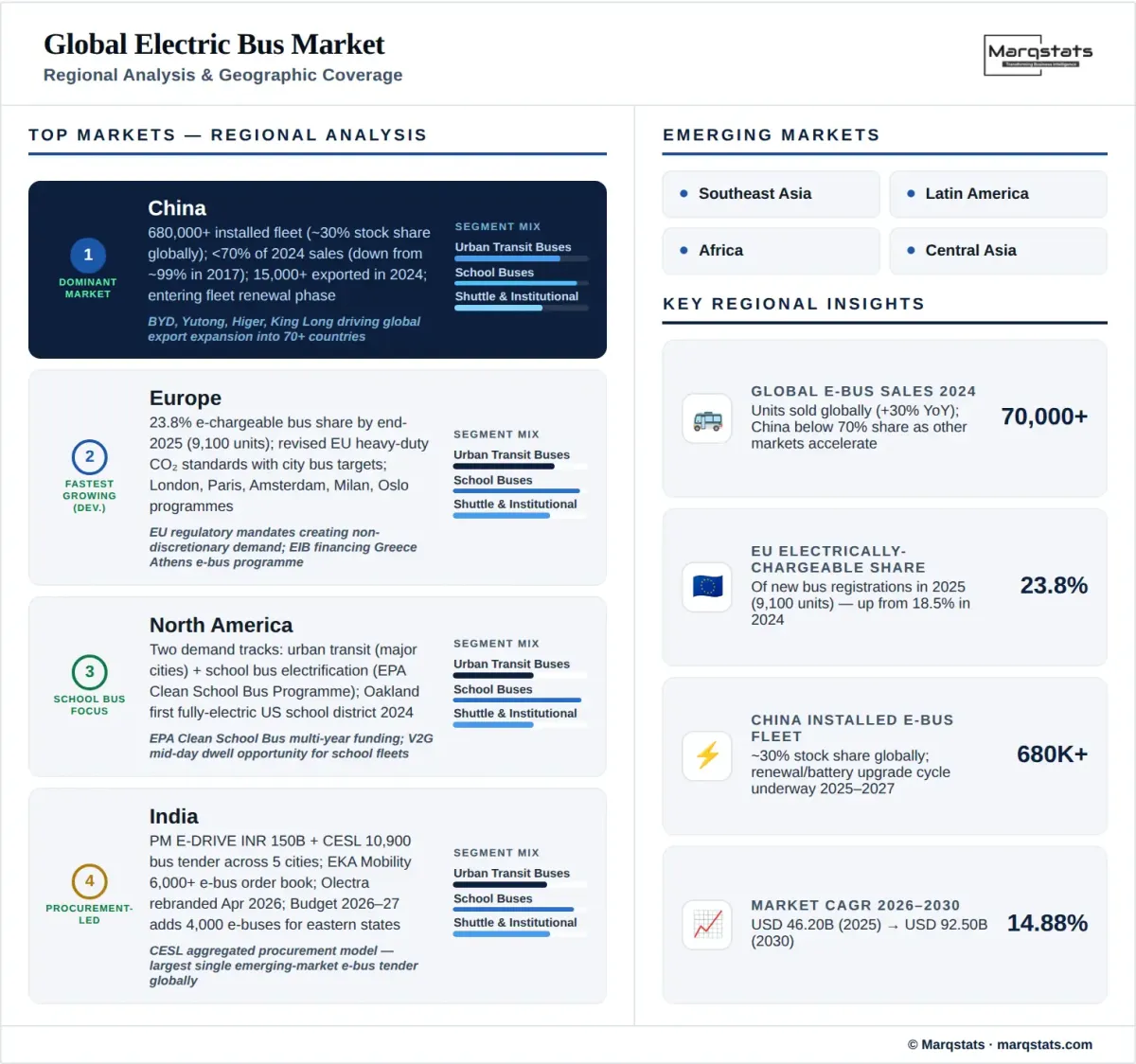
The global electric bus market was valued at USD 46.20 billion in 2025 and is projected to reach USD 92.50 billion by 2030, expanding at a CAGR of 14.88% during the forecast period 2026–2030. Global electric bus sales exceeded 70,000 units in 2024, growing approximately 30% year-on-year, with China contributing the dominant volume share though its proportion has declined from approximately 99% in 2017 to below 70% in 2024 as European, North American, and emerging markets accelerate. The electric bus market is now best understood as a system market: vehicles, depots, grid connections, operational scheduling, and financing and procurement structures are tightly coupled. Where this system is coordinated—as in city-led bus electrification programmes—adoption can reach very high fleet shares; where it is fragmented, growth slows despite improving battery economics.
The market is transitioning from a first-deployment phase to a fleet renewal and infrastructure maturation phase. China’s installed electric bus base exceeds 680,000 vehicles, with many deployed before 2020 now entering replacement cycles. The IEA notes that 2024 Chinese sales increases partly reflect renewal of older electric buses rather than first-time electrification, signalling a structural shift in demand composition. In Europe, electrically-chargeable bus registrations reached 23.8% share by end-2025 (approximately 9,100 units), up from 18.5% in 2024, driven by revised EU heavy-duty CO₂ standards that include explicit city bus requirements. In North America, school bus electrification has emerged as a distinct market segment, with Oakland becoming the first US school district with a fully electric fleet in 2024 and the EPA Clean School Bus Programme providing multi-year funding across priority communities.
The competitive and strategic landscape is evolving rapidly. Chinese OEMs such as BYD and Yutong are expanding aggressively into export markets, with China exporting over 15,000 electric buses in 2024 (25%+ year-on-year growth). Tashkent signed a purchase agreement for 2,000 BYD buses in early 2025. Outside China, competitive differentiation is shifting from standalone vehicle sales toward end-to-end operational solutions—vehicle, depot design, energy management, software, and service warranty structures—because fleet operators increasingly procure a delivered service rather than a standalone chassis. Charging strategy has become the controlling design variable: depot charging (overnight DC) is the baseline for most routes, while opportunity charging (pantograph at terminals) expands feasible schedules but increases infrastructure complexity and capital requirements.
Key Takeaways
Market Overview & Analysis
Report Summary
The electric bus market encompasses battery-electric buses (BEVs), plug-in hybrid electric buses (PHEVs), and fuel cell electric buses (FCEVs) deployed across urban transit, intercity coach, school transport, shuttle, and institutional fleet applications globally. The market covers the full system stack: vehicles, depot charging infrastructure (overnight DC and opportunity/pantograph), grid interconnection and energy management, fleet scheduling and telematics software, and the procurement and financing structures that underpin deployment at scale. The market’s growth is driven by municipal zero-emission mandates, air quality improvement targets, declining battery costs (lithium-ion pack prices approaching USD 115/kWh), total cost of ownership advantages in energy-intensive transit operations, and structured government procurement programmes.
A major structural shift is underway in market demand composition. In China, where the electric bus installed base exceeds 680,000 vehicles and many cities electrified years ago, 2024 sales increases partly reflected replacement of older buses and large-scale battery upgrade programmes tied to documentation and recycling requirements. This renewal dynamic is material for 2025–2027 unit volumes even if new-city electrification saturates. In Europe, growth is increasingly shaped by revised EU heavy-duty CO₂ standards that set reduction trajectories including explicit city bus requirements, directly shaping procurement economics and OEM compliance strategies. In North America, the EPA Clean School Bus Programme is delivering multi-year funding to replace diesel school buses with zero-emission alternatives, creating a parallel electrification track alongside urban transit.
The market’s bottlenecks are shifting from vehicle availability toward depot power upgrades, grid interconnection timelines, delivery lead times, and operational maturity. The practical constraint is often not energy (kWh per day) but peak power (kW/MW) and interconnection timelines; coordinated charging schedules can reduce peaks but do not eliminate the need for upgraded service at many depots operating at scale. This makes depot readiness—rather than bus technology—the critical-path workstream for fleet electrification in most cities.
Market Dynamics
Key Drivers
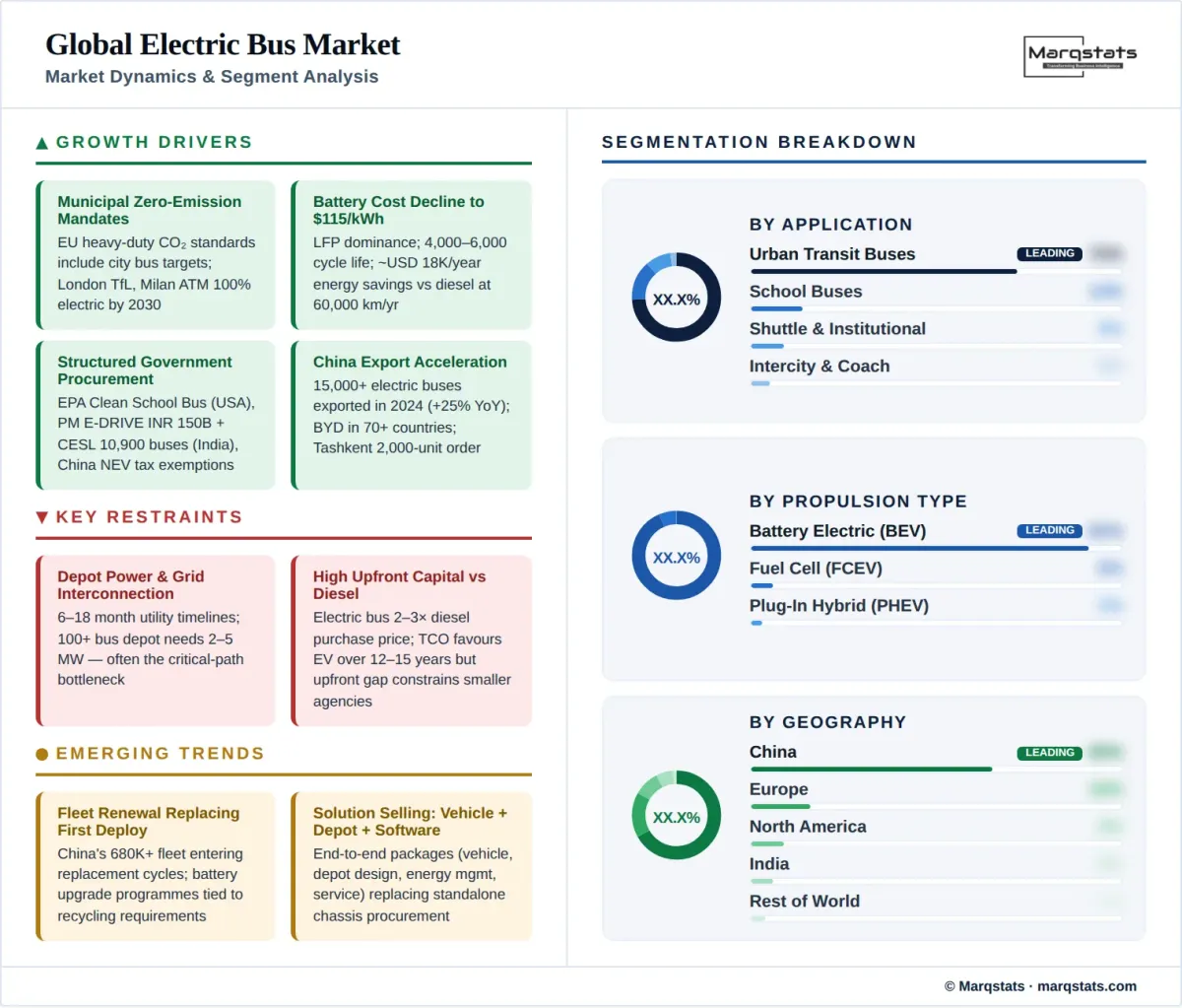
- Municipal zero-emission mandates and climate regulation: Cities worldwide are adopting zero-emission bus targets: Shenzhen fully electrified its bus fleet years ago, Milan’s ATM committed to 100% electric by 2030, and London’s TfL is progressively electrifying its fleet. The EU’s revised heavy-duty CO₂ standards include city bus requirements and target trajectories for reducing emissions versus 2019 reference levels. These regulatory commitments create non-discretionary procurement demand, making transit bus electrification less sensitive to short-term economic cycles than private vehicle markets.
- Declining battery costs and improving operating economics: Lithium-ion battery pack prices have fallen toward USD 115/kWh, and LFP chemistry dominance in bus applications has improved cycle life to 4,000–6,000 cycles. On an energy-cost basis, electric buses demonstrate significant advantages over diesel: at USD 0.15/kWh electricity and 1.2 kWh/km consumption versus USD 1.20/L diesel at 0.4 L/km, a bus operating 60,000 km annually saves approximately USD 18,000 in energy costs alone. These savings compound with lower maintenance requirements (fewer moving parts, regenerative braking reducing brake wear) and increasingly favourable TCO calculations over 12–15 year bus lifetimes.
- Structured government procurement and funding programmes: Government procurement programmes are the primary demand driver outside China. The US EPA Clean School Bus Programme provides multi-year funding for zero-emission school bus replacements. India’s PM E-DRIVE scheme allocated INR 150 billion for e-buses and e-trucks, with CESL tendering 10,900 electric buses across five Indian cities. China’s NEV purchase tax incentives have been extended under a 2024–2027 framework, supporting commercial electrification. These structured programmes aggregate demand, improve financeability, and enable supplier planning.
- China’s export expansion opening new markets: Chinese OEMs exported over 15,000 electric buses in 2024, growing 25%+ year-on-year. BYD, Yutong, Higer, and King Long are establishing international distribution, manufacturing, and service networks across Europe, Latin America, Southeast Asia, and Africa. Tashkent’s 2,000-unit BYD order and Uganda’s Kiira Motors’ 450-bus deal with South Africa’s Golden Arrow Bus Services illustrate how Chinese manufacturing scale is penetrating diverse markets.
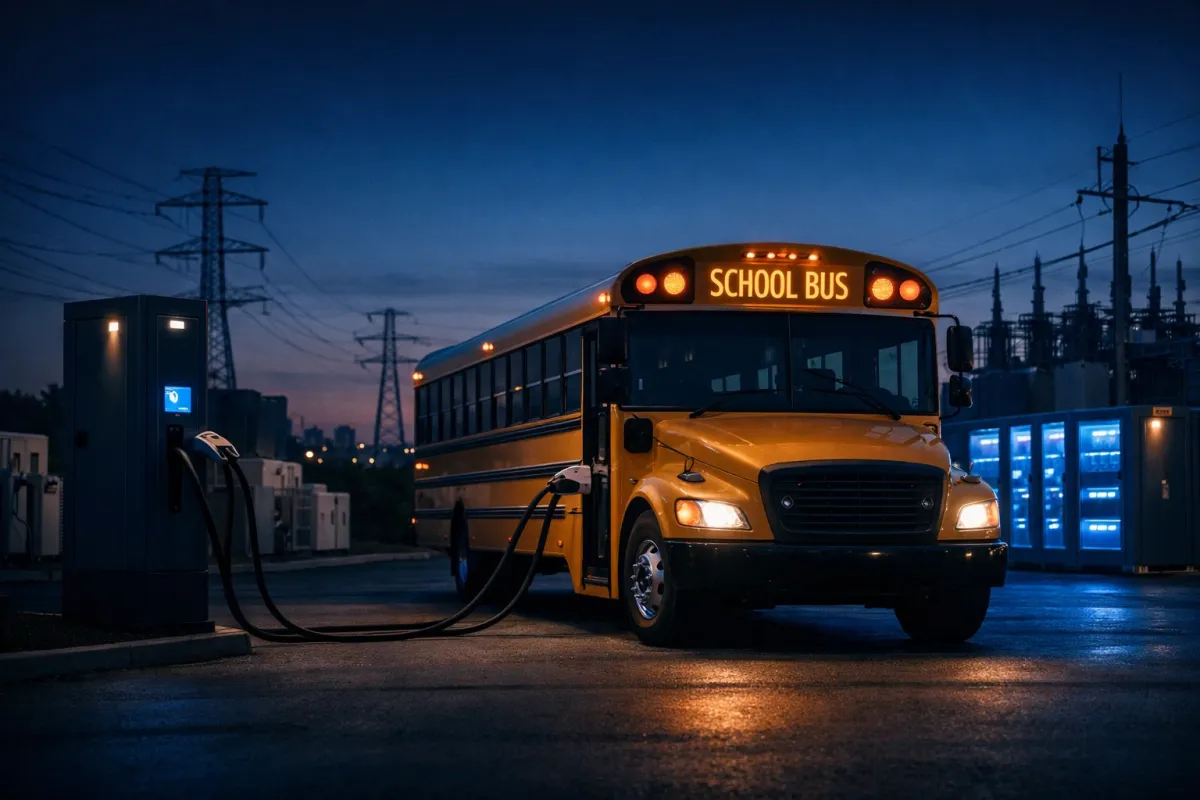
- School bus electrification as a distinct growth vector: School buses represent a parallel electrification track in the US with different depot patterns, duty cycles, and funding pathways than urban transit. Oakland became the first US school district with a fully electric fleet in 2024. The EPA Clean School Bus Programme has disbursed awards across multiple fiscal years, and school buses’ predictable morning/afternoon schedules create potential for vehicle-to-grid (V2G) energy export during mid-day dwell periods.
Key Restraints
- Depot power upgrades and grid interconnection as critical-path constraints: The practical constraint for fleet-scale electrification is often not energy (kWh/day) but peak power demand (kW/MW) and grid interconnection timelines. Depot upgrades can require 6–18 months for utility approvals, transformer installation, and service upgrades. At scale, a depot electrifying 100+ buses may require 2–5 MW of power capacity, necessitating high-voltage interconnection that exceeds standard commercial service levels.
- High upfront capital costs versus diesel fleet economics: Electric buses carry a significant purchase price premium over diesel equivalents, typically 2–3x for a standard 12-metre transit bus. While TCO can favour electric over a 12–15 year lifecycle, the upfront capital intensity creates financing challenges, particularly for smaller transit agencies and developing-market operators without access to concessional finance or green bond markets.
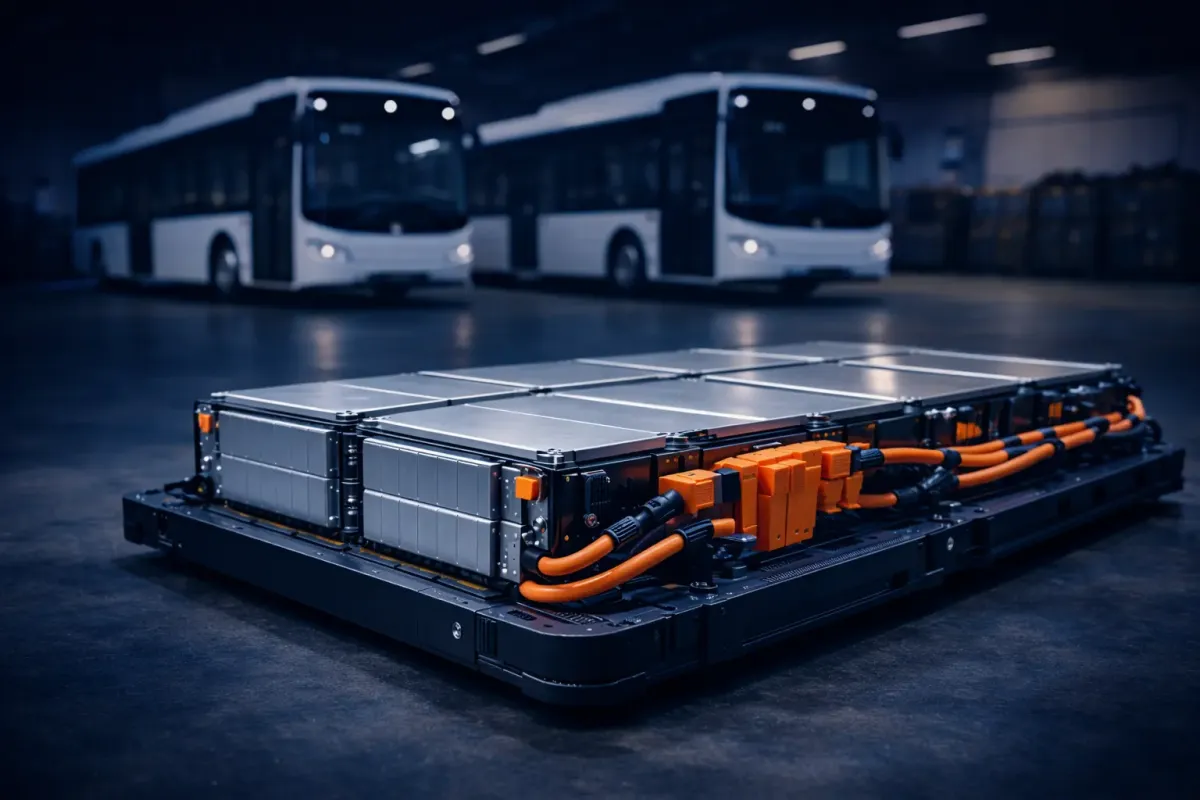
- Battery lifecycle management and mid-life replacement costs: First-generation electric bus fleets are now reaching ages where battery degradation becomes an operational planning issue. Battery replacement and mid-life refurbishment are becoming procurement and circularity topics, not just technical ones. Operators must plan for state-of-health monitoring, replacement triggers, second-life battery pathways, and end-of-life recycling compliance.
- Charging infrastructure complexity for high-utilisation routes: Depot-only charging works well for routes with sufficient overnight dwell time but fails for high-utilisation routes requiring 18+ hours of daily operation. Opportunity charging (pantograph at route terminals) expands feasible schedules but increases infrastructure complexity, capital costs, and maintenance requirements. The lack of universal charging standards for pantograph systems across OEMs adds integration risk.
Key Trends
- From first deployment to fleet renewal and battery upgrade cycles: The market’s centre of gravity is moving from first-time electrification to fleet renewal. China has examined large-scale battery upgrades for city buses, tied to documentation and recycling requirements. This renewal dynamic creates a recurring demand cycle that is more predictable than greenfield electrification and supports aftermarket and battery refurbishment business models.
- Solution selling replacing standalone vehicle procurement: Outside China, competitive differentiation is shifting toward end-to-end delivery: vehicle + depot design + energy management + service/warranty. Fleet operators increasingly buy an operational solution rather than a standalone chassis. This trend favours OEMs and integrators that can package charging infrastructure, fleet management software, energy tariff optimisation, and long-term maintenance contracts.
- Vehicle-to-grid (V2G) and grid integration creating ancillary revenue: Electric school buses and transit buses with predictable dwell periods are emerging as distributed energy resources. V2G capability allows buses to export stored energy to the grid during peak demand, creating ancillary revenue streams that improve fleet economics. The US electric school bus V2G market is a distinct opportunity given school buses’ long mid-day and summer idle periods.
- Fuel cell buses as a complementary solution for specific duty cycles: Fuel cell buses remain relevant for very long duty cycles, intercity routes, and cold-climate operations where battery limitations become binding. However, battery-electric buses dominate current deployments globally due to lower total system complexity and established depot-charging infrastructure. The economic case for fuel cell buses depends on hydrogen supply cost, station utilisation, and the degree to which the full vehicle-depot-fuel logistics system is financed as a package.
Market Segmentation
Urban transit buses dominate electric bus deployment globally because predictable routes and fixed depots simplify charging and scheduling, municipal procurement aggregates demand and improves financeability, and local air quality improvements are most valued in dense urban corridors. Transit buses are typically 10–14 metres in length with battery capacities of 200–400 kWh. China’s installed transit electric bus base exceeds 680,000 vehicles. In Europe, transit agencies in cities including London, Paris, Amsterdam, Milan, Oslo, and Hamburg are executing multi-year electrification programmes with depot conversions.
School buses represent a distinct electrification track concentrated in North America, with different depot patterns, duty cycles, and funding pathways than urban transit. School buses typically operate 50–80 km daily in two split shifts (morning and afternoon), with extended dwell periods during mid-day and summer that are well-suited for V2G applications. The EPA Clean School Bus Programme provides multi-year funding, and Oakland became the first fully-electric school bus district in 2024. Battery requirements are typically 100–200 kWh, and depot charging overnight is generally sufficient for school duty cycles.
Airport shuttles, corporate campus shuttles, university buses, and hospital transport services represent a growing niche for electric bus deployment. These applications feature fixed routes, known schedules, and captive depots, making them well-suited for depot-charged battery-electric buses. The segment benefits from institutional sustainability commitments and the ability to control charging infrastructure within campus boundaries.
Intercity coach electrification lags city buses because higher sustained speeds, longer daily distances, and passenger comfort requirements (HVAC load) push energy and charging demands beyond depot-only feasibility. Battery capacities of 400–600 kWh and opportunity or megawatt-class charging may be required. Fuel cell buses have a stronger relative case in intercity applications where range and refueling speed are operationally critical.
Battery-electric buses dominate the global electric bus market with over 90% of deployments. BEV buses benefit from established depot-charging infrastructure, declining LFP battery costs, and lower total system complexity compared to fuel cell alternatives. Battery capacities range from 100 kWh for school and shuttle applications to 400+ kWh for 12–14 metre transit buses requiring full-day operational range. BEV bus economics are strongest on routes where depot dwell time exceeds 6 hours and daily range requirements stay within 200–300 km.
Fuel cell electric buses represent a small but strategically relevant segment, primarily deployed in demonstration and niche applications where battery limitations are binding: intercity routes exceeding 400 km daily, cold-climate operations where battery capacity degrades, and high-utilisation schedules without sufficient depot dwell time. China’s fuel cell bus fleet accounts for approximately 25% of its total FCEV fleet (7,748 units as of Q2 2025). In Europe, fuel cell buses are deployed in select cities under joint procurement programmes such as JIVE and JIVE2.
Plug-in hybrid buses serve as a transitional technology in markets where full electrification infrastructure is not yet available. PHEV buses combine electric drivetrain with diesel or CNG backup, reducing emissions while maintaining operational flexibility. The segment is declining as battery-electric range and charging infrastructure improve, making PHEV buses increasingly unnecessary for urban transit applications.
By Geography
China
China is the dominant global electric bus market by both stock and annual sales volume. The country’s installed electric bus fleet exceeds 680,000 vehicles, with an electric bus stock share of approximately 30%—the highest globally. Global electric bus sales exceeded 70,000 in 2024, with China contributing below 70% of that volume. China exported over 15,000 electric buses in 2024, growing 25%+ year-on-year, with BYD, Yutong, Higer, and King Long leading export expansion into Southeast Asia, Latin America, Europe, and Africa. The market is now transitioning from first-time electrification to fleet renewal and battery upgrade cycles, with the government linking replacement programmes to documentation and recycling requirements.
Europe
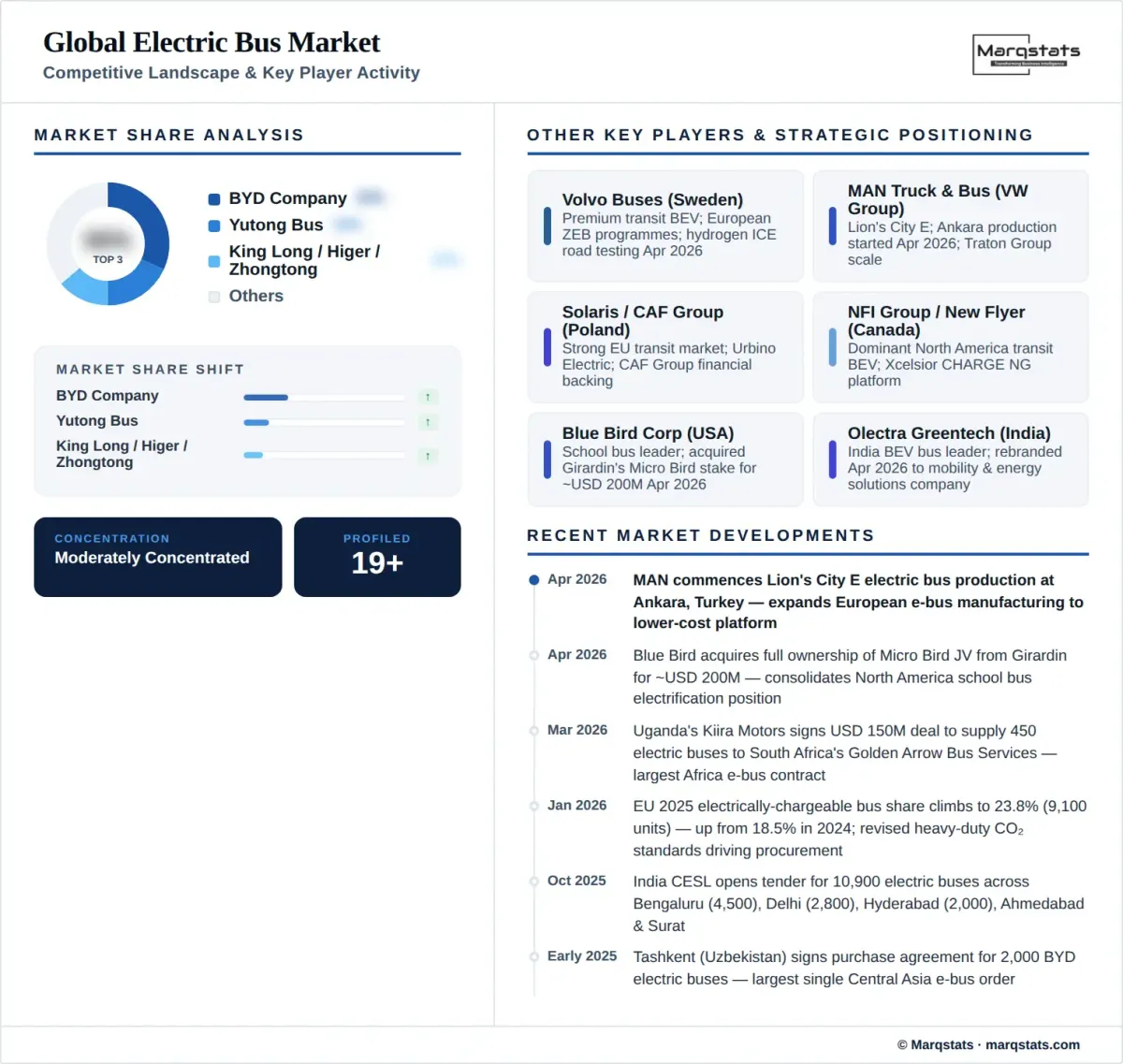
Europe is the second-largest electric bus market and the fastest-growing among developed economies. EU electrically-chargeable bus registrations reached 23.8% share by end-2025 (approximately 9,100 units), up from 18.5% share in 2024. The revised EU heavy-duty CO₂ standards include city bus requirements and target trajectories that directly shape procurement economics. MAN commenced electric Lion’s City E bus production at its Ankara plant in April 2026. Key transit electrification programmes are underway in London, Paris, Amsterdam, Milan, Oslo, Hamburg, and Barcelona. The EIB is supporting Greece in designing energy solutions and charging infrastructure for electric buses in Athens.
North America
North America’s electric bus market is characterised by two distinct demand tracks: urban transit bus electrification in major cities and school bus electrification funded through the EPA Clean School Bus Programme. Oakland became the first US school district with a fully electric fleet in 2024. Blue Bird completed the acquisition of Girardin’s stake in the Micro Bird JV in April 2026 (approximately USD 200 million), strengthening its position in the school bus segment. The US megawatt charging system (MCS) ecosystem is progressing toward field deployment, though infrastructure remains the binding constraint for larger transit fleet conversions.
India
India’s electric bus market is procurement-led, driven by CESL’s tendering of 10,900 electric buses across five cities (Bengaluru, Delhi, Hyderabad, Ahmedabad, Surat) under Phase 1 of PM E-DRIVE. EKA Mobility sold 1,143 electric commercial vehicles in FY 2025–26 and holds a confirmed order book of 6,000+ e-buses. Olectra Greentech refreshed its brand identity in April 2026, repositioning from electric bus manufacturer to a broader mobility and energy solutions company. The PM E-DRIVE scheme was extended to March 2028 with an INR 109 billion outlay, and the Budget 2026–27 allocated 4,000 e-buses specifically for eastern states.
Emerging Markets (Southeast Asia, Latin America, Africa)
Emerging markets are becoming significant growth vectors for electric bus deployment, primarily through Chinese OEM export and local assembly partnerships. A Taiwanese electric bus company is considering a USD 25 million production facility in the Philippines. Uganda’s Kiira Motors signed a USD 150 million deal to supply 450 electric buses to South Africa’s Golden Arrow Bus Services. Thailand’s new industry minister pledged support for EV growth. NV Gotion entered an MOU with Thailand’s PLANET for EV and energy storage partnerships. These markets are characterised by growing urbanisation, worsening urban air quality, and increasing availability of concessional finance for clean transport.
How Competition Is Evolving
The global electric bus competitive landscape is led by Chinese manufacturers that combine scale, cost competitiveness, and increasingly sophisticated export capabilities. BYD is the largest global electric bus manufacturer with deployments across 70+ countries and a comprehensive product range from 6-metre minibuses to 27-metre bi-articulated platforms. Yutong is a major exporter with international orders across Europe, Latin America, and Central Asia, including the 2,000-unit Tashkent order. King Long, Higer, and Zhongtong are expanding global distribution. China’s export of 15,000+ electric buses in 2024 reflects a structural shift from domestic-only to global supply.
European OEMs compete through technology leadership, aftersales integration, and compliance with stringent local procurement requirements. Volvo Buses, MAN (Traton/VW Group), Mercedes-Benz/Daimler Truck (EvoBus), Solaris (CAF Group), and VDL Groep offer electric bus platforms tailored to EU depot and operational standards. MAN began electric Lion’s City E production at its Ankara plant in April 2026. Competitive differentiation outside China is increasingly defined by end-to-end solution delivery: vehicle + depot design + energy management + software + service warranty, as transit agencies procure operational outcomes rather than standalone vehicles.
In India, Olectra Greentech (Megha Engineering Group), Tata Motors (through Switch Mobility), Ashok Leyland (Switch Mobility), PMI Electro Mobility, and JBM Auto are the primary electric bus manufacturers. PMI is investing INR 12 billion in Rajasthan for a 33,000-unit annual capacity plant. In North America, Blue Bird, IC Bus, Thomas Built (Daimler Truck), New Flyer (NFI Group), and Proterra (now part of Phoenix Motorcars/Proterra assets) serve the transit and school bus segments.
Companies Covered
Companies covered in the report include:
Recent Market Activity
Table of Contents
Coverage & Segmentation
This report provides a comprehensive analysis of the global electric bus market covering the historical period 2021–2025 and forecast period 2026–2030, with 2025 as the base year. The study examines market size in value (USD billion) and volume (units), segmented by application (urban transit, school, shuttle/institutional, intercity/coach), propulsion (BEV, FCEV, PHEV), bus length (<9m, 9–14m, >14m), charging infrastructure (depot, opportunity/pantograph, hybrid), and geography (China, Europe, North America, India, rest of world). The competitive landscape profiles 19 leading OEMs across vehicle manufacturing, charging infrastructure, and fleet solution delivery.
Primary research includes structured interviews with 40+ industry stakeholders spanning bus OEMs, transit agency procurement teams, depot infrastructure providers, energy management platform companies, battery suppliers, and government policy teams. Secondary research draws from IEA Global EV Outlook 2025, ACEA registration data, EPA Clean School Bus Programme data, CAAM statistics, company annual reports, and transit authority procurement documents. All market estimates represent Marqstats Intelligence proprietary calculations.