Market Snapshot
Middle bar: base-year value × (1 + CAGR), rounded to two decimals. This is a calculated illustration, not a separately researched annual estimate.
The India EV tyre market reached an estimated USD 0.55 billion in 2025 and is projected to reach USD 1.06 billion by 2030, expanding at a 14.20% CAGR across the 2026–2030 forecast period. In unit terms, demand scales from roughly 11 million tyres in 2025 toward approximately 48 million by 2030, a volume CAGR near 32%. The wide gap between value and volume growth reflects a mix shift toward lower-priced electric two-wheeler tyres, which dominate unit additions and compress blended average selling prices even as higher-value passenger-car tyres lift the value pool.
Volume scaling is driven by a mechanical mismatch between conventional tyres and electric powertrains. Heavy lithium-ion battery packs, instant peak torque, and regenerative braking subject tyres to higher shear stress, producing wear rates 20% to 30% faster than internal-combustion equivalents. Owing to these demands, vehicle manufacturers collaborate with tyre makers during early homologation to protect driving range, contain road noise, and carry elevated axle loads, which moves EV tyres from interchangeable commodities toward system-critical components.
Demand concentrates in West India, where Maharashtra and Gujarat lead volume through dense urban registrations and a deep automotive manufacturing base. The passenger-car segment ranks as the fastest-growing category, while electric two-wheelers remain the largest by unit volume. Growth is attributed to record electric-vehicle adoption, accelerated replacement cycles, and a premiumisation shift toward low-rolling-resistance, energy-rated tyres. The market is moderately consolidated, with domestic manufacturers holding the majority of volume alongside global players that anchor the premium passenger-car tier, and competitive advantage increasingly rests on original-equipment co-development, energy-label performance, and the depth of replacement distribution.
Key Takeaways
Market Overview & Analysis
Report Summary
The India EV tyre market comprises tyres engineered for battery-electric two-wheelers, three-wheelers, passenger cars, and commercial vehicles, spanning original-equipment fitment and the replacement aftermarket. Electric mobility reframes the tyre from a commodity into a performance-defining component, since rolling resistance, load rating, and acoustic behaviour directly govern range, payload, and cabin refinement. The study scopes the market by value in US dollars, with unit volume tracked as a parallel measure, and segments demand by vehicle type, tyre construction, rim size, and demand category across India’s four regional clusters.
Demand rests on three reinforcing pillars. First, record electric-vehicle adoption expands both the factory-fitment pool and the future replacement base. Second, accelerated tread wear shortens replacement intervals, converting a one-time sale into a recurring revenue stream. Third, energy labelling and acoustic engineering shift buyers toward premium, certified products that command higher prices. These dynamics position EV tyres within the broader India EV components value chain, where localisation and co-development with vehicle manufacturers increasingly determine competitive advantage.
Forecast growth assumes sustained electric-vehicle penetration across two-wheeler and passenger-car segments, a steady transition toward radial and energy-rated construction, and maturing replacement demand as the installed EV base ages beyond its first tread cycle. The estimate carries near-term sensitivity to the scheduled tapering of purchase subsidies and to natural-rubber price volatility, and upside sensitivity to faster passenger-car electrification and to wider mandatory energy labelling.
Two structural features distinguish this market from the broader Indian tyre industry. First, the value-to-volume divergence is unusually wide: two-wheeler tyres drive the bulk of unit additions at low unit prices, while passenger-car tyres contribute disproportionately to value, so blended average selling prices fall even as total value rises. Second, the replacement share is structurally larger than in internal-combustion segments because accelerated wear shortens the interval between purchases, which raises the lifetime tyre count per vehicle and increases the strategic value of aftermarket distribution. Manufacturers that combine factory-fitment positions with dense replacement networks are well placed to capture the recurring revenue this creates.
Market Dynamics
Key Drivers
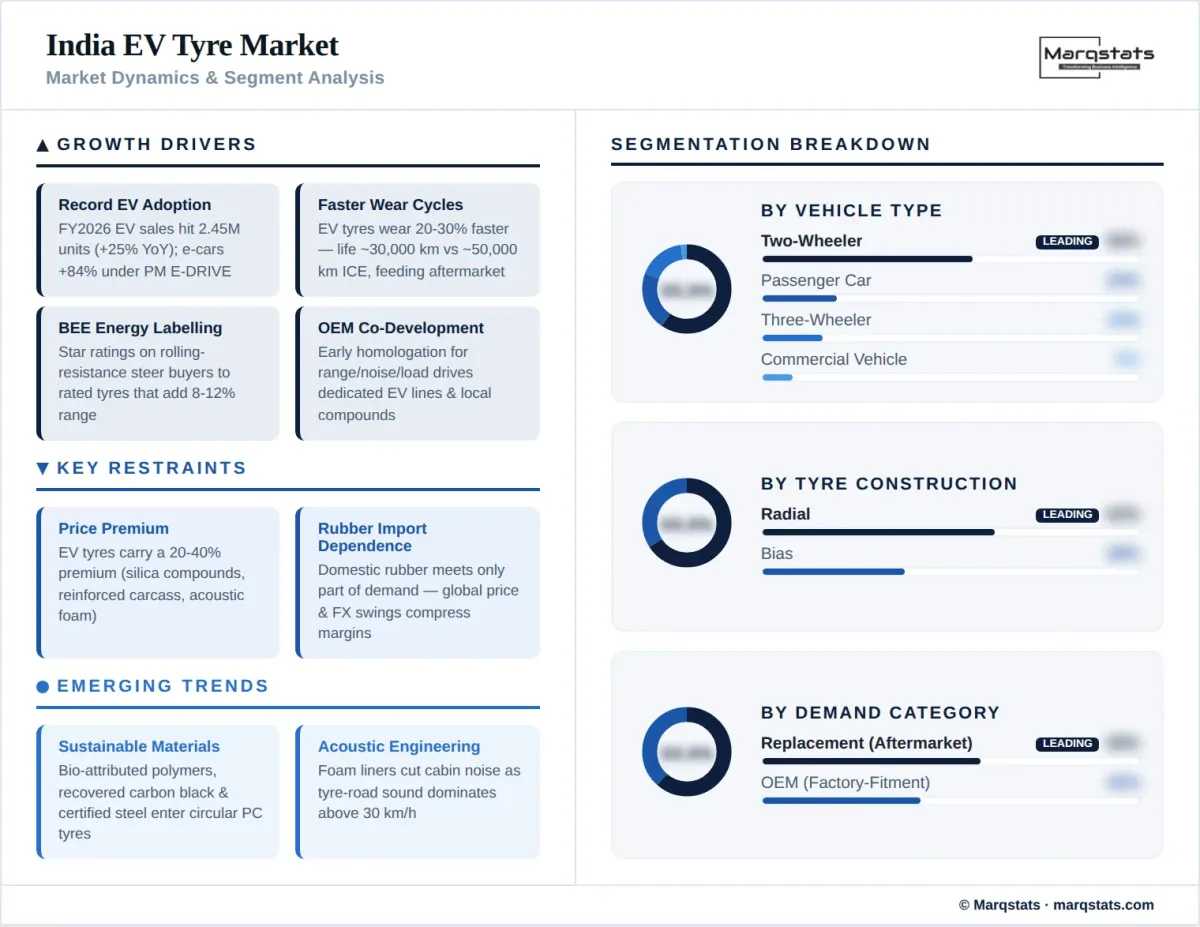
- Record electric-vehicle adoption: India’s FY2026 electric-vehicle sales reached a record 2.45 million units, up about 25% year-on-year, with electric passenger cars rising roughly 84%, supported by the PM E-DRIVE scheme administered through the Ministry of Heavy Industries, which expands the addressable OEM and replacement tyre pools.
- Energy labelling and premiumisation: The tyre star-labelling programme run by the Bureau of Energy Efficiency rates products on rolling-resistance and wet-grip performance, steering buyers toward energy-rated tyres that extend real-world range by 8% to 12% and command higher retail prices. Visible star ratings shift consumer preference toward certified products, enabling manufacturers to defend premium positioning at the point of sale.
- Accelerated replacement cycles: Stop-go urban traffic, instant torque, and heavier kerb weights cut EV tyre service life toward 30,000 km against roughly 50,000 km for comparable internal-combustion cars, generating a large, recurring aftermarket pool that typically activates 24 to 30 months after purchase.
- OEM co-development and localisation: Vehicle manufacturers engage tyre makers during early homologation to optimise range, noise, and load capacity, prompting domestic majors to commission dedicated electric-vehicle production lines and indigenous compound development. Localisation of advanced compounds and reinforced carcasses reduces import reliance and shortens development cycles for new electric platforms.
- Policy-mandated efficiency: Tightening fuel-efficiency norms and the auto-component production-linked incentive scheme push automakers toward low-rolling-resistance tyres to lower fleet-average emissions, sustaining a policy-supported demand floor for premium products. The vehicle-scrappage policy and the gradual move toward harmonised standards reinforce the shift to certified, energy-rated construction.
Key Restraints
- Price premium over conventional tyres: EV-specific tyres carry a 20% to 40% price premium owing to advanced silica compounds, reinforced carcasses, and acoustic foam application, which can divert price-sensitive replacement buyers toward cheaper generic products at the expense of range and safety. The premium is most acute in the two-wheeler segment, where absolute price differences weigh heavily on cost-conscious buyers and slow the migration toward energy-rated products.
- Natural-rubber import dependence: Domestic rubber output meets only part of industry demand, leaving manufacturers exposed to global commodity prices and currency movement, compressing operating margins and limiting the absorption of tariff-related cost increases. Shipping-corridor disruptions and concentrated supply origins add volatility that complicates long-term pricing and procurement planning.
- Bias-to-radial transition friction: Bias construction still accounts for the majority of commercial-fleet tyres, and a rapid shift toward radial-favouring noise and emissions standards risks raising acquisition costs for small operators; the Automotive Tyre Manufacturers Association advocates a phased transition to limit disruption.
- Subsidy tapering risk: Purchase incentives under PM E-DRIVE were reduced in 2025 and carry a near-term terminal date, which raises effective on-road prices and risks tempering two-wheeler volume growth that underpins unit tyre demand.
Key Trends
- Sustainable and circular materials: Manufacturers are adopting bio-attributed polymers, recovered carbon black, and certified sustainable steel, with domestic majors launching circular-material passenger-car tyres to meet green procurement and export-compliance expectations, and certification frameworks becoming a differentiator in original-equipment selection.
- Acoustic and noise-cancellation engineering: With engine noise absent, tyre-road interaction dominates cabin sound above 30 km/h, prompting integration of acoustic foam liners that reduce interior noise and differentiate premium electric-vehicle tyre lines, particularly in the passenger-car segment where refinement is a purchase criterion.
- Smart and connected tyres: Embedded pressure and temperature sensors linked to fleet dashboards are entering commercial electric-vehicle deployments, extending tyre life through predictive maintenance, reducing unplanned downtime, and creating recurring service revenue alongside hardware sales.
- Organised replacement and digital retail: Multi-brand organised outlets and e-commerce-plus-doorstep installation are gaining share of replacement demand, while organised used-car platforms emerge as a consolidated business-to-business buyer pool for certified-quality EV tyres as pre-owned electric vehicles enter resale channels.
Market Segmentation
Electric two-wheelers are the largest segment by unit volume, reflecting their dominant share of India’s electric-vehicle sales and short replacement cycles. High urban utilisation and exposure to potholes accelerate tread wear, sustaining a large, fast-turning replacement pool, although low per-unit pricing limits the segment’s contribution to market value relative to its volume share. Demand is reinforced by the scale of electric scooter and motorcycle adoption in metropolitan and tier-two markets, and by a growing fleet and shared-mobility base whose intensive duty cycles compress replacement intervals further.
Passenger-car tyres are the fastest-growing segment and the largest contributor to market value, driven by electric passenger-car sales rising roughly 84% year-on-year in FY2026. Higher specification requirements for range, load, and acoustics support premium pricing, and original-equipment co-development with carmakers anchors early demand ahead of a maturing replacement cycle. The arrival of mass-market electric sports utility vehicles, which carry heavier battery packs and larger rim diameters, lifts both unit value and reinforcement requirements, while state purchase incentives in major markets accelerate fleet renewal and seed future replacement volume.
Commercial-vehicle tyres, spanning electric buses and light commercial vehicles, scale with fleet electrification and last-mile logistics. The segment carries the highest load and durability demands and is the principal adopter of connected-tyre fleet solutions, where uptime and predictable maintenance directly affect operating economics. Public transit electrification programmes and the expansion of quick-commerce and parcel fleets add steady demand, while bias construction retains a foothold in cost-sensitive intra-city haulage.
Electric three-wheeler tyres serve the dense passenger and cargo mobility base that leads India’s overall electric-vehicle penetration. Demand is steady and price-sensitive, with bias construction retaining relevance owing to low cost and durability under high-load, low-speed urban duty cycles. The segment benefits from rapid fleet electrification in last-mile delivery and shared passenger transport, where intensive daily usage shortens replacement intervals and sustains a reliable, high-frequency aftermarket.
Radial tyres hold the largest and fastest-growing share of value, favoured for passenger-car and premium applications owing to lower rolling resistance, better heat dissipation, and longer tread life. Manufacturer investment concentrates on electric-vehicle-specific radial lines that pair energy efficiency with reinforced load capacity. Radialisation in passenger and light-vehicle categories continues to advance as energy labelling rewards lower rolling resistance, reinforcing the construction’s alignment with electric-mobility requirements.
Bias construction retains the majority of the commercial-fleet tyre base, supported by lower acquisition cost and ruggedness on poor road surfaces. The segment faces gradual displacement as efficiency and noise standards favour radial designs, though a phased regulatory transition tempers the pace of change. Its persistence in three-wheeler and cost-sensitive commercial duty cycles reflects the price sensitivity of fleet operators and the durability demands of high-load, low-speed urban operation.
Demand spans 13–15 inch, 16–18 inch, 19–21 inch, and above 21 inch rim categories. Smaller rim sizes dominate volume through two-wheeler and entry passenger-car fitment, while larger diameters grow with premium electric sports utility vehicles that demand higher load ratings and reinforced sidewalls. Rim-size mix increasingly tracks the shift toward larger, heavier electric passenger platforms.
Original-equipment fitment accounts for a substantial share of demand and anchors brand selection through homologation, since the factory-fitted tyre shapes early replacement preference. Co-development agreements and energy-rating requirements concentrate OEM volume among manufacturers with dedicated electric-vehicle compounds. As carmakers tune vehicles for range and acoustic refinement, the fitment decision increasingly locks in a specific tyre specification, giving suppliers that win these positions a durable downstream advantage when the first replacement cycle begins.
The replacement aftermarket is the larger and faster-compounding category, driven by accelerated EV tread wear that activates a recurring purchase cycle within 24 to 30 months. Organised multi-brand outlets, e-commerce, and used-vehicle platforms are reshaping how replacement demand is sourced and fulfilled. As the installed electric-vehicle base widens and first-generation vehicles reach their second and third tyre cycles, the aftermarket pool deepens, raising the strategic value of distribution reach, fitment-network density, and brand trust at the point of replacement.
By Geography
West India (Maharashtra & Gujarat)
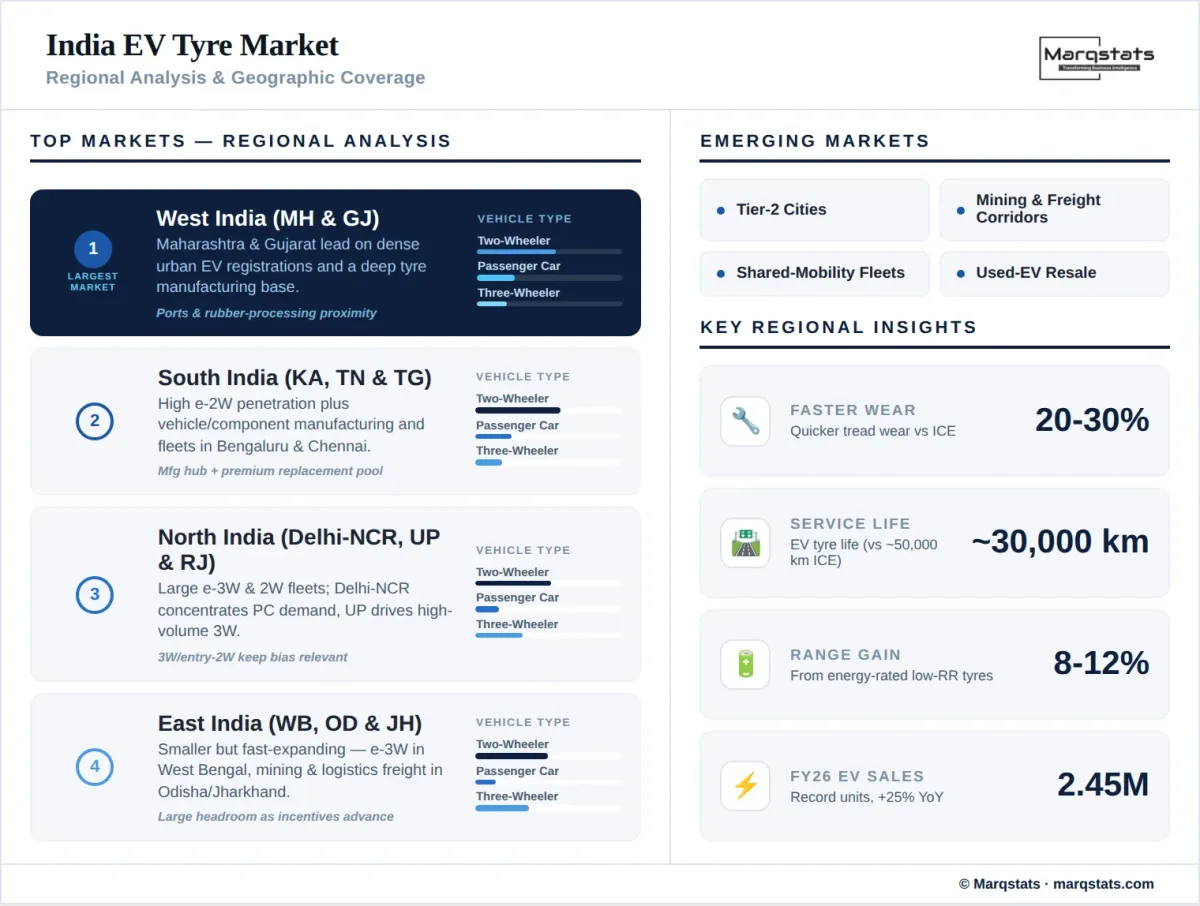
West India is the largest regional market, led by Maharashtra and Gujarat through dense urban electric-vehicle registrations, a deep automotive and tyre manufacturing base, and extensive organised distribution. The region anchors both original-equipment fitment near manufacturing clusters and high-turnover replacement demand in metropolitan centres. Proximity to ports and rubber-processing capacity supports supply-chain efficiency, while state electric-mobility policies and a concentration of fleet operators sustain demand across two-wheeler, passenger-car, and commercial categories.
South India (Karnataka, Tamil Nadu & Telangana)
South India is a major demand and production hub, with Karnataka and Tamil Nadu combining high electric two-wheeler penetration, vehicle manufacturing capacity, and strong fleet adoption around Bengaluru and Chennai. Telangana adds momentum through urban commuter and fleet registrations. The region’s concentration of vehicle and component manufacturing supports original-equipment fitment, while a large information-technology workforce and active shared-mobility operators sustain premium passenger-car and two-wheeler replacement demand.
North India (Delhi-NCR, Uttar Pradesh & Rajasthan)
North India scales on the back of large electric three-wheeler and two-wheeler fleets, with Delhi-NCR concentrating passenger and fleet demand and Uttar Pradesh providing high-volume three-wheeler registrations. State incentives and urban air-quality pressure reinforce adoption across the region. The dominance of cost-sensitive three-wheeler and entry two-wheeler segments keeps bias construction relevant, while metropolitan passenger-car growth lifts demand for radial and energy-rated products.
East India (West Bengal, Odisha & Jharkhand)
East India represents a smaller, fast-expanding market, led by electric three-wheeler adoption in West Bengal and rising commercial and logistics activity across Odisha and Jharkhand. Growth tracks improving charging access and the spread of organised replacement channels into tier-two cities. Mining and industrial freight corridors add commercial-vehicle tyre demand, while lower current penetration leaves substantial headroom as state incentives and fleet electrification advance.
How Competition Is Evolving
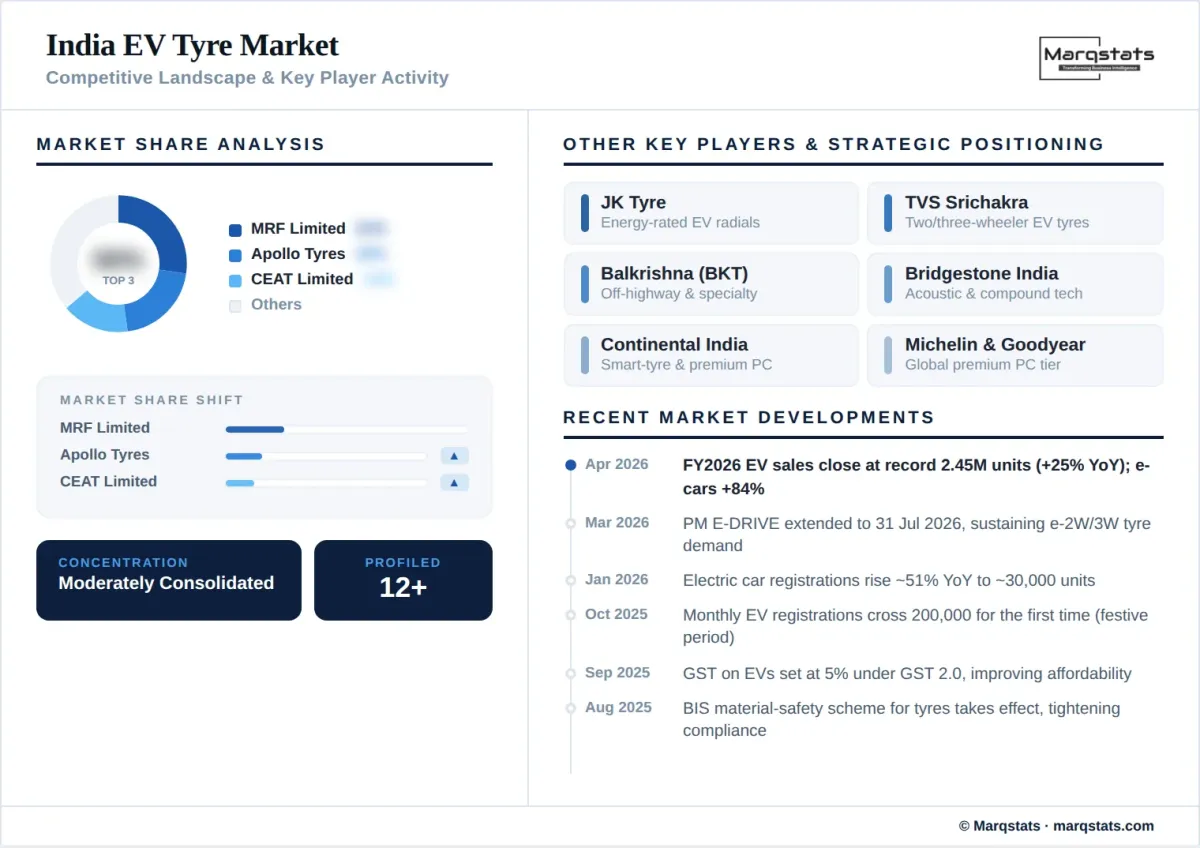
The India EV tyre market is moderately consolidated, with a small group of domestic majors holding the bulk of volume alongside established global manufacturers that compete on technology and premium positioning. Domestic firms such as MRF Limited, Apollo Tyres Limited, CEAT Limited, and JK Tyre & Industries Limited leverage extensive distribution, local manufacturing scale, and energy-rated electric-vehicle product lines, while global players bring acoustic, compound, and smart-tyre technology to the premium passenger-car segment.
Competition increasingly turns on original-equipment co-development and certification. Manufacturers that secure factory-fitment positions on high-volume electric platforms gain a durable advantage in the subsequent replacement cycle, and energy-labelling performance has become a primary differentiator in passenger-car tenders. Investment concentrates on low-rolling-resistance compounds, acoustic foam construction, sustainable materials, and connected-tyre fleet solutions that bundle hardware with predictive-maintenance services.
Domestic capacity expansion, indigenous research centres, and sustainable-material launches are widening the gap between well-capitalised national manufacturers and smaller regional producers. As certified passenger-car volumes rise and pre-owned electric vehicles begin to enter resale channels, supply-chain depth in compounds, steel cord, and acoustic materials will determine which players capture the premium replacement pool. Partnerships that bundle connected-tyre hardware with fleet-management services, alongside investment in energy-rated radial capacity, are emerging as the principal levers of competitive positioning over the forecast period.
Companies Covered
Companies covered in the report include:
Recent Market Activity
Table of Contents
Coverage & Segmentation
This report provides a comprehensive analysis of the India EV tyre market across the 2021 to 2030 study horizon, with 2025 as the base year, a 2021–2025 historical period, and a 2026–2030 forecast period. The study scopes tyres for battery-electric two-wheelers, three-wheelers, passenger cars, and commercial vehicles, measured primarily by value in US dollars with unit volume tracked in parallel, segmented by vehicle type, tyre construction, rim size, and demand category across India’s four regional clusters.
Coverage spans market sizing and forecasts, replacement-cycle and average-selling-price modelling, the energy-labelling and standards environment, original-equipment and aftermarket channel dynamics, sustainable-material and connected-tyre trends, competitive benchmarking, and company profiles. The report quantifies demand across West, South, North, and East India and assesses the shift from commodity tyres toward system-critical, energy-rated products across a 280-page deliverable.