Market Snapshot
Middle bar: base-year value × (1 + CAGR), rounded to two decimals. This is a calculated illustration, not a separately researched annual estimate.
The US private label tire market is valued at USD 4,704.06 million in 2025 and is projected to reach USD 6,078.92 million by 2030, registering a CAGR of 5.26% over 2026–2030. The market covers new passenger and light truck replacement tires sold under brands owned by distributors, retailers and independent marketers rather than by tire makers. Brand-type data attributed to the U.S. Tire Manufacturers Association (USTMA) put private brands at 14% of passenger and 12% of light truck replacement tires, which applied to 2025 shipments gives an estimated 35.59 million private label tires, or 13.71% of the 259.6 million passenger and light truck replacement tires shipped.
Market size and forecast figures are generated using Marqstats' proprietary estimation framework, updated as of October 2026.
Coverage spans two vehicle types, three brand program types, three sales channels and four US regions: the South, West, Midwest and Northeast. The analysis benchmarks 16 private brand owners, distributors, retailers and contract manufacturers, including American Tire Distributors, Inc., TBC Corporation, The Reinalt-Thomas Corporation, Tireco, Inc. and Omni United (S) Pte. Ltd., and tracks reference sizes such as 205/55R16, 215/55R17, 225/65R17 and 235/65R17 for passenger tires and LT265/70R17 and LT275/70R18 for pickups. Associate brands owned by tire makers, such as second-line brands sold through dealer networks, sit outside the private label market.
Key Takeaways
Market Overview & Analysis
Report Summary
The US private label tire market comprises new passenger and light truck replacement tires sold under brands owned by wholesale distributors, retailers and independent brand marketers, valued at USD 4,704.06 million in 2025 at the prices dealers pay. These brands are produced under contract by tire makers in Asia, North America and elsewhere, and the brand owner controls product range, pricing and distribution. Manufacturer-owned flagship and associate brands, truck and bus tires, original equipment fitments, retreads and installation services sit outside the market perimeter.
Brand-type data attributed to USTMA split the passenger replacement market into 77% manufacturer brands, 9% associate brands and 14% private brands, and the light truck market into 82%, 6% and 12%. Applying these shares to 2025 shipments of 221.9 million passenger and 37.7 million light truck replacement tires gives an estimated 31.07 million private label passenger tires and 4.52 million light truck tires. The combined share works out to 13.71%, weighted by class, rather than the simple average of the two shares.
Definitions matter for sizing. A manufacturer brand, such as a tire maker's flagship line, is owned and marketed by the company that makes it. An associate brand is also owned by a tire maker and sold as a second line, often through a narrower dealer network at lower prices. A private brand is owned by a company that does not make the tire, such as a distributor, retailer or importer, and is built to the owner's specification at contract plants. Some independent marketers own brands sold through many distributors, and Marqstats counts them as private label because the brand owner does not make the tire.
Private brands sit in the value and mid-price tiers. Marqstats values private label passenger tires at an estimated USD 124.24 each in 2025, about 28% below the USD 172.56 average passenger replacement tire, and light truck private label tires at USD 186.65, about 25% below the USD 248.87 average. Dealers stock private brands because they earn higher gross margins than national brands, carry no internet price pressure from the same SKU at a competitor, and build store loyalty.
Private brand economics rest on sourcing and distribution. The brand owner negotiates contract volumes with factories, carries the inventory and duty risk, and earns the margin between landed cost and dealer price, while the dealer earns a higher margin than on national brands of the same size. Because the same tire is not sold under the same name at competing stores or online, dealers face less price matching. When duty rules change, the brand owner can move a SKU to another factory, which national brands with fixed plant footprints often cannot do as quickly.
Private brands have gained share steadily. Marqstats estimates private label units rose from 30.94 million in 2021 to 35.59 million in 2025, lifting the blended share of passenger and light truck replacement units from 12.30% to 13.71%, while total passenger and light truck shipments grew from 251.5 million to 259.6 million. Growth came from wider size ranges, light truck expansion and distributor consolidation, and Marqstats projects a further rise to 15.19% by 2030, with private label units growing about 2.5% a year against about 0.4% for the parent market.
Ownership, exclusivity and manufacturing are separate layers. American Tire Distributors, Inc. owns the Hercules and Ironman brands, which it bought for USD 310 million, and TBC Corporation markets its own brands through wholesale channels and Big O Tires franchise stores. Independent marketers such as Tireco, Inc. with Milestar, Turbo Wholesale Tires, Inc. with Lexani and Lionhart, and Omni United (S) Pte. Ltd. with Radar source from contract factories, while The Reinalt-Thomas Corporation, operating as Discount Tire, sells exclusive brands such as Arizonian and Pathfinder in its own stores. One factory can make several labels, and one brand owner can source from several countries.
Value grows faster than units through share gains and price. Private label units rise from 35.59 million in 2025 to 40.20 million by 2030, the average value per tire rises from USD 132.17 to USD 151.22, and market value reaches an estimated USD 4,848.57 million in 2026 even as total passenger and light truck replacement shipments dip to an estimated 255.4 million. The full US replacement market by tire class is covered in the Marqstats US Replacement Tire Market report.
Market Dynamics
Key Drivers
Five factors support private label tire demand in the United States.
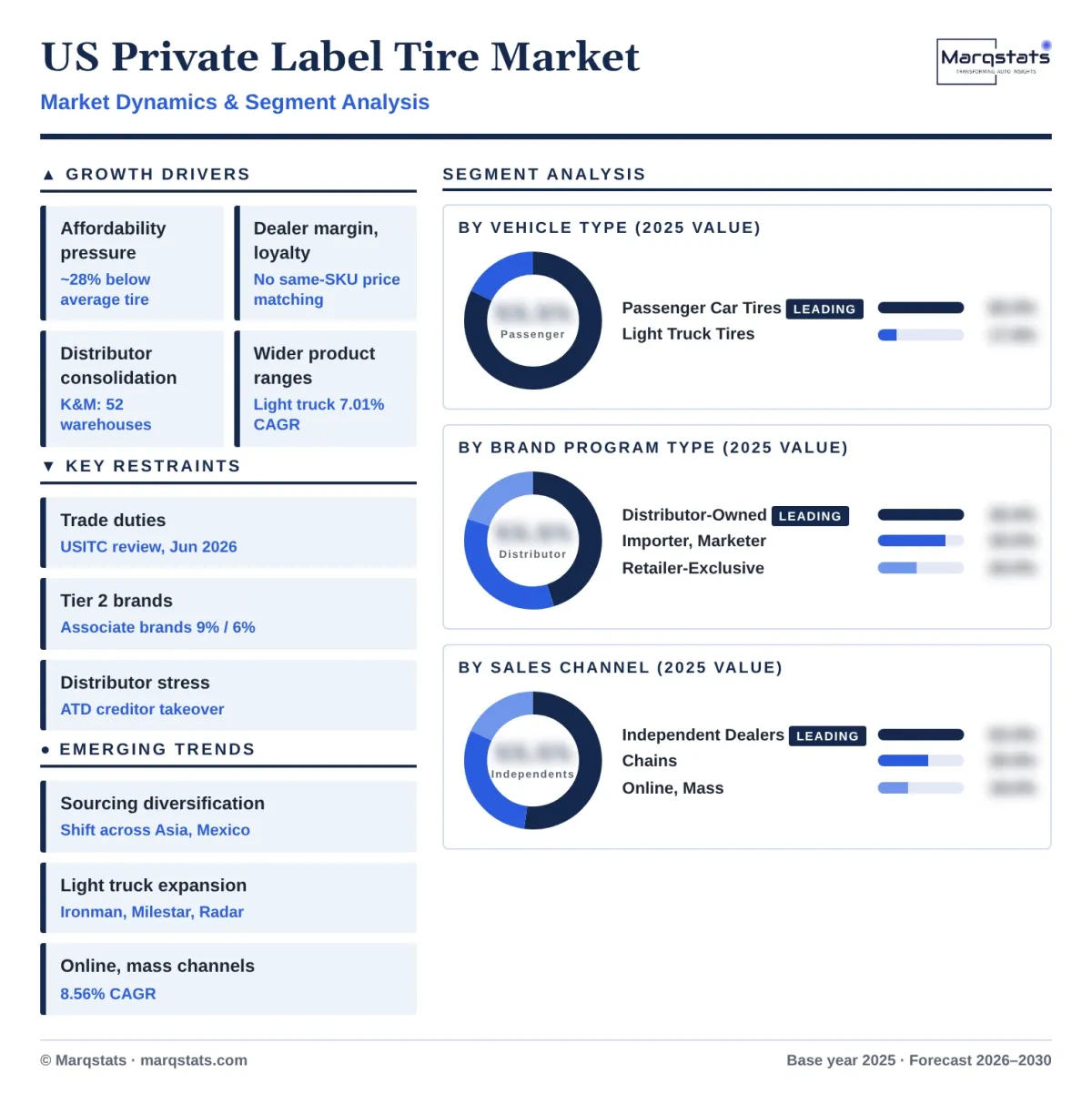
- Affordability pressure on drivers. Private label passenger tires sell at an estimated 28% below the average passenger replacement tire, which appeals to drivers facing higher prices across vehicle ownership. Nokian Tyres estimated that the North American passenger and light truck replacement market fell about 5% in the first half of 2026, and price-sensitive buyers trade down within a shrinking market. Private brand passenger units rise from 31.07 million in 2025 to 34.61 million by 2030. Value-focused drivers also keep older vehicles longer, and these vehicles often get lower-priced replacement tires.
- Dealer margin and loyalty. Dealers earn higher gross margins on private brands than on national brands, and the same SKU is not sold at every competing store or online, which limits price matching. Private brands also tie customers to a dealer network for future replacements, which supports program groups and wholesale distributors that bundle private brands with dealer support. Program groups often require dealers to carry a private brand line in return for rebates and marketing support. Private brands also let dealers offer a complete good-better-best price ladder from a single supplier.
- Distributor consolidation. K&M Tire, Inc. and Zurcher Tire, Inc. announced a merger in January 2026 that gave K&M 52 warehouses, and creditors took over American Tire Distributors in May 2025 after its second Chapter 11 filing. Larger distributors push their own brands through wider networks, and private label share rises from 13.71% of passenger and light truck units in 2025 to 15.19% by 2030. Consolidated distributors also negotiate larger contract volumes with factories, which lowers unit cost. National wholesale reach also lets private brands appear in rural dealers that national brands serve less often.
- Wider product ranges. Private brand owners now cover touring, performance, all-terrain, mud-terrain and all-weather tires in sizes from 15 to 22 inches. Omni United expanded its Radar Renegade-X line with nine new sizes in February 2026 and launched the Renegade A/T and Renegade A/T Trail in August 2026, and light truck private label value grows at a 7.01% CAGR. All-weather and three-peak lines from private brands also widen choice for buyers in snow states. Private brand owners add new sizes faster than before as SUV and crossover fitments multiply.
- Brand building by independent marketers. Independent marketers invest in sponsorships and dealer programs to move private brands closer to national brands in consumer awareness. Radar Tires signed a multi-year partnership with the Texas Rangers in April 2026 and hired a North American territory sales manager the same month, and importer and marketer brands grow fastest by program type at a 6.44% CAGR. Marketer brands also offer road hazard warranties to match national brand terms. Sponsorships also build recognition among younger drivers who shop online first.
Key Restraints
Four constraints hold back private label tire growth.
- Trade duties on imported tires. Most private brands are made in Asia, so antidumping and countervailing duties, Section 232 measures and other tariffs raise landed costs. The US International Trade Commission began a five-year review in June 2026 of duties on passenger and light truck tires from South Korea, Taiwan, Thailand and Vietnam, key sourcing countries for private brands, and sourcing shifts from one country to another disrupt supply. Duty changes can move a private brand's landed cost several dollars per tire in a single ruling. Importers carry several months of stock, so a duty change can strand inventory bought at old cost.
- Competition from Tier 2 and Tier 3 manufacturer brands. Asian tire makers sell their own brands in the US at prices close to private labels, and manufacturer associate brands hold 9% of passenger and 6% of light truck replacement tires. These brands compete for the same value-seeking buyers and the same dealer shelf space. Tier 2 brands also benefit from manufacturer marketing budgets that private brand owners cannot match. Some Tier 2 brands also gain original equipment fitments that lend credibility in the replacement channel.
- Distributor financial stress. American Tire Distributors filed for Chapter 11 in October 2024, its second filing, and creditors acquired substantially all of its assets in May 2025. Financial stress at a large distributor can disrupt private brand supply, fill rates and dealer support. Dealers that rely on one distributor's private brand face supply risk when that distributor restructures. Dealers in affected regions often shift volume to a second distributor's brand during disruptions.
- Quality and recall risk. Private brand owners rely on contract factories, and a recall falls on the brand owner even when it does not make the tire. Buyers who associate private brands with lower quality stay with national brands for safety-critical purchases, which caps share gains in premium and high-performance sizes. Brand owners answer with longer treadwear warranties and third-party test results. Ultra-high-performance and run-flat sizes remain dominated by national brands.
Key Trends
Four shifts are changing how private label tires are made, sold and marketed.
- Sourcing diversification. Private brand owners spread production across Thailand, Vietnam, Cambodia, Indonesia, Mexico and other countries to manage duty exposure, and the Supreme Court ruled in February 2026 that the International Emergency Economic Powers Act does not authorize tariffs. Brand owners that can move a SKU between factories quickly keep fill rates high when duty rules change. DOT codes identify the plant, which helps dealers track sourcing changes for each SKU. Mexico and Southeast Asia gain share of private brand sourcing as Chinese-origin tires face high duties.
- Light truck and off-road expansion. Ironman, Milestar, Radar and Lionhart all extend all-terrain and mud-terrain ranges for pickups and SUVs in sizes such as LT265/70R17 and LT275/70R18. Light truck private label tires rise from 17.95% of private label value in 2025 to 19.49% by 2030. Off-road styling and aggressive sidewalls appeal to younger pickup and SUV owners. Rugged-terrain and hybrid all-terrain treads are the fastest-growing private brand categories.
- Online and mass merchant growth. Online tire retailers and mass merchants list private and value brands alongside national brands with transparent pricing, and online and mass merchant channels grow fastest at an 8.56% CAGR to 21.00% of private label value by 2030. Online listings also make private brand reviews visible to shoppers, which rewards strong products. Mobile installation services make online private brand purchases more convenient.
- Retail and distribution consolidation. TBC Corporation sold its Midas franchise network in 2025 after selling its company-owned retail stores in 2023, and the K&M Tire and Zurcher Tire merger closed on 1 February 2026. Fewer, larger distributors and dealer groups control private brand programs and negotiate harder with contract factories. Consolidation also reduces the number of competing private brand programs in some regions. Large dealer groups also launch their own brands as they grow.
Market Segmentation
Passenger car private label tires account for an estimated USD 3,859.65 million, or 82.05% of 2025 value, and are projected to reach USD 4,894.15 million by 2030 at a 4.86% CAGR. Private brands hold 14% of passenger replacement tires, an estimated 31.07 million units in 2025 at about USD 124.24 each, rising to 34.61 million units by 2030 as share reaches 15.50%. Common sizes include 205/55R16, 215/55R17, 225/65R17 and 235/65R17. Touring and all-season passenger lines make up most private brand passenger volume. Private brand share of passenger units rises from 14.00% in 2025 to 15.50% by 2030.
Light truck private label tires account for an estimated USD 844.41 million, or 17.95% of 2025 value, and are projected to reach USD 1,184.77 million by 2030 at a 7.01% CAGR, the faster vehicle type. Private brands hold 12% of light truck replacement tires, an estimated 4.52 million units in 2025 at about USD 186.65 each, rising to 5.60 million units by 2030 as share reaches 13.50%. All-terrain sizes such as LT265/70R17 and LT275/70R18 lead demand. Light truck private label units grow from 4.52 million in 2025 to 5.60 million by 2030. Private brand share of light truck units rises from 12.00% in 2025 to 13.50% by 2030.
Distributor-owned brands account for an estimated USD 2,116.83 million, or 45.00% of 2025 value, the largest program type, and are projected to reach USD 2,613.94 million by 2030 at a 4.31% CAGR. American Tire Distributors' Hercules and Ironman brands and TBC Corporation's brands reach independent dealers through national wholesale networks, and regional distributors such as K&M Tire carry their own programs. Distributor brands depend on the health and reach of the owner's wholesale network. Distributor brand share eases from 45.00% to 43.00% of value by 2030 as marketer brands gain.
Importer and marketer brands account for an estimated USD 1,646.42 million, or 35.00% of 2025 value, and are projected to reach USD 2,249.20 million by 2030 at a 6.44% CAGR, the fastest program type. Tireco's Milestar, Turbo Wholesale's Lexani and Lionhart, Tire Group International's brands and Omni United's Radar sell through multiple distributors and dealers rather than one owned network. Marketers often sell through several competing distributors in the same region. Marketer brand share rises from 35.00% to 37.00% of value by 2030.
Retailer-exclusive brands account for an estimated USD 940.81 million, or 20.00% of 2025 value, and are projected to reach USD 1,215.78 million by 2030 at a 5.26% CAGR. Discount Tire's Arizonian and Pathfinder, Walmart's Douglas and Big O Tires' franchise brand are sold only through the owner's stores, which gives the retailer full control of price and promotion. Retailers use exclusive brands to anchor good-better-best price ladders. Retailer-exclusive share holds at 20.00% of value through 2030.
Independent tire dealers account for an estimated USD 2,446.11 million, or 52.00% of 2025 private label value, and are projected to reach USD 2,978.67 million by 2030 at a 4.02% CAGR. Dealers in program groups buy private brands from wholesale distributors and use them to compete with chains on price. Many independents carry two or three private brands across price tiers. Independent dealer share eases from 52.00% to 49.00% of value by 2030.
Regional and national chains account for an estimated USD 1,411.22 million, or 30.00% of 2025 value, and are projected to reach USD 1,823.68 million by 2030 at a 5.26% CAGR. Chains such as Discount Tire and Big O Tires franchise stores sell their own exclusive brands next to national brands. Chains promote exclusive brands with in-store financing and warranty bundles. Chain share holds at 30.00% of value through 2030.
Online retailers and mass merchants account for an estimated USD 846.73 million, or 18.00% of 2025 value, and are projected to reach USD 1,276.57 million by 2030 at an 8.56% CAGR, the fastest channel. Online tire sellers and warehouse and big-box stores list private brands with installation at partner shops. Online sellers also ship directly to installers, which widens reach in rural areas. Online and mass merchant share rises from 18.00% to 21.00% of value by 2030.
By Geography
South
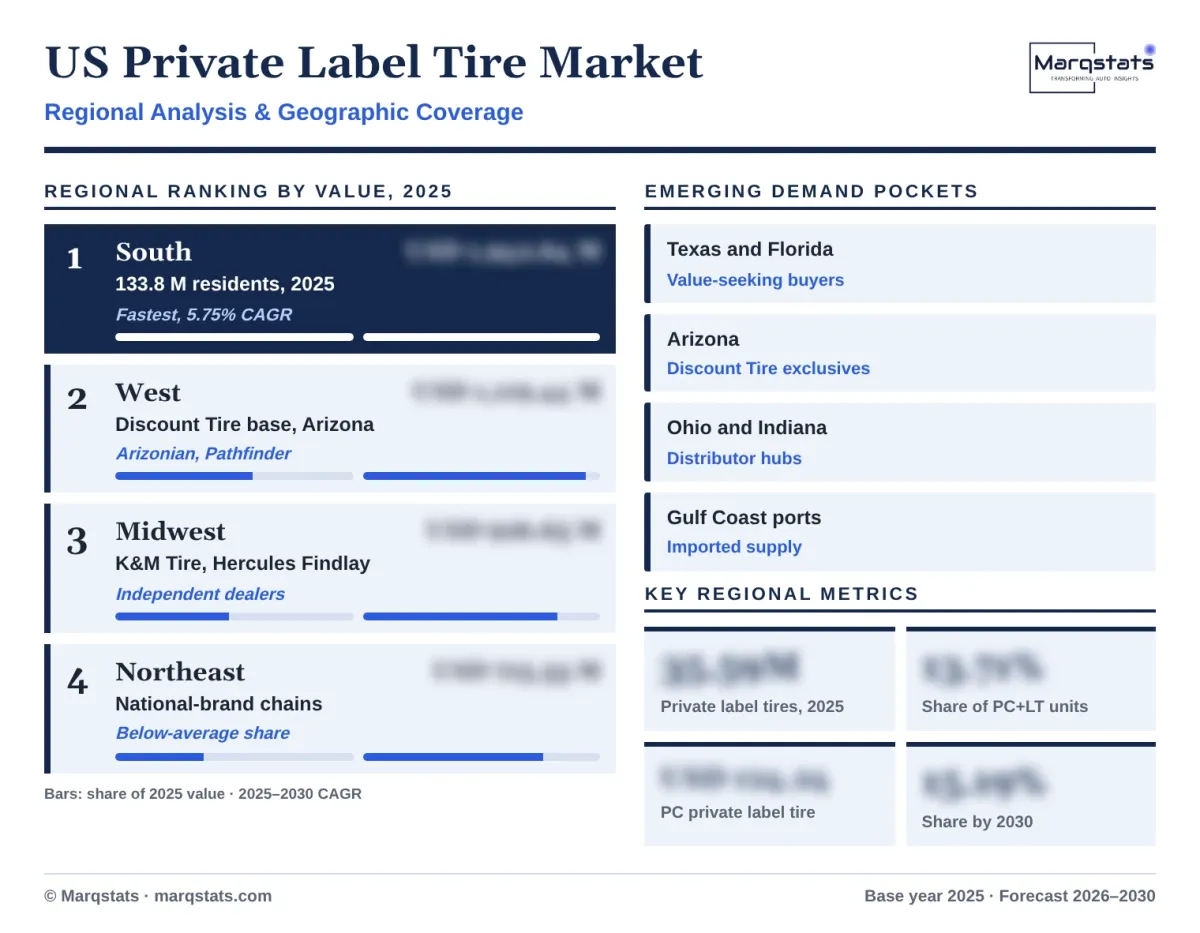
The South is the largest regional market at 41.29% of 2025 value, or USD 1,942.64 million, and grows fastest at a 5.75% CAGR to USD 2,568.73 million by 2030. The region held 133.8 million residents in July 2025, 39.16% of the US population, and long driving distances and price-sensitive buyers in Texas, Florida and Georgia support private brand demand. Omni United's Radar partnership with the Texas Rangers targets this market. Rural and exurban drivers in the region favor value all-terrain tires for pickups. Gulf Coast ports also handle a growing share of imported private brand tires.
West
The West accounts for 23.80% of 2025 value, or USD 1,119.44 million, and is projected to reach USD 1,458.29 million by 2030 at a 5.43% CAGR. Discount Tire, headquartered in Scottsdale, Arizona, sells its Arizonian and Pathfinder brands across the region, and California ports and warehouses handle a large share of imported private brand tires. Long commuting distances in California and Arizona raise tire wear and replacement frequency. Mountain states add demand for private brand all-terrain tires on pickups.
Midwest
The Midwest accounts for 19.70% of 2025 value, or USD 926.65 million, and is projected to reach USD 1,165.59 million by 2030 at a 4.70% CAGR. K&M Tire, based in Delphos, Ohio, added Zurcher's 12 distribution centers in Michigan, Indiana, Illinois, Iowa and Missouri, and Hercules operates a large warehouse in Findlay, Ohio. Independent dealers dominate tire retail in many small Midwestern towns. Regional distributors in the Midwest compete hard with national wholesalers for dealer business.
Northeast
The Northeast accounts for 15.21% of 2025 value, or USD 715.33 million, and is projected to reach USD 886.31 million by 2030 at a 4.38% CAGR. Dense urban markets have more national-brand chain stores and dealership service centers, which keeps private brand share below the national average. Higher labor costs in the region also narrow the price gap between private and national brands at installation. Winter and all-weather private brand lines gain ground in the region's snow belt.
How Competition Is Evolving
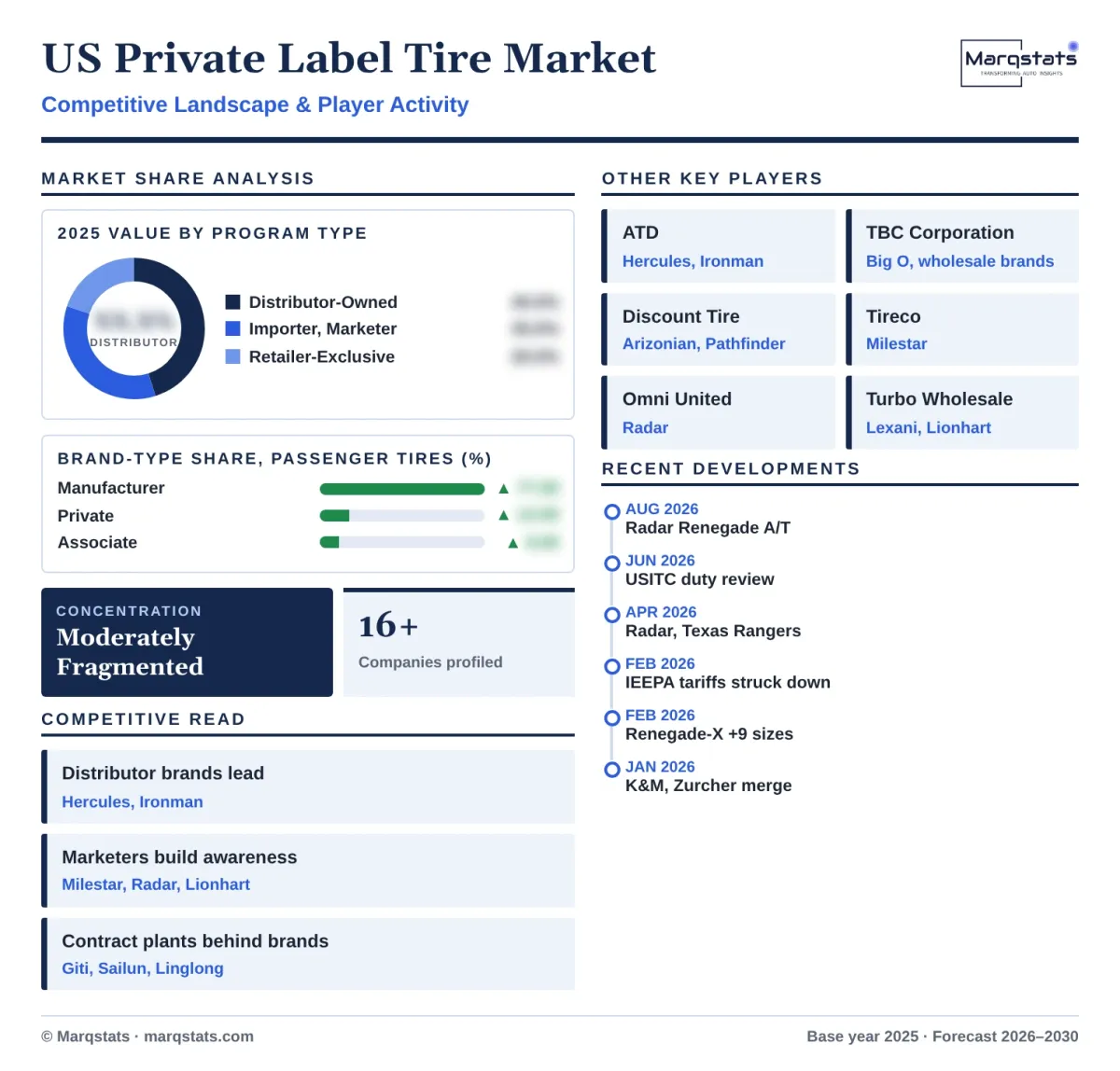
The US private label tire market is moderately fragmented, with a few large distributor brands and many independent marketers. American Tire Distributors, Inc. with Hercules and Ironman, and TBC Corporation with its wholesale and Big O Tires brands, lead distributor-owned programs, while Tireco, Inc., Turbo Wholesale Tires, Inc., Tire Group International, LLC and Omni United (S) Pte. Ltd. compete as independent marketers. The Reinalt-Thomas Corporation and Walmart Inc. run retailer-exclusive brands. No single program holds a dominant share, and many dealers carry two or three private brands at different price points alongside national brands, so brand owners compete for each SKU slot on the dealer's shelf and in the distributor's catalog.
Contract manufacturers sit behind the brands. Giti Tire Pte. Ltd., Sailun Group Co., Ltd., Shandong Linglong Tyre Co., Ltd., Zhongce Rubber Group Co., Ltd. and Triangle Tyre Co., Ltd. produce private brand tires in plants across Asia, and The Goodyear Tire & Rubber Company makes Walmart's Douglas brand. Brand owners compete on supply reliability, size coverage and the ability to move production between countries as duty rules change. Contract factories also make tires for several competing brand owners, so differentiation rests on tread design, warranty terms and marketing rather than on manufacturing alone.
Distribution reach and dealer support decide share. Distributors bundle private brands with dealer programs, marketing funds and next-day delivery, and the K&M Tire and Zurcher Tire merger in early 2026 gave K&M 52 warehouses. Independent marketers build brand awareness through sponsorships and product launches, such as Radar's Renegade A/T in August 2026, to win shelf space from national brands and Tier 2 manufacturer brands.
Ownership changes reshape the field. Creditors took control of American Tire Distributors in May 2025, TBC Corporation sold its company-owned stores in 2023 and its Midas network in 2025 to focus on wholesale and brands, and private brand programs move with these changes. Dealer channel economics are covered in the Marqstats US Tire Dealer Market report.
Companies Covered
Companies covered in the report include:
Recent Market Activity
Table of Contents
Coverage & Segmentation
The US private label tire market comprises new passenger and light truck replacement tires sold under brands owned by distributors, retailers and independent marketers, valued at dealer purchase prices in US dollars. The market excludes manufacturer flagship and associate brands, truck and bus tires, original equipment fitments, retreads and services. Coverage uses a 2025 base year, a 2021–2025 historical period and a 2026–2030 forecast period, with 2026 as the estimated year. US passenger and light truck shipment totals match the Marqstats US Replacement Tire Market report.
Segmentation covers two vehicle types, three brand program types, three sales channels and four US regions, with 16 brand owners, distributors, retailers and contract manufacturers profiled. Units apply private brand shares by tire class to replacement shipments, value applies a discount to the average dealer value per tire, and regional values follow population adjusted for price sensitivity. Sizes such as 205/55R16, 215/55R17, 225/65R17, 235/65R17, LT265/70R17 and LT275/70R18 are tracked as reference sizes. Light truck replacement tires are covered in the Marqstats US SUV and Light Truck Replacement Tire Market report.