Market Snapshot
Middle bar: base-year value × (1 + CAGR), rounded to two decimals. This is a calculated illustration, not a separately researched annual estimate.
Market Size (2025, Base Year): USD 523.13 Million
Estimated Value (2026): USD 810.30 Million
Forecast Value (2030): USD 2,037.80 Million
CAGR: 31.25% | Forecast Period: 2026 – 2030
Growth — Absolute: USD 1514.67 Million
Largest Market: Region Hovedstaden (33.0% of national BEV parc)
Fastest Growing: Tires, Mounting & Chassis Alignment (34.00% of 2025 workshop turnover)
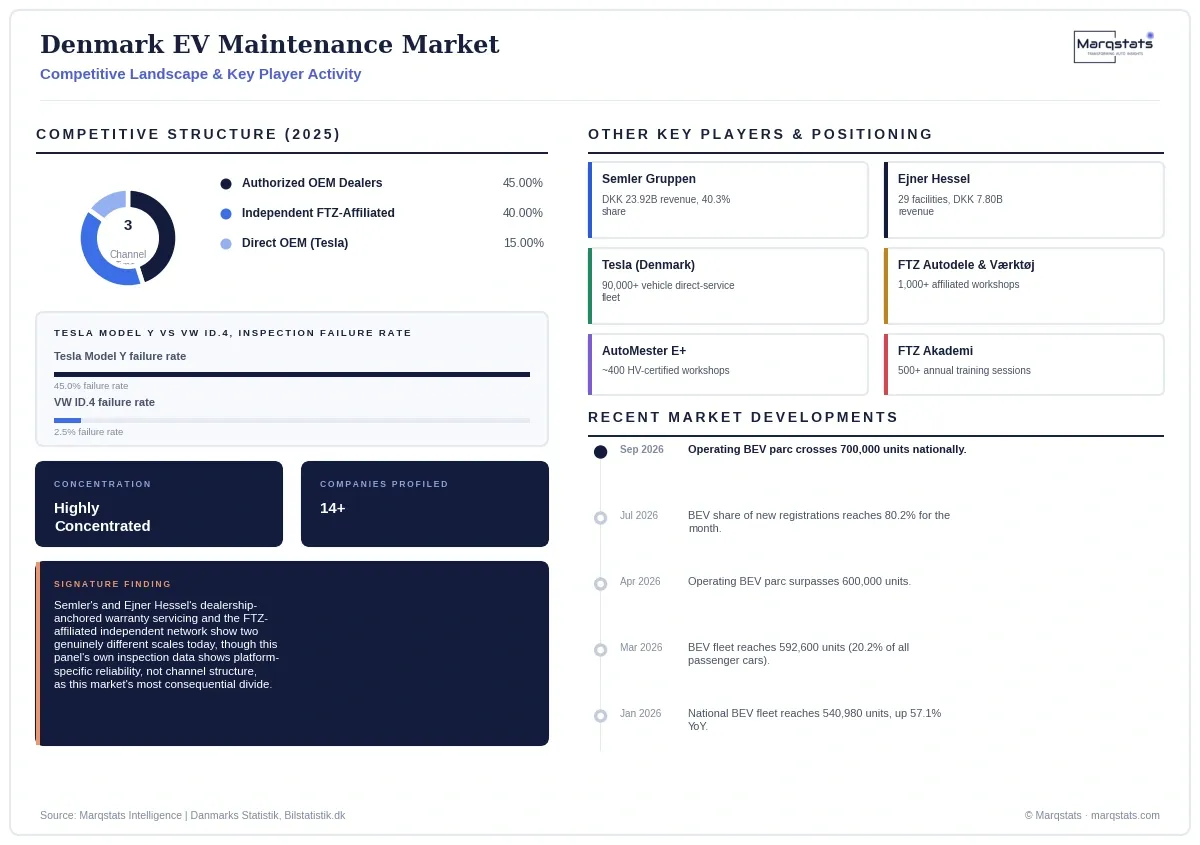
Highest Inspection Risk: Tesla Model Y (45.0% first-inspection failure rate, 2025)
Market Concentration: Moderately Fragmented
Base Year: 2025 | Historical Period: 2021 – 2025 | Forecast Period: 2026 – 2030
Units Considered: Value (USD Million)
Segments Covered: 1 | Regions Covered: 5 | Companies Profiled: 14
Report Pages: 240 | Deliverables: PDF, Excel, PPT
Key Takeaways
Market Overview & Analysis
Report Summary
This analysis reads Denmark's own fully worked sizing chain, statutory inspection data, and regional distribution figures together as a single coherent picture rather than isolated data points, since the underlying research itself was structured to support exactly that kind of integrated reading.
Denmark's EV maintenance market is measured across tires and chassis alignment, brake overhauls, suspension and steering, electrical/high-voltage inspection, and thermal management servicing, valued at USD 523.13 million (DKK 3,475.27 million) in 2025. This figure is taken directly from the underlying research's own fully worked sizing chain, anchored to Danmarks Statistik and Bilstatistik.dk registration records covering an average active operating fleet of 442,710 vehicles.
Structurally, this is a market defined by a genuine platform-specific reliability divergence -- the same-vintage Tesla Model Y and Volkswagen ID.4 failing statutory inspection at wildly different rates -- layered on top of Denmark's near-complete national pivot to pure battery-electric passenger cars, driven by one of Europe's most aggressive EV tax incentive structures.
The analysis is built for four reader types making different decisions: an independent workshop operator weighing FTZ Akademi high-voltage certification investment against the DKK 460,000 full-readiness capital hurdle, a fleet or leasing manager assessing platform-specific reliability risk ahead of first roadworthiness inspections, an authorized dealership group defending warranty-anchored revenue, and an investor tracking how the aging BEV cohort's exit from warranty coverage reshapes channel share.
Same Age, Same Test, an Eighteen-Fold Difference in Outcome
It's easy to talk about EV reliability as a single category. Denmark's own statutory inspection data shows exactly why that framing breaks down once you compare specific platforms head to head.
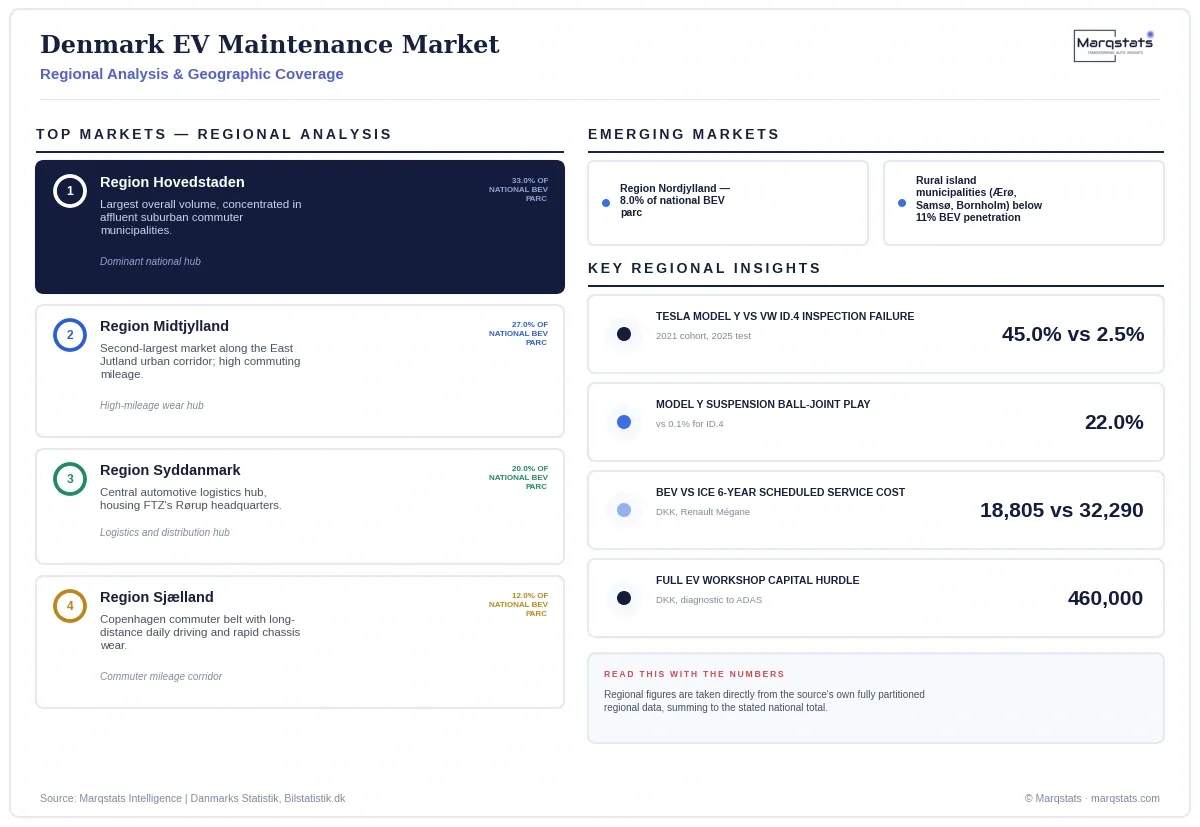
Out of 2,394 Tesla Model Y vehicles from the 2021 registration cohort inspected in 2025 -- their first mandatory 4-year roadworthiness test -- 1,069 failed, a 45.0% failure rate. The Volkswagen ID.4, inspected under identical criteria from the same 2021 vintage, failed at just 2.5%. Same age. Same test. Nearly an eighteen-fold difference. The gap traces to a specific, documented mechanical cause: excessive suspension ball-joint and control-arm-bushing play was found in 22.0% of inspected Model Y units, against just 0.1% for the ID.4 -- a disparity formal enough that it produced consumer warranty disputes at the Danish Automotive Appeals Board. 'Electric' and 'low-maintenance' simply aren't the same claim in this market, and which specific platform a fleet manager or workshop is servicing matters more than whether it's electric at all.
A Tax Structure That Made Denmark's EV Transition Look Almost Total
Denmark's BEV adoption numbers look less like a gradual technology shift and more like a near-complete pivot. The fiscal architecture behind that speed is worth understanding on its own terms.
Conventional fossil-fuel vehicles face registration tax excise brackets reaching up to 150% of vehicle value, while zero-emission vehicles priced below roughly DKK 419,000 remain tax-exempt through at least 2027 under the National Budget Agreement. Layer on residential electricity taxation cut from 72.7 to just 0.8 øre/kWh for 2026 and 2027, and the result shows up directly in the numbers: BEVs accounted for 94.6% of household new-car registrations in January 2026. Internal combustion purchases among retail consumers have fallen to residual levels -- this isn't a market trending toward electrification, it's one that has effectively already arrived.
Market Dynamics
Key Drivers
- The FTZ wholesale network's daily component distribution cadence directly sustains rapid independent-workshop turnaround times nationwide.
- Denmark's own regional data shows a genuine income-and-housing effect concentrating early EV adoption, since affluent single-family-housing municipalities suited for home charging installations directly sustain lower average fleet ages and higher vehicle replacement rates than urban rental-heavy districts, shaping where workshop investment should concentrate first.
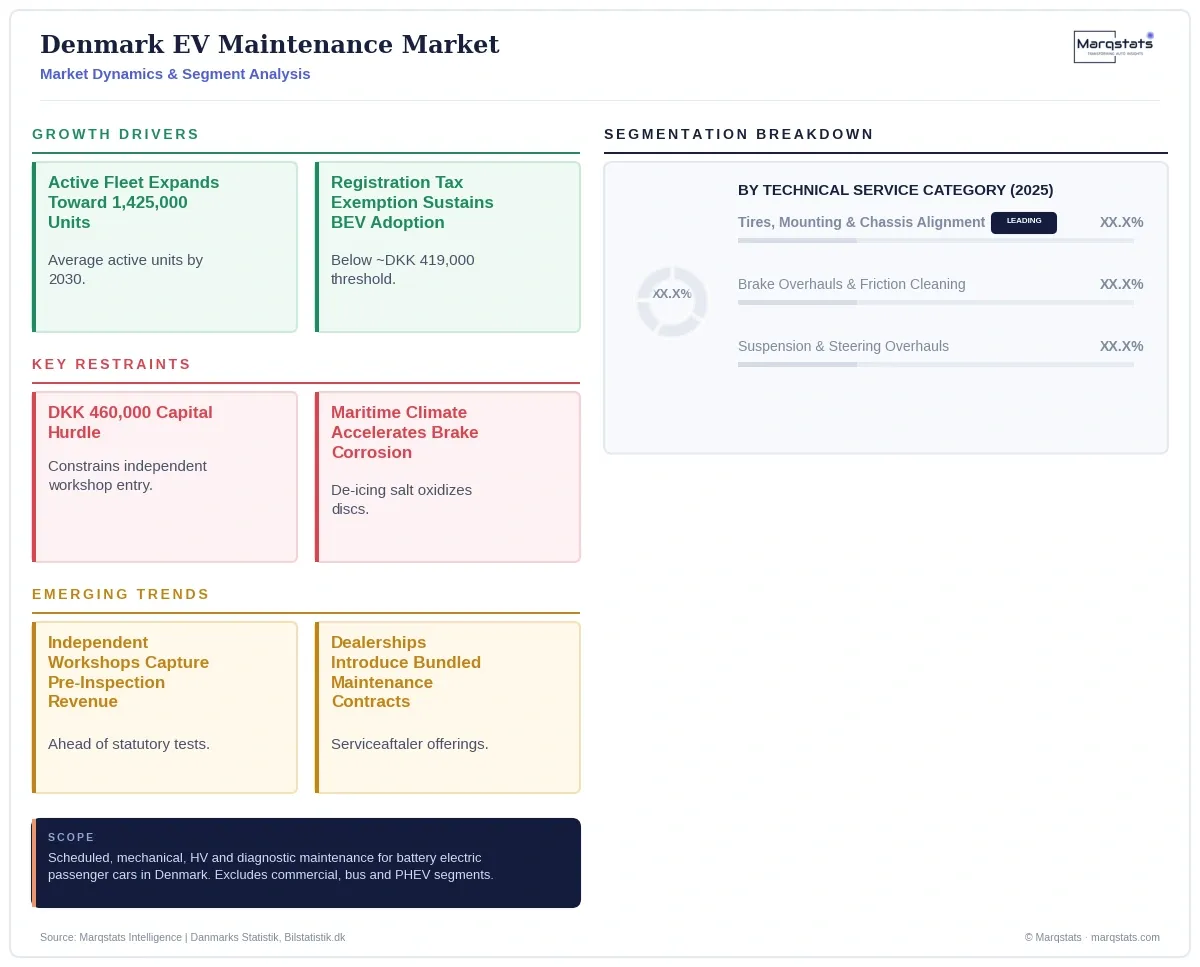
- This market's own fully worked sizing chain shows tires, mounting and chassis alignment already the single largest technical category at 34.00% of 2025 workshop turnover, a structural signal that specialized high-load tire inventory represents the most immediate revenue opportunity for workshops entering this market.
- Denmark's active BEV fleet is expanding rapidly, from 442,710 average active units in 2025 toward a projected 1,425,000 by 2030, directly growing the addressable base for recurring EV aftermarket maintenance demand.
- Denmark's registration tax exemption for zero-emission vehicles below roughly DKK 419,000, preserved through at least 2027, and the 2026-2027 residential electricity tax cut are directly sustaining near-complete household adoption of battery electric vehicles.
- The high statutory roadworthiness inspection failure rates documented among first-generation BEVs -- particularly the Tesla Model Y's 45.0% rate -- are directly creating immediate commercial opportunity for pre-inspection service packages addressing suspension wear and brake disc resurfacing.
- Semler Gruppen's approximately 90,000 annual technician training hours through the Semler Academy, and FTZ Akademi's 500-plus annual training sessions, are directly expanding certified high-voltage technician capacity nationwide.
- FTZ's 1,000-plus affiliated independent workshop network, distributing parts up to 10 times daily from its Rørup logistics facility, is directly sustaining independent aftermarket capacity as the ICE fleet contracts.
Key Restraints
- Denmark's maritime winter climate genuinely constrains the brake-wear savings EVs typically promise, since road de-icing salt exposure and regenerative-braking underutilization combine to accelerate cast-iron disc corrosion regardless of how lightly the friction system is actually used day to day.
- The stark platform-specific reliability gap documented at statutory inspection -- Tesla Model Y's 45.0% failure rate against the Volkswagen ID.4's 2.5% -- directly restrains any blanket marketing claim that electric vehicles are inherently low-maintenance, since fleet buyers and consumers evaluating specific models face genuinely different risk profiles within the same powertrain category.
- A full baseline capital hurdle of DKK 460,000 for diagnostic hardware, high-voltage tooling, battery drop lifts, and ADAS calibration systems directly constrains independent workshop entry into comprehensive EV servicing.
- Manufacturer warranty coverage spanning 4 to 5 years or 100,000 to 150,000 km directly binds newer vehicle owners to authorized dealer networks, constraining independent workshop volume until the fleet matures further.
- Denmark's maritime climate directly accelerates brake disc corrosion, since regenerative braking underutilizes traditional hydraulic friction brakes while winter road de-icing salts oxidize cast-iron discs, generating recurring failure-mode service demand rather than the reduced brake maintenance EVs typically promise.
- This market's own disclosed limitation -- a single forward trajectory rather than a range of named scenarios -- means Marqstats cannot present the same disclosed upside-downside spread available for most other countries in this vertical; this is flagged honestly rather than papered over with an invented range.
Key Trends
- Regional service capacity is beginning to diverge sharply between Hovedstaden's dense warranty-checkup-focused workshop network and Nordjylland's rural mixed-fleet garages, raising genuine open questions about whether that two-track structure will persist or converge as the national fleet's average age climbs toward 2030.
- Insurers and leasing companies are increasingly differentiating premium and residual-value assumptions by specific vehicle platform rather than by powertrain type alone, given how directly the documented inspection failure-rate gap between Tesla and Volkswagen Group models demonstrates model-level, not category-level, reliability risk.
- Independent workshops are directly capturing pre-inspection service revenue by addressing suspension joint wear, brake disc resurfacing, and sensor calibration ahead of statutory roadworthiness tests, given the high documented first-inspection failure rates among leading BEV models.
- Authorized dealership groups are directly introducing bundled maintenance contracts (serviceaftaler) covering wear-prone chassis parts and over-the-air software support to mitigate customer retention drop-off as vehicles exit warranty.
- Component distributors including FTZ are directly realigning inventory away from ICE-specific parts toward heavy-duty suspension links, corrosion-resistant brake rotors, and high-load-capacity EV tires.
- Regulatory compliance for heat pump and refrigerant servicing is directly expanding under Commission Implementing Regulation (EU) 2025/1893, with FTZ Akademi introducing dedicated R744 transcritical refrigeration training modules in 2026.
Strategic Implications
- Authorized dealers should also weight suspension and chassis diagnostic capacity heavily specifically, given how directly this market's signature inspection-failure finding traces to exactly this component category.
- Insurers should also weight platform-specific inspection failure history heavily when pricing comprehensive coverage nationwide, given how directly the Model Y-versus-ID.4 gap demonstrates that powertrain type alone is a poor proxy for mechanical risk.
- Component suppliers should also weight EV-specific tire and suspension bushing inventory planning heavily nationwide, given how directly both categories anchor this market's largest documented service revenue drivers and its signature reliability finding.
- Independent repair facilities should attain Level 2 high-voltage technical certification and offer specialized pre-inspection packages specifically, given how directly the documented 45.0% Tesla Model Y first-inspection failure rate creates immediate, quantifiable commercial opportunity.
- Authorized franchise dealerships should expand bundled maintenance contract offerings specifically, given how directly margin pressure builds as vehicles age past their initial 2-to-5-year warranty period and enter independent networks.
- Parts manufacturers and distributors should realign inventory toward heavy-duty suspension links, corrosion-resistant brake rotors, and high-load-capacity tires specifically, given how directly these categories anchor this market's largest documented service revenue drivers.
- Fleet and leasing managers should evaluate platform-specific reliability data before vehicle acquisition specifically, given how directly the Model Y-versus-ID.4 inspection gap shows that model selection, not powertrain type alone, drives maintenance risk.
Outlook
Unlike most other countries in this coverage set, the underlying research presents a single forward trajectory through 2030 rather than a named set of alternative scenarios. This is disclosed honestly here rather than papered over with an invented range.
The active operating BEV fleet expands from 442,710 average active units in 2025 to a projected 1,425,000 average active units by 2030, consistent with the Danish Energy Agency's Climate Status and Outlook 2026 projection of approximately 1.5 million total registered BEVs comprising over 45% of the national passenger fleet. Total market value grows from USD 523.13 million (DKK 3,475.27 million) in 2025 to USD 2,037.80 million (DKK 13,537.50 million) by 2030, a 31.25% CAGR, as average per-vehicle expenditure rises from DKK 7,850 to DKK 9,500 annually with fleet maturation and the progressive expiration of initial 4-to-5-year manufacturer warranty coverage.
This trajectory assumes Denmark's registration tax exemption for zero-emission vehicles below roughly DKK 419,000 remains in force through the forecast period, the residential electricity tax reduction to 0.8 øre/kWh persists through at least 2027, and certified high-voltage technician training through the Semler Academy and FTZ Akademi continues expanding to meet the aging fleet's servicing demand. A sensitivity analysis on the central per-vehicle spend assumption shows a DKK 50 variance shifts the 2025 base valuation by DKK 221.35 million (USD 33.32 million), and by 2030 the same variance across 1,425,000 active units shifts total market value by DKK 712.50 million (USD 107.25 million), underscoring fleet volume and average vehicle operational age as the primary determinants of market scale.
Market Segmentation
By Geography
Region Hovedstaden (Capital Region)
33.0% of the national BEV parc (178,500 units, 23.4% regional fleet penetration), the largest overall volume, concentrated in affluent suburban commuter municipalities north of Copenhagen with low average fleet age and workshop demand focused on routine warranty checkups and seasonal tire changes.
Region Midtjylland
27.0% of the national BEV parc (146,000 units, 20.8% regional penetration), the second-largest market, centered along the East Jutland urban corridor, where long commuting distances accelerate wear on tires, suspension linkages, and brake components.
Region Syddanmark
20.0% of the national BEV parc (108,000 units, 17.5% regional penetration), supported by single-family housing suited for home charging and serving as a central automotive logistics hub, housing FTZ's Rørup headquarters.
Region Sjælland
12.0% of the national BEV parc (65,000 units, 15.2% regional penetration), covering commuter populations traveling into the Copenhagen metropolitan area, where long commuting distances lead to faster mileage accumulation and mechanical wear.
Region Nordjylland
8.0% of the national BEV parc (43,480 units, 13.6% regional penetration), exhibiting the lowest electrification rates alongside rural island municipalities where average vehicle ages range from 14.5 to 15.4 years, producing a two-track aftermarket of fast-moving urban EV workshops and rural garages still focused on aging ICE fleets.
How Competition Is Evolving
Overall market concentration is genuinely expected to shift somewhat by 2030 as the fleet matures out of warranty.
No single company in this market spans authorized dealership warranty servicing, independent FTZ-affiliated franchise coverage, and direct OEM service simultaneously, leaving genuine competitive white space for any group capable of bridging Semler's and Ejner Hessel's dealership-anchored warranty servicing with the independent networks this market's aging fleet will increasingly rely on as vehicles exit warranty.
The Danish EV aftermarket splits between authorized dealership networks and independent repair chains supported by national wholesale distributors, without a stated numeric value split between channels in the underlying research; that limitation is disclosed here rather than an invented percentage. Semler Gruppen A/S, Denmark's largest automotive enterprise, generated DKK 23.92 billion in 2025 revenue with a 40.3% new-passenger-car market share across Volkswagen, Audi, Škoda, SEAT, Cupra and Porsche, operating extensive authorized workshop networks. Ejner Hessel A/S recorded DKK 7.80 billion in annual revenue across 29 facilities servicing Mercedes-Benz, Renault, Dacia and Ford electric vehicles. Tesla operates outside traditional dealership structures via a direct-service model with centralized hubs in Greve, Hillerød, Odense, Aarhus and Aalborg, though its more than 90,000-vehicle Danish fleet faces service capacity constraints pushing many owners toward independent workshops.
FTZ Autodele & Værktøj A/S is the primary wholesale distributor, generating DKK 2.5 billion in annual turnover from a 40,000-square-meter Rørup logistics facility and 50 regional branches, distributing components up to 10 times daily via a 370-vehicle fleet to more than 1,000 affiliated independent workshops under the AutoMester/E+, CarPeople and Din Bilpartner banners. Bosch Car Service provides diagnostic systems and calibration hardware in partnership with Robert Bosch A/S. Regulatory oversight rests with the Danish Road Safety Agency (Færdselsstyrelsen, statutory inspections) and the Danish Working Environment Authority (Arbejdstilsynet, high-voltage safety tiers).
Companies Covered
Companies covered in the report include:
Recent Market Activity
Table of Contents
Coverage & Segmentation
The analysis measures routine scheduled service, high-voltage battery diagnostic checks, electric drive unit servicing, friction brake maintenance and refurbishment, suspension and steering overhauls, EV-specific tire replacement cycles, and thermal management servicing for battery electric passenger vehicles in Denmark, across a 2025 base year and a 2026 to 2030 forecast period, denominated in United States dollars at the pack's own stated 2025 annual average rate of 6.6432 DKK per USD. Unlike several other markets in this coverage set, this pack contains no meaningful commercial-vehicle, bus, or plug-in-hybrid segmentation.
The analysis spans one quantified segmentation dimension (technical service category, 2025 only), five regional groupings, and 14 profiled entities across dealership groups, independent franchise networks and regulatory bodies. Fleet figures trace to Danmarks Statistik and Bilstatistik.dk; market value traces directly to the underlying research's own fully worked sizing model, with both 2025 and 2030 figures directly source-stated. Unlike most other countries in this vertical, this pack presents a single forward trajectory rather than named alternative scenarios, and its technical service category split and channel structure lack a stated 2030 breakdown -- both disclosed honestly rather than invented.