Market Snapshot
Middle bar: base-year value × (1 + CAGR), rounded to two decimals. This is a calculated illustration, not a separately researched annual estimate.
Market Size (2025, Base Year): USD 118.99 Million
Estimated Value (2026): USD 144.55 Million
Forecast Value (2030): USD 754.00 Million
CAGR: 44.68% | Forecast Period: 2026 – 2030
Growth — Absolute: USD 635.01 Million
Largest Market: Mazowieckie / Warsaw Hub (23.00% of 2025 maintenance spend)
Fastest Growing: Independent Aftermarket (28.00% to 55.00% share, 2025-2030)
Dominant Segment: PHEV Maintenance (56.08% of 2025 market value despite 48.83% fleet share)
Market Concentration: Moderately Fragmented
Base Year: 2025 | Historical Period: 2021 – 2025 | Forecast Period: 2026 – 2030
Units Considered: Value (USD Million)
Segments Covered: 2 | Regions Covered: 6 | Companies Profiled: 14
Report Pages: 240 | Deliverables: PDF, Excel, PPT
Key Takeaways
Market Overview & Analysis
Report Summary
This analysis reads Poland's own fully worked sizing chain, regional distribution data, and named-scenario regulatory framework together as a single coherent picture rather than isolated data points, since the underlying research itself was structured to support exactly that kind of integrated reading.
Poland's EV maintenance market is measured across PHEV and BEV powertrain servicing and OEM-versus-independent service channels, valued at USD 118.99 million (PLN 475.96 million) in 2025. This figure is taken directly from the underlying research's own fully worked sizing chain, anchored to PZPM/PSNM registration data covering an active fleet of 249,321 units.
Structurally, this is a market defined by a genuine PHEV profitability paradox -- the smaller-by-count powertrain segment generating the majority of service revenue -- layered on top of a severe SEP G1 technician certification bottleneck and a corporate-fleet-dominated ownership structure that concentrates purchasing power among lease companies rather than individual consumers.
The analysis is built for four reader types making different decisions: an independent workshop operator weighing SEP G1 certification investment against the PLN 15,000-to-25,000 high-voltage bay retrofit cost, a corporate fleet manager negotiating standardized service-level agreements, an authorized dealer group defending warranty-anchored revenue, and an investor tracking how Clean Transport Zone expansion and post-subsidy adoption pace shape this market's two-scenario range.
Why the Smaller Half of the Fleet Generates the Bigger Half of the Revenue
Plug-in hybrids look like a transitional technology destined to fade as pure electric vehicles mature. Poland's own workshop revenue data tells a genuinely different story about which powertrain actually keeps the aftermarket in business today.
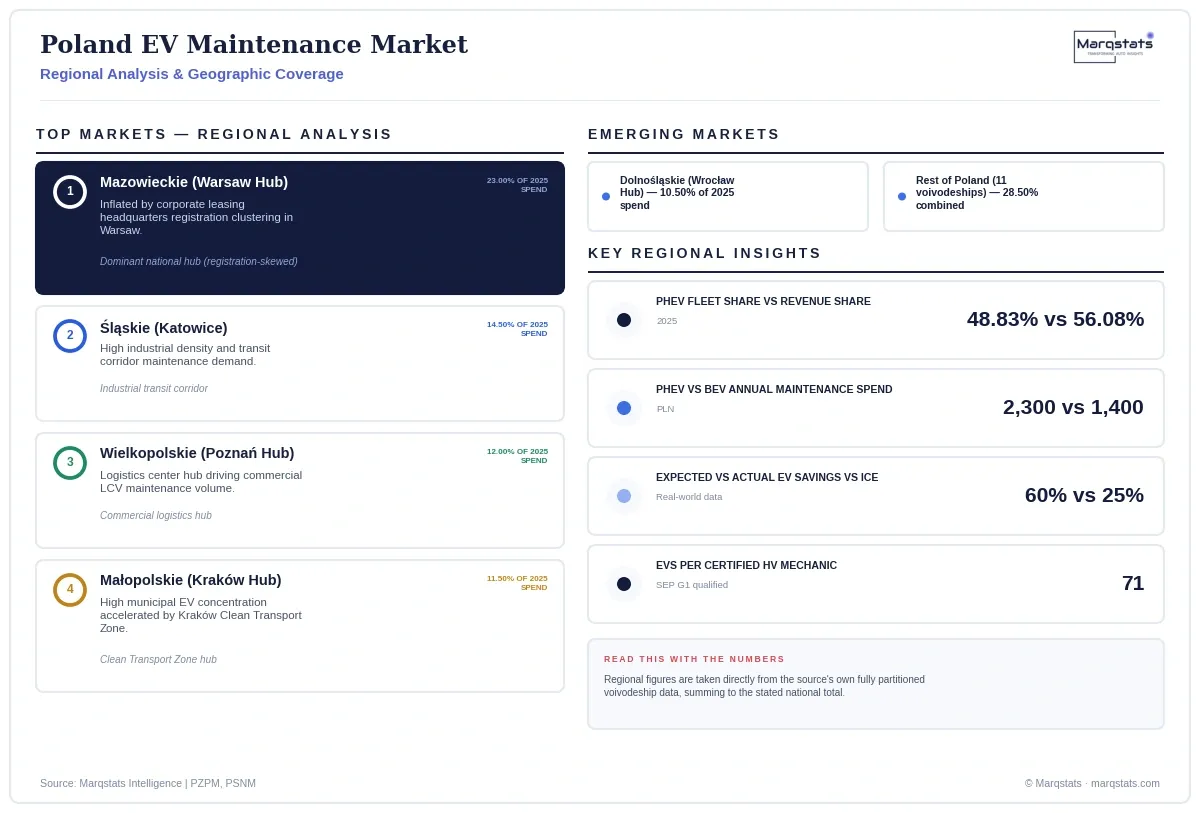
PHEVs make up 48.83% of Poland's 2025 electrified passenger fleet -- less than half -- yet generate 56.08% of total EV passenger maintenance revenue. The mechanism is straightforward once you trace it through: a plug-in hybrid never gets to retire its internal combustion service schedule. It still needs engine oil, spark plug and filter replacements on the same intervals as a conventional petrol car, and it adds high-voltage battery insulation checks and dual-powertrain diagnostics on top of that -- not instead of it. Average annual PHEV servicing spend of PLN 2,300 runs 64.29% above pure BEV spend of PLN 1,400. Less than half the fleet, more than half the revenue: plug-in hybrids are the quiet profitability engine of the Polish EV aftermarket, not the pure battery-electric vehicles that dominate industry attention and marketing.
A Technician Shortage With a Number Attached to Every Vehicle
Most discussions of EV technician shortages stay vague -- 'not enough qualified staff.' Poland's own registry data lets you attach an actual ratio to that shortage, and it's worth sitting with the number.
Mandatory SEP G1 high-voltage qualification requirements restrict traction battery diagnostic work to fewer than 18% of Poland's approximately 20,000 independent repair shops, leaving roughly 3,500 qualified technicians nationally against an active EV fleet of 249,321 units -- a ratio of 71 electric vehicles per certified mechanic. That's not a distant future problem; it's today's reality, and it's the single clearest reason authorized dealer networks (ASO) currently retain 72.00% of EV maintenance value despite independent workshops' typically lower labor rates. Until certification capacity scales meaningfully, the qualification bottleneck, not customer preference, is what decides where EV service revenue actually flows in Poland.
Market Dynamics
Key Drivers
- The Q1 2026 Electromobility Meter's 75% year-on-year BEV registration growth directly signals accelerating near-term fleet expansion nationwide.
- EU Regulation 2019/631's fleet CO2 performance standard is directly enforcing a legal floor under automaker zero-emission production targets in Poland regardless of national subsidy timing, providing this market's underlying demand trajectory with a structural backstop independent of domestic political cycles.
- Weighted average new electric passenger car prices falling 20% between H1 2024 and H1 2025 are directly expanding C-segment EV sales volume, creating a growing pool of out-of-warranty 3-to-5-year-old vehicles that will enter independent repair channels over the coming forecast years.
- Poland's own regional data shows a genuine corporate registration effect, since lease fleets registered under Mazowieckie headquarters disperse a documented share of real-world commuting and delivery mileage into surrounding voivodeships, sustaining service demand pure registration data alone would understate.
- This market's own fully worked sizing chain shows PHEV maintenance already the single largest powertrain category at 56.08% of 2025 value despite a smaller fleet share, a structural signal that dual-powertrain service capacity represents the most immediate revenue opportunity for workshops entering this market.
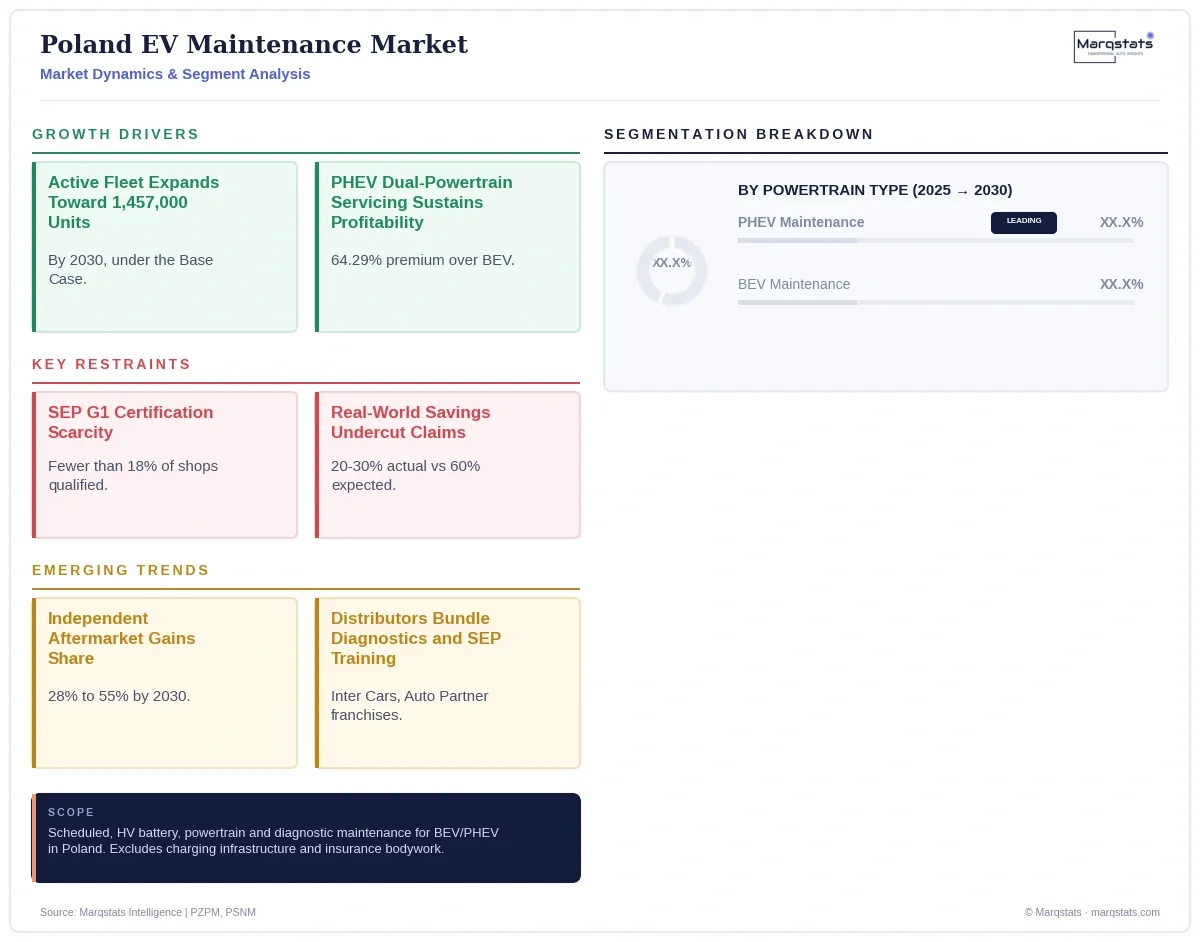
- Poland's active plug-in EV fleet is expanding rapidly, from 249,321 units in 2025 toward a projected 1,457,000 units by 2030 under the Base Case, directly growing the addressable base for recurring EV aftermarket maintenance demand.
- PHEV maintenance's structurally higher per-vehicle spend is directly sustaining aftermarket profitability even as the fleet mix shifts, since dual-powertrain servicing needs generate 64.29% more revenue per vehicle than pure BEVs.
- Clean Transport Zones activated in Kraków and Warsaw in January 2026 are directly accelerating commercial LCV fleet electrification, driving a 34% increase in commercial EV routine servicing demand across major urban logistics nodes.
- Corporate fleet management companies controlling 82% of new BEV registrations are directly standardizing maintenance purchasing through service-level agreements, sustaining predictable recurring revenue for major parts distributors.
- Rapid DC fast-charging infrastructure expansion (4,399 points by end-2025, up 63%) is directly increasing average annual EV mileage by approximately 18%, accelerating thermal management fluid degradation and suspension bushing replacement frequencies.
Key Restraints
- A genuine expectation gap between marketed EV cost savings and real-world independent workshop data directly complicates aftermarket sales messaging, since consumers anchored on early OEM whitepaper claims of 60% savings may react negatively upon discovering actual net savings closer to 25% once accelerated chassis wear is factored in.
- Independent workshop operators lacking SEP G1 certification genuinely face a legal prohibition, not merely a competitive disadvantage, since Polish Labor Code (BHP) rules bar mechanics without valid E1/D1 qualifications from disassembling any high-voltage component regardless of the mechanic's general automotive experience level.
- Poland's absence of a domestic hydrometallurgical or pyrometallurgical traction battery recycling facility genuinely constrains end-of-life pack handling for collision and warranty repairers, a logistical gap the underlying research itself flags as unresolved rather than papered over with an invented solution.
- Mandatory SEP G1 high-voltage certification requirements directly restrict traction battery diagnostic work to fewer than 18% of independent repair shops, concentrating high-margin EV battery servicing within authorized dealer networks and constraining independent workshop revenue capture.
- High-voltage workshop bay setup costs of PLN 15,000 to PLN 25,000 per bay directly delay independent garage retrofits, causing regional service capacity shortages outside Poland's major metropolitan centers.
- Real-world maintenance savings running only 20% to 30% below petrol vehicles, well under early OEM whitepaper claims of 60%, directly complicates the aftermarket cost-savings pitch, since accelerated tire and suspension wear from battery weight offsets much of the powertrain-side savings.
- This market's own two-scenario framework spans a genuinely wide 2030 range, from USD 754.00 million under the Base Case to USD 915.20 million under the Accelerated Scenario -- a disclosed spread reflecting real uncertainty in subsidy renewal and Clean Transport Zone expansion timing, not a narrow band around a single estimate.
Key Trends
- Insurance providers are directly beginning to differentiate EV coverage terms by documented real-world repair driver categories specifically, given how directly brake caliper seizure and junction box thermal stress claims data diverges from conventional petrol-vehicle claims patterns.
- Fleet operators managing heavy-duty commercial e-LCVs under Clean Transport Zone mandates are directly negotiating dedicated depot maintenance contracts with commercial-focused service providers, given the documented higher annual mileage and heavier duty cycles these platforms carry relative to private passenger BEVs and PHEVs.
- Regional service capacity is beginning to diverge sharply between Mazowieckie's dense corporate-fleet-driven workshop concentration and the fragmented rural voivodeships, raising genuine open questions about whether that gap will narrow as the fleet matures toward the 2030 forecast, given that a 2030 regional breakdown is not yet published in the underlying research.
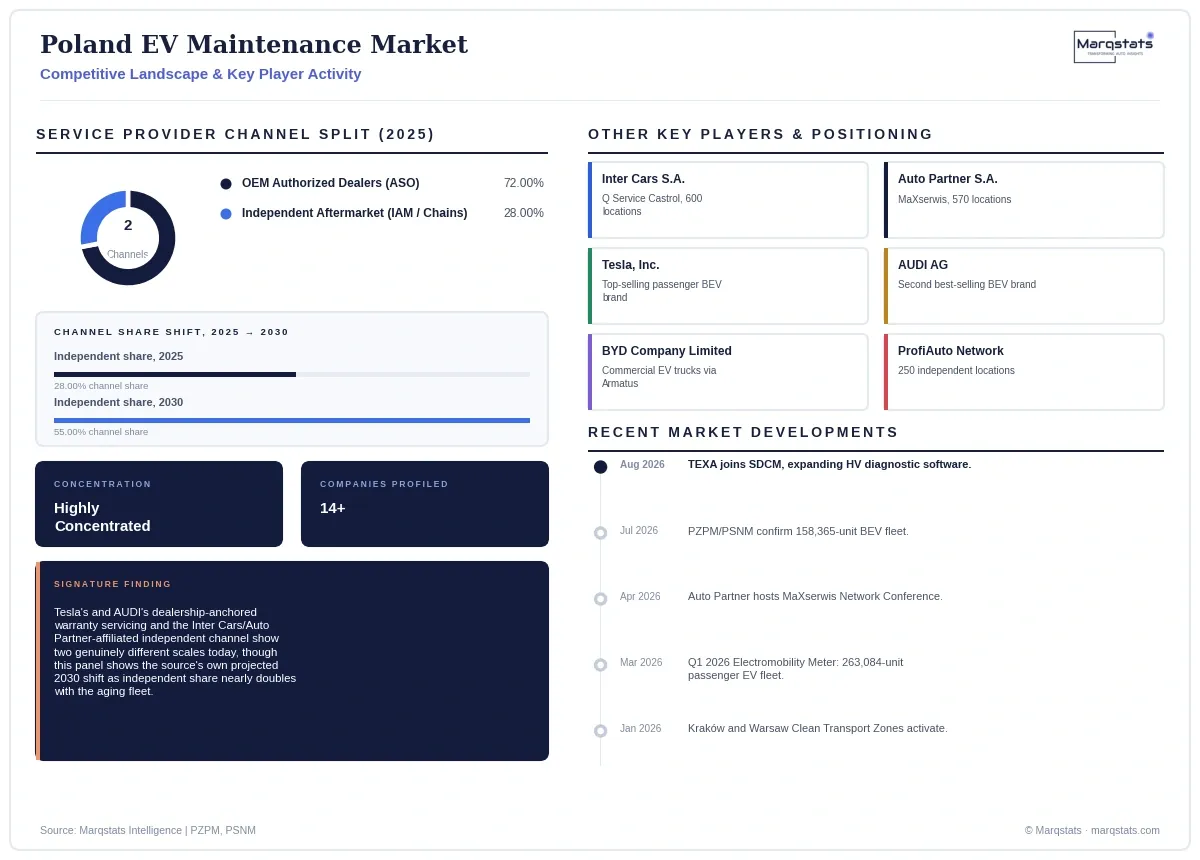
- Independent aftermarket chains -- Q Service Castrol, MaXserwis, ProfiAuto -- are directly gaining share against authorized dealers, projected to expand from 28.00% to 55.00% of total market value by 2030 as the EV fleet ages out of factory warranty coverage.
- Parts distributors Inter Cars and Auto Partner are directly bundling technical repair software, diagnostic equipment, and SEP training into franchise network agreements to compete for EV aftermarket dominance across their affiliated workshop chains.
- Premature brake caliper seizing from regenerative braking underutilization, and junction box thermal stress, are directly emerging as the top EV repair drivers identified in MotoFocus mechanic surveys, ahead of electric motor reliability concerns.
- The scheduled expiration of "NaszEauto" purchase subsidies in H1 2026 is directly expected to cool new EV sales growth in late 2026, while the 1-to-3-year-old EV cohort entering initial maintenance cycles expands 118% year-on-year.
Strategic Implications
- Franchised dealers should also weight PHEV-specific dual-powertrain diagnostic capacity heavily nationwide, given how directly this segment anchors this market's single largest documented profitability driver despite its smaller fleet share.
- Component suppliers should also weight thermal management fluid and regenerative-braking-duty caliper inventory heavily nationwide, given how directly these two categories anchor this market's documented top real-world repair drivers ahead of electric motor reliability concerns.
- Insurers and fleet risk managers should also weight junction box thermal stress and brake caliper seizure prevention heavily in maintenance contract design nationwide, given how directly these two failure modes were identified as the top EV repair drivers ahead of electric motor reliability concerns in MotoFocus mechanic surveys.
- Independent workshop operators should prioritize SEP G1 E1/D1 certification investment specifically, positioning ahead of the fleet-wide warranty expiration wave given how directly the current 71-EVs-per-mechanic ratio signals acute capacity scarcity rather than a distant future problem.
- Authorized dealership networks should extend structured PHEV-specific service packages specifically, given how directly plug-in hybrids' dual-powertrain maintenance needs make them this market's single largest profitability driver.
- Parts distributors and equipment manufacturers should prioritize EV-specific tire, suspension bushing, and regenerative-braking-duty brake caliper inventory specifically, given how directly these categories anchor this market's largest documented service revenue drivers.
- Investors and analysts should track NFOŚiGW subsidy renewal decisions and Clean Transport Zone expansion timing across Poznań, Wrocław, Gdańsk and Łódź as the two clearest variables separating this market's Base Case and Accelerated scenarios.
Outlook
Testing in the underlying research confirmed the Polish EV maintenance market supports only two differentiated forward scenarios based on specific regulatory triggers, not three -- disclosed honestly here rather than an invented third path, since EU fleet emission mandates enforce a legal adoption floor regardless of national subsidy timing.
Under the Base Case, the scheduled expiration of the "NaszEauto" purchase subsidy scheme in H1 2026 is followed by market recovery in 2027 driven by EU Regulation 2019/631 fleet emission compliance penalties on automakers; the active fleet reaches 1,457,000 units by 2030 (1,450,000 light EVs plus 7,000 buses and heavy vehicles), generating USD 754.00 million (PLN 3,016.00 million) in total market value at a 44.68% CAGR.
Under the Accelerated High-Voltage Aftermarket Adoption Scenario, the Polish National Fund for Environmental Protection (NFOŚiGW) enacts an extended zero-emission subsidy program before December 2026, combined with statutory expansion of Clean Transport Zones to four additional metropolitan cities -- Poznań, Wrocław, Gdańsk and Łódź -- by 2028; the active fleet expands to 1,720,000 units by 2030, lifting total market value to USD 915.20 million.
Market Segmentation
USD 66.73 million (56.08% share) in 2025, growing to USD 357.47 million (47.41% share) by 2030. The current profitability engine, anchored by dual-powertrain servicing at Inter Cars-affiliated networks, despite fleet share compressing toward 2030.
USD 52.26 million (43.92% share) in 2025, growing to USD 396.53 million (52.59% share) by 2030. Anchored by Auto Partner-affiliated networks, overtaking PHEV value share by 2030 as pure electric adoption scales.
USD 85.67 million (72.00% share) in 2025, growing to USD 339.30 million (45.00% share) by 2030. Anchored by Tesla and AUDI, sustained by SEP G1 certification scarcity concentrating high-voltage work within franchised networks.
USD 33.32 million (28.00% share) in 2025, growing to USD 414.70 million (55.00% share) by 2030. The fastest-growing channel, anchored by Q Service Castrol and MaXserwis, capturing majority share by 2030 as vehicles exit warranty.
By Geography
Mazowieckie (Warsaw Hub)
23.00% of 2025 maintenance spend (54,659 units), inflated by a registration clustering artefact since corporate leasing headquarters concentrate BEV registrations in Warsaw regardless of where the vehicles actually operate.
Śląskie (Katowice / Upper Silesia)
14.50% of 2025 maintenance spend (34,459 units), driven by high industrial density and transit corridor maintenance demand.
Wielkopolskie (Poznań Hub)
12.00% of 2025 maintenance spend (28,518 units), anchored by Poznań's role as a logistics center driving commercial LCV maintenance volume.
Małopolskie (Kraków Hub)
11.50% of 2025 maintenance spend (27,329 units), accelerated by high municipal EV concentration following the January 2026 Kraków Clean Transport Zone activation.
Dolnośląskie (Wrocław Hub)
10.50% of 2025 maintenance spend (24,953 units), sustained by an automotive manufacturing cluster with strong local EV adoption.
Rest of Poland (11 Voivodeships)
28.50% of 2025 maintenance spend (67,731 units), spanning a fragmented rural and minor urban active vehicle fleet; a 2030 regional breakdown is not published in the underlying research and is disclosed here as a gap rather than estimated.
How Competition Is Evolving
Consolidation pressure on smaller uncertified independent operators is genuinely likely to increase further.
This landscape genuinely continues consolidating around the two dominant distributor-affiliated franchise anchors as SEP certification compliance costs rise nationwide.
Overall market concentration is genuinely expected to shift somewhat by 2030 as independent aftermarket share overtakes authorized dealer share for the first time.
No single company in this market spans authorized dealer warranty servicing, distributor-affiliated independent franchise coverage, and diagnostic equipment supply simultaneously, leaving genuine competitive white space for any group capable of bridging Tesla's and AUDI's dealership-anchored warranty servicing with the Inter Cars and Auto Partner-affiliated independent networks this market's own scenario framework shows expanding sharply by 2030.
Competition spans two dominant parts distributor-affiliated franchise networks, franchised OEM dealerships, and specialized international workshop concepts. Inter Cars S.A., the largest CEE automotive parts distributor, operates the Q Service Castrol network of approximately 600 affiliated locations and, through subsidiary Armatus Sp. z o.o., serves as official dealer for BYD electric commercial trucks. Auto Partner S.A. operates the MaXserwis network of approximately 570 locations, including more than 80 premium-tier MaXserwis Premium Motul sites. ProfiAuto Network (Moto-Profil) and Bosch Car Service Polska operate parallel independent and franchised workshop networks. Tesla and AUDI led 2025 passenger BEV sales, with BMW, Mercedes-Benz, Hyundai, Kia and Stellantis maintaining parallel authorized dealer service networks.
Chinese entrants XPeng and Chery are expanding authorized service coverage alongside new model launches, including the 800V-architecture XPeng G6. Component suppliers NRF, FORVIA Hella, BorgWarner and Clarios support the thermal management, electric drive and auxiliary battery segments of the independent parts supply chain. TEXA S.p.A., a diagnostic equipment manufacturer, joined the Stowarzyszenie Dystrybutorów i Producentów Części Motoryzacyjnych (SDCM) trade association in August 2026, expanding high-voltage diagnostic software availability. Regulatory oversight rests with PZPM and PSNM (registration tracking), Transportowy Dozór Techniczny (TDT, inspection supervision), and Stowarzyszenie Elektryków Polskich (SEP, high-voltage technician certification).
Companies Covered
Companies covered in the report include:
Recent Market Activity
Table of Contents
Coverage & Segmentation
The analysis measures scheduled maintenance, high-voltage battery diagnostics, powertrain servicing, brake and suspension repair, thermal management servicing, and mandatory technical inspections for battery electric and plug-in hybrid vehicles across light passenger (M1) and commercial (N1, N2, N3) categories registered in the Central Register of Vehicles (CEP) in Poland, across a 2025 base year and a 2026 to 2030 forecast period, denominated in United States dollars at the pack's own stated constant 2025 average rate of 4.00 PLN per USD. It excludes public charging infrastructure capital expenditure, electrical energy sales for EV charging, motor vehicle insurance bodywork repairs, and new or used vehicle sales value.
The analysis spans two segmentation dimensions — powertrain type and service provider channel — six regional groupings, and 14 profiled entities across parts distributors, franchise networks and regulatory bodies. Fleet figures trace to PZPM/PSNM statutory data; market value and both segmentation dimensions trace directly to the underlying research's own fully worked sizing model, with both 2025 and 2030 figures directly source-stated throughout.