Market Snapshot
Middle bar: base-year value × (1 + CAGR), rounded to two decimals. This is a calculated illustration, not a separately researched annual estimate.
Market Size (2025, Base Year): USD 31.80 Million
Estimated Value (2026): USD 48.25 Million
Forecast Value (2030): USD 269.74 Million
CAGR: 53.32% | Forecast Period: 2026 – 2030
Growth — Absolute: USD 237.94 Million
Largest Market: Riyadh Province (45.00% of 2025 active fleet)
Fastest Growing: Independent Specialist Workshops (27.99% to 35.00% share, 2025-2030)
Dominant Segment: Authorized OEM Dealerships (57.99% channel share, 2025)
Market Concentration: Moderately Fragmented
Base Year: 2025 | Historical Period: 2021 – 2025 | Forecast Period: 2026 – 2030
Units Considered: Value (USD Million)
Segments Covered: 3 | Regions Covered: 4 | Companies Profiled: 14
Report Pages: 240 | Deliverables: PDF, Excel, PPT
Key Takeaways
Market Overview & Analysis
Report Summary
This analysis reads Saudi Arabia's own fully worked sizing chain, regional distribution data, and named-scenario supply-chain framework together as a single coherent picture rather than isolated data points, since the underlying research itself was structured to support exactly that kind of integrated reading.
Saudi Arabia's EV maintenance market is measured across passenger, light commercial and heavy commercial propulsion classes, valued at USD 31.80 million in 2025. This figure is taken directly from the underlying research's own fully worked sizing chain, an internal fleet-times-per-vehicle-spend calculation covering an active operational fleet of 48,841 units.
Structurally, this is a market shaped by a genuine Gulf desert climate paradox -- EV maintenance savings on powertrain lubrication and brake wear are fully offset by higher thermal, HVAC and tire costs, netting to cost parity with ICE vehicles -- layered on top of a severe certified-technician shortage and a sovereign-capital-backed domestic manufacturing buildout (Lucid, Ceer Motors) still ramping toward scale.
The analysis is built for four reader types making different decisions: an independent workshop operator weighing SASO high-voltage certification investment against the parallel-import Chinese EV servicing opportunity, a fleet operator scaling commercial electrification in Riyadh or the Eastern Province, an OEM captive service network defending warranty-anchored revenue, and an investor tracking how NAVA technician graduation pace and Ceer Motors' Q4 2026 launch shape this market's scenario range.
A Cost Comparison Where the Numbers Land in Exactly the Same Place
Most EV cost-savings pitches lean on eliminated oil changes and reduced brake wear. In Saudi Arabia, it's worth tracing through why that pitch runs into a genuine wall.
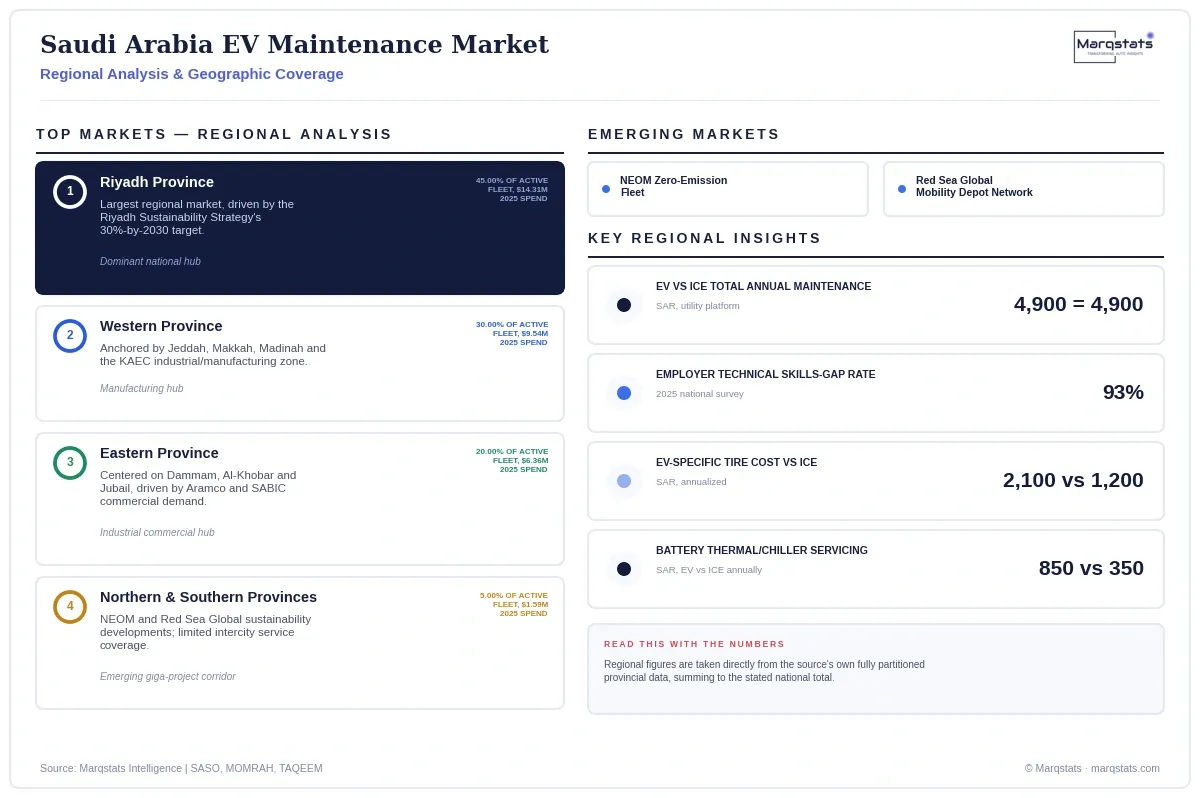
A mid-size ICE utility platform and its battery-electric equivalent both land at exactly SAR 4,900 in total annualized maintenance spend. The EV side does win the categories you'd expect -- powertrain lubrication falls from SAR 1,200-2,000 to zero, and regenerative braking cuts friction brake servicing from SAR 1,400 to SAR 400. But Gulf desert conditions -- summer ambient temperatures above 45C to 50C, asphalt surfaces passing 65C -- erase that advantage from the other direction: battery thermal and chiller servicing more than doubles, HVAC maintenance doubles, and EV-specific tire replacement nearly doubles as heavy curb mass and instant torque accelerate tread wear. The headline savings number a cost-conscious buyer would expect simply isn't there in this specific climate.
A Technician Shortage That's Already Showing Up in Employer Surveys
Saudi Arabia's EV fleet is scaling faster than most other markets in this coverage set. The workforce data suggests the technician pipeline hasn't kept pace, and it's worth understanding just how acute the gap already is.
A survey of the national automotive market found 93% of employers experienced technical skills gaps in 2025 -- not a projected future shortage, but a documented present-day one. The National Automotive and Vehicles Academy at King Abdullah Economic City, built through a TVTC, HRDF and Lucid Motors partnership, is the Kingdom's structured response, offering EV Service Technician and EV Industrial Technician diploma tracks with hands-on rotations at Lucid's Arizona and Saudi operations. But graduating a certified national cohort takes years, not a single training cycle, meaning this specific labor constraint should be treated as a multi-year structural feature of the market through at least the early 2030s.
Market Dynamics
Key Drivers
- Grey-market Chinese EVs from Li Auto, XPeng, Xiaomi and Zeekr entering without local OEM distributor support are directly sustaining a genuinely distinct independent-workshop revenue stream, since these vehicles require third-party extended warranties, software re-engineering, and cell-level battery repairs unavailable to authorized dealers bound by franchise agreements.
- Saudi Arabia's own regional data shows a genuine concentration effect around sovereign giga-projects, since NEOM's Zero-Emission Fleet and Red Sea Global's Mobility Depot Network sustain dedicated internal service depots that would not otherwise exist in the sparsely populated Northern and Southern Provinces, directly seeding future independent service capacity along these corridors.
- This market's own fully worked sizing chain shows tires, suspension and caliper brakes already the single largest technical category at 37.99% of total value, a structural signal that specialized high-load tire inventory represents the most immediate revenue opportunity for workshops entering this market.
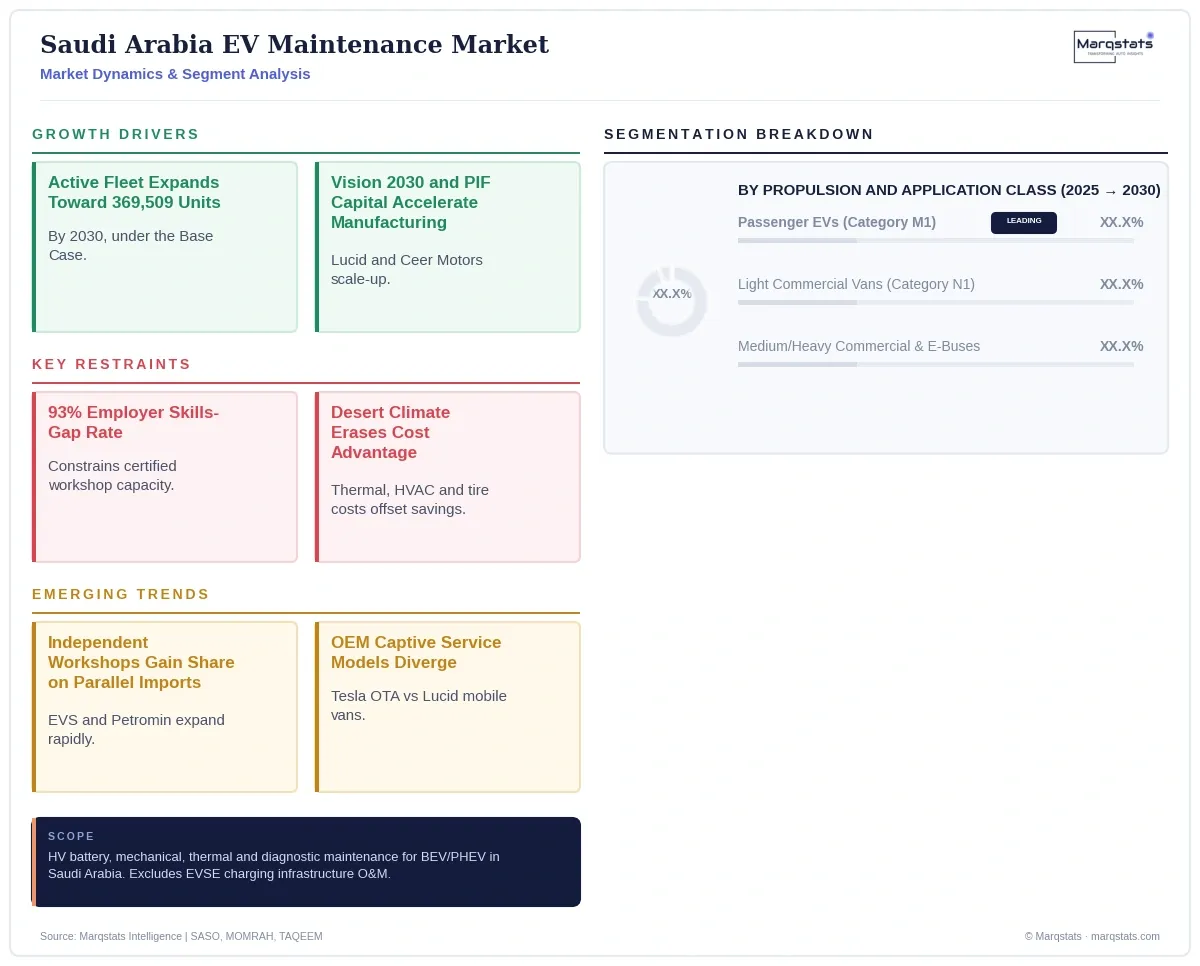
- Saudi Arabia's active EV fleet is expanding rapidly, from 48,841 units in 2025 toward a projected 369,509 units by 2030 under the Base Case Scenario, directly growing the addressable base for recurring EV aftermarket maintenance demand.
- Vision 2030 government fleet procurement targets and Public Investment Fund capital deployed into Lucid and Ceer Motors are directly accelerating domestic EV adoption and manufacturing scale ahead of Ceer's Q4 2026 commercial launch.
- The Riyadh Sustainability Strategy's target of 30% zero-emission vehicles in the capital by 2030 is directly concentrating institutional and government fleet electrification in the country's largest regional maintenance market.
- TAQEEM's January 2025 digital damage-assessment integration with Najm for Insurance Services is directly channeling collision claims toward SASO-classified high-voltage repair centers, formalizing demand for certified workshops.
- EVS's expansion to 13 GCC locations servicing more than 21 pure-electric nameplates is directly capturing the underserved parallel-imported Chinese EV segment lacking factory distributor support.
Key Restraints
- Saudi Arabia's absence of statutory public datasets tracking EV depreciation rates, out-of-warranty battery failure frequencies, average repair cycle times, or insurance total-loss ratios genuinely constrains market transparency for independent workshops and insurers alike, a systemic data gap the underlying research itself flags as unresolved.
- Saudi Arabia's persistent shortage of certified high-voltage technicians genuinely constrains near-term independent workshop capacity, since NAVA graduates alone cannot yet meet documented demand, a gap the 93% employer skills-gap survey figure confirms is already acute rather than a distant projection.
- This market's cost-parity finding -- identical SAR 4,900 total annualized spend for ICE and BEV utility platforms -- directly restrains the marketing case for EV adoption on cost grounds alone, since buyers weighing total ownership cost in Saudi conditions cannot point to lower maintenance spend as EVs offer in most other markets.
- A survey-documented 93% employer skills-gap rate directly constrains independent workshop capacity, since the pace of EV adoption threatens to outstrip certified high-voltage technician supply from NAVA and vocational institutes, particularly during peak summer service demand.
- Gulf desert climate conditions directly erase EV maintenance cost advantages on thermal, HVAC and tire line items, meaning this market's total annualized BEV maintenance spend matches ICE parity rather than delivering the cost savings buyers in temperate markets typically expect.
- The absence of domestic battery recycling infrastructure directly creates a logistical bottleneck for collision repairers, since damaged packs must be stored in secure staging yards or exported under Basel Convention hazardous waste protocols.
- This market's own three-scenario framework spans a genuinely wide 2030 range, from USD 146.20 million under the Downside Case to USD 405.60 million under the Upside Case -- a disclosed spread reflecting real uncertainty in manufacturing ramp-up and parallel-import policy, not a narrow band around a single central estimate.
Key Trends
- Regional service capacity is beginning to diverge sharply between Riyadh's dense multi-brand high-voltage bay concentration and the Northern and Southern Provinces' sparse independent coverage, raising genuine open questions about whether intercity highway corridor service voids will persist or close as the fleet scales toward 2030.
- Fleet operators managing commercial vans and buses under severe desert duty cycles are increasingly negotiating dedicated depot maintenance contracts directly with fleet-focused service providers, given the documented accelerated thermal and tire wear these platforms experience under sustained Gulf heat.
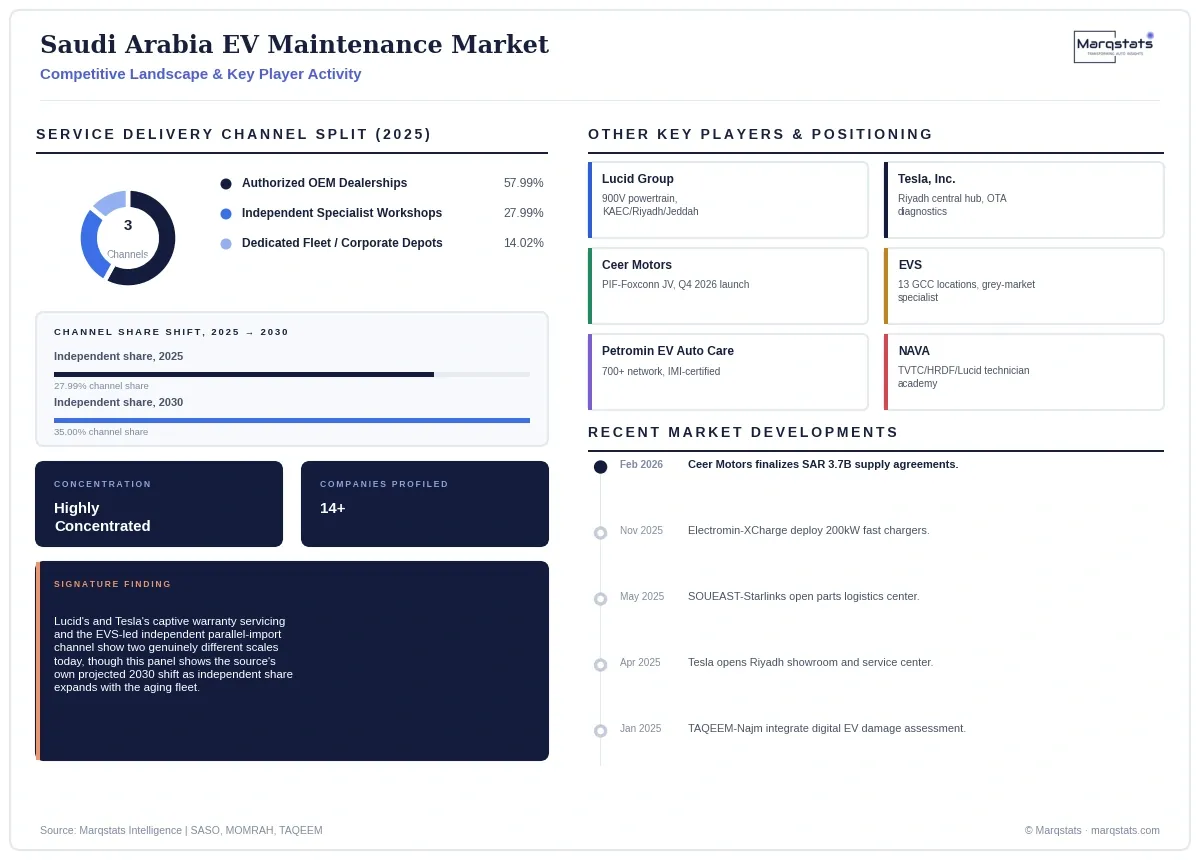
- Independent specialist workshops led by EVS are directly gaining share against authorized dealerships, projected to expand from 27.99% to 35.00% of total market spend by 2030 as parallel-imported Chinese EVs and post-warranty vehicles both grow.
- OEM captive service models are directly diverging in structure, from Tesla's centralized-hub-plus-mobile-technician model relying on over-the-air diagnostics to Lucid's mobile maintenance van fleet serving customers outside Tier-1 metropolitan centers.
- Petromin's 700-plus express maintenance station network is directly being upgraded to handle hybrid and electric vehicles, backed by IMI Level 3 and 4 technician training through its Autotech Group partnership.
- Insurance and collision repair workflows are directly digitizing through the TAQEEM-Najm Taqdeer integration, formalizing referral pathways toward SASO-certified EV repair centers.
Strategic Implications
- Insurers should also weight electrical isolation verification protocols heavily nationwide, given how directly TAQEEM's digital assessment integration already routes structural claims toward certified centers.
- Component suppliers should also weight EV-specific tire and dielectric thermal coolant inventory planning heavily nationwide, given how directly both categories anchor this market's largest documented cost-offsetting service categories under Gulf climate stress.
- Independent repair businesses should prioritize SASO High-Voltage Star-Rating certification specifically, investing in Class 0 PPE and 1,000V-rated tooling to qualify for TAQEEM-Najm Taqdeer referrals covering high-margin collision repairs.
- Automotive dealership groups should develop dedicated service channels for parallel-imported Chinese EVs specifically, given how directly this underserved segment is already sustaining EVS's 13-location GCC expansion outside the franchised network.
- Parts distributors should secure regional supply chains for desert-rated components specifically -- high-load EV tires, dielectric battery coolants, and heavy-duty HVAC compressors -- given how directly these categories anchor this market's cost-parity finding.
- Commercial fleet operators should mandate 10,000 km tire rotations and managed daily fast-charging limits specifically, given how directly accelerated tire and thermal wear shape total cost of ownership under Gulf operating conditions.
Outlook
The underlying research presents three genuinely distinct trajectories diverging on named supply-chain and regulatory trigger conditions. This market's own forecast horizon reaches 2030 directly, requiring no Marqstats extrapolation.
Under the Base Case, Lucid and Ceer plants ramp up steadily, government fleets meet procurement goals, and NAVA graduates fill certified technician roles; the active fleet reaches 369,509 units by 2030, generating USD 269.74 million in total market value at a 53.32% CAGR.
Under the Upside Case, municipal authorities enforce 100% zero-emission requirements for urban commercial fleets and widespread DC charging hubs open nationwide; the active fleet expands to 520,000 units by 2030, lifting total market value to USD 405.60 million at a 66.42% CAGR.
Under the Downside Case, supply bottlenecks delay Ceer Motors output, ZATCA restricts parallel imports without compensating dealer price drops, and workforce shortages persist; the active fleet reaches only 215,000 units by 2030, with total market value reaching only USD 146.20 million at a 35.69% CAGR.
Market Segmentation
USD 24.42 million (76.79% share) in 2025, growing to USD 189.63 million (70.30% share) by 2030. Anchored by the Lucid Air, Tesla Model Y, BYD Han and BYD Atto 3, driven by private consumers and government sedan fleets.
USD 5.47 million (17.20% share) in 2025, growing to USD 56.11 million (20.80% share) by 2030. Centered on corporate delivery fleets utilizing Quantron and TAM platforms operated through Petromin Electromin.
USD 1.91 million (6.01% share) in 2025, growing to USD 24.01 million (8.90% share) by 2030. Driven by public transit bus networks operating in Riyadh and Makkah.
USD 18.44 million (57.99% share) in 2025, growing to USD 124.08 million (46.00% share) by 2030. Anchored by Lucid Studios, Tesla's corporate service center, and BYD's Al-Futtaim-managed network, sustained by factory warranty mandates.
USD 8.90 million (27.99% share) in 2025, growing to USD 94.41 million (35.00% share) by 2030. The fastest-growing channel, led by EVS, Petromin EV Auto Care and TyrePlus, servicing parallel-imported Chinese vehicles.
USD 4.46 million (14.02% share) in 2025, growing to USD 51.25 million (19.00% share) by 2030. Maintained by municipal bus operators, logistics groups, and giga-project mobility teams at NEOM and Red Sea Global.
USD 12.08 million (37.99% share) in 2025, growing to USD 86.32 million (32.00% share) by 2030. The largest category, driven by high-load tire replacement and caliper pin reconditioning.
USD 8.27 million (26.01% share) in 2025, growing to USD 80.92 million (30.00% share) by 2030. The fastest-growing category, anchored by battery chiller and dielectric coolant servicing under sustained Gulf heat.
USD 6.04 million (18.99% share) in 2025, growing to USD 53.95 million (20.00% share) by 2030. Anchored by remote OTA diagnostics and ECU calibration.
USD 5.41 million (17.01% share) in 2025, growing to USD 48.55 million (18.00% share) by 2030. Anchored by TAQEEM-Najm-directed high-voltage-certified collision repair.
By Geography
Riyadh Province
45.00% of the active fleet and USD 14.31 million in 2025 maintenance spending, the largest regional market, driven by the Riyadh Sustainability Strategy's 30%-zero-emission-by-2030 target and hosting Tesla's central service hub, Lucid's flagship Studio, and two EVS centers.
Western Province
30.00% of the active fleet and USD 9.54 million in 2025 maintenance spending, anchored by Jeddah, Makkah, Madinah and the King Abdullah Economic City industrial zone, home to Lucid's AMP-2 assembly facility and Ceer Motors' manufacturing complex.
Eastern Province
20.00% of the active fleet and USD 6.36 million in 2025 maintenance spending, centered on Dammam, Al-Khobar and Jubail Industrial City, driven by commercial operations supporting Saudi Aramco, SABIC and regional freight transport.
Northern & Southern Provinces
5.00% of the active fleet and USD 1.59 million in 2025 maintenance spending, spanning NEOM and Red Sea Global sustainability developments, though commercial fast-fit and independent repair options along intercity highway corridors remain limited.
How Competition Is Evolving
This landscape genuinely continues consolidating around a small number of sovereign-backed anchors.
Overall market concentration is genuinely expected to shift somewhat by 2030 as independent aftermarket share expands.
No single company in this market spans OEM captive manufacturing, independent multi-brand servicing, and sovereign-backed workforce training simultaneously, leaving genuine competitive white space for any group capable of bridging Lucid's and Tesla's captive warranty servicing with the independent parallel-import channel this market's own scenario framework shows expanding sharply by 2030.
Competition spans OEM captive manufacturers, domestic joint ventures, authorized distributors, and independent multi-brand networks. Lucid Group, majority-owned by the Public Investment Fund, operates a direct-sales captive-servicing model bypassing traditional dealership intermediaries, equipped for its proprietary 900V electrical architecture. Tesla entered the market with its April 2025 Riyadh showroom and service facility, relying on centralized hubs and over-the-air diagnostics. Ceer Motors, a Public Investment Fund and Foxconn joint venture, is building factory-authorized aftersales networks ahead of its Q4 2026 commercial launch, with drive units supplied under an SAR 8.2 billion Hyundai Transys contract. Al-Futtaim Electric Mobility manages BYD's dealer network, focused on the proprietary Blade Battery and backed by an 8-year factory warranty.
On the independent side, EVS operates as the Kingdom's largest independent multi-brand EV specialist, with two Riyadh centers and eleven across the broader Gulf region, servicing more than 21 pure-electric nameplates including parallel-imported Chinese models. Petromin Corporation has pivoted into electrified mobility via Electromin and Petromin EV Auto Care, training technicians to IMI Level 3/4 standards through an Autotech Group partnership and operating 12 dedicated EV flagship centers across a 700-plus-location network. TyrePlus, under Michelin's retail network, handles specialized high-load EV tire fitting nationally. Regulatory oversight rests with SASO (technical standards), MOMRAH (workshop licensing), and TAQEEM (insurance damage assessment).
Companies Covered
Companies covered in the report include:
Recent Market Activity
Table of Contents
Coverage & Segmentation
The analysis measures scheduled servicing, high-voltage battery diagnostics, thermal management, EV-specific tire replacement, collision repair, and digital diagnostics for BEV and PHEV passenger vehicles, light commercial vans, and medium/heavy commercial buses and trucks in Saudi Arabia, across a 2025 base year and a 2026 to 2030 forecast period, denominated in United States dollars at the statutory peg of 3.75 SAR per USD.
The analysis spans three segmentation dimensions — propulsion/application class, service delivery channel and technical service category — four regional groupings, and 14 profiled entities across OEM captive operators, independent networks and regulatory bodies. Fleet figures trace to the pack's own registration data; market value and all three segmentation dimensions trace directly to the underlying research's own fully worked sizing model. Three citations to a blocklisted competing research publisher were identified and reviewed individually in this build; see the Verification Log for how each was handled.