Market Snapshot
Key Takeaways
Market Overview & Analysis
Report Summary
This analysis reads Germany's own fully worked sizing model, official roadworthiness inspection statistics, and named-scenario regulatory framework together as a single coherent picture rather than isolated data points, since the underlying research itself was structured to support exactly that kind of integrated reading.
Germany's EV maintenance market is measured across tire servicing, routine inspections, chassis and brake wear, high-voltage battery diagnostics, and auxiliary electrical services, valued at USD 2,325.60 million (EUR 2,214.90 million) in 2025. This figure is taken directly from the underlying research's own fully worked arithmetic sizing model, anchored to statutory KBA fleet registration data.
Structurally, this is a market shaped by an official, government-collected empirical dataset few other markets in this coverage set can match: the TUV-Report 2025's statutory roadworthiness inspection statistics reveal service model, not just powertrain architecture, as a decisive factor in EV defect rates, alongside a fully quantified urban-rural workshop pricing divide and a hard regulatory deadline forcing OEM-to-standardized diagnostic access transition.
The analysis is built for four reader types making different decisions: an independent workshop operator weighing DGUV Stufe 2S certification and SERMI accreditation investment now that Volkswagen's proprietary GeKo tokens have been terminated, a franchised dealership group defending warranty-era retention as vehicles approach the 8-year battery warranty threshold, a fleet operator managing corporate leasing tax incentives, and an investor tracking how Euro 7 enforcement and DGUV certification scale-up shape this market's Base-to-Accelerated scenario range.
Why the Tesla Model 3 Fails Inspection More Than Any Other Car in Germany
A 14.2% significant-defect rate on a vehicle's first statutory inspection would normally point to a manufacturing or engineering problem. Germany's own TUV-Report 2025 data points somewhere more specific: the Tesla Model 3 ranks dead last of 111 evaluated nameplates, worse than every other vehicle in the German market regardless of powertrain, and the inspection engineers' own explanation has nothing to do with the car itself.
Tesla's direct-to-consumer service model relies on condition-based telematics rather than fixed scheduled visits — the car tells the owner when something needs attention, rather than the owner bringing the car in on a calendar. That sounds efficient in principle. In practice, defects like lighting misalignment, brake rotor pitting, and suspension bushing wear simply go uncorrected until the statutory TUV inspection catches them, because nothing in Tesla's own service model prompts an earlier look. The Volkswagen e-Golf, subject to regular scheduled workshop visits, shows what happens under the opposite model: a 3.4% defect rate, ranking 9th of 111 nameplates overall. Same country, same regulatory environment, a fundamentally different outcome tied directly to how service visits actually get triggered.
A Genuinely Quantified Answer to "Does Location Change What You Pay"
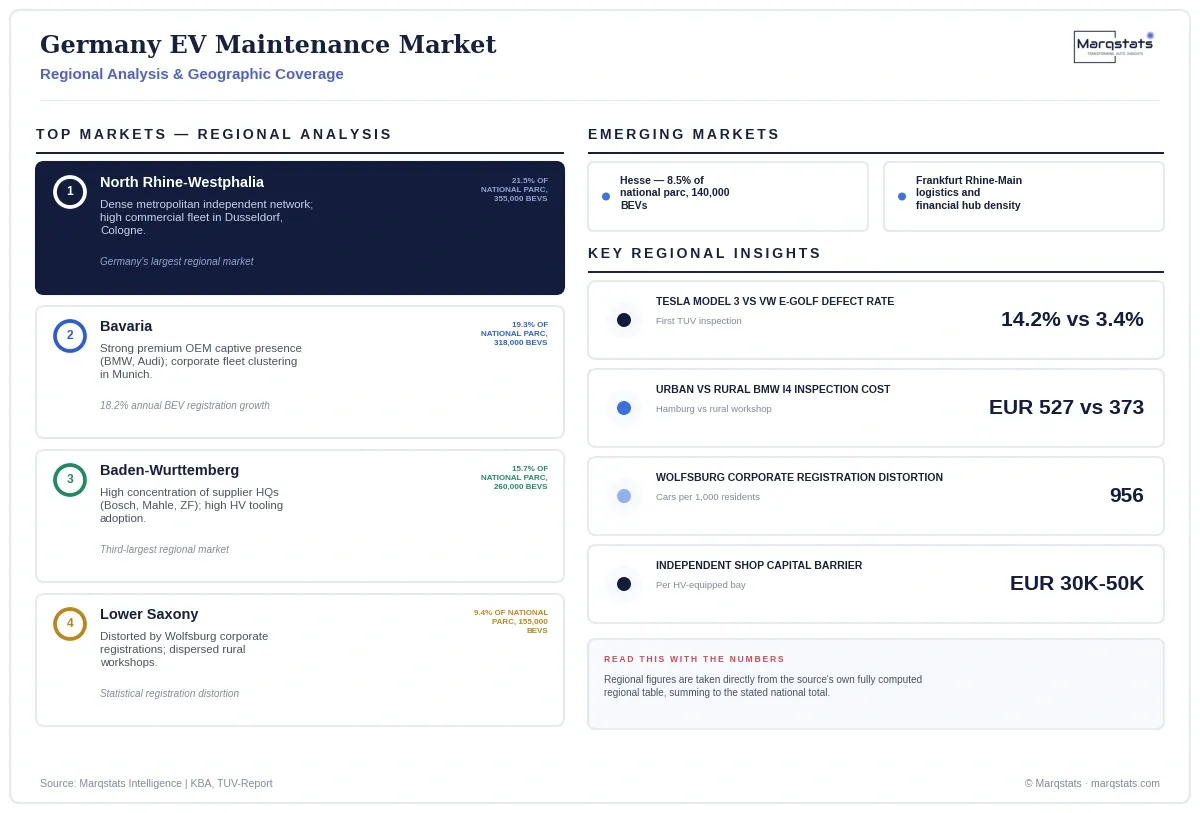
Most markets can only gesture vaguely at urban-versus-rural service cost differences. Germany's own ADAC empirical cost surveys give a precise, directly comparable answer: identical routine BMW i4 inspection work costs EUR 527 in metropolitan Hamburg against EUR 373 in rural workshops within a 60-kilometer radius — a documented 41% metropolitan premium for literally the same service.
That gap traces to specific, identifiable drivers rather than vague regional variation: commercial real estate overhead in dense metro centers and tighter labor market competition for certified high-voltage technicians. For anyone planning workshop expansion or pricing strategy in Germany specifically, this isn't a rough directional guess — it's a documented, source-quantified benchmark worth building directly into site-selection and pricing models rather than treating as background noise.
Market Dynamics
Key Drivers
- Germany's total automotive service and repair sector reached EUR 36.60 billion in 2025, stabilizing after a 7.4% nominal increase the prior year, supported by an aging passenger car parc averaging 10.6 years and rising hourly billing rates that continue anchoring workshop revenue growth across all powertrains.
- Germany's fully worked sizing model shows tires and wheel services already the single largest service category at 28.5% of 2025 value, a structural signal that specialized tire inventory and precision alignment capability represent the most immediate revenue opportunity for workshops entering this market.
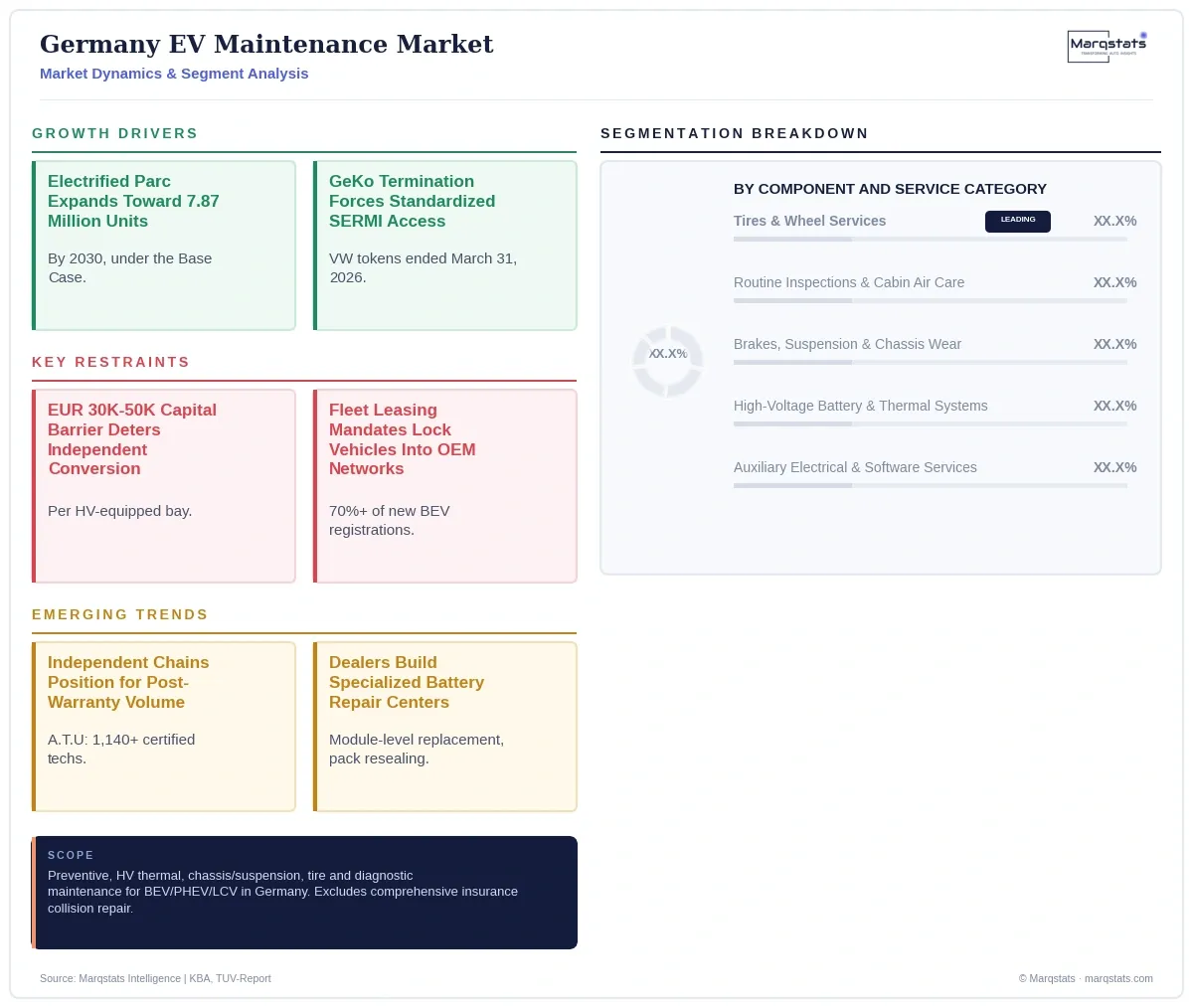
- Germany's electrified fleet is expanding rapidly, from 2,711,155 units in 2025 toward a projected 7,870,000 units by 2030 under the Base Case Scenario, directly growing the addressable base for recurring EV aftermarket maintenance demand.
- The termination of Volkswagen Group's proprietary GeKo access tokens on March 31, 2026, combined with SERMI's April 2024 activation, is forcing a hard, dated transition from OEM-controlled to standardized digital diagnostic access that independent workshops can now plan their certification investment around with genuine confidence.
- Favorable 0.25% company car taxation for electric vehicles up to EUR 100,000 continues driving corporate fleet EV adoption, which governs over 70% of new BEV registrations in Germany and mandates routine maintenance within franchised networks to protect residual values.
- Independent workshop chains including A.T.U and Bosch Car Service have already trained over 1,140 and staffed over 1,000 partner locations respectively with DGUV Stufe 2S certified technicians, demonstrating a genuinely scalable independent-channel certification model other operators can follow.
- Euro 7's mandatory battery durability standards, requiring 80% capacity retention at 5 years and 72% at 8 years, are directly driving workshop investment in calibrated State of Health testing equipment ahead of the November 2026 enforcement deadline.
Key Restraints
- This market's own three-scenario framework spans a genuinely wide 2030 range, from USD 5,720.0 million under the Constrained Transition Scenario to USD 9,580.0 million under the Accelerated Electrification Scenario -- a disclosed spread reflecting real uncertainty in technician certification scale-up and OEM digital access enforcement, not a narrow band around a single central estimate.
- Standalone independent workshops face an initial capital investment exceeding EUR 30,000 to EUR 50,000 per bay to secure high-voltage isolation equipment, protective gear, and digital diagnostic interfaces, a genuine barrier concentrating 64.0% of EV maintenance revenue within franchised OEM networks.
- Commercial fleet leasing contracts, which govern over 70% of new BEV registrations, mandate routine maintenance within franchised networks to protect residual values, structurally limiting independent workshop access to the fastest-growing segment of the fleet.
- Regional registration data is distorted by German tax rules requiring large leasing providers and commercial fleets to register vehicles centrally at corporate headquarters, with Wolfsburg's 956 passenger cars per 1,000 residents reflecting Volkswagen AG's own corporate registrations rather than genuine local EV density.
- The Constrained Transition Scenario's own trigger conditions -- an acute technician certification deficit, persistent OEM digital barriers, and elevated electricity tariffs slowing EV sales -- represent a genuine, evidenced downside risk to the market's Base Case trajectory.
Key Trends
- Fleet operators managing high-mileage commercial electric vans are increasingly negotiating dedicated maintenance contracts directly with structured independent chains given the mandatory annual UVV accident prevention inspection requirement these vehicles already face under DGUV Vorschrift 70.
- Independent workshop chains are positioning to capture volume as vehicles leave warranty coverage, with A.T.U's over 1,140 DGUV Stufe 2S certified technicians ensuring at least one high-voltage specialist at each of its roughly 530 operating branches nationwide.
- Franchised dealership networks including Volkswagen Group Retail Deutschland are building specialized battery repair centers capable of module-level replacement and pack resealing, anticipating rising demand as early-generation EVs exceed their 8-year warranty threshold.
- Diagnostic equipment manufacturers including Hella Gutmann, AVL DiTEST and Bosch are developing integrated cybersecurity gateway unlock and high-voltage measurement platforms specifically to support SERMI-authenticated independent workshop access.
- Tire manufacturers Continental (Vergolst) and Michelin are developing specialized EV product lines aligned to upcoming Euro 7 abrasion standards, anticipating tires becoming an even larger share of aftermarket revenue as brake particulate limits tighten.
Strategic Implications
- Independent workshop operators and fast-fit chains should treat DGUV Stufe 2S certification and SERMI accreditation as a mandatory near-term operational baseline now that Volkswagen's proprietary GeKo tokens have been terminated, following the scalable training model A.T.U and Bosch Car Service have already demonstrated.
- Franchised dealership networks should defend warranty-era retention through specialized battery repair center investment, while preparing fixed-price post-warranty maintenance packages specifically timed to the 8-year, 160,000-kilometer battery warranty threshold.
- Parts wholesalers and equipment manufacturers should prioritize regional distribution capacity specifically in underserved rural districts, given the documented 41% urban-rural pricing premium and the acute high-voltage certified technician shortage the Constrained Transition Scenario identifies in these areas.
- Investors and analysts should track Euro 7 enforcement timelines and DGUV Stufe 2S certification scale-up rates as the two clearest variables separating this market's Base Case and Accelerated Electrification scenarios, given how directly both feed the underlying research's own named trigger conditions.
Outlook
Three genuinely distinct, evidenced trajectories emerge from named, distinct trigger conditions rather than differing growth-rate assumptions applied to the same story. This market's own forecast horizon reaches 2030 directly, requiring no Marqstats extrapolation; the pack's own analysis further extends to 2035, referenced here for context only.
Under the Base Case Scenario, steady economic fundamentals hold, favorable 0.25% company car taxation for vehicles up to EUR 100,000 continues, and independent workshop chains progressively secure SERMI certification, with workshop hourly billing rates rising 2.5% to 3.5% annually; the electrified parc reaches 7,870,000 units by 2030, generating USD 7,743.60 million (EUR 7,374.90 million) in total market value at a 27.23% CAGR.
Under the Accelerated Electrification Scenario, full enforcement of Euro 7 non-exhaust particulate limits takes effect in 2026 and 2027, sub-EUR 25,000 compact BEVs revive private retail adoption, and broad commercial scaling of remanufactured traction battery modules reduces repair costs; the electrified parc reaches 9,600,000 units by 2030, lifting total market value to USD 9,580.00 million (EUR 9,120.00 million).
Under the Constrained Transition Scenario, an acute deficit in qualified technicians leaves fewer than 20% of independent workshops obtaining DGUV Stufe 2S certification, persistent OEM digital barriers limit independent workshop capabilities, and slower EV sales from elevated electricity tariffs constrain fleet growth; the electrified parc reaches only 5,850,000 units by 2030, with total market value reaching USD 5,720.00 million (EUR 5,450.00 million).
Market Segmentation
1,651,643 units, EUR 1,230.5 million (55.55% share) in 2025. Low mechanical complexity, high tire wear, specialized high-voltage diagnostics.
967,200 units, EUR 899.5 million (40.61% share) in 2025. Highest per-vehicle cost due to maintenance of both ICE and high-voltage systems.
92,312 units, EUR 84.9 million (3.84% share) in 2025. Subject to mandatory annual UVV accident prevention inspections and heavy daily duty cycles.
EUR 1,417.5 million (64.00% share) in 2025. Full diagnostic telemetry access; warranty compliance lock-in; fleet leasing mandates.
EUR 542.7 million (24.50% share) in 2025. Centralized DGUV Stufe 2S qualification; competitive labor pricing; SERMI digital access.
EUR 254.7 million (11.50% share) in 2025. Low overhead; customer proximity; constrained by high-voltage tooling and training costs.
EUR 631.2 million (28.50% share) in 2025. High torque and vehicle mass accelerate tread wear; widespread demand for premium HL/XL tires.
EUR 509.4 million (23.00% share) in 2025. Visual safety audits, high-voltage interlock testing, brake fluid checks, cabin filter replacements.
EUR 465.1 million (21.00% share) in 2025. Premature control arm and bushing wear; brake disc rust and caliper binding from regenerative braking underuse.
EUR 343.3 million (15.50% share) in 2025. State-of-health evaluations, dielectric coolant flushing at 3-to-4-year intervals, wiring isolation testing.
EUR 265.8 million (12.00% share) in 2025. 12-volt battery failure replacements, ADAS sensor recalibrations, SERMI-authenticated firmware updates.
By Geography
North Rhine-Westphalia
3.34% of the regional parc (355,000 registered BEVs, 21.5% of the national parc), an estimated EUR 476.0 million 2025 maintenance market, Germany's single largest regional market, supported by a broad automotive base of 10.63 million passenger cars and dense metropolitan independent networks in Düsseldorf and Cologne.
Bavaria
3.78% of the regional parc (318,000 registered BEVs, 19.3% of the national parc), an estimated EUR 426.5 million 2025 maintenance market, anchored by strong premium OEM captive presence (BMW, Audi) and significant corporate fleet clustering in Munich, representing an 18.2% annual growth rate in pure electric registrations.
Baden-Württemberg
3.73% of the regional parc (260,000 registered BEVs, 15.7% of the national parc), an estimated EUR 348.8 million 2025 maintenance market, home to a high concentration of supplier headquarters (Bosch, Mahle, ZF) and correspondingly high workshop high-voltage tooling adoption rates.
Lower Saxony
3.11% of the regional parc (155,000 registered BEVs, 9.4% of the national parc), an estimated EUR 207.9 million 2025 maintenance market, statistically distorted by Wolfsburg corporate registrations and characterized by dispersed rural workshops with lower high-voltage capacity.
Hesse
3.58% of the regional parc (140,000 registered BEVs, 8.5% of the national parc), an estimated EUR 187.8 million 2025 maintenance market, anchored by high fleet density around the Frankfurt Rhine-Main logistics and financial hub and correspondingly high labor billing rates.
Remaining 11 Federal States Combined
An estimated 413,643 registered BEVs and EUR 567.9 million 2025 maintenance market, including Berlin, Rhineland-Palatinate, Saxony, Schleswig-Holstein and the five eastern federal states, which collectively account for less than 11% of the national BEV population, reflecting lower per-capita EV ownership and an acute shortage of high-voltage certified technicians in rural districts.
How Competition Is Evolving
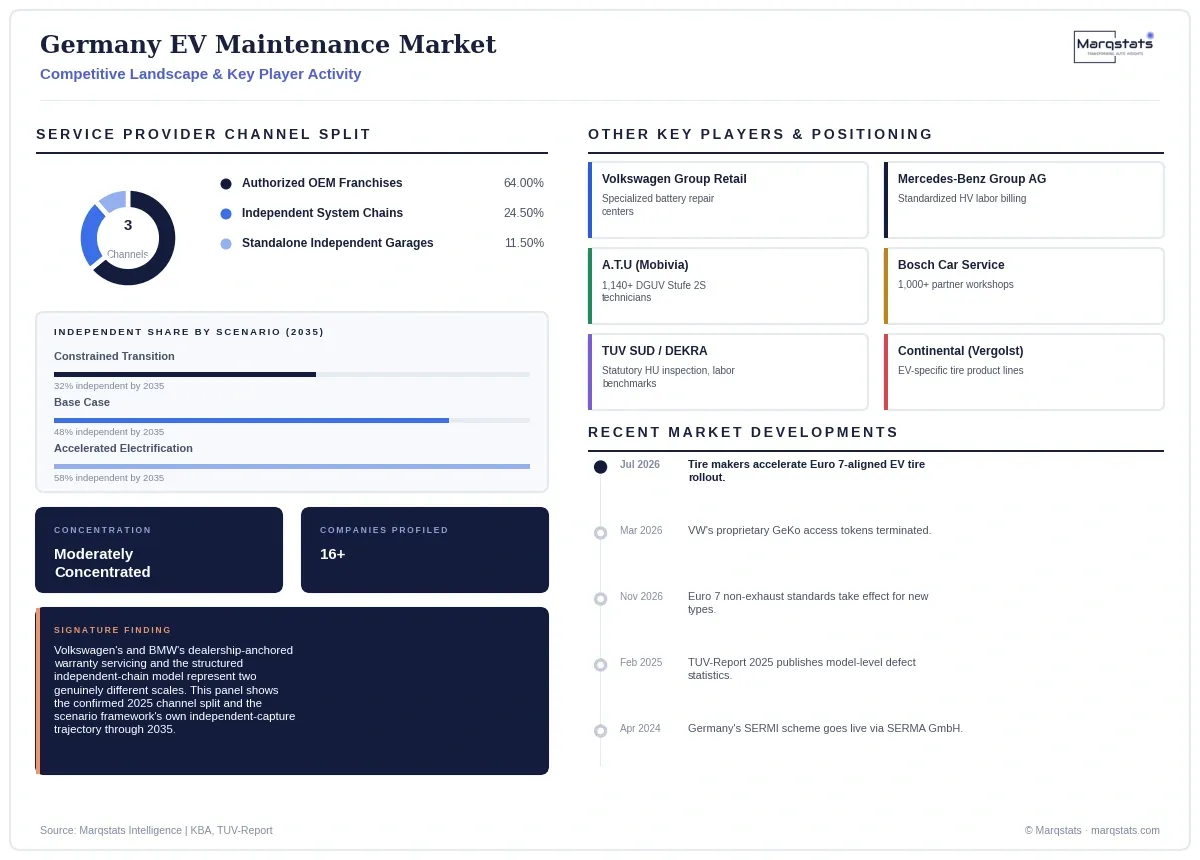
No single company in this market spans franchised warranty-era dealership servicing, structured independent chain operations, and diagnostic equipment manufacturing simultaneously, leaving genuine competitive white space for any group capable of bridging Volkswagen's and BMW's dealership-anchored warranty servicing with the independent channels this market's own scenario framework shows capturing between 32% and 58% of the aftermarket by 2035.
Competition spans franchised OEM captive dealership networks, structured independent workshop chains, and standalone independent garages. Volkswagen Group Retail Deutschland, Mercedes-Benz Group and BMW anchor the dominant franchised dealership channel, each operating specialized battery repair centers, standardized high-voltage labor billing, and proprietary diagnostic authentication protocols. On the independent side, A.T.U (a Mobivia subsidiary) and Bosch Car Service anchor structured multi-brand aftermarket maintenance, having trained over 1,140 and staffed over 1,000 partner locations respectively with DGUV Stufe 2S certified technicians. Diagnostic equipment specialists Hella Gutmann Solutions and AVL DiTEST anchor high-voltage measurement and ADAS calibration tooling, while Mahle Aftermarket anchors dielectric coolant exchange systems.
On wholesale parts distribution, LKQ Europe (Stahlgruber) and WM SE (Trost) anchor component logistics and technician training, while Continental (Vergolst) and Michelin anchor tire manufacturing and fast-fit service specifically engineered for EV wear characteristics and upcoming Euro 7 abrasion standards. Statutory inspection oversight rests with TUV SUD and DEKRA, both of which also publish representative hourly labor rate benchmarks and rapid battery health testing tools used across the independent aftermarket.
Companies Covered
The report profiles 16+ companies with full strategy and financials analysis, including:
Recent Market Activity
Table of Contents
Coverage & Segmentation
This report measures scheduled periodic inspections, high-voltage thermal system servicing, mechanical chassis and suspension wear-and-tear repairs, dedicated tire consumption, 12V battery replacements, and non-warranty electronic diagnostics for BEVs, PHEVs and electric LCVs in Germany, across a 2025 base year and a 2026 to 2030 forecast period, denominated in United States dollars at the pack's own stated European Central Bank rate of 1.05 USD per EUR. It excludes comprehensive insurance accident collision body repair to isolate the recurring mechanical and electrical service aftermarket.
The analysis spans three segmentation dimensions — powertrain and vehicle class, service provider channel, and component and service category — six regional geographies, and 15 profiled entities across OEMs, independent chains, diagnostic equipment suppliers and statutory inspection bodies. Fleet and registration figures trace to KBA; market value and all three segmentation dimensions trace directly to the underlying research's own fully worked sizing model.