Market Snapshot
Key Takeaways
Market Overview & Analysis
Report Summary
The Philippines EV maintenance market is measured across scheduled preventive maintenance, high-voltage diagnostic servicing, power electronics repair, and specialized tire and brake reconditioning for registered electrified vehicles, valued at USD 78.36 million in 2025. This figure is taken directly from the underlying research's own fully partitioned sizing chain, anchored to statutory LTO and DOE registered fleet data rather than a third-party aggregated estimate.
Structurally, this is a market defined by a severe mismatch between fleet growth and technical workforce capacity: registered EVs grew 446% in key passenger segments in a single year, while the national accredited training infrastructure has not scaled to match, concentrating servicing capability within OEM dealership networks and a handful of certified independent chains.
The analysis is built for four reader types making different decisions: an independent workshop operator weighing the PHP 250,000 upfront high-voltage tooling investment against the pace of TESDA facility expansion, a commercial fleet operator like Mober evaluating depot-based servicing economics against diesel fleet operating costs, an OEM distributor deciding between BYD's concentrated dealership model and VinFast's distributed independent-partner model, and an investor tracking how Executive Order No. 12's tariff durability and TESDA capacity expansion together shape this market's Downside-to-Upside scenario range.
A Fleet Growing Six Times Faster Than the Workforce That Services It
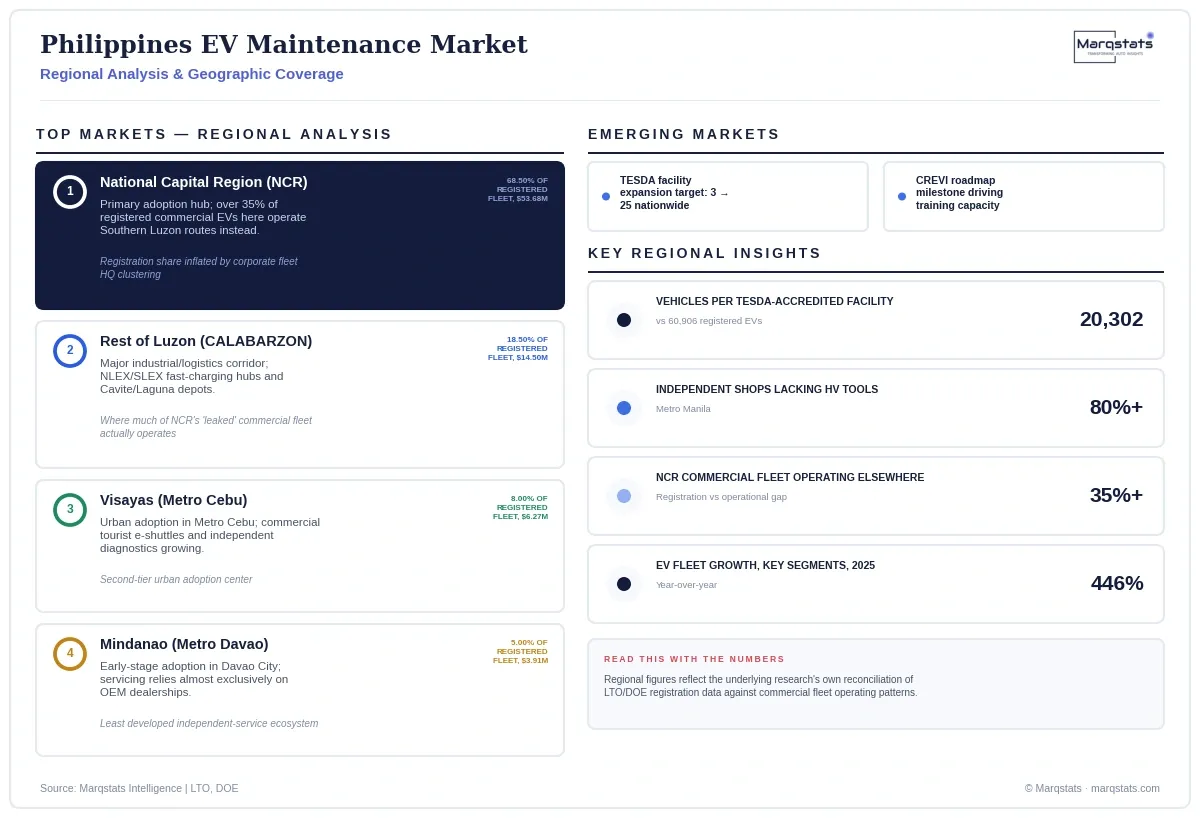
The scale of this mismatch is worth sitting with directly. The Philippine electric vehicle fleet expanded 446% in key passenger segments in 2025 alone, reaching 60,906 registered units. Over that same period, TESDA — the national vocational training regulator responsible for accrediting EV servicing competency — has certified precisely 3 training programs nationwide. Dividing the fleet by the facility count yields a genuinely stark number: 20,302 registered vehicles for every single accredited training facility in the entire country.
The practical consequence shows up directly in workshop capability data: over 80% of independent repair shops in Metro Manila lack the CAT III 1000V insulated hand tools and insulated safety gloves required for high-voltage battery service, facing a PHP 250,000 upfront tooling barrier on top of the certified-technician shortage. Out-of-warranty EV owners are consequently pushed back toward expensive OEM dealership servicing regardless of price, not because dealerships offer better value, but because the independent alternative genuinely cannot legally or technically perform the work yet.
Why Metro Manila's 68.5% Registration Share Overstates Its Genuine Service Demand
Official LTO and DOE data credit the National Capital Region with 68.5% of the country's registered EV fleet — an genuinely commanding share on paper. That figure is confirmed inflated by a specific, identifiable mechanism: commercial logistics operators headquarter and register their EV fleets in Metro Manila for administrative convenience, while the vehicles themselves operate delivery routes across the CALABARZON industrial corridor in Southern Luzon. The underlying research is explicit that over 35% of registered commercial logistics EVs fall into this pattern.
This matters concretely for anyone planning regional workshop capacity, parts distribution or diagnostic equipment investment: a plan built directly on raw NCR registration share would systematically over-allocate resources to Metro Manila itself and under-allocate to the Laguna and Cavite logistics corridors where a meaningful share of registered NCR vehicles actually spend their operating lives and generate genuine maintenance demand.
Market Dynamics
Key Drivers
- The Philippines' own fully partitioned sizing model shows service component demand concentrating specifically in battery systems and high-voltage repair categories as the fleet matures, a structural signal that diagnostic tooling and technician certification, not general mechanical capacity, will be the binding capacity constraint through the remainder of this decade.
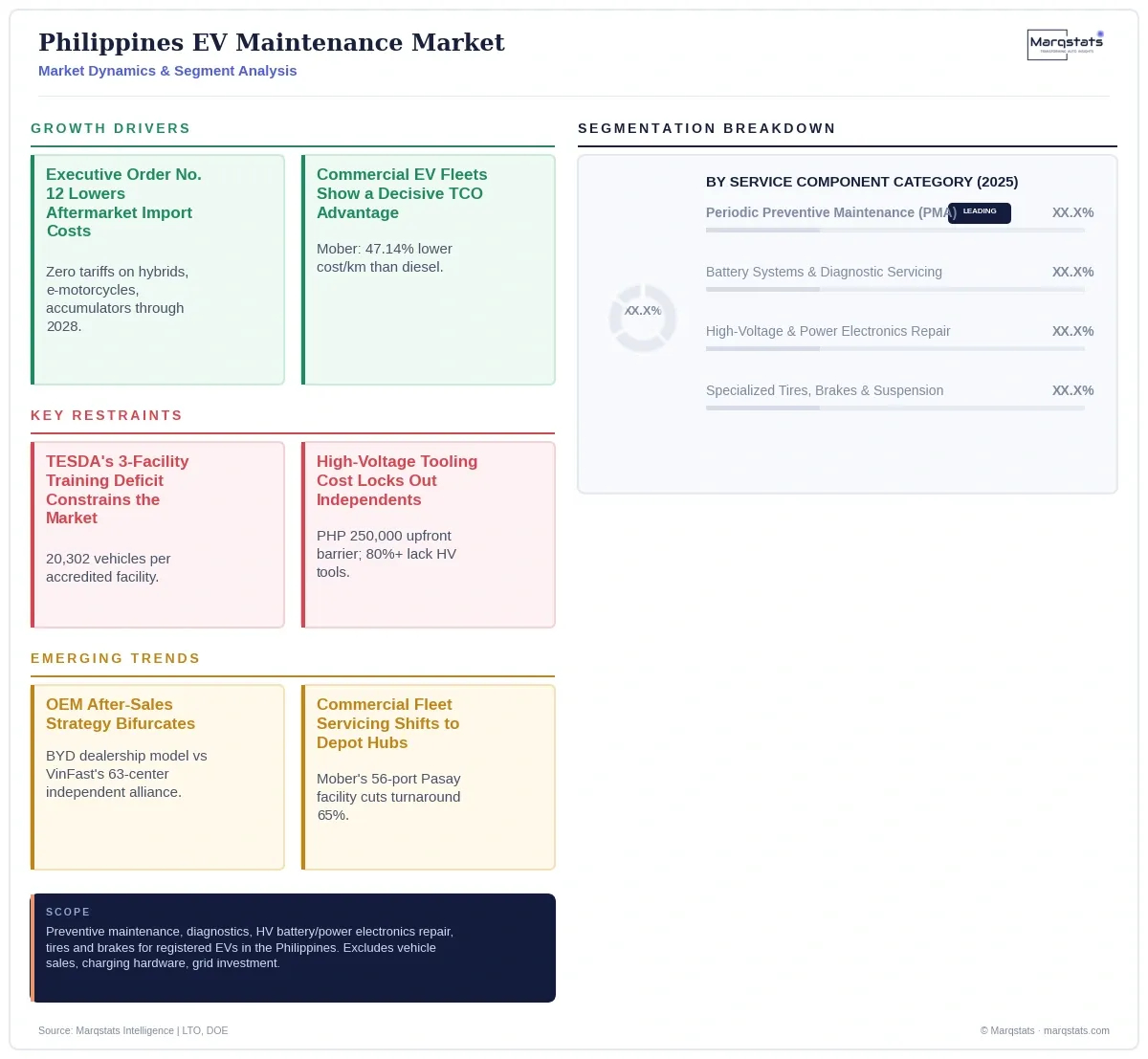
- Executive Order No. 12's zero-tariff policy, extended through 2028, lowers aftermarket replacement parts import costs by 5% to 30% across hybrids, e-motorcycles and accumulator batteries, directly improving independent workshop unit economics for battery cell rebalancing and component replacement.
- Commercial fleet electrification is demonstrating a dramatic, quantifiable total cost of ownership advantage — Mober Technology's EV delivery fleet operates at a 47.14% lower maintenance cost per kilometer than comparable diesel vans, a margin concrete enough to justify continued fleet conversion independent of fuel price volatility.
- The PHP 60 billion Electric Vehicle Incentive Strategy (EVIS), enacted July 2026, mandates PHP 5 billion in direct investment and targets 10,000 units of local production, expanding the domestic manufacturing base that anchors long-term aftermarket parts availability.
- VFELP compliance filings cataloged 949 recognized EV models as of August 2026, with BEVs comprising 64.7% of that total, giving workshops and parts distributors an expanding, increasingly diverse addressable vehicle population to plan service and inventory capacity around.
- VinFast's certification of 63 Motech service centers demonstrates a viable, scalable alternative to OEM-only servicing — a template other manufacturers entering the Philippine market could replicate to build distributed post-warranty service capacity faster than growing a proprietary dealership network alone.
Key Restraints
- The market's own most influential sizing assumption — average annual four-wheeler maintenance spend, accounting for 99.56% of total market value — remains an assumed figure derived from a single commercial fleet operator's logs rather than an official statutory series, a genuine data-availability gap the underlying research discloses explicitly.
- TESDA's accredited EV training infrastructure, at just 3 facilities nationwide against a 60,906-unit registered fleet, is the single most binding constraint on how quickly independent workshops can legally and technically service out-of-warranty electrified vehicles.
- Over 80% of independent repair shops in Metro Manila lack the CAT III 1000V insulated tooling required for high-voltage battery service, facing a PHP 250,000 upfront capital barrier that compounds the certified-technician shortage into a genuine structural bottleneck.
- The public charging-to-fleet ratio widened to 38:1 in early 2026 (60,906 EVs against 1,569 public chargers), quadrupling the CREVI roadmap's own 10:1 benchmark and increasing onboard charger thermal stress from more frequent, higher-power charging cycles.
- No official Philippine body publishes warranty claim or failure rate data for EV battery management systems or power electronics operating under the country's tropical humidity and ambient temperature conditions, leaving workshops and insurers without a statistical basis for component-level reliability planning.
Key Trends
- Financing institutions are increasingly underwriting commercial EV fleet expansion directly, exemplified by the Asian Development Bank's $100 million financing to Ayala Corporation and Clime Capital's $6 million investment in Mober's fleet expansion, signaling growing institutional confidence in the underlying maintenance-cost economics this market's own data documents.
- OEM after-sales strategy is bifurcating between concentrated dealership models, exemplified by BYD's 40%+ passenger EV sales share serviced through ACMobility's network, and distributed independent-partner models, exemplified by VinFast's 63-center Motech alliance — two genuinely different bets on how to build post-warranty servicing capacity at scale.
- Commercial fleet maintenance is shifting from decentralized independent workshops toward dedicated depot hub models, following Mober's 3,000 sqm Pasay facility integrating 56 charging ports with on-site preventive maintenance bays that cut vehicle turnaround time by 65% for logistics clients including IKEA and Nestlé.
- Executive Order No. 12's accumulator battery tariff elimination is enabling Metro Manila service providers to introduce module-level battery cell rebalancing at 40% below full pack replacement cost, a genuinely new service category independent workshops can offer as import costs fall.
- Dongfeng Motors Philippines' September 2026 launch of its nationwide "PROTECH" after-sales framework, extending maintenance intervals and warranty coverage across commercial EV models, signals growing OEM competition specifically on service-network quality rather than price alone.
Strategic Implications
- Technical training institutions and vocational colleges, following TESDA's own stated capacity target of 25 accredited facilities, should treat facility accreditation timeline as a genuine market-shaping variable in its own right, not merely a policy compliance exercise, given how directly it constrains every other channel's ability to capture post-warranty servicing demand.
- OEM distributors should evaluate VinFast's distributed independent-partner servicing model as a genuine alternative to building proprietary dealership capacity from scratch, particularly for brands entering the market without BYD's or ACMobility's existing Ayala Corporation infrastructure advantages.
- Independent workshop operators and investors should treat TESDA accreditation and CAT III 1000V tooling investment as the binding near-term constraint on capturing post-warranty EV servicing demand, prioritizing certification ahead of broader facility expansion rather than after it.
- Commercial fleet operators evaluating EV conversion should model total cost of ownership against Mober's demonstrated 47.14% per-kilometer maintenance cost advantage over diesel, while planning depot-based servicing infrastructure from the outset rather than retrofitting it after initial fleet deployment.
- Investors and analysts should track TESDA facility accreditation counts and Executive Order No. 12's tariff renewal status as the two clearest variables separating this market's Downside and Upside scenarios, given how directly both feed the underlying research's own named trigger conditions.
Outlook
Three genuinely distinct, evidenced trajectories emerge from named regulatory and infrastructure trigger conditions rather than differing growth-rate assumptions applied to the same story. Under the Downside Infrastructure Bottleneck Scenario, Executive Order No. 12's import tariff exemptions expire in 2028 without renewal, distribution grid connectivity delays halt high-power DC fast-charger deployment outside Manila, and persistent technical workforce deficits restrict independent service expansion; the registered EV fleet reaches 350,000 units by 2030, with total maintenance expenditure reaching USD 195.00 million.
Under the Base Case Scenario, Executive Order No. 12's zero-tariff policy is fully executed through 2028, the CREVI roadmap reaches 311,700 EVs by 2028 on schedule, and TESDA expands accredited facilities from 3 to 25 nationwide; the registered EV fleet reaches 620,000 units by 2030, generating USD 325.50 million in annual maintenance expenditure at a 32.96% CAGR.
Under the Upside Accelerated Electrification Scenario, NEDA legislatively extends Executive Order No. 12's zero-tariff policies through 2035, the PHP 60 billion EVIS local manufacturing incentive program disburses in full by Q4 2027, and EV integration becomes mandatory across all public utility vehicle modernization fleets; the registered EV fleet expands to 900,000 units by 2030, lifting total maintenance expenditure to USD 485.00 million, as the independent aftermarket modernizes rapidly alongside TESDA's expanded training capacity.
Market Segmentation
USD 29.78 million (38.00% share) in 2025; projected to reach USD 117.18 million (36.00% share) by 2030. The largest category, anchored by Rapidé Auto Service's scheduled inspection programs.
USD 22.33 million (28.50% share) in 2025; projected to reach USD 97.65 million (30.00% share) by 2030. Anchored by TESDA competency standards and Motech Automotive's certified diagnostic capability.
USD 14.50 million (18.50% share) in 2025; projected to reach USD 61.85 million (19.00% share) by 2030. Covers traction motor and inverter repair, anchored by VinFast Philippines' authorized network.
USD 11.75 million (15.00% share) in 2025; projected to reach USD 48.82 million (15.00% share) by 2030. Anchored by Rymax Philippines' fluid and component distribution partnerships.
USD 53.68 million (68.50% share) in 2025; projected to reach USD 218.08 million (67.00% share) by 2030. The largest vehicle segment by value, anchored by BYD and ACMobility's dealership network.
USD 17.63 million (22.50% share) in 2025; projected to reach USD 78.12 million (24.00% share) by 2030. Anchored by Mober Technology's commercial logistics fleet operations.
USD 7.05 million (9.00% share) in 2025; projected to reach USD 29.30 million (9.00% share) by 2030. Anchored by Hatasu and TailG's L-category registered fleet base.
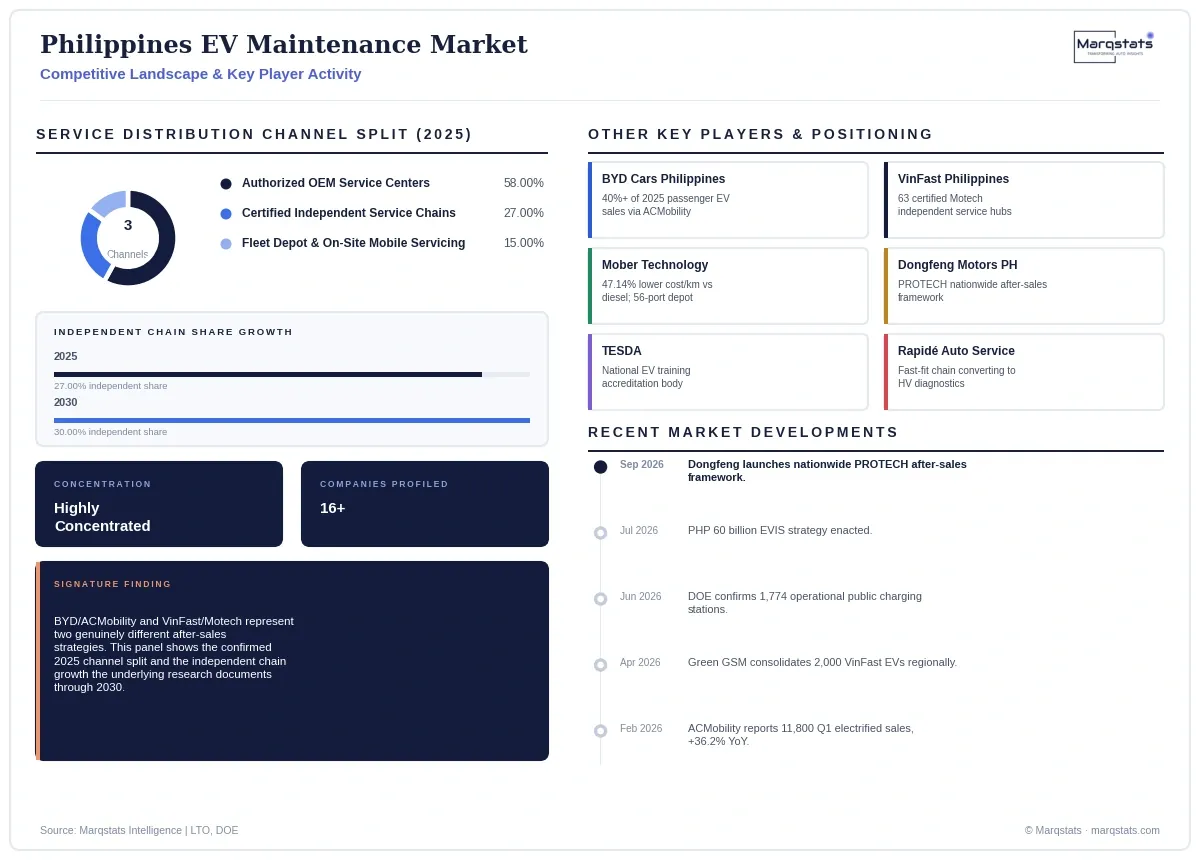
USD 45.45 million (58.00% share) in 2025; projected to reach USD 179.03 million (55.00% share) by 2030. Dominant during initial 3-year warranty periods, anchored by ACMobility's BYD network.
USD 21.16 million (27.00% share) in 2025; projected to reach USD 97.65 million (30.00% share) by 2030. The fastest-growing channel, anchored by Motech and Rapidé's expanding certified capacity.
USD 11.75 million (15.00% share) in 2025; projected to reach USD 48.82 million (15.00% share) by 2030. Anchored by Mober's Central Charge depot model.
By Geography
A note on regional registration distortion
Official LTO and DOE data attribute 68.5% of national EV registrations to the National Capital Region. This figure is inflated by corporate commercial fleet headquarter registration; over 35% of registered commercial logistics EVs registered in NCR actually operate delivery routes in Southern Luzon, per the underlying research's own reconciliation.
National Capital Region (NCR / Metro Manila)
68.50% of the registered fleet, USD 53.68 million in 2025 value, the primary adoption hub containing the plurality of official registrations, though a meaningful share of registered commercial logistics EVs here actually operate on Southern Luzon delivery routes.
Rest of Luzon (CALABARZON / Central Luzon)
18.50% of the registered fleet, USD 14.50 million in 2025 value, a major industrial and logistics corridor serviced by expressway fast-charging hubs along the NLEX/SLEX and specialized depot facilities in Cavite and Laguna.
Visayas (Metro Cebu Hub)
8.00% of the registered fleet, USD 6.27 million in 2025 value, urban adoption centered in Metro Cebu with growing deployment of commercial tourist e-shuttles and independent diagnostic facilities.
Mindanao (Metro Davao Hub)
5.00% of the registered fleet, USD 3.91 million in 2025 value, early-stage adoption concentrated in Davao City, with servicing relying almost exclusively on authorized OEM dealership networks.
How Competition Is Evolving
No single company in this market spans OEM dealership servicing, certified independent chains and commercial fleet depot operations simultaneously, leaving genuine competitive white space for any group capable of bridging warranty-era OEM relationships with the post-warranty independent and depot channels this market's own forecast shows capturing a growing share of expenditure by 2030.
Competition spans OEM dealership networks, certified independent service chains, and commercial fleet depot operators, with two genuinely distinct after-sales strategies defining the market's structure. BYD Cars Philippines, distributed through ACMobility (Ayala Corporation), captured over 40% of passenger electrified sales in 2025 with 26,122 deliveries, concentrating short-term warranty servicing within Ayala's own dealership network. VinFast Philippines has pursued the opposite strategy, certifying 63 Motech Automotive service centers as the largest independent EV after-sales network in the country — deliberately building distributed servicing capacity outside its own proprietary dealership footprint. Dongfeng Motors Philippines launched its nationwide PROTECH after-sales framework in September 2026, extending maintenance intervals and warranty coverage specifically to compete on service quality.
On commercial fleet servicing, Mober Technology anchors the depot-based model with its 3,000 sqm Pasay Central Charge facility integrating 56 charging ports and on-site preventive maintenance bays serving logistics clients including IKEA and Nestlé, backed by Clime Capital and BDO Unibank financing. Rapidé Auto Service Experts is converting its fast-fit service bays for high-voltage diagnostics, while Rymax Philippines anchors fluid and component distribution alongside Dongfeng's expanding network. On the infrastructure side, Shell Pilipinas and Meralco PowerGen subsidiary Movem Electric are expanding public charging networks that indirectly support commercial fleet servicing economics, while TESDA, the Electric Vehicle Association of the Philippines (EVAP), and technical universities including Cavite State University anchor the national technician training pipeline this market's growth depends on.
Companies Covered
The report profiles 16+ companies with full strategy and financials analysis, including:
Recent Market Activity
Table of Contents
Coverage & Segmentation
This report measures scheduled preventive maintenance, diagnostic servicing, high-voltage battery system testing and repair, traction motor and power electronics care, thermal management fluid replacement, specialized tires, and brake reconditioning for registered BEVs, PHEVs, HEVs, LCVs, buses, trucks, and L-category electric motorcycles and tricycles in the Philippines, across a 2025 base year and a 2026 to 2030 forecast period, denominated in United States dollars at an official average exchange rate of 57.00 PHP/USD for 2025, held constant across the forecast period. It excludes whole vehicle sales and manufacturing output value, public charging station hardware and installation, utility grid upgrades, unbundled electricity tariffs, and unregistered light e-bikes.
The analysis spans three segmentation dimensions — service component category, vehicle category and service distribution channel — four regional geographies, and 16 profiled entities across OEMs, independent service chains, fleet operators and regulatory bodies. Fleet and registration figures trace to the LTO and DOE; market value and segment splits trace to the underlying research's own fully partitioned sizing model.