Market Snapshot
Middle bar: base-year value × (1 + CAGR), rounded to two decimals. This is a calculated illustration, not a separately researched annual estimate.
Market Size (2025, Base Year): USD 60.55 Million
Estimated Value (2026): USD 93.46 Million
Forecast Value (2030): USD 336.14 Million
CAGR: 40.89% | Forecast Period: 2026 – 2030
Growth — Absolute: USD 275.59 Million
Largest Market: Hlavní město Praha (34.40% of national registered BEV fleet)
Fastest Growing: HV Diagnostics, Battery & Inverter (18.20% to 23.80% share, 2025-2030)
Dominant Segment: Authorized OEM Networks (78.40% channel share, 2025)
Market Concentration: Moderately Fragmented
Base Year: 2025 | Historical Period: 2021 – 2025 | Forecast Period: 2026 – 2030
Units Considered: Value (USD Million)
Segments Covered: 3 | Regions Covered: 5 | Companies Profiled: 13
Report Pages: 240 | Deliverables: PDF, Excel, PPT
Key Takeaways
Market Overview & Analysis
Report Summary
This analysis reads the Czech Republic's own fully worked sizing chain, regulatory framework, and regional distribution data together as a single coherent picture rather than isolated data points, since the underlying research itself was structured to support exactly that kind of integrated reading.
The Czech Republic's EV maintenance market is measured across mechanical wear and chassis, thermal and climate systems, high-voltage diagnostics, and software/ADAS servicing, valued at USD 60.55 million (CZK 1,409.56 million) in 2025. This figure is taken directly from the underlying research's own fully worked sizing chain, anchored to statutory fleet data covering 98,779 active electrified vehicles.
Structurally, this is the fastest-growing market Marqstats has sized in this vertical, off the smallest current base among comparable European markets, shaped by a genuine regulatory bottleneck: a statutory electrical-engineering qualification requirement that most practicing automotive mechanics lack is constraining independent workshop capacity even as the fleet expands nearly fivefold by 2030.
The analysis is built for four reader types making different decisions: an independent workshop operator weighing Section 6 electrical-engineering certification investment against SERMI accreditation costs, a franchised dealer group defending warranty-anchored revenue as import volumes rise, a parts distributor scaling EV-specific inventory ahead of the 2028 warranty-expiration wave, and an investor tracking how EU fleet emissions policy shapes this market's Base-to-Downside scenario range.
Why a Single Company Town Distorts the Whole Country's EV Statistics
Most countries in this coverage set show some version of a capital-city registration distortion, where corporate leasing headquarters inflate one region's apparent EV adoption. The Czech Republic has that too, in Prague. But it also has something more specific and more extreme, tucked inside a single Central Bohemian district.
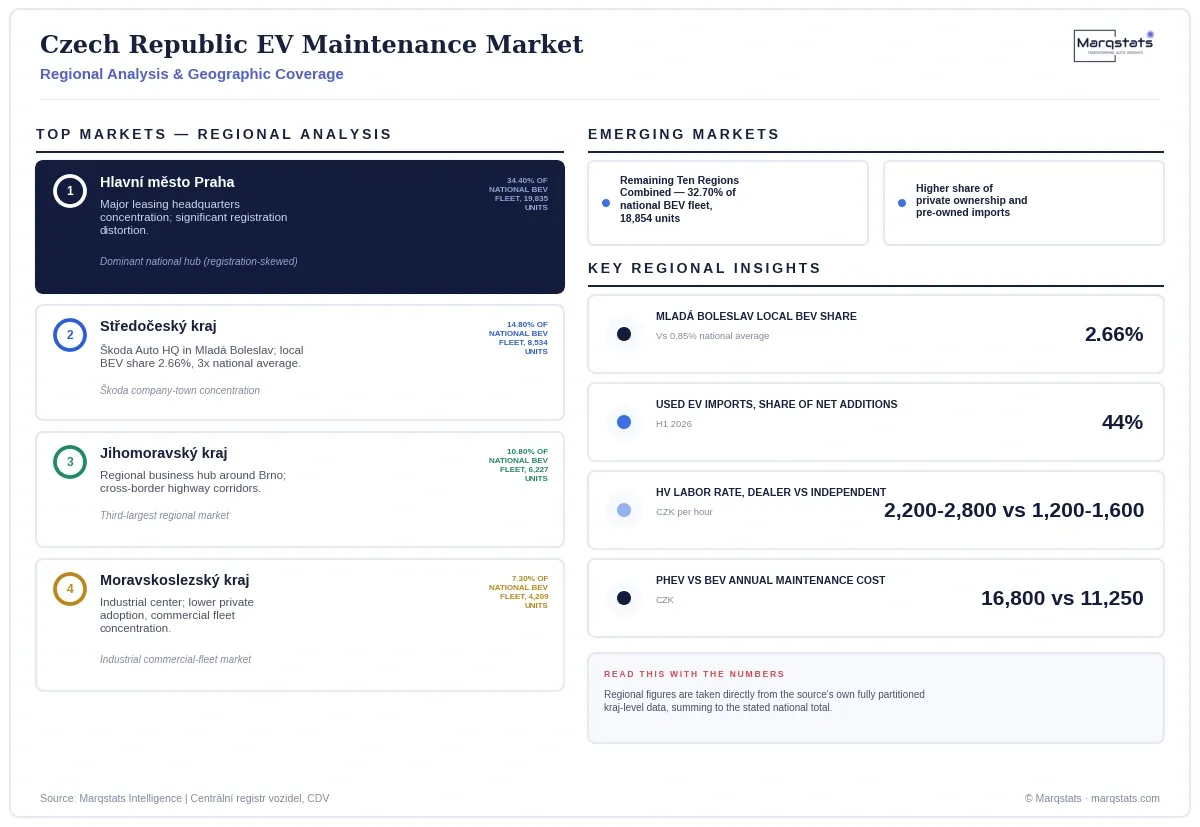
Mladá Boleslav's local BEV share sits at 2.66% -- over three times the national average of 0.85%. This isn't a corporate leasing headquarters effect the way Prague's is; it's Škoda Auto's actual manufacturing headquarters, with the company's own internal fleet and employee leasing programs concentrated in the town where the cars are built. That's a genuinely different mechanism from Prague's distortion, and it means anyone reading Czech regional EV data needs to account for two separate, structurally different sources of geographic skew, not just one.
The Qualification Gap That's Quietly Protecting Dealer Market Share
On paper, EU antitrust law (the Motor Vehicle Block Exemption Regulation) should give independent Czech workshops a clear path to servicing in-warranty EVs and capturing share from franchised dealers. In practice, a separate piece of domestic regulation is quietly working against that outcome.
Section 6 "Qualified Electrician" certification, required for any live high-voltage repair work, demands formal vocational education in electrical engineering -- not just an automotive certification, but a genuinely different professional credential most working mechanics were never trained toward. That's a structural bottleneck no amount of MVBER antitrust protection can route around, and it helps explain why authorized dealers still commanded 78.40% of market value in 2025 despite the legal right of independents to compete for in-warranty work.
Market Dynamics
Key Drivers
- The Czech Republic's own regional data shows a meaningful gap between where corporate fleet vehicles are registered and where they actually circulate, since leasing fleets registered under Prague plates disperse a documented share of real-world driving activity into regional cities, sustaining service demand across networks that pure registration data alone would understate.
- The Czech Republic's own fully worked sizing chain shows mechanical wear, chassis and tires already the single largest service activity category at 48.50% of total value, a structural signal that specialized tire inventory and chassis repair capability represent the most immediate revenue opportunity for workshops entering this market.
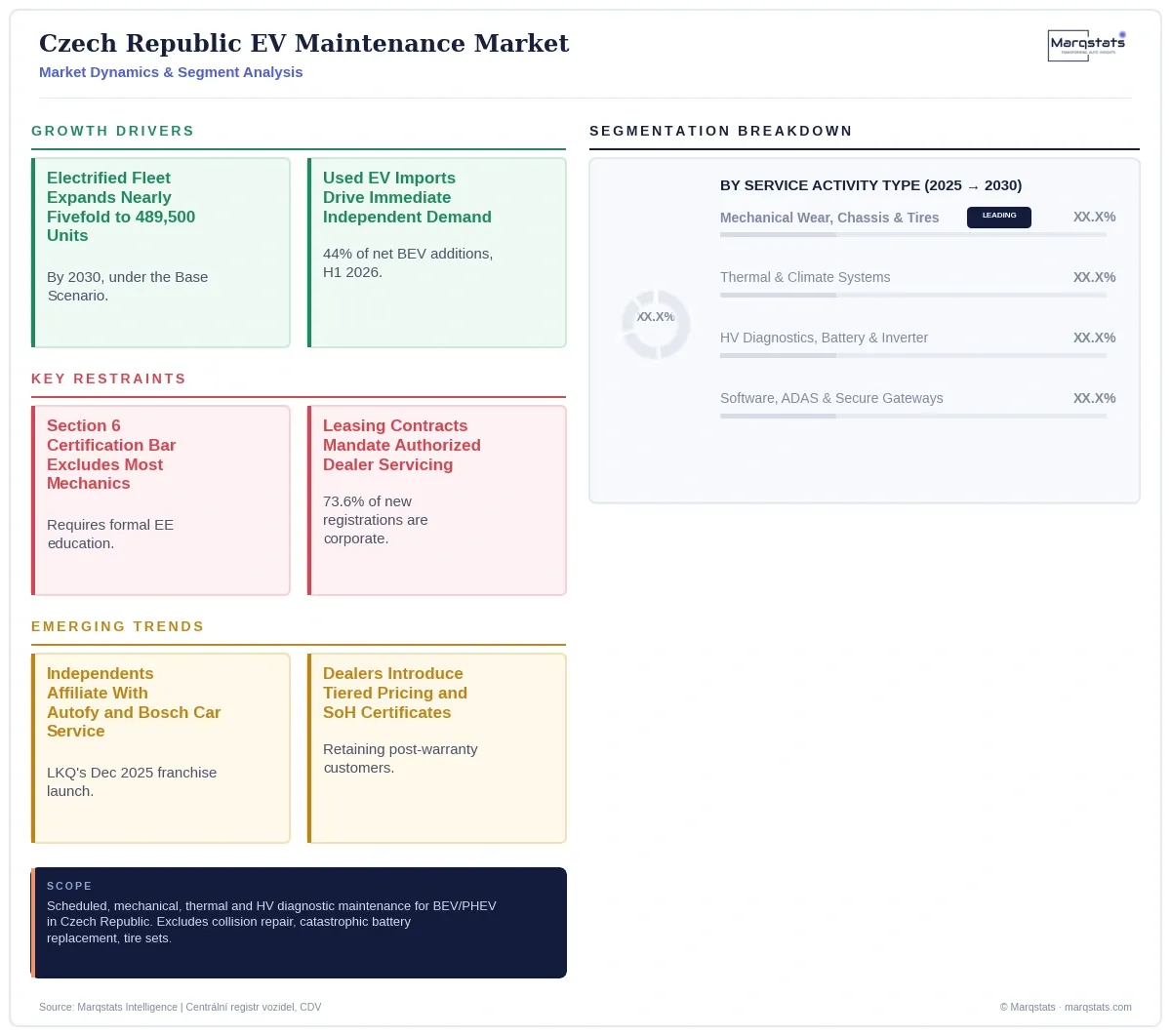
- The Czech Republic's electrified fleet is expanding almost fivefold, from 98,779 units in 2025 toward a projected 489,500 units by 2030 under the Base Scenario, directly growing the addressable base for recurring EV aftermarket maintenance demand.
- The 2024 "Electromobility Guarantee" subsidy program, financed through the National Recovery Plan, provided credit guarantees and capital subsidies up to CZK 300,000 for commercial vehicles, directly accelerating corporate fleet electrification.
- Imported pre-owned electric vehicles from Germany, Austria and Belgium, representing 44% of net BEV additions in the first half of 2026, are introducing older, out-of-warranty vehicles that create immediate independent workshop demand rather than waiting years for organic fleet aging.
- LKQ Europe's December 2025 launch of the Autofy garage franchise concept is upgrading over 300 independent garages with structured EV service packages, directly building certification and tooling capacity to compete for post-warranty volume.
- The TRANSCom 2/2025 commercial fleet funding program, launched February 2026 with CZK 960 million from the Modernization Fund, is directly subsidizing zero-emission commercial trucks and chargers.
Key Restraints
- The Czech Republic's average passenger vehicle age of 16.68 years genuinely contrasts with the still-young electrified fleet, meaning workshops built around servicing the country's dominant older combustion base may need meaningful reinvestment to capture the specific high-voltage servicing opportunity this younger, faster-growing electrified segment represents.
- This market's own two-scenario framework spans a genuinely wide 2030 range, from USD 251.83 million under the Downside Scenario to USD 336.14 million under the Base Scenario -- a disclosed spread reflecting real uncertainty in EU fleet emissions policy continuity and domestic grid connection capacity, not a narrow band around a single central estimate.
- Section 6 "Qualified Electrician" certification under Government Decree No. 194/2022 Coll. requires formal vocational education in electrical engineering that most practicing automotive mechanics lack, creating a severe labor bottleneck across the more than 6,000 independent repair garages in the Czech Republic.
- Workshops lacking SERMI accreditation through an accredited Conformity Assessment Body cannot recode replacement BMS units, reinitialize high-voltage inverters, or complete software restores on accident-damaged vehicles, restricting independent service capabilities.
- Major operational leasing providers including LeasePlan/Ayvens, Arval and Drivalia contractually require routine servicing to be performed within authorized dealer workshops to protect vehicle residual values, directly constraining independent workshop access to the 73.6% of new vehicle registrations purchased by corporate entities.
- Under the Downside Scenario, compliance flexibilities during the European Commission's 2026 regulatory review and domestic grid connection bottlenecks could slow fleet growth to 365,000 units by 2030, a genuinely material reduction from the Base Scenario's 489,500 units.
Key Trends
- Fleet operators managing high-mileage commercial electric vans are increasingly negotiating dedicated maintenance contracts directly with authorized dealer networks offering centralized high-voltage competence, given the documented intense duty cycles parcel logistics carriers including DPD and DHL place on their electrified delivery fleets.
- Franchised dealers are introducing tiered service pricing for older vehicles, certified battery health certificates for used-car resale, and multi-year service contracts bundled into original vehicle financing to counter post-warranty customer migration to independents.
- Independent workshops are affiliating with distributor-backed garage network programs, such as LKQ's Autofy and Bosch Car Service, to access certified technical training, tooling, and diagnostic capabilities without building capacity from scratch.
- Parts distributors are broadening inventories toward EV-specific replacement categories -- low-conductivity coolants, electromechanical thermal valves, R744/R1234yf service parts, and reinforced suspension linkages -- as demand for combustion consumables declines.
- Specialized independent workshops are demonstrating the technical viability of independent high-voltage maintenance outside franchised networks by pairing third-party battery diagnostic hardware, such as AVILOO, with post-crash unlocking services.
Strategic Implications
- Component suppliers should also weight EV-specific tire and low-conductivity coolant inventory planning heavily nationwide, given how directly both categories anchor this market's largest documented service revenue drivers.
- Independent workshop operators should train at least one master technician to Section 6 certification specifically, positioning ahead of the 2028 wave when the 2020-2022 vehicle cohort exits factory warranties and independent aftermarket share is projected to expand sharply.
- Franchised dealership networks should leverage early high-voltage training investments to dominate complex battery module rebuilding and specialized structural repairs, while introducing tiered pricing and bundled service contracts to retain post-warranty customers before independents scale certified capacity.
- Parts distributors should prioritize expanding beyond wholesale logistics into comprehensive technical service partnerships, given how directly certified training programs and reverse logistics capability determine which distributors capture the independent garage relationship as combustion-parts demand declines.
- Investors and analysts should track EU fleet emissions policy continuity through the 2026 regulatory review nationwide and SERMI Conformity Assessment Body accreditation pace as the two clearest variables separating this market's Base and Downside scenarios.
Outlook
Unlike most other markets in this coverage set, the underlying research presents only two named forward scenarios rather than a full three-tier framework: a Base Scenario (Regulatory Alignment) and a Downside Scenario (Regulatory Softening). No Upside or Accelerated scenario is provided in the source, and Marqstats presents only these two scenarios rather than constructing a third the underlying research did not give.
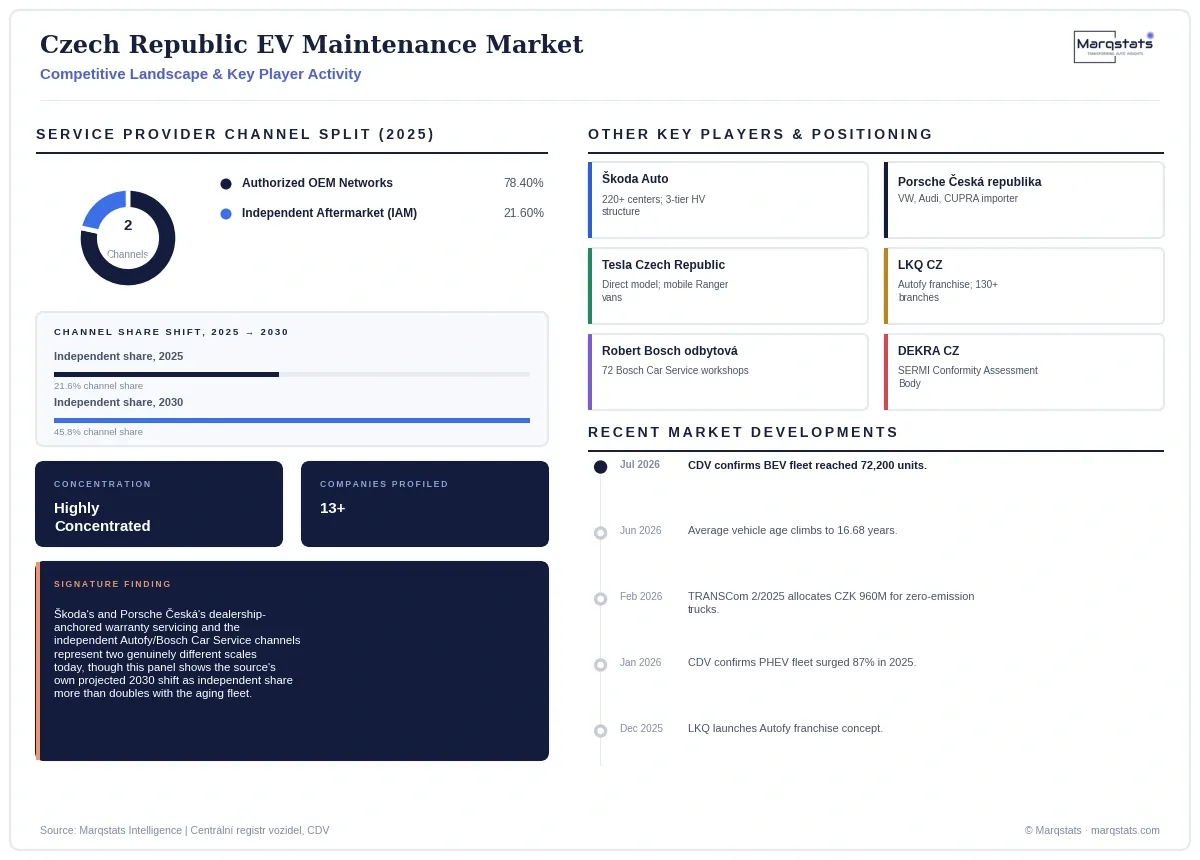
Under the Base Scenario (Regulatory Alignment), the European Commission retains 2025 fleet emissions targets under Regulation (EU) 2019/631, reinforces the 2035 zero-emission tailpipe mandate, and commercial truck funding proceeds through the Modernization Fund; the total electrified fleet reaches 489,500 units by 2030 (320,000 passenger BEVs, 145,000 passenger PHEVs, 18,500 light commercial BEVs, 2,500 heavy trucks and buses), generating USD 336.14 million (CZK 7,825.25 million) in total market value at a 40.89% CAGR, with independent aftermarket channel share expanding to 45.80%.
Under the Downside Scenario (Regulatory Softening), the European Commission introduces compliance flexibilities or reduces penalties during the 2026 regulatory review of Regulation (EU) 2019/631, decelerating OEM delivery incentives, and domestic high-power charging deployment faces grid connection bottlenecks; the total electrified fleet reaches only 365,000 units by 2030, with total market value reaching only USD 251.83 million (CZK 5,862.50 million) at a 33.00% CAGR, and authorized OEM dealerships retaining 64.00% market control as independent workshops face ongoing Section 6 certification and SERMI accreditation bottlenecks.
Market Segmentation
USD 47.47 million (78.40% share) in 2025, growing to USD 182.19 million (54.20% share) by 2030. Anchored by Škoda Auto's 220+ service centers, sustained by corporate leasing warranty mandates.
USD 13.08 million (21.60% share) in 2025, growing to USD 153.95 million (45.80% share) by 2030. The fastest-growing channel, led by LKQ's Autofy and Bosch Car Service franchise networks.
USD 27.87 million (46.02% share) in 2025, growing to USD 177.31 million (52.75% share) by 2030. The largest aggregate revenue source by 2030 as pure electric adoption outpaces hybrids.
USD 26.16 million (43.20% share) in 2025, growing to USD 120.20 million (35.76% share) by 2030. Generates outsized 2025 revenue share relative to fleet size from dual-powertrain servicing.
USD 3.77 million (6.23% share) in 2025, growing to USD 22.32 million (6.64% share) by 2030. Anchored by parcel logistics carriers including DPD, DHL and Zásilkovna.
USD 0.97 million (1.60% share) in 2025, growing to USD 4.57 million (1.36% share) by 2030. Specialized fleet vans operating mixed urban and inter-city routes.
USD 1.79 million (2.95% share) in 2025, growing to USD 11.73 million (3.49% share) by 2030. Anchored by municipal electric transit buses and heavy regional delivery tractors.
USD 29.37 million (48.50% share) in 2025, growing to USD 145.21 million (43.20% share) by 2030. The largest category, driven by suspension wear and EV-rated tire replacement.
USD 13.56 million (22.40% share) in 2025, growing to USD 72.27 million (21.50% share) by 2030. Anchored by low-conductivity coolant flushes and R744/R1234yf heat pump servicing.
USD 11.02 million (18.20% share) in 2025, growing to USD 80.00 million (23.80% share) by 2030. The fastest-growing category, anchored by SoH audits and module cell balancing.
USD 6.60 million (10.90% share) in 2025, growing to USD 38.66 million (11.50% share) by 2030. Anchored by ECU flashing, ADAS calibration and secure gateway authentication.
By Geography
Hlavní město Praha (Prague)
34.40% of the national registered BEV fleet (19,835 units), affected by a significant fleet registration distortion since major leasing companies and enterprise fleets maintain corporate headquarters in Prague, with company cars carrying Prague plates while operating permanently in regional cities such as Plzeň, Ostrava or Liberec.
Středočeský kraj (Central Bohemia)
14.80% of the national registered BEV fleet (8,534 units), featuring high commuter traffic and Škoda Auto's corporate operational base in Mladá Boleslav, where local BEV share reaches 2.66% -- more than three times the national average of 0.85%.
Jihomoravský kraj (South Moravia)
10.80% of the national registered BEV fleet (6,227 units), a regional business hub around Brno with transit logistics and cross-border highway corridors.
Moravskoslezský kraj
7.30% of the national registered BEV fleet (4,209 units), an industrial center with lower private EV adoption but notable commercial fleet concentration.
Remaining Ten Regions Combined
32.70% of the national registered BEV fleet (18,854 units), exhibiting a higher share of private ownership, pre-owned imports, and distributed rural driving patterns.
How Competition Is Evolving
No single company in this market spans franchised warranty-anchored dealership servicing, independent multi-brand franchise operation, and specialized battery diagnostic services simultaneously, leaving genuine competitive white space for any group capable of bridging Škoda's and Porsche Česká's dealership-anchored warranty servicing with the independent channels this market's own segmentation shows gaining a genuinely large share as the fleet ages past warranty.
Competition spans franchised OEM dealer networks, aftermarket parts distributors, independent garage franchise concepts, and specialized diagnostic providers. Škoda Auto a.s. operates the most comprehensive authorized network with over 220 service partner facilities organized into three technical tiers (Standard Service Partners, High-Voltage Partners, and High-Voltage Experts capable of opening sealed battery enclosures). Porsche Česká republika serves as importer for Volkswagen, Audi, SEAT and CUPRA with over 100 authorized centers, while Hyundai Motor Czech has deployed 800V diagnostic tooling across 50+ dealerships and Tesla operates a direct-to-consumer model with mobile Ranger service vans.
On the independent side, LKQ CZ s.r.o. operates the largest wholesale supply network with over 130 branches, and launched the Autofy garage franchise concept in December 2025 to upgrade 300+ independent garages for EV servicing. Robert Bosch odbytová supports 72 franchised Bosch Car Service workshops with diagnostic hardware and training. Specialized independent operators like Lukáš Auto pair AVILOO battery diagnostic hardware with post-crash unlocking services. Regulatory oversight rests with the compliance framework under Government Decree No. 194/2022 Coll. and Conformity Assessment Bodies like DEKRA CZ handling SERMI accreditation.
Companies Covered
Companies covered in the report include:
Recent Market Activity
Table of Contents
Coverage & Segmentation
The analysis measures scheduled periodic servicing, mechanical wear and chassis maintenance, thermal and climate system servicing, high-voltage diagnostics and battery repair, and software/ADAS/secure gateway servicing for BEV and PHEV vehicles across passenger, light commercial and heavy commercial categories in the Czech Republic, across a 2025 base year and a 2026 to 2030 forecast period, denominated in United States dollars at the pack's own stated benchmark rate of 23.28 CZK per USD. It excludes structural collision repairs, catastrophic battery pack replacements from impact damage, and seasonal tire set replacements.
The analysis spans three segmentation dimensions — service provider channel, powertrain architecture and service activity type — five regional groupings across the Czech Republic's fourteen administrative regions, and 13 profiled entities across OEM networks, independent distributors and regulatory bodies. Fleet figures trace to the Central Register of Vehicles and CDV; market value and all three segmentation dimensions trace directly to the underlying research's own fully worked sizing model, with both 2025 and 2030 figures directly source-stated throughout.