Market Snapshot
Middle bar: base-year value × (1 + CAGR), rounded to two decimals. This is a calculated illustration, not a separately researched annual estimate.
Market Size (2025, Base Year): USD 260.94 Million
Estimated Value (2026): USD 337.45 Million
Forecast Value (2030): USD 738.94 Million
CAGR: 23.15% | Forecast Period: 2026 – 2030
Growth — Absolute: USD 478.00 Million
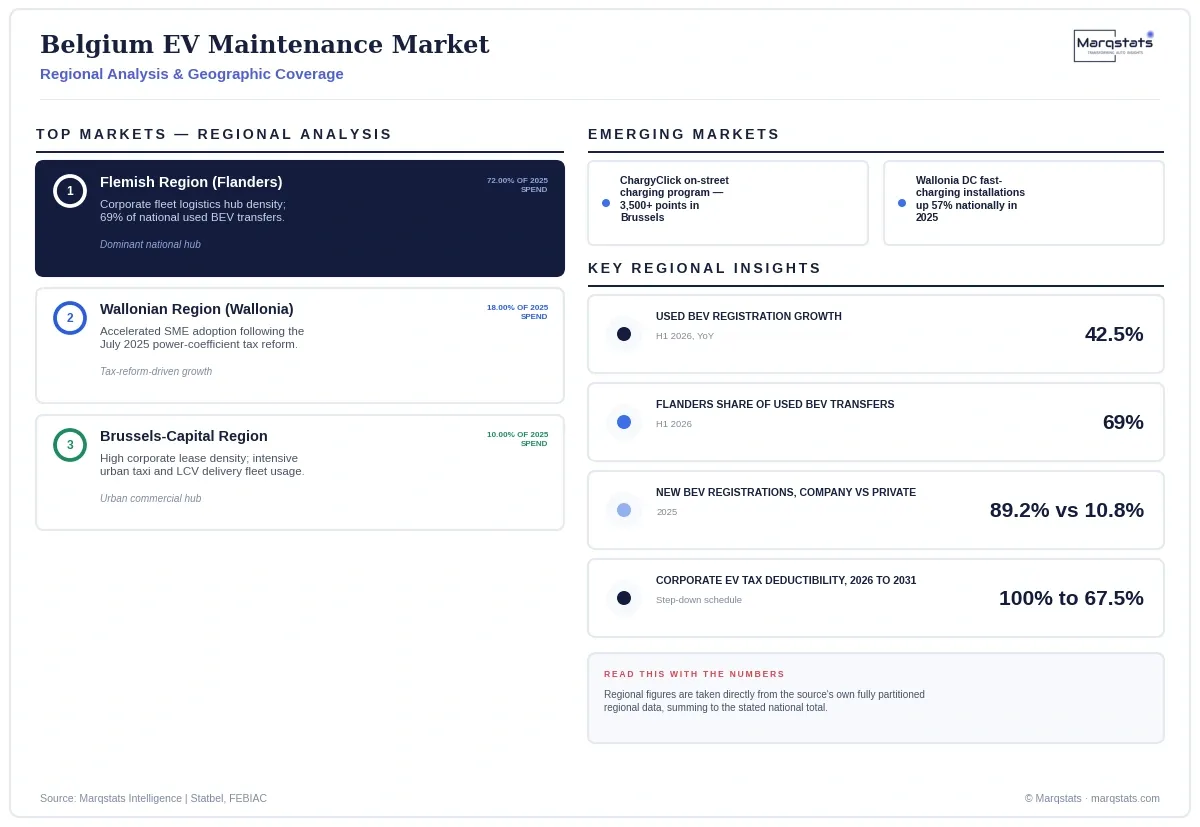
Largest Market: Flemish Region (72.00% of 2025 maintenance spend)
Fastest Growing: Independent Aftermarket Chains (25.00% to 35.00% share, 2025-2030)
Dominant Segment: Wear-and-Tear Maintenance (40.00% of 2025 market value)
Market Concentration: Moderately Fragmented
Base Year: 2025 | Historical Period: 2021 – 2025 | Forecast Period: 2026 – 2030
Units Considered: Value (USD Million)
Segments Covered: 3 | Regions Covered: 3 | Companies Profiled: 14
Report Pages: 240 | Deliverables: PDF, Excel, PPT
Key Takeaways
Market Overview & Analysis
Report Summary
This analysis reads Belgium's own fully worked sizing chain, regional distribution data, and named-scenario regulatory framework together as a single coherent picture rather than isolated data points, since the underlying research itself was structured to support exactly that kind of integrated reading.
Belgium's EV maintenance market is measured across routine mechanical servicing, high-voltage diagnostics, wear-and-tear maintenance, and collision repair, valued at USD 260.94 million (EUR 241.61 million) in 2025. This figure is taken directly from the underlying research's own fully worked sizing chain, anchored to Statbel and FEBIAC registration data covering an active plug-in fleet of 779,377 units.
Structurally, this is a market shaped by a genuine regulatory-timing mismatch -- reduced state inspection frequency coinciding with surging used-BEV resale volume, spawning a new independent battery diagnostic industry -- layered on top of a corporate-fleet-dominated ownership structure and a tiered technician certification system that concentrates high-voltage work within authorized dealer networks.
The analysis is built for four reader types making different decisions: an independent workshop operator weighing HEV3 certification investment against the out-of-warranty used-BEV opportunity, a fleet manager navigating the corporate tax deductibility step-down, an authorized dealer group defending warranty-anchored revenue, and an investor tracking how AFIR infrastructure rollout and regional subsidy reintroduction shape this market's scenario range.
Two Regulatory Timelines Moving in Opposite Directions -- and the Gap Between Them
It's easy to read Belgium's inspection reform and used-EV market growth as two unrelated stories. Lined up on the same calendar, they reveal something genuinely distinctive about where this market's newest service category actually came from.
Starting September 1, 2026, Flanders shifts passenger vehicle roadworthiness testing from mandatory annual inspections to a biennial cycle -- a real reduction in state-mandated oversight frequency. At almost exactly the same moment, Belgium's used BEV market is accelerating fast: registrations rose 42.5% year-on-year in the first half of 2026 alone, driven by corporate lease contracts terminating at 36 to 48 months flooding ex-fleet electric vehicles into retail resale channels. Fewer mandatory inspection visits are now coinciding with a surge in exactly the vehicle population -- aging, out-of-warranty, previously fleet-managed BEVs -- that buyers most need independent verification on before a resale transaction. That gap didn't stay unfilled: specialist providers like EV Batterij Controle now connect directly to a vehicle's onboard diagnostic port and battery management system to generate certified capacity reports for Car-Pass transfers, a private-sector category that exists specifically because state oversight frequency dropped right as resale volume and risk both climbed.
Why Nearly Nine in Ten New BEVs Never Belong to a Private Buyer
Belgium's EV adoption numbers can look like organic consumer demand at a glance. The registration data tells a much more concentrated story about who's actually buying these vehicles, and why.
Professional company car registrations accounted for 89.2% of all newly registered BEVs in 2025 -- just 10.8% went to private retail purchasers. That concentration traces directly to Belgian federal tax policy: zero-emission corporate vehicles retain 100% tax deductibility through 2026, stepping down gradually to 67.5% by 2031, while conventional ICE and PHEV corporate acquisitions lose deductibility entirely from January 1, 2026. The practical effect is that this market's maintenance economics are overwhelmingly shaped by fleet management company decisions -- standardized service-level agreements, lease-return conditioning, depot maintenance contracts -- not individual consumer purchasing behavior, even as the vehicles themselves eventually cycle into private hands through the used-BEV market.
Market Dynamics
Key Drivers
- EDUCAM's structured six-year HEV recertification cycle is directly sustaining a predictable technician training revenue stream nationwide.
- The extension of statutory defect repair windows from 15 to 60 days under the reformed Flemish inspection framework is directly relieving supply chain pressure for specialized high-voltage components, allowing workshops to source parts without rushing vehicles back onto the road under a compressed timeline.
- Belgium's own regional data shows a genuine corporate registration effect, since lease fleets registered under Brussels headquarters disperse a documented share of real-world urban delivery and taxi mileage into surrounding regions, sustaining service demand pure registration data alone would understate.
- This market's own fully worked sizing chain shows wear-and-tear maintenance already the single largest service category at 40.00% of total value, a structural signal that specialized EV tire inventory and suspension component capacity represent the most immediate revenue opportunity for workshops entering this market.
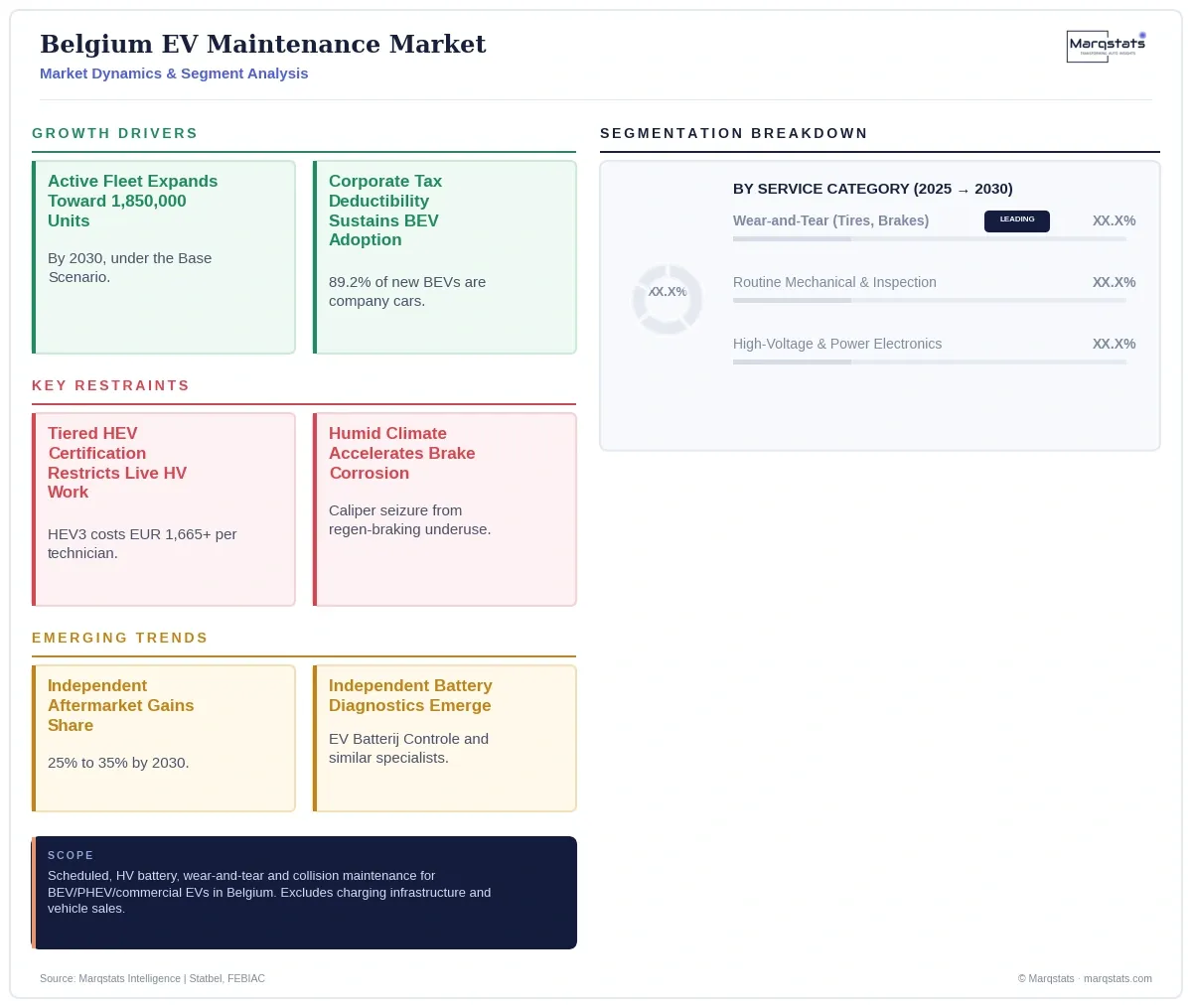
- Belgium's active plug-in fleet is expanding rapidly, from 779,377 units in 2025 toward a projected 1,850,000 units by 2030 under the Base Market Scenario, directly growing the addressable base for recurring EV aftermarket maintenance demand.
- Federal corporate tax deductibility rules favoring zero-emission vehicles through 2026 and beyond are directly sustaining an 89.2% company-car share of new BEV registrations, concentrating maintenance purchasing among fleet management companies requiring standardized service contracts.
- The surge in used BEV registrations -- up 42.5% year-on-year in H1 2026 -- is directly expanding demand for independent battery State of Health diagnostics ahead of Car-Pass resale transfers.
- Wallonia's July 2025 power-coefficient tax reform, favoring compact lower-power urban BEVs, is directly accelerating EV fleet adoption among Wallonian SMEs and private buyers, driving local demand for HEV-certified repair facilities.
- Belgium's public charging infrastructure expansion past 106,677 points by 2025, including Brussels' ChargyClick program placing a charger within 150 meters of every residence, is directly supporting sustained EV mileage accumulation and wear-driven service demand.
Key Restraints
- Grid distribution bottlenecks genuinely constrain depot charging installation timelines for commercial fleet operators in several regions.
- Belgium's humid maritime climate genuinely compounds the regenerative-braking underutilization problem beyond what drier climates in this coverage set experience, since surface oxidation on friction components accelerates independent of how lightly the brakes are actually used day to day.
- Belgium's absence of a domestic hydrometallurgical or pyrometallurgical traction battery recycling facility genuinely constrains end-of-life pack handling for collision and warranty repairers, a logistical gap the underlying research itself flags as unresolved rather than papered over with an invented solution.
- The tiered HEV1/HEV2/HEV3 certification structure directly restricts live high-voltage repair work to authorized OEM centers and specialized regional hubs, since HEV3 certification costs EUR 1,665 in training plus fees per technician and requires six-year renewal.
- Belgium's humid climate directly accelerates friction brake corrosion and caliper seizure from regenerative-braking underuse, generating high rejection rates at technical inspection centers and a recurring pre-inspection service burden most temperate-but-drier markets in this coverage set do not face at the same intensity.
- Corporate PHEV tax deductibility dropping to 0% for post-2025 registrations directly caps long-term PHEV fleet growth, plateauing this segment's maintenance demand contribution even as pure BEV adoption continues accelerating.
- This market's own three-scenario framework spans a genuinely wide 2030 range, from USD 561.60 million under the Restrained Scenario to USD 880.20 million under the Accelerated Scenario -- a disclosed spread reflecting real uncertainty in infrastructure rollout and grid capacity, not a narrow band around a single estimate.
Key Trends
- Fleet operators managing heavy-duty electric trucks and vans are directly negotiating dedicated depot maintenance contracts with commercial-focused service providers, given the documented severe duty cycles these platforms experience under urban last-mile delivery operations.
- Regional service capacity is beginning to diverge sharply between Flanders' dense corporate-fleet-driven workshop concentration and Wallonia's tax-reform-accelerated SME adoption, raising genuine open questions about whether independent HEV-certified capacity will expand evenly or continue concentrating around Flanders' existing infrastructure advantage.
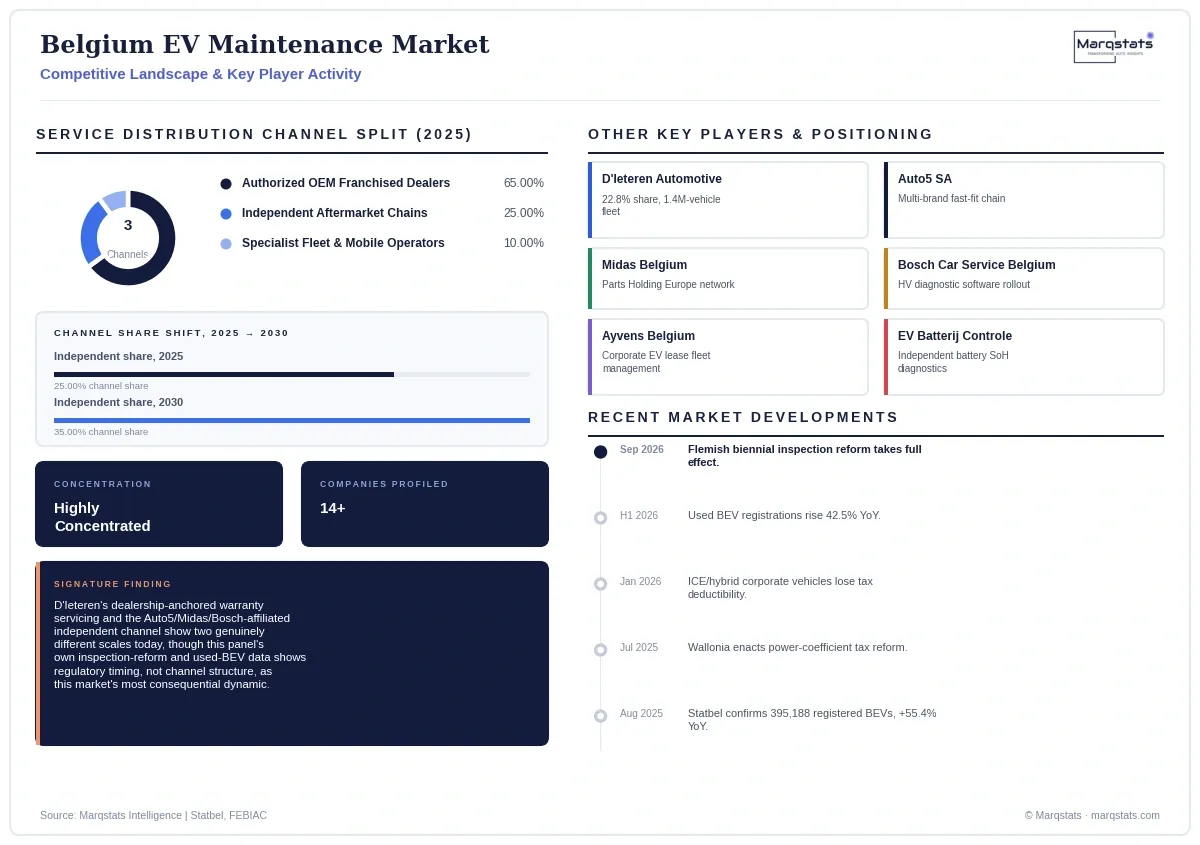
- Independent aftermarket chains -- Auto5, Midas, Bosch Car Service -- are directly gaining share against authorized dealers, projected to expand from 25.00% to 35.00% of total market value by 2030 as early-adopter BEVs exit factory warranty coverage.
- Independent battery diagnostic specialists are directly emerging as a distinct service category, decoupled from routine mechanical maintenance, to serve the expanding used-BEV resale market with certified capacity documentation.
- Preventive brake cleaning and mechanical exercise services are directly expanding as a pre-inspection revenue category, given how directly regenerative-braking underuse drives corrosion-related roller-brake test failures.
- Fleet leasing companies including Ayvens Belgium are directly enforcing strict maintenance protocols through authorized dealers and certified independent repairers, standardizing service-level agreements across large corporate EV lease portfolios.
Strategic Implications
- Component suppliers should also weight EV-specific tire and thermal coolant inventory planning heavily nationwide, given how directly both categories anchor this market's largest documented service revenue drivers.
- Insurers and Car-Pass administrators should also weight independent battery State of Health certification heavily in resale transaction workflows nationwide, given how directly reduced statutory inspection frequency under the Flemish reform shifts verification responsibility toward private-sector diagnostic providers.
- Independent workshop operators should prioritize HEV2 and HEV3 certification investment specifically, positioning ahead of the used-BEV resale wave and the post-2028 cohort of vehicles exiting original manufacturer warranty coverage.
- Battery diagnostic specialists should formalize partnerships with Car-Pass resale platforms and second-hand dealers specifically, given how directly the biennial inspection reform and surging used-BEV volume together expand demand for independent State of Health certification outside the statutory inspection cycle.
- Fleet leasing companies should extend standardized end-of-lease battery health verification protocols specifically, given how directly ex-fleet BEVs entering retail channels at 36-to-48-month lease-return intervals shape this market's expanding used-vehicle diagnostic demand.
- Investors and analysts should track AFIR infrastructure implementation pace and regional private EV subsidy reintroduction as the two clearest variables separating this market's Accelerated and Restrained scenarios.
Outlook
The underlying research presents three genuinely distinct trajectories diverging on named regulatory and infrastructure trigger conditions. This market's own forecast horizon reaches 2030 directly, requiring no Marqstats extrapolation.
Under the Base Market Scenario, strict adherence to the corporate tax deductibility step-down schedule proceeds as legislated -- 100% through 2026, stepping down to 75% by 2030 -- alongside complete elimination of tax deductibility for post-2025 corporate ICE and PHEV acquisitions, while the Flemish biennial inspection reform stabilizes routine pre-inspection visits as high-voltage diagnostics and tire wear maintenance expand; the active fleet reaches 1,850,000 units by 2030 (1,350,000 BEVs plus 500,000 PHEVs), generating USD 738.94 million (EUR 684.20 million) in total market value at a 23.15% CAGR.
Under the Accelerated Fleet Transition Scenario, full national implementation of the EU Alternative Fuels Infrastructure Regulation in 2026 combines with regional re-introduction of targeted private EV purchase subsidies in Wallonia and Flanders and strict municipal Zero-Emission Zone enforcement in Brussels, Antwerp and Ghent; the active fleet expands to 2,200,000 units by 2030 (1,700,000 BEVs), lifting total market value to USD 880.20 million at a 27.56% CAGR, with independent multi-brand networks capturing 45% of total service volume.
Under the Restrained Market Transition Scenario, a potential legislative amendment extends partial tax deductibility for corporate plug-in hybrids while electrical grid distribution bottlenecks limit depot charging installations for commercial fleets, and corporate leasing companies extend standard lease terms from 36 to 60 months; the active fleet reaches only 1,450,000 units by 2030 (1,050,000 BEVs), with total market value reaching only USD 561.60 million at a 16.57% CAGR.
Market Segmentation
USD 65.23 million (25.00% share) in 2025, growing to USD 155.18 million (21.00% share) by 2030. Driven by biennial inspection prep and fleet lease service schedules.
USD 46.97 million (18.00% share) in 2025, growing to USD 184.74 million (25.00% share) by 2030. The fastest-growing category, expanding as out-of-warranty BEV stock ages and SoH checks proliferate.
USD 104.38 million (40.00% share) in 2025, growing to USD 280.80 million (38.00% share) by 2030. The dominant category, driven by heavy EV curb mass and instant torque wear.
USD 44.36 million (17.00% share) in 2025, growing to USD 118.23 million (16.00% share) by 2030. Anchored by mandatory HEV2/HEV3 certification for body shop high-voltage de-energization.
USD 136.08 million (52.15% share) in 2025, growing to USD 480.31 million (65.00% share) by 2030. The primary revenue engine, supported by corporate tax deductibility and expanding charging infrastructure.
USD 109.62 million (42.01% share) in 2025, growing to USD 184.74 million (25.00% share) by 2030. Dual-powertrain maintenance needs, with growth plateauing as corporate tax deductibility phases out.
USD 12.53 million (4.80% share) in 2025, growing to USD 55.42 million (7.50% share) by 2030. High annual mileage from urban last-mile delivery driving elevated wear-and-tear demand.
USD 2.71 million (1.04% share) in 2025, growing to USD 18.47 million (2.50% share) by 2030. Requiring heavy-duty high-voltage workshop bays and megawatt-level diagnostic equipment.
USD 169.61 million (65.00% share) in 2025, growing to USD 406.42 million (55.00% share) by 2030. Anchored by D'Ieteren, BMW and Mercedes, controlling under-warranty fleet lease maintenance.
USD 65.23 million (25.00% share) in 2025, growing to USD 258.63 million (35.00% share) by 2030. The fastest-growing channel, led by Auto5, Midas and Bosch Car Service capturing out-of-warranty and used-BEV work.
USD 26.09 million (10.00% share) in 2025, growing to USD 73.89 million (10.00% share) by 2030. Anchored by dedicated corporate depot maintenance and on-site SoH battery certification.
By Geography
Flemish Region (Flanders)
72.00% of 2025 maintenance spend (USD 161.07 million), supported by corporate fleet logistics hub density around the Antwerp-Bruges port zone, 69% of national used BEV transfers, and leadership in implementing the September 2026 biennial technical inspection reform.
Wallonian Region (Wallonia)
18.00% of 2025 maintenance spend (USD 40.27 million), driven by the highest relative growth rate in high-power DC charging installations nationally and the July 2025 power-coefficient tax reform favoring compact urban BEVs.
Brussels-Capital Region
10.00% of 2025 maintenance spend (USD 22.37 million), characterized by intensive urban taxi and ride-hailing usage, LCV last-mile parcel delivery fleets, and high-turnover company cars requiring frequent brake, tire and bodywork triage, supported by the ChargyClick program's dense on-street charging network.
How Competition Is Evolving
Consolidation pressure on smaller independent operators is genuinely likely to increase further as HEV certification compliance costs rise.
Overall market concentration is genuinely expected to shift somewhat by 2030 as independent aftermarket share expands alongside the aging out-of-warranty fleet.
No single company in this market spans OEM importer-retailer warranty servicing, independent multi-brand chain coverage, and independent battery diagnostic specialization simultaneously, leaving genuine competitive white space for any group capable of bridging D'Ieteren's dealership-anchored warranty servicing with the Auto5 and Midas-affiliated independent networks this market's own scenario framework shows expanding sharply by 2030.
Competition spans OEM importer-retailers, independent multi-brand chains, sector federations, and fleet leasing companies. D'Ieteren Automotive SA/NV operates as the exclusive Belgian distributor for Volkswagen Group brands, holding a 22.8% passenger car market share and an active service fleet of over 1.4 million vehicles through its Wondercar and Wonderservice networks. Auto5, Midas Belgium (Parts Holding Europe), and Bosch Car Service Belgium operate extensive independent multi-brand service networks, expanding HEV2 technician certification and multi-brand EV maintenance packages to capture out-of-warranty fleet vehicles.
Ayvens Belgium, formed via ALD Automotive and LeasePlan, manages corporate EV lease assets and enforces strict maintenance protocols through authorized dealers and certified independent repairers. EV Batterij Controle provides independent, on-site battery State of Health diagnostic testing for warranty compliance and second-hand vehicle transfers. Regulatory and technical governance rests with FEBIAC (registration statistics), TRAXIO (workshop labor standards), the EDUCAM Foundation (HEV1/HEV2/HEV3 technician certification), and Statbel (statutory fleet data).
Companies Covered
Companies covered in the report include:
Recent Market Activity
Table of Contents
Coverage & Segmentation
The analysis measures scheduled mechanical servicing, high-voltage battery health diagnostics, thermal management fluid flushing, electronic software recalibration, brake system maintenance, specialized tire replacement, and periodic roadworthiness inspection fees for battery electric and plug-in hybrid passenger cars, light commercial vehicles, and heavy commercial vehicles in Belgium, across a 2025 base year and a 2026 to 2030 forecast period, denominated in United States dollars at the pack's own stated standard 2025 rate of 1.08 USD per EUR.
The analysis spans three segmentation dimensions — service category, vehicle class and powertrain, and service distribution channel — three regional groupings, and 14 profiled entities across OEM importers, independent chains, fleet leasing companies and regulatory bodies. Fleet figures trace to Statbel and FEBIAC statutory data; market value and all three segmentation dimensions trace directly to the underlying research's own fully worked sizing model, with both 2025 and 2030 figures directly source-stated throughout.