Market Snapshot
Middle bar: base-year value × (1 + CAGR), rounded to two decimals. This is a calculated illustration, not a separately researched annual estimate.
Market Size (2025, Base Year): USD 19.06 Million
Estimated Value (2026): USD 36.83 Million
Forecast Value (2030): USD 188.76 Million
CAGR: 58.15% | Forecast Period: 2026 – 2030
Growth — Absolute: USD 169.70 Million
Largest Market: Central Region (68.50% of 2025 maintenance spend)
Fastest Growing: Independent Workshops & Fast-Fit Chains (18.00% to 36.00% share, 2025-2030)
Dominant Segment: Authorized OEM Dealerships (82.00% channel share, 2025)
Market Concentration: Moderately Fragmented
Base Year: 2025 | Historical Period: 2021 – 2025 | Forecast Period: 2026 – 2030
Units Considered: Value (USD Million)
Segments Covered: 3 | Regions Covered: 5 | Companies Profiled: 14
Report Pages: 240 | Deliverables: PDF, Excel, PPT
Key Takeaways
Market Overview & Analysis
Report Summary
This analysis reads Malaysia's own fully worked sizing chain, regional distribution data, and named-scenario infrastructure framework together as a single coherent picture rather than isolated data points, since the underlying research itself was structured to support exactly that kind of integrated reading.
Malaysia's EV maintenance market is measured across tires and wheel servicing, scheduled inspections, chassis and brake work, high-voltage diagnostics, and auxiliary electrical upkeep, valued at USD 19.06 million (RM 84.83 million) in 2025. This figure is taken directly from the underlying research's own fully worked sizing chain, anchored to JPJ and MAA registration data covering an active fleet of 58,500 units.
Structurally, this is a market shaped by a genuine recurring-cost policy reform -- a kilowatt-based road tax restructuring that cut ongoing EV ownership costs by up to 85% -- layered on top of a conventional warranty-driven dealership-to-independent transition and a domestic manufacturing pivot from imported CBU models toward localized CKD assembly at sub-RM-100,000 price points.
The analysis is built for four reader types making different decisions: an independent workshop operator weighing RM 150,000-to-300,000 high-voltage bay investment against the post-warranty volume wave, a fleet operator scaling commercial electrification, an authorized dealer group defending warranty-anchored revenue, and an investor tracking how CKD assembly ramp-up and charging infrastructure rollout shape this market's two-scenario range.
The Tax Reform That Mattered More Than the Purchase Incentive
Most coverage of Malaysia's EV policy focuses on the purchase-tax exemptions that expired at the end of 2025. The reform that actually stabilizes this market's long-term fleet growth assumptions is a different one entirely, and it's worth tracing through why.
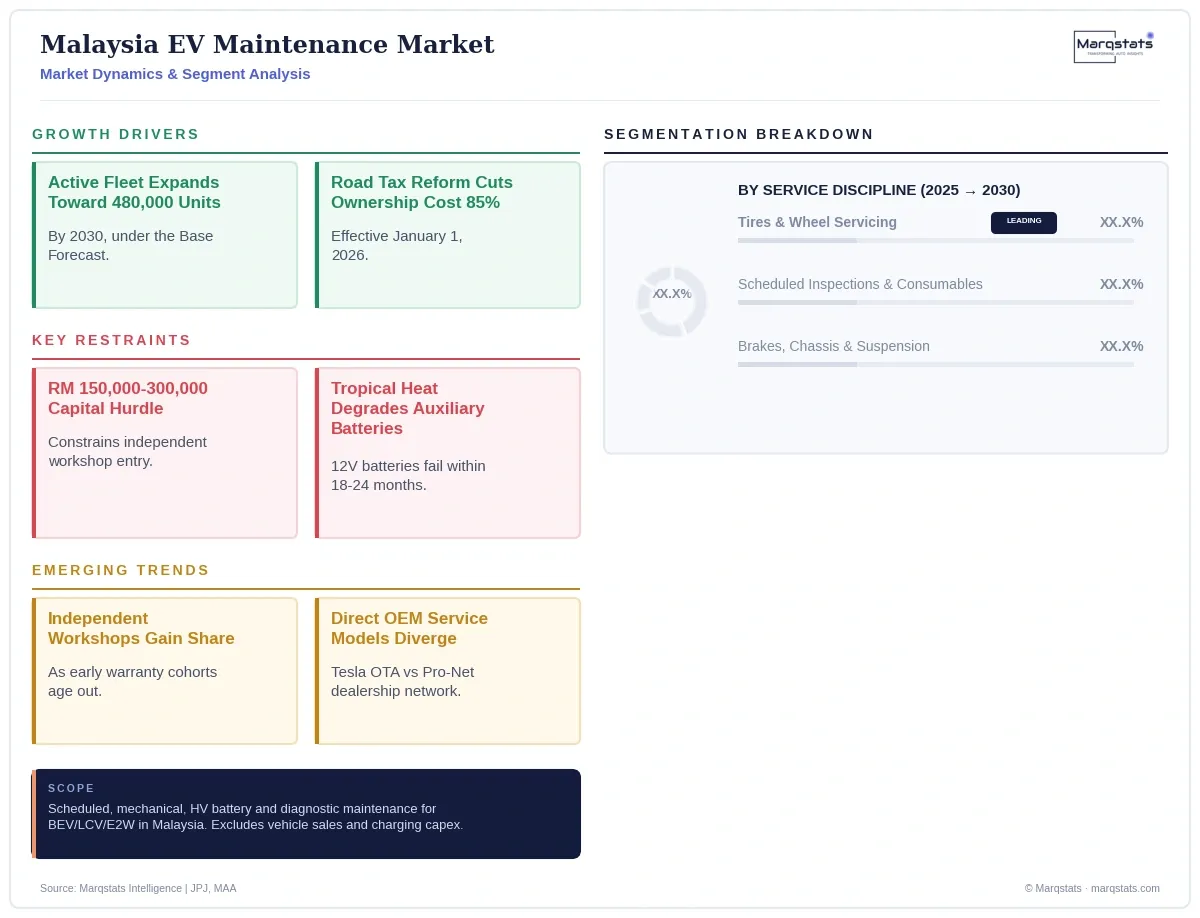
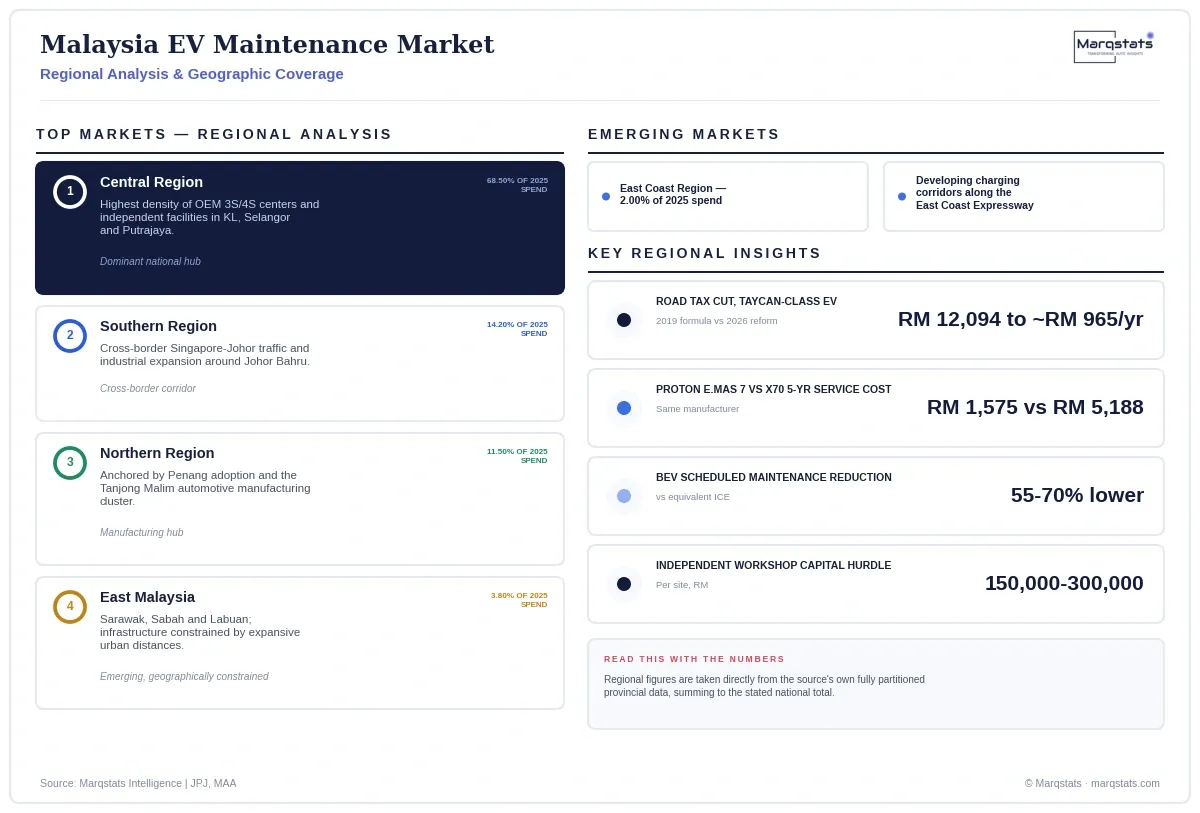
Since 2019, Malaysia's road tax formula for electric vehicles used a progressive structure that punished exactly the vehicles the government was otherwise trying to promote -- a mid-tier 300 kW electric SUV faced RM 4,503 annually, while a performance EV in the Porsche Taycan class faced RM 12,094 every year. Those fees were steep enough to function as a de facto adoption penalty once the initial purchase-tax holiday ended on 31 December 2025. The restructured kilowatt-based formula that took effect 1 January 2026 replaced that system with output-power bands and capped incremental charges, cutting ongoing annual road tax by up to 85% -- the highest power band now capped between RM 865 and RM 965, a fraction of the old Taycan-class fee. This is a recurring-ownership-cost reform, not a one-time purchase incentive, and it's the detail the underlying research itself credits with stabilizing this market's long-term fleet growth assumptions.
Why the Same Manufacturer's Own Numbers Make the Clearest Case
Third-party cost estimates always invite skepticism about methodology. Proton's own published service schedules remove that objection entirely, since they compare two vehicles from the identical manufacturer.
Proton's electric e.MAS 7 costs RM 1,575.48 in scheduled maintenance over a 5-year, 100,000-kilometer cycle. The petrol Proton X70, same manufacturer, same warranty administration, same published-schedule methodology, costs RM 5,188.06 over the identical period -- a 229.3% premium for the ICE vehicle. Perodua's own numbers show the same pattern: the electric QV-E at RM 1,416.08 against the petrol Myvi at RM 3,368.70. When the comparison controls for manufacturer, warranty structure, and measurement method this cleanly, the scheduled-maintenance savings case for EVs in Malaysia is about as unambiguous as this kind of comparison gets.
Market Dynamics
Key Drivers
- Rapid Bus's announced procurement of 300 electric vans between late 2027 and 2028 is directly expanding commercial fleet segment spend, part of a broader shift toward 8.00% of total market value by 2030 as higher-mileage commercial duty cycles generate proportionally larger maintenance line items.
- Malaysia's own regional data shows a genuine corporate registration effect, since leasing fleets registered under Kuala Lumpur or Selangor headquarters disperse a documented share of real-world tire and chassis wear volume into the Southern and Northern corridors, sustaining service demand pure registration data alone would understate.
- This market's own fully worked sizing chain shows tires and wheel servicing already the single largest technical category at 44.00% of 2025 value, a structural signal that specialized high-load tire inventory represents the most immediate revenue opportunity for workshops entering this market.
- Malaysia's active BEV fleet is expanding rapidly, from 58,500 units in 2025 toward a projected 480,000 units by 2030 under the Base Forecast Scenario, directly growing the addressable base for recurring EV aftermarket maintenance demand.
- The January 1, 2026 kilowatt-based road tax reform, cutting ongoing annual ownership tax by up to 85%, is directly removing a recurring cost barrier that could otherwise have slowed fleet retention and growth following the CBU tax holiday's expiration.
- Localized CKD assembly from Proton's Pro-Net subsidiary (e.MAS 5, e.MAS 7) and Perodua's QV-E, both priced below the RM 100,000 floor previously applied to imported CBU models, is directly democratizing EV ownership and expanding the addressable fleet base.
- Pro-Net's 46-service-center network reporting a 98.8% common spare-parts availability rate, alongside its August 2026 certification of 37 technicians under Level 2 EV standards with MARA TVET, is directly expanding certified high-voltage service capacity.
- Puspakom's August 2026 deployment of AI-assisted undercarriage scanning systems is directly formalizing mandatory battery-enclosure safety inspection, channeling commercial fleet renewals and ownership transfers toward verified-safe vehicles.
Key Restraints
- Malaysia's absence of a domestic hydrometallurgical or pyrometallurgical traction battery recycling facility genuinely constrains end-of-life pack handling, requiring damaged or degraded modules to be stored or exported, a logistical gap the underlying research flags as unresolved for collision and warranty repairers alike.
- Malaysia's tropical ambient temperatures genuinely accelerate auxiliary 12V battery degradation, since parasitic loads from telematics, battery management systems and continuous cabin pre-cooling can degrade secondary battery chemistry within just 18 to 24 months, generating a recurring failure-mode service category most temperate markets in this coverage set do not face at the same intensity.
- Manufacturer warranty structures spanning 6 to 8 years or 150,000 to 160,000 km directly bind owners to authorized dealer networks during the initial ownership cycle, constraining independent workshop volume until early adoption cohorts exit warranty.
- Independent workshops face a genuine RM 150,000-to-300,000-per-site capital hurdle for isolated high-voltage bays, Class-0 PPE, battery lifting tables, and multi-protocol diagnostic systems, directly constraining independent-channel capacity expansion.
- This market's own two-scenario framework spans a genuinely wide 2030 range, from USD 122.25 million under the Constrained Infrastructure Scenario to USD 188.76 million under the Base Forecast Scenario -- a disclosed spread reflecting real uncertainty in charging infrastructure rollout and CKD assembly pace, not a narrow band around a single central estimate.
- Continued Budi95 fuel subsidies under the Constrained Infrastructure Scenario directly moderate the relative cost advantage of EV ownership, tempering the pace of ICE-to-BEV fleet conversion outside the Base Forecast trajectory.
Key Trends
- Regional service capacity is beginning to diverge sharply between the Central Region's dense OEM-and-independent workshop concentration and East Malaysia's geographically constrained coverage, raising genuine open questions about whether that gap will narrow as CKD assembly-driven affordability expands the fleet toward the 2030 forecast.
- Independent workshop chains -- Lim Tayar, Carro Care, and Petronas AutoExpert -- are directly gaining share against authorized dealerships, projected to expand from 18.00% to 36.00% of total market spend by 2030 as early warranty cohorts age out.
- Direct OEM service models are directly diverging in structure, from Tesla's centralized-hub-plus-mobile-Ranger model relying on over-the-air diagnostics to Pro-Net's dealership-network-plus-Body & Paint expansion strategy.
- Lim Tayar's co-hosted "Pop-Up EV Clinics" with technical platforms like SoyaCincau are directly building consumer trust in independent-channel high-voltage battery diagnostics ahead of formal warranty expiration.
- Statutory inspection infrastructure is directly modernizing through Puspakom's AI-assisted undercarriage scanning, formalizing battery-enclosure safety verification as a mandatory roadworthiness checkpoint.
Strategic Implications
- Battery cell and component suppliers should also weight high-cycling 12V auxiliary battery inventory heavily nationwide, given how directly tropical thermal stress shortens this component's service life relative to temperate markets.
- Insurers and fleet risk managers should factor Puspakom's new AI-assisted undercarriage battery-enclosure scanning into claims and renewal workflows specifically, given how directly this formalizes structural damage detection as a mandatory roadworthiness checkpoint ahead of commercial fleet renewals and ownership transfers.
- Independent workshop operators should prioritize NOSS G452-010-3:2023 technician certification and RM 150,000-to-300,000 high-voltage bay investment specifically, positioning ahead of the post-2028 wave of vehicles exiting 6-to-8-year manufacturer warranties.
- Authorized dealership groups should expand structured long-term service agreements specifically, modeled on BYD's Service Plus package, to maximize warranty-period retention value as routine mechanical service revenue declines under electrification.
- Component suppliers and tire retailers should realign inventory toward acoustic-damped high-load EV tires, corrosion-resistant regenerative-braking-duty brake pads, and high-cycling 12V auxiliary batteries specifically, given how directly these categories anchor this market's largest documented service revenue drivers.
- Investors and analysts should track DC fast-charger deployment pace along interstate routes and CKD assembly ramp-up at Tanjong Malim and Serendah as the two clearest variables separating this market's Base Forecast and Constrained Infrastructure scenarios.
Outlook
Unlike most other countries in this coverage set, the underlying research presents two named forward scenarios rather than three. This is disclosed honestly here rather than an invented third path.
Under the Base Forecast Scenario (Accelerated Localization and Fleet Scaling), smooth ramp-up of sub-RM 100,000 CKD models from Proton, Perodua, and Chinese manufacturers continues through 2027, maintaining vehicle affordability following the CBU tax holiday's expiration; the active fleet reaches 480,000 units by 2030, generating USD 188.76 million (RM 840.00 million) in total market value at a 58.15% CAGR, with annual BEV registrations reaching roughly 125,000 units, approximately 15% of an 830,000-unit Total Industry Volume.
Under the Constrained Infrastructure Scenario, delays in public DC fast-charger deployment along interstate transit routes, power upgrade challenges in multi-unit housing developments, and the continuation of targeted Budi95 fuel subsidies moderate adoption; the active fleet reaches only 320,000 units by 2030, with total market value reaching only USD 122.25 million (RM 544.00 million) at a 45.02% CAGR, prolonging authorized dealer warranty retention share and leaving independent workshops a smaller pool of out-of-warranty vehicles to justify high-voltage infrastructure investment.
Market Segmentation
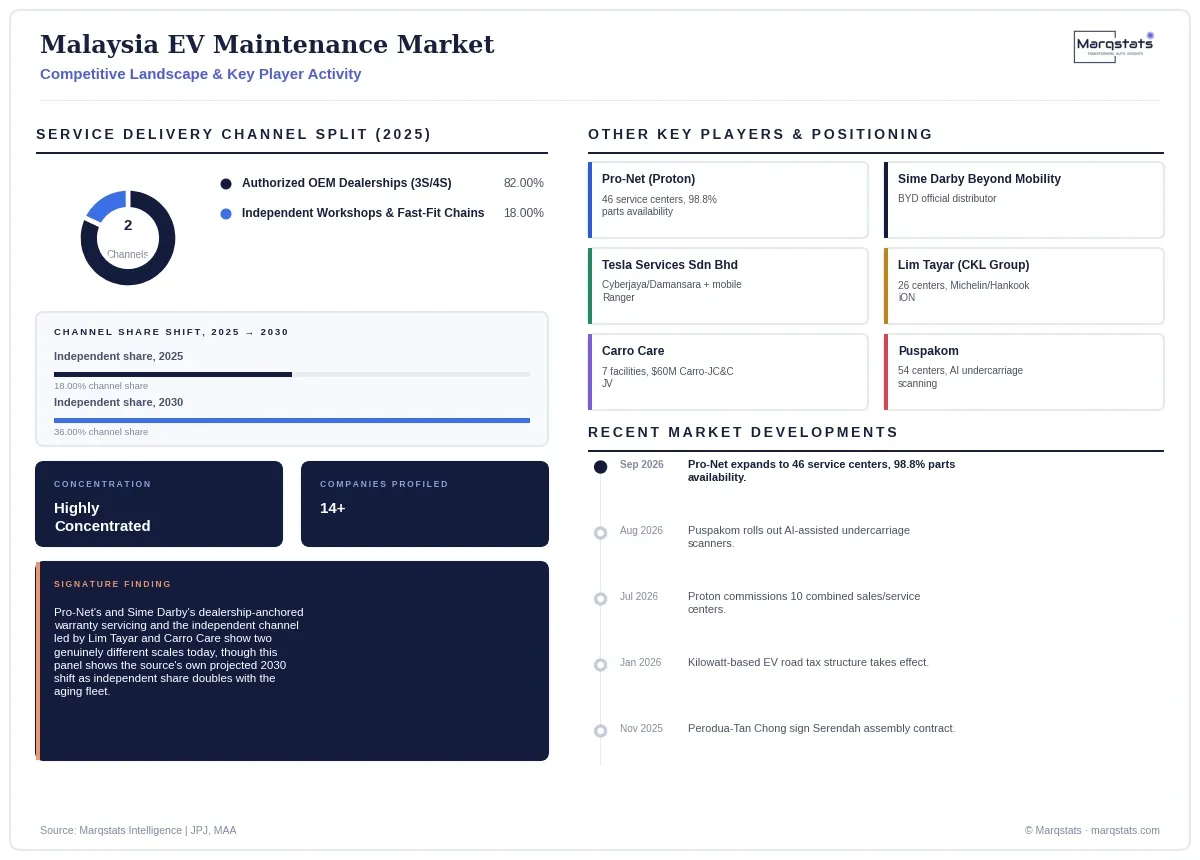
USD 15.63 million (82.00% share) in 2025, growing to USD 120.81 million (64.00% share) by 2030. Anchored by Pro-Net, Sime Darby Beyond Mobility (BYD), and Tesla Services, sustained by 6-to-8-year factory warranties.
USD 3.43 million (18.00% share) in 2025, growing to USD 67.95 million (36.00% share) by 2030. The fastest-growing channel, led by Lim Tayar, Carro Care, and Petronas AutoExpert.
USD 8.39 million (44.00% share) in 2025, growing to USD 77.39 million (41.00% share) by 2030. The largest category, driven by EV-specific acoustic foam tires and dynamic load balancing.
USD 4.96 million (26.00% share) in 2025, growing to USD 43.41 million (23.00% share) by 2030. Anchored by reduction gearbox oil and HEPA cabin filter replacement.
USD 2.86 million (15.00% share) in 2025, growing to USD 32.09 million (17.00% share) by 2030. Anchored by caliper slide lubrication to prevent seizure from one-pedal driving modes.
USD 1.52 million (8.00% share) in 2025, growing to USD 24.54 million (13.00% share) by 2030. The fastest-growing category, driven by aging battery packs showing cell degradation and cooling circuit fouling.
USD 1.33 million (7.00% share) in 2025, growing to USD 11.33 million (6.00% share) by 2030. Anchored by 12V AGM/lithium battery replacement under tropical thermal stress.
USD 17.54 million (92.00% share) in 2025, growing to USD 166.11 million (88.00% share) by 2030. The core of the market, driven by private commuters and e-hailing drivers.
USD 0.95 million (5.00% share) in 2025, growing to USD 15.10 million (8.00% share) by 2030. The fastest-growing category, anchored by urban logistics and Rapid Bus's 300-electric-van procurement.
USD 0.57 million (3.00% share) in 2025, growing to USD 7.55 million (4.00% share) by 2030. Anchored by last-mile delivery riders and urban daily commuters.
By Geography
Central Region
68.50% of 2025 maintenance spend (USD 13.06 million), the operational heart of the sector, containing the highest density of dedicated OEM 3S/4S centers, advanced independent facilities, and specialized tire retail outlets across Kuala Lumpur, Selangor, and Putrajaya.
Southern Region
14.20% of 2025 maintenance spend (USD 2.71 million), supported by cross-border commuter traffic from Singapore and expanding industrial operations around Johor Bahru and Seremban.
Northern Region
11.50% of 2025 maintenance spend (USD 2.19 million), anchored by high adoption rates on Penang Island and automotive manufacturing activities centered around Tanjong Malim.
East Malaysia
3.80% of 2025 maintenance spend (USD 0.72 million), where fleet deployment faces geographic constraints and large distances between urban nodes such as Kuching, Sibu, Miri, and Kota Kinabalu, supported by regional initiatives like FAWOAM-Sarawak Skills.
East Coast Region
2.00% of 2025 maintenance spend (USD 0.38 million), with developing charging corridors along the East Coast Expressway and aftersales facilities clustered primarily around Kuantan.
How Competition Is Evolving
Consolidation pressure on smaller independent operators is genuinely likely to increase.
Overall market concentration is genuinely expected to shift somewhat by 2030 as independent aftermarket share expands alongside domestic CKD assembly scale-up.
No single company in this market spans OEM subsidiary warranty servicing, independent multi-brand tire and chassis work, and statutory inspection authority simultaneously, leaving genuine competitive white space for any group capable of bridging Pro-Net's and Sime Darby's dealership-anchored warranty servicing with the independent channels this market's own scenario framework shows expanding sharply by 2030.
Competition spans OEM subsidiary networks, authorized distributors, direct OEM service operations, and independent multi-brand chains. Pro-Net leads authorized aftersales for Proton's electrified portfolio, managing 46 dedicated Proton e.MAS service centers and 10 Body & Paint facilities across five regions, reporting a 98.8% common spare-parts availability rate. Sime Darby Beyond Mobility serves as BYD's official distributor and service provider, operating multi-bay hubs across Klang Valley, Penang and Johor Bahru. Tesla Services Sdn Bhd manages centralized service facilities in Cyberjaya and Damansara supported by a mobile Ranger fleet relying on condition-based telematics. Cycle & Carriage Bintang operates as a primary authorized retail partner for Mercedes-Benz and emerging NEV brands.
On the independent side, CKL Group's Lim Tayar operates 26 retail automotive centers positioned to capture EV tire and chassis servicing demand through partnerships with Michelin, Pirelli and Hankook's dedicated iON EV platform. Carro Care, a $60 million capital alliance between Carro and Jardine Cycle & Carriage, operates seven service and refurbishment facilities offering fixed-price maintenance for out-of-warranty vehicles. Petronas Lubricants International operates 124 licensed Petronas AutoExpert workshops under the ministry-partnered Servis Ihsan Madani programme. Puspakom, regulated by JPJ, operates 54 statutory inspection centers now equipped with AI-assisted undercarriage scanning. Bateriku maintains a nationwide mobile roadside recovery fleet with 180-plus B-Stop service points for 12V auxiliary power recovery.
Companies Covered
Companies covered in the report include:
Recent Market Activity
Table of Contents
Coverage & Segmentation
The analysis measures routine scheduled preventive servicing, manufacturer-compliant periodic inspections, high-voltage battery diagnostic scans, cooling circuit flushes, brake system upkeep, auxiliary 12V battery replacements, and tire replacements for passenger cars, light commercial vehicles, and electric two-wheelers across Peninsular and East Malaysia, across a 2025 base year and a 2026 to 2030 forecast period, denominated in United States dollars at the pack's own stated rate of 4.45 MYR per USD. It excludes initial vehicle sales, charging station capital expenditure, retail public charging electricity billing, and comprehensive insurance underwriting premiums.
The analysis spans three segmentation dimensions — service delivery channel, service discipline and vehicle class — five regional groupings, and 14 profiled entities across OEM subsidiaries, independent networks and regulatory bodies. Fleet figures trace to JPJ and MAA statutory data; market value and all three segmentation dimensions trace directly to the underlying research's own fully worked sizing model, with both 2025 and 2030 figures directly source-stated throughout.