Market Snapshot
Key Takeaways
Market Overview & Analysis
Report Summary
This analysis reads South Korea's own fully partitioned sizing chain, regional distribution data, and named-scenario regulatory framework together as a single coherent picture rather than isolated data points, since the underlying research itself was structured to support exactly that kind of integrated reading.
South Korea's EV maintenance market is measured across battery diagnostics and health certification, BMS and software diagnostics, EV chassis and tire servicing, and thermal management, valued at USD 432.90 million in 2025. This figure is taken directly from the underlying research's own fully partitioned sizing chain, anchored to statutory MOLIT registration data covering 899,101 cumulative registered EVs at year-end 2025.
Structurally, this is a market shaped by a legal, not merely economic, barrier: South Korea's Motor Vehicle Management Act legally excludes the country's Class 3 neighborhood repair shops from servicing any high-voltage system exceeding 60 volts, concentrating maintenance capability among OEM franchised networks and the smaller population of Class 1 and Class 2 shops that have invested in high-voltage certification.
The analysis is built for four reader types making different decisions: an independent Class 1 or Class 2 workshop operator weighing high-voltage re-tooling investment against a market where fewer than 12% of peers have already made that investment, an imported OEM like Mercedes-Benz confronting a severe service-network deficit relative to domestic Hyundai coverage, a battery diagnostics provider like LG Energy Solution scaling Battery-as-a-Service capability, and an investor tracking how MOLIT's diagnostic certification enforcement timeline shapes this market's Base-to-Downside scenario range.
A Fire in Incheon That Reshaped an Entire Regulatory Architecture
On August 1, 2024, a Mercedes-Benz EQE caught fire in an underground parking garage in Cheongna, Incheon. The fire damaged 140 vehicles and took 8 hours to extinguish. That single incident did something South Korea's broader EV policy discussion hadn't yet fully accomplished: it catalyzed mandatory battery supplier disclosures and accelerated MOLIT's strict battery health inspection standards into concrete, enforceable regulation.
The practical throughline from that fire to today's market structure is direct and traceable: within months, revised Automobile Management Act provisions replaced manufacturer self-certification with government safety pre-approval for every replacement battery pack, effective February 17, 2025. By March 2026, MOLIT was proposing further amendments expanding mandatory battery disclosure items from 6 to 10. A single underground parking garage incident, in other words, set in motion the specific regulatory chain now shaping which workshops can legally perform which kinds of EV service work across the entire country.
Why a 60-Volt Threshold Is Quietly Reshaping South Korea's Repair Industry
It would be easy to read South Korea's 24.9% decline in independent shop counts as evidence of a struggling industry facing broad economic pressure. The underlying research's own data points to something more specific and more structural: a legal voltage threshold, not shrinking demand, is the actual driver.
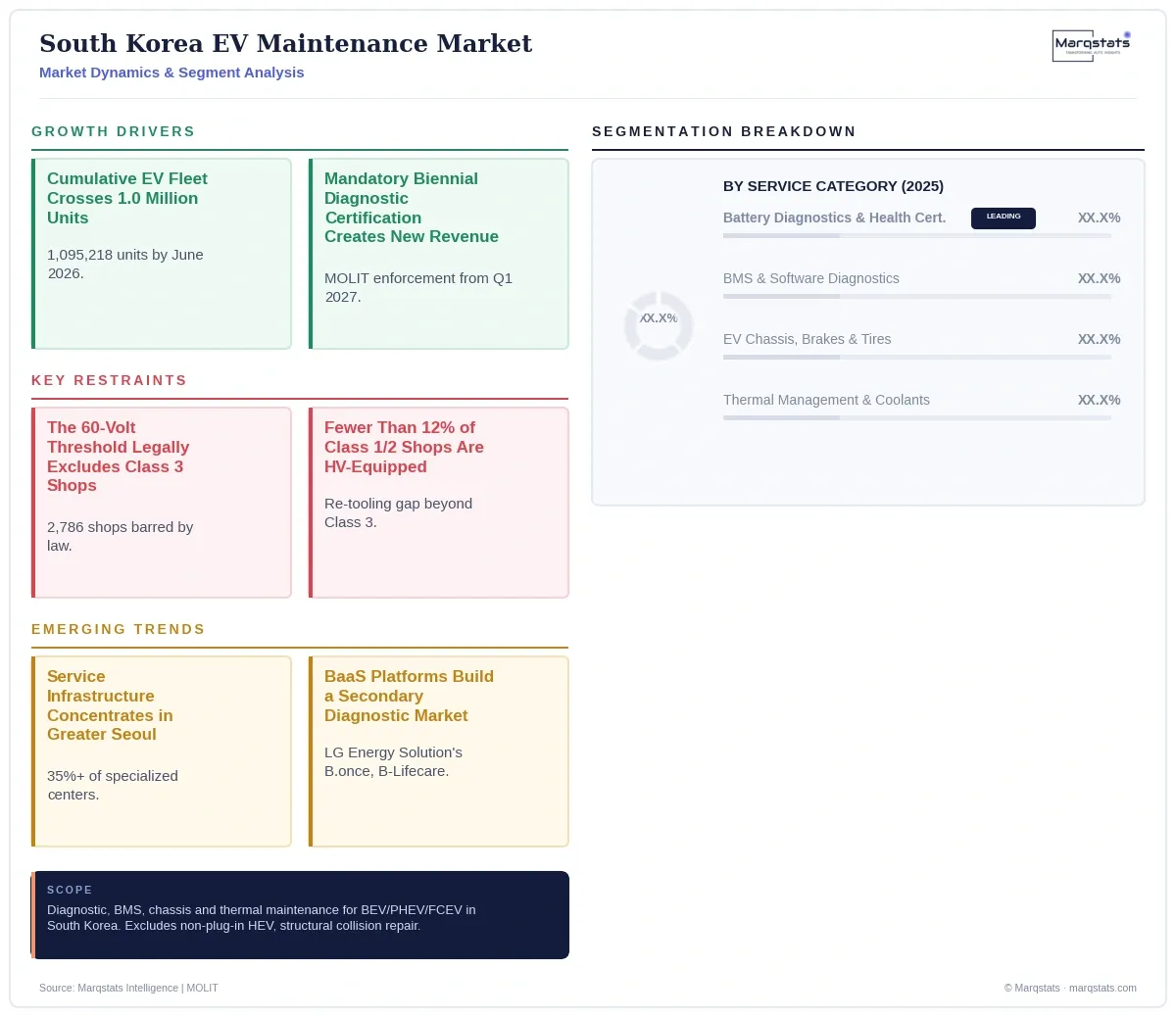
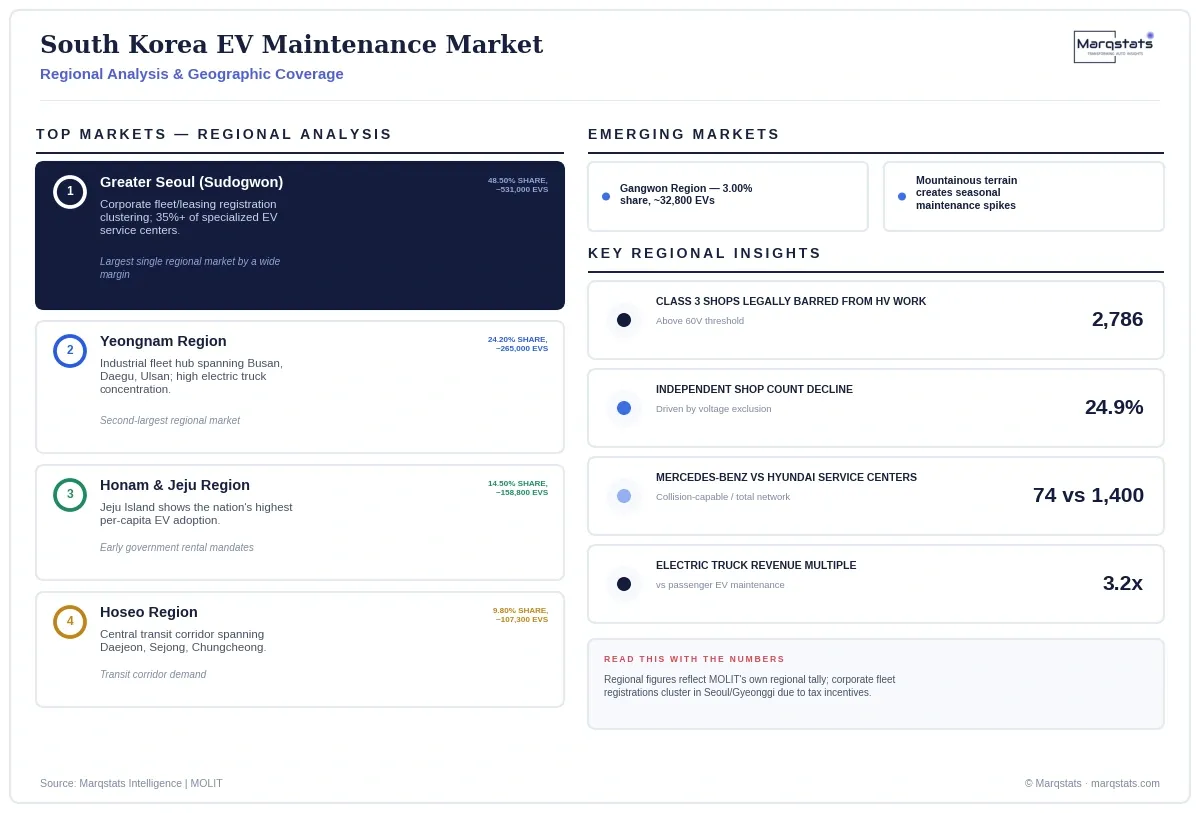
The Motor Vehicle Management Act draws a hard line at 60 volts. South Korea's 2,786 licensed Class 3 neighborhood repair shops — the small, local garages most consumers think of as their default mechanic — are legally barred from working on anything above that threshold. Since virtually every EV high-voltage system operates well above 60 volts, this isn't a capital or skills barrier these shops could invest their way past. It's a legal exclusion, full stop, and it explains why high-voltage maintenance has concentrated so heavily in OEM networks like Hyundai's 1,400 Bluehands locations specifically — those networks aren't just better resourced, they're operating in a legal category most neighborhood shops simply cannot enter.
Market Dynamics
Key Drivers
- Government subsidy volume for EVs is expanding materially, with a 2026 supplementary budget extending planned annual subsidy coverage to 280,000 passenger cars, 45,000 commercial trucks and 3,800 buses nationwide, directly sustaining new-fleet growth that anchors this market's forward addressable base.
- South Korea's fully partitioned service category data shows battery diagnostics and health certification already established as the single largest category at 38.5% of 2025 value, a structural signal that diagnostic technology providers like LG Energy Solution are positioned at the genuine center of this market's near-term value creation, not at its outer periphery.
- South Korea's cumulative registered EV fleet crossed 1.0 million units on April 15, 2026 and reached 1,095,218 by June 2026, directly expanding the addressable base for recurring high-voltage aftermarket maintenance demand across passenger, commercial and special-purpose vehicle categories alike.
- Mandatory biennial battery health diagnostic certification, integrated with standardized Battery-as-a-Service protocols like LG Energy Solution's B.once, is establishing a genuinely new, recurring high-margin service category independent of traditional mechanical wear-and-tear maintenance.
- Commercial electric light trucks, generating 3.2 times the annual maintenance revenue per vehicle of passenger EVs, represent a disproportionately valuable and rapidly growing segment for workshops and parts suppliers capable of serving intensive commercial usage patterns.
- Revised 2025/2026 government subsidy rules requiring real-time battery state-of-charge and diagnostic data transmission during charging sessions are directly incentivizing broader adoption of connected diagnostic infrastructure across the entire vehicle parc.
- Rapid diagnostic technology commercialization, exemplified by LG Energy Solution's 5-minute B.once battery health scan, is lowering the time and cost barrier to battery state-of-health certification, supporting both new maintenance revenue and a growing secondary used-EV certification market nationwide.
Key Restraints
- Winter range degradation in mountainous regions like Gangwon creates genuine localized seasonal maintenance demand spikes that national-average service capacity planning does not fully anticipate, a regional climate factor most of South Korea's flatter, more temperate population centers do not share and rarely plan capacity around.
- The underlying research's own reconciliation places only 65.0% of headline value inputs on directly published statutory sources, with the remaining share reflecting calibrated labor rate and inspection fee assumptions -- a genuine data-availability gap disclosed explicitly throughout this analysis.
- The Motor Vehicle Management Act's legal prohibition on Class 3 shops servicing systems above 60 volts structurally excludes 2,786 licensed neighborhood repair shops from the high-voltage maintenance market entirely, regardless of any capital or training investment those shops might otherwise make.
- Fewer than 12% of South Korea's approximately 5,000 licensed Class 1 and Class 2 repair shops have invested in high-voltage safety gear, ground-isolation testing, and insulated lift equipment, indicating the re-tooling gap extends well beyond the legally excluded Class 3 segment.
- Imported EV brands face a severe service-network deficit relative to domestic manufacturers: Mercedes-Benz operates just 74 collision-capable service centers for approximately 830,000 total brand vehicles, against Hyundai's 1,400 Bluehands locations, creating genuine maintenance wait-time disparities by brand.
- Non-plug-in hybrid vehicles, at 2.81 million units, absorb 71.1% of total green service bay throughput nationwide, structurally delaying independent workshop investment in pure high-voltage BEV repair tools even as the BEV-specific fleet continues to grow.
Key Trends
- Fleet operators managing commercial electric trucks nationwide are increasingly negotiating dedicated maintenance contracts directly with OEM networks given the documented 3.2x revenue-density premium this vehicle category commands, treating service-cost predictability as a genuine procurement priority rather than an afterthought.
- Insurance and used-vehicle marketplaces are increasingly treating verified battery diagnostic certification as a transactional requirement rather than an optional add-on, following the adoption pattern LG Energy Solution's B.once and B-Lifecare platforms have already established with used-car platform Revolt and major auction houses.
- Geographic service infrastructure remains heavily concentrated in the Greater Seoul Metropolitan Area, with over 35% of specialized EV service centers located there, leaving rural and agricultural regions structurally underserved despite rapid electric truck adoption in those same areas.
- Battery-as-a-Service diagnostic applications are establishing a secondary software maintenance market independent of physical repair bays, with LG Energy Solution's B-Lifecare and B.once monetizing used EV residual value certification directly.
- Point-of-sale battery disclosure requirements are expanding, with proposed March 2026 MOLIT regulations increasing mandatory disclosure items from 6 to 10, backed by fines up to KRW 10 million, forcing used car dealers to provide verified diagnostic certificates prior to sale.
- Service bay margin profiles are shifting structurally as diagnostic software scans and EV-rated tire and caliper maintenance replace traditional ICE fluid and mechanical consumable revenue, altering which technical capabilities generate the most workshop value per visit.
Strategic Implications
- Policy makers at MOLIT should weigh the underlying research's own quantified scenario spread carefully, given how directly the choice between full Q1 2027 enforcement and multi-year compliance waivers translates into a USD 386.67 million difference in projected 2030 market value between the Base Case and Downside scenarios.
- Independent Class 1 and Class 2 workshop operators should treat high-voltage re-tooling investment as a genuine near-term competitive differentiator, given that fewer than 12% of peers have made this investment to date, creating meaningful first-mover advantage for those who do.
- Imported OEM distributors, particularly Mercedes-Benz and other brands facing severe service-network deficits relative to Hyundai's domestic coverage, should prioritize expanding collision-capable and high-voltage service center density as a direct competitive response to documented maintenance wait-time disparities.
- Battery diagnostics providers and BaaS platform operators should continue scaling standardized protocols like B.once specifically toward MOLIT's Q1 2027 mandatory certification timeline, positioning their technology as the compliance infrastructure the Base Case Scenario's own trigger condition depends on, well ahead of that enforcement date.
- Investors and analysts should track MOLIT's biennial diagnostic certification enforcement timeline and independent Class 2 shop re-tooling adoption rates as the two clearest variables separating this market's Base Case and Downside scenarios, given how directly both feed the underlying research's own named trigger conditions and how quickly either could shift the market's near-term trajectory.
Outlook
The underlying research tested for three forward trajectories and confirmed only two are genuinely distinct, explicitly rejecting a third because current legislative dockets present no additional distinct regulatory trigger beyond the two identified below.
Under the Base Case Scenario, Accelerated Diagnostic Integration, MOLIT fully enforces mandatory biennial battery health diagnostic certification across all Class 1 and Class 2 inspection centers starting Q1 2027, integrated with standardized BaaS software protocols like LG Energy Solution's B.once, with government purchase subsidies strictly conditioned on real-time battery diagnostic data transmission; the cumulative registered EV fleet reaches 2,750,000 units by 2030, generating USD 1,466.67 million in annual maintenance expenditure at a 27.64% CAGR.
Under the Downside Case Scenario, Regulatory Bottleneck and Independent Resistance, high re-tooling costs cause widespread compliance delays among independent Class 2 shops, prompting MOLIT to grant multi-year enforcement waivers for high-voltage diagnostic scanning, while lingering consumer safety concerns limit new EV sales penetration to under 15% of annual registrations through 2028; the cumulative registered EV fleet reaches only 2,250,000 units by 2030, with total maintenance expenditure reaching USD 1,080.00 million.
Market Segmentation
884,413 units (80.75% share), anchored by Hyundai Motor Group, the dominant vehicle category by volume.
193,689 units (17.68% share), anchored by the Hyundai Porter II EV and Kia Bongo III EV, generating 3.2 times the annual maintenance revenue per vehicle of passenger EVs due to intensive commercial usage.
15,909 units (1.45% share), anchored by the Hyundai ST1 and Solati EV.
1,207 units (0.11% share), anchored by specialized utility EV manufacturers.
USD 166.67 million (38.50% share) in 2025. The largest category, anchored by LG Energy Solution's B.once diagnostic service.
USD 103.93 million (24.00% share) in 2025. Anchored by Hyundai Bluehands and Kia AutoQ proprietary diagnostic platforms.
USD 97.41 million (22.50% share) in 2025. Anchored by Hankook Tire and Kumho Tire's specialized EV-rated product lines.
USD 64.96 million (15.00% share) in 2025. Anchored by Hanon Systems' thermal management component supply.
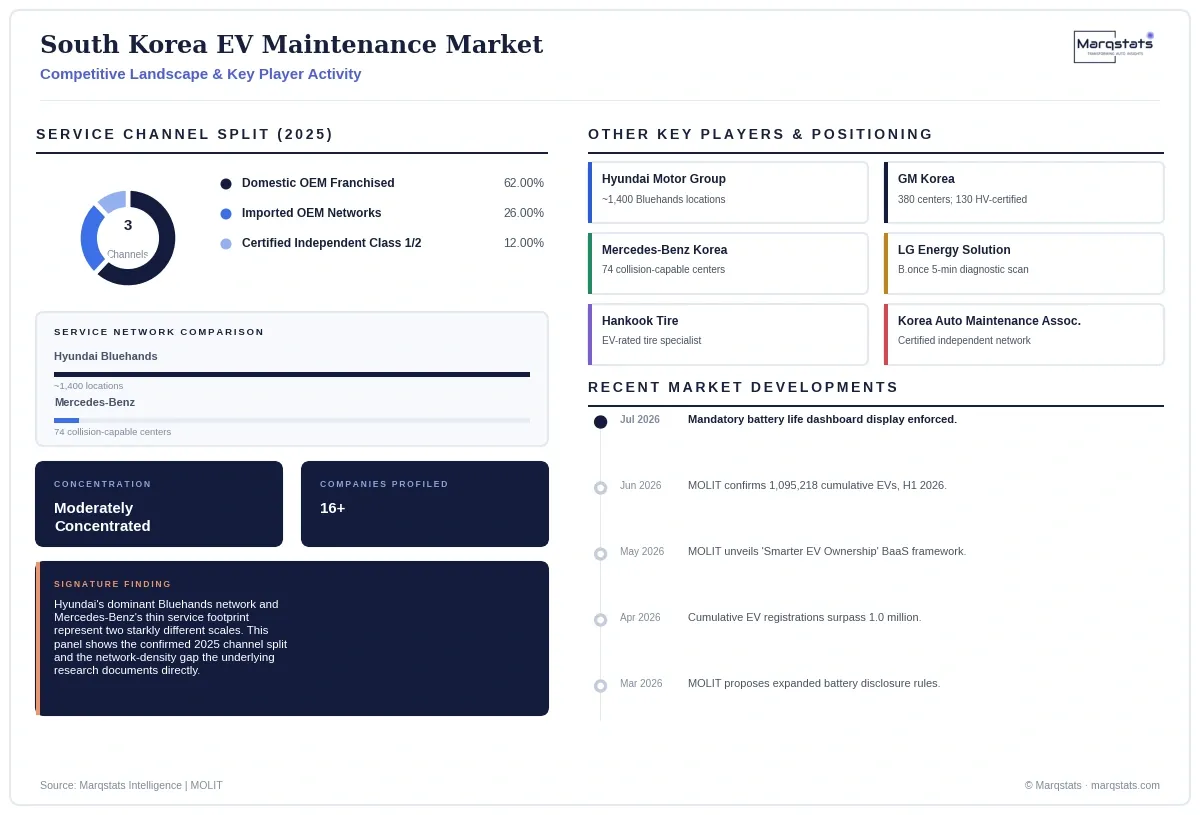
62.00% share, anchored by Hyundai Bluehands' approximately 1,400 locations, the dominant channel given warranty requirements and diagnostic software lock-ins.
26.00% share, anchored by Mercedes-Benz, BMW and Tesla, constrained by a genuine service-network deficit relative to domestic coverage.
12.00% share, anchored by the Korea Auto Maintenance Association's certified network, the smallest but most structurally important channel for post-warranty servicing growth.
By Geography
A note on regional registration clustering
Corporate fleet and leasing registrations cluster heavily in Seoul and Gyeonggi due to corporate tax incentives, a registration effect the underlying research flags explicitly alongside each regional figure below.
Greater Seoul (Sudogwon)
48.5% share (approximately 531,000 EVs) as of June 2026. Corporate fleet and leasing registrations cluster heavily in Seoul and Gyeonggi due to corporate tax incentives, and the region hosts over 35% of the nation's specialized EV service centers.
Yeongnam Region
24.2% share (approximately 265,000 EVs) as of June 2026, an industrial fleet hub spanning Busan, Daegu and Ulsan with high electric truck concentration.
Honam & Jeju Region
14.5% share (approximately 158,800 EVs) as of June 2026. Jeju Island shows the nation's highest per-capita EV adoption due to early government rental mandates.
Hoseo Region
9.8% share (approximately 107,300 EVs) as of June 2026, the central transit corridor spanning Daejeon, Sejong and Chungcheong.
Gangwon Region
3.0% share (approximately 32,800 EVs) as of June 2026. Mountainous terrain limits winter range, creating localized seasonal maintenance spikes.
How Competition Is Evolving
No single company in this market spans domestic OEM warranty servicing, imported-brand network expansion and battery diagnostic certification simultaneously, leaving genuine competitive white space for any group capable of bridging Hyundai's dominant Bluehands warranty-era coverage with the certified independent and diagnostic-technology channels this market's own segmentation shows growing fastest as the fleet ages past warranty.
Competition spans domestic OEM franchised networks, imported OEM networks facing genuine service-density deficits, and a smaller certified independent segment structurally constrained by high-voltage licensing requirements. Hyundai Motor Group anchors the dominant domestic channel through its approximately 1,400-location Bluehands network, complemented by Kia's AutoQ platform. GM Korea operates 380 total service centers nationally, with 130 locations (approximately 34% of its network) certified to perform high-voltage work and EV battery repairs, and 133 locations concentrated in the Greater Seoul Metropolitan Area. Imported brands including Mercedes-Benz, BMW and Tesla operate materially thinner networks — Mercedes-Benz's 74 collision-capable centers for approximately 830,000 total brand vehicles illustrate the scale of the deficit relative to domestic coverage.
On battery diagnostics and certification, LG Energy Solution anchors the market through its B.once rapid diagnostic service and B-Lifecare residual value certification platform, both adopted by used-car platform Revolt and major auction houses. Hankook Tire and Kumho Tire anchor specialized EV-rated tire supply, while Hanon Systems anchors thermal management component supply. On the independent side, the Korea Auto Maintenance Association represents the certified Class 1 and Class 2 shop segment, though fewer than 12% of its roughly 5,000 members have invested in the high-voltage safety gear and insulated lift equipment required to compete for high-voltage servicing work. Regulatory oversight rests with MOLIT (Ministry of Land, Infrastructure and Transport), the Ministry of Environment, and the Ministry of Trade, Industry and Energy (MOTIE).
Companies Covered
The report profiles 16+ companies with full strategy and financials analysis, including:
Recent Market Activity
Table of Contents
Coverage & Segmentation
This report measures routine scheduled maintenance, high-voltage battery diagnostic scanning, battery state-of-health certification, thermal management system servicing, electric powertrain diagnostics, software-defined vehicle firmware updates, and EV-specific chassis maintenance for BEVs, PHEVs and FCEVs in South Korea, across a 2025 base year and a 2026 to 2030 forecast period, denominated in United States dollars at a benchmark reference rate of 1,350 KRW/USD. It excludes non-chargeable hybrid electric vehicles from pure EV high-voltage maintenance calculations and excludes major structural collision body repairs covered by insurance.
The analysis spans three segmentation dimensions — vehicle type, service category and service channel — five regional geographies, and 16 profiled entities across OEMs, battery diagnostics providers and regulatory bodies. Fleet and registration figures trace to MOLIT; market value and segment splits trace to the underlying research's own fully partitioned sizing model.