Market Snapshot
Key Takeaways
Market Overview & Analysis
Report Summary
This analysis reads Switzerland's own fully worked sizing chain, cantonal distribution data, and named-scenario regulatory framework together as a single coherent picture rather than isolated data points, since the underlying research itself was structured to support exactly that kind of integrated reading.
Switzerland's EV maintenance market is measured across tires and wheel assemblies, scheduled inspection, mechanical wear and braking, and high-voltage diagnostics, valued at USD 399.86 million (CHF 359.87 million) in 2025. This figure is taken directly from the underlying research's own fully worked sizing chain, anchored to statutory fleet data covering 249,832 active BEVs and 112,015 PHEVs.
Structurally, this is a market shaped by a genuine cost inversion for plug-in hybrids, which cost more to maintain than either pure electric or pure combustion vehicles, alongside a rapidly maturing fleet crossing the four-to-six-year age threshold that is shifting channel share meaningfully from franchised dealers toward independent workshops.
The analysis is built for four reader types making different decisions: an independent workshop operator weighing Level 2/3 high-voltage certification investment and multi-brand network affiliation, a franchised dealer group consolidating module repairs into centralized regional hubs, a parts distributor building supply chains for Chinese and Tesla platforms, and an investor tracking how cantonal tax policy and the proposed federal EV road tax shape this market's Baseline-to-Accelerated scenario range.
The Powertrain Neither Fully Electric Nor Fully Combustion Actually Costs the Most
Conventional wisdom about hybrid vehicles often assumes they split the difference between electric and combustion maintenance costs — cheaper than pure ICE, more expensive than pure BEV, landing somewhere in the middle. Switzerland's own empirical workshop data shows the opposite is true.
Plug-in hybrids cost CHF 1,250 annually to maintain in Switzerland — more than conventional combustion vehicles at CHF 1,180, and dramatically more than pure BEVs at CHF 880. The mechanism is straightforward once you see it: a PHEV doesn't get to skip oil changes, exhaust maintenance, or emissions testing, since it still carries a full combustion engine. But it also doesn't get to skip thermal cooling checks, onboard charger maintenance, or the elevated tire wear from carrying battery ballast on top of a full ICE drivetrain. For anyone choosing between powertrains based purely on maintenance economics, this is a genuinely counterintuitive finding worth knowing before the purchase, not after the first service bill.
Why Zug and Zurich's EV Numbers Overstate Their Actual Service Demand
Cantonal fleet statistics in Switzerland create a genuine interpretation trap for anyone using registration data to plan workshop investment. Zug and Zurich post outsized EV registration numbers relative to their resident populations — not because residents there are disproportionately buying EVs, but because major leasing companies and corporate fleets maintain administrative headquarters in those cantons.
The vehicles themselves are frequently driven and serviced across suburban commuter belts in Aargau, Bern, and the Romandie — places whose registration-based fleet share genuinely understates their actual servicing demand. Anyone planning workshop capacity based on where vehicles are registered, rather than where they actually get driven and serviced, risks systematically misallocating investment away from the regions that need it most.
Market Dynamics
Key Drivers
- Switzerland's own MFK statutory inspection cycle generates consistent, compulsory pre-inspection preparation turnover for workshops nationwide, providing a durable, non-discretionary revenue floor independent of individual consumer maintenance decisions.
- Regenerative braking's documented 40% to 60% extension of friction brake pad and rotor lifespan represents a genuine, durable cost advantage for BEV owners specifically, even though Swiss winter conditions partially offset this benefit through accelerated caliper corrosion and slider-pin seizure requiring periodic mechanical intervention regardless of actual pad wear.
- Switzerland's own regional data shows a meaningful gap between statutory cantonal registration figures and actual on-road servicing demand, since corporate leasing fleets registered in Zug and Zurich disperse a substantial share of their real-world driving activity into Aargau, Bern and the Romandie, sustaining service demand across regional networks that pure registration data alone would understate.
- Switzerland's own fully worked sizing chain shows tires and wheel assemblies already the single largest service category at 34.00% of total value, a structural signal that specialized high-load tire inventory and precision alignment capability represent the most immediate revenue opportunity for workshops entering this market.
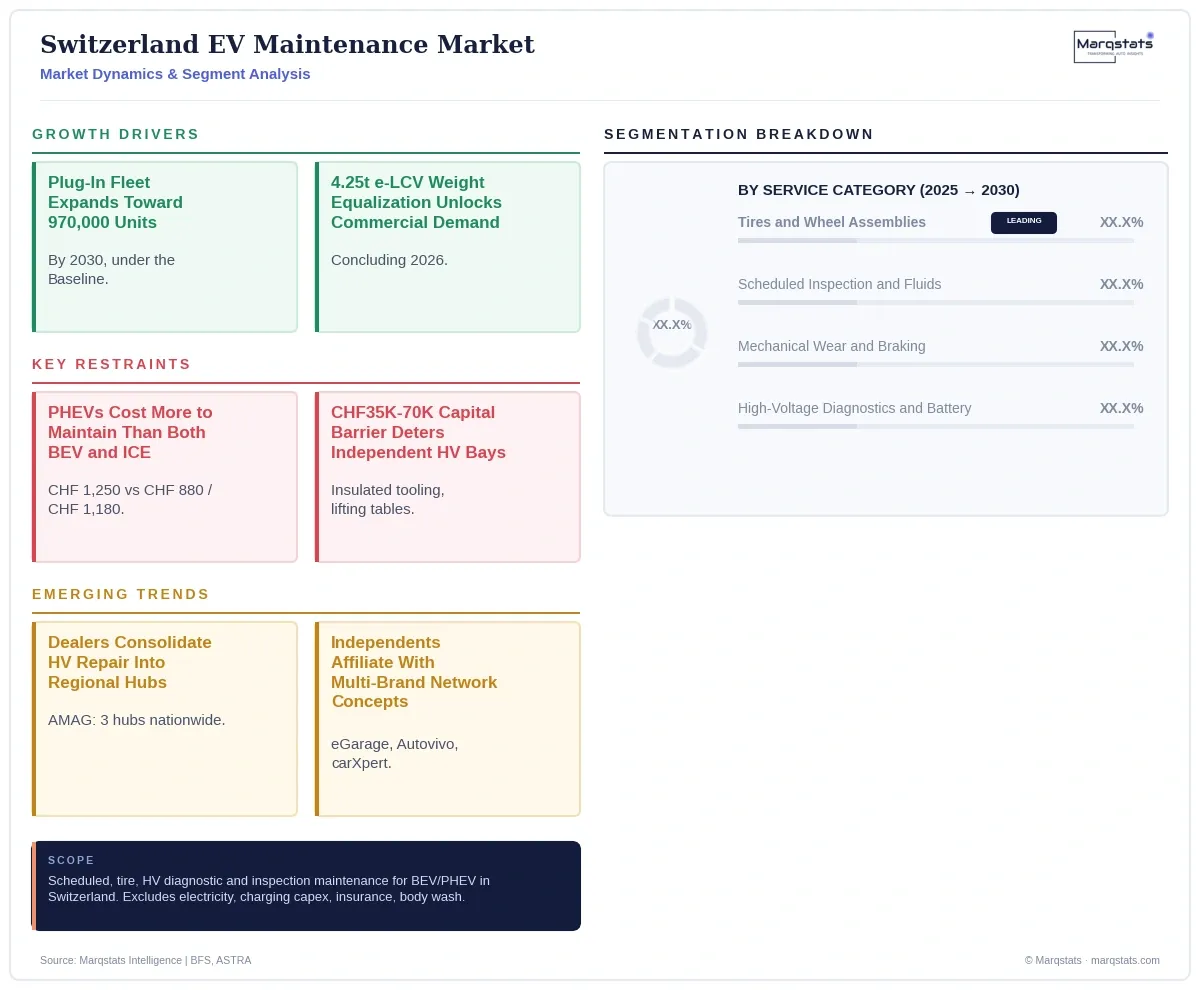
- Switzerland's plug-in fleet is expanding rapidly, from 361,847 units in 2025 toward a projected 970,000 units by 2030 under the Baseline Scenario, directly growing the addressable base for recurring EV aftermarket maintenance demand.
- The September 2025 Federal Council consultation on 4.25-tonne e-LCV weight equalization, concluding in 2026, removes tachograph mandates and heavy-vehicle transit restrictions for electric delivery vans, unlocking high-mileage commercial e-LCV maintenance demand.
- New BEV registrations expanded 15.6% year-on-year to 52,843 units in 2025 even as total new passenger car registrations contracted 2.1%, demonstrating strong counter-cyclical momentum that directly expands the future maintenance-eligible fleet.
- National distributors including hostettler autotechnik and Swiss Automotive Group are deploying dedicated EV workshop concepts (eGarage, Autovivo, carXpert) that supply independent garages with specialized tooling, technical training, and diagnostic gateway access.
- The commercial rollout of hostettler's Aravolt replacement parts line in September 2026 is establishing direct supply chains for Chinese EV brands and Tesla platforms, expanding independent workshop capability as these brands scale their Swiss footprint.
Key Restraints
- Switzerland's persistent structural shortage of skilled young mechanics genuinely constrains near-term capacity expansion, since while basic high-voltage safety is now integrated into standard vocational apprenticeships, the existing master technician workforce still requires meaningful continuing education investment to achieve Level 2 and Level 3 certifications.
- This market's own three-scenario framework spans a genuinely wide 2030 range, from USD 788.90 million under the Deceleration Scenario to USD 1.20 billion under the Accelerated Transition Scenario -- a disclosed spread reflecting real uncertainty in cantonal tax harmonization and the proposed federal EV road tax, not a narrow band around a single central estimate.
- Plug-in hybrid vehicles cost more to maintain than both pure BEVs and pure ICE vehicles, a genuine structural disadvantage for this powertrain segment that could dampen future PHEV purchase decisions as maintenance-cost awareness spreads among Swiss consumers.
- Fully equipping a workshop bay for high-voltage servicing requires CHF 35,000 to CHF 70,000 in capital investment for insulated tooling, mobile battery lifting tables, and SUVA-mandated fire-quenched battery quarantine storage, a genuine barrier driving regional service consolidation among small rural workshops.
- Secure Diagnostic Gateways mandated under UNECE Regulations R155 and R156 require independent workshops to purchase recurring multi-brand diagnostic subscriptions from providers including Bosch, Hella Gutmann, and Texa, concentrating complex electronic diagnostics within well-capitalized networks.
- Only a limited cohort of Swiss technicians holds Level 3 Hochvoltexperte certification, requiring extensive electrical engineering credentials, causing major dealer groups to consolidate structural battery pack repairs within a small number of centralized regional facilities rather than distributing capability broadly.
Key Trends
- Regional service capacity is beginning to diverge between the major cantonal centers and Switzerland's more Alpine and peripheral regions, raising genuine open questions about whether centralized regional hub models or mobile diagnostic units will emerge as the preferred way to extend high-voltage repair capability into lower-density cantons over the coming years.
- Fleet operators managing high-mileage commercial electric vans are increasingly negotiating dedicated maintenance contracts directly with authorized dealer networks offering centralized high-voltage competence hubs, given the documented complexity of structural battery repairs commercial e-LCV platforms like the eVito and eSprinter require.
- Franchised dealership networks are consolidating high-voltage battery repair capability into centralized regional competence hubs, mirroring AMAG's three-hub model across Dübendorf, Crissier and Breganzona, rather than equipping every local dealership individually.
- Independent workshops are affiliating with multi-brand network concepts including hostettler's eGarage and Autovivo or SAG's carXpert to secure digital gateway bypasses, diagnostic data pipelines, and technical support hotlines.
- Industry associations including AGVS, TCS and auto-schweiz launched a national campaign in March 2026 establishing standardized battery health testing and residual value transparency to accelerate used EV transactions and subsequent aftermarket servicing.
- Wholesale parts distributors are diversifying inventories toward high-load suspension components, specialized brake pads for low-use/high-torque environments, EV cooling fluids, and cabin environmental filtration as ICE component demand secularly declines.
Strategic Implications
- Component suppliers should also weight EV-specific tire and cooling fluid inventory planning heavily nationwide, given how directly both categories anchor this market's largest documented service revenue drivers.
- Independent workshop operators should prioritize Level 2 and Level 3 high-voltage certification and affiliation with multi-brand network concepts, positioning their commercial offering specifically toward the expanding pool of vehicles aged four years and older where lower hourly billing rates provide genuine competitive advantage.
- Franchised dealership networks should continue consolidating capital-intensive high-voltage tooling and Level 3 technicians into centralized regional hubs while capturing higher-margin specialized operations including ADAS calibration and certified battery health testing to offset secular decline in conventional mechanical servicing.
- Wholesale parts distributors should prioritize direct supply chain development for Chinese EV brands and Tesla platforms specifically, following hostettler's Aravolt model, given how directly these nameplates are expanding their Swiss footprint outside traditional OEM parts channels.
- Investors and analysts should track cantonal tax harmonization progress nationwide and the proposed federal EV replacement road tax as the two clearest variables separating this market's Baseline and Accelerated scenarios, given how directly both feed the underlying research's own named trigger conditions.
Outlook
The underlying research presents three genuinely distinct trajectories diverging on named regulatory and macroeconomic trigger conditions. This market's own forecast horizon reaches 2030 directly, requiring no Marqstats extrapolation.
Under the Baseline Scenario (Sustained Regulatory Alignment), market growth reflects ongoing adoption in line with Swiss federal climate targets, gradual residential charging infrastructure expansion via the “Right to Charge” legislative movement, and implementation of 4.25-tonne e-LCV weight equalization in 2026; the active electrified fleet reaches 970,000 units by 2030, generating USD 994.23 million (CHF 894.80 million) in total market value at a 19.98% CAGR.
Under the Accelerated Transition Scenario (Mandated Decarbonization and Fleet Equalization), cantonal tax structures harmonize to penalize fossil-fuel drivetrains uniformly, corporate ESG procurement accelerates commercial fleet transition, and third-party modular battery remanufacturing centers scale rapidly; the active electrified fleet exceeds 1,150,000 units by 2030, driving total market value to USD 1,200.00 million (CHF 1,080.00 million) at a 24.5% CAGR.
Under the Deceleration Scenario (Infrastructure Bottlenecks and EV Tax Drag), the proposed federal replacement road tax on electric vehicles is implemented punitively to compensate for National Roads and Urban Traffic Fund shortfalls, combined with persistent tenant constraints in multi-family dwelling charging access; the active electrified fleet reaches only 750,000 units by 2030, with total market value reaching only USD 788.90 million (CHF 710.00 million) at a 14.5% CAGR.
Market Segmentation
USD 135.95 million (34.0% share) in 2025, growing to USD 328.10 million (33.0% share) by 2030. The largest category, driven by high-load EV tire sets and biannual seasonal changeovers.
USD 107.96 million (27.0% share) in 2025, growing to USD 238.62 million (24.0% share) by 2030. Anchored by microfiltration, brake fluids and MFK statutory inspection preparation.
USD 83.97 million (21.0% share) in 2025, growing to USD 218.73 million (22.0% share) by 2030. Anchored by heavy-mass suspension bushings and oxidized brake disc replacement.
USD 71.97 million (18.0% share) in 2025, growing to USD 208.79 million (21.0% share) by 2030. The fastest-growing category, anchored by SoH testing and module replacement.
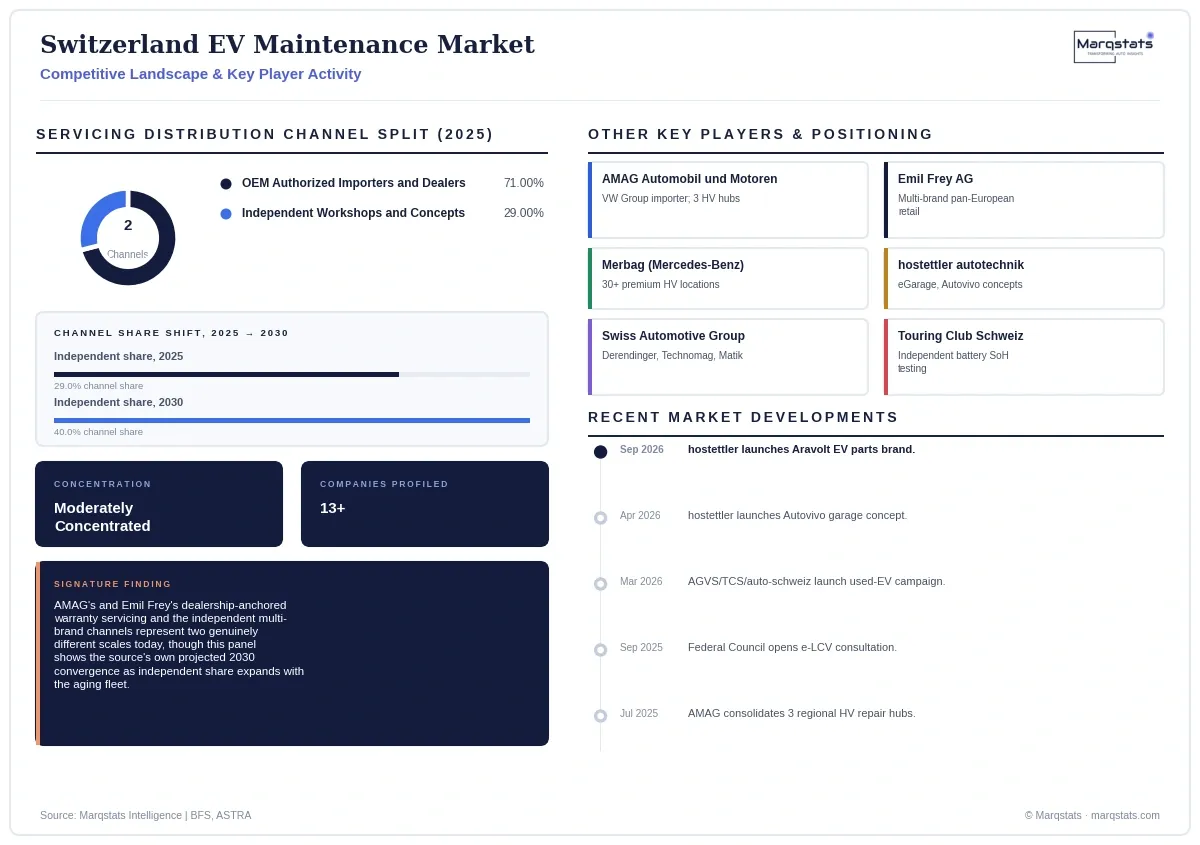
USD 283.90 million (71.0% share) in 2025, growing to USD 596.54 million (60.0% share) by 2030. Anchored by AMAG, Emil Frey and Merbag, sustained by captive 8-year battery warranties.
USD 115.96 million (29.0% share) in 2025, growing to USD 397.69 million (40.0% share) by 2030. The fastest-growing channel, led by hostettler eGarage, carXpert and Bosch Car Service.
By Geography
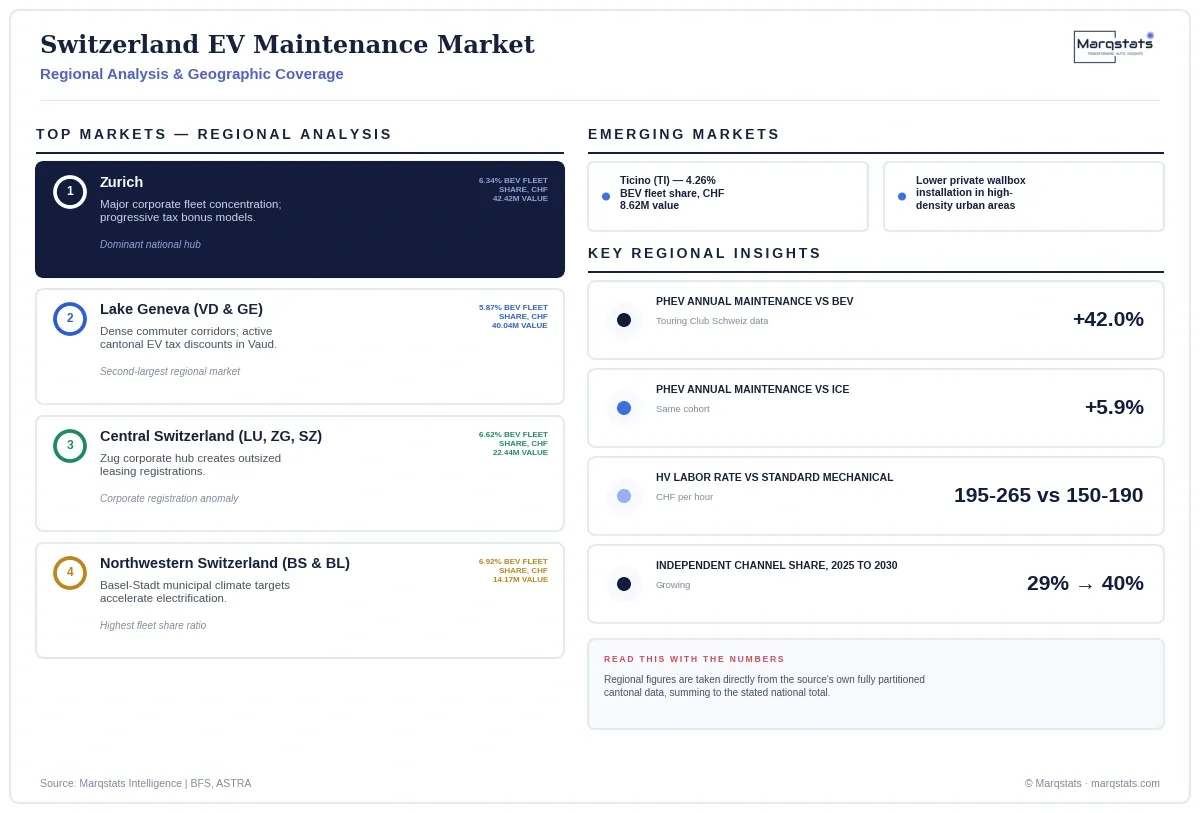
Zurich (ZH)
6.34% BEV fleet share (48,200 units of 760,200 total registered vehicles), CHF 42.42 million in maintenance value, driven by major corporate fleet concentration and progressive tax bonus models.
Lake Geneva (VD & GE)
5.87% BEV fleet share (45,500 units of 775,100 total registered vehicles), CHF 40.04 million in maintenance value, anchored by dense commuter corridors and active cantonal EV tax discounts in Vaud.
Bern (BE)
4.57% BEV fleet share (25,400 units of 555,400 total registered vehicles), CHF 22.35 million in maintenance value, supported by an extensive geographic network and moderate cantonal eco-rebates.
Aargau (AG)
5.52% BEV fleet share (23,800 units of 431,268 total registered vehicles), CHF 20.94 million in maintenance value, a strategic transit hub with elevated hybrid/EV fleet proportion despite lower headline registration counts.
Northwestern Switzerland (BS & BL)
6.92% BEV fleet share (16,100 units of 232,500 total registered vehicles), CHF 14.17 million in maintenance value, where Basel-Stadt municipal climate targets accelerate electrification.
Central Switzerland (LU, ZG, SZ)
6.62% BEV fleet share (25,500 units of 385,000 total registered vehicles), CHF 22.44 million in maintenance value, where Zug's corporate hub creates outsized leasing registrations relative to actual regional service demand.
How Competition Is Evolving
Switzerland's technician certification framework, its cantonal registration distortions, and its documented data-transparency gaps around battery failure rates are each disclosed explicitly throughout this analysis, consistent with the underlying research's own emphasis on precise, well-sourced empirical measurement.
No single company in this market spans franchised warranty-anchored dealership servicing, independent multi-brand affiliation, and national parts distribution simultaneously, leaving genuine competitive white space for any group capable of bridging AMAG's and Emil Frey's dealership-anchored warranty servicing with the independent channels this market's own scenario framework shows gaining 11 percentage points of combined share by 2030.
Competition spans OEM authorized importer conglomerates, independent multi-brand workshop concepts, and national parts distributors. AMAG Automobil und Motoren AG anchors the dominant authorized channel as Switzerland's largest automotive enterprise and exclusive Volkswagen Group importer, operating three regional high-voltage competence hubs in Dübendorf, Crissier and Breganzona. Emil Frey Group operates extensive multi-brand retail spanning European, Japanese, Korean and American nameplates through proprietary technical academies, while Merbag anchors premium Mercedes-Benz passenger and e-LCV servicing across more than 30 locations.
On the independent side, hostettler autotechnik ag anchors the eGarage and Autovivo workshop concepts through 12 regional logistics hubs, while Swiss Automotive Group supplies independent workshops through Derendinger, Technomag and Matik distribution banners supporting carXpert and Garage plus concepts. Robert Bosch AG delivers diagnostic hardware and high-voltage training to its Bosch Car Service network. Regulatory and standards oversight rests with ASTRA (statutory inspection), AGVS (technician certification framework), EKAS and SUVA (occupational safety), with Touring Club Schweiz providing independent battery health certification supporting the used EV market.
Companies Covered
The report profiles 13+ companies with full strategy and financials analysis, including:
Recent Market Activity
Table of Contents
Coverage & Segmentation
This report measures routine scheduled servicing, mechanical friction and chassis wear replacements, high-voltage electrical diagnostics, battery health certifications, tire replacements, and statutory inspection preparations for BEV and PHEV vehicles in Switzerland, across a 2025 base year and a 2026 to 2030 forecast period, denominated in United States dollars at the pack's own stated benchmark rate of 1.11 USD per CHF. It excludes upstream electricity sales, retail charging hardware installation, capital vehicle depreciation, automotive insurance premiums, and cosmetic body wash operations.
The analysis spans two segmentation dimensions — aftermarket service category and servicing distribution channel — six cantonal regional groupings, and 13 profiled entities across OEM importers, independent workshop networks and regulatory bodies. Fleet figures trace to the Federal Statistical Office and Federal Roads Office; market value and both segmentation dimensions trace directly to the underlying research's own fully worked sizing model, with both 2025 and 2030 figures directly source-stated throughout.