Market Snapshot
Middle bar: base-year value × (1 + CAGR), rounded to two decimals. This is a calculated illustration, not a separately researched annual estimate.
Market Size (2025, Base Year): USD 659.38 Million
Estimated Value (2026): USD 767.45 Million
Forecast Value (2030): USD 1,357.53 Million
CAGR: 15.54% | Forecast Period: 2026 – 2030
Growth — Absolute: USD 698.15 Million
Largest Market: Stockholm County (32.03% of national electrified fleet)
Fastest Growing: Thermal Management & Battery (15.00% to 18.00% share, 2025-2030)
Dominant Segment: Plug-in Hybrid (PHEV) (51.33% revenue share despite 43.54% fleet share, 2025)
Market Concentration: Moderately Fragmented
Base Year: 2025 | Historical Period: 2021 – 2025 | Forecast Period: 2026 – 2030
Units Considered: Value (USD Million)
Segments Covered: 3 | Regions Covered: 6 | Companies Profiled: 14
Report Pages: 240 | Deliverables: PDF, Excel, PPT
Key Takeaways
Market Overview & Analysis
Report Summary
This analysis reads Sweden's own fully worked sizing chain, regional distribution data, and named-scenario regulatory framework together as a single coherent picture rather than isolated data points, since the underlying research itself was structured to support exactly that kind of integrated reading.
Sweden's EV maintenance market is measured across tires and chassis, scheduled servicing, braking systems, thermal management, and software/ADAS diagnostics, valued at USD 659.38 million (SEK 6,481.44 million) in 2025. This figure is taken directly from the underlying research's own fully worked sizing chain, anchored to statutory fleet data covering 858,521 active electrified vehicles.
Structurally, this is a market shaped by a genuine revenue inversion where plug-in hybrids, not pure electric vehicles, generate the largest single share of maintenance turnover, alongside a rapidly maturing fleet crossing eight-year battery warranty expiration that is shifting channel share meaningfully from franchised dealers toward independent workshops nearing parity by 2030.
The analysis is built for four reader types making different decisions: an independent workshop operator weighing Branschstandard för Elfordon Level 3/4 certification investment and SERMI accreditation, a franchised dealer group introducing subscription service models to retain post-warranty customers, a battery recycling investor tracking FoRetur's new producer responsibility infrastructure, and an analyst tracking how entry-level BEV pricing and EU fleet mandates shape this market's Constrained-to-Accelerated scenario range.
Why the Compromise Vehicle Generates the Compromise-Free Revenue
Plug-in hybrids are typically marketed as a bridge technology — electric range for daily driving, combustion backup for longer trips. Sweden's own maintenance revenue data shows this bridge vehicle generating something unexpected: the single largest share of aftermarket turnover in the entire electrified segment.
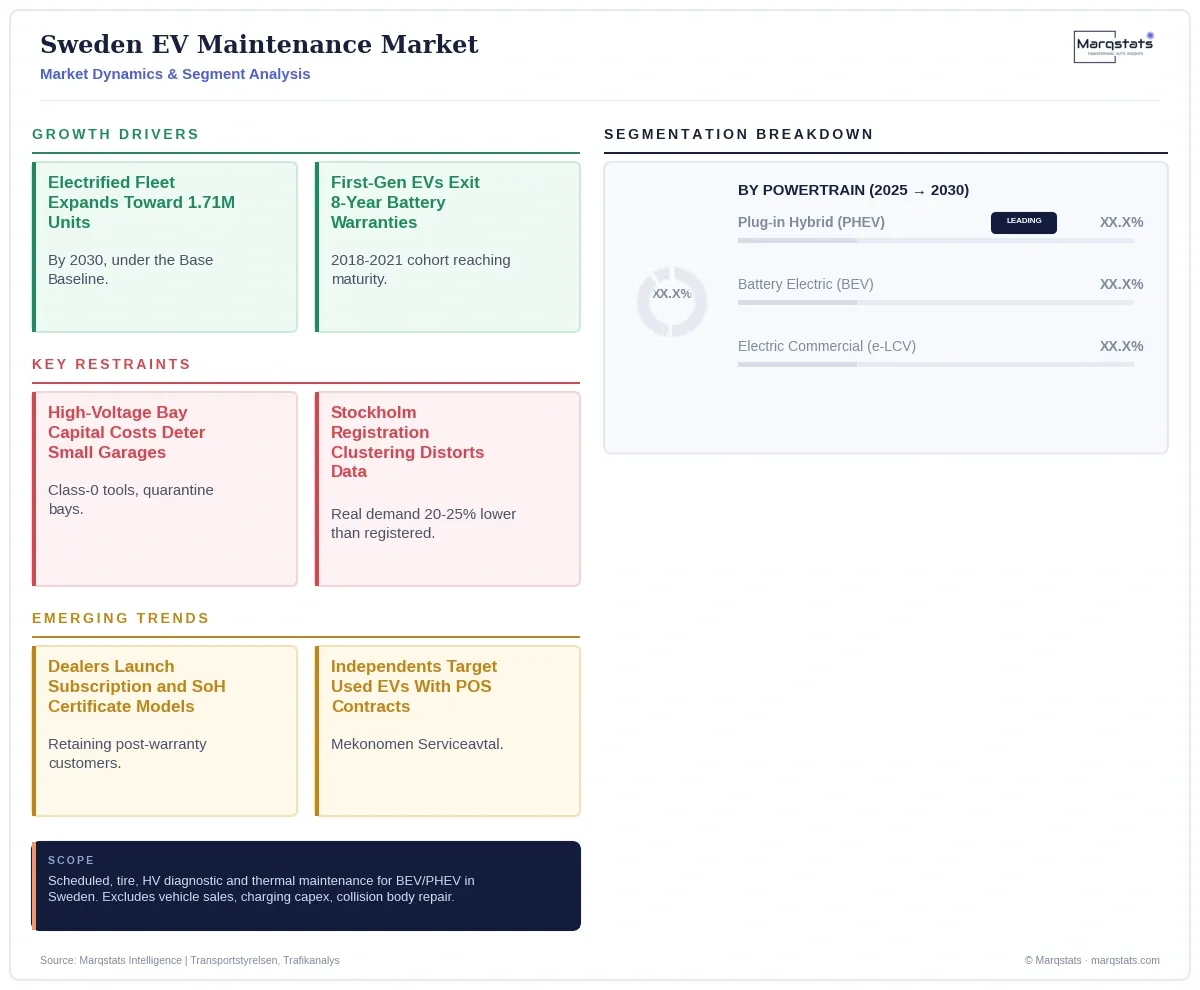
PHEVs represent 43.54% of Sweden's electrified fleet but generate 51.33% of maintenance revenue — more than pure BEVs, which hold a larger 50.40% fleet share but capture only 38.72% of revenue. The mechanism is direct: a PHEV owner still needs oil changes, spark plugs and exhaust servicing, since the combustion engine never goes away. But that same owner also needs high-voltage isolation checks, inverter cooling flushes and auxiliary battery maintenance, since the electric system is fully real too. Workshops positioning specifically around PHEV servicing capability, not just pure-BEV high-voltage work, are targeting the segment generating the most revenue per vehicle in today's Swedish market — even though the underlying research's own forecast shows this specific advantage reversing sharply by 2030 as BEV volumes scale.
A Winter Climate That Turns an EV Advantage Into a Workshop Revenue Line
Regenerative braking is usually framed as a straightforward EV benefit: less friction brake wear, longer pad life, fewer replacements. In Sweden's climate specifically, that benefit creates a distinct, offsetting maintenance requirement most owners don't anticipate.
Because regenerative braking handles most deceleration, friction brakes see far less use — which sounds purely positive until winter road salt and moisture start accumulating on discs and calipers that never get mechanically cleared through normal use the way an ICE vehicle's brakes would. The result is corrosion pitting, debonding friction linings, and seized caliper slide pins — a frequent cause of failed annual roadworthiness inspections specifically for electric cars. Swedish workshops have adapted by recommending annual preventive brake servicing regardless of pad wear, turning what should be a cost-saving feature into a genuine, recurring revenue line unique to this climate.
Market Dynamics
Key Drivers
- Sweden's own regional data shows Northern Sweden's rapid electrification growth despite its harsh sub-arctic climate genuinely counterintuitive, since conventional wisdom might predict slower adoption in cold-climate regions, yet Västernorrland County's fleet expanded 28% in a single year, suggesting genuine untapped demand across Sweden's northern regions.
- Sweden's own fully worked sizing chain shows tires, alignment and chassis already the single largest maintenance category at 29.00% of total value, a structural signal that specialized tire inventory and precision alignment capability represent the most immediate revenue opportunity for workshops entering this market.
- Sweden's electrified fleet is expanding rapidly, from 858,521 units in 2025 toward a projected 1,710,000 units by 2030 under the Base Baseline Scenario, directly growing the addressable base for recurring EV aftermarket maintenance demand.
- The first generations of mass-market electric vehicles from the 2018-2021 incentives era are now approaching expiration of their eight-year or 160,000 km traction battery guarantees, migrating an increasing share of maintenance work toward independent workshops.
- Bilia AB's May 2026 master franchise agreement with Kia Sweden, expected to contribute approximately SEK 2.0 billion in annual turnover by 2028, is directly expanding authorized electrified servicing capacity across seven Stockholm and Western Sweden locations.
- MEKO AB's proprietary E+ certification standard, with over 980 group workshops certified at Level 2, and its March 2025 master service agreement with General Motors for Cadillac electric models, demonstrate independent networks scaling genuine high-voltage capability.
- FoRetur AB's December 2025 approval as a designated producer responsibility organization for EV traction batteries, in partnership with Stena Recycling and Hydrovolt, is building national collection and recycling infrastructure supporting the broader aftermarket ecosystem.
Key Restraints
- Sweden's persistent shortage of certified high-voltage technicians genuinely constrains near-term capacity expansion, since Level 3 and Level 4 Branschstandard för Elfordon certification requires meaningful training investment beyond standard automotive apprenticeship curricula, a gap independent chains are only beginning to close through programs like KGK Motor's ProMeister Academy.
- This market's own three-scenario framework spans a genuinely wide 2030 range, from USD 1,113.94 million under the Constrained Transition Scenario to USD 1,546.29 million under the Accelerated High-Parc Scenario -- a disclosed spread reflecting real uncertainty in entry-level BEV pricing and EU fleet mandate enforcement, not a narrow band around a single central estimate.
- Establishing a compliant high-voltage service bay requires capital investment in Class-0 insulated hand tools, differential oscilloscopes, thermal imaging cameras, and battery quarantine spaces, a genuine barrier risking exclusion from post-warranty servicing for garages that delay this investment.
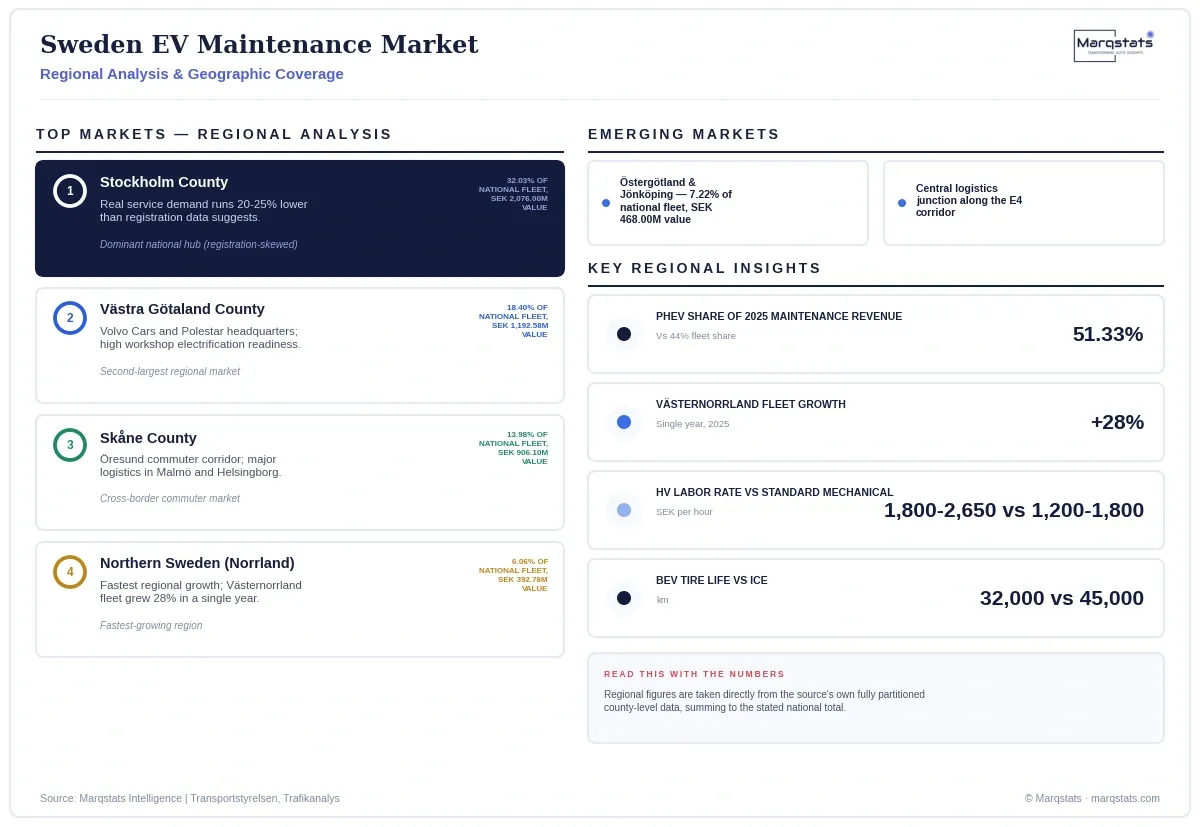
- The Stockholm Registration Clustering Artefact means headline capital-region fleet figures meaningfully overstate actual local servicing demand, since real localized activity runs an estimated 20% to 25% lower than registration tallies suggest, with demand dispersed into surrounding commuter belts instead.
- Connected vehicle data access remains a persistent constraint for independent workshops, as automaker-installed Secure Gateways restrict two-way OBD-II data transmission under UNECE Regulations 155 and 156, requiring ongoing SERMI cryptographic token renewal to maintain diagnostic access.
- Regenerative braking's underutilization of friction brakes, combined with Swedish winter road salt exposure, creates a persistent corrosion and caliper-seizure failure mode that frequently causes electric vehicles to fail mandatory annual roadworthiness inspections.
Key Trends
- Regional service capacity is beginning to diverge meaningfully between Sweden's major metropolitan counties and its more dispersed northern and rural regions, raising genuine open questions about whether mobile diagnostic units or satellite workshop investment will emerge as the preferred way to extend high-voltage capability into Norrland specifically.
- Fleet operators managing high-utilization commercial electric vans are increasingly negotiating dedicated maintenance contracts directly with authorized dealer networks offering centralized high-voltage capability, given the documented intense duty cycles and rapid tire degradation these platforms experience under sustained payload.
- Franchised dealerships are introducing monthly service subscriptions, tire storage packages, and verified battery State-of-Health certificates for the used-car market to retain customers as vehicles exit factory warranty coverage.
- Independent chains including Mekonomen are launching integrated point-of-sale service contracts specifically targeting second-hand electric and hybrid vehicles, securing long-term maintenance volume as vehicles leave warranty protection.
- Tier-1 component suppliers are expanding production of coated anti-corrosion brake rotors, dielectric coolants, high-voltage air conditioning compressors, and reinforced suspension joints specifically engineered for electric platform wear characteristics.
- Diagnostic equipment manufacturers are incorporating automated SERMI token verification directly into scan tools to streamline independent workshop access through automaker Secure Gateways.
Strategic Implications
- Battery recycling investors should track FoRetur's national collection infrastructure rollout closely nationwide, given how directly it establishes the logistics backbone supporting end-of-life battery servicing across the broader Swedish aftermarket.
- Independent workshop operators should prioritize Branschstandard för Elfordon Level 3 and 4 certification alongside Godkänd Bilverkstad accreditation, positioning specifically around PHEV dual-powertrain servicing capability given its documented outsized revenue contribution relative to fleet share today.
- Franchised dealership networks should accelerate subscription service model rollout and verified battery health certification offerings, given how directly the aging fleet and expanding independent channel capacity threaten conventional per-visit revenue as vehicles exit warranty coverage.
- Component suppliers and distributors should prioritize anti-corrosion brake hardware and dielectric thermal management fluids specifically for the Swedish winter climate, given how directly regenerative braking underutilization and road salt exposure drive this market's distinct maintenance profile.
- Investors and analysts should track entry-level BEV pricing below SEK 300,000 nationwide and EU fleet mandate enforcement consistency as the two clearest variables separating this market's Constrained Transition and Accelerated High-Parc scenarios, given how directly both feed the underlying research's own named trigger conditions.
Outlook
The underlying research presents three genuinely distinct trajectories diverging on named macroeconomic and regulatory trigger conditions. This market's own forecast horizon reaches 2030 directly, requiring no Marqstats extrapolation.
Under the Base Baseline Scenario, steady adoption continues alongside sustained Swedish corporate fleet electrification, with independent workshops expanding high-voltage service capacity under SERMI; the electrified passenger car parc expands to 1,710,000 vehicles (1,250,000 BEVs, 380,000 PHEVs, 80,000 e-LCVs) by 2030, generating USD 1,357.53 million (SEK 13,344.00 million) in total market value at a 15.54% CAGR.
Under the Accelerated High-Parc Scenario, lower electricity costs, corporate fleet sustainability mandates, and the introduction of entry-level electric cars priced below SEK 300,000 push electrified drivetrains to over 80% of Swedish new-car sales; the active electrified fleet reaches 1,950,000 vehicles by 2030, expanding total market value to USD 1,546.29 million (SEK 15,200.00 million) at a 18.60% CAGR.
Under the Constrained Transition Scenario, persistent high borrowing costs, reduced consumer purchasing power, and potential rollbacks of European fleet emissions penalties slow adoption, with electrified drivetrains stabilizing near 50% of annual registrations; the active electrified fleet reaches only 1,450,000 vehicles by 2030, yielding an aftermarket valuation of only USD 1,113.94 million (SEK 10,950.00 million) at a 11.04% CAGR.
Market Segmentation
USD 338.46 million (51.33% share) in 2025, growing to USD 378.89 million (27.91% share) by 2030. The largest revenue segment despite a smaller fleet share, led by Volvo XC60 T8 and Kia Ceed SW PHEV.
USD 255.31 million (38.72% share) in 2025, growing to USD 864.75 million (63.70% share) by 2030. Projected to invert and dominate by 2030 as the pure-electric fleet scales, led by Volvo EX30 and Tesla Model Y.
USD 65.61 million (9.95% share) in 2025, growing to USD 113.90 million (8.39% share) by 2030. Anchored by high per-vehicle utilization, led by Ford E-Transit and VW ID. Buzz Cargo.
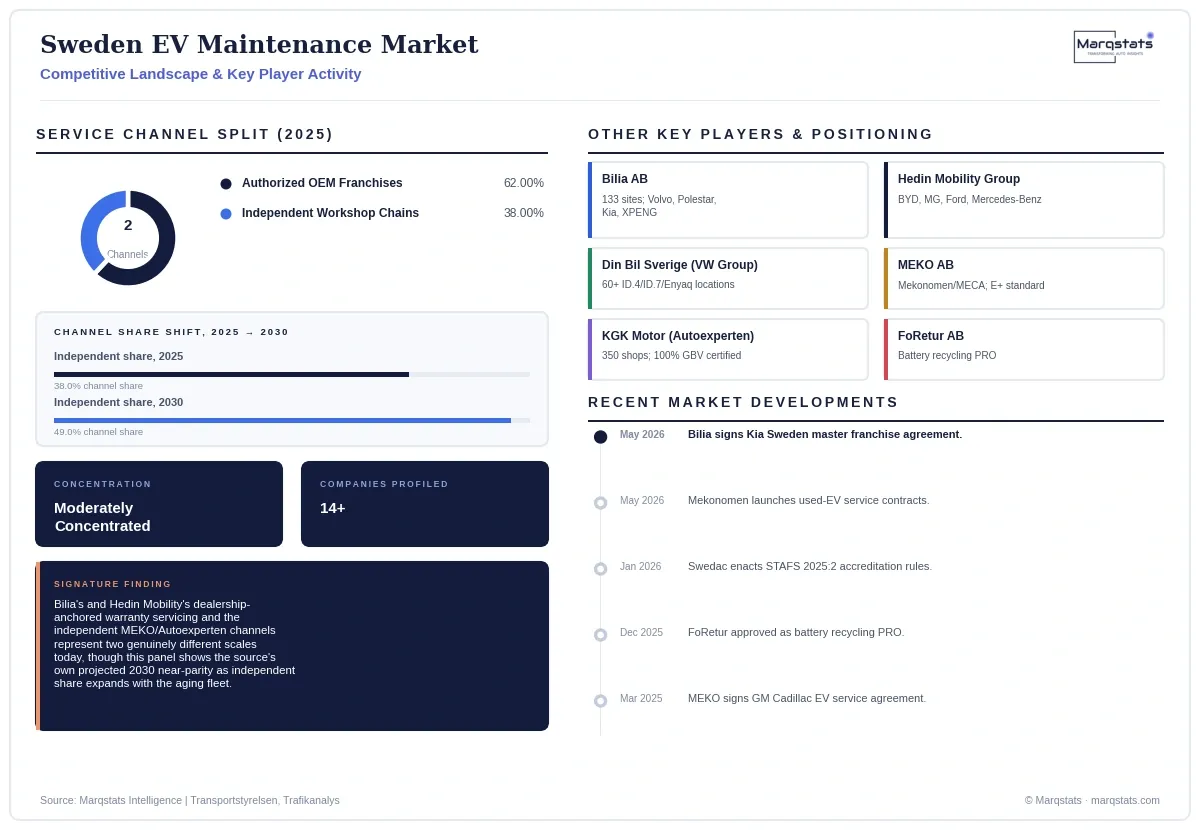
USD 408.82 million (62.00% share) in 2025, growing to USD 692.34 million (51.00% share) by 2030. Anchored by Bilia AB and Din Bil Sverige, sustained by 8-year battery warranties and captive service subscriptions.
USD 250.56 million (38.00% share) in 2025, growing to USD 665.19 million (49.00% share) by 2030. Nearing parity with dealers by 2030, led by MEKO's Mekonomen/MECA and KGK Motor's Autoexperten.
USD 191.22 million (29.00% share) in 2025, growing to USD 407.26 million (30.00% share) by 2030. The largest category, driven by instantaneous torque and heavy battery curb weights.
USD 171.44 million (26.00% share) in 2025, growing to USD 298.66 million (22.00% share) by 2030. Anchored by high-voltage interlock testing and cabin air filter replacement.
USD 118.69 million (18.00% share) in 2025, growing to USD 203.63 million (15.00% share) by 2030. Anchored by caliper corrosion from regenerative braking underuse in winter climate.
USD 98.91 million (15.00% share) in 2025, growing to USD 244.36 million (18.00% share) by 2030. The fastest-growing category, anchored by dielectric coolant renewals and SoH testing.
USD 79.13 million (12.00% share) in 2025, growing to USD 203.63 million (15.00% share) by 2030. Anchored by sensor recalibrations and bus-communication troubleshooting.
By Geography
Stockholm County (Stockholms län)
32.03% of the national electrified fleet (275,000 units), SEK 2076.00 million in 2025 maintenance value, though affected by the Stockholm Registration Clustering Artefact: major commercial leasing companies register national vehicle pools here even though many vehicles operate in surrounding counties, meaning real localized service demand runs an estimated 20% to 25% lower than registration tallies suggest.
Västra Götaland County (Västra Götalands län)
18.40% of the national electrified fleet (158,000 units), SEK 1192.58 million in 2025 maintenance value, home to Volvo Cars and Polestar headquarters with high workshop electrification readiness.
Skåne County (Skåne län)
13.98% of the national electrified fleet (120,000 units), SEK 906.10 million in 2025 maintenance value, driven by cross-border commuter patterns across the Öresund corridor into Denmark and major logistics operations in Malmö and Helsingborg.
Östergötland & Jönköping
7.22% of the national electrified fleet (62,000 units), SEK 468.00 million in 2025 maintenance value, a central logistics junction along the E4 corridor.
Northern Sweden (Norrland)
6.06% of the national electrified fleet (52,000 units), SEK 392.78 million in 2025 maintenance value, registering the fastest year-over-year electrification growth in 2025 (Västernorrland County's fleet expanded 28% in a single year), driven by sub-arctic winter conditions accelerating auxiliary battery failures and chassis rust.
Rest of Sweden
22.31% of the national electrified fleet (191,521 units), SEK 1445.98 million in 2025 maintenance value, comprising distributed rural and semi-urban commuter populations.
How Competition Is Evolving
Sweden's overall competitive picture remains genuinely fluid entering 2027.
No single company in this market spans franchised warranty-anchored dealership servicing, independent multi-brand consolidation, and specialized tire and fast-fit operations simultaneously, leaving genuine competitive white space for any group capable of bridging Bilia's and Hedin Mobility's dealership-anchored warranty servicing with the independent channels this market's own scenario framework shows nearing parity with dealers by 2030.
Competition spans franchised OEM dealer groups, independent workshop consolidators, and specialized tire and fast-fit chains. Bilia AB anchors the dominant authorized channel with 133 facilities nationwide, serving as authorized partner for Volvo, Polestar and XPENG, and expanded its portfolio in May 2026 through a Kia Sweden master franchise agreement expected to contribute approximately SEK 2.0 billion in annual turnover by 2028. Hedin Mobility Group AB services BYD, MG, Ford and Mercedes-Benz, while Din Bil Sverige AB, a wholly owned Volkswagen Group subsidiary, manages high volumes of ID.4, ID.7 and Škoda Enyaq models.
On the independent side, MEKO AB represents the largest aftermarket operator in Northern Europe, coordinating approximately 4,500 affiliated workshops across eight countries through its Mekonomen and MECA banners, underpinned by its proprietary E+ certification standard with over 980 group workshops certified at Level 2. KGK Motor AB operates Autoexperten, the first nationwide network to achieve 100% Godkänd Bilverkstad compliance. Regulatory and standards oversight rests with MRF, Svenska Fordonsbranschen (joint developers of the Branschstandard för Elfordon), and Swedac (SERMI accreditation).
Companies Covered
Companies covered in the report include:
Recent Market Activity
Table of Contents
Coverage & Segmentation
This report measures scheduled servicing, unscheduled mechanical repairs, tire and chassis wear, braking system maintenance, thermal management servicing, and software/ADAS diagnostics for BEV and PHEV vehicles in Sweden, across a 2025 base year and a 2026 to 2030 forecast period, denominated in United States dollars at the pack's own stated benchmark rate of 9.83 SEK per USD. It excludes vehicle sales, charging infrastructure capital costs, and structural collision body repairs.
The analysis spans three segmentation dimensions — powertrain, service channel and maintenance category — six regional geographies, and 14 profiled entities across OEM dealer groups, independent chains and regulatory bodies. Fleet figures trace to Transportstyrelsen and Trafikanalys; market value and all three segmentation dimensions trace directly to the underlying research's own fully worked sizing model, with both 2025 and 2030 figures directly source-stated throughout.