Market Snapshot
Middle bar: base-year value × (1 + CAGR), rounded to two decimals. This is a calculated illustration, not a separately researched annual estimate.
Market Size (2025, Base Year): USD 61.25 Million
Estimated Value (2026): USD 91.72 Million
Forecast Value (2030): USD 171.10 Million
CAGR: 22.80% | Forecast Period: 2026 – 2030
Growth — Absolute: USD 109.85 Million
Largest Market: Bogotá D.C. & Cundinamarca (63.00% of national maintenance expenditure)
Fastest Growing: HV Traction Battery Modular Repair (14.50% to 20.00% share, 2025-2030)
Dominant Segment: Authorized OEM Dealerships (84.80% channel share, 2025)
Market Concentration: Moderately Fragmented
Base Year: 2025 | Historical Period: 2021 – 2025 | Forecast Period: 2026 – 2030
Units Considered: Value (USD Million)
Segments Covered: 2 | Regions Covered: 6 | Companies Profiled: 13
Report Pages: 240 | Deliverables: PDF, Excel, PPT
Key Takeaways
Market Overview & Analysis
Report Summary
This analysis reads Colombia's own fully worked sizing chain, regional distribution data, and named-scenario regulatory framework together as a single coherent picture rather than isolated data points, since the underlying research itself was structured to support exactly that kind of integrated reading.
Colombia's EV maintenance market is measured across preventative diagnostics and thermal loops, mechanical suspension and friction systems, high-voltage battery repair, powertrain electronics, and software/ADAS recalibration, valued at USD 61.25 million (COP 230.14 billion) in 2025. This figure is taken directly from the underlying research's own fully worked sizing chain, anchored to statutory fleet data covering 53,700 active electrified vehicles.
Structurally, this is a market defined by an extreme concentration of maintenance revenue in transit bus operations despite their small fleet share, alongside a dealership-dominated channel structure facing genuine erosion pressure as early adoption cohorts approach warranty expiration and independent workshops overcome capital barriers to high-voltage servicing capability.
The analysis is built for four reader types making different decisions: an independent workshop operator weighing the COP 120,000,000 high-voltage capital investment against RETIE certification requirements, a transit concessionaire like Green Móvil managing depot-based battery lifecycle programs, a parts distributor repositioning inventory under ASOPARTES guidance, and an investor tracking how Decreto 0595's local content requirements and grid capacity constraints shape this market's Base-to-Accelerated scenario range.
A Vehicle Category That's Barely 3% of the Fleet but Nearly Half the Revenue
It's tempting to size an aftermarket opportunity by counting vehicles -- more units on the road should mean more service revenue, roughly proportionally. Colombia's transit bus segment breaks that assumption more dramatically than almost anywhere else covered in this vertical.
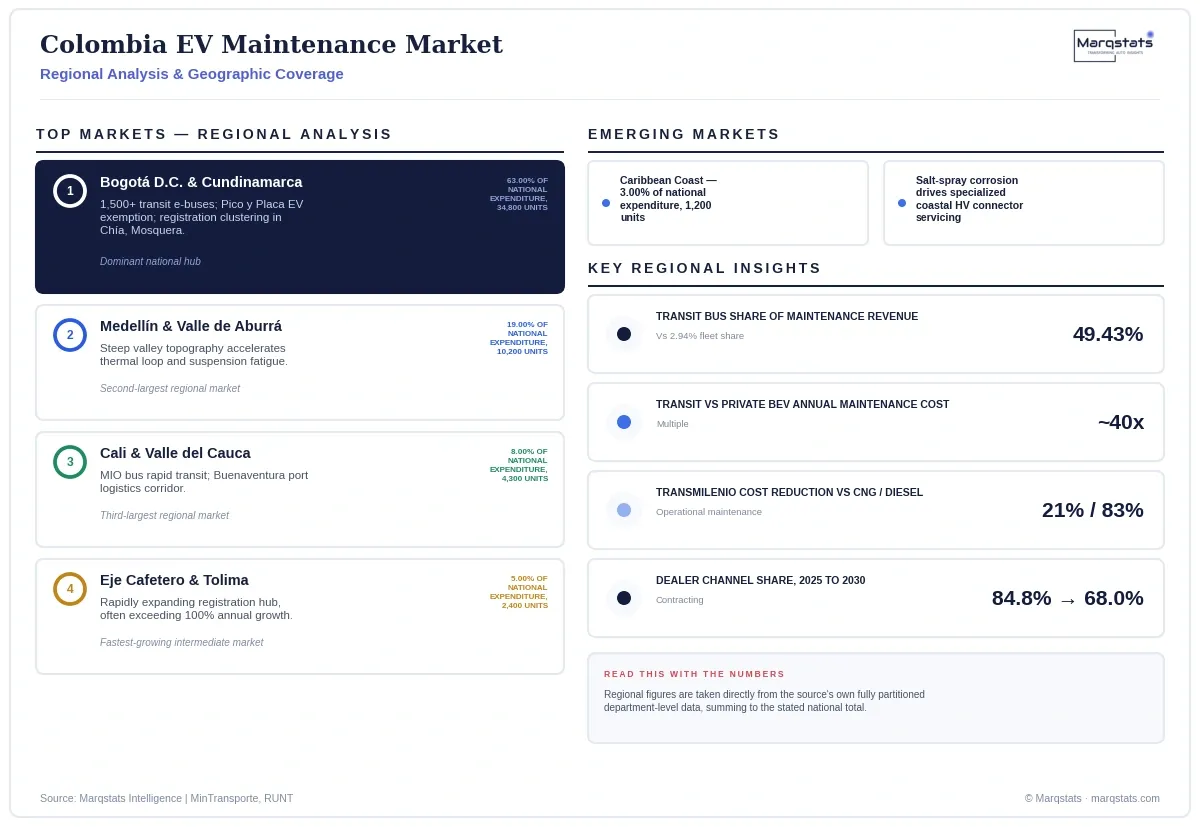
Transit buses represent 2.94% of Colombia's electrified fleet and generate 49.43% of maintenance revenue -- nearly half the entire national market concentrated in a category that's fewer than 3 vehicles in every 100. The mechanism is straightforward once you see the per-unit economics: a transit bus running 60,000 to 80,000 kilometers annually under full passenger loads, serviced under a contractually enforced preventative maintenance regime, generates roughly forty times the annual maintenance spend of a private passenger BEV averaging just 10,000 to 12,000 kilometers a year. For anyone assessing this market's real revenue geography, transit depot capability matters disproportionately more than private-passenger dealership coverage.
Why a Corporate Leasing Effect Makes Bogotá's Number Look Even Bigger Than It Is
Bogotá already leads Colombia's EV maintenance market on genuine merit -- the largest electric transit fleet in Latin America, a Pico y Placa exemption driving private adoption, real charging infrastructure density. The registration figures add a further boost on top of that, though, and it's worth separating the two.
Neighboring Cundinamarca municipalities including Chía, Mosquera and Funza charge lower vehicle registration fees and municipal property taxes than Bogotá D.C. itself. Corporate leasing providers and commercial fleet managers register vehicles in those municipalities while the vehicles actually operate and get serviced primarily within the Bogotá capital district. That means Bogotá's true maintenance demand runs even higher than its already-dominant 63.00% national share suggests, since some of what shows up as Cundinamarca fleet is functionally Bogotá service demand in practice.
Market Dynamics
Key Drivers
- The Colombian peso's 14.79% strengthening during 2025, while genuinely beneficial for reducing imported component and tooling costs, also represents a currency dynamic workshops and distributors cannot rely on persisting indefinitely, given the severe depreciation the peso experienced across 2022 and 2023 before this recovery.
- Colombia's own regional data shows a meaningful gap between where corporate fleet vehicles are registered and where they actually circulate, since leasing fleets registered in lower-fee Cundinamarca municipalities disperse a documented share of their real-world operating and servicing activity into Bogotá itself, sustaining service demand the capital district's own registration data alone would understate.
- Colombia's own fully worked sizing chain shows preventative diagnostics and thermal loop servicing already the single largest technical category at 38.00% of total value, a structural signal that thermal management capability represents the most immediate revenue opportunity for workshops entering this market, given the country's tropical and high-altitude operating conditions.
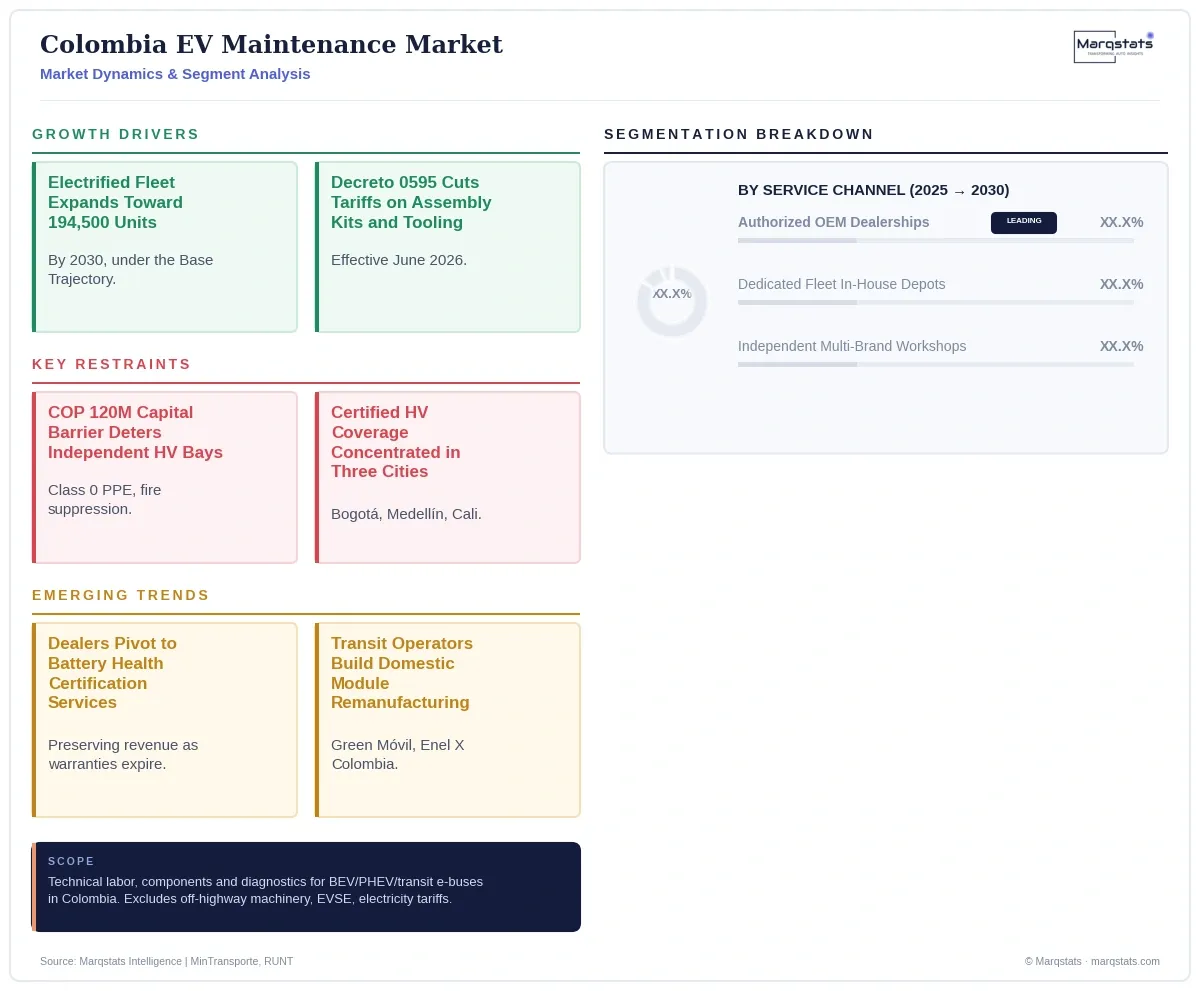
- Colombia's electrified fleet is expanding rapidly, from 53,700 units in 2025 toward a projected 194,500 units by 2030 under the Base Trajectory Scenario, directly growing the addressable base for recurring EV aftermarket maintenance demand.
- New annual BEV registrations reached 21,301 units in 2025, and the Colombian peso's 14.79% strengthening during 2025 reduced the landed cost of imported high-voltage replacement modules and diagnostic software licenses, easing aftermarket cost pressure.
- Decreto 0595 de 2026's 0% import tariffs on CKD/SKD assembly kits and testing/diagnostic equipment, effective June 11, 2026, are directly reducing landed costs for imported tooling and encouraging domestic remanufacturing of wear components.
- Bogotá's Pico y Placa traffic restriction system fully exempts electric and plug-in hybrid vehicles from peak-hour driving bans, directly driving EV adoption among private owners and commercial fleets in the capital district.
- TransMilenio's operational data showing a documented 21% maintenance cost reduction versus CNG buses and 83% versus diesel is demonstrating concrete total-cost-of-ownership advantages that support continued transit fleet electrification investment.
Key Restraints
- Colombia's aging national vehicle parc, historically dominated by internal combustion platforms, sits in genuine contrast to the still-young electrified fleet, meaning workshops built around the country's dominant ICE servicing base may need meaningful reinvestment to capture the specific high-voltage servicing opportunity this younger, faster-growing electrified segment represents.
- Colombia's persistent shortage of certified high-voltage technicians genuinely constrains near-term capacity expansion outside the three primary metropolitan areas, since RETIE electrical safety certification and CONTE professional licensing require meaningful training investment vocational institutions in intermediate cities have only recently begun to provide at scale.
- This market's own three-scenario framework spans a genuinely wide 2030 range, from USD 129.94 million under the Infrastructure-Constrained Deceleration Scenario to USD 209.05 million under the Accelerated Electrification & Assembly Scenario -- a disclosed spread reflecting real uncertainty in grid capacity and fiscal policy, not a narrow band around a single central estimate.
- Outfitting a repair bay for high-voltage vehicle servicing requires capital outlays exceeding COP 120,000,000, a genuine barrier concentrating independent workshop activity toward basic mechanical work rather than modern high-voltage platform servicing.
- Access to proprietary diagnostic software environments, such as BYD's Vehicle Diagnostic System or Tesla's Toolbox application, is restricted to authorized franchisees, structurally locking independent repair shops out of high-voltage electronic diagnostics and safety clearing operations.
- Outside Bogotá, Medellín and Cali, certified high-voltage workshop coverage remains limited, meaning vehicles suffering major powertrain failures or battery casing breaches often require flatbed transport hundreds of kilometers to specialized facilities.
- Under the Infrastructure-Constrained Deceleration Scenario, major electrical grid distribution delays under CREG/UPME capacity caps and the potential imposition of fiscal import duties on EVs could reduce the 2030 fleet to just 148,000 units, a genuinely material reduction from the Base Scenario's 194,500 units.
Key Trends
- Regional service capacity is beginning to diverge sharply between Colombia's three primary metropolitan areas and its rapidly growing intermediate cities, raising genuine open questions about whether satellite dealership investment or mobile diagnostic units will emerge as the preferred way to extend certified high-voltage capability into secondary markets like Pereira and Bucaramanga.
- Fleet operators managing high-mileage commercial delivery vans from brands like Foton, JAC, Dongfeng and Renault are increasingly negotiating dedicated maintenance contracts directly with fleet-focused service providers, given the documented intense stop-and-go wear patterns these last-mile logistics platforms experience under sustained urban payload conditions.
- Dealership groups are pivoting from basic parts-swapping toward specialized high-margin services including advanced battery health certifications, proprietary software subscriptions, and extended factory warranty products to preserve revenue as vehicles age out of standard warranty coverage.
- Transit concessionaires and energy infrastructure developers, including Green Móvil and Enel X Colombia, are building domestic capability to balance, repair and replace individual battery modules rather than importing entirely new traction packs as early BYD bus cohorts approach mid-life overhauls.
- Aftermarket parts distributors represented by ASOPARTES are shifting inventory away from internal combustion components toward specialized EV parts including low-conductivity coolants, high-load suspension bushings, and regenerative braking friction materials.
- SENA and CONTE are working to establish high-voltage technical training centers in intermediate growth cities including Pereira, Bucaramanga and Villavicencio, directly addressing the technician shortage constraining coverage outside primary metropolitan areas.
Strategic Implications
- Component suppliers should also weight EV-specific tire and dielectric coolant inventory planning heavily nationwide, given how directly both categories anchor this market's largest documented service revenue drivers.
- Independent workshop operators should prioritize RETIE electrical safety certification and CONTE licensing investment specifically, positioning ahead of the wave of early adoption cohorts exiting eight-year factory battery warranties, while leveraging Decreto 0595's 0% tariff provisions to reduce diagnostic equipment acquisition costs.
- Transit concessionaires and municipal fleet operators should prioritize domestic battery module remanufacturing capability specifically, given how directly this controls capital expenditure and maintains contractual service-availability thresholds as early BYD bus cohorts approach mid-life overhauls.
- Parts distributors should prioritize establishing organized regional inventories in Medellín and Cali specifically, given how directly the underlying research shows certified workshop capacity concentrated in just three metropolitan areas nationally.
- Investors and analysts should track Decreto 0595's local content requirement compliance nationwide and grid capacity constraints under CREG/UPME as the two clearest variables separating this market's Base and Accelerated scenarios, given how directly both feed the underlying research's own named trigger conditions.
Outlook
The underlying research presents three genuinely distinct trajectories diverging on named regulatory and infrastructure trigger conditions. This market's own forecast horizon reaches 2030 directly, requiring no Marqstats extrapolation.
Under the Base Trajectory Scenario (Evidenced Growth), Decreto 0595 de 2026's RTE-E rules are implemented as planned and current tax exclusions under Ley 1715 and Ley 1964 continue; the electrified fleet reaches 194,500 units by 2030 (152,000 BEVs, 28,500 PHEVs, 11,200 commercial, 2,800 transit e-buses), generating USD 171.10 million (COP 642.82 billion) in total market value at a 22.80% CAGR.
Under the Accelerated Electrification & Assembly Scenario, TransMilenio Phase VII electric mandates take effect alongside nationwide low-emission zones in Bogotá and Medellín; the electrified fleet expands to 245,000 units by 2030, lifting total market value to USD 209.05 million (COP 785.40 billion) at a 27.81% CAGR.
Under the Infrastructure-Constrained Deceleration Scenario, major electrical grid distribution delays under CREG/UPME capacity caps combine with the imposition of fiscal import duties on EVs to offset fuel tax losses; the electrified fleet reaches only 148,000 units by 2030, with total market value reaching only USD 129.94 million (COP 488.20 billion) at a 16.23% CAGR.
Market Segmentation
USD 51.94 million (84.80% share) in 2025, growing to USD 116.35 million (68.00% share) by 2030. Anchored by Motorysa (BYD), Astara Colombia, Casa Toro and Dinissan, sustained by 8-year warranties.
USD 6.37 million (10.40% share) in 2025, growing to USD 24.81 million (14.50% share) by 2030. Anchored by Green Móvil and Enel X Colombia servicing transit bus concessions.
USD 2.94 million (4.80% share) in 2025, growing to USD 29.94 million (17.50% share) by 2030. The fastest-growing channel, expanding nearly fourfold as warranties expire.
USD 23.27 million (38.00% share) in 2025, growing to USD 59.88 million (35.00% share) by 2030. The largest category, driven by tropical and high-altitude thermal cycling.
USD 20.21 million (33.00% share) in 2025, growing to USD 53.04 million (31.00% share) by 2030. Anchored by suspension rebuilds from urban road imperfections and speed bumps.
USD 8.88 million (14.50% share) in 2025, growing to USD 34.22 million (20.00% share) by 2030. The fastest-growing category, anchored by cost-effective modular cell-level remediation.
USD 5.21 million (8.50% share) in 2025, growing to USD 12.83 million (7.50% share) by 2030. Anchored by rotor bearing diagnostics and SiC/IGBT inverter analysis.
USD 3.67 million (6.00% share) in 2025, growing to USD 11.12 million (6.50% share) by 2030. Anchored by firmware deployment and camera/radar recalibration after suspension work.
By Geography
Bogotá D.C. & Cundinamarca Corridor
63.00% of national maintenance expenditure (34,800 active units, 72 certified HV facilities), driven by over 1,500 municipal transit e-buses, Pico y Placa EV exemptions, and a registration clustering effect where corporate fleets register in lower-fee municipalities like Chía while operating primarily within Bogotá.
Medellín & Valle de Aburrá (Antioquia)
19.00% of national maintenance expenditure (10,200 active units, 28 certified HV facilities), where steep valley topography accelerates thermal loop and suspension fatigue, served by dealership groups including MOEVO, Andar and Autolarte.
Cali & Valle del Cauca
8.00% of national maintenance expenditure (4,300 active units, 12 certified HV facilities), anchored by the MIO bus rapid transit system and light commercial fleets serving the Buenaventura port logistics corridor.
Eje Cafetero & Tolima (Pereira, Manizales, Ibagué)
5.00% of national maintenance expenditure (2,400 active units, 8 certified HV facilities), a rapidly expanding regional registration hub often exceeding 100% annual growth from a low baseline.
Caribbean Coast (Barranquilla, Cartagena, Santa Marta)
3.00% of national maintenance expenditure (1,200 active units, 5 certified HV facilities), where early-stage logistics and hotel fleet electrification requires specialized coastal servicing to address salt-spray corrosion on high-voltage connectors.
Rest of Colombia
2.00% of national maintenance expenditure (800 active units, 3 certified HV facilities), reflecting incipient dealer satellite service points and acute technical bottlenecks requiring flatbed transport to primary hubs.
How Competition Is Evolving
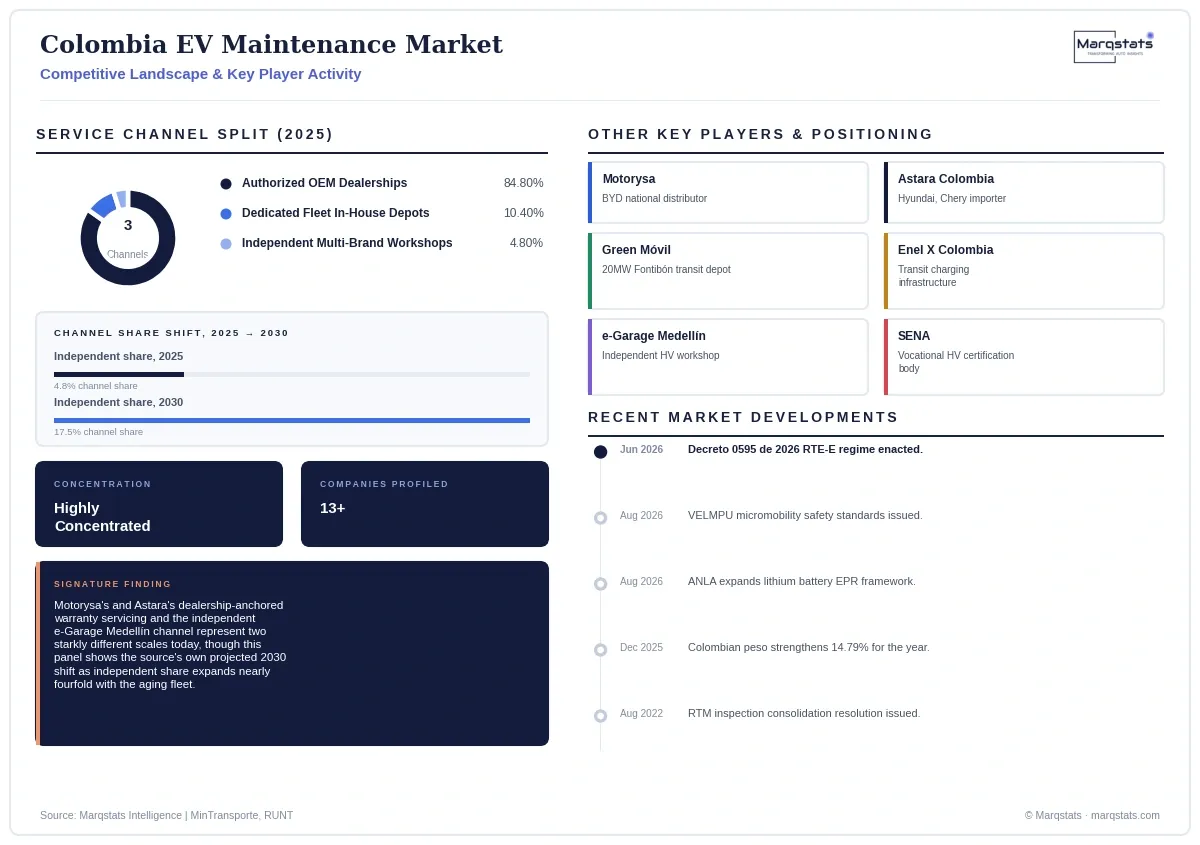
No single company in this market spans franchised warranty-anchored dealership servicing, dedicated fleet depot operation, and independent multi-brand workshop capability simultaneously, leaving genuine competitive white space for any group capable of bridging Motorysa's and Astara's dealership-anchored warranty servicing with the independent channels this market's own scenario framework shows expanding nearly fourfold by 2030.
Competition spans authorized OEM importer/dealer networks, dedicated fleet depot operators, and independent workshop networks. Motorysa serves as BYD's national distributor, alongside Astara Colombia (Hyundai and Chery), Casa Toro and Dinissan, collectively providing eight-year, 150,000-to-160,000-kilometer traction battery warranties that structurally tie private owners to dealership service departments. Dedicated fleet in-house depots, led by Green Móvil and Masivo Capital in partnership with energy infrastructure providers like Enel X Colombia, operate purpose-built facilities such as the 20-megawatt Centro Logístico Green Móvil in Bogotá's Fontibón district, housing over 400 transit buses.
On the independent side, e-Garage Medellín and the Bosch Car Service network serve out-of-warranty grey imports and older micro-EVs, constrained by capital barriers and restricted proprietary diagnostic software access. Aftermarket parts distribution is represented by industry body ASOPARTES. Regulatory and standards oversight rests with MinTransporte (statutory inspection), MinMinas (RETIE electrical safety), ICONTEC/ONAC (CDA inspection standards), SENA (vocational HV certification), and CONTE (professional electrical licensing).
Companies Covered
Companies covered in the report include:
Recent Market Activity
Table of Contents
Coverage & Segmentation
The analysis measures skilled technical labor, certified replacement components, wear-and-tear friction materials, specialized dielectric and glycol thermal coolants, digital diagnostic subscriptions, and component-level remedial services for road-registered BEV, PHEV and electric municipal transit buses in Colombia, across a 2025 base year and a 2026 to 2030 forecast period, denominated in United States dollars at the pack's own stated year-end 2025 Representative Market Rate of COP 3,757.08 per USD. It excludes off-highway machinery, non-plug-in hybrids, EVSE installation, and retail electricity consumption tariffs.
The analysis spans two segmentation dimensions — service channel and technical typology — six regional department groupings, and 13 profiled entities across importer/dealer networks, fleet depot operators and regulatory bodies. Fleet figures trace to statutory Colombian vehicle registries; market value and both segmentation dimensions trace directly to the underlying research's own fully worked sizing model, with both 2025 and 2030 figures directly source-stated throughout.