Market Snapshot
Key Takeaways
Market Overview & Analysis
Report Summary
This analysis reads China's own fully partitioned sizing chain, named regional concentrations, and two-scenario regulatory framework together as a single coherent picture rather than isolated data points, since the underlying research itself was structured to support exactly that kind of integrated reading.
China's EV maintenance market is measured across preventive servicing, Three-Electric high-voltage diagnostics, tire and chassis wear, and collision and structural body repair, valued at USD 12,575.82 million (RMB 90.40 billion) in 2025. This figure is taken directly from the underlying research's own fully sourced sizing chain, anchored to MPS statutory fleet data and F6 Big Data Institute industry tracking.
Structurally, this is the largest and fastest-scaling market in this coverage set by a wide margin, shaped by a genuine historical inflection: the same electrification that eliminated traditional ICE mechanical maintenance is generating an entirely new aftermarket built on high-voltage diagnostics, structural gigacasting collision repair, and thermal management servicing — an aftermarket the existing technician workforce has not yet scaled to support.
The analysis is built for four reader types making different decisions: an independent workshop operator weighing high-voltage tooling investment against a labor market where vocational programs supply under 15% of demand, a battery manufacturer like CATL evaluating forward integration into downstream service following Ningjia's own precedent, a dealership group like Zhongsheng managing the shift from vehicle-sales to aftersales-margin dependence, and an investor tracking how right-to-repair policy progress shapes this market's Baseline-to-Upside scenario range.
A Technician Shortage That's Getting Worse, Not Better, as the Market Grows
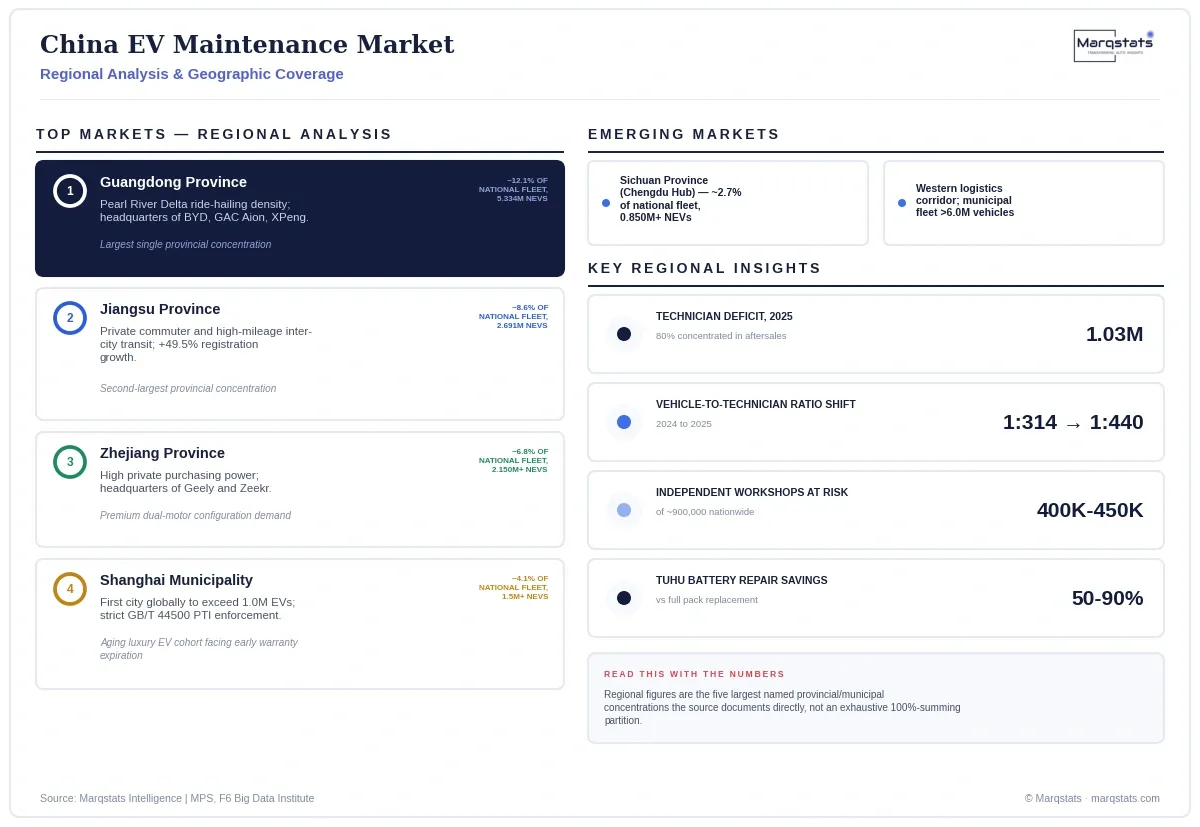
It would be reasonable to assume that as China's NEV maintenance market has scaled dramatically — nearly doubling from RMB 31.40 million vehicles in 2024 toward 49 million by mid-2026 — the technician workforce serving it would have scaled proportionally. The underlying research's own data shows the opposite: the vehicle-to-technician ratio actually widened, from one certified technician per 314 EVs in 2024 to one per 440 EVs through 2025.
The reason isn't a lack of attention to the problem — monthly starting salaries for qualified NEV high-voltage technicians in Tier-1 cities now run RMB 10,000 to RMB 18,000, nearly double traditional ICE mechanic compensation, a genuinely strong market signal. The constraint is upstream: vocational colleges and technical institutes have been slow to update curricula still emphasizing internal combustion mechanics, and graduating classes supply less than 15% of net annual demand. Fleet growth is simply outrunning the training pipeline's capacity to respond, even with strong financial incentives already in place.
Why Gigacasting Is Turning Minor Collisions Into Total Losses
Integrated high-pressure aluminum die-casting — the manufacturing technique that lets automakers like Tesla, XPeng, Xiaomi and Seres replace hundreds of stamped sheet-metal components with a single large casting — is a genuine manufacturing efficiency win. It's also creating a specific, quantifiable collision-repair problem the underlying research documents in detail.
Structural gigacastings cannot be straightened using conventional hydraulic frame equipment or repaired with localized torch heating, because thermal exposure alters the structural alloy's temper and causes micro-fracturing. The practical consequence: impact damage reaching the mounting points of a rear cast sub-frame often forces complete replacement of the entire structural casting, or results in a total insurance write-off — for damage that, on a traditional stamped-steel vehicle, might have been a routine, localized panel repair. This is a genuinely new category of collision economics specific to China's most advanced manufacturing platforms.
Market Dynamics
Key Drivers
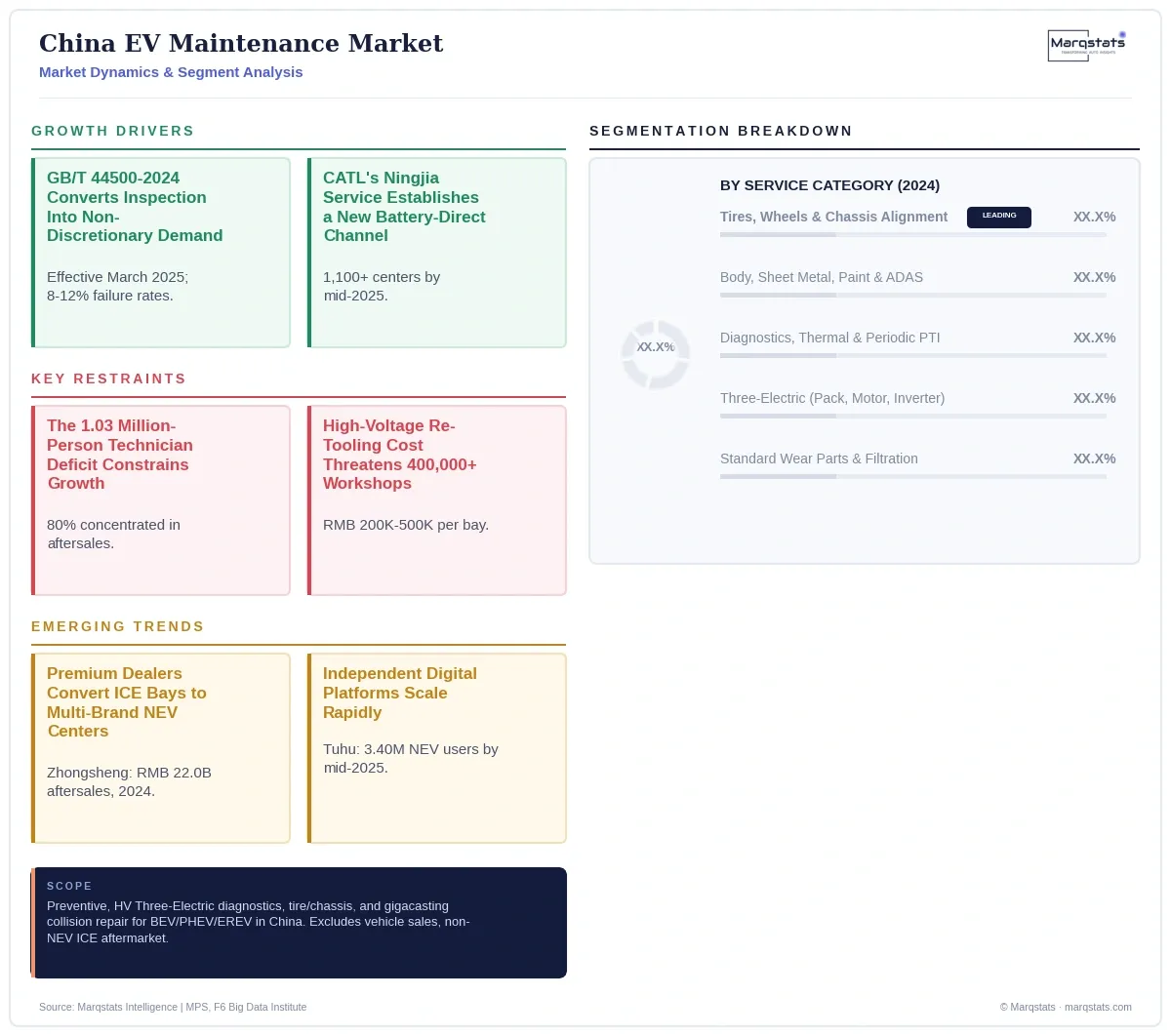
- China's fully partitioned service category data shows tires, wheels and chassis alignment already the single largest category at 28.0% of 2024 value, a structural signal that specialized tire inventory and precision alignment capability, not general mechanical capacity, represent the most immediate revenue opportunity for workshops entering this market.
- GB/T 44500-2024's mandatory periodic technical inspection regime, effective March 2025, is converting over 15,000 licensed inspection stations into direct, non-discretionary demand generators, channeling battery packs failing at 8% to 12% rates on vehicles older than five years into certified repair facilities.
- The forward integration of battery manufacturers into downstream service, exemplified by CATL's Ningjia Service reaching over 1,100 centers by mid-2025, is establishing a genuinely new competitive channel that lets EV owners access certified battery maintenance outside franchised OEM dealership networks entirely.
- Independent platform disintermediation of full battery pack replacement, exemplified by Tuhu Car Care's nearly 100,000 module- and cell-level repairs cutting costs to 10% to 50% of full replacement, demonstrates a commercially proven alternative to OEM warranty-locked repair economics.
- Dealership groups are actively restructuring around aftersales margin dependence as new-vehicle retail margins compress nationwide, with aftersales already contributing 51.3% of gross profit at dedicated new-energy dealerships despite generating under 15% of corporate revenue.
- Commercial fleet electrification, with ride-hailing and delivery vehicles averaging 80,000 to 120,000 km annually against 12,000 to 16,000 km for private vehicles, is generating a disproportionately large and recurring maintenance revenue base concentrated specifically in high-capacity independent workshops serving commercial ride-hailing and logistics fleets.
Key Restraints
- The 2030 endpoint used throughout this analysis is a Marqstats extrapolation of the underlying research's own directly stated 2029 scenario figures, since the pack's own forecast horizon runs through 2029 rather than 2030 -- a genuine methodological gap disclosed explicitly rather than presented as a directly source-stated figure.
- China's national high-voltage technician deficit reached 1.03 million personnel by 2025, with aftersales representing 80% of that gap, directly constraining how quickly both OEM and independent channels can scale certified service capacity regardless of capital availability.
- Manufacturer encryption of CAN bus protocols, ISO 14229 UDS, and BMS cloud keys structurally confines independent workshops to external visual inspections and basic terminal testing for most vehicles, absent formal right-to-repair regulation requiring standardized diagnostic access.
- Upgrading an independent ICE workshop to handle high-voltage EV service requires RMB 200,000 to RMB 500,000 in capital per bay for insulated equipment, explosion-proof storage, and specialized testing gear — a cost structure projected to force 400,000 to 450,000 of China's roughly 900,000 traditional independent workshops into consolidation or closure over the next five years.
- Structural gigacasting collision repair complexity, requiring complete structural casting replacement rather than localized panel repair for damage reaching sub-frame mounting points, is raising average collision repair costs and total-loss frequency for China's most advanced manufacturing platforms specifically.
Key Trends
- Premium dealership groups are converting underutilized luxury ICE service bays into certified multi-brand NEV maintenance and bodyshop centers, following Zhongsheng Group's own expansion to RMB 22.00 billion in 2024 aftersales turnover.
- New-force manufacturers including NIO, Li Auto and XPeng are adopting hybrid service models, maintaining direct centers in Tier-1 cities while partnering with established dealer groups for Tier-2 through Tier-4 collision and chassis maintenance coverage as delivery volumes scale rapidly.
- Independent digital aggregation platforms are scaling rapidly beyond routine servicing, with Tuhu's NEV transacting user base reaching 3.40 million by mid-2025 (a 105% year-on-year increase) and JD Auto expanding to over 1,500 workshops targeting commercial fleet and battery maintenance partnerships.
- Diagnostic equipment manufacturers including Autel and Launch Tech are increasingly forced to reverse-engineer communication protocols or negotiate individual commercial data-licensing agreements with each OEM separately, absent standardized right-to-repair access requirements for electric vehicles nationwide.
Strategic Implications
- New entrants and capital allocators should avoid generic, low-complexity fast-repair models facing margin pressure from declining oil-and-filter volumes, instead prioritizing higher-barrier segments including battery remanufacturing, automated cell balancing equipment, and GB/T 44500-2024-aligned inspection and testing facilities nationwide.
- Incumbent dealership groups should consolidate physical footprints into centralized, multi-brand high-voltage diagnostic and structural repair hubs, following Zhongsheng's own precedent, while introducing subscription-based extended service and battery health packages to retain owners as factory warranties expire.
- Independent aftermarket chains and franchise operators should prioritize securing dual technician accreditations and high-voltage diagnostic bench investment now, while pursuing fleet partnerships with commercial ride-hailing and logistics operators to secure steady, recurring service volume ahead of any formal right-to-repair policy shift.
- Investors and analysts should track right-to-repair regulatory progress from MIIT and SAMR and vocational technician training scale-up rates as the two clearest variables separating this market's Baseline and Upside scenarios, given how directly both feed the underlying research's own named trigger conditions and how quickly either could shift the 2029 outcome materially.
Outlook
The underlying research presents two distinct forward trajectories, both broadly positive, with no Downside or contraction scenario modeled anywhere in the source material. The 2030 figures below are Marqstats extrapolations of the pack's own directly stated 2029 endpoints, held one additional year at each scenario's own five-year CAGR, disclosed explicitly; the pack's own 2029 figures are given for reference alongside.
Under the Baseline Regulatory Convergence Scenario (Consensus Scenario), nationwide GB/T 44500-2024 enforcement continues generating 8% to 12% inspection failure rates on battery packs older than five years, OEMs maintain proprietary diagnostic encryption while expanding formal partnerships with organized independent chains, and vocational training reduces the technician deficit from 80% to 50% by 2029; the operational NEV fleet reaches 92.50 million units by 2029 (RMB 263.80 billion / USD 36,698.01 million), extrapolated to RMB 355.21 billion (USD 49,414.33 million) by 2030 at a 31.48% CAGR, with 4S dealerships retaining 65% market share.
Under the Accelerated IAM Liberalization Scenario (Upside Scenario), explicit right-to-repair regulations from MIIT and SAMR require automakers to license encrypted diagnostic protocols to accredited independent networks, commercial-scale cell-level battery remanufacturing cuts average repair costs by 60%, and expanded government subsidies address the technician shortage by 2028; the operational NEV fleet reaches 105.00 million units by 2029 (RMB 315.00 billion / USD 43,820.60 million), extrapolated to RMB 439.46 billion (USD 61,134.61 million) by 2030, as independent aftermarket chains achieve market parity at 48% of value share, breaking the 4S network's historical monopoly on high-voltage battery repairs.
Market Segmentation
USD 2321.80 million (28.0% share) in 2024. The largest category, driven by 20-30% faster EV tire wear and specialized acoustic-foam, high-load-rated tire demand.
USD 2196.59 million (26.5% share) in 2024. Anchored by gigacasting structural repair complexity and mandatory ADAS radar/camera recalibration.
USD 1534.42 million (18.5% share) in 2024. Anchored by GB/T 44500-2024 compliance testing at licensed inspection stations.
USD 1250.63 million (15.1% share) in 2024. The fastest-growing category as vehicles age past warranty; over 85% concentrated in 4S dealership networks.
USD 986.31 million (11.9% share) in 2024. Covers HEPA/activated carbon cabin filtration and brake fluid hygroscopic analysis.
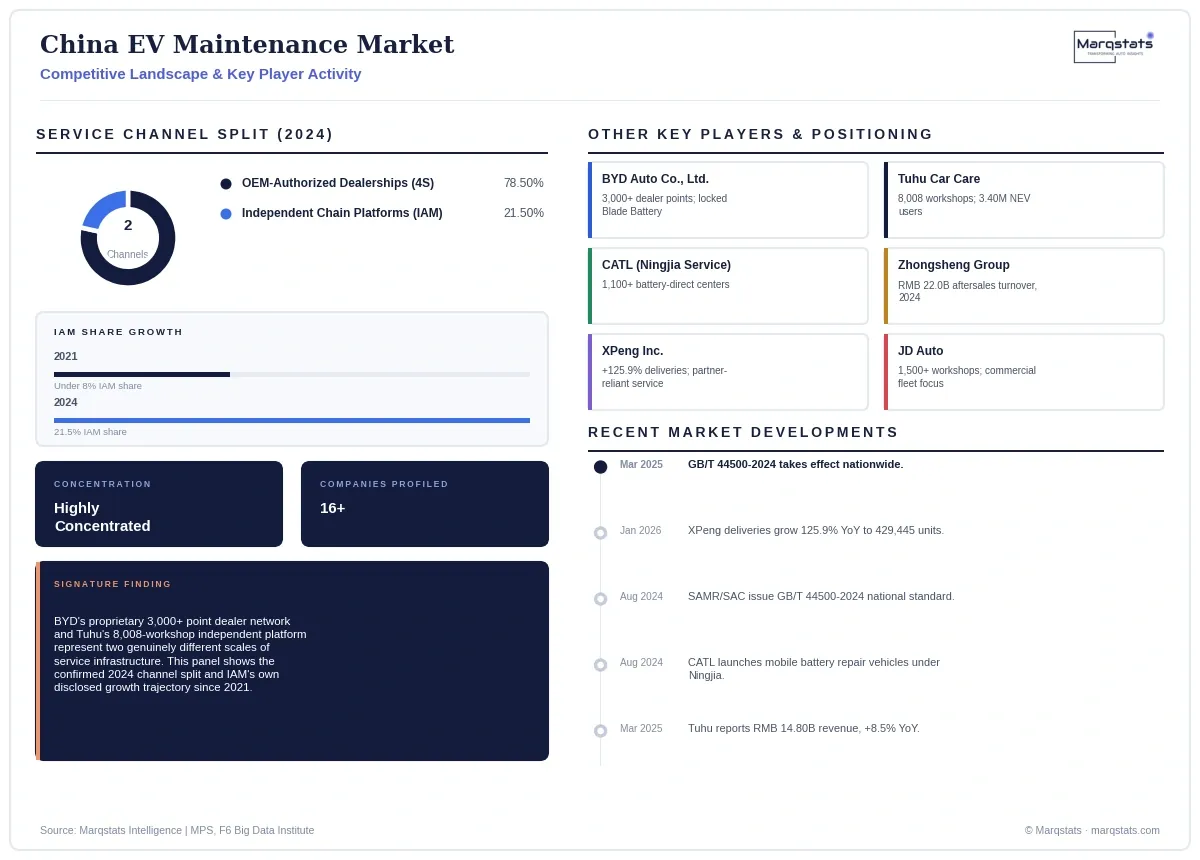
USD 6509.10 million (78.5% share) in 2024, anchored by BYD's 3,000-plus proprietary dealer points and warranty-locked Blade Battery servicing, generating 45% to 55% gross margins.
USD 1782.04 million (21.5% share) in 2024, up from under 8% in 2021, anchored by Tuhu Car Care's 8,008-workshop network, generating 28% to 38% gross margins.
An emerging channel, under 3% of value and currently embedded within IAM/4S reporting, anchored by CATL's Ningjia Service reaching over 1,100 centers nationwide by mid-2025, generating 35% to 45% gross margins on pack-opening and Cell-to-Pack repair.
By Geography
A note on regional coverage
The underlying research provides named top-provincial and municipal fleet figures rather than an exhaustive regional partition summing to 100%; the entries below are the five largest named concentrations the source documents directly.
Guangdong Province
5.334 million operational NEVs as of 2025 (approximately 12.1% of the national NEV fleet), the nation's largest concentration, anchored by dense Pearl River Delta ride-hailing networks and the headquarters of BYD, GAC Aion and XPeng.
Jiangsu Province
2.691 million operational NEVs at year-end 2024 (approximately 8.6% of the national fleet), following a 49.5% annual registration increase, anchored by private commuter and high-mileage inter-city transit demand.
Zhejiang Province
2.150 million-plus operational NEVs at year-end 2024 (approximately 6.8% of the national fleet), anchored by high private purchasing power, dual-motor premium configurations, and the headquarters of Geely and Zeekr.
Shanghai Municipality
1.500 million-plus operational NEVs by 2025 (approximately 4.1% of the national fleet), the first city globally to exceed 1.0 million EVs, marked by strict GB/T 44500 PTI enforcement and an aging luxury EV cohort facing early warranty expiration.
Sichuan Province (Chengdu Hub)
0.850 million-plus operational NEVs at year-end 2024 (approximately 2.7% of the national fleet), the primary western logistics corridor, with Chengdu's total municipal vehicle fleet exceeding 6.0 million units relying heavily on municipal quick-service networks.
How Competition Is Evolving
No single company in this market spans OEM warranty-locked dealership servicing, institutional independent digital franchise operations and forward-integrated battery-manufacturer service simultaneously, leaving genuine competitive white space for any group capable of bridging BYD's proprietary Blade Battery servicing with the independent and battery-direct channels this market's own scenario framework shows potentially reaching parity with 4S dealerships by 2029.
Competition spans OEM-authorized 4S dealership networks, institutional independent digital franchise platforms, and an emerging forward-integrated battery-manufacturer channel. BYD Auto Co., Ltd. operates China's largest proprietary authorized service footprint, spanning over 3,000 dealer points across its Dynasty and Ocean sales channels, retaining service custody of its proprietary Blade Battery packs via locked diagnostic algorithms. Zhongsheng Group Holdings, China's largest luxury automotive dealership group, expanded total aftersales turnover to RMB 22.00 billion in 2024 (+9.6% YoY), converting underutilized luxury ICE service bays to serve domestic electric platforms including Seres AITO. Premium new-force manufacturers NIO, Li Auto and XPeng operate hybrid models, maintaining direct Tier-1 city centers while partnering with established dealer groups for lower-tier market coverage.
On independent aftermarket platforms, Tuhu Car Care Co., Ltd. (HKEX: 9690) anchors the sector with 8,008 certified factory workshops and a 3.40 million-strong NEV transacting user base by mid-2025, having bypassed OEM diagnostic restrictions through direct technical authorizations with manufacturers including SAIC-GM-Wuling and NIO. JD Auto and New Carzone / Tmall Car Care anchor Alibaba- and JD.com-affiliated digital aggregation, targeting commercial fleets and routine EV servicing respectively. On forward-integrated battery servicing, Contemporary Amperex Technology Co., Ltd. (CATL) anchors the emerging channel through its Ningjia Service brand, while diagnostic equipment suppliers Autel Intelligent Technology and Launch Tech anchor the independent sector's third-party tooling capability. Regulatory oversight rests with SAMR, SAC, MPS, and MIIT.
Companies Covered
The report profiles 16+ companies with full strategy and financials analysis, including:
Recent Market Activity
Table of Contents
Coverage & Segmentation
This report measures scheduled preventive maintenance, high-voltage Three-Electric system diagnostics and repair, tire and chassis servicing, collision and structural body repair including gigacasting-specific processes, and periodic technical inspection compliance for BEVs, PHEVs and EREVs in China, across a 2025 base year and a 2026 to 2030 forecast period, denominated in United States dollars at the pack's own stated institutional benchmark of 7.1884 RMB/USD. It excludes whole vehicle sales revenue and general internal combustion aftermarket spend outside the NEV segment.
The analysis spans two segmentation dimensions — service category and service channel — five named regional concentrations, and 16 profiled entities across OEMs, independent platforms, battery manufacturers and regulatory bodies. Fleet and registration figures trace to MPS; market value and segment splits trace to the underlying research's own fully partitioned sizing model, with the 2030 endpoint disclosed as a Marqstats extrapolation of the pack's own stated 2029 figures.