Market Snapshot
Key Takeaways
Market Overview & Analysis
Report Summary
This analysis reads France's own fully sourced sizing chain, official roadworthiness inspection statistics, and named-scenario regulatory framework together as a single coherent picture rather than isolated data points, since the underlying research itself was structured to support exactly that kind of integrated reading.
France's EV maintenance market is measured across preventive servicing, high-voltage battery diagnostics, chassis and suspension wear, thermal management, and specialized tire replacement, valued at USD 1,386.47 million (EUR 1,206.83 million HT) in 2025. This figure is taken directly from the underlying research's own fully sourced, year-by-year sizing chain, anchored to SDES statutory fleet registration data.
Structurally, this is a market shaped by an official, government-collected empirical dataset few other markets in this coverage set can match: UTAC-OTC's mandatory roadworthiness inspection program generates direct, national-scale defect statistics on exactly how French EVs actually fail inspection, revealing a genuine cold-and-wet-climate brake corrosion pattern alongside markedly superior overall pass rates for younger EVs.
The analysis is built for four reader types making different decisions: an independent workshop operator weighing NF C 18-550 B2VL certification and SERMI accreditation investment now that digital diagnostic access barriers have formally lifted, a franchised dealership group defending aftersales retention as vehicles exit warranty, an insurer or collision network recalibrating premiums against a 15.4% EV claim severity premium, and an investor tracking how EU Data Act implementation and social leasing scale-up shape this market's Base-to-Upside scenario range.
Why France's Own Inspection Data Tells a More Precise Story Than Most Markets Can
Most markets in this coverage set rely on insurance claims data, workshop surveys, or manufacturer disclosures to understand how EVs actually fail in the field. France has something more direct: a mandatory, government-run roadworthiness inspection program covering over 26.6 million light vehicle inspections annually, generating official defect statistics broken down by specific failure mode.
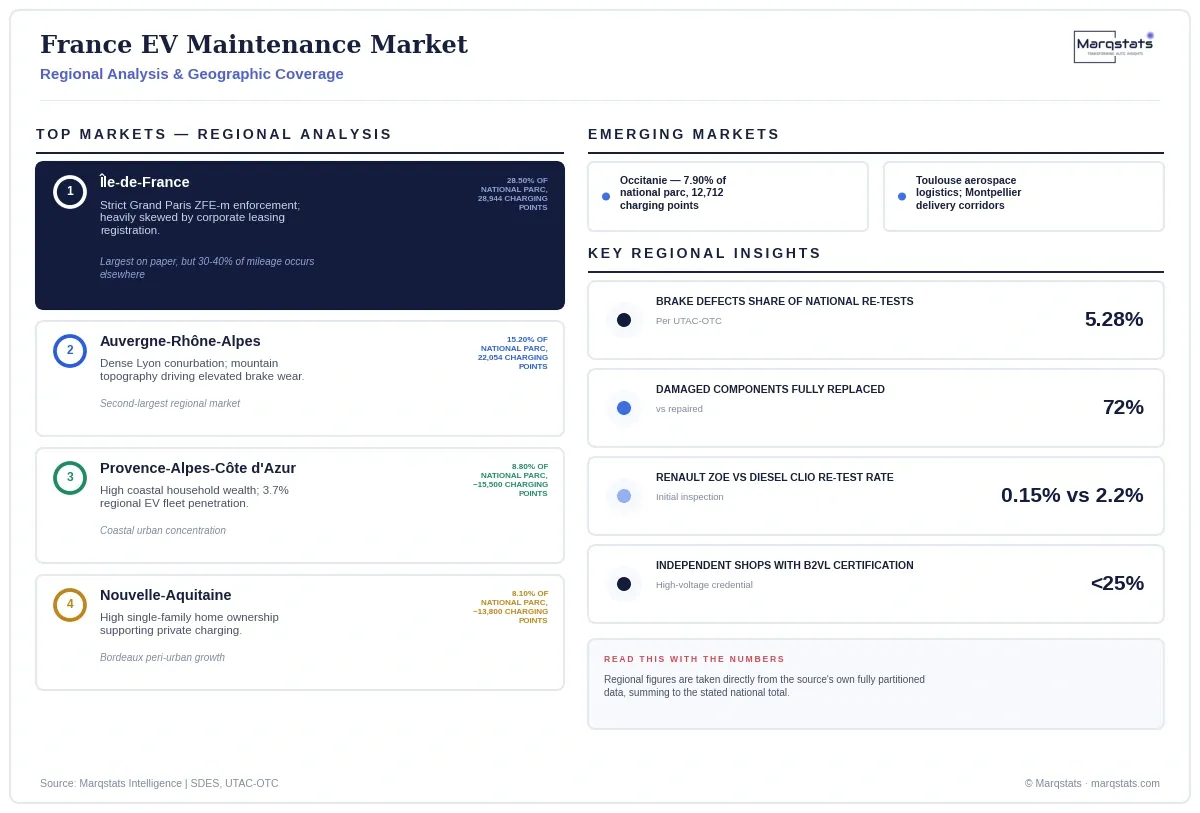
That data tells a genuinely two-sided story. On one hand, younger EVs pass roadworthiness inspections at rates the broader fleet can't match — the Renault Zoe's 0.15% initial re-test prescription rate against 2.2% for older diesel Clio models is a dramatic difference. On the other hand, friction braking system defects specifically — disc corrosion, caliper pin seizure — show up in 5.28% of national re-tests, a failure mode UTAC-OTC's own data traces directly to regenerative braking underuse in France's wet, salt-treated winter road conditions. A market this well-instrumented lets you see both halves of the EV maintenance story clearly, rather than having to infer one from the other.
A Statistical Distortion Worth Correcting Before Trusting Regional Data
Île-de-France's 28.5% share of France's national EV fleet looks, on its face, like a genuine measure of where EV maintenance demand actually concentrates. Reading the underlying research's own analysis more carefully complicates that picture significantly.
Major leasing companies and financial captives — Ayvens/ALD Automotive, Arval, Mobilize — register their corporate vehicle fleets through central administrative offices located in Paris, Hauts-de-Seine and Yvelines. Those registrations count fully toward Île-de-France's statistical share. But an estimated 30% to 40% of those vehicles' actual operational mileage, and the maintenance intervals that follow from it, happen across provincial distribution centers and peri-urban corridors throughout the rest of France. Anyone using raw regional registration data to plan workshop capacity or parts inventory should treat Île-de-France's headline share as a meaningful overstatement of where the actual service work occurs.
Market Dynamics
Key Drivers
- France's fully year-by-year sizing chain shows chassis, steering and suspension already constructed as the single largest service category, a structural signal that heavy-duty suspension component inventory and precision alignment capability represent the most immediate revenue opportunity for workshops entering this market.
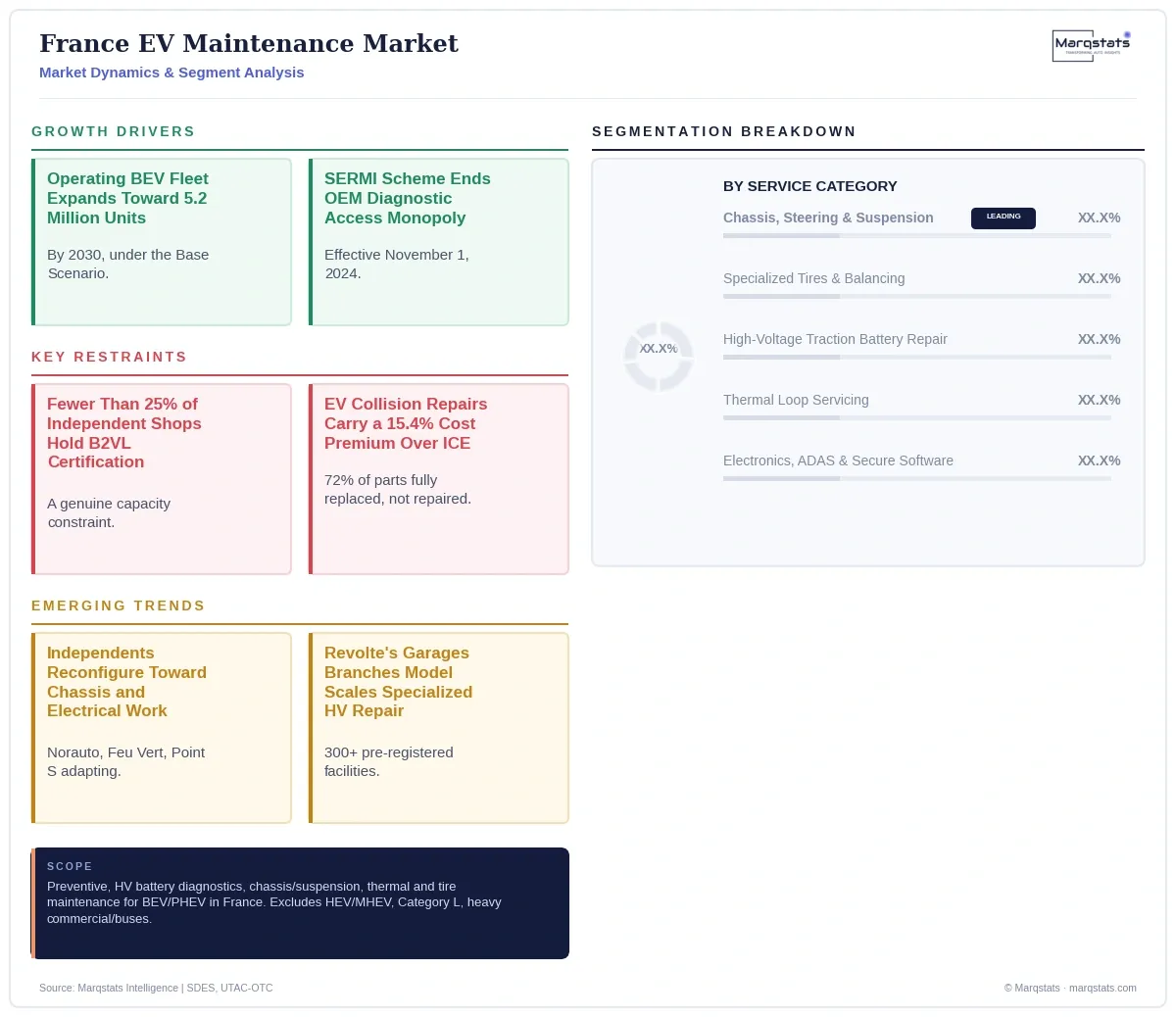
- France's operating BEV fleet is expanding rapidly, from 1,419,800 units in 2025 toward a projected 5,200,000 units by 2030 under the Base Scenario, directly growing the addressable base for recurring electric vehicle maintenance demand.
- The formal activation of the European SERMI security certification scheme in November 2024 ended OEM monopoly on encrypted electronic security access, giving independent workshops a genuine, standardized pathway to compete for post-2024 vehicle diagnostic and repair work.
- ANFA's codification of three new Professional Qualification Certificates for traction battery disassembly and maintenance, targeting 3,000 certified high-voltage technicians by 2027, is directly expanding the qualified labor pool independent workshops depend on.
- Institutional capital investment in specialized EV repair networks, exemplified by Revolte's EUR 4.0 million Series A round backed by mutual insurer Macif and Groupe IMA, is building dedicated module-level battery repair infrastructure outside both dealership and generic independent channels.
- France's social leasing scheme, which delivered approximately 50,000 subcompact electric cars to low-income households within six weeks of its January 2024 launch, is creating a genuinely new entry-level EV maintenance demand segment.
Key Restraints
- The underlying research's own information-asymmetry section explicitly documents that no statutory statistical agency publishes transaction-level hourly labor rates differentiated by electrification level, since dealerships and independent workshops routinely combine high-voltage diagnostic billing into general mechanical labor codes -- a genuine data gap disclosed explicitly throughout this analysis.
- Fewer than 25% of independent French repair facilities currently employ technicians certified to the NF C 18-550 B2VL level or higher, structurally limiting how much of the newly-accessible SERMI diagnostic rights independent workshops can actually convert into completed high-voltage repair work.
- Proprietary OEM battery State of Health telemetry encryption prevents independent repairers from verifying whether an older EV with reduced range requires a full traction battery pack replacement (EUR 8,000 to EUR 15,000) or a targeted single-module replacement (EUR 300), a genuine information asymmetry complicating independent repair economics.
- Electric vehicle collision repairs carry a 15.4% average cost premium over ICE equivalents, with 72% of damaged components now completely replaced rather than repaired, driven by strict manufacturer liability constraints on high-voltage battery trays and integrated aluminum crash structures that prevent mechanical reshaping or structural welding.
- Corporate fleet registration practices concentrate an estimated 28.5% of France's statistical EV parc in Île-de-France, while 30% to 40% of those vehicles' actual operational mileage occurs across provincial regions, distorting regional demand planning based on raw registration data.
Key Trends
- Independent repairers are reconfiguring business models away from combustion engine wear items toward chassis, electrical, and thermal management services, with fast-fit chains including Norauto, Feu Vert and Point S adapting workshop bays to capture high-turnover, non-invasive EV maintenance categories.
- Franchised dealership networks are introducing transparent, fixed-price maintenance packages specifically targeting second- and third-hand EV owners, emphasizing certified high-voltage battery health verification to counter the documented 60% customer migration to independents after four to five years.
- Specialized high-voltage engineering networks, led by Revolte's "Garages Branchés" model, are training and equipping independent mechanics for complex electronics and module-level battery repairs without requiring individual workshops to fund cleanroom facility investment themselves.
- Circular economy component adoption remains sharply bifurcated: while recycled sheet metal, mirrors and lighting components have reached 6% to 7.5% adoption, circular usage of high-voltage battery modules and electric traction motors remains below 2%, constrained by proprietary OEM software locks and a scarcity of certified industrial remanufacturers.
Strategic Implications
- Independent repairers and regional workshop networks should treat NF C 18-550 B2VL certification and SERMI digital accreditation as a mandatory near-term operational baseline, given how directly the current sub-25% certification rate constrains independent participation in the fastest-growing segments of this market.
- Franchised dealer networks should defend aftersales retention specifically through transparent, fixed-price maintenance packages for aging EV cohorts, while aligning labor pricing structures to avoid applying premium high-voltage technician rates to standard suspension or tire work that accelerates customer migration toward independent fast-fit competitors.
- Private equity and venture capital investors should prioritize industrializing traction battery remanufacturing and universal multi-brand diagnostic tools, given how directly enterprises capable of navigating OEM software gateways stand to capture a leading share of the EUR 4.78 billion Base Scenario aftermarket spend emerging by 2030.
- Investors and analysts should track EU Data Act battery health passport implementation progress and social leasing scheme scale-up as the two clearest variables separating this market's Base and Upside scenarios, given how directly both feed the underlying research's own named trigger conditions and how quickly either could shift the 2030 outcome materially.
Outlook
Three genuinely distinct, evidenced trajectories emerge from named, distinct trigger conditions rather than differing growth-rate assumptions applied to the same story. Unlike several other markets in this coverage set, this market's own forecast horizon reaches 2030 directly, requiring no Marqstats extrapolation.
Under the Base Scenario, favorable corporate benefit-in-kind taxation continues and Low Emission Zones (ZFE-m) are enforced in major conurbations including Paris, Lyon and Marseille, with average spend stabilizing as battery warranty expirations are balanced by module remanufacturing; the operating BEV fleet reaches 5,200,000 units by 2030, generating EUR 920.00 average annual spend per vehicle and USD 5,496.10 million (EUR 4,784.00 million) in total market value.
Under the Upside Scenario, the EU Data Act's standardized open battery health passport mandate takes full effect by 2027, a second iteration of social leasing delivers 75,000 units annually, and SERMI accreditation reaches 50% of independent garages; the operating BEV fleet expands to 5,800,000 units by 2030, lifting total market value to USD 6,263.53 million (EUR 5,452.00 million).
Under the Downside Scenario, fiscal austerity eliminates ecological bonus incentives, municipal ZFE-m enforcement is diluted and delayed, and persistent technician shortages leave fewer than 15% of independent garages securing B2VL certification; the operating BEV fleet reaches only 4,400,000 units by 2030, with total market value reaching USD 4,549.45 million (EUR 3,960.00 million).
Market Segmentation
USD 305.02 million (22.0% share) in 2025. Anchored by specialized centers including Revolte, given a EUR 8,000-15,000 full pack replacement cost versus EUR 300 for a single module.
USD 367.41 million (26.5% share) in 2025. The largest category, driven by elevated shear loads necessitating replacement at 60,000-80,000 km, well ahead of ICE lifecycles.
USD 332.75 million (24.0% share) in 2025. Anchored by fast-fit specialists Point S, Euromaster and Feu Vert; the single largest recurring consumer expense.
USD 201.04 million (14.5% share) in 2025. Anchored by dielectric coolant and heat pump servicing using R1234yf and R744 recovery equipment.
USD 180.24 million (13.0% share) in 2025. Anchored by SERMI-compliant gateway flashing and radar/camera recalibration.
88.5% of total market value in 2025, with private retail owners averaging 11,600 km annual mileage and longer ownership tenures than commercial fleet operators.
11.5% of total market value in 2025, characterized by demanding duty cycles averaging 12,900 to over 25,000 km in urban delivery applications, driving adoption of mobile on-site fleet servicing and telematics-driven predictive maintenance.
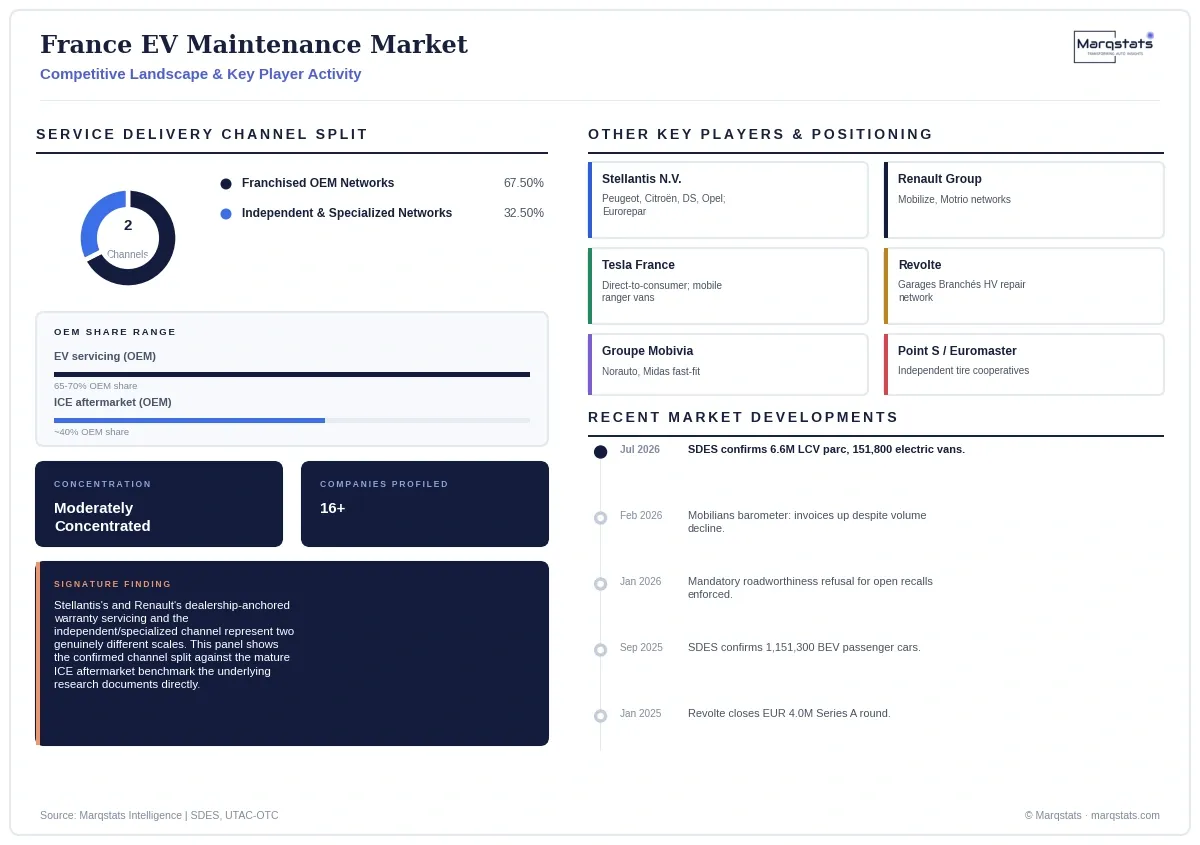
65% to 70% of total EV servicing turnover, compared to approximately 40% across the mature ICE aftermarket, sustained by statutory manufacturer warranties and long-term full-maintenance leasing packages from captive financing divisions including Mobilize Financial Services and Stellantis Financial Services.
The remaining share, led by multibrand fast-fit networks (Norauto, Feu Vert, Point S, Euromaster, Speedy) capturing high-turnover non-invasive maintenance, alongside specialized high-voltage engineering networks like Revolte's "Garages Branchés" coordinating complex module-level battery repairs.
By Geography
Île-de-France
28.5% of the national EV parc (28,944 public charging points), heavily skewed by corporate fleet leasing registration practices; strict Grand Paris ZFE-m enforcement and high corporate leasing share drive demand, though an estimated 30% to 40% of registered vehicles' actual operational mileage occurs across provincial regions.
Auvergne-Rhône-Alpes
15.2% of the national EV parc (22,054 public charging points), anchored by dense Lyon urban conurbation, Swiss cross-border commuters, and severe mountain topography driving elevated brake wear.
Provence-Alpes-Côte d'Azur (PACA)
8.8% of the national EV parc (approximately 15,500 public charging points), anchored by high household wealth along coastal urban zones and 3.7% regional EV fleet penetration.
Nouvelle-Aquitaine
8.1% of the national EV parc (approximately 13,800 public charging points), anchored by high single-family home ownership supporting private charging and expanding Bordeaux peri-urban electric commuting.
Occitanie
7.9% of the national EV parc (12,712 public charging points), anchored by commercial aerospace logistics fleets in Toulouse and Montpellier's urban clean delivery corridors.
Remaining 8 Regions Combined
31.5% of the national EV parc (approximately 92,500 public charging points), characterized by slower fleet renewal in rural zones and greater reliance on local independent workshops, which remain under-equipped for high-voltage servicing in regions including Grand Est, Bourgogne-Franche-Comté and Centre-Val de Loire.
How Competition Is Evolving
No single company in this market spans franchised warranty-era dealership servicing, multibrand independent fast-fit operations, and specialized high-voltage engineering simultaneously, leaving genuine competitive white space for any group capable of bridging Stellantis's and Renault's dealership-anchored warranty servicing with the independent and specialized channels this market's own churn pattern shows feeding steadily as vehicles age past four to five years.
Competition spans franchised OEM dealership networks, multibrand independent fast-fit chains, and a specialized high-voltage engineering channel. Stellantis N.V. (Peugeot, Citroën, DS, Opel) and Renault Group anchor the dominant domestic dealership channel, operating the Eurorepar and Motrio independent-adjacent repair franchises respectively. Volkswagen Group France, Tesla France, BMW Group France, Hyundai Motor France, Kia France, Toyota France, Mercedes-Benz France, Ford France and Nissan West Europe each maintain dedicated high-voltage dealer service infrastructure, with Tesla operating entirely outside the franchised model via direct company-owned centers and mobile ranger maintenance fleets. On the independent side, Groupe Mobivia (Norauto, Midas), Feu Vert, Point S, Euromaster (Michelin) and Speedy (Bridgestone) anchor the multibrand fast-fit channel.
On specialized high-voltage repair, Revolte anchors the pure-play EV engineering channel through its "Garages Branchés" network, backed by institutional equity from mutual insurer Macif and Groupe IMA. Robert Bosch France, Valeo and Forvia anchor component and diagnostic equipment supply, while Michelin and TotalEnergies Lubrifiants anchor tire and dielectric fluid manufacturing. Regulatory and standards oversight rests with SDES, UTAC-OTC, COFRAC, PFA, Mobilians, FNA, FIEV and ANFA, with DEKRA Certification serving as the first COFRAC-accredited SERMI conformity assessment body.
Companies Covered
The report profiles 16+ companies with full strategy and financials analysis, including:
Recent Market Activity
Table of Contents
Coverage & Segmentation
This report measures scheduled preventive maintenance, high-voltage battery diagnostic triage and module reconditioning, electric drive unit maintenance, regenerative braking system upkeep, thermal management fluid replacement, chassis suspension rebuilds, and electric-specific tire replacement for BEVs and PHEVs in France, across a 2025 base year and a 2026 to 2030 forecast period, denominated in United States dollars at the pack's own stated European Central Bank rate of 1.14885 USD per EUR. It excludes non-plug-in hybrid (HEV) and 48-volt mild hybrid (MHEV) vehicles, Category L two-wheelers, and heavy commercial vehicles and buses.
The analysis spans three segmentation dimensions — service category, vehicle fleet classification and service delivery channel — six regional geographies, and 15 profiled entities across OEMs, independent networks, component suppliers and regulatory bodies. Fleet and registration figures trace to SDES and RSVERO; market value and channel/fleet splits trace to the underlying research's own fully sourced sizing model, with the service-category shares disclosed as a Marqstats construction.