Market Snapshot
Key Takeaways
Market Overview & Analysis
Report Summary
This analysis reads Canada's own fully partitioned sizing chain, provincial distribution data, and named-scenario regulatory framework together as a single coherent picture rather than isolated data points, since the underlying research itself was structured to support exactly that kind of integrated reading.
Canada's EV maintenance market is measured across specialized tire servicing, friction brake corrosion management, suspension and steering wear, high-voltage thermal management, and diagnostics, valued at USD 553.34 million in 2025. This figure is derived from the underlying research's own sourced cost-modeling framework, anchored to Statistics Canada statutory fleet registration data covering 685,199 cumulative ZEVs at year-end 2024.
Structurally, this is a market shaped by two forces working simultaneously: a genuine cold-climate operating environment that transforms rather than eliminates brake servicing, and a newly operative federal right-to-repair legal framework that gives independent shops statutory standing to demand diagnostic access — even as consumer warranty misconceptions continue concentrating current service volume within franchised dealership networks.
The analysis is built for four reader types making different decisions: an independent workshop operator weighing high-voltage certification investment now that Bills C-244, C-294 and C-59 provide statutory diagnostic access rights, a franchised dealership group managing the transition from quick-lube volume toward high-voltage repair margin, a provincial workforce program administrator scaling technician training capacity, and an investor tracking how federal ZEV mandate enforcement shapes this market's Baseline-to-Accelerated scenario range.
Why Canadian Winters Turn a Vanishing Service Category Back Into Annual Work
Regenerative braking is one of the most consistently cited EV maintenance advantages worldwide: capturing kinetic energy through the drive motor instead of burning it off as heat, it can extend friction brake pad life well past 120,000 kilometers in mild climates. Reading only that fact, a workshop might reasonably expect Canadian EV brake service demand to be shrinking.
The underlying research's own data shows the opposite happening for a specific, mechanical reason. Because regenerative braking absorbs up to 90% of deceleration events, friction pads rarely engage with enough force or duration to generate the heat needed to evaporate accumulated road salt brine from Canadian winter de-icing operations. The result is galvanic corrosion — seized slide pins, pitted rotors, caliper brackets that stop moving freely — that has nothing to do with mechanical wear and everything to do with underuse in a corrosive environment. Canadian workshops end up performing brake service just as often as before, only now the job is an annual preventive teardown and cleaning procedure instead of a wear-driven replacement.
A Right-to-Repair Law That Actually Passed, and What Happens Next
Right-to-repair legislation for vehicles remains a live, unresolved fight in many markets — proposed, debated, sometimes passed at the state or provincial level, rarely settled nationally. Canada's own situation is genuinely further along: Bills C-244 and C-294 received Royal Assent in November 2024, adding statutory language to the Copyright Act that makes it lawful for independent shops to circumvent manufacturer digital locks solely for diagnosis, maintenance and repair.
Having the legal right, though, isn't the same as having the practical capability. AIA Canada's own consumer research found 41% of EV owners still incorrectly believe independent repair voids their factory warranty, and dealership networks retain proprietary diagnostic tooling and technician training investments independents haven't yet matched. The legal foundation is genuinely in place; the practical shift in where Canadian EV owners actually take their vehicles will depend on how quickly independent shops can close the certification and consumer-perception gap that legislation alone doesn't resolve.
Market Dynamics
Key Drivers
- Canadian Automobile Association and Vincentric's own empirical cost data confirms 82% of evaluated EV nameplates maintain lower routine operating costs than internal combustion equivalents, a durable consumer-facing economic argument that continues supporting adoption even as specific service categories like tires and brakes run higher than ICE equivalents.
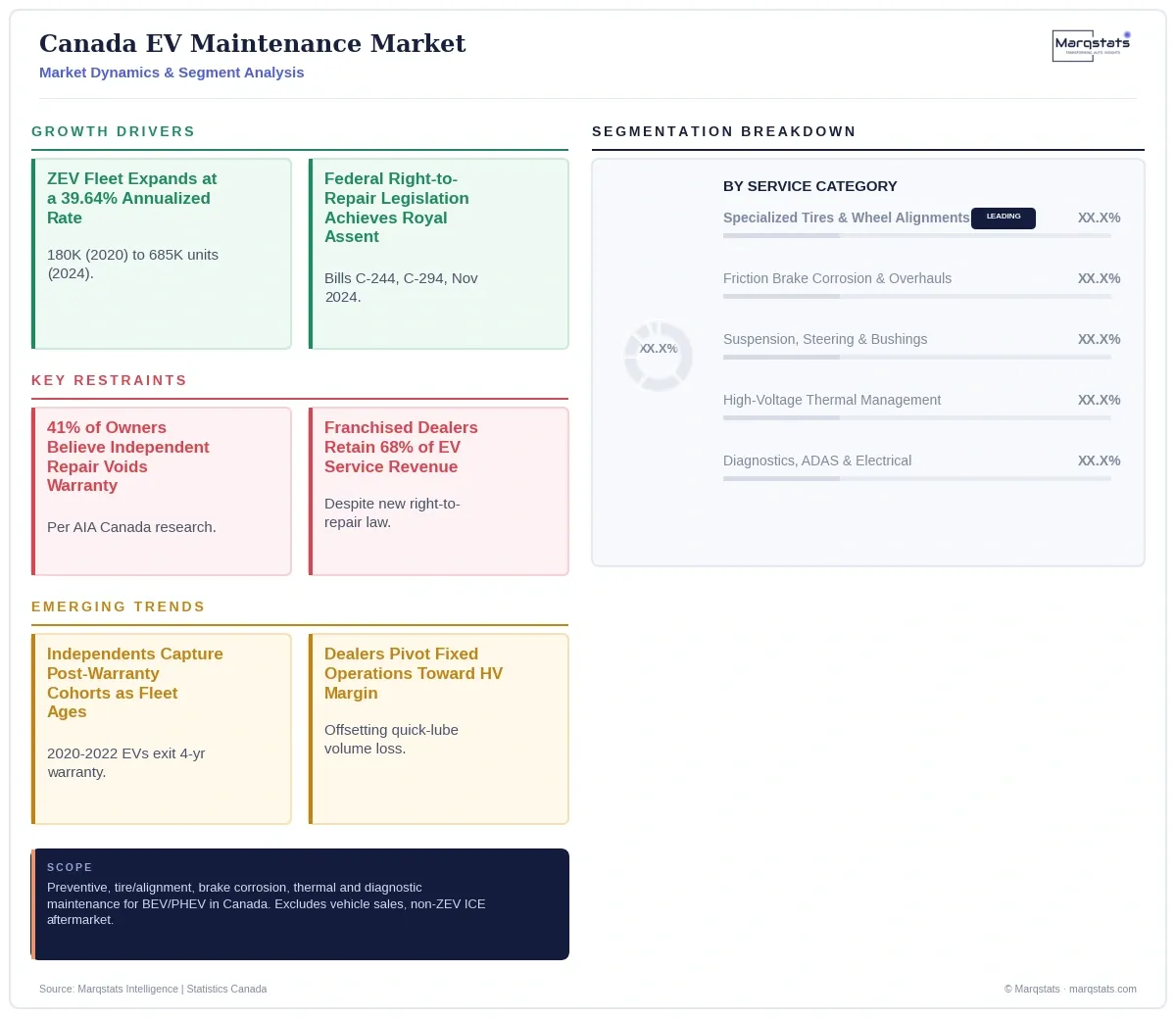
- Canada's fully partitioned service category data shows specialized tires and wheel alignments already the single largest category at 38.5% of total value, a structural signal that tire inventory and precision alignment capability, reinforced by mandatory seasonal changeovers, represent the most immediate revenue opportunity for workshops entering this market.
- Canada's light-duty ZEV fleet expanded from 180,201 units in 2020 to 685,199 units by year-end 2024, an annualized 39.64% expansion rate, directly growing the addressable base for recurring electric vehicle maintenance demand.
- Federal right-to-repair legislation, with Bills C-244 and C-294 achieving Royal Assent in November 2024, provides independent repair shops genuine statutory standing to circumvent manufacturer digital locks for diagnosis and repair, a legal foundation few other markets in this coverage set can match.
- Provincial workforce development programs, including Quebec's Compétences VE and British Columbia's EVfriendly certification standard, are actively expanding the qualified high-voltage technician pool needed to support independent aftermarket growth.
- Commercial light-duty fleet electrification, with delivery vans and municipal vehicles traveling up to three times the annual mileage of retail vehicles, is generating disproportionately concentrated recurring maintenance revenue for workshops equipped to serve high-duty-cycle commercial accounts.
- Mandatory seasonal tire changeovers across Canada provide independent repair facilities a recurring, built-in opportunity to inspect suspension wear and perform precision alignments on heavy EV chassis, generating consistent twice-yearly service touchpoints.
Key Restraints
- Shifting economic conditions and evolving North American trade relationships led the federal government to propose Canada Gazette Part I revisions to the Electric Vehicle Availability Standard's implementation framework in August 2026, introducing genuine near-term ambiguity around the strict quota enforcement timeline this market's own Accelerated Mandate Scenario depends on.
- The underlying research's own reconciliation places 100% of historical fleet volume on directly published statutory registries, with market values derived from empirical cost calibrations rather than direct revenue disclosures -- a genuine methodology distinction disclosed explicitly throughout this analysis.
- Consumer warranty misconceptions remain widespread: AIA Canada's own research found 41% of EV owners incorrectly believe independent repair voids their factory warranty, sustaining dealership channel concentration independent of the new legal right-to-repair framework.
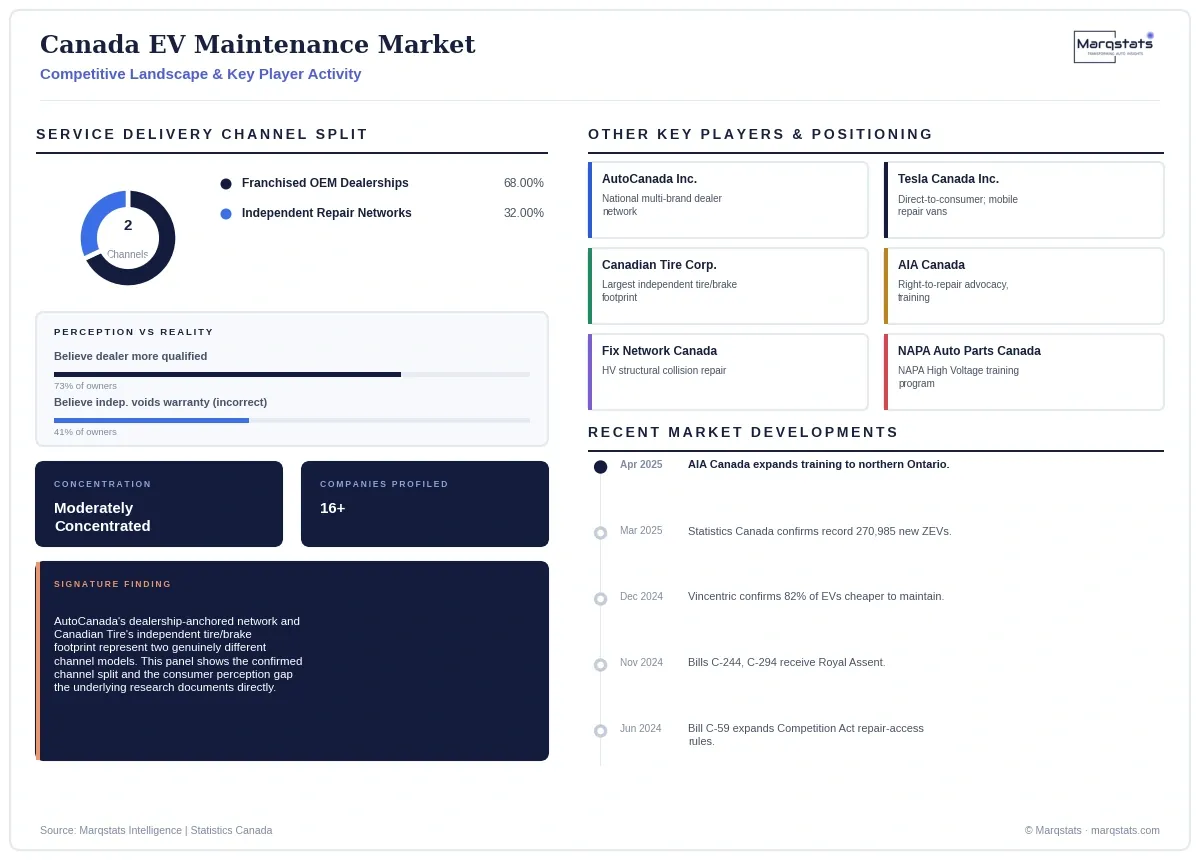
- Franchised OEM dealerships capture 68.0% of total Canadian EV maintenance revenue, reinforced by secure gateway modules, encrypted CAN bus architectures, and the 73% of owners who believe dealership technicians hold superior technical qualifications.
- This report's 2025 base-year figure and 2030 endpoint both rely on Marqstats interpolation and extrapolation rather than source-stated figures, since the underlying research's own table jumps directly from a 2024 actual to a 2029 projection with no intermediate years stated -- a genuine data-availability gap disclosed explicitly throughout this analysis.
- Shifting federal policy conditions, including proposed Canada Gazette Part I revisions to the Electric Vehicle Availability Standard's compliance schedule, introduce genuine near-term regulatory uncertainty around the strict quota enforcement the Accelerated Mandate Scenario depends on.
Key Trends
- Fleet operators managing commercial light-duty vans and municipal vehicles are increasingly negotiating dedicated maintenance contracts directly with tire and mechanical networks like Kal Tire and Fountain Tire, given the documented three-fold mileage premium these vehicles accumulate relative to retail passenger vehicles.
- Independent repair networks are beginning to capture post-warranty mechanical maintenance as the 2020 through 2022 EV cohorts exceed their 4-year, 80,000-kilometer base factory warranties, led by tire replacements, chassis alignments, and brake rebuilds.
- Franchised dealership groups are deliberately pivoting fixed-operations strategy toward capturing complex high-voltage repairs and certified battery health assessments specifically to offset contracting quick-lube service volume.
- Post-secondary institutions across Ontario, Quebec and British Columbia are scaling dedicated high-voltage technician training programs, with AIA Canada's Innovation in Automotive Training program expanding to northern Ontario via Cambrian College in April 2025.
- Multi-shop collision repair operators including Fix Network Canada and Boyd Group Services are building certified high-voltage structural repair and ADAS recalibration capability specifically to serve the growing EV collision segment.
Strategic Implications
- Independent repair shop operators should treat the November 2024 right-to-repair legislation as a genuine near-term strategic opening nationwide, prioritizing high-voltage certification investment and consumer education specifically to counter the persistent warranty-void misconception that AIA Canada's own research documents.
- Franchised dealership groups should continue optimizing fixed operations toward high-voltage repair margin and certified battery health assessment programs nationwide, given how directly contracting quick-lube volume threatens traditional service-lane profitability as the fleet electrifies.
- Provincial workforce development administrators should prioritize scaling Compétences VE-style and EVfriendly-style certification programs beyond their current provincial anchors, given how directly technician supply constrains independent aftermarket capture regardless of the legal right-to-repair framework now in place across the entire country.
- Investors and analysts should track Electric Vehicle Availability Standard compliance enforcement and provincial purchase incentive renewal decisions across every major province as the two clearest variables separating this market's Baseline and Accelerated Mandate scenarios, given how directly both feed the underlying research's own named trigger conditions and how quickly either could shift the 2029 outcome materially.
Outlook
The underlying research presents two genuinely distinct, evidenced forward trajectories, having explicitly tested and rejected a low-growth downside scenario given binding provincial zero-emission sales mandates already in force across more than 68% of Canada's EV market. The 2030 figures below are Marqstats extrapolations of the pack's own directly stated 2029 endpoints, held one additional year at each scenario's own five-year CAGR, disclosed explicitly; the pack's own 2029 figures are given for reference alongside.
Under the Baseline Market Trajectory, provincial incentives phase out on a structured schedule including Quebec's Roulez vert subsidies through 2027, and federal sales targets adjust toward an emissions-based standard aligned with North American production timelines; the light-duty ZEV fleet reaches 2,480,000 units by 2029 (CAD 2,260.04 million / USD 1,650.28 million), extrapolated to CAD 2,969.92 million (USD 2,168.63 million) by 2030 at a 31.41% CAGR.
Under the Accelerated Mandate Scenario, the federal government strictly maintains original 2026-2030 compliance quotas under the Electric Vehicle Availability Standard without compliance flexibilities, alongside renewed federal purchase subsidies and expanded charging infrastructure investment; the light-duty ZEV fleet reaches 3,100,000 units by 2029 (CAD 2,825.00 million / USD 2,062.82 million), extrapolated to CAD 3,881.55 million (USD 2,834.31 million) by 2030.
Market Segmentation
USD 213.04 million (38.5% share) in 2025. The largest category, driven by instant torque, heavy curb weight and mandatory seasonal tire changeovers.
USD 116.20 million (21.0% share) in 2025. Anchored by road salt brine galvanic corrosion converting brake service into annual preventive work.
USD 85.77 million (15.5% share) in 2025. Anchored by dynamic battery mass fatigue over winter frost heaves and potholes.
USD 66.40 million (12.0% share) in 2025. Anchored by low-conductivity dielectric coolant flushes at 4-to-5-year intervals.
USD 47.03 million (8.5% share) in 2025. Anchored by proprietary sensor calibration and secure gateway firmware programming.
USD 24.90 million (4.5% share) in 2025. Covers heat pump loops, desiccant bags and 12V auxiliary battery service.
USD 376.27 million (68.0% share) in 2025. Sustained by diagnostic tooling locks, warranty perception, and secure gateway architectures.
USD 177.07 million (32.0% share) in 2025. Growing as post-warranty tire, brake, chassis and suspension demand shifts away from dealers.
USD 348.60 million (63.0% share) in 2025. Structural volume dominance at 71.2% of the registered ZEV fleet.
USD 204.74 million (37.0% share) in 2025. Higher per-unit service costs across dual-powertrain systems despite lower unit share.
USD 478.64 million (86.5% share) in 2025. Standard personal commuting profiles at 15,000 to 20,000 km/year.
USD 74.70 million (13.5% share) in 2025. High annual duty cycles of 45,000 to 75,000 km/year with daily fast-charging.
By Geography
Quebec
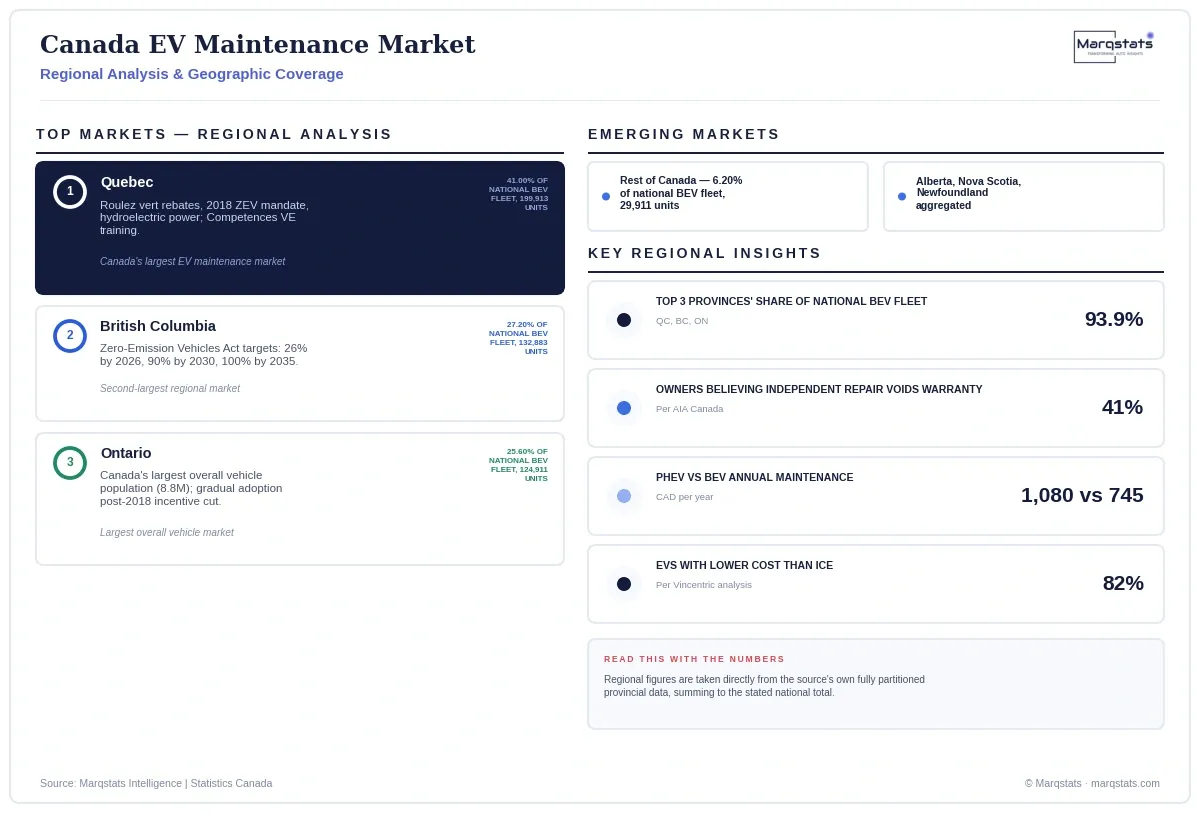
41.0% of the national BEV fleet (199,913 vehicles) in 2024, generating 30.9% of new ZEV sales (147,416 units), Canada's largest EV maintenance market, anchored by accessible hydroelectric power, the Roulez vert purchase rebate program, and a 2018 zero-emission sales mandate.
British Columbia
27.2% of the national BEV fleet (132,883 vehicles) in 2024, generating 20.9% of provincial light-duty ZEV sales, underpinned by the Zero-Emission Vehicles Act's phased sales targets of 26% by 2026, 90% by 2030 and 100% by 2035.
Ontario
25.6% of the national BEV fleet (124,911 vehicles) in 2024, generating 8.1% new ZEV market share within Canada's largest overall light-duty vehicle population of 8.8 million vehicles, with adoption growing more gradually following the 2018 cancellation of provincial consumer purchase incentives.
Rest of Canada
6.2% of the national BEV fleet (29,911 vehicles) in 2024, aggregating Alberta, Nova Scotia, Newfoundland and other provinces under combined national reporting provisions.
How Competition Is Evolving
No single company in this market spans franchised warranty-era dealership servicing, vertically integrated direct-to-consumer service, and independent high-voltage repair simultaneously, leaving genuine competitive white space for any group capable of bridging AutoCanada's dealership-anchored warranty servicing with the independent channel this market's own post-warranty cohort is beginning to feed.
Competition spans franchised OEM dealership groups, national aftermarket repair chains, specialized tire and collision networks, and wholesale parts distributors. AutoCanada Inc. and Dilawri Group of Companies anchor the dominant franchised dealership channel, alongside direct-to-consumer OEMs Tesla Canada and Rivian Automotive Canada operating entirely outside the traditional dealer model. On the independent side, Canadian Tire Corporation anchors the largest independent retail footprint for EV tires and brakes, while UAP Inc./NAPA Auto Parts Canada anchors wholesale distribution through its NAPA High Voltage training program. Fix Network Canada and Boyd Group Services anchor certified high-voltage collision and structural repair capability.
On workforce development and standards, the Automotive Industries Association of Canada (AIA Canada) anchors national right-to-repair advocacy and technical research, while the Automotive Retailers Association administers British Columbia's EVfriendly shop certification standard. Quebec's regional parity committees (CPA Montréal, CPA Québec, CPA Mauricie) administer the Compétences VE technician training framework. Diagnostic equipment suppliers Snap-on Tools of Canada, Bosch Automotive Service Solutions and Autel Canada anchor the specialized high-voltage tooling market independent shops depend on.
Companies Covered
The report profiles 16+ companies with full strategy and financials analysis, including:
Recent Market Activity
Table of Contents
Coverage & Segmentation
This report measures scheduled preventive maintenance, specialized tire and wheel alignment servicing, friction brake corrosion management, suspension and steering component wear, high-voltage thermal management, and diagnostics and electrical repair for BEVs and PHEVs in Canada, across a 2025 base year and a 2026 to 2030 forecast period, denominated in United States dollars at the pack's own stated Bank of Canada 2024 benchmark of USD 0.7302 per CAD. It excludes whole vehicle sales revenue and general internal combustion aftermarket spend outside the ZEV segment.
The analysis spans four segmentation dimensions — service category, service delivery channel, powertrain architecture and fleet operating profile — four provincial geographies, and 16 profiled entities across OEMs, aftermarket chains, trade associations and diagnostic equipment suppliers. Fleet and registration figures trace to Statistics Canada; market value and segment splits trace to the underlying research's own fully partitioned sizing model, with the 2025 base year and 2030 endpoint disclosed as Marqstats interpolations and extrapolations of the pack's own stated 2024 and 2029 figures.