Market Snapshot
Middle bar: base-year value × (1 + CAGR), rounded to two decimals. This is a calculated illustration, not a separately researched annual estimate.
Market Size (2025, Base Year): USD 2,171.98 Million (Wholesale)
Estimated Value (2026): USD 2,274.29 Million
Forecast Value (2030): USD 2,707.11 Million
CAGR: 4.50% | Forecast Period: 2026 – 2030
Growth — Absolute: USD 535.13 Million
Physical Volume: 443.15 Million Litres (2025) to 483.84 Million Litres (2030), Volume CAGR 1.77%
Largest Market: Ontario (37.5% of 2025 volume)
Fastest Growing: Transmission and Transaxle Fluids (2.11% volume CAGR)
Dominant Segment: Passenger Car Motor Oil (46.50% of 2025 volume)
Market Concentration: Moderately Concentrated (Top Five Above 75%)
Base Year: 2025 | Historical Period: 2021 – 2025 | Forecast Period: 2026 – 2030
Units Considered: Value (USD Million) and Volume (Million Litres)
Segments Covered: 3 | Regions Covered: 6 | Companies Profiled: 14
Report Pages: 175 | Deliverables: PDF, Excel, PPT
Key Takeaways
Market Overview & Analysis
Report Summary
Canada's lubricants aftermarket is a mature volume market growing on price. Fleets keep ageing, vehicles are getting heavier, and hybrids are spreading faster than pure electrics, which pushes the product mix toward synthetics. Volume grows 1.77% a year; value grows 4.50%.
The analysis measures the wholesale value of engine oils, transmission fluids, gear oils, brake fluids and greases supplied after factory delivery: USD 2,171.98 million in 2025. It excludes factory first-fill and industrial lubricants, and it excludes retail service labour. The base-year volume rests on one syndicated-research citation that Marqstats could not verify against a statutory series, and the limit runs through every figure.
The analysis is written for four readers: a blender planning capacity for 0W-16 and the January 2027 PC-12 heavy-duty category, a quick-lube operator reshaping the service menu, a jobber supplying independent garages, and an investor tracking how hybrid adoption changes value per litre.
The EV Mandate Missed, and Hybrids Took the Space
Canada's electrification path bent sharply in 2025, and the direction of the bend matters more for oil than the headline ZEV number.
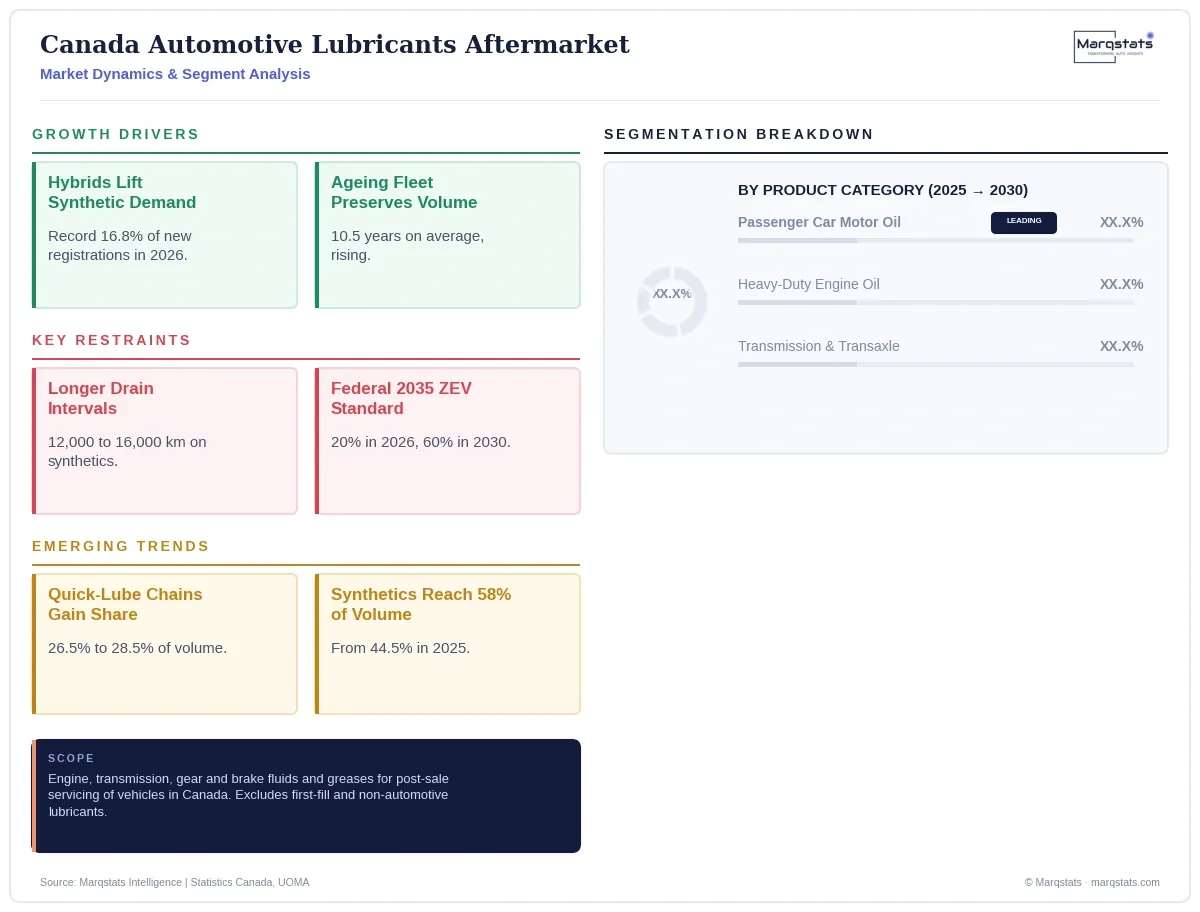
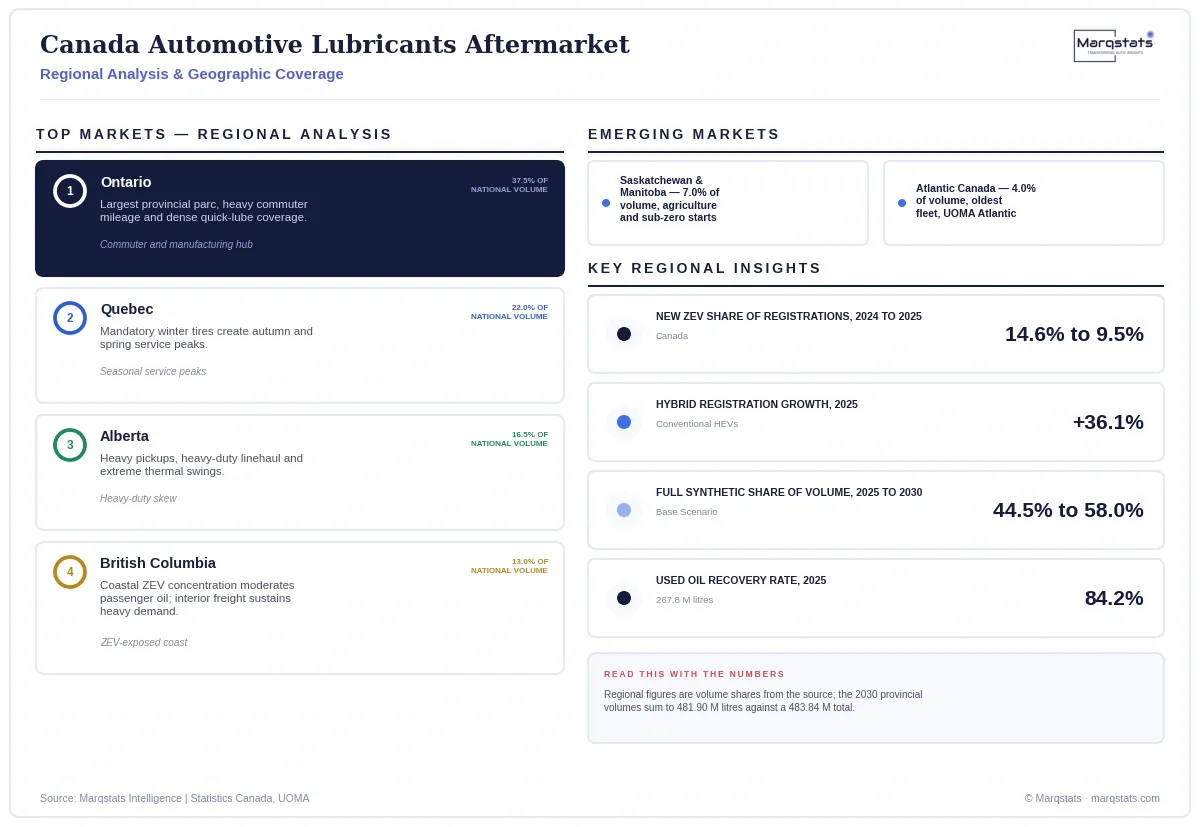
New zero-emission registrations, battery electric plus plug-in hybrid, fell 34.7% in 2025 to 9.5% of new vehicles, against 14.6% a year earlier. Battery electric fell 43.1% and plug-in hybrids 10.0%, after Quebec restructured its Roulez vert subsidies and British Columbia suspended its Go Electric rebates. The federal Electric Vehicle Availability Standard calls for 20% zero-emission sales in 2026 and 60% in 2030. Federal purchase support returned in February 2026, and first-quarter ZEV registrations rebounded 15.8% to a 10.8% share, but the combustion engine remains the core of the fleet for at least a decade. Meanwhile unsubsidised conventional hybrids grew 36.1% in 2025 to 224,192 units, and reached a record 16.8% of new registrations in 2026.
Why a Hybrid Is Harder on Oil Than a Petrol Car
A hybrid keeps its combustion engine, but it runs that engine differently.
In suburban driving and on sub-zero winter commutes the engine cycles on and off and often fails to hold oil temperatures high enough to boil off contaminants. Unburnt fuel and condensation stay in the crankcase, thinning the oil, forming low-temperature sludge and adding wear to bearings and timing chains. Hybrid makers therefore specify full-synthetic, ultra-low-viscosity oils, SAE 0W-16, 0W-12 and 0W-8, with tuned dispersants, oxidation inhibitors and zinc boundary-wear additives. Hybrid adoption does not remove oil demand. It retires low-tier mineral oil and lifts revenue in professional service networks.
Heavier Vehicles Refill the Sump Longer Oil Intervals Empty
Service intervals are lengthening, yet volume still grows.
Light-vehicle drain intervals have stretched from 5,000 km to 12,000 to 16,000 km on high-tier synthetics with oil-life monitors. Offsetting this, light trucks, crossovers and SUVs took 87.6% of new light-vehicle deliveries in 2025, multipurpose vehicles were 63.2% of new registrations, and passenger cars fell 7.0% to under 12% of deliveries. Those vehicles carry 5.5 to 7.5 litre sumps against 3.8 to 4.5 litres for older passenger cars. The average light-duty fleet is 10.5 years old and rising, and older engines top off more often between drains.
A Base-Oil Producer Selling Into Its Own Market
Canada has an unusual supply position for a mid-sized market.
Petro-Canada Lubricants' Mississauga complex, owned by HF Sinclair, has a nameplate capacity above 15,600 barrels a day of Group II and III base stocks, about 900 million litres a year, and exports to more than 80 markets. Imperial Oil blends in Sarnia and Strathcona. Because Canadian refiners focus on Group II and III, Canada imports polyalphaolefin Group IV stocks, synthetic esters and additive packages, mainly from Texas, Louisiana and Ohio under the trade agreement with the United States and Mexico. Home-grown base oil reduces the exposure to import shocks that some other markets in this coverage set face, but the premium synthetic grades still depend on the United States.
What the Evidence Does and Does Not Show
The sizing is only as strong as its anchor.
The 443.15 million litre base-year volume, the 2030 total and the 1.77% volume CAGR come from one syndicated-research estimate. No Statistics Canada or Natural Resources Canada series was available to check it. Provincial 2030 volumes add to 481.90 million litres, not 483.84, a 1.94 million litre gap that is left unallocated. Brand shares are unaudited estimates, and the commercial fleet figure of about 1.35 million units is unverified. None of this changes the direction of the trends, which rest on registration data, but it limits how precisely the absolute size can be quoted.
Provincial Stewardship Sets the Cost of Every Litre
Canada's used-oil system is regulated province by province, and the charges sit in the price.
Under provincial producer-responsibility laws, manufacturers, brand owners and first importers must fund the collection and recovery of used oil, filters and containers. Programs run through the Used Oil Management Association framework and include Interchange Recycling in British Columbia, ARMA in Alberta, SARRC in Saskatchewan, MARRC in Manitoba, Automotive Materials Stewardship in Ontario, SOGHU in Quebec and UOMA Atlantic. They are financed by environmental handling charges of CAD 0.04 to 0.16 per litre on wholesale sales or imports, which pay return incentives to certified collectors. In 2025 the system recovered 267.8 million litres, an 84.2% recovery rate against 83.6% in 2024. Because the rules discourage residential collection, they also push owners toward professional service.
Quebec's Winter Tire Law Shapes the Service Calendar
One provincial rule changes when oil is sold.
Quebec requires winter tires on passenger vehicles from 1 December to 15 March. The mandate creates two peaks, in autumn and spring, when owners bring cars in for tire changeovers, and shops bundle preventive oil and fluid changes into the same visit. Quebec holds 22.0% of national volume, and its share is projected to slip from 22.0% to 21.1% by 2030, and the source does not say why. The lesson for quick-lube operators elsewhere is that co-marketing tires with fluids can lift ticket value as oil intervals stretch.
Heavy-Duty Oil Is Heading Into a New Specification Cycle
Freight fleets face a formulation change with a fixed date.
The PC-12 category, finalised by the Truck and Engine Manufacturers Association and the API and open for licensing on 1 January 2027, introduces API CL-4, which is backward compatible and has higher high-temperature high-shear viscosity, and API FB-4, a lower viscosity fuel-economy grade. Both limit sulphated ash, phosphorus and sulphur to protect exhaust aftertreatment required by federal emissions rules for model year 2027. Blenders therefore need parallel supply chains, one for legacy Class 8 equipment and one for newer linehaul fleets, and fleets are already moving from 15W-40 mineral to 10W-30 and 5W-30 synthetics. Heavy-duty engine oil holds 21.67% of 2025 volume.
Market Dynamics
Key Drivers
- An ageing fleet, 10.5 years on average and 10.6 in the Base Scenario by 2030, preserves the addressable base as owners keep vehicles longer on high prices and financing costs.
- Conventional hybrids, up 36.1% in 2025 and at a record 16.8% of new registrations in 2026, demand premium full-synthetic oils and lift value per litre.
- Light trucks, crossovers and SUVs are 87.6% of new light-vehicle deliveries, and their larger sumps offset the effect of longer drain intervals.
- Synthetic mix shift, 44.5% to 58.0% of volume, is driven by sub-zero start requirements and OEM specifications including ILSAC GF-7 and GM dexos1 Gen 3.
- Heavy-duty demand holds through freight and resource corridors, with the PC-12 category licensing from 1 January 2027 opening a new formulation cycle.
Key Restraints
- Biofuel blending adds pressure on crankcase chemistry: higher bio-component blow-by raises fuel dilution and oil acidification, so blenders must raise base numbers and antioxidant levels, which adds formulation cost.
- Extended drain intervals of 12,000 to 16,000 km cut the number of changes per vehicle, which holds volume growth below fleet growth.
- The federal standard requires 100% zero-emission light-duty sales by 2035, so combustion oil demand faces gradual pressure even though 2025 sales lagged the interim targets.
- Professional channels handle 85% of volume because underbody trays, reset tools and used-oil rules keep owners out of their own garages, which limits DIY volume at 15%.
- The size of the market rests on a single external estimate, so absolute figures carry more uncertainty than the direction of change.
Key Trends
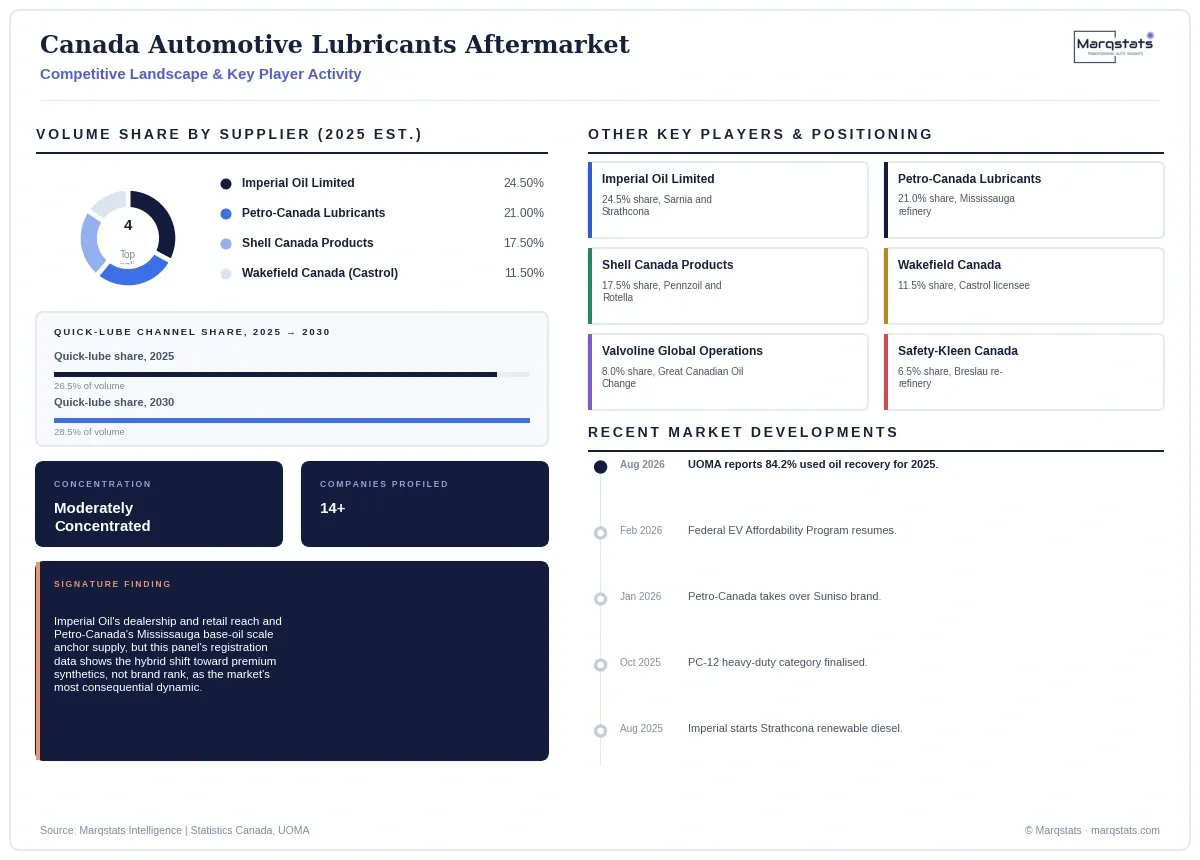
- Quick-lube chains are growing share, from 26.5% to 28.5% of volume, and adding tire, brake, cabin filter and transmission flush services to offset longer drain intervals.
- Ultra-low-viscosity oils are spreading: 0W-20 rises from 38.5% to 43.0% and 0W-16 from 7.5% to 15.0% of the light-duty slate, with early 0W-8 and 0W-12 in Japanese hybrids.
- Heavy-duty fleets are moving from 15W-40 mineral toward 10W-30 and 5W-30 synthetics for fuel savings, ahead of the PC-12 category with API CL-4 and FB-4 grades.
- Circular products are scaling: Safety-Kleen's Breslau re-refinery turns about 227 million litres of used oil a year into Group II and II+ base oil, and transit and freight fleets buy re-refined oil to meet Scope 3 targets.
Strategic Implications
- Blenders should shift capacity from Group I and II mineral oils toward Group III, III+ and PAO synthetics tuned for stop-start hybrids, and prepare parallel CL-4 and FB-4 supply chains before PC-12 licensing on 1 January 2027.
- Quick-lube and independent operators should install multi-reel dispensing for 0W-16, 0W-20 and CVT and DCT fluids and expand menus to transmission flushes, differential services and brake fluid checks.
- Jobbers and distributors should stock for many specifications in smaller quantities and support provincial stewardship reporting so customers can claim return incentives.
- Investors and analysts should track quarterly ZEV and hybrid registrations against the 20% and 60% federal milestones, the variable that separates the Base and Downside cases.
- Fleet managers should budget for the shift from 15W-40 to synthetic heavy-duty grades and consider closed-loop re-refined oil contracts to reduce Scope 3 emissions.
Outlook
The underlying research presents three scenarios tied to named policy and economic triggers. Endpoints and CAGRs for all three were checked against the stated 2030 values; the Base value CAGR checks to 4.50% and not the 4.51% stated in the source.
Under the Base Scenario, conventional hybrids take 15% to 18% of new light-vehicle sales, ZEV registrations recover to 16% to 20% by 2030 (18.0% used in the scenario table), and the average light-duty fleet age stabilises at 10.6 years. Full synthetics reach 58.0% of volume. Volume reaches 483.84 million litres, a 1.77% CAGR, and value reaches USD 2,707.11 million (CAD 3,784 million), a 4.50% CAGR.
Under the Upside Scenario, affordability limits, financing costs and trade policy slow the transition, provinces follow Quebec and British Columbia in cutting purchase subsidies and Ottawa adjusts interim ZEV thresholds. Owners keep vehicles longer, average fleet age passes 11.2 years, and ZEV sales reach only 11.0%. Volume reaches 512.40 million litres, a 2.95% CAGR, and value reaches USD 2,968.95 million (CAD 4,150 million), a 6.45% CAGR.
Under the Downside Scenario, falling battery costs, sub-CAD 35,000 electric models, reinstated provincial incentives and enforcement of the Electric Vehicle Availability Standard push ZEV sales past 30% by 2028 and to 45% by 2030, with low-emission zones in Montreal and Vancouver. Fleet age falls to 9.8 years and full synthetics reach 66.0%. Volume reaches 446.00 million litres, a 0.13% CAGR, and value reaches USD 2,493.20 million (CAD 3,485 million), a 2.80% CAGR, held up by heavy-duty freight and specialty e-fluids.
Market Segmentation
206.06 million litres (46.50% share) in 2025, moving to 224.50 million litres (46.40% share) by 2030. Anchored by Mobil 1 and Pennzoil; the largest category at about 1.73% volume growth a year.
96.04 million litres (21.67% share) in 2025, moving to 104.52 million litres (21.60% share) by 2030. Anchored by Petro-Canada DURON and Shell Rotella; stable on freight and resource corridors.
65.59 million litres (14.80% share) in 2025, moving to 72.82 million litres (15.05% share) by 2030. The fastest-growing large category at 2.11% a year, driven by CVTs, dual-clutch and 8-to-10-speed automatics.
37.67 million litres (8.50% share) in 2025, moving to 40.88 million litres (8.45% share) by 2030. Anchored by Castrol Syntrax and Mobilube, skewed to Alberta and Saskatchewan.
14.18 million litres (3.20% share) in 2025, moving to 15.24 million litres (3.15% share) by 2030. DOT 4 products from Recochem and Catalys.
13.74 million litres (3.10% share) in 2025, moving to 14.76 million litres (3.05% share) by 2030. Shell Gadus and Petro-Canada PRECISION ranges.
9.88 million litres (2.23% share) in 2025, moving to 11.12 million litres (2.30% share) by 2030. Power steering fluids and suspension dampers; the fastest-growing small category.
By Geography
Ontario
166.18 million litres (37.5% share) in 2025, moving to 182.40 million litres (37.7%) by 2030. Largest provincial parc, heavy commuter mileage, dense quick-lube coverage and a manufacturing base.
Quebec
97.49 million litres (22.0% share) in 2025, moving to 102.09 million litres (21.1%) by 2030. Mandatory winter tires from 1 December to 15 March create two seasonal service peaks that bundle oil changes; used oil is overseen by SOGHU.
Alberta
73.12 million litres (16.5% share) in 2025, moving to 81.77 million litres (16.9%) by 2030. Class 2b and 3 heavy pickups, heavy-duty linehaul and extreme thermal swings.
British Columbia
57.61 million litres (13.0% share) in 2025, moving to 61.45 million litres (12.7%) by 2030. Coastal ZEV concentration moderates passenger car oil, while interior forestry, mining and freight sustain heavy commercial demand.
Saskatchewan & Manitoba
31.02 million litres (7.0% share) in 2025, moving to 34.84 million litres (7.2%) by 2030. High per-capita vehicle ownership, agricultural machinery and sub-zero cold starts.
Atlantic Canada
17.73 million litres (4.0% share) in 2025, moving to 19.35 million litres (4.0%) by 2030. An older-than-average fleet, rural commuting and corrosive coastal environments; used oil is coordinated by UOMA Atlantic through 850 collection points.
Provincial Data Notes
The Northern Territories are under 0.05 million litres and are excluded from the road-vehicle parc. The 2030 provincial volumes add to 481.90 million litres, which leaves 1.94 million litres of the 483.84 million national total unallocated in the source.
How Competition Is Evolving
The market is moderately concentrated, with the top five finished-lubricant suppliers above 75% of volume. Estimated shares are Imperial Oil 24.5%, Petro-Canada Lubricants 21.0%, Shell Canada 17.5%, Wakefield Canada (Castrol) 11.5%, Valvoline 8.0%, Safety-Kleen 6.5% and independent regional blenders 11.0%. These shares are unaudited.
Imperial Oil, an ExxonMobil affiliate, blends at Sarnia and Strathcona and supplies dealership factory-fill, quick-lube bulk and Esso retail. Petro-Canada Lubricants, part of HF Sinclair, owns the Mississauga base-oil complex and leads in heavy commercial, mining and Western distribution. Shell Canada blends at Brockville and Calgary and reaches consumers through Pennzoil, Quaker State and the Jiffy Lube installer network. Wakefield Canada is the exclusive Canadian commercial licensee for BP and Castrol.
Valvoline runs a vertically integrated quick-lube model through Great Canadian Oil Change and Oil Changers, and Safety-Kleen closes the loop by collecting used oil and selling re-refined EcoPower oil. Wholesale to independent garages runs through UAP (the NAPA Canada network) and LKQ's Uni-Select programs, while Canadian Tire dominates shelf space for packaged oil.
Companies Covered
Companies covered in the report include:
Recent Market Activity
Table of Contents
Coverage & Segmentation
The analysis measures crankcase engine oils, transmission and transaxle fluids, gear oils, brake fluids, greases and specialty fluids supplied after factory delivery to vehicles in Canada, for a 2025 base year and a 2026 to 2030 forecast, in United States dollars at 1.3978 Canadian dollars per US dollar. Values are wholesale and exclude retail service labour. Factory first-fill and non-automotive lubricants are excluded.
The analysis covers three segmentation dimensions, product category, base stock formulation and distribution channel, six provinces and regions plus the territories, and 14 profiled entities. Formulation and channel volumes are computed from stated shares.