Market Snapshot
Middle bar: base-year value × (1 + CAGR), rounded to two decimals. This is a calculated illustration, not a separately researched annual estimate.
The German automotive lubricants aftermarket reached €2,450.00 million (USD 2,646.00 million) in 2025, even as physical service-fill volume contracts from 348,500 metric tonnes to a projected 323,300 metric tonnes by 2030, a -1.49% compound annual rate of decline, because battery electric vehicles expand from just 3.3% to approximately 10.5% of Germany's 49.34 million-unit passenger car parc while the average age of the remaining internal combustion fleet climbs from 10.9 to 11.4 years, preserving crankcase top-up demand even as electrification erodes the addressable base.
Total domestic deliveries of mineral, synthetic, and bio-based lubricants across all applications in Germany encompassed between 960,000 and 985,000 metric tonnes in 2025. Within this gross volume, total automotive lubricants account for 402,000 metric tonnes, of which factory first-fill applications consume 53,500 metric tonnes (13.31%), isolating the addressable German automotive lubricants aftermarket at 348,500 metric tonnes, valued at €2,450.00 million (USD 2,646.00 million at 1.08 USD/EUR) on a blended wholesale and trade-delivery basis.
The market's defining structural finding is a genuine divergence between volume and value driven by the interaction of fleet electrification and fleet aging. Germany's total motorized vehicle fleet expanded 0.7% year-on-year to a record 61,097,943 units at the start of 2025, with 49,339,166 passenger cars. Battery electric vehicles expanded from 1,651,643 units (3.3% share) to 2,034,260 units (4.1% share) across 2025 alone, directly displacing crankcase oil demand. Simultaneously, the average age of passenger cars climbed to 10.9 years by year-end 2025, up from 9.5 years in 2018, with 88.3% of passenger cars (43.6 million units) registered to private owners who demonstrate a higher propensity to operate vehicles beyond the manufacturer warranty window. Older engines exhibit higher mechanical clearances and top-up oil consumption, preserving crankcase service events even as electrification erodes the addressable internal combustion base, while market value expands through product mix premiumization toward high-value synthetic fluids and specialized API Group III+ base oils.
Key Takeaways
Market Overview & Analysis
Report Summary
This analysis sizes the German automotive lubricants aftermarket on a service-fill basis, encompassing all post-sale lubricants and functional automotive fluids dispensed during scheduled servicing, preventative maintenance, inspection intervals, and fluid top-ups across the operational lifetime of motorized road vehicles. The market explicitly excludes OEM factory first-fill lubricants delivered directly to domestic assembly plants, general industrial lubricants, process oils, and bunker lubricants. The market is sized in metric tonnes and EUR/USD million across a 2021-2025 historical period and a 2026-2030 forecast period, with 2025 as the base year.
The German automotive lubricants aftermarket registered 348,500 metric tonnes valued at €2,450.00 million (USD 2,646.00 million) in 2025, following a period of secular volumetric contraction from 376,200 metric tonnes in 2021. By 2030, physical volume is projected to decline further to 323,300 metric tonnes, a -1.49% compound annual growth rate, while market value expands to €2,610.00 million, a +1.27% compound annual growth rate. This divergence reflects product mix premiumization toward high-value synthetic fluids, polyalphaolefins and specialized API Group III+ base oils, required by ACEA C7-23 and F01-24 specifications, replacing lower-cost mineral formulations even as electric vehicle adoption structurally suppresses total addressable volume.
The Base Case Scenario projects aftermarket volume contracting to 323,300 metric tonnes (-1.49% CAGR) and market value expanding to €2,610.00 million (+1.27% CAGR) by 2030, anchored in battery electric vehicles reaching approximately 10.5% of the passenger car fleet (roughly 5.2 million units) counterbalanced by the average passenger car age expanding to 11.4 years. The Downside Scenario (Accelerated Electrification and Fleet Scrappage), reaching only 297,500 metric tonnes (-3.12% CAGR) and €2,420.00 million (-0.25% CAGR), is triggered by federal fleet renewal incentives or elevated municipal emission surcharges targeting pre-Euro 6 vehicles, pushing BEV penetration to 16.0% (over 8.0 million units) by 2030. The Upside Scenario (Extended ICE Fleet Preservation and Synthetic Upcycling), reaching 330,000 metric tonnes (-1.08% CAGR) and €2,720.00 million (+2.11% CAGR), is triggered by sustained consumer resistance to electric mobility driven by volatile household electricity tariffs and grid congestion, limiting BEV parc share to 7.5% by 2030.
Market Dynamics
Key Drivers
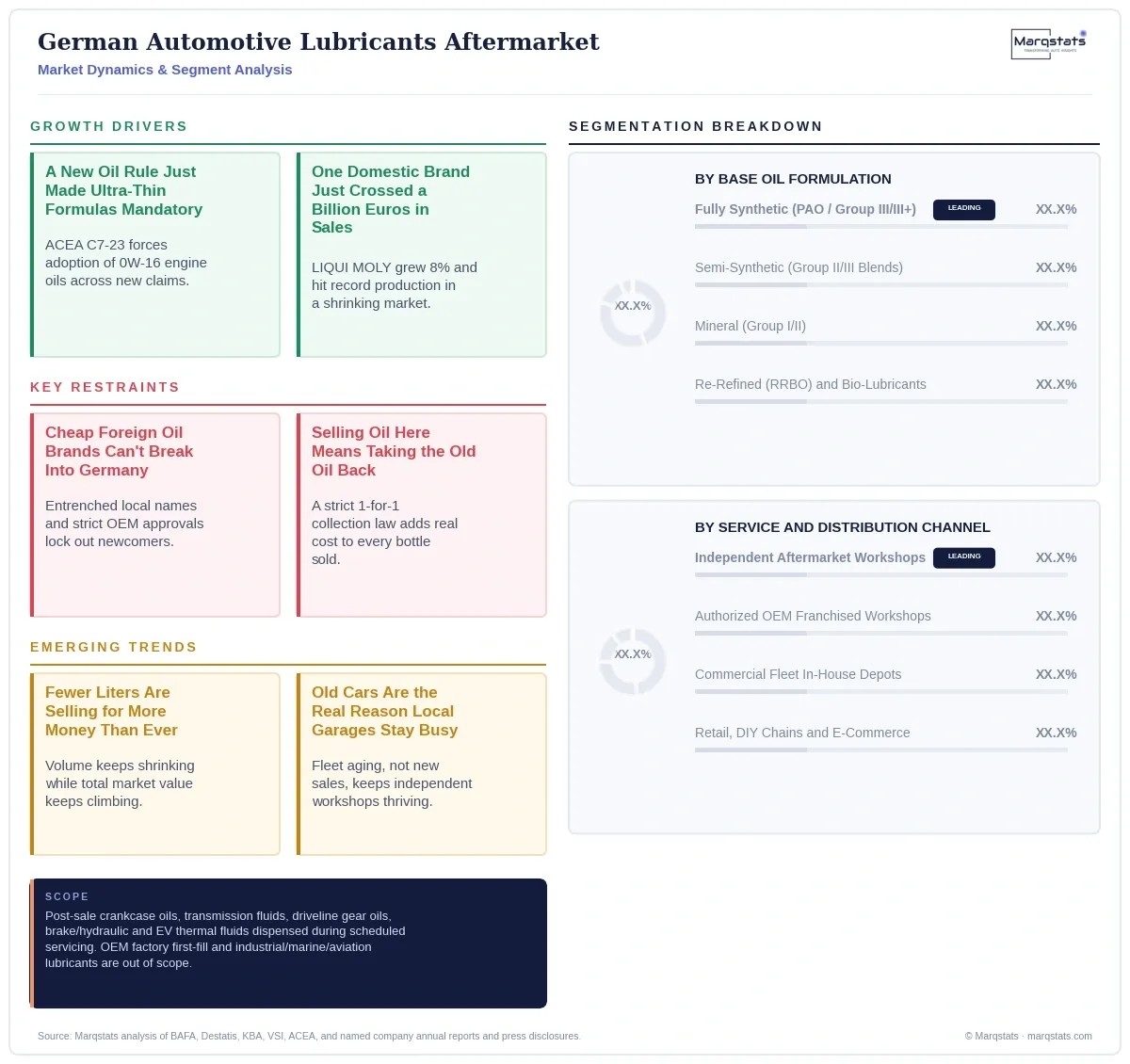
- Statutory ACEA sequences anchor baseline reformulation demand, exemplified by the ACEA 2023 Light-Duty Sequences becoming mandatory for all new commercial product claims on 1 August 2024, with legacy ACEA 2021 marketing claims expiring 1 August 2025, formally consolidating the shift toward low-SAPS chemistries compatible with gasoline particulate filters and diesel particulate filters and introducing ACEA C7-23 requirements for ultra-low viscosity SAE 0W-16 engine oils.
- Domestic blenders are scaling physical production capacity to meet both aftermarket and export demand, exemplified by LIQUI MOLY GmbH sustaining its 2024 momentum into 2025 with an 8.0% revenue increase to approximately €1,080.00 million and record production of 119,000 metric tonnes of oil, followed by the consolidation of its Meguin blending subsidiary and a capital investment program at Saarlouis targeting 160,000 metric tonnes of annual blending capacity.
- Heavy commercial freight demand demonstrates structural resilience against electrification pressure, exemplified by heavy-duty engine oil consumption declining by less than 1.0% annually along major transit corridors including the A1, A2 and A7, since technical hurdles facing electric commercial prime movers preserve diesel-dependent lubricant demand across Germany's export-oriented freight logistics economy.
- Circular economy mandates are directly expanding re-refined base oil demand, exemplified by the statutory preference for material re-refining over energetic incineration codified in Section 2 of the Altölverordnung, driving re-refined base oils and bio-lubricants from 21,000 metric tonnes (6.02% share) in 2025 toward 30,500 metric tonnes (9.43% share) by 2030, accelerated by Corporate Sustainability Reporting Directive Scope 3 greenhouse gas reporting requirements.
- Independent blenders are repositioning product portfolios toward electric vehicle thermal management, exemplified by ROWE Mineralölwerk realigning its corporate identity in January 2026 as a dual provider of advanced lubricants and dedicated EV and hybrid coolants, acknowledging the long-term volume trajectory while capturing early market share in high-voltage service applications.
Key Restraints
- The German aftermarket is heavily defended by established domestic brands with strong workshop recognition, notably LIQUI MOLY and FUCHS, combined with stringent OEM factory approval architectures including VW 508 00/509 00 and MB 229.52 that require capital-intensive testing regimens, making conventional price-competitive commodity mineral formulations an unviable strategy for prospective market entrants and foreign blenders.
- The Altölverordnung's mandatory 1:1 retail collection obligation, requiring physical lubricant vendors to accept used oil from end-consumers up to the exact volume sold, creates significant logistical and administrative hurdles for new market participants lacking established reverse-logistics contracts, structurally constraining Do-It-Yourself retail channel expansion to just 9.98% of aftermarket volume in 2025.
- Because the German vehicle parc combines an aging legacy fleet averaging 10.9 years with sophisticated modern powertrains, blenders must produce and warehouse a genuinely wide range of stock-keeping units, spanning legacy SAE 10W-40 and 5W-30 formulations to ultra-low viscosity 0W-16 and 0W-20 fluids compliant with ACEA C7-23 and F01-24, creating substantial inventory and formulation complexity relative to markets with more homogeneous fleet demographics.
- Demand for certified re-refined base oils is projected to consistently outpace domestic refining capacity as automotive blenders face expanding Scope 3 greenhouse gas reporting requirements under European Union directives, creating a genuine supply constraint that only facilities equipped with advanced catalytic hydroprocessing technology, such as PURAGLOBE in Zeitz, are currently positioned to address at scale.
Key Trends
- The divergence between the market's -1.49% physical volume compound annual growth rate and its considerably higher +1.27% value compound annual growth rate demonstrates that Germany's aftermarket expansion, unlike volume-driven markets, is now driven almost entirely by chemical premiumization toward synthetic and re-refined formulations rather than fleet growth.
- The consistency between the average passenger car age climbing to 10.9 years and independent aftermarket workshops capturing 48.01% of aftermarket volume, the largest single channel, demonstrates that fleet aging, not new vehicle sales trends, is the primary structural anchor sustaining Germany's independent workshop channel dominance as vehicles exit OEM warranty coverage.
- The finding that heavy-duty engine oil consumption declines by less than 1.0% annually along major transit corridors despite passenger car electrification accelerating indicates that commercial freight logistics, not passenger vehicles, represent the most volumetrically resilient segment of Germany's automotive lubricants aftermarket through 2030.
- The fact that LIQUI MOLY sustained 8.0% revenue growth to approximately €1,080.00 million in 2025 while the broader market experienced volumetric contraction demonstrates that individual branded blenders with strong workshop recognition can outperform aggregate market trends by capturing premiumization gains disproportionately relative to less-differentiated competitors.
- The statutory preference for material re-refining over energetic incineration codified in Section 2 of the Altölverordnung, combined with projected demand for certified re-refined base oils consistently outpacing domestic refining capacity, indicates that Germany represents a genuinely premier operational environment in Europe for circular economy specialists and base oil re-refining infrastructure investors specifically.
Strategic Implications
For a prospective market entrant or foreign blender, attempting to enter Germany with conventional, price-competitive commodity mineral or baseline synthetic formulations represents an unviable commercial strategy given entrenched domestic brand recognition and OEM approval architectures; commercial opportunity is restricted to niche, high-margin segments including specialized dielectric and immersion cooling fluids for electric drivetrains, and verified circular lubricants formulated with certified API Group III re-refined base stocks that enable corporate transport fleets to satisfy CSRD Scope 3 reporting mandates.
For an incumbent lubricant blender, managing operational bifurcation between contracting volume and premiumizing value requires prioritizing margin retention through deepening digital integration with wholesale automotive parts distributors including WM SE and LKQ Stahlgruber, automating bottling and batch-blending infrastructure to handle growing formulation complexity, and executing a dual-portfolio commercial model that uses strong cash generation from internal combustion engine oils to fund research and distribution agreements for dedicated electric vehicle thermal management fluids.
For a base oil re-refiner, circular economy specialist, or infrastructure investor, Germany represents a premier operational environment in Europe given the statutory preference for material re-refining over energetic incineration codified in the Altölverordnung, guaranteeing long-term domestic feedstock security; facilities equipped with advanced catalytic hydroprocessing technology to produce virgin-equivalent API Group III base oils hold a distinct advantage as lubricant blenders seek lower-carbon inputs to meet Product Carbon Footprint reduction targets.
Outlook
Base Case Scenario (Controlled Transition and Fleet Aging Compensation): 323,300 metric tonnes by 2030 (-1.49% five-year volume CAGR) and €2,610.00 million (+1.27% five-year value CAGR). This trajectory is anchored in battery electric vehicles expanding from 3.3% to approximately 10.5% of the passenger car fleet by 2030, counterbalanced by the secular aging of the remaining internal combustion fleet from 10.9 to 11.4 years, with older engines exhibiting higher mechanical clearances and top-up oil consumption preserving crankcase service events, while heavy-duty engine oil consumption declines by less than 1.0% annually along major transit corridors.
Downside Scenario (Accelerated Electrification and Fleet Scrappage): 297,500 metric tonnes by 2030 (-3.12% five-year volume CAGR) and €2,420.00 million (-0.25% five-year value CAGR). The specific trigger is the introduction of federal fleet renewal incentives (Abwrackprämie 2.0) or elevated municipal emission surcharges targeting pre-Euro 6 combustion vehicles, prematurely retiring older vehicles and reducing the average passenger fleet age to 10.2 years, combined with widespread availability of low-cost battery electric vehicles from European and Chinese OEMs accelerating BEV fleet penetration to 16.0% by 2030, alongside aggressive increases in the distance-based commercial vehicle toll incentivizing battery-electric heavy truck deployment.
Upside Scenario (Extended ICE Fleet Preservation and Synthetic Upcycling): 330,000 metric tonnes by 2030 (-1.08% five-year volume CAGR) and €2,720.00 million (+2.11% five-year value CAGR). The specific trigger is sustained consumer resistance to electric mobility driven by volatile household electricity tariffs, grid congestion, and steep residual value depreciation in the used BEV market, limiting BEV parc share to 7.5% by 2030 and pushing the average passenger car age past 12.0 years, while road freight volume grows in line with European transit demand and potential regulatory recognition of circular, re-refined synthetic lubricants under revised climate protection targets incentivizes fleets to utilize circular premium formulations.
Market Segmentation
Passenger Car Motor Oils represent the majority volume of aftermarket lubricant consumption, generating 182,900 metric tonnes (52.48% share) in 2025, contracting to 163,600 metric tonnes (50.60% share) by 2030 as PCMO volume faces the direct brunt of electrification drag while battery electric vehicles expand within the passenger fleet, offset by parc aging to 10.9 years and OEM specifications including VW 508 00/509 00 and BMW LL-17 FE+.
Heavy-Duty Motor Oils, accounting for 99,400 metric tonnes (28.52% share) in 2025, exhibit greater volume resilience, expanding to 29.32% share (94,800 metric tonnes) by 2030 due to heavy diesel freight logistics underpinning the German export economy and technical hurdles facing electric commercial prime movers, anchored by ACEA E8/E11/F01 and MB 228.51/228.61 specifications along trans-European freight corridors.
Transmission and driveline oils, including automatic transmission fluids, dual-clutch transmission fluids and axle gear oils, account for 45,400 metric tonnes (13.03% share) in 2025, supported by increasing multi-speed automatic and dual-clutch transmission penetration, while brake fluids, hydraulic suspension fluids and emerging dedicated electric-driveline thermal management coolants comprise the remaining 20,800 metric tonnes (5.97% share), the fastest-growing category by share as specialized dielectric immersed battery fluids expand.
Fully Synthetic (PAO / Group III/III+)
Independent aftermarket workshops (Freie Werkstätten) represent the largest channel, capturing 167,300 metric tonnes (48.01% share) in 2025, expanding to 49.80% share (161,000 metric tonnes) by 2030, benefiting directly from the aging car fleet as private vehicle owners transition servicing away from franchised dealerships to networks including Bosch Car Service, Auto-plus and Point S once vehicles pass the typical 2-to-4-year OEM warranty window.
Franchised OEM dealership workshops (Vertragswerkstätten) represent 94,000 metric tonnes (26.97% share) in 2025, contracting to 83,200 metric tonnes (25.73% share) by 2030, concentrating heavily on vehicles aged 0 to 4 years, commercial leasing fleets and complex late-model powertrains requiring documented OEM digital service records and factory-warranted fluid approvals.
Dedicated commercial fleet depots and haulage service workshops command 52,400 metric tonnes (15.04% share) in 2025, expanding to 51,100 metric tonnes (15.81% share) by 2030, procuring lubricants in bulk road tankers and intermediate bulk containers directly from major blenders or regional mineral oil wholesalers to service freight haulage, bus transit and municipal utilities.
By Geography
North Rhine-Westphalia
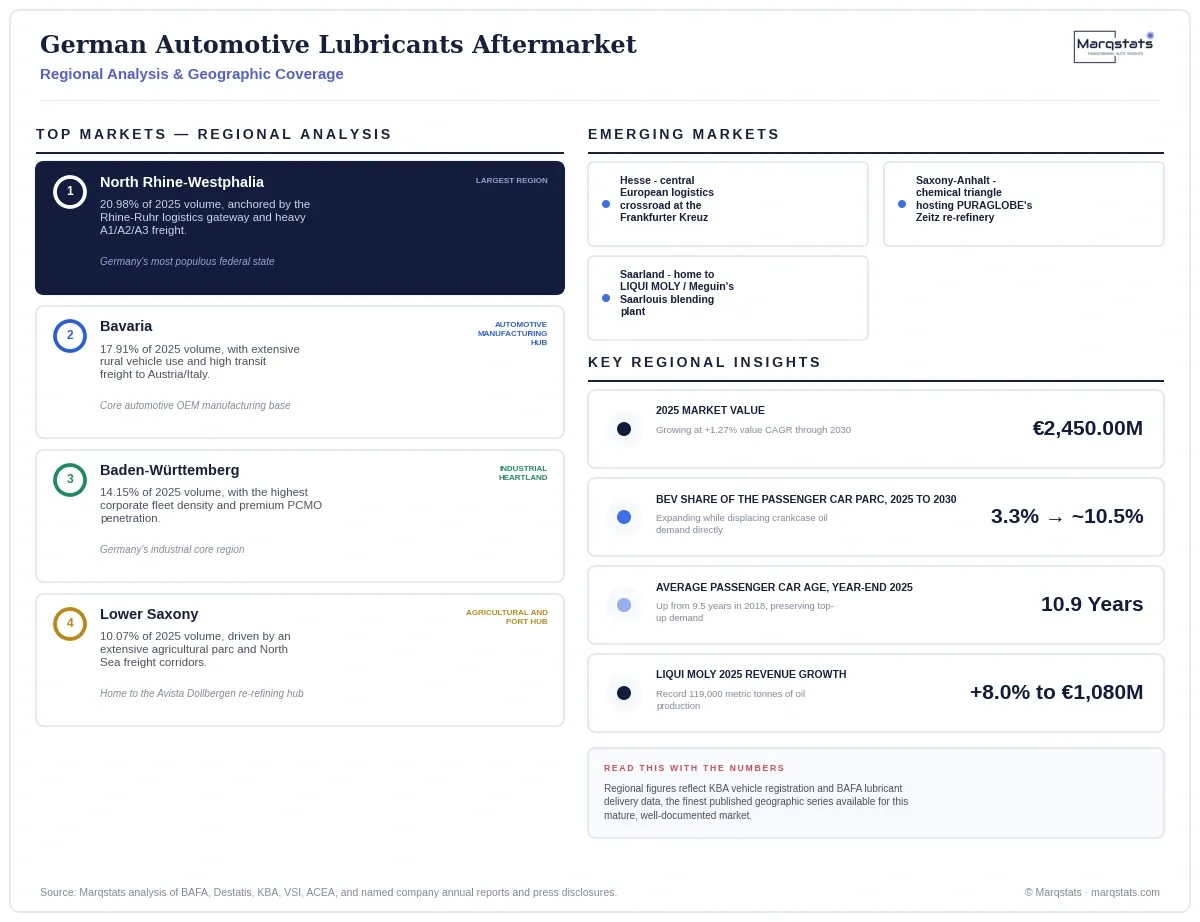
North Rhine-Westphalia represents Germany's largest regional market, generating 73.10 kt (20.98% share) in 2025, anchored by the nation's highest population, the Rhine-Ruhr logistics gateway, and heavy freight demand along the A1, A2 and A3 corridors.
Bavaria
Bavaria accounts for 62.40 kt (17.91% share) in 2025, serving as Germany's automotive manufacturing hub with extensive rural vehicle use and high transit freight volumes toward Austria and Italy.
Baden-Württemberg
Baden-Württemberg generates 49.30 kt (14.15% share) in 2025, concentrating the nation's industrial heartland, highest corporate fleet density and premium PCMO penetration among major German regions.
Lower Saxony
Lower Saxony accounts for 35.10 kt (10.07% share) in 2025, characterized by an extensive agricultural vehicle parc and North Sea port freight corridors along the A7 and A27, home to the Avista Dollbergen re-refining hub.
Hesse
How Competition Is Evolving
Hesse generates 27.20 kt (7.81% share) in 2025, functioning as a central European logistics crossroad anchored around the Frankfurter Kreuz and A5/A3 corridors, hosting a major air and road cargo interface.
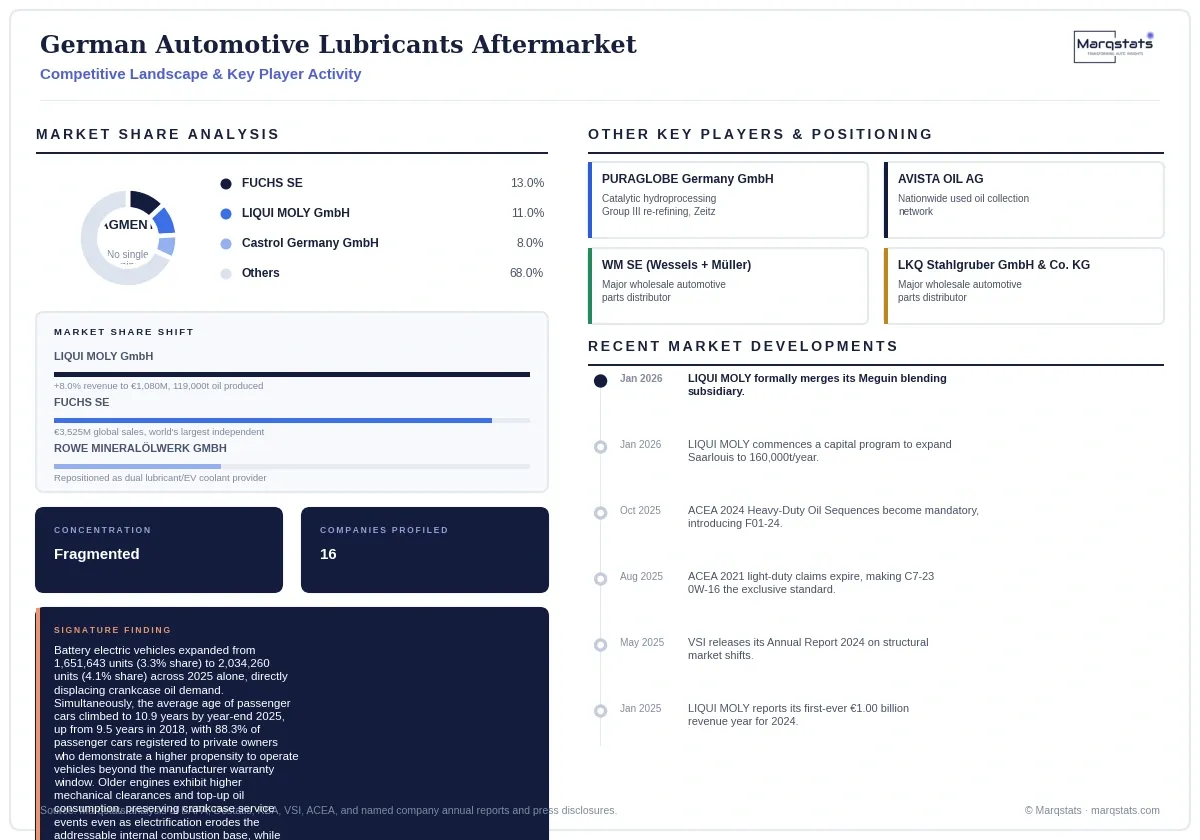
The German automotive lubricants aftermarket features a blend of domestic independent specialists, global integrated oil majors and specialized re-refiners, with no single vendor commanding dominant share; FUCHS SE, headquartered in Mannheim, stands as the world's largest independent lubricant manufacturer, generating global sales revenues of €3,525.00 million in 2024, while LIQUI MOLY GmbH, based in Ulm, holds the branded market share leadership within German independent workshop and retail channels, surpassing €1.0 billion in sales revenue for the first time in 2024 before growing a further 8.0% to approximately €1,080.00 million in 2025.
Firms compete differently by tier: global integrated majors including Castrol and Shell compete on OEM franchised dealership relationships and factory-approved formulations, domestic independent specialists including LIQUI MOLY, FUCHS and ROWE compete on workshop brand recognition and technical differentiation, exemplified by ROWE Mineralölwerk repositioning its corporate identity toward dedicated EV and hybrid coolants in January 2026, and base oil re-refiners including PURAGLOBE and AVISTA OIL compete on certified circular feedstock security under the statutory Altölverordnung.
The most significant recent competitive-landscape development is LIQUI MOLY GmbH's formal consolidation of its Meguin GmbH & Co. KG blending subsidiary effective 1 January 2026, integrating corporate legal structures and establishing a single balance sheet, paired with the commencement of a capital investment program at its Saarlouis site to expand finished lubricant blending throughput capacity to 160,000 metric tonnes per year, demonstrating that domestic German blenders are leveraging automated domestic infrastructure to supply both the domestic aftermarket and expanding export volumes.
Companies Covered
Companies covered in the report include:
Recent Market Activity
Table of Contents
Coverage & Segmentation
Coverage spans the German automotive lubricants aftermarket on a service-fill basis, encompassing all post-sale lubricants and functional automotive fluids dispensed during scheduled servicing, preventative maintenance, inspection intervals, and fluid top-ups across the operational lifetime of motorized road vehicles. The market is sized in metric tonnes and EUR/USD million across a 2021-2025 historical period and a 2026-2030 forecast period, with 2025 as the base year. Three segmentation dimensions are quantified: product category, base oil formulation, and service and distribution channel.
Excluded from scope: OEM factory first-fill lubricants delivered directly to domestic assembly plants, general industrial lubricants, process oils, and bunker lubricants. A separate Marqstats study addresses the global automotive lubricants aftermarket on a comparable basis.
