Market Snapshot
Middle bar: base-year value × (1 + CAGR), rounded to two decimals. This is a calculated illustration, not a separately researched annual estimate.
Market Size (2025, Base Year): USD 1,185.38 Million (EUR 1,097.57 Million, Wholesale)
Estimated Value (2026): USD 1,210.90 Million
Forecast Value (2030): USD 1,314.52 Million
CAGR: 2.09% | Forecast Period: 2026 – 2030
Growth — Absolute: USD 129.14 Million
Physical Volume: 194,621 Tonnes (2025) to 189,812 Tonnes (2030), Volume CAGR -0.50%
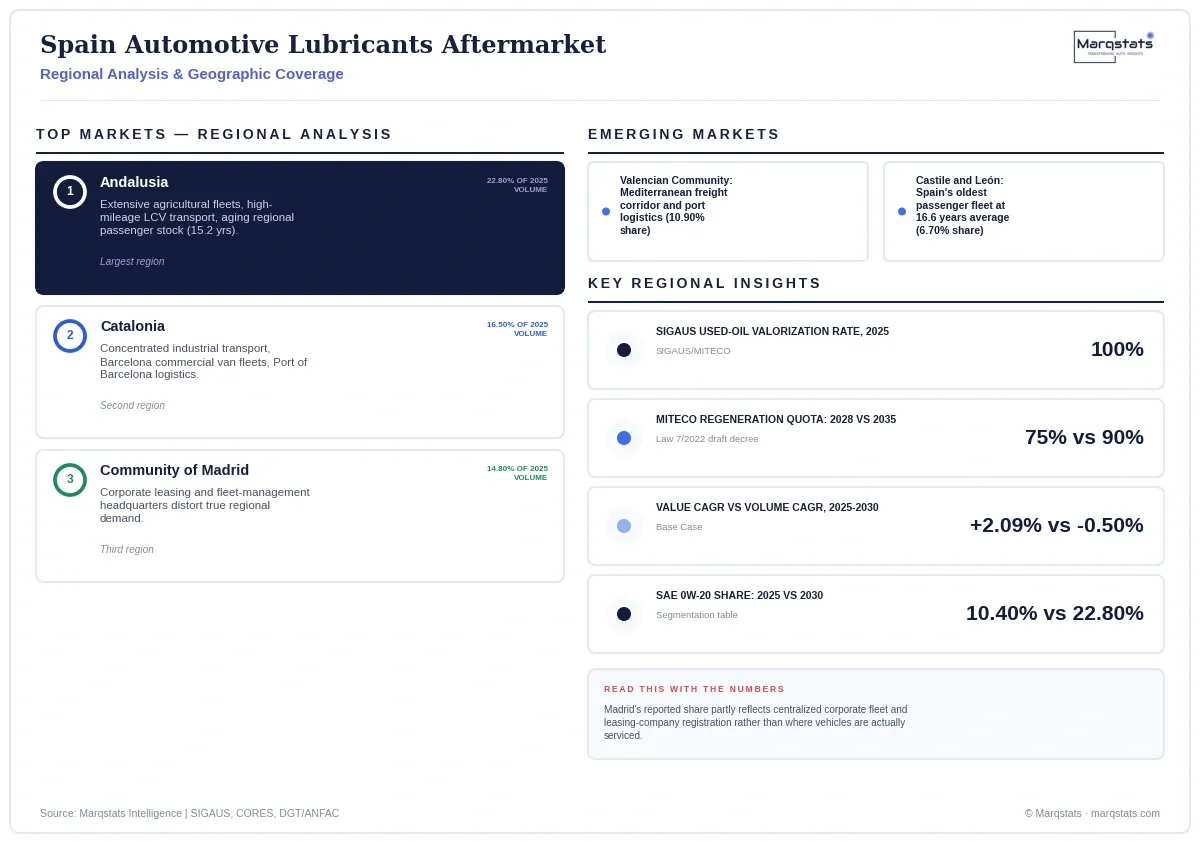
Largest Market: Andalusia (22.80% of 2025 volume)
Fastest Growing: SAE 0W-20 (10.40% to 22.80% share, 2025-2030)
Dominant Segment: SAE 5W-30 (44.50% of 2025 volume)
Market Concentration: Moderately Concentrated (Repsol Leads at 24.80%)
Base Year: 2025 | Historical Period: 2021 – 2025 | Forecast Period: 2026 – 2030
Units Considered: Value (USD Million)
Segments Covered: 2 | Regions Covered: 8 | Companies Profiled: 8
Report Pages: 165 | Deliverables: PDF, Excel, PPT
Key Takeaways
Market Overview & Analysis
Report Summary
Spain's lubricants aftermarket is anchored by one of the oldest vehicle fleets in Western Europe and a circular-economy regime that already recovers every litre of used oil it collects, with a binding new quota about to push that system further.
The analysis measures the wholesale value of engine oils, driveline fluids, gear lubricants, brake fluids and chassis greases bought for aftermarket servicing: USD 1,185.38 million in 2025. It excludes OEM factory first-fill.
The monetary sizing chain traces to a source Marqstats could not independently verify; this is disclosed prominently below and in the accompanying verification log, not omitted.
The analysis is written for four readers: a blender deciding how fast to build regenerated base stock into its formulations ahead of MITECO's 2028 quota, a distributor managing SKU proliferation from viscosity bifurcation, a workshop group budgeting for eSIR digital waste tracking, and an investor tracking three forward scenarios.
Spain's combination of an unusually old vehicle fleet, a fully operational circular-economy collection system, and binding new regeneration law makes it a useful case study for how a mature European aftermarket can grow in value while its physical footprint quietly shrinks.
A Circular Economy Already at 100%, About to Get a Binding Floor
Spain's used-oil recycling system does not need to be built. It needs to be redirected toward a higher-value outcome, and a new decree just made that mandatory.
SIGAUS collected 153,589 tonnes of used oil across 66,000 generation points in 2025 and valorized all 137,557 net tonnes after removing water and sediment, a 100% rate. But only 72.8% of that volume, 100,110 tonnes, went to re-refining into new base oil; the remainder was converted to industrial fuel for cement, lime and paper kilns, a lower-value outcome than regeneration. MITECO's draft Royal Decree under Law 7/2022 replaces the old non-binding preference for recycling with hard numbers: 75% of treated waste oil must become regenerated base oil by 2028, 80% by 2030, 90% by 2035. That is a direct mandate to domestic re-refiners like Cator in Catalonia and Ecolube in Madrid to expand hydrofinishing capacity, and a direct signal to blenders that regenerated Group II/III base stock is becoming a supply-chain necessity, not a marketing differentiator.
Hybrid Engines Are Harder on Oil Than the Combustion Engines They Replace
Electrification is often framed as simplifying lubricant demand. In the hybrid segment specifically, it does the opposite.
Nearly 20% of new Spanish vehicle registrations in 2025 were hybrids, and their duty cycle is genuinely harder on engine oil than a standard combustion engine's. Under urban driving, the internal combustion engine in a hybrid cycles on and off repeatedly, often failing to reach the 85°C to 105°C sump temperature a conventional engine holds continuously. That incomplete warm-up traps unburned fuel and moisture in the crankcase, accelerating oxidation, acid buildup and emulsion sludge formation. Instantaneous load transfers, a cold engine firing abruptly under full throttle at a highway on-ramp, generate acute boundary-lubrication stress the oil film has to survive with no warm-up runway. Blenders have responded with dedicated chemistry: Moeve's XTAR MAX HYBRID line and TotalEnergies' Quartz Ineo Xtra Dynamics 0W-20 both use balanced ZDDP packages and ashless anti-wear compounds specifically tuned against low-speed pre-ignition and fuel dilution, formulations a standard combustion-engine 0W-20 was never designed to handle.
A Fleet Old Enough to Buffer Against Any Single Bad Year
Spain's aftermarket has a structural stabilizer most younger vehicle markets lack: age itself.
The circulating fleet reached 34,723,151 vehicles at end-2025, averaging 14.42 years old across all vehicle classes; passenger cars alone average 14.60 years, and 64.3% of the passenger parc is older than 10 years. Older engines run wider mechanical clearances and higher oil consumption between scheduled changes, which sustains continuous top-up demand largely independent of new-car sales cycles or economic conditions. Heavy commercial vehicles show the same pattern even more starkly: 32.8% of trucks exceed 20 years in service, and their 30-to-45-litre crankcases combined with high annual mileage sustain heavy-duty oil demand even through freight downturns.
A Fleet Splitting Into Two Viscosity Worlds at Once
Spain's lubricants market is not transitioning from one dominant viscosity grade to another. It is bifurcating into two permanent, coexisting product families.
SAE 5W-30 remains the core volume grade, though its share is projected to fall from 44.50% to 38.20% by 2030 as ultra-low-viscosity SAE 0W-20 more than doubles its share, from 10.40% to 22.80%, driven by Stellantis, Volkswagen Group and Mercedes-Benz factory specifications on newer platforms. At the other end, legacy 10W-40 and 5W-40 grades persist for the aging portion of the fleet lacking particulate filters. For distributors and independent workshop buying groups, this means permanent SKU proliferation rather than a one-time product transition, forcing dedicated dispensing equipment to prevent cross-contamination between low-SAPS and high-SAPS fluid families on the same shop floor.
Two Refiners Competing on Opposite Integration Models
Spain's two largest lubricant sellers reach the same independent-workshop shelf through structurally different supply chains, and both are scaling.
Repsol built its 24.80% lead on domestic blending integration, running plants in Puertollano and Cartagena and distributing through more than 3,000 of its own service stations, giving it direct control from base oil to retail pump. Moeve, formerly Cepsa, takes a similar integrated path but through a different asset: its blending complex sits inside the Gibraltar-San Roque refinery in Cádiz, tying lubricant production directly to its broader energy-transition strategy rather than a standalone retail network. Both approaches converge on the same conclusion this market rewards: owning the supply chain from crude to crankcase captures more margin than competing purely on finished-product brand strength, which is exactly why Castrol and TotalEnergies, the next two largest players, instead lean on OEM factory-fill partnerships (Volkswagen, Ford, Chery for Castrol; Stellantis for TotalEnergies) to secure volume they cannot win through domestic refining scale alone.
A Distribution Layer Built Specifically to Beat SKU Proliferation
Viscosity bifurcation would overwhelm a typical independent workshop's storage capacity if the wholesale layer did not exist specifically to absorb that complexity.
AD Parts, the dominant Independent Aftermarket purchasing group on the Iberian Peninsula, operates a dedicated packaging and chemical centre in Girona capable of handling more than 24 million litres of lubricant a year, marketing its own AD-branded product line alongside Tier-1 oil major brands under one catalogue. Rival buying groups, Groupauto Unión Ibérica's EuroTaller and Top Car concepts, CGA Red de Talleres' Multitaller and Auto Taller, and Nexus-affiliated Group Serca, provide the same function regionally: two-to-four-hour delivery of the specific low-viscosity fluid a given workshop needs that day, rather than requiring each independent garage to warehouse every SKU itself. This wholesale layer is what makes viscosity bifurcation commercially survivable for a small, independent operator.
The Regeneration Target Was Set Because the Old Rule Had No Teeth
Spain's previous used-oil rule was not silent on regeneration. It simply never made regeneration mandatory, and the industry's own energy-recovery habits show what a non-binding preference actually produces in practice.
Under the outgoing Real Decreto 679/2006, recycling was preferred over energy recovery in principle, with no binding penalty structure attached. In practice, only 72.8% of Spain's net-collected used oil in 2025 was directed to re-refining; the remainder was converted to Fuel BIA, a lower-sulfur industrial fuel burned in cement, lime and paper kilns, a use that destroys the oil's molecular value rather than recovering it. The new MITECO framework under Law 7/2022 replaces the soft preference with hard, escalating quotas, 75% by 2028, 80% by 2030, 90% by 2035, precisely because a preference without a binding number left nearly 30 percentage points of value-destroying combustion as the path of least resistance for waste-oil handlers. The gap between what the old rule allowed and what the new one requires is itself a measure of how much regenerated base-oil supply is about to enter the market that would not have otherwise.
Trucks and Buses Show the Same Ageing Pattern Spreading Beyond Passenger Cars
Spain's ageing-fleet story is usually told through passenger cars, but the same mechanical logic is playing out, arguably more sharply, in commercial vehicles.
Heavy commercial vehicles average 15.0 years, and 32.8% of operating trucks exceed 20 years in service, a figure that outpaces the passenger car ageing rate. Combined with crankcase capacities of 30 to 45 litres per vehicle, well beyond a passenger car's 4-to-6-litre sump, and sustained high annual mileage even through freight downturns, this segment anchors heavy-duty engine oil demand against exactly the kind of macroeconomic pressure that might otherwise be expected to suppress it. ANFAC itself has flagged the consequence bluntly: at the current fleet-renewal pace, Spain will not meet EU decarbonization targets for industrial vehicles until 2075, a full 45 years past the nominal target horizon, which in aftermarket terms means heavy-duty diesel formulations remain a structural, multi-decade demand category rather than a transitional one.
Why the DIY Channel Stays Small in a Market This Price-Sensitive
A market with a 14-year-old average fleet and clear cost pressure on maintenance spending would normally see a healthy do-it-yourself channel emerge to undercut workshop labour charges. In Spain, that channel stays capped at 6.0% of volume, and the reason is regulatory rather than economic.
Hazardous waste rules prohibit uncertified handling and disposal of used motor oil, which means a private individual changing their own oil at home has no legal, convenient way to dispose of the spent fluid the way a workshop routed through SIGAUS's collection network can. That single structural constraint, not price or convenience, is what keeps hypermarket and online fluid-only sales a minority channel even in a market with every other incentive pointing toward lower-cost self-service maintenance. As digital eSIR waste tracking tightens further, this gap is more likely to widen than close, reinforcing the independent workshop's position as the default destination for anyone outside the franchised dealer network.
Market Dynamics
Key Drivers
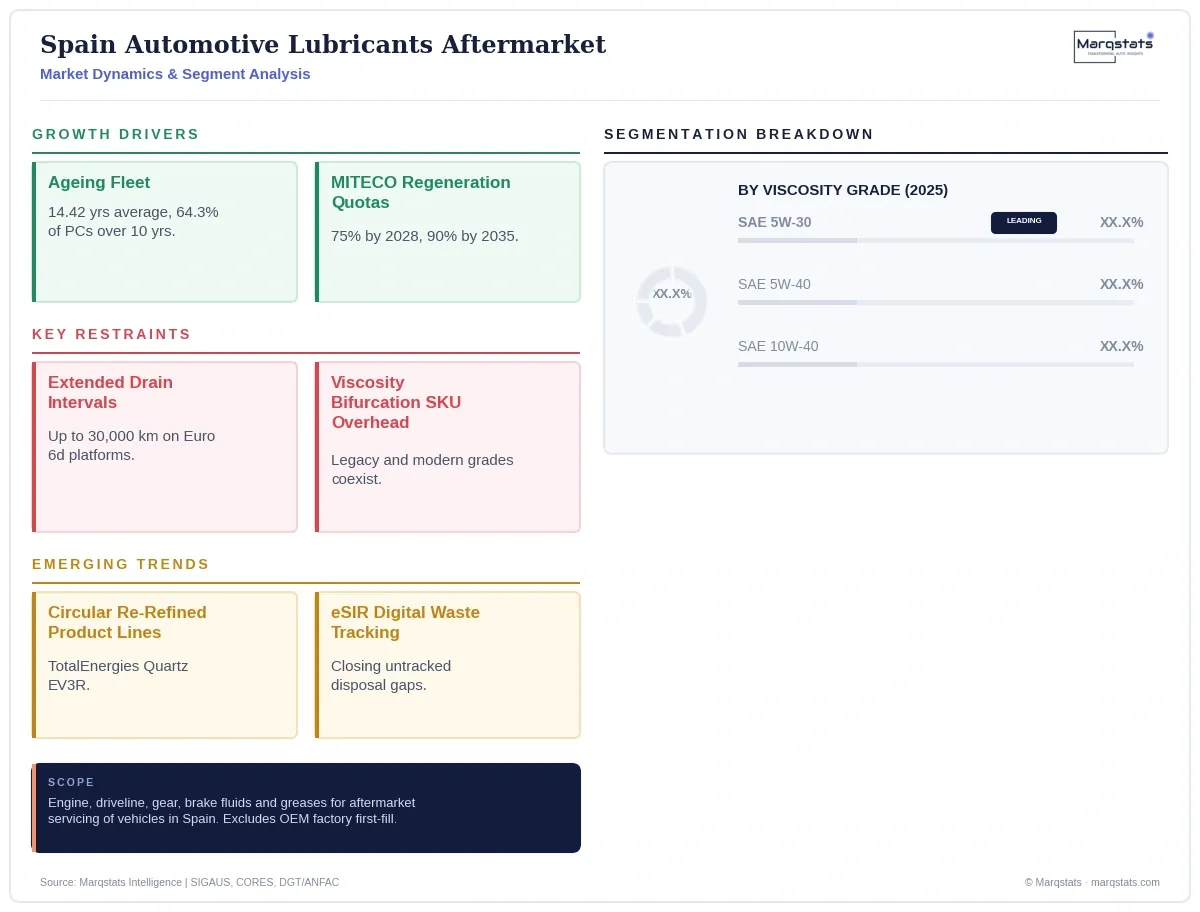
- An ageing fleet, averaging 14.42 years with 64.3% of passenger cars past 10 years old, sustains continuous top-up demand largely independent of economic cycles, a dynamic that extends even more sharply into the heavy commercial vehicle segment.
- MITECO's escalating regeneration quotas (75% by 2028, rising to 90% by 2035) are making regenerated base stock a supply-chain necessity rather than an optional circular add-on, a shift the industry's own pre-quota re-refining rate of 72.8% shows was already underway.
- Hybrid vehicle growth is driving demand for dedicated anti-wear, anti-dilution synthetic formulations that a standard combustion-engine oil cannot substitute for, given the repeated cold-start cycling that urban hybrid duty imposes on the crankcase.
- Euro 6d-ISC-FCM and upcoming Euro 7 emissions mandates are accelerating the shift toward ultra-low-viscosity 0W-20 and 0W-30 grades on new platforms.
- SIGAUS's universal, uniform-cost collection coverage across urban and rural Spain sustains high compliance and feedstock availability for domestic re-refiners.
Key Restraints
- Extended oil-drain intervals on modern Euro 6d platforms (20,000 to 30,000 km) structurally cap physical volume growth even as the fleet remains large.
- Gradual BEV fleet penetration, though currently a small share of the parc, will progressively remove crankcase oil demand from the newest vehicle cohort.
- Viscosity bifurcation between legacy and modern grades increases SKU count and warehousing overhead for distributors and workshops alike.
- Strict domestic hazardous-waste regulations constrain the DIY retail channel to just 6.0% of volume, limiting a low-cost distribution route some other markets rely on more heavily.
Key Trends
- Circular product lines formulated with regenerated base stocks, such as TotalEnergies' Quartz EV3R series, are moving from a marketing niche toward a mainstream requirement.
- Digital waste tracking via MITECO's eSIR system is closing gaps in untracked used-oil disposal and forcing workshops to log fluid batch origins electronically.
- Packaging is shifting from single-use containers toward returnable 208-litre drums and bag-in-box formats under Extended Producer Responsibility rules for commercial packaging.
- Automated lubricant look-up engines are being integrated into workshop software to prevent chassis-specific fluid misapplication as OEM specifications proliferate.
Strategic Implications
- Blenders should secure early joint ventures with domestic re-refiners to lock in regenerated Group II/III base stock supply ahead of the 2028 mandatory quota, and should direct R&D toward hybrid-specific formulations that command margin protection against private-label competition, particularly given how much further the regeneration requirement still has to climb by 2035.
- Distributors and IAM buying groups should manage slower-moving legacy grades through bulk private-label packaging while concentrating capital on rapid fulfillment of OEM-approved synthetic fluids, and should integrate automated fluid look-up tools into workshop software to reduce chassis-specific misapplication risk as OEM specifications keep multiplying.
- Independent workshops should modernize dispensing equipment to prevent cross-contamination between low-SAPS and high-SAPS fluid families, and should upgrade waste-oil storage ahead of mandatory eSIR digital tracking, since retrofitting a non-compliant storage tank after enforcement begins costs more than upgrading proactively.
- Investors should track MITECO regeneration-quota enforcement and EU ETS II carbon pricing implementation from 2027, the two triggers separating the three forecast scenarios, and should treat the monetary sizing figures here with the caution disclosed in the evidence section pending independent verification of the underlying source.
Outlook
The underlying research presents three scenarios tied to named fleet-renewal and decarbonization triggers.
Under the Base Case, the fleet remains structurally aged (average passenger car age 14.5 to 14.8 years), new registrations recover moderately (1.15 to 1.25 million units), and BEVs stay under 10% of new sales through 2028. Volume contracts to 189,812 tonnes, a -0.50% CAGR, while value reaches USD 1,314.52 million (EUR 1,217.15 million), a 2.09% CAGR.
Under the Upside scenario, fleet stagnation and extended lifecycle maintenance push average car age beyond 15.5 years as the MOVES subsidy programme lapses without replacement. Volume reaches 191,500 tonnes, a -0.32% CAGR, and value reaches USD 1,428.60 million (EUR 1,322.78 million), a 3.80% CAGR, as higher additive costs and premium synthetic top-up fluids drive realization.
Under the Downside scenario, accelerated BEV cost declines push pure electrics above 30% of new registrations by 2028, EU ETS II carbon pricing on transport fuels begins in 2027, and municipal Low Emission Zones accelerate pre-Euro 4 scrappage. Volume contracts to 180,200 tonnes, a -1.53% CAGR, and value growth slows to USD 1,232.10 million (EUR 1,140.83 million), a 0.78% CAGR.
Market Segmentation
44.50% of 2025 volume, moving to 38.20% by 2030.
18.20% of 2025 volume, moving to 12.50% by 2030.
12.80% of 2025 volume, moving to 7.60% by 2030.
10.40% of 2025 volume, moving to 22.80% by 2030.
5.80% of 2025 volume, moving to 9.40% by 2030.
0.80% of 2025 volume, moving to 3.50% by 2030.
7.50% of 2025 volume, moving to 6.00% by 2030.
57.5% of aftermarket volume.
23.5% of aftermarket volume.
13.0% of aftermarket volume.
6.0% of aftermarket volume.
By Geography
Andalusia
44,374 tonnes (22.80% share) in 2025.
Catalonia
32,112 tonnes (16.50% share) in 2025.
Community of Madrid
28,804 tonnes (14.80% share) in 2025.
Valencian Community
21,214 tonnes (10.90% share) in 2025.
Galicia
14,013 tonnes (7.20% share) in 2025.
Castile and León
13,040 tonnes (6.70% share) in 2025.
Basque Country
10,704 tonnes (5.50% share) in 2025.
Rest of Spain
30,360 tonnes (15.60% share) in 2025.
Registration Distortion
The Community of Madrid represents more than 20% of new vehicle sales and official fleet registrations due to the concentration of major vehicle leasing firms, car-sharing companies and corporate fleets headquartered in the capital, even though a substantial portion of actual mechanical servicing occurs across regional highway corridors and secondary workshops elsewhere in Spain.
How Competition Is Evolving
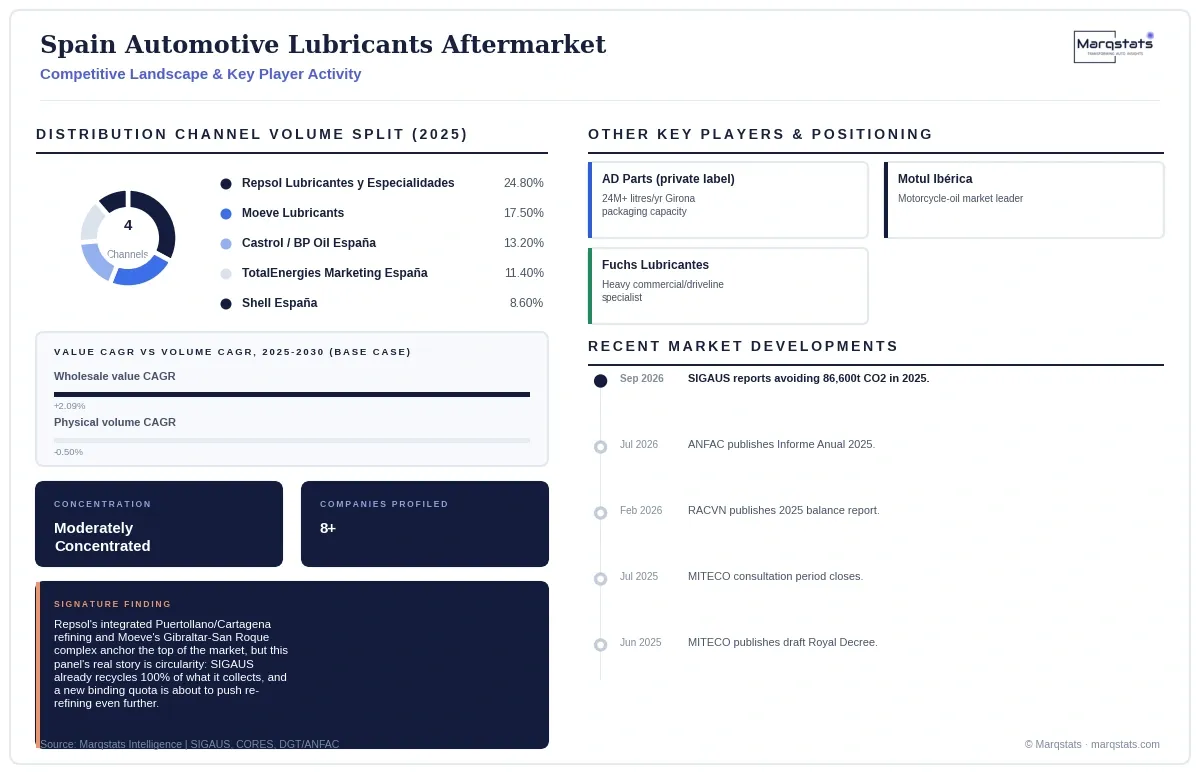
Repsol Lubricantes y Especialidades leads the market with 24.80% of aftermarket volume, operating domestic blending facilities in Puertollano (Ciudad Real) and Cartagena (Murcia) under the Repsol Elite, Master and Leader brands, backed by more than 3,000 service stations and OEM factory-fill relationships.
Moeve Lubricants (formerly Cepsa, rebranded in late 2024) holds 17.50% share, operating an integrated base-oil and blending complex at the Gibraltar-San Roque refinery in Cádiz, distributing its XTAR and XTAR MAX HYBRID lines through its proprietary Talleres de Confianza network.
BP Oil España/Castrol Iberia holds 13.20% share, focused on premium passenger car motor oils with OEM alliances including Volkswagen Group, Ford and Chery Auto; TotalEnergies Marketing España holds 11.40%, anchored by its Valdemoro (Madrid) blending facility and a strategic Stellantis partnership, and leads in circular re-refined formulations through its Quartz EV3R line.
Shell España holds 8.60% share via GTL synthetic technology; the remainder splits between AD Parts' private-label operation (6.80%, the largest IAM private label with a Girona packaging centre exceeding 24 million litres annual capacity), Motul Ibérica (4.20%, motorcycle-oil leader), Fuchs Lubricantes (3.80%, heavy commercial and driveline specialist), and other independent blenders including Olipes and Krafft.
Companies Covered
Companies covered in the report include:
Recent Market Activity
Table of Contents
Coverage & Segmentation
The analysis measures service-fill crankcase engine oils, transmission and driveline fluids, gear lubricants, hydraulic brake fluids and chassis greases bought for aftermarket servicing of vehicles in Spain, for a 2025 base year and a 2026 to 2030 forecast, in United States dollars and euros at the European Central Bank reference rate of 1.0800 USD per EUR. OEM factory first-fill is excluded.
The analysis covers two segmentation dimensions, viscosity grade and distribution channel, a 17-Autonomous-Community regional split (eight rows shown, remainder grouped), and eight profiled entities. The monetary sizing chain carries a sourcing flag; physical volume, competitive shares and regional splits do not. See the verification log for full disclosure.