Market Snapshot
Key Takeaways
Market Overview & Analysis
Report Summary
The global automotive metal stamping market comprises press-based forming of steel and aluminum sheet into body panels, structural reinforcements, and chassis components for passenger cars and light commercial vehicles. This study segments the market by process, material, and vehicle type, with a 2025 base year, historical coverage from 2021 to 2025, and forecasts to 2030. Market size is stated as stamped-component revenue in United States dollars, covering parts sold to automotive OEMs and Tier-1 assemblers rather than stamping press equipment sales.
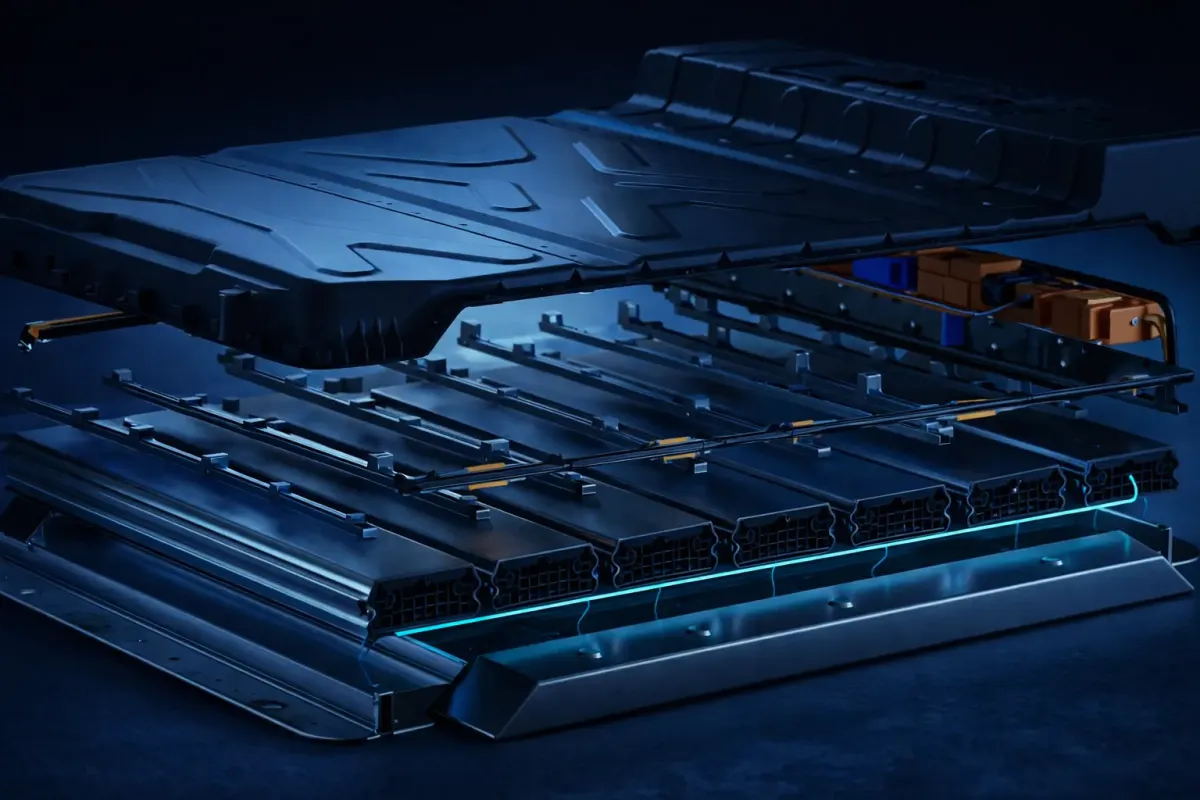
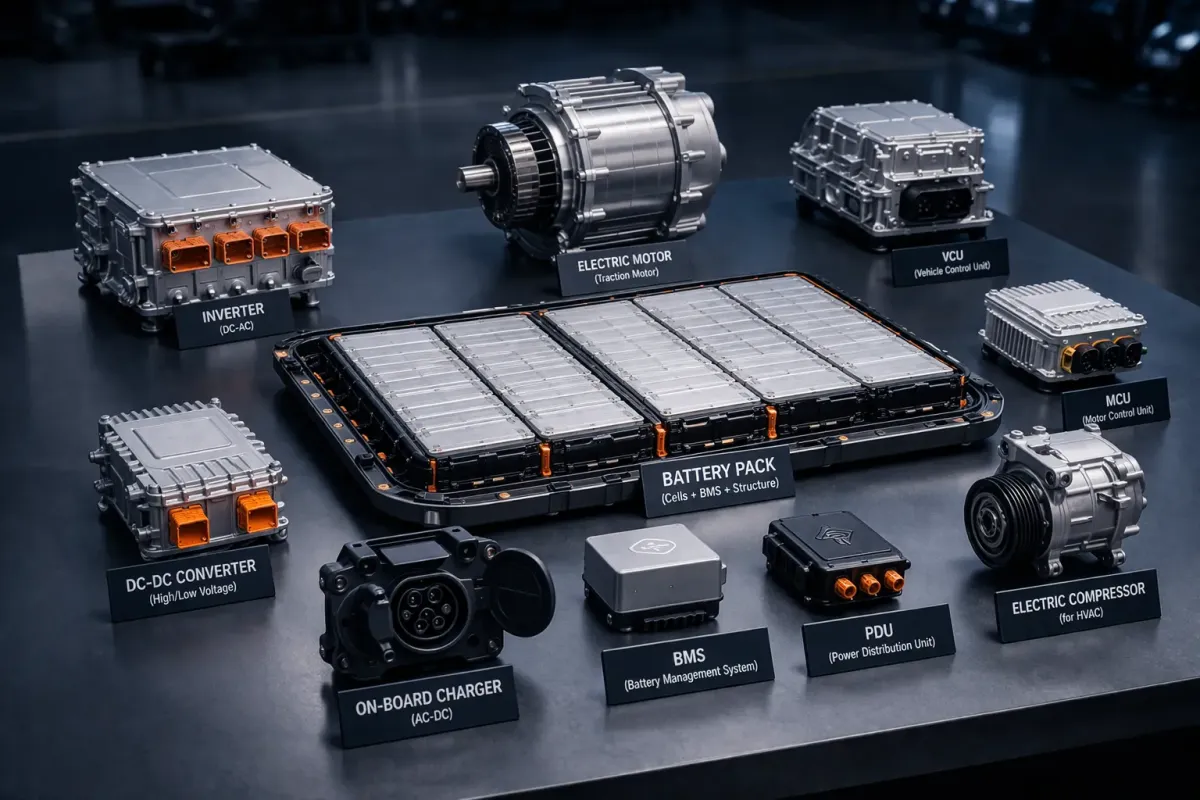
Demand for stamped components tracks global vehicle production closely, since nearly every vehicle body and chassis architecture relies on stamped sheet-metal parts regardless of propulsion type. This makes automotive metal stamping one of the more production-volume-correlated categories within Marqstats' automotive component coverage, in contrast to categories tied more closely to feature adoption or technology-mix shift. Electric vehicles introduce an incremental stamped-component category, battery enclosures and structural trays, without eliminating the body-panel and chassis stamping demand common to internal-combustion vehicles, making EV production growth additive to rather than a substitute for existing stamping demand. A typical electric vehicle requires broadly comparable body-panel stamping content to an equivalent internal-combustion model, plus the incremental battery enclosure and tray content specific to its powertrain architecture, meaning the stamping industry's total addressable content per vehicle is, if anything, expanding through the industry-wide shift toward electrification rather than contracting.
Material mix shift toward advanced high-strength steel and aluminum is reshaping supplier economics more than it is reshaping unit volumes, since these materials command higher per-part revenue and require different tooling and press specifications than conventional mild steel. Suppliers that have invested in aluminum and hot-stamping capability are capturing disproportionate value growth relative to unit growth, a pattern consistent with the broader premiumisation and lightweighting trend running through global vehicle architecture over the past decade.
The competitive structure of this market is closely tied to vehicle assembly plant geography, since stamped components, particularly large body panels, are costly and impractical to ship long distances and are typically produced within a limited radius of the assembly plant they supply. This proximity requirement means stamping capacity investment decisions follow OEM assembly plant location decisions closely, and a supplier's regional footprint is often as important a competitive asset as its process or material capability. Smaller stampers producing lower-value, high-volume commodity parts face the tightest margin pressure in the industry, while suppliers with advanced-material and hot-stamping capability, or with in-house tool-and-die design, are better positioned to compete on capability rather than price alone.
Market Dynamics
Key Drivers
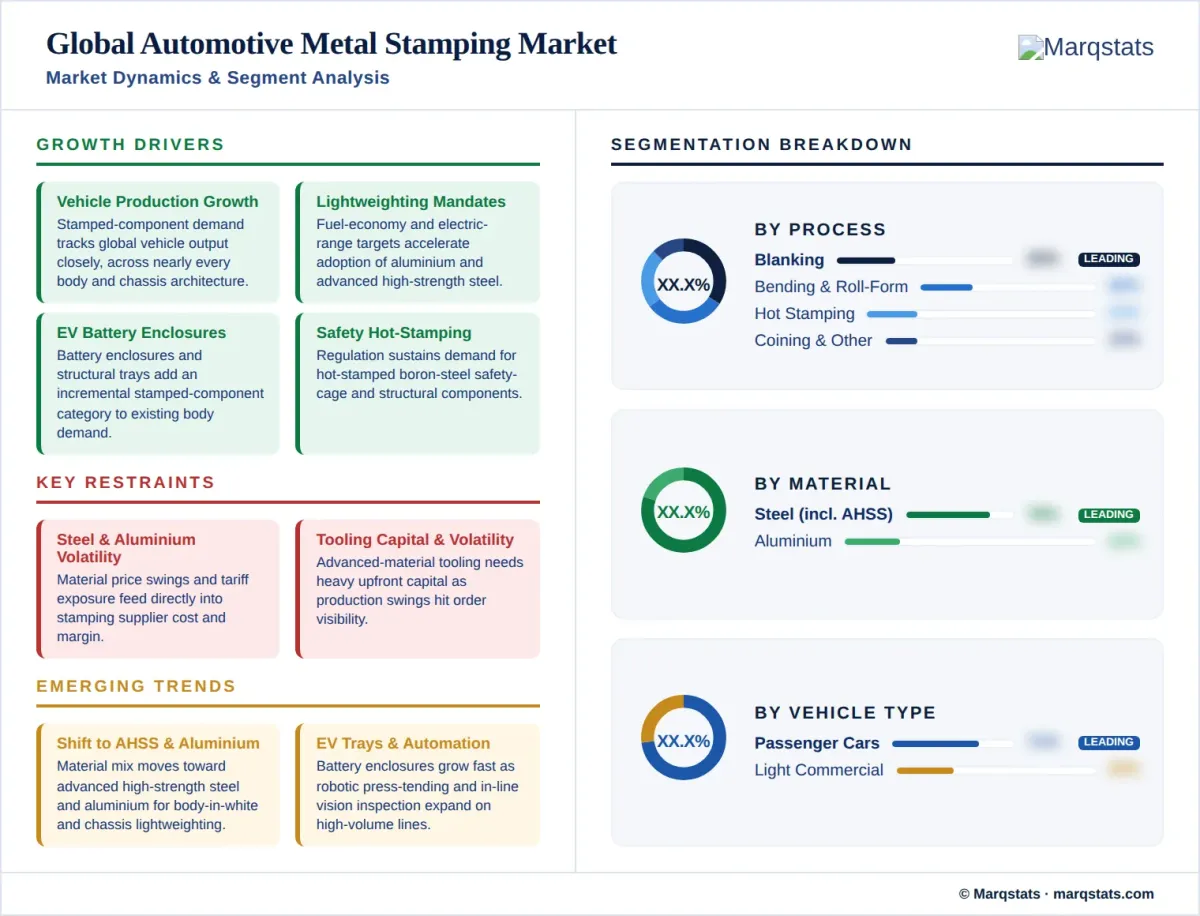
- Global vehicle production growth directly drives stamped-component demand across nearly every vehicle architecture.
- Fuel-economy and electric-vehicle range targets are accelerating adoption of lightweight aluminum and advanced high-strength steel.
- Electric vehicle battery enclosure and structural tray production has introduced an incremental stamped-component demand category.
- Automation and robotic press-tending investment is improving throughput and consistency across high-volume stamping operations.
- Safety regulation is sustaining demand for hot-stamped boron steel components in structural and safety-cage applications.
Key Restraints
- Steel and aluminum price volatility, including tariff exposure, directly affects stamping supplier material cost and margin.
- Tooling and press investment for advanced high-strength steel and aluminum stamping requires substantial upfront capital commitment.
- Vehicle production volatility tied to semiconductor and broader supply-chain disruption continues to affect stamping order visibility.
Key Trends
- Material mix is shifting toward advanced high-strength steel and aluminum for body-in-white and chassis lightweighting.
- Electric vehicle battery enclosures and structural trays are emerging as a distinct, fast-growing stamped-component category.
- Automation, robotic press-tending, and in-line vision inspection are expanding across high-volume stamping operations.
- Stamping capacity is shifting toward China and India even as North American and European suppliers retain premium, safety-critical component work.
Market Segmentation
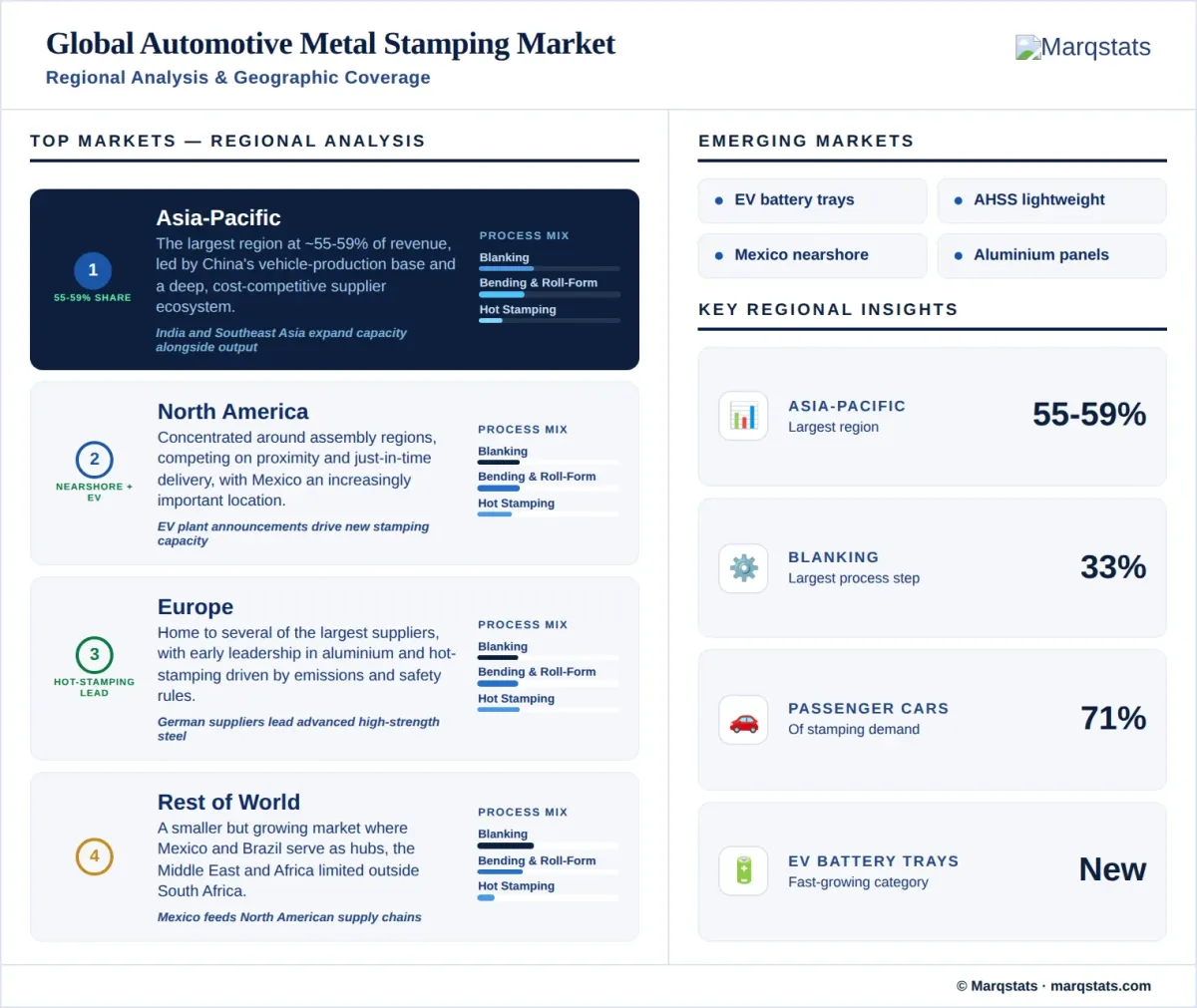
Blanking, the process of cutting flat sheet metal into the initial shape required for subsequent forming, represents the largest process segment at roughly 33% of revenue, reflecting its role as a foundational first step in nearly every stamped-part production sequence regardless of the part's final geometry or material. Precision blanking, used for tighter-tolerance applications, commands a meaningful price premium over standard blanking and is gaining share as component tolerance requirements tighten across advanced vehicle architectures.
Bending and roll-forming processes, used to shape brackets, chassis members, and structural frame components, represent a large secondary process category, with demand closely tied to structural and chassis component programmes rather than exterior body panel production. Roll-forming in particular is gaining share for long, constant-cross-section structural members, where it offers cost advantages over conventional press-bending for high-volume production runs.
Hot stamping, used to form boron steel into ultra-high-strength safety-cage and structural components, remains a smaller but fast-growing process category, driven by safety regulation and the structural demands of electric vehicle battery protection requirements. The process requires substantially higher capital investment per press than conventional cold stamping, given the furnace, transfer, and quench-die tooling the process requires, concentrating hot-stamping capability among larger, better-capitalised suppliers. Battery enclosure and underbody protection components for electric vehicles are an increasingly important application for hot-stamped parts, extending the process beyond its traditional safety-cage and pillar-reinforcement applications.
Coining, flanging, embossing, and other specialty processes serve smaller-volume, precision-critical applications, including trim components and parts requiring tight dimensional tolerances beyond standard blanking and bending capability. These processes typically command higher per-part pricing than high-volume blanking and bending, reflecting the greater precision and typically lower production volumes involved.
Steel, including conventional mild steel and advanced high-strength steel, remains the dominant material by both volume and revenue, reflecting its cost advantage, established supply chain, and continued suitability for the large majority of structural and body applications. Advanced high-strength steel in particular has grown from a niche safety-component material into a mainstream body-in-white specification, offering much of aluminum's weight-saving benefit at a materially lower material cost, which has slowed rather than reversed aluminum's share gains in many vehicle segments. Steel's established recycling infrastructure and scrap-value recovery also give it a cost and sustainability advantage over aluminum that continues to matter in mass-market vehicle programmes where every component cost is scrutinised closely.
Aluminum stamping is gaining share fastest among the major materials, driven by lightweighting mandates and its favourable strength-to-weight ratio for body panels and select structural applications, though it commands a materially higher per-part cost than steel and requires different tooling and joining approaches. Aluminum adoption remains most concentrated in premium and electric vehicle segments, where the cost premium is more easily absorbed within overall vehicle pricing, while mass-market segments have leaned more heavily toward advanced high-strength steel as the primary lightweighting lever.
Passenger cars account for roughly 71% of stamping demand, reflecting both higher global production volumes relative to commercial vehicles and the extensive use of stamped components across body structures, doors, hoods, fenders, and roof panels in passenger vehicle architectures. Sport-utility vehicle and crossover body styles, which have grown to dominate passenger-vehicle production in many markets, generally require a larger stamped-panel surface area per vehicle than smaller sedan and hatchback body styles, providing a structural tailwind to passenger-car stamping revenue independent of unit production growth.
Light commercial vehicles, including vans and pickup trucks, represent most of the remaining demand, with stamping specifications typically emphasising structural durability and load-bearing capacity over the styling and NVH considerations that weigh more heavily in passenger-car panel design. Heavier-gauge steel and reinforced structural stampings are more common in this vehicle category, reflecting the higher payload and towing requirements these vehicles are designed to meet.
By Geography
Asia-Pacific
Asia-Pacific holds roughly 55% to 59% of global revenue, the largest of any region, led by China's vehicle production base and supported by a deep, cost-competitive domestic stamping supplier ecosystem. India and Southeast Asian markets are expanding stamping capacity alongside rising domestic and export-oriented vehicle production, with several global suppliers establishing or expanding regional facilities to serve both local assembly and export-oriented component supply chains.
North America
North America remains a significant stamping market concentrated around established vehicle assembly regions, with domestic suppliers competing on proximity to assembly plants, just-in-time delivery capability, and increasing specialisation in advanced high-strength steel and aluminum components for premium and electric vehicle programmes. Mexico has emerged as an increasingly important stamping production location within the broader North American supply chain, combining lower labour costs with proximity to United States assembly plants. Electric vehicle assembly plant announcements across the region have driven a parallel wave of new stamping capacity investment, as suppliers position facilities near newly announced battery and vehicle assembly sites to secure early involvement in emerging vehicle platforms.
Europe
Europe is home to several of the industry's largest stamping suppliers and combines substantial domestic vehicle production with early leadership in aluminum and hot-stamping technology adoption, driven by stringent emissions and safety regulation across the region. German and other Western European suppliers in particular have led adoption of advanced high-strength steel and hot-stamping processes, reflecting the region's early and sustained regulatory emphasis on vehicle safety and emissions performance and its concentration of premium vehicle manufacturers willing to absorb higher material costs.
Rest of World
Latin America, the Middle East, and Africa represent a smaller but growing stamping market, with Mexico and Brazil serving as important regional production hubs supplying both domestic assembly and North American export markets. Brazil's stamping industry serves primarily the domestic South American vehicle market, while Mexico's output is weighted more heavily toward integration into North American supply chains. The Middle East and Africa remain the smallest of the four regions covered in this study, with limited domestic vehicle assembly outside South Africa constraining local stamping demand relative to the region's population and vehicle parc.
How Competition Is Evolving
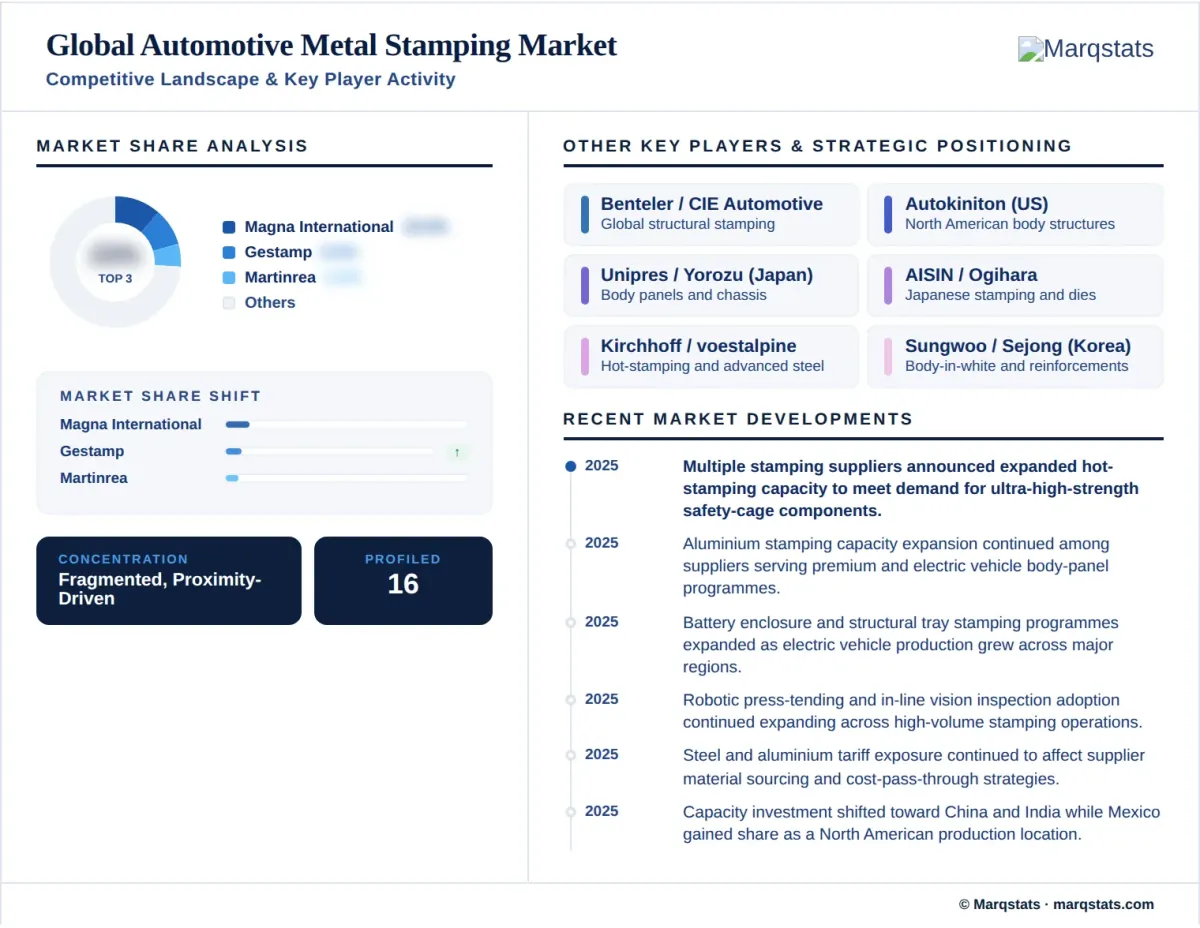
The market is moderately fragmented, with a group of large, globally distributed Tier-1 suppliers competing alongside numerous regional and country-specific stamping specialists that serve local OEM assembly plants. The largest suppliers compete on multi-plant global footprint, advanced material capability, and the ability to co-locate stamping operations near major OEM assembly facilities to support just-in-time delivery requirements that leave minimal buffer inventory. Long-term supply agreements tied to specific vehicle platforms are the norm in this industry, meaning competitive contests are won primarily at the platform-award stage years before production begins, rather than through ongoing price competition on already-awarded programmes.
Competitive strategy centers on advanced material capability, particularly aluminum and hot-stamping process investment, since these capabilities command premium pricing and are increasingly specified for lightweighting and electric-vehicle programmes. Automation investment in robotic press-tending and in-line inspection is becoming a competitive necessity rather than a differentiator among the largest suppliers, while regional and smaller suppliers compete primarily on cost and proximity to specific OEM assembly plants rather than on advanced-material breadth. Vertical integration into tool and die design is a further differentiator among the largest suppliers, since in-house tooling capability shortens development lead times and gives suppliers greater control over a programme's total cost structure.
Companies Covered
The report profiles 16+ companies with full strategy and financials analysis, including:
Recent Market Activity
Table of Contents
Coverage & Segmentation
This report provides a comprehensive assessment of the global automotive metal stamping market across a 2025 base year, historical data from 2021 to 2025, and forecasts spanning 2026 to 2030. Market size is stated as stamped-component revenue in United States dollars, covering parts sold to automotive OEMs and Tier-1 assemblers. Segmentation covers three dimensions: process, material, and vehicle type, alongside regional analysis spanning Asia-Pacific, North America, Europe, and the rest of world.
The scope covers press-based forming processes including blanking, bending, hot stamping, coining, and related specialty processes, applied to steel and aluminum sheet for automotive body, structural, and chassis components. The study excludes forging, die-casting, machining, and welded fabrication, which involve different forming processes and supplier bases, as well as stamping press equipment sales, which Marqstats treats as a separate capital-equipment category. Non-automotive stamping, including consumer appliances and electronics, is also excluded, since these end markets carry different customer relationships and specification requirements despite occasional overlap in underlying press technology. Aftermarket and refurbished stamped components are excluded as an immaterial share of total category revenue, consistent with this being an overwhelmingly OEM-driven, first-fit component market. Country-level detail beyond the four-region split covered here is available under customization, alongside deeper cuts by process, material, or vehicle platform.