Market Snapshot
Key Takeaways
Market Overview & Analysis
Report Summary
Malaysia has an automotive electronics industry that is several times the size of what its own vehicle industry consumes. The country assembled 747,780 vehicles in 2025, a figure that fell 5.4% on the prior year, while its automotive semiconductor and electronics output ran at an estimated USD 3,645.00 million, of which an estimated 86.01% left the country. Reading this market off Malaysian vehicle demand understates it by a factor of more than three.
The measure is the value of automotive electronics and semiconductor product designed, manufactured and supplied in Malaysia, covering semiconductor assembly, test and packaging, printed circuit board assemblies and electronic control units, smart cockpit and infotainment systems, connectivity modules and network access devices, and advanced driver assistance sensing and vehicle compute platforms. It covers supply to both domestic and global manufacturer programmes. Vehicle assembly, non-electronic components and the retail value of finished vehicles are separate markets.
The analysis is written for semiconductor operators sizing Malaysian capacity against global automotive demand rather than local, domestic electronics suppliers competing for national manufacturer content awards, manufacturers deciding where advanced driver assistance content is assembled, and policymakers who set a Level 3 autonomy target for 2030 against a supply base that is currently export-oriented.
Malaysia Automotive Electronics and Semiconductor Market Size and Forecast
Output value is estimated at USD 3,645.00 million in 2025, USD 4,100.00 million in 2026 and USD 8,250.00 million by 2030, an increase of USD 4,605.00 million. Domestic vehicle production moves from 747,780 to 900,000 units across the same window, which is the demand base for an estimated 13.99% of the panel and for none of the remainder.
Two growth rates apply and the second is higher. The five-year value rate connecting 2025 and 2030 is 17.75%; the four-year rate connecting 2026 and 2030 is 19.10%. The 1.35-point gap exists because the largest single capacity addition in the market does not begin ramping until the first quarter of 2028, so the back half of the window carries more growth than the front.
Value compounds 13.97 points ahead of domestic vehicle production at 17.75% against 3.78%, and the gap is a scope fact rather than a productivity one. The domestic and export streams are published separately for that reason: domestic original equipment supply moves from an estimated USD 510.00 million to USD 1,720.00 million at 27.52%, while export to global programmes moves from an estimated USD 3,135.00 million to USD 6,530.00 million at 15.81%.
The volume series is carried as domestic vehicle production at 747,780 units in 2025 and 900,000 by 2030, locked to the figure used across this programme's Malaysian manufacturing pages. It is disclosed as a partial demand base rather than presented as the market's driver, because no official body publishes a unit series for automotive semiconductor or electronics output and inventing one would be worse than stating the limitation.
A sizing range is published rather than a point. The 2030 figure sits within a band of USD 6,900.00 million to USD 9,800.00 million against domestic production of 850,000 to 950,000 vehicles, corresponding to rates of 13.62% and 21.87%, and the spread turns on ramp timing at the largest expansion rather than on demand.
The Largest Single Commitment Is Dated and Does Not Ramp Until 2028
NXP Semiconductors broke ground in August 2026 on a 500,000 square foot expansion of its Petaling Jaya assembly and test facility, taking total production area to around 900,000 square feet, a 125.00% increase on the prior footprint. Production ramp begins in the first quarter of 2028, and the company expects the site to more than double its output when fully operational.
The company has manufactured in Malaysia since 1972, and its Kuala Lumpur operation produces microprocessors, advanced driver assistance and radar devices, microcontrollers, audio processors, sensors, power management and radio frequency devices. That product list is the reason the semiconductor segment dominates this panel: these are automotive devices shipped to global programmes, and the Malaysian vehicle market consumes almost none of them.
The timing shapes the forecast more than the size does. A ramp starting in the first quarter of 2028 places the largest capacity addition in the final two years of the window, which is why the four-year growth rate of 19.10% exceeds the five-year rate of 17.75% and why the published sizing band turns on ramp timing rather than on end demand.
Advanced Driver Assistance Is the Fastest Segment and Malaysia Has Set a Date
Malaysia set a 2030 target for Level 3 autonomous driving capability in May 2026, with the national automotive institute expected to lay the groundwork and industry urged to build capability in sensors, semiconductors and software. It is a target with a date attached and no published mandate behind it, which makes it a demand signal rather than a requirement.
The content is already arriving through product rather than through policy. The Jaecoo J5 launched in March 2026 with Level 2 plus capability across 19 functions, the Chery Tiggo 9 in June 2026 with 23 functions and a 15.6-inch display, and the Proton S70 in February 2026 with Level 2 capability across 13 functions alongside a 12.3-inch infotainment screen and a 10.25-inch digital cluster. Advanced driver assistance is standard equipment on Chinese completely knocked down models in Malaysia.
The counter-example is the most useful data point in the segment. Proton removed advanced driver assistance from the updated X90 in March 2026 and cut prices by up to MYR 30,000. That single decision prices the content directly: a manufacturer judged that MYR 30,000 of price was worth more to the buyer than the driver assistance package, which is the clearest available read on where the feature sits in Malaysian purchase decisions today.
Advanced driver assistance sensing and vehicle compute moves from an estimated USD 385.00 million to USD 1,480.00 million at 30.91%, the fastest of five product segments. Vehicles assembled in Malaysia with Level 2 capability or above rise from an estimated 194,420 units to 585,000, and Level 3 capable assembly reaches an estimated 90,000 units by 2030 from zero.
High-Compute Platforms Are Entering Local Assembly
Volvo Car Malaysia launched the locally assembled 2026 EX90 in September 2026 at MYR 428,888 with dual Nvidia Drive AGX Orin chips delivering 500 trillion operations per second for artificial intelligence and safety functions, with the imported model's roof-mounted lidar omitted. The locally assembled ES90, launched in January 2026 from MYR 339,888, runs the same Nvidia platform.
Two vehicles do not make a segment, but they establish that Malaysian assembly lines can build vehicles carrying centralised high-performance compute, which is a different manufacturing and validation proposition from fitting discrete electronic control units. The lidar omission on the locally built EX90 is equally informative about where the boundary currently sits.
The upstream capability is being organised alongside it. XPeng announced in June 2026 a dedicated local research and development team and an automotive semiconductor and chip centre initiative with the national investment authority and Arm, alongside targets of more than 80 stations and more than 1,800 direct current fast-charging points with 1,000 kW hypercharging by 2028. Proton showed its electrical and electronic architecture, modular vehicle cockpit concept, smart cockpit head unit and driver assistance system at KLIMS 2026.
Malaysian Suppliers Are Winning the Domestic Content
MCE Holdings opened the MYR 50 million MCE Auto Hub at Serendah in July 2026 across 3.24 hectares for smart cockpit, infotainment, driver assistance and electronic control unit production, with up to MYR 200 million planned over the next decade and stated collaboration with local semiconductor and integrated circuit design firms. The company employs about 680 people including 90 engineers.
Its award book is disclosed and long-dated. A 40-month, MYR 54.28 million Perodua package covers audio displays, reverse cameras and driver assistance components for an internal combustion model, with MYR 4.95 million of investment and production from the fourth quarter of the financial year ending 31 July 2027. Approximately MYR 37.9 million of Proton electronics and mechatronics contracts run seven years. The two together total about MYR 92.18 million.
The other Malaysian names are moving on capability and ownership. Betamek Electronics received Level 4 recognition under the national Industry4WRD smart manufacturing assessment on 13 July 2026 and said it would extend automation and digital integration to next-generation vehicle electronics platforms. Nationgate completed the acquisition of Valeo Malaysia's printed circuit board assembly, module and injection parts operation in Penang for MYR 60.89 million in cash and 168.2 million shares on 31 December 2025, taking full ownership.
Penang Is a Connectivity Cluster That Serves No Malaysian Vehicle
Rolling Wireless began full-scale mass production of 4G and 5G network access devices at its Penang plant on 5 March 2026 for multiple global manufacturer programmes, after completing automotive-grade qualification. Network access devices are the modules that connect a vehicle to a cellular network, and the programmes they serve are not Malaysian.
Nationgate's acquired Valeo operation sits in the same state, producing printed circuit board assemblies, modules and injection parts. Penang and the northern corridor account for an estimated USD 1,020.60 million of output, 28.00% of the market, against a negligible share of Malaysian vehicle assembly, which is concentrated in Selangor, Perak and Kedah.
That geographic mismatch is the clearest physical expression of what this panel measures. Klang Valley and Selangor take an estimated 54.00% of output on the strength of NXP's Petaling Jaya site and MCE's Serendah hub, and between them the two clusters hold an estimated 82.00% of the market while accounting for a minority of the country's vehicle production.
Market Dynamics
Key Drivers
- Global automotive semiconductor demand rather than Malaysian vehicle demand drives an estimated 86.01% of the panel, worth USD 3,135.00 million in 2025 and compounding at 15.81%.
- The largest single capacity commitment is dated and sized, with NXP adding 500,000 square feet at Petaling Jaya for a total around 900,000 and output expected to more than double from a first-quarter 2028 ramp.
- Advanced driver assistance is becoming standard on locally assembled models, with the Jaecoo J5 at 19 functions, the Chery Tiggo 9 at 23 functions and the Proton S70 at 13 functions.
- National manufacturer content awards are long-dated, with MCE Holdings holding a 40-month MYR 54.28 million Perodua package and roughly MYR 37.9 million of seven-year Proton contracts.
- Malaysia's 2030 Level 3 autonomy target is pulling sensor, semiconductor and software capability building forward, with an estimated 90,000 Level 3 capable vehicles assembled by 2030 from zero.
Key Restraints
- The domestic demand base is small and slow, with vehicle production at 747,780 units in 2025, down 5.4%, supporting an estimated 13.99% of the panel.
- Driver assistance content is price-elastic in this market, demonstrated when Proton removed it from the updated X90 in March 2026 and cut prices by up to MYR 30,000.
- The largest capacity addition does not ramp until the first quarter of 2028, placing most of its contribution in the final two years of the forecast window.
- The Level 3 target for 2030 carries no published mandate, so it functions as a demand signal rather than a requirement that suppliers can plan capacity against.
Key Trends
- Centralised high-compute platforms are entering local assembly, with the Volvo EX90 at MYR 428,888 carrying dual Nvidia Drive AGX Orin chips at 500 trillion operations per second.
- Malaysian companies are acquiring multinational operations rather than only supplying them, with Nationgate taking full ownership of Valeo Malaysia's Penang operation for MYR 60.89 million and 168.2 million shares.
- Connectivity module manufacture is scaling for export, with Rolling Wireless in full mass production of 4G and 5G network access devices at Penang from 5 March 2026.
- Chinese manufacturers are proposing upstream semiconductor capability, with XPeng announcing a chip centre initiative with the national investment authority and Arm in June 2026.
Market Segmentation
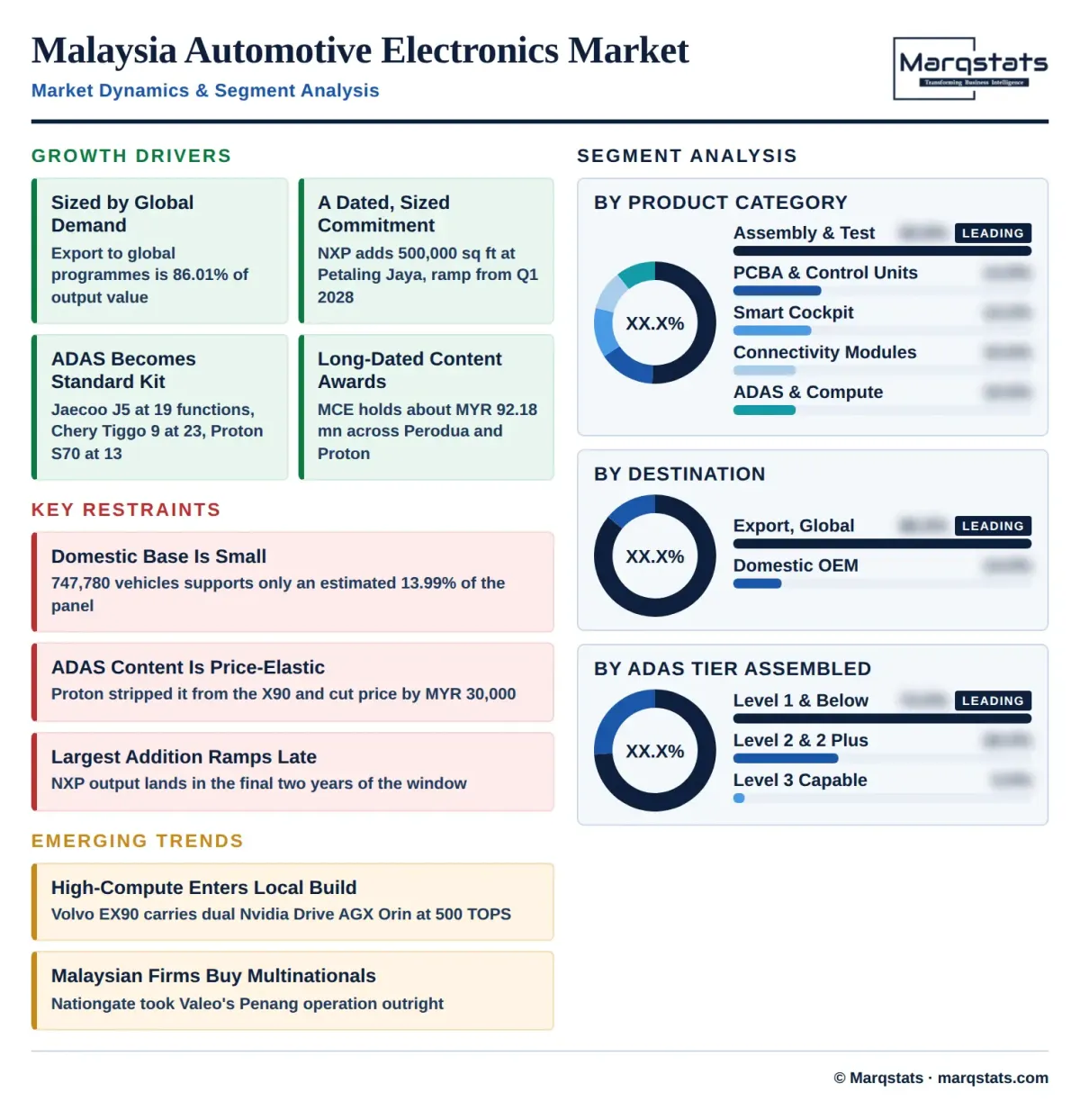
Semiconductor assembly, test and packaging accounted for an estimated USD 1,850.00 million in 2025, 50.75% of the market, growing to an estimated USD 3,700.00 million or 44.85% by 2030 at a 14.87% compound rate. NXP's Petaling Jaya site is the anchor, expanding by 500,000 square feet to around 900,000 with a ramp from the first quarter of 2028.
Printed circuit board assemblies and electronic control units accounted for an estimated USD 545.00 million in 2025, 14.95% of the market, growing to an estimated USD 1,080.00 million or 13.09% by 2030 at a 14.66% compound rate. Nationgate's acquired Valeo Penang operation and MCE's Serendah hub carry the bulk of Malaysian capability in this category.
Smart cockpit and infotainment systems accounted for an estimated USD 480.00 million in 2025, 13.17% of the market, growing to an estimated USD 1,150.00 million or 13.94% by 2030 at a 19.09% compound rate. Display sizes are rising with content, from the Proton S70's 12.3-inch infotainment screen and 10.25-inch cluster to the Chery Tiggo 9's 15.6-inch unit.
Connectivity modules and network access devices accounted for an estimated USD 385.00 million in 2025, 10.56% of the market, growing to an estimated USD 840.00 million or 10.18% by 2030 at a 16.89% compound rate. Rolling Wireless entered full-scale mass production of 4G and 5G devices at Penang on 5 March 2026 for multiple global manufacturer programmes.
Advanced driver assistance sensing and vehicle compute platforms accounted for an estimated USD 385.00 million in 2025, 10.56% of the market and the smallest category, growing to an estimated USD 1,480.00 million or 17.94% by 2030 at a 30.91% compound rate, the fastest of the five. The locally assembled Volvo EX90 and ES90 carry Nvidia Drive AGX Orin compute at 500 trillion operations per second.
Domestic original equipment supply accounted for an estimated USD 510.00 million in 2025, 13.99% of the market, growing to an estimated USD 1,720.00 million or 20.85% by 2030 at a 27.52% compound rate, nearly twice the export rate. It is the stream tied to the 747,780 vehicles Malaysia assembles and the only one that responds to domestic content policy.
Export to global programmes accounted for an estimated USD 3,135.00 million in 2025, 86.01% of the market, growing to an estimated USD 6,530.00 million or 79.15% by 2030 at a 15.81% compound rate. Semiconductor assembly and test and connectivity module manufacture carry almost all of it, and none of it depends on Malaysian vehicle demand.
Multinational semiconductor operations accounted for an estimated USD 2,259.90 million in 2025, 62.00% of the market, growing to an estimated USD 4,455.00 million or 54.00% by 2030 at a 14.54% compound rate. NXP, present in Malaysia since 1972, is the largest, and Valeo's Penang operation moved out of this group on its December 2025 sale.
Malaysian-owned Tier-1 electronics suppliers accounted for an estimated USD 947.70 million in 2025, 26.00% of the market, growing to an estimated USD 2,433.75 million or 29.50% by 2030 at a 20.76% compound rate. MCE Holdings, Betamek and Nationgate are the listed core, with MCE holding about MYR 92.18 million of national manufacturer awards.
Chinese and other entrants accounted for an estimated USD 437.40 million in 2025, 12.00% of the market, growing to an estimated USD 1,361.25 million or 16.50% by 2030 at a 25.49% compound rate, the fastest origin group. XPeng's semiconductor and chip centre initiative with the national investment authority and Arm is the group's most advanced upstream proposal.
Vehicles assembled with Level 1 capability or below accounted for an estimated 553,360 units in 2025, 74.00% of national production, falling to an estimated 225,000 units or 25.00% by 2030. Proton's removal of driver assistance from the updated X90 in March 2026, cutting prices by up to MYR 30,000, shows the tier is a deliberate price position rather than a technical ceiling.
Vehicles assembled with Level 2 or Level 2 plus capability accounted for an estimated 194,420 units in 2025, 26.00% of national production, rising to an estimated 585,000 units or 65.00% by 2030. The Jaecoo J5 at 19 functions, the Chery Tiggo 9 at 23 functions and the Proton S70 at 13 functions define the tier.
Vehicles assembled with Level 3 capability accounted for 0 units in 2025 and reach an estimated 90,000 units or 10.00% of national production by 2030. Malaysia set the 2030 Level 3 target in May 2026, and the locally assembled Volvo EX90's dual Nvidia Drive AGX Orin compute at 500 trillion operations per second is the nearest capability in market.
National manufacturer programmes accounted for an estimated USD 346.27 million in 2025, 9.50% of the market, growing to an estimated USD 1,072.50 million or 13.00% by 2030. Proton and Perodua content awards to Malaysian suppliers carry the growth, with MCE holding roughly MYR 92.18 million across the two.
Non-national and global manufacturer programmes accounted for an estimated USD 3,298.72 million in 2025, 90.50% of the market, growing to an estimated USD 7,177.50 million or 87.00% by 2030. The group spans locally assembled non-national models and the far larger export stream serving manufacturer programmes outside Malaysia.
By Geography
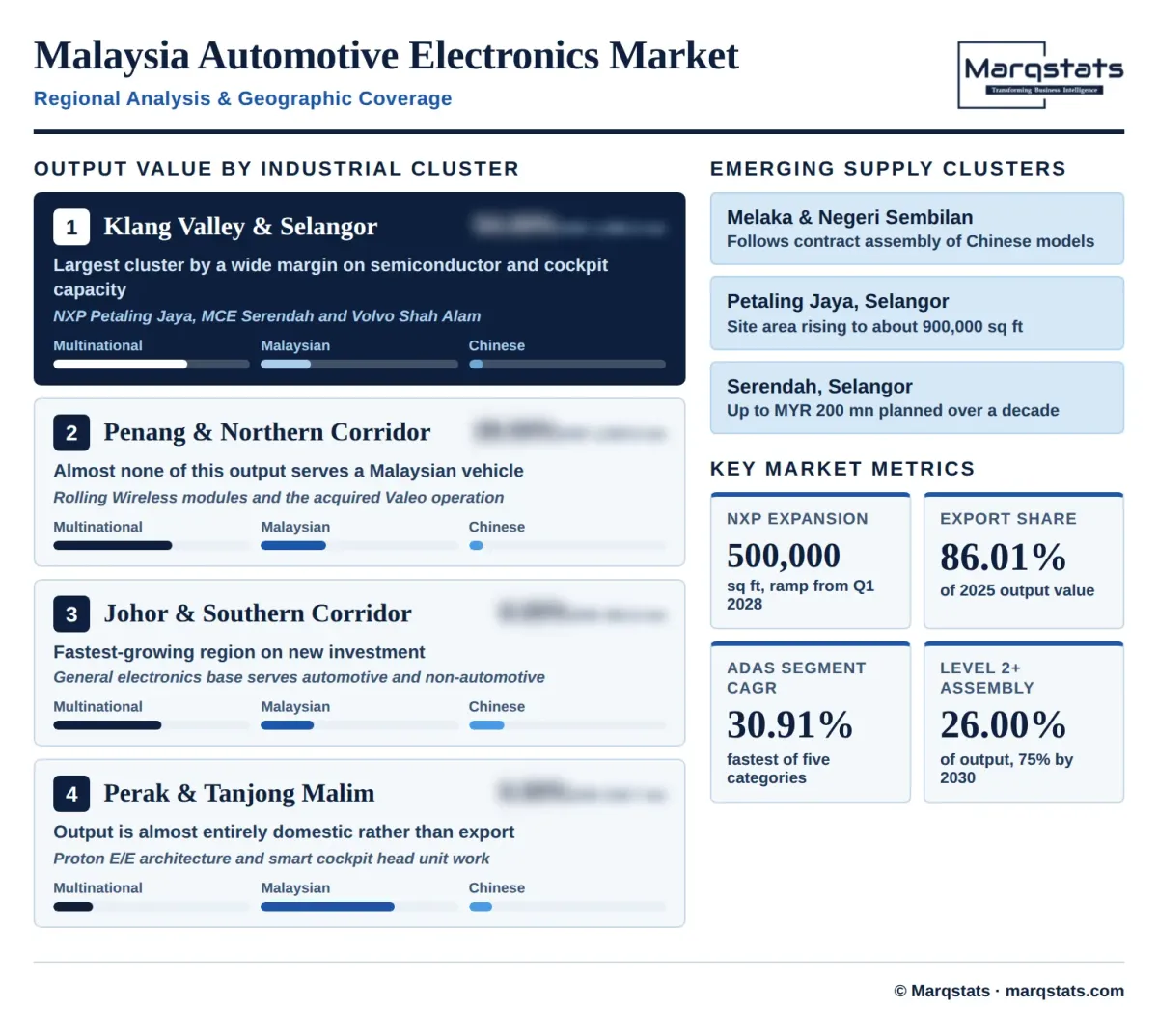
Klang Valley and Selangor
The Klang Valley and Selangor account for an estimated USD 1,968.30 million of output in 2025, 54.00% of the market, the largest cluster by a wide margin. NXP's Petaling Jaya assembly and test site, expanding by 500,000 square feet to around 900,000, and MCE's MYR 50 million Serendah hub across 3.24 hectares both sit here, as does Volvo's Shah Alam assembly line.
Penang and the Northern Corridor
Penang and the northern corridor account for an estimated USD 1,020.60 million, 28.00% of the market, and almost none of it serves a Malaysian vehicle. Rolling Wireless produces 4G and 5G network access devices for global manufacturer programmes from 5 March 2026, and Nationgate's acquired Valeo operation produces printed circuit board assemblies, modules and injection parts.
Johor and the Southern Corridor
Johor and the southern corridor account for an estimated USD 291.60 million, 8.00% of the market, and the state's general electronics base supplies both automotive and non-automotive demand. It is the fastest-growing region on new investment, though its automotive-specific concentration remains well below Penang's.
Perak and the Tanjong Malim Corridor
Perak and the Tanjong Malim corridor account for an estimated USD 218.70 million, 6.00% of the market, and the output is almost entirely domestic. Proton's electrical and electronic architecture work, its modular vehicle cockpit concept and its smart cockpit head unit, all shown at KLIMS 2026, sit inside the corridor alongside the powertrain and vehicle plants.
Melaka and Negeri Sembilan
Melaka and Negeri Sembilan account for an estimated USD 145.80 million, 4.00% of the market, the smallest cluster. The region's electronics demand follows the contract assembly operations located there, which build Chinese models carrying standard driver assistance content of 19 to 23 functions.
How Competition Is Evolving
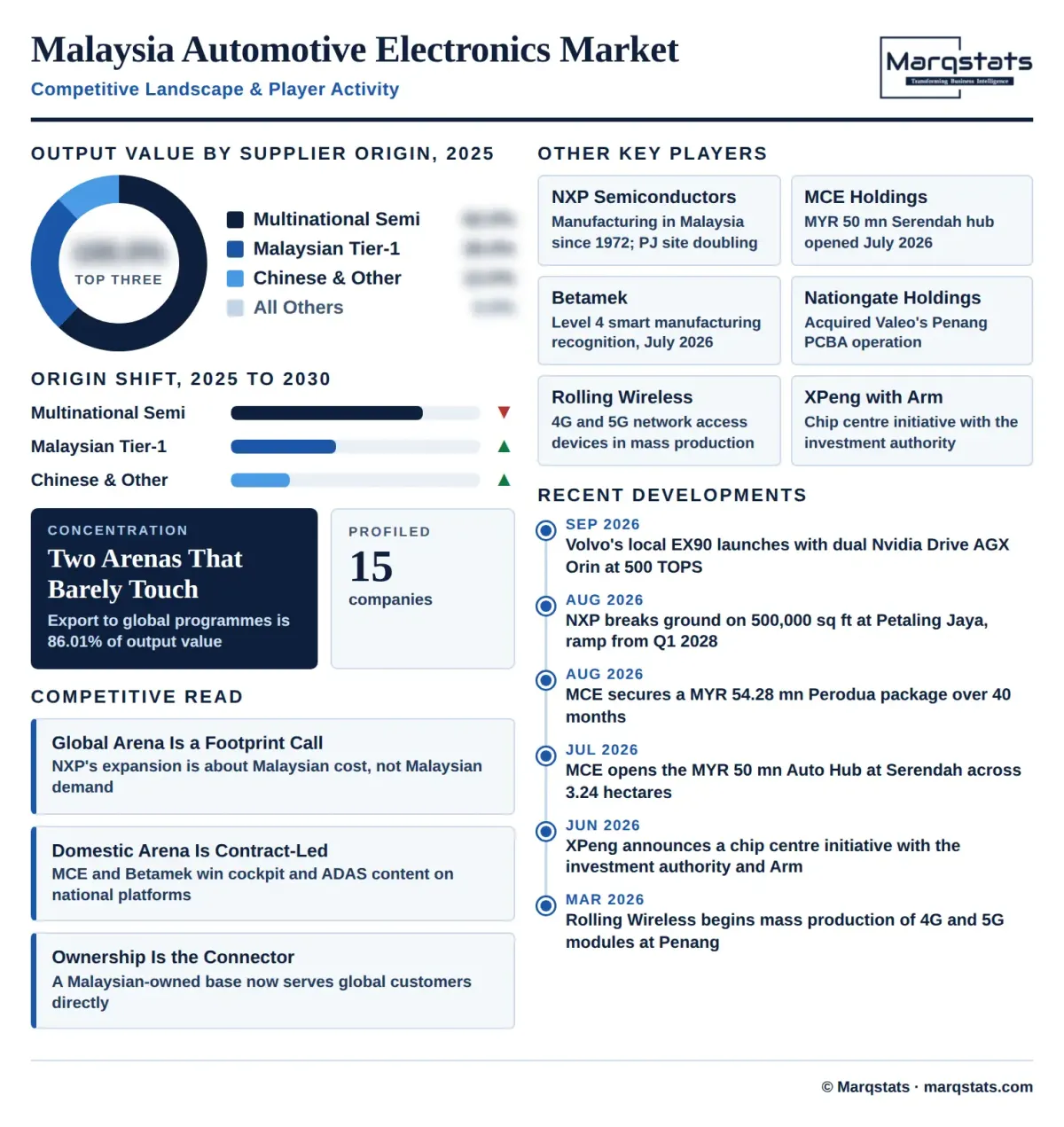
This market has two competitive arenas that barely touch. In semiconductor assembly and test, which is an estimated 50.75% of the panel, the competition is global and Malaysia's position is a manufacturing footprint decision made by companies headquartered elsewhere. NXP has manufactured here since 1972 and is adding 500,000 square feet to a site whose output it expects to more than double, which is a statement about Malaysian cost and capability rather than about Malaysian demand.
In domestic vehicle electronics, which is an estimated 13.99% of the panel, the competition is local and the contracts are disclosed. MCE Holdings and Betamek are winning cockpit, audio display, reverse camera and driver assistance content on national manufacturer programmes, with MCE's Perodua and Proton awards totalling about MYR 92.18 million and Betamek reaching Level 4 smart manufacturing recognition in July 2026. Neither is large by international supplier standards and both are growing faster than the market.
The connecting movement is ownership. Nationgate acquired Valeo Malaysia's Penang operation outright for MYR 60.89 million in cash and 168.2 million shares on 31 December 2025, moving a multinational electronics operation into Malaysian hands, and Rolling Wireless scaled network access device production in the same state for global programmes. A Malaysian-owned supplier base serving global customers is a different industry from a Malaysian-owned supplier base serving Proton and Perodua, and this market now contains both.
Companies Covered
The report profiles 15+ companies with full strategy and financials analysis, including:
Recent Market Activity
Table of Contents
Coverage & Segmentation
The analysis measures the value of automotive electronics and semiconductor product designed, manufactured and supplied in Malaysia from 2021 to 2030, with 2025 as the base year and 2026 to 2030 as the forecast period, covering semiconductor assembly, test and packaging, printed circuit board assemblies and electronic control units, smart cockpit and infotainment systems, connectivity modules and network access devices, and advanced driver assistance sensing and vehicle compute platforms, supplied to both domestic and global manufacturer programmes. Vehicle assembly, non-electronic components and the retail value of finished vehicles are separate markets. Values are expressed in USD at a disclosed constant MYR 4.20 per USD.
Coverage spans five product categories, two destinations, three supplier origin groups, three driver assistance capability tiers and two customer types, with five regional clusters analysed on output value and anchor facility capacity. Domestic vehicle production is carried as the unit series at 747,780 in 2025 and is disclosed as a partial demand base covering an estimated 13.99% of the panel rather than presented as the market's driver, because no official body publishes a unit series for automotive electronics or semiconductor output. Fifteen entities are profiled across multinational semiconductor operations, listed Malaysian electronics suppliers, manufacturers whose content decisions set domestic demand, and the compute and architecture providers entering local assembly.