Market Snapshot
Key Takeaways
Market Overview & Analysis
Report Summary
This analysis reads Turkey's own fully partitioned sizing chain, regional distribution data, and named fiscal-trigger scenario framework together as a single coherent picture rather than isolated data points, since the underlying research itself was structured to support exactly that kind of integrated reading.
Turkey's EV maintenance market is measured across scheduled preventive maintenance, high-voltage battery diagnostics, chassis and tire servicing, and thermal cooling loop maintenance for registered BEVs and PHEVs, valued at USD 78.36 million in 2025. This figure is taken directly from the underlying research's own fully partitioned sizing chain, anchored to TUIK statutory fleet data and OSS Dernegi industry association figures.
Structurally, this is a market whose growth is anchored to fleet accumulation rather than new-vehicle sales momentum, and whose competitive shape is being actively reshaped by mandatory high-voltage safety compliance standards that concentrate service capability among authorized dealerships and organized multi-brand chains, at the direct expense of traditional independent repair shops lacking the floor space or capital to comply.
The analysis is built for four reader types making different decisions: an independent workshop operator weighing TSE 13910 compliance investment against the pace of out-of-warranty fleet growth, a domestic battery specialist like ASPILSAN Enerji scaling cell-level repair capability against full-pack replacement economics, an OEM distributor navigating Turkey's evolving OTV tax and import tariff structure, and an investor tracking how tax policy and BYD's Manisa investment decision together shape this market's Downside-to-Upside scenario range.
Why Falling New-Car Sales Didn't Slow This Market Down
It would be reasonable to assume a 30.6% year-over-year contraction in new EV sales during the first eight months of 2026 signals a market in genuine trouble. The operational fleet data tells a completely different story: Turkey's operational BEV fleet grew 53.2% over that exact same period, expanding from 308,217 to 472,157 units. Both statistics are simultaneously true, and reconciling them reveals something important about how EV maintenance markets actually work.
New-vehicle sales measure a single period's flow. Fleet size measures the accumulated stock of every vehicle sold in every prior period that hasn't been scrapped or exported. A sharp sales slowdown in any single eight-month window barely dents a multi-year accumulation of hundreds of thousands of vehicles — and every one of those vehicles, sold in a strong year or a weak one, still needs cabin filters, brake fluid and tire replacements on schedule. For anyone forecasting Turkey's EV maintenance demand specifically, this is the single most important distinction to get right: track the fleet, not the sales headline.
The 85% Savings Number Only Tells Half the Story
Comparative total-cost-of-ownership data for a compact BEV against an equivalent ICE vehicle shows a genuinely dramatic 85.45% reduction in scheduled mechanical maintenance costs over a 5-year ownership period — TRY 8,000 against TRY 55,000. That number, on its own, understates the real economics of EV ownership in Turkey specifically.
Factor in tire replacement costs — EV-rated tires running TRY 15,000 to TRY 25,000 per set every 40,000 km, driven by the combination of heavier battery-pack curb weight and instant motor torque accelerating tread wear — and net five-year maintenance savings moderate to a still-substantial but meaningfully lower 50% to 55%. Neither number is wrong; they're answering different questions. The 85% figure describes powertrain-only mechanical servicing. The 50% to 55% figure describes what an owner's wallet actually experiences once every consumable category is included.
Market Dynamics
Key Drivers
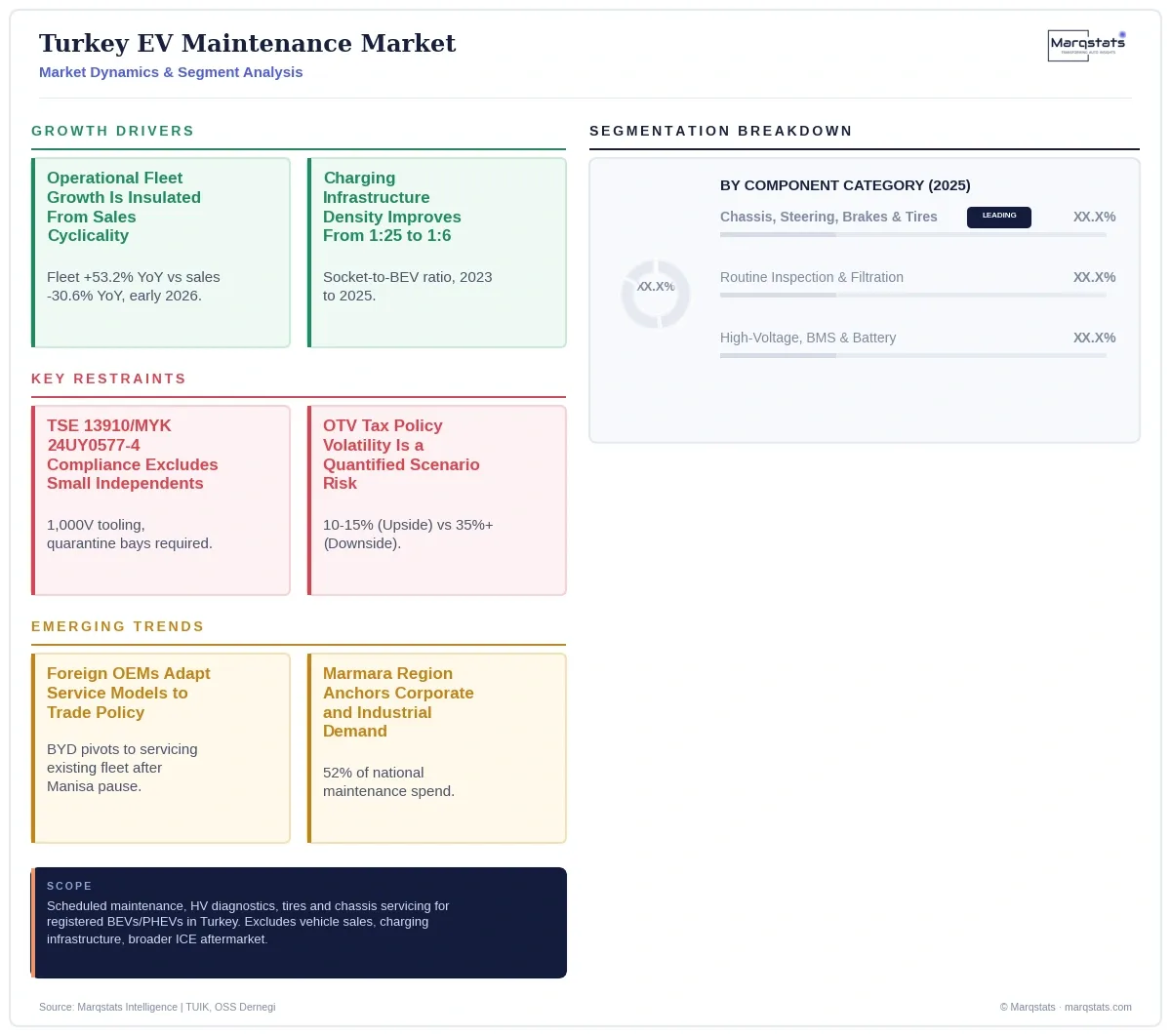
- Turkey's fully partitioned component-category data shows chassis, brake and tire spend already the largest single category at 48% of 2025 value, a structural signal that specialized consumable inventory and alignment capability, not general mechanical capacity, represent the most immediate revenue opportunity for workshops entering this market.
- Turkey's operational BEV fleet continues expanding even during periods of new-sales contraction, structurally insulating aftermarket maintenance revenue from short-term automotive sales cyclicality and macro-tightening monetary conditions.
- Dramatic improvement in public charging infrastructure density, from 1 socket per 25 BEVs in mid-2023 to 1 socket per 6 BEVs by mid-2025 under EPDK oversight, reduces range anxiety and supports higher annual vehicle mileage, directly driving more predictable consumable wear and recurring maintenance spend.
- Organized independent service chains are aggressively scaling EV-certified capacity, exemplified by Bosch Car Service achieving full 81-province coverage in February 2026 and Brisa's OtoPratik targeting expansion from 48 to 200 EV-certified service points nationwide.
- Domestic battery repair capability is emerging as a genuine cost-reduction lever, with ASPILSAN Enerji and independent specialist RS Servis developing cell-level and module-level repair capabilities that cut out-of-warranty battery service costs by 60% to 80% compared to full pack replacement.
- Togg's domestic production ramp at its Gemlik facility, combined with nearly 30% domestic market share of total BEV registrations, anchors substantial routine maintenance demand within its proprietary T-Care network while supporting broader domestic component and engineering talent availability.
Key Restraints
- The underlying research's own 2030 segment projections rely on Marqstats directional construction rather than a source-stated breakdown, since the pack provides fully sourced 2025 splits but no corresponding forward-year segment table -- a genuine data-availability gap disclosed explicitly throughout this analysis.
- TSE 13910 and MYK 24UY0577-4 compliance requirements — 1,000V insulated tooling, fire-resistant battery quarantine bays, and certified high-voltage technicians — create a structural barrier that traditional independent repair shops in industrial zones (sanayi siteleri) often cannot clear, concentrating high-voltage service volume among authorized dealerships and organized chains instead.
- Special Consumption Tax (OTV) policy volatility represents a genuine, quantified market-shaping risk: the underlying research's own scenario framework shows a swing from a 10% to 15% rate under the Upside Scenario to above 35% under the Downside Scenario producing a USD 205.3 million difference in projected 2030 market value.
- Accelerated EV tire wear, driven by heavier battery-pack curb weight and instant motor torque, moderates the otherwise dramatic powertrain maintenance savings EVs deliver, reducing net 5-year cost savings from an 85.45% gross reduction to a 50% to 55% net figure once tire replacement is included.
- Macroeconomic headwinds including tightening monetary conditions and import tariff adjustments on non-EU vehicles (30% to 40% duty, with an $8,500 per-unit minimum effective September 2025) directly constrain new EV sales volume, even though they have not yet meaningfully slowed operational fleet accumulation.
Key Trends
- Insurance underwriters operating in Turkey's coastal regions are increasingly factoring brake caliper corrosion risk into commercial fleet policy terms, following the underlying research's own documentation of humidity-driven seizure risk from reduced physical brake actuation on regenerative-braking-equipped EVs.
- Foreign OEMs are adapting service delivery models to Turkey's specific trade and tariff environment, exemplified by BYD maintaining its 20-plus location authorized service network and deliberately pivoting dealer focus toward servicing existing fleet imports even after placing its Manisa manufacturing investment on hold.
- Regional service demand concentrates heavily around the Marmara region's industrial and metropolitan corridor, anchored by corporate fleet headquarters, major production facilities including Togg's Gemlik plant and Hyundai Assan's Izmit factory, and heavy commercial transit along the Istanbul-Ankara highway.
- Seasonal tourism-driven demand is emerging in coastal Aegean and Mediterranean regions, with rental car fleets operating at airport hubs in Antalya, Izmir and Bodrum integrating EVs and creating distinct seasonal maintenance cycles tied to tourist volume.
- As Turkey's overwhelmingly warranty-covered BEV fleet (95%-plus registered since 2023) ages past the 3-to-5-year mark, service delivery is set to transition structurally from free OEM warranty programs toward fee-for-service models, a monetization shift not yet fully reflected in current market data.
Strategic Implications
- Policy makers evaluating OTV tax-rate stability should weigh the underlying research's own quantified scenario spread carefully, given how directly a roughly 25-percentage-point OTV swing translates into a USD 205.3 million difference in projected 2030 market value between the Downside and Upside scenarios.
- Independent workshop operators should treat TSE 13910 and MYK 24UY0577-4 compliance investment as a near-term strategic priority rather than a deferred cost, given how directly the current regulatory structure is already concentrating high-voltage service volume among compliant authorized and organized-chain competitors.
- OEM distributors and dealer networks should plan for a structural shift from warranty-driven to fee-for-service maintenance revenue over the next 3 to 5 years, following the pattern the underlying research's own fleet-age data makes explicit, rather than assuming current warranty-anchored service volumes will persist unchanged.
- Battery repair specialists and domestic component manufacturers should prioritize scaling cell-level and module-level repair capability now, given the genuine 60% to 80% cost advantage this approach holds over full pack replacement and the accelerating volume of vehicles approaching their 8-year battery warranty threshold.
- Investors and analysts should track OTV tax-rate policy and BYD's Manisa investment reactivation timeline as the two clearest variables separating this market's Downside and Upside scenarios, given how directly both feed the underlying research's own named trigger conditions.
Outlook
Three genuinely distinct, evidenced trajectories emerge from a single named fiscal trigger condition rather than differing growth-rate assumptions applied to the same story: Turkey's Ozel Tuketim Vergisi (OTV) special consumption tax rate on electric vehicles. Under the Downside Scenario, the government raises OTV above 35% to offset falling fossil fuel tax revenue, persistent high borrowing costs restrict vehicle financing, and local manufacturing investments face extended delays; the operational BEV fleet reaches 1,350,000 units by 2030, with total maintenance expenditure reaching USD 280.20 million at a 29.02% CAGR.
Under the Base Scenario, OTV remains stable at its July 2025-established 25% rate, Togg continues production ramp toward 80,000 units annually, and foreign OEMs maintain existing import and dealer volumes; the operational BEV fleet reaches 1,900,000 units by 2030, generating USD 390.80 million in annual maintenance expenditure at a 37.88% CAGR.
Under the Upside Scenario, OTV reduces to 10% to 15% for compact entry-level models, BYD reactivates its paused $1 billion Manisa production plant by late 2027, and local EV assembly at Hyundai's Izmit plant scales smoothly; the operational BEV fleet expands to 2,400,000 units by 2030, lifting total maintenance expenditure to USD 485.50 million at a 44.02% CAGR, as lower purchase prices accelerate consumer adoption and independent workshops expand rapidly through localized component sourcing.
Market Segmentation
USD 53.28 million (68.00% share) in 2025; projected at USD 214.94 million (55.00% share) by 2030. Anchored by Togg's T-Care network, Tesla's app-based mobile service, and BYD's dealer network; dominant during warranty periods.
USD 17.24 million (22.00% share) in 2025; projected at USD 125.06 million (32.00% share) by 2030. The fastest-growing channel, anchored by Bosch Car Service's 81-province coverage, Brisa's OtoPratik, and Stellantis's Eurorepar.
USD 7.84 million (10.00% share) in 2025; projected at USD 50.80 million (13.00% share) by 2030. Anchored by specialists like RS Servis, structurally constrained by TSE 13910 compliance barriers.
USD 37.61 million (48.00% share) in 2025; projected at USD 175.86 million (45.00% share) by 2030. The largest category, driven by accelerated EV tire wear and brake caliper corrosion risk in humid coastal regions.
USD 27.43 million (35.00% share) in 2025; projected at USD 117.24 million (30.00% share) by 2030. Covers cabin air filtration, brake fluid moisture analysis, and chassis component inspection at 1-year/15,000km intervals.
USD 13.32 million (17.00% share) in 2025; projected at USD 97.70 million (25.00% share) by 2030. The fastest-growing category as the fleet ages past its 8-year/160,000km battery warranty window.
By Geography
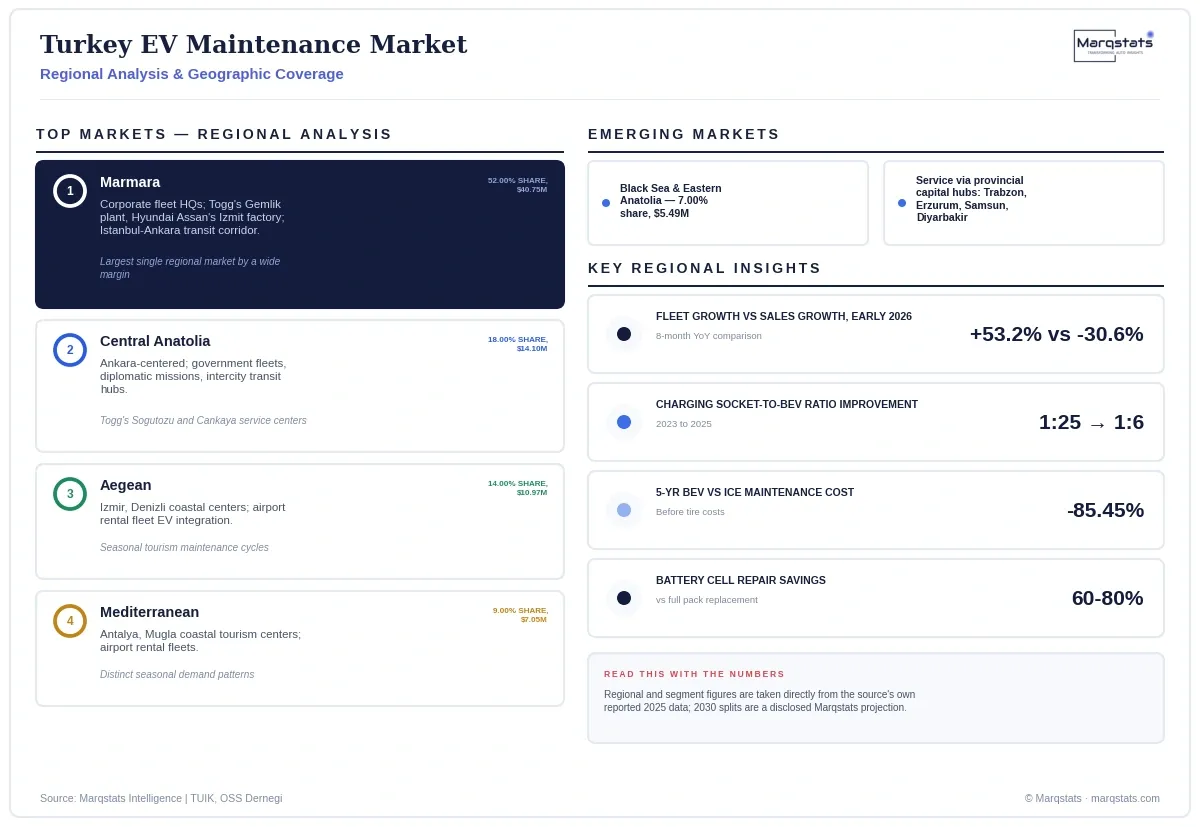
Marmara
USD 40.75 million (52.00% share) in 2025, from an estimated 192,700 registered BEVs, anchored by corporate fleet headquarters, major production facilities including Togg's Gemlik plant and Hyundai Assan's Izmit factory, and heavy commercial transit along the Istanbul-Ankara highway corridor.
Central Anatolia
USD 14.10 million (18.00% share) in 2025, from an estimated 66,700 registered BEVs, centered in Ankara and driven by government agency fleets, diplomatic missions, and intercity transit hubs, supported by Togg's Sogutozu and Cankaya experience and service centers.
Aegean
USD 10.97 million (14.00% share) in 2025, from an estimated 51,800 registered BEVs, driven by coastal urban centers including Izmir and Denizli, with rental car fleets at Izmir's airport hub integrating EVs to meet seasonal tourist demand.
Mediterranean
USD 7.05 million (9.00% share) in 2025, from an estimated 33,300 registered BEVs, driven by coastal tourism centers including Antalya and Mugla, with airport rental fleets creating distinct seasonal maintenance cycles.
Black Sea & Eastern Anatolia
USD 5.49 million (7.00% share) in 2025, from an estimated 26,091 registered BEVs, with service delivery relying primarily on provincial capital hubs including Trabzon, Erzurum, Samsun, Diyarbakir and Gaziantep.
How Competition Is Evolving
No single company in this market spans domestic OEM manufacturing, organized independent fast-fit servicing and specialized battery repair simultaneously, leaving genuine competitive white space for any group capable of bridging Togg's proprietary warranty-era network with the post-warranty independent and battery-specialist channels this market's own forecast shows capturing a growing share of expenditure by 2030.
Competition spans authorized OEM dealer networks, organized independent fast-fit chains, and specialized multi-brand mechatronic workshops, with mandatory high-voltage safety compliance increasingly concentrating volume among the first two channels. Togg, Turkey's domestic EV producer, operates a hybrid fixed-hub and mobile service model under its T-Care branding across major metro areas, supported by its TRUTEK technical division in Ankara, and anchors nearly 30% of total BEV registrations. Tesla relies on central service hubs supplemented by app-based mobile service units, having sold 31,509 Model Y vehicles in 2025 (+273% year-over-year). BYD maintained over 20 authorized service locations despite a 77.4% year-to-date sales decline and placing its $1 billion Manisa manufacturing investment on hold in mid-2026, pivoting dealer focus toward servicing its existing fleet of imports.
On organized independent chains, Robert Bosch Sanayi ve Ticaret A.S. achieved full 81-province Bosch Car Service coverage in February 2026, equipping locations with high-voltage diagnostic scanners and battery test units for multi-brand EV servicing. Brisa, a Sabanci Holding and Bridgestone partnership, operates 48 EV-certified OtoPratik locations out of 68 total points, targeting expansion to 200 nationwide and integrating Arvento vehicle telematics for fleet-operated EVs. Stellantis's Eurorepar Car Service network spans 300 locations. On specialized battery repair, domestic manufacturer ASPILSAN Enerji anchors lithium-ion cell and BMS capability from its Kayseri facility, while independent operator RS Servis specializes in high-voltage battery cell repair and micro-EV warranty support nationwide.
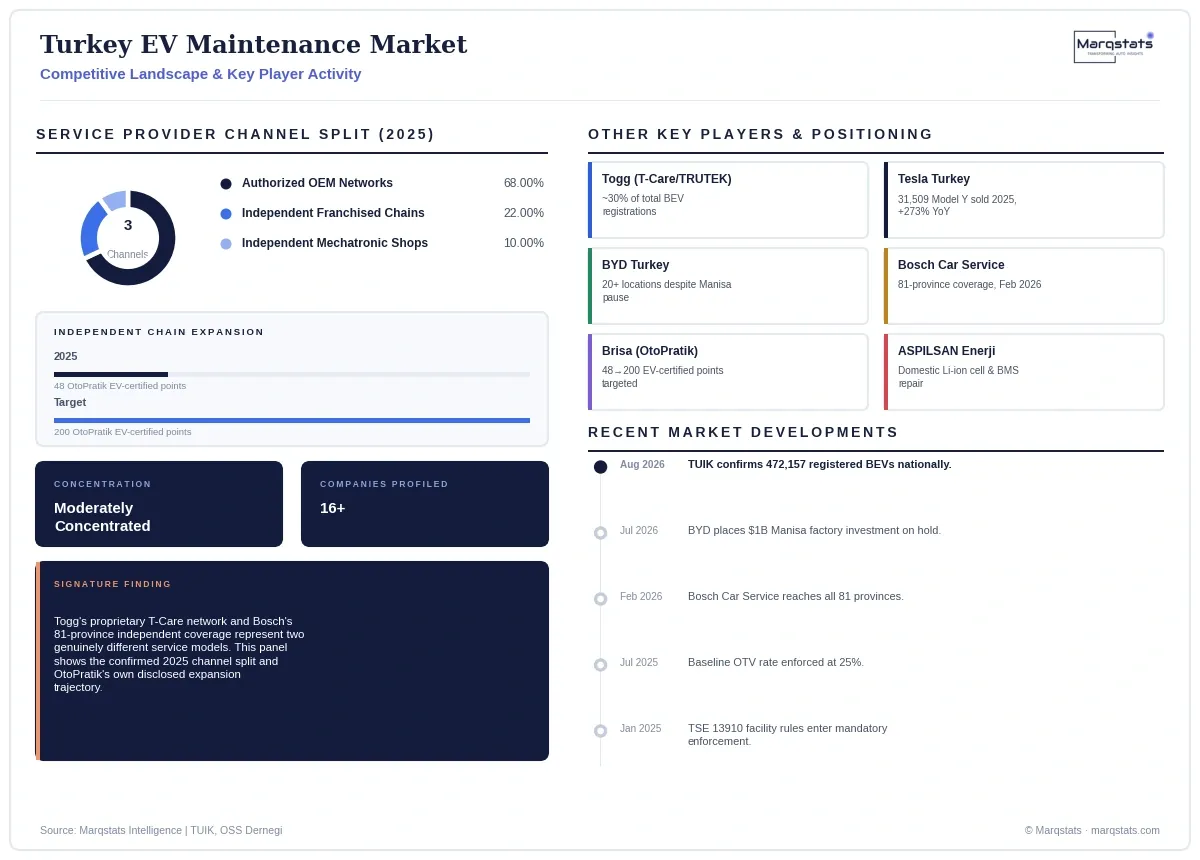
Companies Covered
The report profiles 16+ companies with full strategy and financials analysis, including:
Recent Market Activity
Table of Contents
Coverage & Segmentation
This report measures scheduled preventive maintenance, cabin air filtration, brake fluid and chassis servicing, specialized EV tire replacement, high-voltage battery diagnostics, and thermal cooling loop maintenance for registered battery electric and plug-in hybrid vehicles in Turkey, across a 2025 base year and a 2026 to 2030 forecast period, denominated in United States dollars. It excludes whole vehicle sales revenue, public charging infrastructure investment, and the broader internal combustion light vehicle aftermarket.
The analysis spans two segmentation dimensions — service provider channel and component maintenance category — five regional geographies, and 16 profiled entities across OEMs, independent chains, battery specialists and regulatory bodies. Fleet and registration figures trace to TUIK and OSS Dernegi; market value and 2025 segment splits trace to the underlying research's own fully partitioned sizing model, with 2030 segment projections disclosed as a Marqstats construction.