Market Snapshot
Key Takeaways
Market Overview & Analysis
Report Summary
This analysis reads Argentina's own fully partitioned sizing chain, regional distortion flags, and named-scenario framework together as a single coherent picture rather than isolated data points, since the underlying research itself was built to support exactly that kind of integrated reading.
Argentina's EV maintenance market is measured across routine preventative maintenance, electrical diagnostics, high-voltage battery servicing, and charger maintenance for electrified light and commercial vehicles, valued at USD 53.22 million in 2025. This figure is taken directly from the underlying research's own sourced sizing chain, anchored to AFAC's statutory fleet data and SIOMAA/ACARA's industry registration figures rather than a third-party aggregated estimate.
Structurally, this is a market whose headline growth conceals a hybrid-dominant reality: 96.33% of the electrified fleet still runs on internal combustion engines requiring conventional lubrication service, while pure battery-electric vehicles — the segment most commonly associated with genuine EV-specific maintenance demand — represent under 4% of the parc. Regulatory policy, not organic consumer preference, has been the primary force shaping this composition, and remains the primary variable that will reshape it going forward.
The analysis is built for four reader types making different decisions: an independent workshop operator weighing high-voltage certification investment against a market still overwhelmingly hybrid-dependent, a domestic micro-EV manufacturer like Coradir navigating Decreto 49/2025's weight-and-power tariff exclusion, a commercial fleet operator evaluating electrification for mining or logistics operations in infrastructure-poor interior provinces, and an investor tracking how import quota policy and foreign exchange restrictions together shape this market's Downside-to-Upside scenario range.
A Market That Looks Electric But Runs on Motor Oil
The headline growth number for Argentina's electrified vehicle fleet is genuinely impressive: 64.20% expansion in a single year. Read past the headline, and a very different picture emerges. Of the 79,093 circulating electrified vehicles this growth produced, 76,192 — 96.33% of the total — are hybrids that still carry a functioning internal combustion engine requiring the same oil changes, filter replacements and spark plug service any conventional gasoline car needs. Pure battery-electric vehicles, the segment most people picture when they hear "EV maintenance market," account for just 2,901 vehicles, 3.67% of the total.
This composition has a direct, practical consequence for anyone planning workshop capacity or technician training: the overwhelming majority of near-term service demand in this market isn't high-voltage diagnostic work at all — it's conventional ICE maintenance delivered to vehicles that happen to also carry an electric motor. A workshop investing heavily in high-voltage certification today, while genuinely forward-looking, is preparing for a segment that currently represents under 4% of the addressable fleet, not the 96% that actually walks through the door.
Why a Weight-and-Power Threshold in One Decree Reshaped Two Different Industries
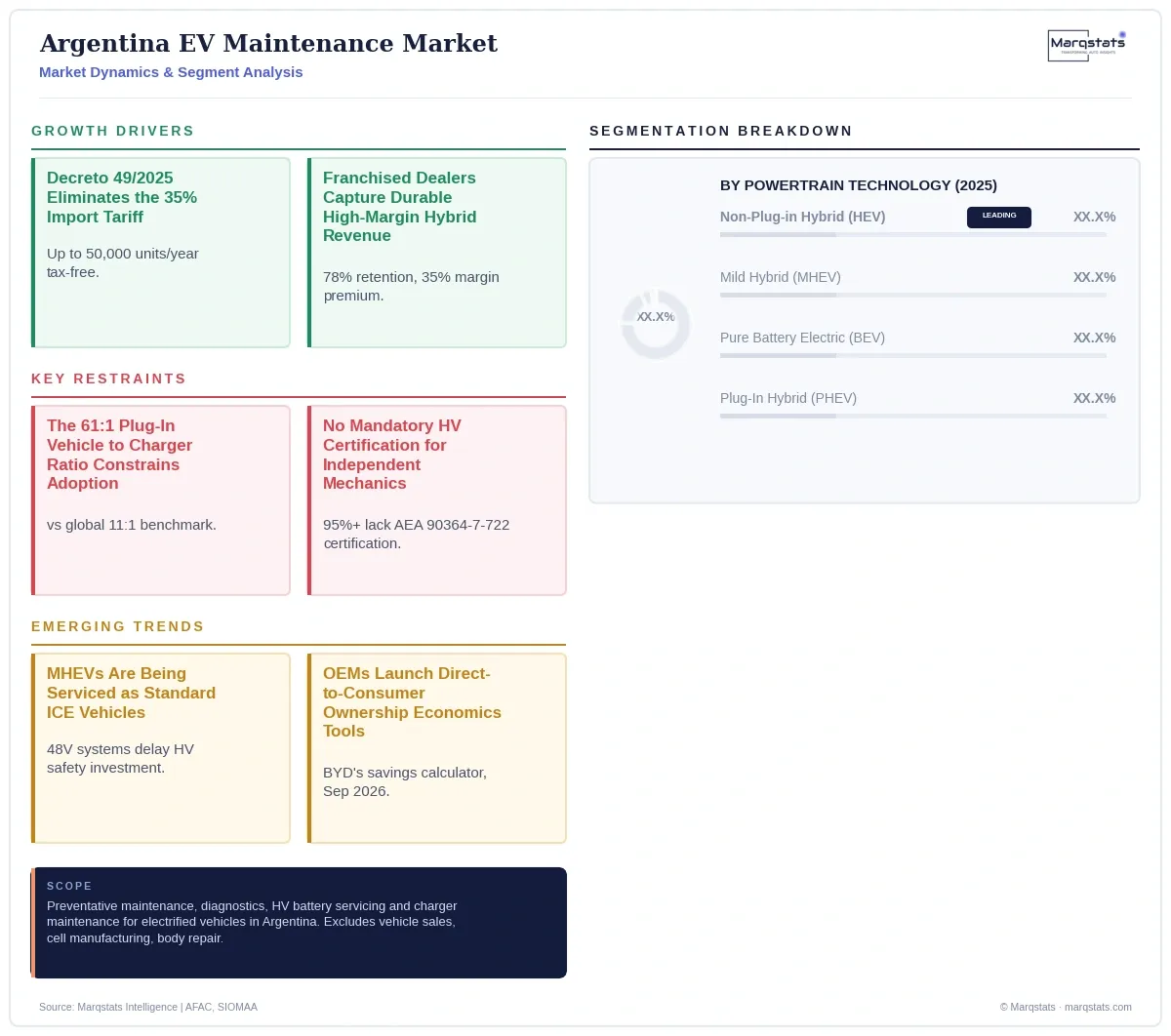
Decreto 49/2025's tariff elimination was designed to accelerate electrified vehicle adoption, and on that goal, it has clearly worked — zero tariffs on up to 50,000 units annually removed a major cost barrier for importers. What the decree's own text also did, less visibly, was draw a specific technical boundary: vehicles weighing under 400 kg or producing under 15 kW were explicitly excluded from the tariff relief.
That boundary happens to fall precisely where Argentina's domestic micro-EV manufacturers operate. Coradir's Tito and Tita models sit below that weight-and-power threshold, meaning the company pays full import duties on the lithium cells and controllers it needs, while an imported USD 50,000 luxury mild-hybrid SUV, comfortably above the threshold, enters completely tariff-free. The practical effect is a policy that accelerates adoption of larger, imported hybrid vehicles more than it supports the smaller, genuinely electric vehicles domestic manufacturers are actually building.
Market Dynamics
Key Drivers
- Argentina's own fully partitioned sizing model shows BEV and PHEV segment value both quadrupling in share by 2030, a structural signal that genuine high-voltage diagnostic demand, still under 4% of the market today, is set to become a materially larger share of near-term investment priority even while hybrid servicing remains dominant in absolute terms throughout the forecast window.
- Decreto 49/2025's elimination of the 35% import tariff on up to 50,000 electrified vehicles annually has directly accelerated fleet growth, with electrified vehicle annual sales reaching 26,632 units in 2025 and continuing to climb into 2026.
- Official dealership networks are capturing durable, high-margin hybrid servicing revenue, with Toyota Argentina and similar franchised networks retaining a 78.00% post-warranty hybrid service share at margins 35.00% higher than equivalent ICE servicing, anchoring near-term market value in the dominant channel.
- Domestic micro-EV manufacturing, exemplified by Coradir's Tito and Tita models, is demonstrating a genuinely disruptive maintenance-cost proposition — cutting routine maintenance spend by 90.00% compared to B-segment ICE vehicles by eliminating oil, spark plug and transmission fluid service requirements entirely.
- Independent advanced repair capacity is beginning to emerge to challenge dealer service monopolies, exemplified by Pixart's July 2025 launch of Argentina's first dedicated independent EV/HEV electronics repair plant in Escobar, equipped with Class 0 dielectric tools and fireproof battery containment chambers.
- Commercial fleet electrification is expanding into mining and logistics, with manufacturers including Foton (represented by Grupo Corven) deploying MHEV and BEV commercial fleets into NOA region mining operations, creating new specialized maintenance demand outside the traditional passenger vehicle market.
Key Restraints
- Argentina's macroeconomic volatility introduces a genuine policy-durability risk this market's own scenario framework treats as a primary variable: unlike markets where import policy risk is largely regulatory, Argentina's Downside Scenario is triggered specifically by foreign exchange payment controls, a distinctly macroeconomic rather than purely automotive-policy risk factor.
- Argentina's public charging network, at just 318 points as of August 2026, creates a 61:1 plug-in-vehicle-to-charger ratio nearly six times worse than the global 11:1 benchmark, constraining how quickly plug-in hybrid and battery-electric adoption can genuinely scale regardless of import policy.
- No national statutory body enforces mandatory high-voltage safety certification for independent garage mechanics, with over 95% of independent repair shops lacking certification under AEA 90364-7-722, creating a genuine liability exposure that constrains independent workshop expansion into high-voltage servicing.
- Decreto 49/2025's 400 kg and 15 kW tariff-exclusion thresholds structurally disadvantage domestic micro-EV manufacturers relative to imported hybrid vehicles, forcing full import duties on lithium cells and controllers precisely for the vehicle category with the most disruptive maintenance-cost proposition.
- Geographic concentration is severe: over 70.00% of specialized high-voltage diagnostic equipment sits within CABA and the AMBA region, leaving interior provinces including Córdoba and Mendoza facing genuine service bottlenecks despite electricity tariffs there reaching ARS 200/kWh, well above metropolitan rates.
Key Trends
- Insurance underwriters and fleet-leasing companies operating in Argentina are beginning to reference high-voltage certification status when structuring commercial policy terms, an early signal that formal safety credentialing may eventually become a de facto market requirement even without a statutory mandate forcing it.
- Mild-hybrid vehicles, which operate on 48V auxiliary systems without high-voltage traction batteries, are being treated by independent workshops as standard ICE vehicles, delaying necessary technician investment in high-voltage safety certification even as MHEV registrations grew 250.30% in 2025.
- OEMs are launching direct-to-consumer digital tools to quantify EV ownership economics, exemplified by BYD Argentina's September 2026 savings calculator demonstrating a Dolphin Mini driving 15,000 km annually saves ARS 1.60 million in fuel costs, while transparently acknowledging offsetting specialized tire wear costs.
- Commercial vehicle manufacturers are confronting a genuine maintenance-infrastructure gap in remote operating regions, with mining sites in the NOA region lacking 3-phase high-power chargers and specialized maintenance personnel, forcing fleet operators toward mobile diagnostic unit deployment as an interim solution.
- Regulatory policy is shifting toward prioritizing earlier-nationalized, lower-FOB-price vehicles within the Decreto 49/2025 quota system, following a January 2026 decree modification substituting Annex I and Articles 2-4 of the original framework.
Strategic Implications
- Policy advocates and industry associations, including AAVEA, should treat the absence of mandatory high-voltage workshop certification as a genuine near-term priority to address, given how directly the current voluntary-compliance structure both limits independent workshop growth and exposes consumers to inconsistent safety standards across the rapidly expanding hybrid and BEV parc.
- New entrants, including independent EV repair specialists and diagnostic equipment providers, should prioritize Class 0 dielectric tooling and high-voltage certification investment specifically in the CABA/AMBA corridor first, following Pixart's own market-entry precedent, before expanding into interior provinces where genuine plug-in vehicle density remains thin.
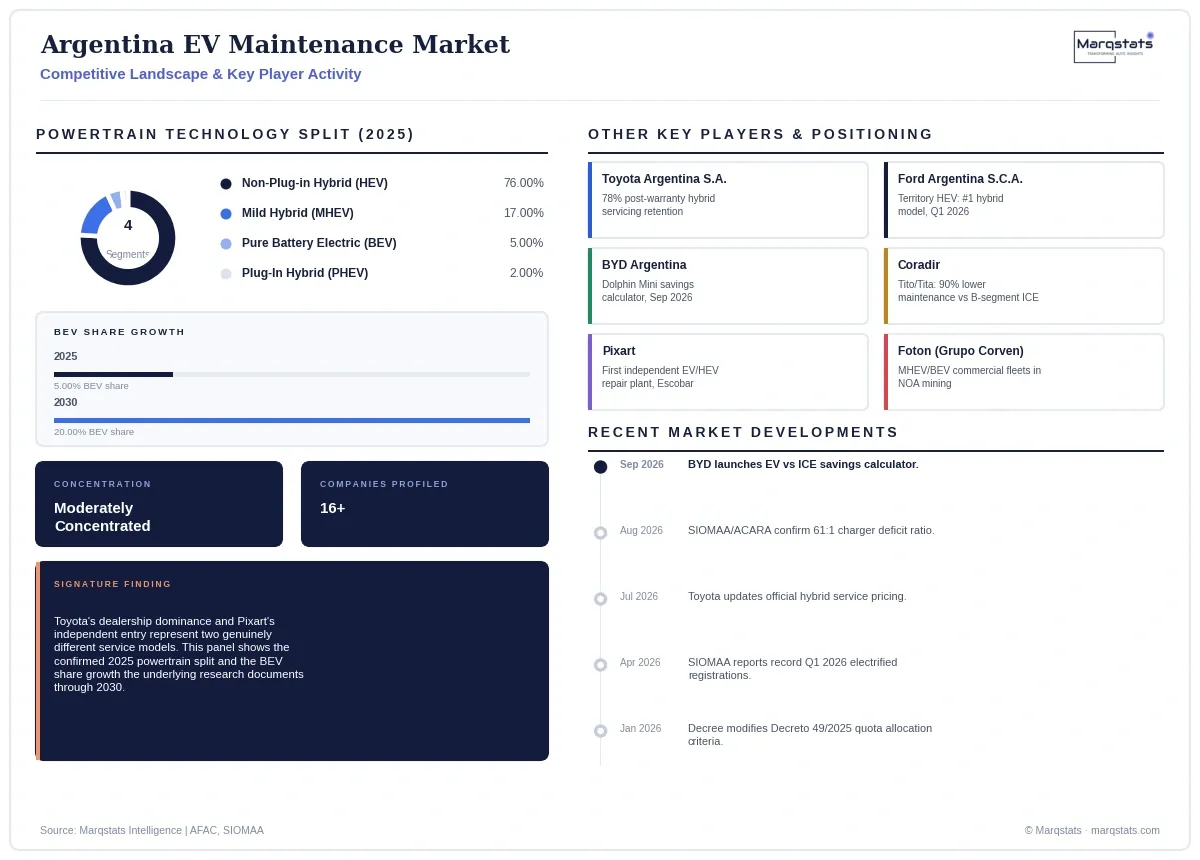
- Incumbent franchised dealerships should treat their current 78.00% post-warranty hybrid servicing retention as a genuinely defensible near-term position given the fleet's 96.33% hybrid composition, while beginning deliberate investment in high-voltage BEV servicing capability ahead of the segment's projected share growth from 5.00% to 20.00% by 2030.
- Suppliers and investors evaluating domestic micro-EV manufacturing, following Coradir's example, should factor Decreto 49/2025's weight-and-power tariff exclusion directly into unit economics modeling, since the current policy structure imposes a genuine, quantifiable cost disadvantage relative to imported hybrid competitors regardless of the vehicle's own environmental or cost advantages.
- Commercial fleet operators electrifying mining and logistics operations in interior provinces should budget for mobile diagnostic unit deployment as a structural requirement, not a temporary workaround, given the persistent gap between metropolitan high-voltage service infrastructure and remote operational geography this market's own regional data documents.
Outlook
Three genuinely distinct, evidenced trajectories emerge from named regulatory and macroeconomic trigger conditions rather than differing growth-rate assumptions applied to the same story. Under the Downside Foreign Exchange Restriction Scenario, the Central Bank of the Argentine Republic reimposes strict SIRA/SEDI foreign exchange payment controls in mid-2027, preventing importers from utilizing full Decreto 49/2025 quotas and stalling 0km electrified vehicle imports below 25,000 units annually; the electrified fleet reaches only 410,000 units by 2030, with total maintenance expenditure reaching USD 245.00 million.
Under the Base Case Scenario, Decreto 49/2025 remains in force through its full five-year term ending January 2030, maintaining the 50,000-unit annual tax-free import cap; the electrified fleet reaches 640,000 units by 2030, generating USD 371.20 million in annual maintenance expenditure at a 47.46% CAGR, as the national fleet reaches 3.7% electrification.
Under the Upside Quota Expansion Scenario, the Argentine National Congress enacts the proposed Ritondo Electromobility Bill before December 2027, expanding public charger tax credits to build 2,500 fast-charging stations and raising the annual import quota under Decreto 49/2025 to 100,000 units; the electrified fleet expands to 920,000 units by 2030, lifting total maintenance expenditure to USD 520.00 million, as electrified sales capture 30% of new vehicle registrations by 2029.
Market Segmentation
USD 40.45 million (76.00% share) in 2025; projected at USD 185.60 million (50.00% share) by 2030. The largest segment by a wide margin, anchored by Toyota Argentina's dominant dealership network, though its share compresses as BEV and PHEV adoption accelerates.
USD 9.05 million (17.00% share) in 2025; projected at USD 74.24 million (20.00% share) by 2030. Anchored by Ford Argentina, operating on 48V auxiliary systems that independent workshops currently service as standard ICE vehicles.
USD 2.66 million (5.00% share) in 2025; projected at USD 74.24 million (20.00% share) by 2030. The fastest-growing segment by share, anchored by BYD Argentina and domestic manufacturer Coradir.
USD 1.06 million (2.00% share) in 2025; projected at USD 37.12 million (10.00% share) by 2030. Anchored by Volvo and BYD, growing fastest in unit terms but constrained by Argentina's severe public charging infrastructure gap.
USD 41.51 million (78.00% share) in 2025; projected at USD 222.72 million (60.00% share) by 2030. Anchored by Toyota, Ford and Renault, dominant during warranty periods with premium hybrid-specific diagnostic margins.
USD 7.98 million (15.00% share) in 2025; projected at USD 74.24 million (20.00% share) by 2030. Anchored by the YPF Boxes network, capturing routine hybrid ICE-side servicing.
USD 3.73 million (7.00% share) in 2025; projected at USD 74.24 million (20.00% share) by 2030. The fastest-growing channel, anchored by Pixart's Escobar facility and Bosch Car Service, though structurally limited by the absence of mandatory high-voltage certification standards.
By Geography
A note on regional registration distortion
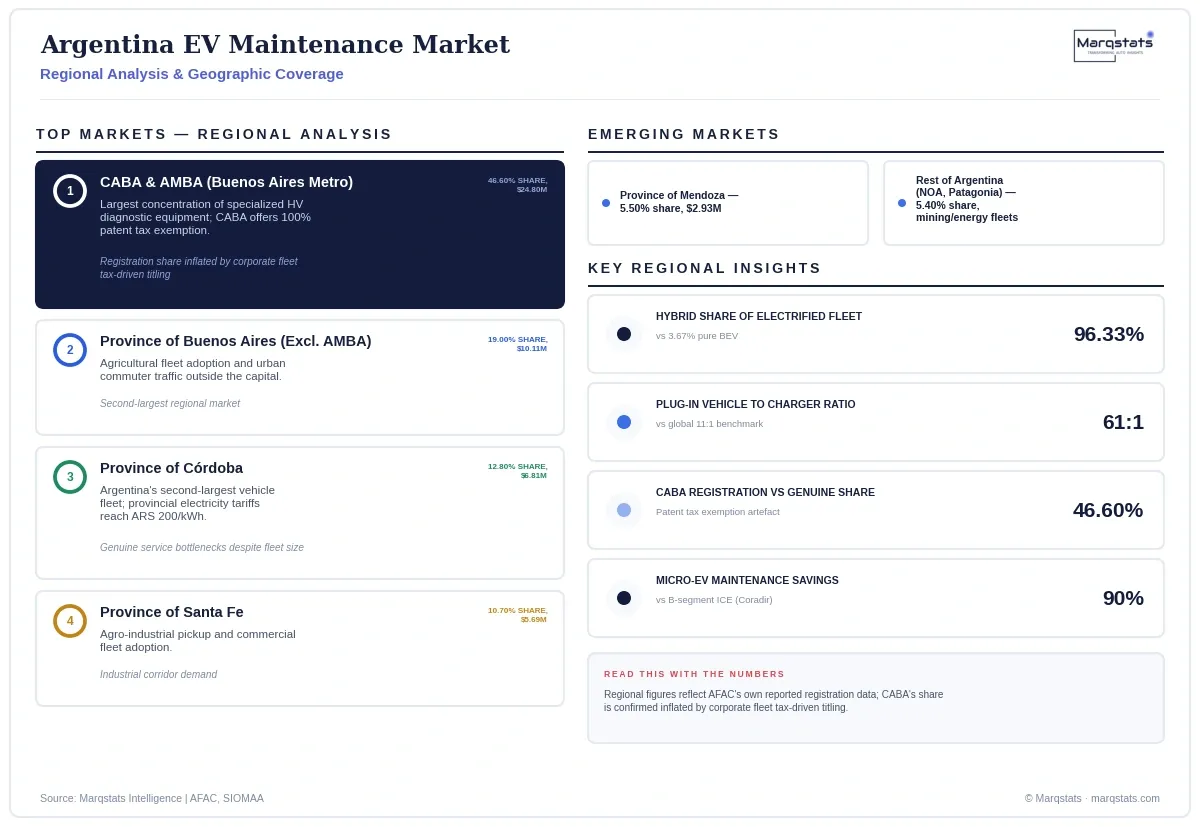
CABA's reported 46.60% share of national EV maintenance revenue is confirmed inflated by corporate fleet registration seeking the city's 100% Patent Tax exemption for electrified vehicles, despite those vehicles operating across the broader AMBA metropolitan region and interior provinces.
CABA & AMBA (Buenos Aires Metropolitan Area)
USD 24.80 million (46.60% share) in 2025, driven by fleet concentration and CABA's 100% patent tax exemption for electrified vehicles — the single largest concentration of specialized high-voltage diagnostic equipment nationally.
Province of Buenos Aires (Excluding AMBA)
USD 10.11 million (19.00% share) in 2025, driven by agricultural fleet adoption and urban commuter traffic outside the capital region.
Province of Córdoba
USD 6.81 million (12.80% share) in 2025, Argentina's second-largest vehicle fleet, facing genuine service bottlenecks despite provincial electricity tariffs reaching ARS 200/kWh.
Province of Santa Fe
USD 5.69 million (10.70% share) in 2025, driven by agro-industrial pickup and commercial fleet adoption.
Province of Mendoza
USD 2.93 million (5.50% share) in 2025, a regional transit hub with municipal fleet electrification underway.
Rest of Argentina (NOA, Patagonia)
USD 2.88 million (5.40% share) in 2025, driven by mining (lithium/copper) and energy sector commercial fleet adoption, though constrained by the absence of 3-phase high-power chargers and specialized maintenance personnel in remote operating sites.
How Competition Is Evolving
No single company in this market spans franchised dealership servicing, quick-service lubricant chains and independent high-voltage diagnostic capability simultaneously, leaving genuine competitive white space for any group capable of bridging warranty-era dealer relationships with the post-warranty independent channel this market's own forecast shows expanding fastest through 2030.
Competition spans franchised dealership networks, quick-service lubricant chains, and an emerging independent specialized EV garage segment still constrained by the absence of mandatory high-voltage certification standards. Toyota Argentina S.A. anchors the franchised dealership channel through its dominant Corolla Cross HEV service volume, retaining a 78.00% post-warranty hybrid servicing share at premium margins; Ford Argentina S.C.A. anchors the mild-hybrid segment following the Ford Territory's displacement of the Corolla Cross as Argentina's top-selling hybrid model in Q1 2026; Renault rounds out the dominant franchised dealership consortium. BYD Argentina and domestic manufacturer Coradir anchor the pure battery-electric segment, with Coradir's Tito and Tita models demonstrating a genuinely disruptive maintenance-cost proposition for the domestic micro-EV category.
On the independent and quick-service side, the YPF Boxes network anchors quick-service lubricant chain volume for hybrid ICE-side servicing, while Pixart's July 2025 launch of Argentina's first dedicated independent EV/HEV electronics repair plant in Escobar — equipped with Class 0 dielectric tools, ultrasound cleaning, V2G test stations and fireproof battery containment chambers — represents the first genuine private-sector challenge to dealer service monopolies. Bosch Car Service anchors broader independent diagnostic capability. On commercial fleet electrification, Foton, represented locally by Grupo Corven, is expanding MHEV and BEV commercial fleets into mining and logistics operations, while AAVEA (the Argentine Association of Electric and Alternative Vehicles) anchors industry-wide standards and policy advocacy.
Companies Covered
The report profiles 16+ companies with full strategy and financials analysis, including:
Recent Market Activity
Table of Contents
Coverage & Segmentation
This report measures routine preventative maintenance, electrical diagnostic scans, high-voltage battery health checks and cell balancing, electric drive motor and inverter maintenance, and public and private charger maintenance services for electrified light and commercial vehicles in Argentina, across a 2025 base year and a 2026 to 2030 forecast period, denominated in United States dollars at a constant 2025 average reference exchange rate of 1,200 ARS/USD held across the forecast period. It excludes whole vehicle sales revenue, high-voltage battery cell manufacturing capital expenditure, raw electricity sales, and structural body repairs.
The analysis spans two segmentation dimensions — powertrain technology and service provider channel — six regional geographies, and 16 profiled entities across OEMs, independent repair specialists and regulatory bodies. Fleet and registration figures trace to AFAC and SIOMAA/ACARA; market value and segment splits trace to the underlying research's own fully partitioned sizing model.