Market Snapshot
Key Takeaways
Market Overview & Analysis
Report Summary
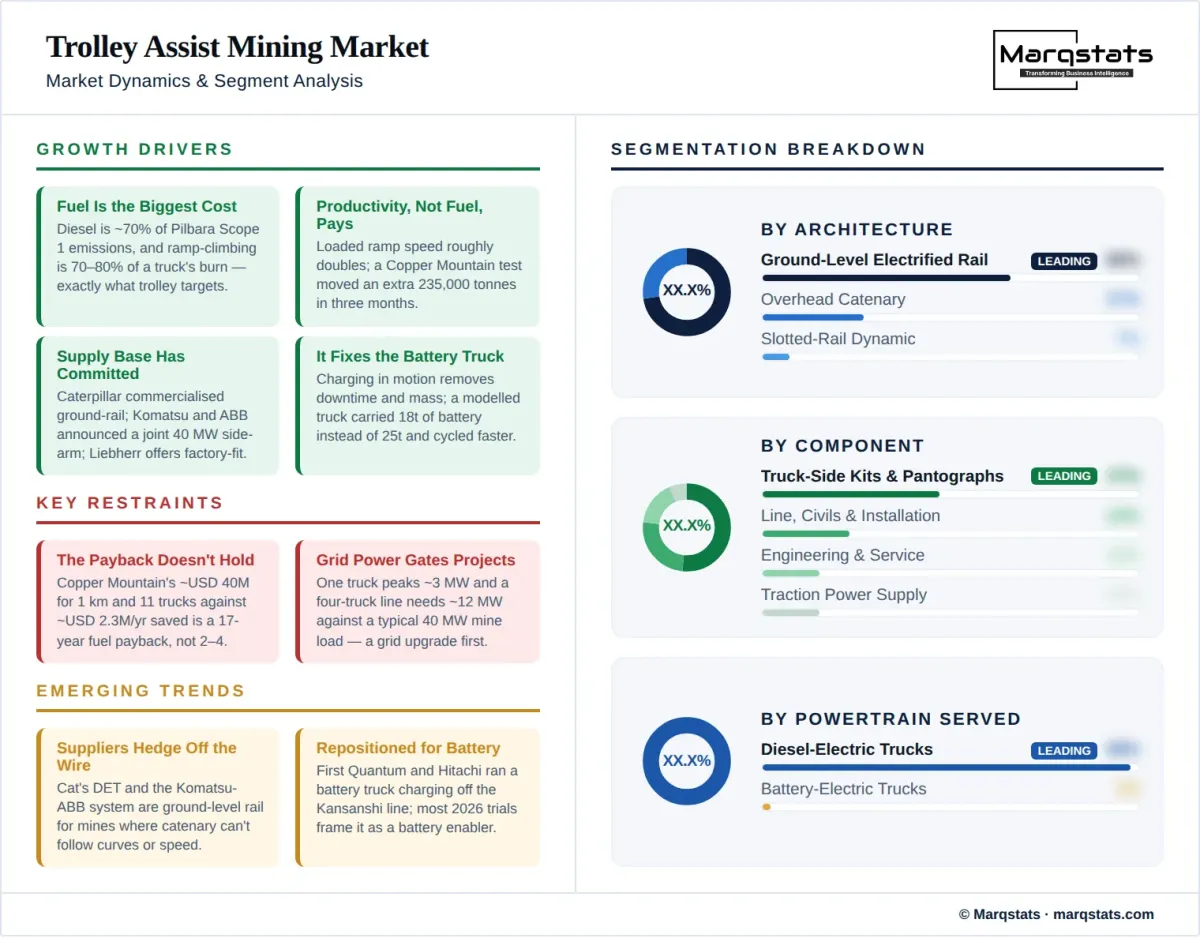
Haulage is where a surface mine burns its diesel. Rio Tinto has stated publicly that diesel accounts for about 70% of total carbon emissions from its Pilbara iron ore operations, and roughly 70% to 80% of a haul truck's fuel is burned climbing the ramp loaded. That concentration is what makes dynamic energy transfer attractive: electrify one steep, heavily trafficked kilometre and you touch a disproportionate share of the fuel bill without electrifying the whole fleet or the whole road network.
The engineering works and has worked for decades. Across four independent operators the pattern is consistent: loaded speed on a ramp roughly doubles, from 11 to 15 kilometres per hour on diesel to 20 to 28 on line. First Quantum's Sentinel cut ramp time from 5.5 minutes to 3.0; Copper Mountain from 3 minutes 54 to 2 minutes 23. Fuel burn on the electrified segment falls by 90% or more — 650 litres per hour to 50 at Sentinel, 29.6 litres per run to 0.9 at Copper Mountain. Modern systems run at about 2,600 volts DC, with one supplier specifying a 2,150 to 2,800 volt operating window and a rated draw of up to 4.5 MW per truck; measured peak demand at an operating site is closer to 3 MW.
What has not worked is the spread of it. The Aitik pilot has not grown beyond its original 700 metres in eight years on the most recent supplier account, although one earlier source records an expansion to 1.7 kilometres. Copper Mountain has not expanded under new ownership. Ferrexpo's 14 kilometres across three pits has been board-approved since early 2022 with nothing built, and its operations were suspended in late 2025 after strikes on Ukraine's power grid. Vale's Carajás line, announced in June 2022 for 2023 commissioning, cannot be confirmed as built. BHP's Escondida system, at a disclosed USD 250 million the largest project ever proposed, remains in permitting. The 2021 and 2022 announcement wave produced remarkably little steel in the ground.
Three things explain the gap. The first is that the payback arithmetic circulating in the industry is wrong: on Copper Mountain's disclosed capital cost and measured energy saving, fuel alone repays the investment in about seventeen years, not two to four. The second is grid capacity — a four-truck installation draws around 12 MW against a typical mine load of roughly 40 MW, and operators and consultants name power availability as a deployment risk, although no project has been publicly confirmed to have been delayed by it. The third is pit geometry: catenary needs a long, straight, steep, stable ramp that will not move for a decade, together with electric-drive trucks and spare grid capacity — a combination that rules out short-life operations, curved or frequently redesigned haul roads and any mechanical-drive fleet. No published estimate exists of what share of the world's open pits qualify.
Marqstats sizes the trolley assist mining market at USD 66.9 million in 2025, rising to USD 412.1 million in 2030 at a CAGR of 43.85%. Installed line grows from 26.0 to 95.2 kilometres and equipped trucks from 280 to 806. Growth is genuine but it comes from a base small enough that a single project moves the total: revenue fell from USD 73 million in 2022 to USD 26 million in 2023 purely because two installations completed and nothing replaced them. Any reader should treat annual figures in this market as project timing rather than trend.
Market Dynamics
Key Drivers
Fuel is the largest controllable cost and the largest emission source. Diesel is roughly 70% of Pilbara iron ore Scope 1 emissions on Rio Tinto's own disclosure, and about 13% of one Australian coal producer's operating costs, rising to 20% including rail logistics. Ramp climbing accounts for 70% to 80% of a haul truck's fuel burn, which is precisely the duty cycle dynamic energy transfer addresses.
Productivity, not fuel, is where the return actually sits. Loaded ramp speed roughly doubles on line, cutting ramp time by 39% to 45%. Copper Mountain's three-month, seven-truck test moved an additional 235,378 tonnes and cut average energy cost per run from USD 50.26 to USD 12.84. Faster cycles reduce the number of trucks needed for a given tonnage, though no operator has published the fleet-size reduction.
The supply base has committed capital and product. Caterpillar built a test track at its Tucson proving ground and commercialised Dynamic Energy Transfer in 2026; Komatsu and ABB announced a joint 40 MW system in May 2026 and Komatsu has a 1.9 kilometre side rail plus a curved trolley section planned at its Arizona proving ground; Liebherr offers trolley as a factory option across the T 236, T 264, T 274 and T 284; Wabtec converts any of its AC-drive trucks in under a week.
Dynamic transfer solves the battery truck's worst problem. Peer-reviewed modelling of an 8,660 metre haul with a 314 metre lift found a battery truck charging dynamically completed the cycle in 1,817 seconds against 2,342 seconds charging statically and 2,500 seconds on battery alone, while carrying 18 tonnes of battery instead of 25. Charging in motion removes both the downtime and a large part of the battery mass.
Autonomy has arrived and is compatible. Komatsu commissioned the thousandth ultra-class autonomous haul truck in April 2026 and demonstrated an electric-drive truck operating autonomously under a live trolley line in May 2025. Caterpillar's system integrates with its autonomy platform. A fixed electrified route is easier, not harder, for an autonomous fleet.
Key Restraints
The payback case does not survive real project costs. Copper Mountain's roughly USD 40 million for one kilometre and eleven converted trucks against a measured energy saving annualising to about USD 2.3 million implies a seventeen-year payback on fuel alone. No trolley-specific internal rate of return or net present value has ever been published by anyone, and the two-to-four-year payback in circulation traces to a 2011 conference paper built on 1980s analysis.
Grid power, not equipment, gates the projects. A single truck peaks at around 3 MW and a four-truck line needs roughly 12 MW against a typical mine's 40 MW total load. Copper Mountain required a 12 MW DC substation for one kilometre; Collahuasi installed two 5.5 MW transformers for its. Mines without spare capacity face a grid upgrade before they face an equipment decision.
Pit geometry disqualifies most operations. Catenary needs a long, straight, steep, stable ramp. First Quantum's design standard for a greenfield project specifies haul roads at least 42 metres wide and no steeper than one in ten, with electrical houses every 350 metres — a specification set at mine-design stage, not retrofitted. Curves, frequent pit-design changes and short remaining mine life all rule it out.
Cheaper, uncommitted alternatives exist. Renewable diesel is a drop-in with zero capital cost and no pit-design constraint, carrying a 15% to 35% price premium over conventional diesel. For any mine with a short remaining life or an unstable pit it is the rational choice, and Rio Tinto ran a 10 million litre Pilbara trial in early 2025 cutting about 27,000 tonnes of CO2.
Conveying beats trucking outright on energy. In-pit crushing and conveying delivers 81% of its energy into moving payload against a truck's 39%, and published studies put haulage energy reduction at 63% to 67% with mining costs down at least 15%. Its weakness is rigidity — Vale added trucks back to its flagship truckless operation in 2024 — but on pure energy it is the stronger answer.
Key Trends
The suppliers are hedging away from overhead wire. Caterpillar's Dynamic Energy Transfer and the Komatsu-ABB proposition are both ground-level electrified rail with a side-mounted arm, explicitly positioned for mines where overhead infrastructure is problematic, and both handle curves and high speeds that catenary cannot. ABB's own November 2025 electrification release led on automated static charging rather than trolley.
Trolley is being repositioned as charging infrastructure for battery trucks rather than assistance for diesel ones. First Quantum and Hitachi Construction Machinery publicly demonstrated an ultra-class battery-electric truck at Kansanshi in April 2026 that charges from the existing trolley line, after a trial running since June 2024, targeting commercial availability in the 2027 financial year. Most current trials — BHP, Rio Tinto, Antofagasta and the Kansanshi programme — frame dynamic transfer as a battery enabler. Codelco's is the exception, running diesel-electric trucks in the classic diesel-assist configuration.
Hydrogen has left the field. First Mode, which absorbed Anglo American's nuGen programme under a USD 200 million agreement in January 2023, lost its funding in December 2024, filed for Chapter 11 the same month, and had substantially all its assets bought by Cummins in February 2025 for a reported USD 18.4 million. Valterra Platinum, which owns Mogalakwena following its demerger from Anglo American in June 2025, has not proceeded with the planned 40-truck rollout.
Battery haulage is winning on momentum and slipping on timing simultaneously. The battery mining truck fleet passed trolley's in 2025 and grew 37% year on year, and Fortescue committed to 360 trucks with 2.6 MWh packs and 6 MW static chargers. Yet BHP stated in August 2026 that battery-electric deployment across its operations is not expected until after the 2030 financial year, and that 240-tonne-class architectures remain under active development.
Nobody discloses what any of this costs. No mining trolley infrastructure contract value has ever been published by ABB, Siemens, Caterpillar, Komatsu, Liebherr or Wabtec. The only public capital figures come from miners: Boliden's SEK 300 million for two mines, Copper Mountain's USD 40 million, BHP's USD 250 million proposal. A market sized on disclosed contract values cannot be built; it has to be built bottom-up from kilometres, megawatts and truck kits.
Market Segmentation
Overhead catenary is the incumbent and the declining share. It accounted for all of the installed dynamic energy transfer line in 2025, roughly 26 kilometres, and for the whole of that year's new installation. Its advantages are maturity and a forty-year operating record; its constraints are that it cannot follow curves, obstructs pit expansion above the line, and requires masts and foundations that make relocation impractical. Catenary line and civils generate USD 15.6 million of 2025 revenue and USD 34.5 million by 2030, growing at 17.20% — the slowest revenue line in this study. Measured against total market value, which also includes power supply, truck kits and engineering, that is 23.3% falling to 8.4%; measured within the line-and-civils spend alone, catenary falls from 100% of it in 2025 to 30.1% in 2030.
Ground-level rail is the challenger and the growth engine. Caterpillar launched Dynamic Energy Transfer in September 2024 — a power module, an electrified ground rail and a machine-mounted connecting arm that works with both diesel-electric and battery-electric trucks, handles curves and high speed, and mounts on either side. Komatsu and ABB announced a comparable side-arm system rated to 40 MW within a single galvanic section in May 2026. The segment generates no 2025 revenue and USD 80.0 million by 2030 — 19.4% of total market value and 69.9% of line-and-civils spend — on 20 kilometres installed in that year alone.
Slotted-rail systems are the third geometry and the least mature. BluVein's design carries the conductor inside a slotted rail with a hammer-shaped collector, avoiding exposed conductors entirely. Two variants exist and should not be conflated: BluVein1, rated at about 1 MW and aimed at underground haulage, is the one that received an A$9 million grant from the Australian Renewable Energy Agency in August 2025, entered staged full-power testing in March 2026 and targets technology readiness level 7 by the end of 2026 with a mine-site trial in 2027. BluVeinXL, the ultra-class surface variant rated at about 8 MW and the only one in this study's scope, is further behind. Slotted rail is grouped with ground-level rail in the revenue segmentation because it does not reach material volume separately within the forecast period.
Truck-side hardware is the largest revenue stream in every year of this study: USD 31.5 million and 47.1% of the market in 2025, USD 159.9 million and 38.8% in 2030, compounding at 38.39%. A retrofit runs to roughly USD 1 million per truck on the one public disclosure, falling as factory-fit displaces retrofit. This is also the segment with the widest supplier base, because it attaches to the truck rather than to the mine — Caterpillar, Komatsu, Liebherr and Hitachi all offer it factory-fitted, and Wabtec converts any of its AC-drive trucks, including Chinese-built ones, in under a week.
Rectifier substations, electrical houses and grid connection are the fastest-growing component at 50.77%, from USD 9.6 million to USD 74.8 million. Installations run at roughly 8 MW of traction supply per kilometre of line — Copper Mountain took a 12 MW DC substation for one kilometre, Collahuasi two 5.5 MW transformers, Aitik a 4.8 MW rectifier for 700 metres. This segment grows faster than the line itself because ground-rail systems carry higher power density and because grid connection costs rise with the remoteness of the sites now being considered.
Line and civils covers masts, contact wire or ground rail, foundations and the earthworks to build the electrified ramp itself. Taken together across both architectures it is USD 15.6 million in 2025 and USD 114.5 million in 2030. The earthworks component is easy to underestimate: Copper Mountain moved 8 million tonnes of material to build the ramp its one-kilometre line sits on, and that civil work sits inside the same capital budget as the electrification.
Engineering, commissioning and aftermarket service is modelled at 18% of installed hardware value throughout, USD 10.2 million in 2025 rising to USD 62.9 million in 2030. No mining trolley engineering award has ever been publicly named to any of the major mine-engineering firms, which is itself informative: this work is currently being done by the equipment suppliers and by local electrical contractors rather than by the study-and-design tier.
Diesel-electric trucks account for effectively all of the installed base and are the reason the technology is called trolley assist rather than trolley haulage — the engine remains, and drops to idle rather than switching off. The sole exception is the single battery-electric demonstrator running under the Kansanshi line. The structural constraint is that mechanical-drive trucks cannot be converted at all, which excludes several of the highest-volume models in the world fleet, and no source publishes the diesel-electric share of the global haul truck population.
Battery-electric trucks are where the supply base expects the market to go, and where every 2026 trial is aimed. Charging in motion removes the two things that make battery haulage difficult — charging downtime and battery mass — and Caterpillar's system was designed from the outset to serve both powertrains. The Kansanshi battery truck commissioned in April 2026 charges from an existing trolley line; BHP will commission static and dynamic charging together at Jimblebar in the 2027 financial year, explicitly to address battery chemistry and charging downtime limitations.
By Geography
Africa
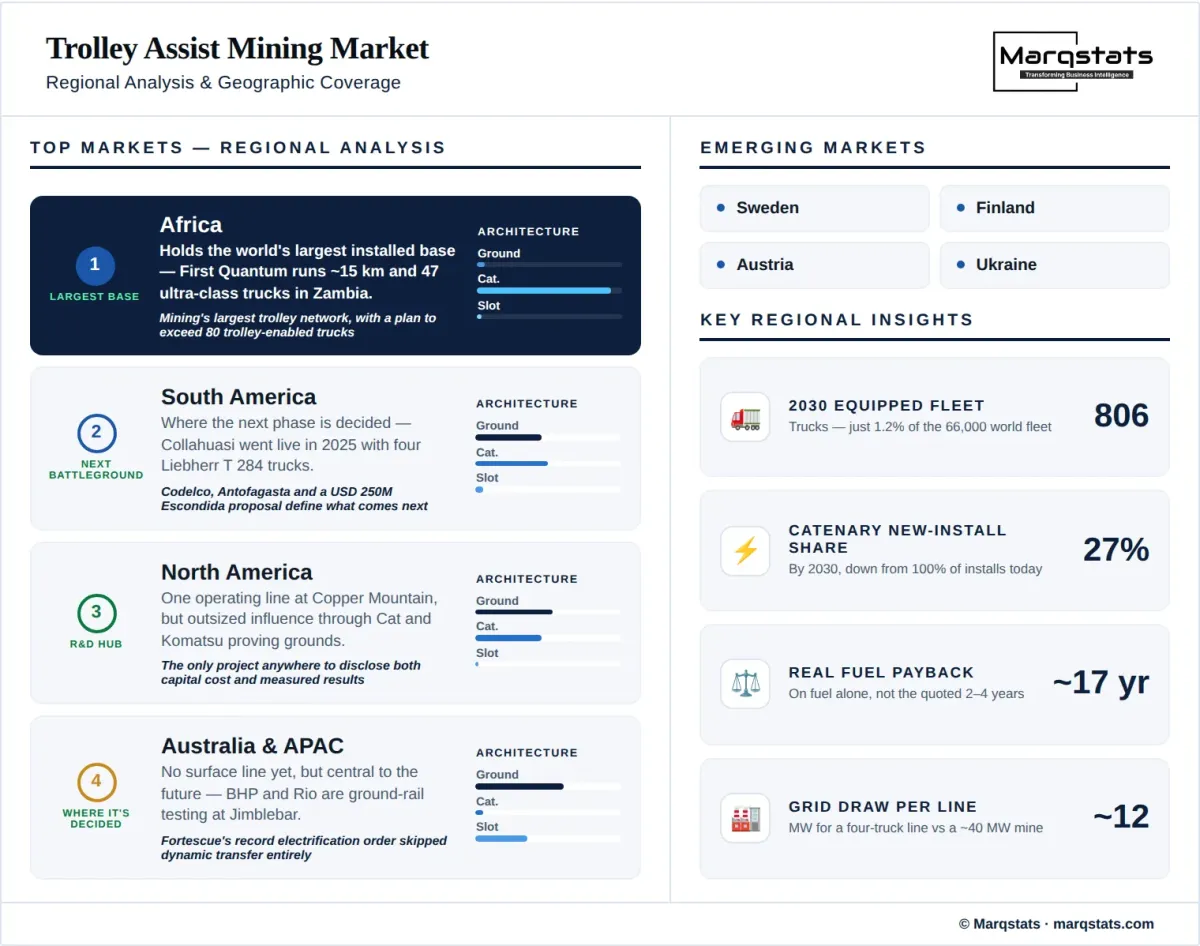
Africa holds the largest installed base in the world and the deepest operating history. First Quantum Minerals operates roughly 15 kilometres of trolley across Kansanshi and Sentinel in Zambia — about ten and five kilometres respectively — with 47 ultra-class trucks running on line and a stated plan to reach more than 80 trolley-enabled trucks and add a further ten kilometres over five years. Those figures rest on a single trade disclosure in May 2026 and do not appear in the company's filings. That is comfortably the largest trolley network in mining, and it is where the technology's economics have been most convincingly demonstrated: Sentinel reports ramp speed doubling and fuel burn falling from 650 to 50 litres per hour on line. Namibia's Husab uranium mine revived an existing line in February 2023 with two Komatsu 960E trucks. Barrick's Lumwana in Zambia appears on supplier reference lists but discloses no line length or current status, and the region's historic installations at Palabora, Sishen, Grootegeluk and Rössing were all decommissioned around 2001, with Nchanga in Zambia having closed earlier on an unrecorded date.
South America
South America is the region where the next phase will be decided. Collahuasi commissioned the continent's first surface trolley system at the Rosario pit in the third quarter of 2025 — one kilometre, four Liebherr T 284 trucks, two 5.5 MW transformers, delivered turnkey by Liebherr with a regional transmission partner. Codelco has committed to a roughly one-year trial of Caterpillar's ground-rail system at Radomiro Tomic with three Cat 798 AC trucks on one operational ramp, scheduled to start in the second quarter of 2026 with preliminary calculations pointing to a 60% to 70% cut in truck emissions; no confirmation of launch had appeared by August 2026. Antofagasta has a board-approved trolley pilot at Los Pelambres that has been described as a trial for two years running and states dynamic charging from 2027. BHP's Escondida proposal, at USD 250 million the largest ever disclosed, remains in environmental permitting. First Quantum's Taca Taca in Argentina designs trolley-assisted haul lanes into its technical report, and the La Granja joint venture in Peru lays out haul roads with straight segments to accommodate future trolley.
Europe
Europe is where the technology was proved and where it has conspicuously failed to scale. Boliden approved SEK 300 million in October 2019 for trolley at Aitik in Sweden and Kevitsa in Finland; Kevitsa runs 1.3 to 1.8 kilometres, depending on the source, with thirteen trucks, while Aitik's pilot line has not grown past 700 metres in eight years despite three further kilometres being in the original plan. VA Erzberg in Austria built five kilometres for seven Liebherr T 236 trucks at a combined line-and-truck cost of EUR 20 million, described at the time as the world's longest truck trolley line and the first hundred-tonne-class trolley fleet, although its operating status since 2021 could not be confirmed. Ferrexpo's 14 kilometres across three Ukrainian pits was approved in early 2022, remains unbuilt, and the operations were suspended in late 2025 after strikes on the national grid. Boliden did, however, commission Komatsu's first diesel-trolley power-agnostic truck at Aitik in July 2025 for a twelve-month field trial.
North America
North America has one operating installation and a disproportionate influence on where the technology goes next. Copper Mountain in British Columbia commissioned one kilometre in April 2022 with a 12 MW DC substation, seven trucks converted rising to eleven, part-funded by a C$2 million provincial industry grant, and is the only project anywhere to have disclosed both a capital cost and measured operating results. It has not expanded since Hudbay acquired the mine in June 2023. Agnico Eagle's Detour Lake project traces to a 2018 scoping study and has no confirmation of progress since. What the region does host is the development work: Caterpillar's ground-rail test track at its Tucson proving ground and Komatsu's Arizona proving ground, which combines a curved trolley section and ramp with a planned 1.9 kilometre side rail and a 6.5 MW static charging area.
Australia and Asia-Pacific
Australia has no operating surface trolley installation and is nonetheless central to the market's future. BHP and Rio Tinto progressed to ground-rail testing on Caterpillar 793 XE battery trucks at Jimblebar in June 2026 and BHP confirmed in August 2026 that it will commission static and dynamic charging there in the 2027 financial year. BluVein's slotted-rail system is being developed in Queensland with Australian federal funding. Fortescue, by contrast, committed USD 2.8 billion to Liebherr for 475 zero-emission machines and chose 2.6 MWh batteries with 6 MW static chargers, explicitly removing the pantograph from its production trucks — the single largest electrification order in mining history contains no dynamic transfer at all. In China, where electric mining trucks are deploying at scale, the dominant architecture is battery swap rather than any form of dynamic transfer, and no delivered Chinese surface trolley installation could be verified.
How Competition Is Evolving
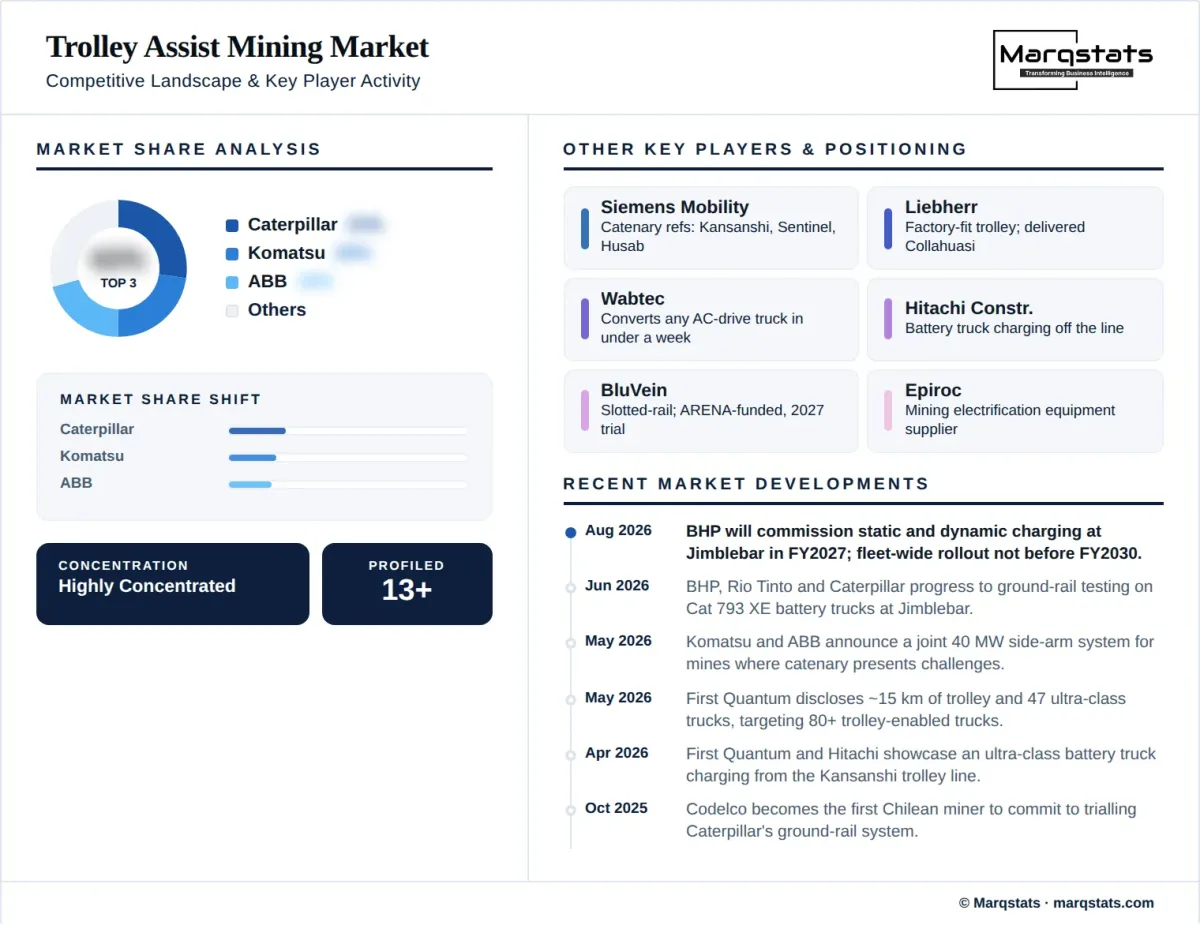
This market is highly concentrated and unusually opaque. Two firms have delivered most of the world's installations: ABB, which supplied Boliden's Aitik and Kevitsa lines and Copper Mountain's 12 MW substation and overhead line, and Siemens Mobility, whose reference list covers Kansanshi, Sentinel, Lumwana and Husab and which dates its entry to 1981. Neither has ever disclosed a contract value for any mining trolley project, and nor has any other supplier. The truck side is split between Caterpillar, whose trolley retrofit has been available for the 795F AC since February 2020; Komatsu, whose trolley package launched on the 830E-5 in 2021 and which demonstrated autonomous operation under a live line in May 2025; Liebherr, which offers trolley as a factory option from the 100-tonne T 236 to the 363-tonne T 284 and delivered Collahuasi turnkey and supplied the Erzberg fleet; and Wabtec, which sells conversion kits for any of its AC-drive trucks including Komatsu, Chinese and Belarusian platforms.
The competitive question in 2026 is not who supplies catenary but whether catenary is what gets bought. Caterpillar's Dynamic Energy Transfer, launched in September 2024, is a ground-level rail rather than an overhead wire, works with diesel-electric and battery-electric trucks alike, handles curves and high speeds, and has attracted BHP, Rio Tinto and Codelco to trials. In May 2026 Komatsu and ABB announced a joint side-arm system rated to 40 MW, positioned for mines where overhead infrastructure presents deployment challenges. That is the two largest incumbent suppliers of catenary hedging into a competing geometry, and it is the clearest signal in the market. BluVein occupies a third position with a slotted rail, backed by Australian government funding and targeting a mine trial in 2027.
Two structural cautions apply to any competitor analysis here. The first is corporate: Siemens now splits three ways, with Siemens Mobility holding the catenary product and Innomotics, sold to a private equity buyer in October 2024, holding the large-drive business; Hitachi Energy is the former ABB Power Grids and is not an ABB entity, nor is it Hitachi Construction Machinery, so three distinct Hitachi companies appear in this market; and Copper Mountain Mining Corporation ceased to exist as an issuer when Hudbay acquired it in 2023. The second is that dealers are not suppliers — Finning, WesTrac, SMS Equipment, Pon and Barloworld appear on these projects as distributors for Caterpillar and Komatsu, and counting them alongside the manufacturer double-counts the revenue.
Companies Covered
The report profiles 13+ companies with full strategy and financials analysis, including:
Recent Market Activity
Table of Contents
Coverage & Segmentation
This study sizes dynamic energy transfer infrastructure for surface mining worldwide: overhead catenary and its masts, foundations and contact wire; ground-level electrified rail and slotted-rail systems; rectifier substations, electrical houses, traction power supply and grid connection; truck-side pantographs, connecting arms, inverter upgrades and conversion kits; and the engineering, installation, commissioning and aftermarket service attached to them. It is an infrastructure market, not a vehicle market. The haul truck itself is out of scope, as are underground mine trolley systems, static fast charging, battery swap, railway electrification and trolleybus systems. The base year is 2025, the historical period 2022 to 2025 and the forecast period 2026 to 2030. All values are in United States dollars at manufacturer and contractor selling prices.
The scope boundary matters more here than in most markets, because five distinct technologies share one vocabulary and are routinely reported as though they were the same thing. Overhead catenary is a wire above the truck; Caterpillar's Dynamic Energy Transfer and the Komatsu-ABB proposition are electrified rails at ground level with a side arm; BluVein's is a slotted rail with an enclosed conductor; static fast charging involves no line at all; and battery swap involves no electrical connection to the vehicle in motion. All five have been described as trolley in trade coverage during the study period. This study covers the first three, which transfer energy to a vehicle in motion, and excludes the last two. Reports that draw the boundary differently will differ in size by roughly a factor of two, and the difference is definitional rather than empirical.