Market Snapshot
Middle bar: base-year value × (1 + CAGR), rounded to two decimals. This is a calculated illustration, not a separately researched annual estimate.
Battery swapping for commercial electric vehicles is commercially real in specific operating models—and China is already at industrial scale. As many as half of China’s electric heavy-duty trucks sold in 2023 were swap-enabled. China’s H1 2025 sales of swap-capable vehicles exceeded 25,400 units, up 134% year-over-year, with swap-capable heavy trucks above 16 tonnes holding approximately 30% market share since 2023. CATL launched its 75# standardised heavy-truck swap block (May 2025) and announced that its “Eight Horizontal and Ten Vertical” network should cover 80% of China’s trunk transport capacity by 2030 across 150,000 km of roads, with its Qiji standard station compatible with 95% of mainstream vehicle models. CATL and Sinopec plan to build 10,000 swap stations (at least 500 in 2025). The battery swapping commercial electric vehicle market size was valued at approximately USD 4.12 billion in 2025 and is projected to reach USD 18.94 billion by 2030, expanding at a CAGR of 35.64% during the forecast period (2026–2030).
The core business model is Battery-as-a-Service (BaaS), not just fast refuelling. Subscription-based models account for approximately 60% of the commercial swapping market because fleet operators prefer predictable costs, round-the-clock availability, and decoupled battery ownership. Chinese fleet operators lower upfront capex by purchasing electric vehicles without batteries and renting batteries from third-party lessors. India’s 2024 Ministry of Power guidelines explicitly frame swapping around BaaS and battery providers. The speed advantage is decisive for commercial fleets: a battery swap takes 1–5 minutes versus 30–60+ minutes for DC fast charging—and for commercial fleets, every hour of downtime is direct revenue loss. Swap-capable heavy trucks complete swaps in approximately 20 seconds (passenger), 30 seconds (light trucks), and 40 seconds (heavy trucks) on leading platforms.
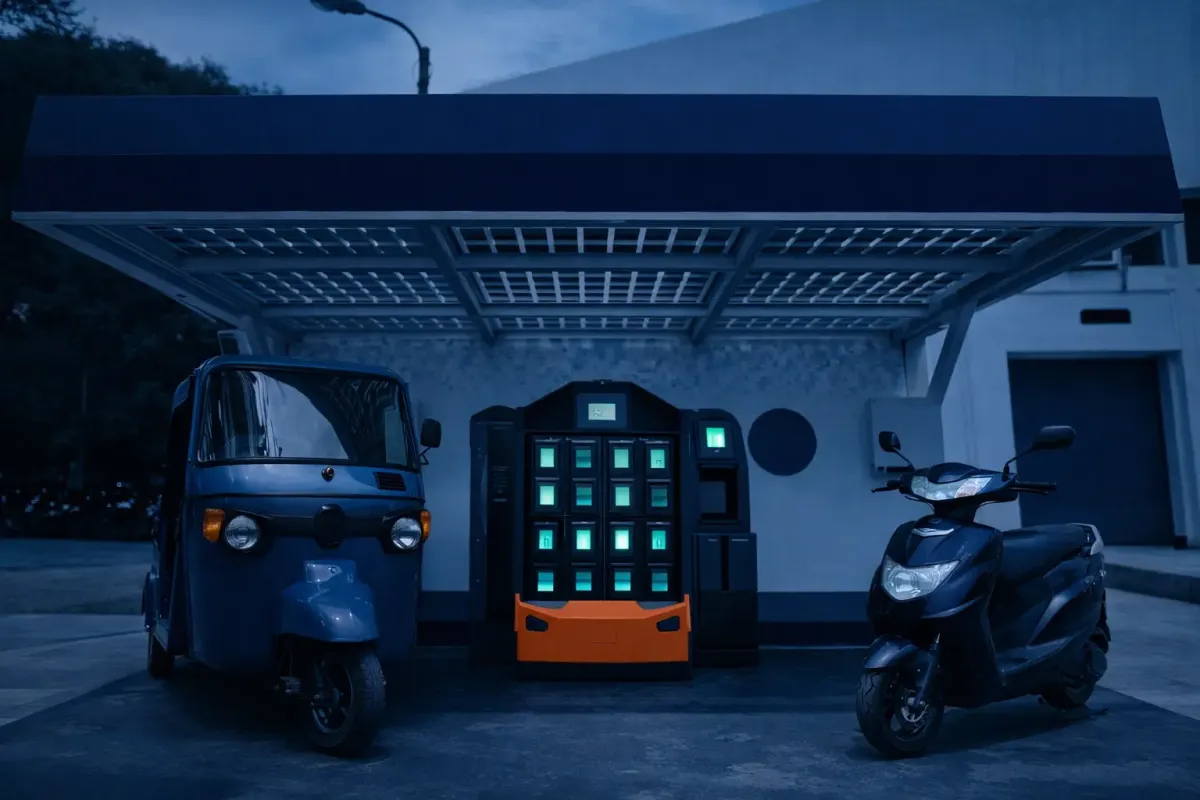
The market is splitting into two arenas. The first is heavy-duty and industrial logistics: ports, drayage, construction, concrete, cement corridors, and short-haul freight where vehicles return to predictable nodes and utilisation is high. India’s JNPA launched the country’s first fleet of 50 heavy electric trucks with swappable batteries (September 2025) and aims to convert 90% of its roughly 600 internal heavy trucks by December 2026. The second is small-format urban commercial mobility: 2W/3W delivery, ride-hailing, and shared last-mile fleets where swapping solves downtime and space constraints—SUN Mobility’s IndianOil joint venture targets 10,000+ swapping stations across 40+ cities with BaaS as the commercial model, and Battery Smart has completed 100+ million swaps across 1,600+ stations serving 90,000+ drivers. The Marqstats India EV battery swap market report and India electric bus battery pack market report provide complementary coverage of India’s swapping ecosystem and bus battery architecture.
Key Takeaways
Market Overview & Analysis
Report Summary
The battery swapping commercial electric vehicle market covers all battery swapping infrastructure, services, and revenue streams serving commercial electric fleets: heavy-duty trucks (>16 tonnes, drayage, cement, port tractors, long-haul freight), medium-duty trucks and vans (urban delivery, logistics), buses (public transit, intercity), and small-format commercial vehicles (2W/3W delivery, ride-hailing, shared fleets). The scope includes swap station hardware (robotic arms, battery racks, cooling systems, power electronics), standardised modular battery packs (CATL Choco-SEB/75# block, SUN Mobility modular packs), BaaS subscription platforms, AI-driven battery inventory and dispatch optimisation software, and the enabling policy/standards framework. Passenger car swapping (NIO consumer network) is excluded from the core scope but referenced for ecosystem context. The market covers the full value chain from battery block manufacturing through station deployment to fleet BaaS operations.
The market works best where five conditions align: high vehicle utilisation (commercial fleets running 16–24 hours/day), predictable routes returning to fixed nodes, uptime-sensitive economics (every hour of downtime = revenue loss), manageable battery standardisation (fewer vehicle platforms = simpler inventory), and infrastructure partners with land/throughput access (fuel stations, ports, logistics yards). This is why swapping is winning first in commercially repetitive routes rather than the whole freight market. Battery swapping can already compete favourably with fast charging on capex/opex in some heavy-duty contexts, and battery-electric truck total cost of ownership is becoming competitive with diesel in major markets.
Market Dynamics
Key Drivers
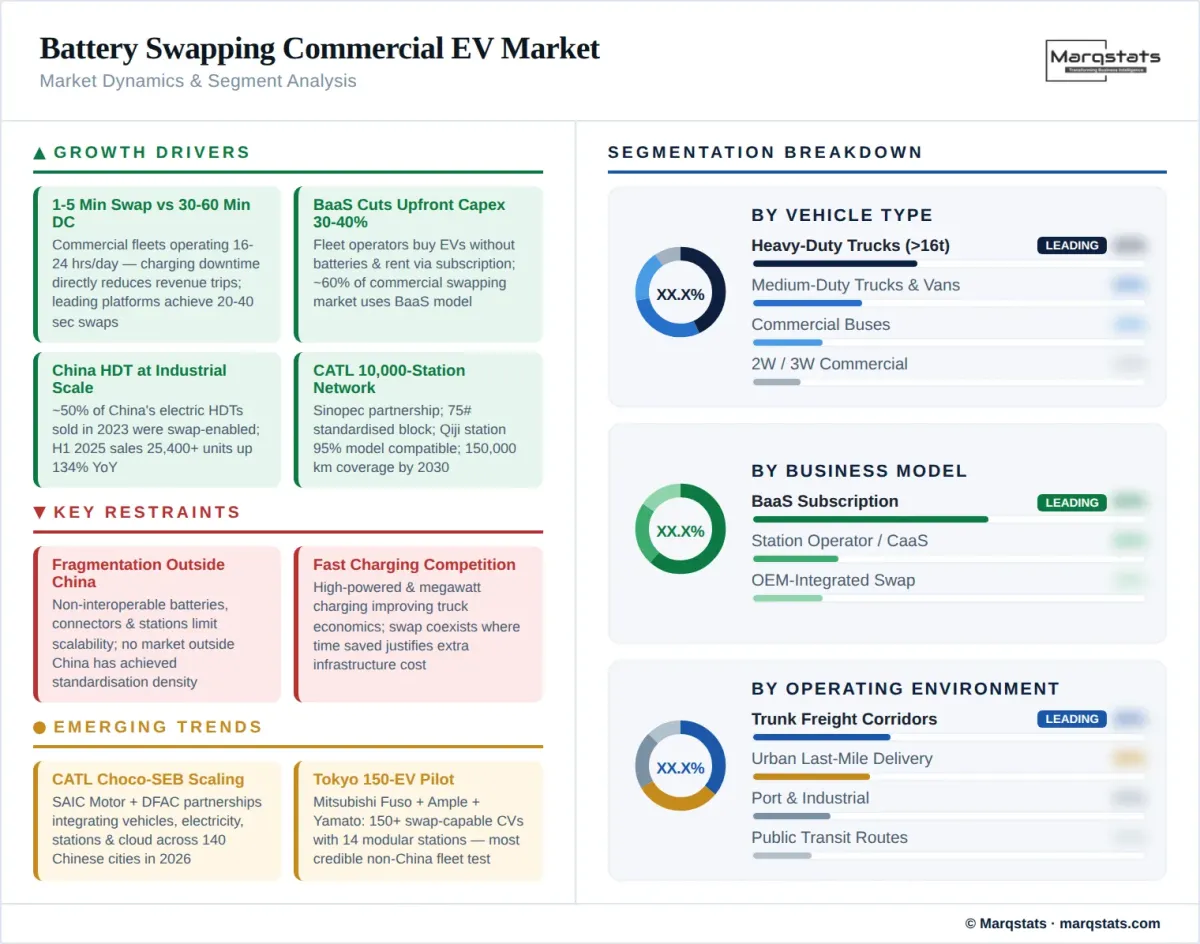
- Commercial fleet downtime economics making swap speed decisive: A battery swap takes 1–5 minutes versus 30–60+ minutes for DC fast charging. For commercial fleets operating 16–24 hours/day in logistics, delivery, and port operations, charging downtime directly reduces revenue-generating trips. Leading swap platforms achieve 20-second swaps (passenger vehicles), 30 seconds (light trucks), and 40 seconds (heavy trucks). This speed advantage is the single most compelling commercial argument for swapping over fast charging in high-utilisation fleet applications.
- BaaS subscription model reducing fleet electrification barriers by 30–40% upfront capex: Fleet operators purchase electric vehicles without batteries and rent batteries from third-party lessors through Battery-as-a-Service. This decouples battery ownership from vehicle purchase, lowering upfront capex by 30–40% and converting a large capital expenditure into a predictable operating cost. Subscription models account for approximately 60% of the commercial swapping market. India’s 2024 Ministry of Power guidelines and China’s NEV Development Plan both formally recognise and promote BaaS.
- China’s industrial-scale heavy-truck swapping proving the model: As many as half of China’s electric heavy-duty trucks sold in 2023 were swap-enabled. H1 2025 swap-capable vehicle sales exceeded 25,400 (up 134% YoY). CATL’s 75# standardised heavy-truck swap block (May 2025), Qiji station compatible with 95% of mainstream models, and 10,000-station Sinopec partnership create the infrastructure backbone. CATL’s Choco-SEB business model with SAIC Motor Commercial Vehicle is entering large-scale operations and is scheduled to cover 140 Chinese cities in 2026. NIO and CATL partnered (March 2025) to build a joint swapping network, signalling ecosystem consolidation.
- India emerging as the most important next-wave market: JNPA launched India’s first fleet of 50 heavy electric trucks with swappable batteries (September 2025), targeting 90% conversion of ~600 internal heavy trucks by December 2026. SUN Mobility’s IndianOil joint venture (600+ stations, 25,000+ EVs at formation) targets 10,000+ stations across 40+ cities. Battery Smart has completed 100+ million swaps across 1,600+ stations, 90,000+ drivers, 50+ cities. India’s PM E-DRIVE allocates INR 2,000 crore for public EV charging stations through March 2028. UltraTech Cement ordered 100 electric trucks on a 400 km corridor—showing heavy-truck swapping is beginning in specific industrial corridors.
- Standardisation advancing: CATL 75# block, India BIS/AIS, Singapore SS 722: CATL’s 75# standardised block and Qiji 95% compatibility represent the most advanced standardisation in heavy trucks. India’s draft battery swapping policy requires BIS-linked standards, AIS safety certification, and ARAI approval for swap-compatible vehicles. Singapore expanded SS 722 in March 2026 to cover battery swap stations for four-wheelers including electric heavy goods vehicles, with SGD 40,000 HVZES incentive. Japan’s June 2025 Mitsubishi Fuso/Ample/Yamato consortium launched 150+ EVs and 14 swap stations in Tokyo with government backing.
Key Restraints
- Ecosystem fragmentation outside China limiting scalability: If batteries, connectors, vehicle software, station formats, and payment/data layers are not interoperable, operators carry more battery inventory, more bespoke equipment, and lower utilisation. India’s draft policy addresses this through interoperability requirements and open communication protocols (OCPP), but implementation is still early. Outside China, no market has achieved the standardisation density needed for network-effect economics.
- Improving fast charging competing with swapping’s value proposition: High-powered and megawatt charging will keep improving truck economics. Battery-electric truck TCO can reach or approach diesel parity in major markets this decade through charging alone. Swapping is unlikely to replace charging everywhere—it coexists where time saved and asset utilisation justify the extra infrastructure and battery inventory. The competitive boundary between swap and charge is application-specific, not universal.
- High station infrastructure capex and battery inventory carrying cost: Each swap station requires significant capital for robotic systems, battery racks, cooling, power electronics, and a fleet of batteries maintained at optimal state of charge. Battery inventory carrying cost is substantial because operators must hold enough batteries to serve peak demand while managing degradation, safety, and logistics. This cost structure favours high-utilisation, high-throughput locations over dispersed low-traffic deployments.
Key Trends
- CATL’s Choco-SEB entering large-scale commercial operations across 140 Chinese cities (2026): CATL and SAIC Motor Commercial Vehicle are co-building an intelligent battery swapping ecosystem integrating “vehicles, electricity, stations, and cloud.” SAIC Maxus’s eDeliver series is equipped with CATL’s Tianxing battery. DFAC (Dongfeng) and CATL are co-building a Choco-SEB ecosystem in Wuhan and Xiangyang. Foton Motor’s all-scenario NEV solution proposes charging-battery swapping integrated technology for short-haul, light-load logistics. These OEM partnerships show swapping is embedding into the Chinese commercial vehicle value chain, not remaining a standalone infrastructure play.
- Japan’s Mitsubishi Fuso/Ample/Yamato 150-EV Tokyo pilot as most credible non-China fleet test: Launched June 2025 with 150+ battery-swappable commercial EVs (Fuso eCanter trucks + Minicab EV kei vans) and 14 modular Ample swap stations, backed by Tokyo Metropolitan Government. Yamato’s logistics operations provide real-world last-mile fleet use cases. Ample’s modular, cross-brand station architecture is significant because it demonstrates multi-OEM compatibility outside the CATL ecosystem.
- AI-driven battery inventory optimisation becoming a competitive moat: Swap stations must manage battery health, utilisation, dispatching, compatibility, and uptime across multiple vehicle types. AI-driven logistics optimise which batteries to charge, which to deploy, and how to balance inventory across stations—turning swap networks from physical kiosks into digital energy platforms. Aulton’s platform connects 521 stations, 130,000+ registered EVs, and 160,000+ batteries, demonstrating the data infrastructure required for network-scale operations.
- Thailand emerging as a Southeast Asian swapping hub: Thailand’s BOI approved THB 1.28 billion across 5 battery swapping station projects (555 motorcycle stations, 7 large commercial vehicle stations, 6 passenger car stations). Mile Green is deploying swapping stations with water-cooling and fire-suppression for Thailand’s tropical climate. UNEX EV launched Thailand’s first intelligent mobility platform with UOTTA battery-swapping technology from China. QTC Energy opened EV charging stations for electric commercial vehicles at ICD Lat Krabang and Laem Chabang Port with battery swapping for e-motorbikes.
Market Segmentation
The highest-value segment per unit. China’s swap-capable heavy trucks >16 tonnes hold approximately 30% market share since 2023. CATL’s 75# standardised swap block is purpose-designed for heavy trucks. CATL and Sinopec’s 10,000-station network targets China’s trunk freight corridors. India’s JNPA 50-truck deployment and UltraTech Cement 100-truck order on a 400 km corridor prove the model is starting in specific industrial applications. Geely/Farizon partners with Tangshan Energy for charging/swapping stations serving methanol-hydrogen electric heavy trucks in the steel, mining, and logistics industries.
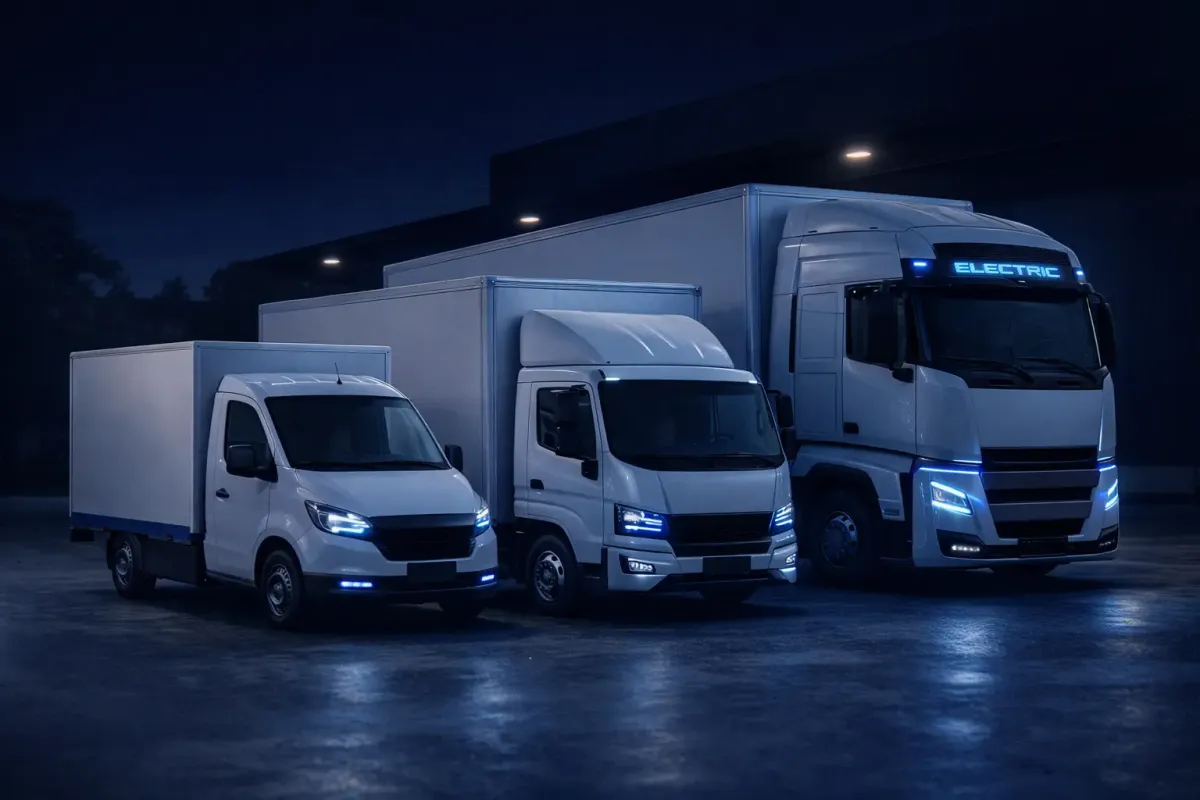
Urban delivery, logistics, and last-mile commercial vehicles. CATL’s Choco-SEB business model with SAIC Motor targets logistics vehicles—SAIC Maxus eDeliver series equipped with Tianxing battery. Newrizon’s iC1 intelligent connected electric light-duty truck supports battery swapping and has been exported to the Middle East. Japan’s Tokyo pilot includes Mitsubishi Minicab EV kei vans alongside Fuso eCanter trucks, validating medium-duty swapping for Yamato’s delivery operations.
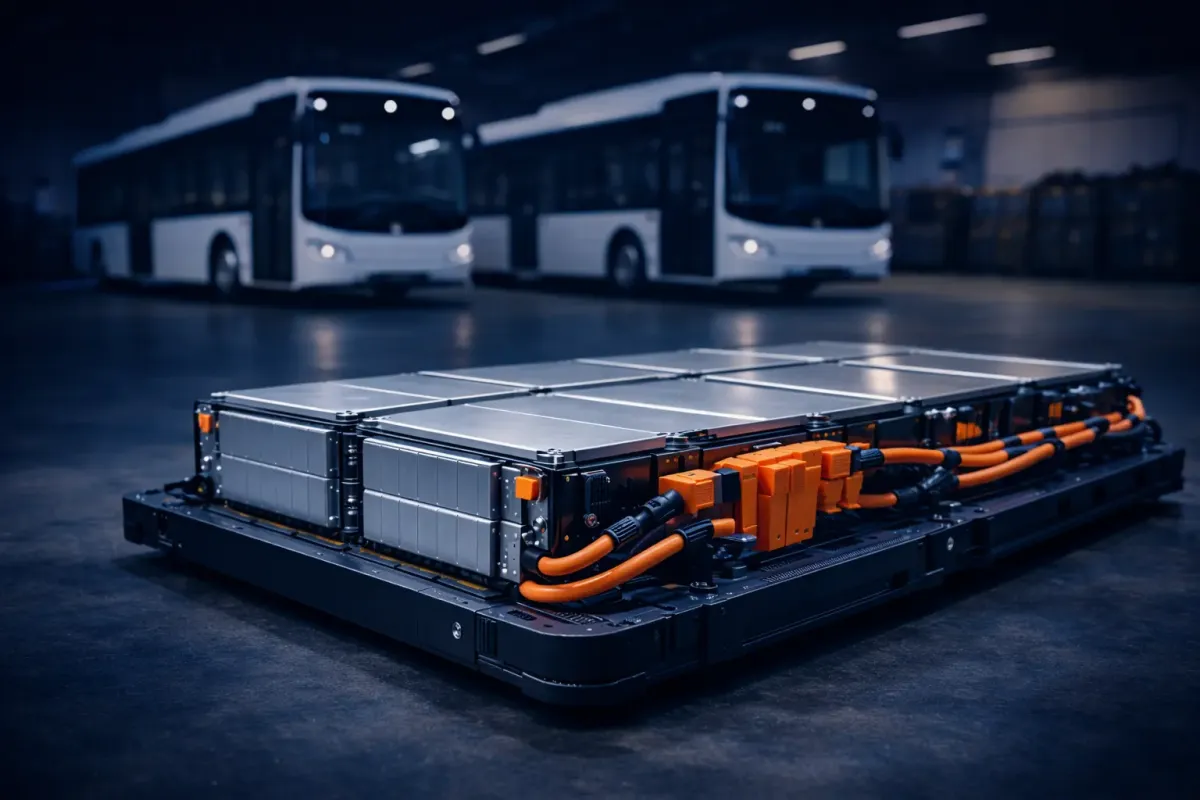
Public transit and intercity buses with depot-based swapping. CATL’s Tianxing B-series batteries for buses are certified to GB 38031-2025. Thailand’s BOI approved 3 battery electric bus/truck projects (THB 2.21 billion, 4,800 units/year annual capacity). Bus swapping operates on fixed routes with predictable depot returns—making scheduling and inventory management simpler than freight applications.
The highest-frequency swapping segment by daily swap count. Battery Smart has completed 100+ million swaps across 1,600+ stations, 90,000+ drivers, 50+ cities—representing approximately 70% of India’s swapping infrastructure. SUN Mobility/IndianOil targets 10,000+ stations across 40+ cities with BaaS. SUN Mobility partnered with Revfin to finance 100,000 EVs (2W delivery + 3W cargo/passenger) under BaaS (March 2024). Gogoro’s Taiwan network (1.4 million smart batteries, 2,700+ GoStations, 650,000+ users, ~370,000 daily swaps) proves dense high-frequency swapping works at scale.
Approximately 60% of the commercial swapping market. Fleet operators purchase EVs without batteries and rent from third-party lessors. CATL, Aulton, SUN Mobility, and Battery Smart all operate BaaS models. India’s Ministry of Power 2024 guidelines explicitly promote BaaS. BaaS transforms the battery from a customer-owned capex item to an operator-managed energy asset—reducing fleet purchase price by 30–40% while giving battery companies control over health, rotation, and second-life management.
Used primarily for 2W/3W commercial fleets where per-swap pricing aligns with per-trip economics. Battery Smart and SUN Mobility both offer transaction-based pricing alongside subscription tiers. Per-swap models work well for gig-economy drivers who prefer variable cost structures matching variable income.
Station operators deploy and maintain swap infrastructure while fleet operators or energy companies pay usage-based fees. CATL’s Sinopec partnership leverages Sinopec’s existing fuel station land and throughput. SUN Mobility’s IndianOil JV leverages 38,000+ fuel stations. This model scales fastest when combined with incumbent infrastructure partners who already control land, power, and customer traffic.
By Geography
China
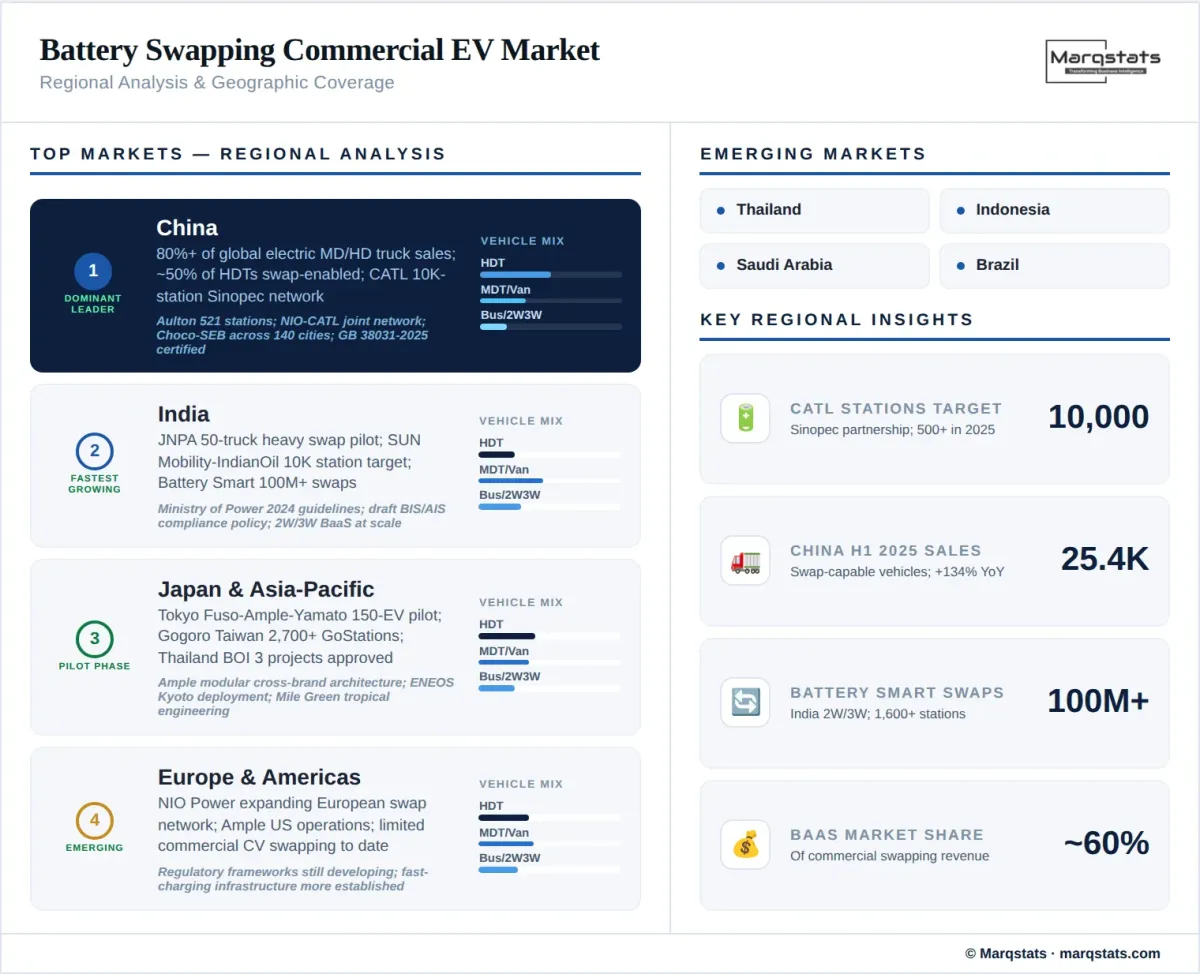
The undisputed global leader. Global electric medium/heavy-duty truck sales exceeded 90,000 in 2024, with 80%+ in China. As many as half of China’s electric HDTs sold in 2023 were swap-enabled. CATL’s ecosystem: 75# standardised block (May 2025), Qiji station (95% model compatibility), 10,000-station Sinopec partnership, Choco-SEB with SAIC Motor/DFAC across 140 cities in 2026, “Eight Horizontal and Ten Vertical” network covering 150,000 km by 2030. NIO and CATL partnered (March 2025) for a joint swapping network. Aulton operates 521 stations with 130,000+ registered EVs. China’s NEV Development Plan explicitly promotes convenient and efficient charging/swapping by 2035. NDRC’s 2024 Action Plan accelerates swapping infrastructure. Hainan Province promotes fast charging, battery swapping, and V2G as complementary technologies.
India
The most important emerging market with strength in small commercial fleets and early heavy-truck pilots. JNPA launched 50 heavy electric swap-capable trucks (September 2025), targeting 90% fleet conversion by December 2026. SUN Mobility/IndianOil JV targets 10,000+ stations across 40+ cities with BaaS. Battery Smart: 100+ million swaps, 1,600+ stations, 90,000+ drivers, 50+ cities. SUN Mobility partnered with Revfin for 100,000 EV fleets under BaaS (March 2024). Ministry of Power 2024 guidelines promote swapping and BaaS nationally. Draft battery swapping policy requires BIS/AIS compliance, ARAI approval, and open protocols (OCPP). PM E-DRIVE allocates INR 2,000 crore for public EV charging stations through 2028. UltraTech Cement ordered 100 electric trucks on a 400 km corridor.
Japan and East Asia
Pilot-stage but with serious commercial fleet pilots. Japan’s Mitsubishi Fuso/Ample/Yamato/Mitsubishi Motors consortium launched 150+ EVs and 14 modular swap stations in Tokyo (June 2025) backed by Tokyo Metropolitan Government. Ample first deployed in Kyoto (2024) with MFTBC and ENEOS, demonstrating core fleet benefits. Taiwan’s Gogoro (1.4M batteries, 2,700+ GoStations, 370,000 daily swaps) proves dense high-frequency swapping at scale in 2W commercial mobility.
Southeast Asia (Thailand)
An emerging production and deployment hub. Thailand BOI approved THB 1.28 billion across 5 battery swapping projects (555 motorcycle, 7 large CV, 6 passenger). Mile Green is deploying swapping stations with tropical-climate engineering. UNEX EV launched Thailand’s first intelligent mobility platform with Chinese UOTTA technology. QTC Energy opened commercial EV charging at Lat Krabang and Laem Chabang Port with motorcycle battery swapping. Banpu NEXT/Durapower’s Chonburi battery plant (15,000+ packs/year) includes e-motorcycle swapping batteries.
Singapore and Rest of World
Singapore leads on standards formalisation. LTA approved sandbox trials for battery swap for electric heavy goods vehicles at PSA port and Tuas logistics (June 2024). SS 722 expanded to cover four-wheeler and heavy goods vehicle swapping (March 2026). SGD 40,000 HVZES incentive for zero-emission HGVs and buses (2026–2028). Europe remains focused on fast/megawatt charging for trucks but monitoring swap developments. Geely/Farizon’s Baotou Steel partnership explores methanol-hydrogen infrastructure including swapping in Inner Mongolia.
How Competition Is Evolving
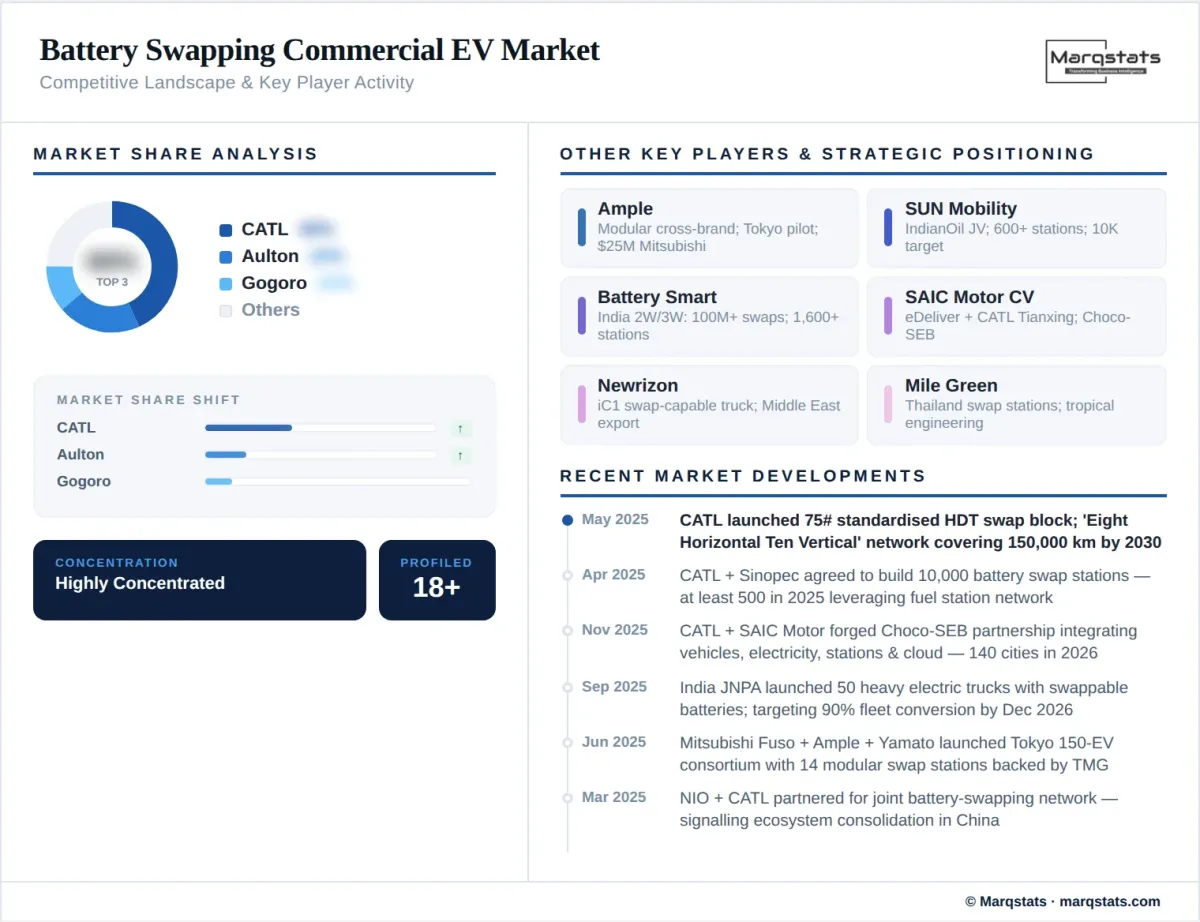
The competitive landscape has four layers. CATL dominates the ecosystem layer with its vertically integrated approach: 75# standardised heavy-truck swap block, Qiji station (95% model compatibility, 3-minute swap), Choco-SEB business model with multiple OEM partners (SAIC Motor, DFAC, Foton), 10,000-station Sinopec partnership, NIO joint swapping network (March 2025), and Tianxing battery series certified to GB 38031-2025 for all commercial vehicle classes. CATL’s “Eight Horizontal and Ten Vertical” network targeting 150,000 km and 80% of China’s trunk transport by 2030 defines the infrastructure trajectory.
Aulton is China’s largest independent third-party provider by station-operation service revenue, with 521 connected stations, 130,000+ registered EVs, and 160,000+ batteries as of mid-2025. Swap times: approximately 20 seconds (passenger), 30 seconds (light trucks), 40 seconds (heavy trucks). Ample is the most important non-China modular station provider, with cross-brand compatibility and the Tokyo consortium with Yamato/Mitsubishi Fuso/MMC as its highest-profile commercial deployment. Ample received a USD 25 million Mitsubishi Corporation investment (November 2024).
In India, SUN Mobility leads open-architecture commercial swapping with its IndianOil JV (600+ stations at formation, 10,000+ target, 38,000+ fuel stations leverage). Battery Smart leads high-frequency 2W/3W swapping (100M+ swaps, 1,600+ stations, 90,000+ drivers). In vehicle OEMs, SAIC Motor Commercial Vehicle (eDeliver/Tianxing), DFAC/Dongfeng (Choco-SEB), Foton Motor (charging-swap integrated), Geely/Farizon (methanol-hydrogen + swap), and Newrizon (iC1 swap-capable export) are the most active commercial vehicle manufacturers with swap-enabled platforms.
Companies Covered
Companies covered in the report include:
Recent Market Activity
Table of Contents
Coverage & Segmentation
This report provides a comprehensive analysis of the global battery swapping commercial electric vehicle market covering the historical period (2021–2025) and forecast period (2026–2030), with 2025 as the base year. The study examines market size in USD and volume across vehicle type (heavy-duty trucks, medium-duty trucks/vans, buses, 2W/3W commercial), business model (BaaS/subscription, pay-per-swap, infrastructure-as-a-service), and geography covering 15 countries across China, India, Japan/East Asia, Southeast Asia, Singapore, and Rest of World. Company profiling covers 20+ players across swap ecosystem operators, commercial vehicle OEMs, energy/infrastructure partners, and technology platform providers. Standards analysis covers China’s NEV Development Plan, CATL Qiji compatibility framework, India’s draft battery swapping policy (BIS/AIS/ARAI), Singapore SS 722, and open communication protocols (OCPP).
Research methodology combines bottom-up modelling from swap-capable vehicle sales data (China H1 2025: 25,400+ units, 134% YoY), station deployment counts (CATL/Sinopec 10,000 target, Aulton 521, SUN Mobility 600+, Battery Smart 1,600+), BaaS subscription pricing, and fleet operator TCO comparisons (swap vs fast charge vs diesel). Primary research encompasses 40+ interactions with swap station operators, commercial fleet managers, battery leasing companies, OEM swap programme teams, utility/energy partners, and standards bodies across China, India, Japan, Singapore, and Thailand.