Market Snapshot
Middle bar: base-year value × (1 + CAGR), rounded to two decimals. This is a calculated illustration, not a separately researched annual estimate.
Market Size (2025, Base Year): USD 2,403.00 Million (Wholesale)
Estimated Value (2026): USD 2,538.00 Million
Forecast Value (2030): USD 3,115.00 Million
CAGR: 5.33% | Forecast Period: 2026 – 2030
Growth — Absolute: USD 712.00 Million
Physical Volume: 696.64 Million Litres (2025) to 815.42 Million Litres (2030), Volume CAGR 3.20%
Largest Market: Central Region (34.00% of 2025 volume)
Fastest Growing: Full Synthetic Lubricants (7.94% to 10.80% share, 2025-2030)
Dominant Segment: Passenger Car Motor Oil (40.64% of 2025 volume)
Market Concentration: Fragmented (No Aggregate Shares Published)
Base Year: 2025 | Historical Period: 2021 – 2025 | Forecast Period: 2026 – 2030
Units Considered: Value (USD Million) and Volume (Million Litres)
Segments Covered: 4 | Regions Covered: 4 | Companies Profiled: 14
Report Pages: 175 | Deliverables: PDF, Excel, PPT
Key Takeaways
Market Overview & Analysis
Report Summary
Mexico's lubricants aftermarket is a large, ageing-fleet market carrying two structural loads at once: an old passenger and light-commercial fleet that keeps mineral oil in demand, and a small but disproportionately heavy commercial fleet that drives more than a third of national volume through sheer sump size and duty cycle.
The analysis measures the wholesale value of engine oils, transmission and driveline fluids, gear oils and greases bought after commercial sale of a vehicle: USD 2,403.00 million in 2025. It excludes OEM factory-fill (41.98 million litres, a separate layer) and industrial, marine and aviation lubricants.
The analysis is written for four readers: a blender securing US Gulf Coast base oil supply against peso volatility, a fleet operator budgeting for NOM-044's low-SAPS mandate, a refaccionaria owner stocking for two very different customer bases, and an investor sizing three regulatory scenarios.
A Truck Fleet That Is 3.5% of Vehicles and 37.6% of Volume
Most fleets in this coverage set show heavy vehicles punching above their numeric weight in oil demand. In Mexico the gap is unusually wide.
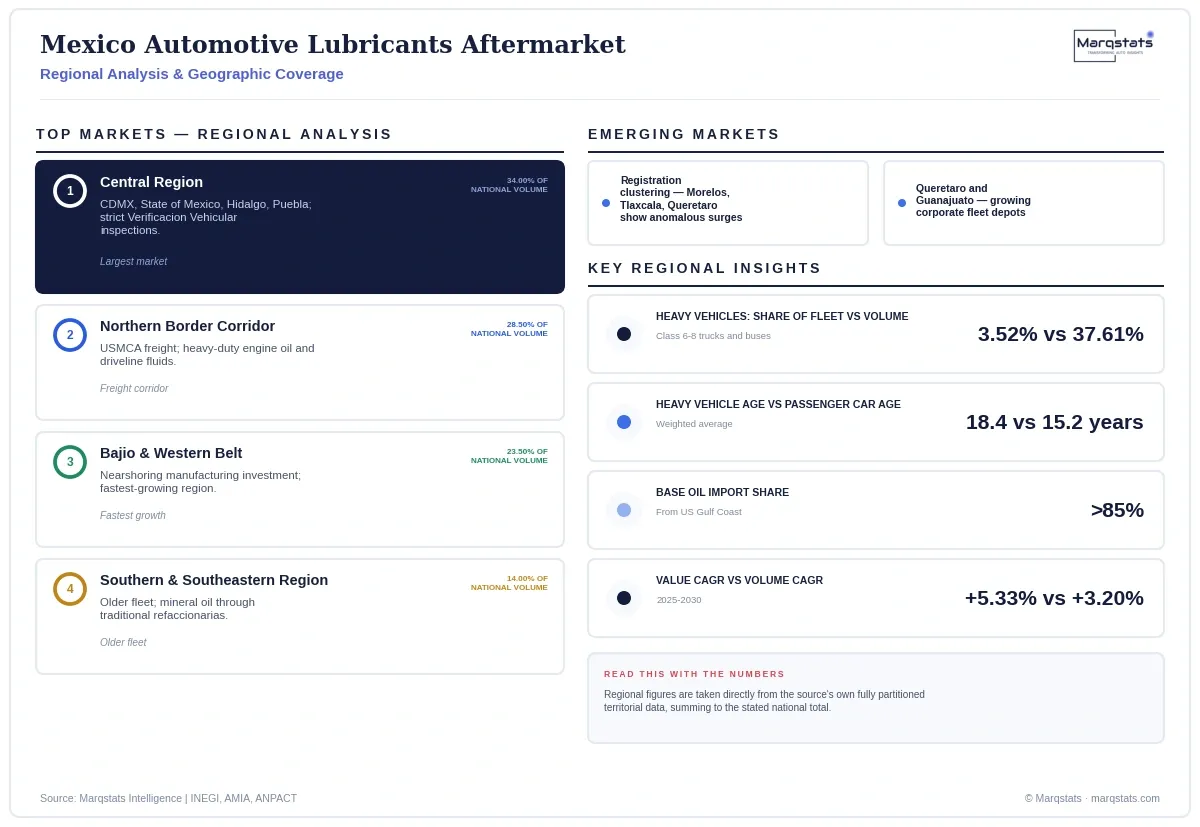
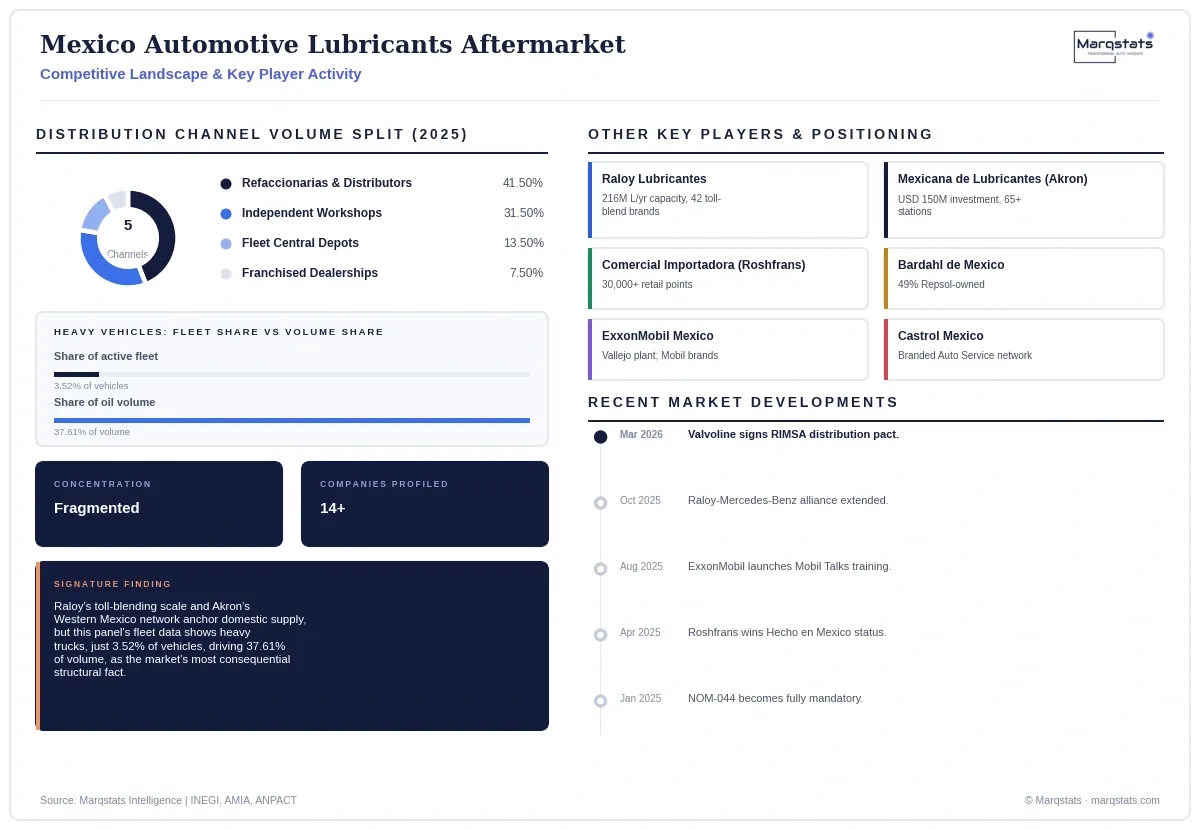
Heavy commercial trucks (Class 6-8) and buses together number 1,627,334 units, just 3.52% of the 46.23 million active fleet, yet the fleet-consumption table puts their combined oil use at 261.99 million litres, 37.61% of national aftermarket volume. A Class 8 tractor holds up to 38 litres in its sump, against 4.2 for a passenger car, and is drained 4.5 times a year against 1.8. These vehicles also run the USMCA freight corridors that move Mexico's manufacturing exports north, which is why the Northern Border Corridor, 28.50% of national volume, is weighted toward heavy-duty and driveline fluids. The heavy fleet is also the oldest: 18.4 years on average, against 15.2 for passenger cars, which is exactly the population NOM-044's 2025 emissions mandate now has to reach.
A Law That Makes Old Trucks Illegal to Certify, Not Illegal to Drive
Mexico's newest heavy-duty emissions rule works on new engines, not the fleet already on the road.
NOM-044-SEMARNAT-2017 became fully mandatory on 1 January 2025. From that date, Mexico no longer certifies newly manufactured or imported heavy-duty diesel engines meeting only Euro V or EPA 07; Euro VI and EPA 2010 are the sole standards for new commercial vehicles above 3,857 kg. Those engines carry diesel particulate filters and selective catalytic reduction systems that are poisoned by sulphated ash, phosphorus and sulphur, so the rule pushes fleets toward low-SAPS API CK-4 and FA-4 oils and away from legacy high-ash CI-4. The catch is fuel: ANPACT and AMDA report that ultra-low-sulfur diesel is not uniformly available on secondary transport routes, so operators fuelling new-generation engines with higher-sulfur diesel degrade their particulate filters and need oils with higher total base number reserves than standard CK-4 provides.
Two Fleets, Two Viscosity Worlds
Mexico's 14.8-year weighted average fleet age hides a split market.
Older vehicles, with worn cylinder liners and gaskets, run on high-viscosity SAE 20W-50 and 25W-60 oils that limit smoke and leakage; this grade is 37.50% of volume in 2025, though it is projected to fall to 30.00% by 2030 as pre-2005 engines retire. Newer light vehicles with gasoline direct injection and turbocharging need SAE 0W-20, 5W-20 or 5W-30 meeting ILSAC GF-6 and API SP to prevent low-speed pre-ignition; the ultra-low 0W-20/0W-16 band grows fastest of all viscosity classes, at an 18.54% CAGR from 31.35 to 73.39 million litres. Both populations coexist because Mexico's fleet renews at only 2.5% to 3.0% a year in the Baseline Scenario.
Where the Base Oil Actually Comes From
Mexico blends its own oil from someone else's crude cut.
PEMEX's Salamanca refinery once supplied domestic Group I base oil, but output has fallen sharply on operational and catalytic constraints. Over 85% of Mexico's base oil, especially hydrotreated Group II and hydrocracked Group III, is imported from US Gulf Coast refiners, arriving by chemical tanker at Altamira, Veracruz and Tuxpan or by rail through Nuevo Laredo. Because these inputs are priced in dollars while workshop billing is in pesos, the research notes that peso depreciation past 20.50 MXN per dollar in late 2024 and early 2025 compressed blender margins before cost pass-through caught up; stabilisation toward 17.50 in 2026 restored them.
What the Evidence Does and Does Not Show
The sizing chain is internally consistent. Its ultimate source is one estimate.
Every figure in the sizing chain, from the national total down through the scenarios, traces to the same syndicated-research source, and Marqstats could not check it against a SENER or INEGI production series. The fleet-table heavy-duty figure (37.61% of volume from 3.52% of vehicles) and the segmentation table's separate heavy-duty engine oil category (40.16% of volume) use different vehicle-class boundaries and should not be compared directly. The registry-to-active-fleet gap of roughly 15 million vehicles is explained only in general terms. None of this changes the direction of the trends, which rest on named regulatory and fleet data. It does limit how precisely the absolute size can be quoted.
Independent Channels Hold the Majority by Design
Mexico's distribution structure keeps most volume outside factory-controlled channels.
Refaccionarias and independent workshops together handle 73.00% of aftermarket volume in 2025, rising to 74.00% by 2030, while franchised dealerships hold only 7.50%, almost entirely in-warranty synthetic fill. Refaccionarias act as regional wholesalers, extending working capital and short-term credit to local garages, which is why brand access in this market runs through distributor relationships as much as through advertising.
Market Dynamics
Key Drivers
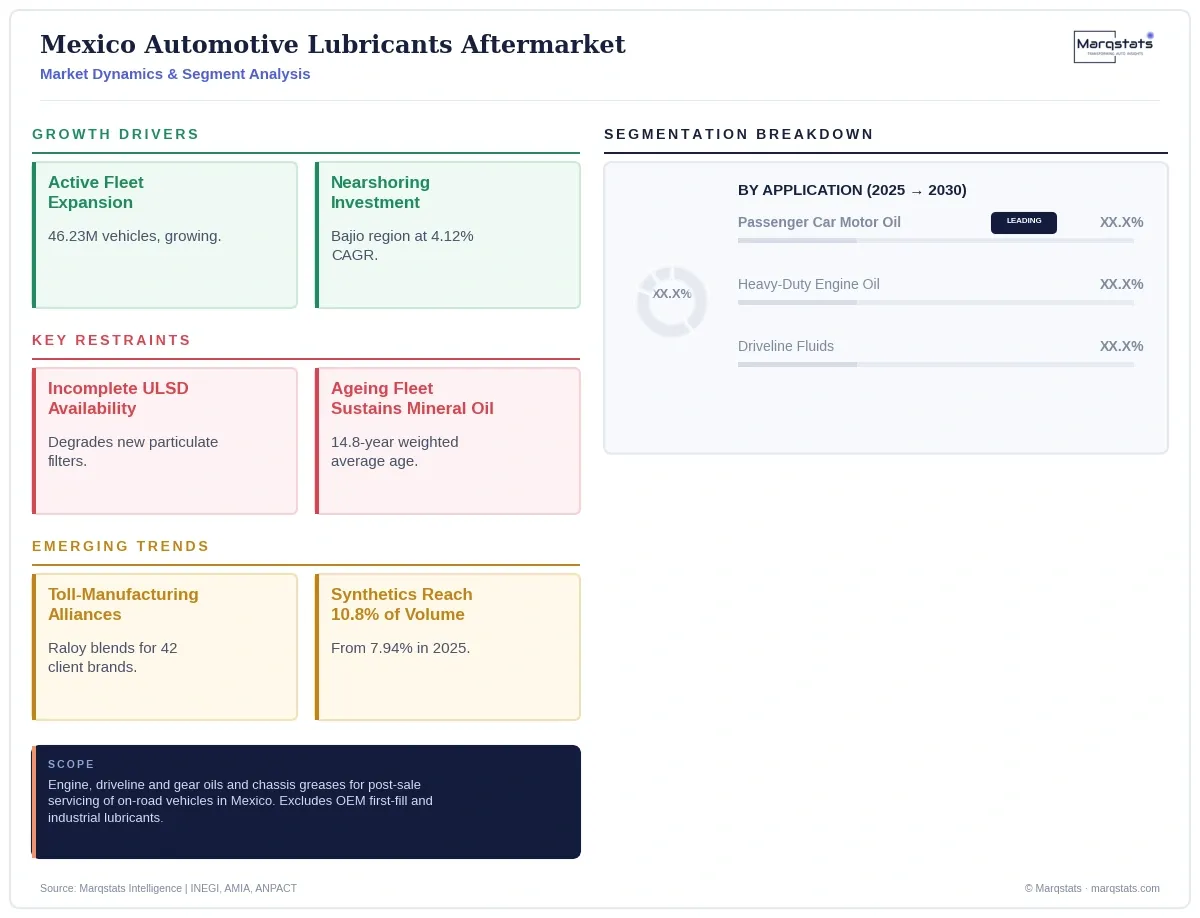
- An active fleet of 46.23 million vehicles, expanding faster than scrappage, keeps recurring maintenance demand rising across all vehicle classes.
- Nearshoring investment in the Bajio and Northern corridors is expanding commercial fleets and corporate depot purchasing, the fastest-growing regional demand driver.
- Motorcycle registrations, up from 293,924 in 2000 to 8,953,446 by 2025, are adding a high-frequency drain segment tied to e-commerce delivery.
- NOM-163-SEMARNAT-SCFI-2023 fleet-wide fuel economy targets for model years 2025 to 2027 mandate ultra-low-viscosity synthetic factory fills, spreading into independent workshop demand.
- USMCA cross-border freight sustains heavy-duty diesel oil demand along the Northern Border Corridor, 28.50% of national volume.
Key Restraints
- Registration-clustering artefacts in states offering zero vehicle ownership tax distort raw registration data, so blenders must plan supply against fuel dispatch volumes rather than municipal registration rolls.
- Incomplete ultra-low-sulfur diesel availability on secondary routes forces some fleets onto higher-sulfur fuel, degrading new particulate filters despite NOM-044 compliance.
- Peso volatility against the dollar compresses blender margins on imported base oil before price pass-through reaches workshops.
- A 14.8-year weighted average fleet age and 2.5% to 3.0% annual renewal in the Baseline Scenario keep mineral oil, 69.80% of volume even in 2030, structurally embedded.
- The market's absolute size rests on one external estimate not verified against a national statistical series, so precision is lower than the direction of its trends.
Key Trends
- Branded technical training is spreading beyond factory-fill accounts into independent workshops, as marketers compete on mechanic education rather than shelf price alone.
- Domestic blenders are formalising toll-manufacturing relationships: Raloy blends for 42 client brands, including a 35-year alliance with Mercedes-Benz Autobuses extended in October 2025.
- Foreign equity is entering domestic brands: Repsol holds 47.92% to 49.00% of Bardahl de Mexico, distributing Repsol Lubricants through Mexican channels since January 2025.
- Technical training is expanding to speed the mineral-to-synthetic transition: ExxonMobil launched its Mobil Talks programme for fleet mechanics at its Vallejo plant in August 2025.
- Logistics partnerships are extending reach into commercial depots: Valvoline signed a supply and distribution pact with RIMSA in March 2026.
Strategic Implications
- Refaccionaria wholesalers should extend credit terms strategically to secure exclusive shelf space against new-entrant brands competing for independent workshop volume.
- New entrants should avoid the mature mineral segment, defended by refaccionaria relationships, and target synthetic PCMO and low-SAPS CK-4/FA-4 heavy-duty oils with direct workshop partnerships and digital transition-guidance tools.
- Domestic blenders should lock in long-term Gulf Coast base oil contracts and expand border and port storage to hedge currency and supply risk, while formulating certified NOM-116 and NOM-163 synthetic lines.
- Additive suppliers should develop packages that tolerate intermittent high-sulfur diesel without shortening particulate filter life, given uneven ultra-low-sulfur diesel availability.
- Fleet operators should budget for CK-4 and FA-4 conversion ahead of full NOM-044 enforcement and monitor regional fuel quality on secondary routes.
- Investors should track ULSD supply policy and NOM-044 enforcement tolerance, the two triggers separating the Stagnation and Accelerated scenarios.
Outlook
The underlying research presents three scenarios tied to named regulatory and fuel-supply triggers. Volume CAGRs and the Baseline value CAGR were recomputed and match; the Stagnation and Accelerated value CAGRs are Marqstats arithmetic on the stated endpoints.
Under the Baseline Scenario, PEMEX gradually increases output from the Dos Bocas refinery, NOM-044 remains legally binding with de facto regional enforcement tolerances, and the fleet renews at 2.5% to 3.0% a year. Volume reaches 815.42 million litres, a 3.20% CAGR, and value reaches USD 3,115.00 million (MXN 54,510.00 million), a 5.33% CAGR, with synthetic penetration at 10.80% of volume.
Under the Stagnation Scenario, PEMEX and the energy regulator issue an indefinite moratorium on nationwide ultra-low-sulfur diesel supply obligations, the transport ministry suspends enforcement of Euro VI under NOM-044 due to fuel shortages, and high tariffs apply to imported synthetic base oils. Volume reaches 765.00 million litres, a 1.89% CAGR, and value reaches USD 2,678.00 million, a 2.19% CAGR, with synthetic penetration held to 7.50%.
Under the Accelerated Modernisation Scenario, nearshoring investment expands heavy commercial fleets, the energy regulator strictly enforces nationwide ultra-low-sulfur diesel compliance, NOM-163 penalises non-synthetic service fills, and informal workshops are formalised. Volume reaches 860.00 million litres, a 4.30% CAGR, and value reaches USD 3,526.00 million, a 7.97% CAGR, with synthetic penetration at 16.50%.
Market Segmentation
537.88 million litres (77.21% share) in 2025, moving to 569.16 million litres (69.80% share) by 2030. Sustained by 14+ year average fleet age and commercial freight top-offs; still the volumetric bedrock in 2030.
103.45 million litres (14.85% share) in 2025, moving to 158.19 million litres (19.40% share) by 2030. The transitional grade for urban delivery fleets and light commercial vehicles moving out of mineral oil.
55.31 million litres (7.94% share) in 2025, moving to 88.07 million litres (10.80% share) by 2030. Driven by turbocharging, NOM-163 fuel-economy targets and premium PCMO; the fastest-growing formulation.
283.11 million litres (40.64% share) in 2025, moving to 338.40 million litres (41.50% share) by 2030. Supported by private ownership growth and ride-hailing fleets in urban centres.
279.77 million litres (40.16% share) in 2025, moving to 313.94 million litres (38.50% share) by 2030. Sustained by nearshoring trade freight and high sump consumption; a different vehicle-class boundary than the fleet-consumption table's heavy-duty figure.
37.62 million litres (5.40% share) in 2025, moving to 54.63 million litres (6.70% share) by 2030. The fastest-growing application, tracking booming delivery-fleet motorcycle registrations.
68.27 million litres (9.80% share) in 2025, moving to 78.28 million litres (9.60% share) by 2030. Growing with automatic transmission penetration in the light-vehicle fleet.
27.87 million litres (4.00% share) in 2025, moving to 30.17 million litres (3.70% share) by 2030. Tied to suspension and heavy-duty fifth-wheel maintenance.
261.24 million litres (37.50% share) in 2025, falling to 244.63 million litres (30.00%) by 2030 as pre-2005 engines are retired.
222.92 million litres (32.00% share) in 2025, rising to 236.47 million litres (29.00%) by 2030; the core commercial transport standard.
125.40 million litres (18.00% share) in 2025, rising to 187.55 million litres (23.00%) by 2030; the main beneficiary of post-2015 light-duty maintenance.
31.35 million litres (4.50% share) in 2025, rising to 73.39 million litres (9.00%) by 2030, an 18.54% CAGR under OEM warranty and efficiency rules.
55.73 million litres (8.00% share) in 2025, rising to 73.38 million litres (9.00%) by 2030; agricultural tractors and older transit buses.
289.11 million litres (41.50% share) in 2025, moving to 334.32 million litres (41.00% share) by 2030. The core backbone of aftermarket supply, extending credit to small independent garages; represented nationally by ARIDRA.
219.44 million litres (31.50% share) in 2025, moving to 269.09 million litres (33.00% share) by 2030. The primary Do-It-For-Me destination for vehicles over five years old, aligned with the CNT technical body.
94.05 million litres (13.50% share) in 2025, moving to 114.16 million litres (14.00% share) by 2030. Bulk tank procurement direct from major blenders for logistics carriers, mining and transit operators.
52.25 million litres (7.50% share) in 2025, moving to 57.08 million litres (7.00% share) by 2030. Captive in-warranty maintenance using proprietary synthetic fluids exclusively.
41.80 million litres (6.00% share) in 2025, moving to 40.77 million litres (5.00% share) by 2030. Emergency quart and litre top-offs, a shrinking DIY channel.
By Geography
Central Region
236.86 million litres (34.00% share) in 2025, moving to 273.17 million litres (33.50%) by 2030. Mexico City, State of Mexico, Hidalgo, Puebla and Morelos. Chronic stop-and-go driving in the Mexico City Metropolitan Area accelerates oil thermal breakdown, and mandatory Verificacion Vehicular inspections enforce regular maintenance. Hosts ExxonMobil's Vallejo plant, Raloy's Tianguistenco plant and Roshfrans' Actopan complex.
Northern Border Corridor
198.54 million litres (28.50% share) in 2025, moving to 234.84 million litres (28.80%) by 2030. Nuevo Leon, Coahuila, Chihuahua, Tamaulipas, Sonora and Baja California. Weighted toward heavy-duty engine oil and driveline lubricants from USMCA cross-border freight; extreme summer heat drives shear-stable SAE 15W-40 and 20W-50 demand.
Bajio & Western Belt
163.71 million litres (23.50% share) in 2025, moving to 199.78 million litres (24.50%) by 2030. Jalisco, Guanajuato, Queretaro, Aguascalientes and San Luis Potosi. The fastest-growing region, at a 4.12% CAGR to 199.78 million litres by 2030, on nearshoring manufacturing investment; Jalisco is Akron's distribution hub, and Queretaro and Guanajuato are growing corporate fleet depot and modern workshop markets.
Southern & Southeastern Region
97.53 million litres (14.00% share) in 2025, moving to 107.63 million litres (13.20%) by 2030. Veracruz, Tabasco, Chiapas, Oaxaca and Yucatan. Lower average household income and an older passenger fleet sustain demand for cost-effective high-viscosity mineral oils sold through traditional over-the-counter refaccionarias.
Registration Clustering
States such as Morelos, Tlaxcala and Queretaro show anomalous vehicle registration surges because leasing firms and private buyers register assets where ownership tax (tenencia vehicular) is zero or administration is lighter, even though the vehicles run in Mexico City, Guadalajara or Monterrey. Major blenders plan supply against PEMEX and private pipeline fuel dispatch volumes rather than municipal registration rolls.
How Competition Is Evolving
The market splits between domestic blenders with deep refaccionaria relationships and multinationals with factory-fill and corporate fleet contracts. The source gives no aggregate market-share figures, so positioning below rests on named company facts rather than percentages.
Raloy Lubricantes, based at Santiago Tianguistenco in the State of Mexico, has 216 million litres a year of blending capacity and currently uses about 156 million litres of it; 70% is toll-blended for 42 client brands, including a 35-year Mercedes-Benz Autobuses alliance extended in October 2025, and the company targets 10% direct branded market share. Mexicana de Lubricantes (Akron), based in Zapopan and Lagos de Moreno, Jalisco, is investing USD 150 million to expand production and its network of over 65 fuel stations across Western and Central Mexico. Comercial Importadora (Roshfrans), in Actopan, Hidalgo, holds Hecho en Mexico certification, supplies over 30,000 retail points and runs a laboratory conducting more than 140,000 fluid tests a year.
Bardahl de Mexico blends in Mexico City and Toluca and is 47.92% to 49.00% owned by Spain's Repsol, distributing Repsol Lubricants domestically since January 2025. ExxonMobil Mexico blends at Vallejo in Mexico City with over 200 staff, leading in factory-fill and commercial trucking contracts. Castrol Mexico runs branded Castrol Auto Service workshops from a Mexico City and Queretaro logistics base, and Valvoline signed a supply and distribution agreement with RIMSA in March 2026 to extend depot coverage.
Companies Covered
Companies covered in the report include:
Recent Market Activity
Table of Contents
Coverage & Segmentation
The analysis measures engine crankcase lubricants, transmission and driveline fluids, gear oils and chassis greases bought after commercial sale for passenger cars, light commercial vehicles, heavy-duty trucks, buses and motorcycles in Mexico, for a 2025 base year and a 2026 to 2030 forecast, in United States dollars at 19.50 pesos per dollar. Values are wholesale, excluding retail VAT and labour. OEM factory-fill and industrial, marine and aviation lubricants are excluded.
The analysis covers four segmentation dimensions, formulation, application, viscosity and channel, four macro-regions and 14 profiled entities. Volumes in each dimension partition exactly to the national totals in 2025 and 2030.