Market Snapshot
Middle bar: base-year value × (1 + CAGR), rounded to two decimals. This is a calculated illustration, not a separately researched annual estimate.
The global van racking market, covering van shelving and racking systems fitted to commercial vans, is estimated at USD 1,703.84 million in 2025 and is projected to reach USD 2,305.68 million by 2030, a CAGR of 6.24%, as the number of vans fitted with racking rises from 701,056 to 804,853 at 2.80% a year. Europe is the largest region at 53.63% of 2025 value, while aluminium systems grow fastest at 10.33% a year because electric vans make every kilogram of racking a deduction from payload and range.
Market size and forecast figures are generated using Marqstats' proprietary estimation framework, updated as of October 2026. The estimate is constructed from regional van registrations, the share of vans fitted with racking on first registration or refit and installed system prices, and it is most sensitive to European van demand and to the pace of electric van adoption.
The market covers fixed and folding shelves, drawer and cabinet units, bins, cases and internal load-securing modules fitted to commercial vans, measured at installed prices including fitting labour and excluding the van, sales taxes and freight. Partitions, flooring, ladder racks, roof systems, electrical equipment and refrigeration are excluded, so that a complete conversion quote is not counted as shelving revenue. Fixed shelving units are the dominant product at 46.46% of 2025 value, and the United States figure matches the shelving and storage systems segment of the Marqstats US commercial van upfitting estimate.
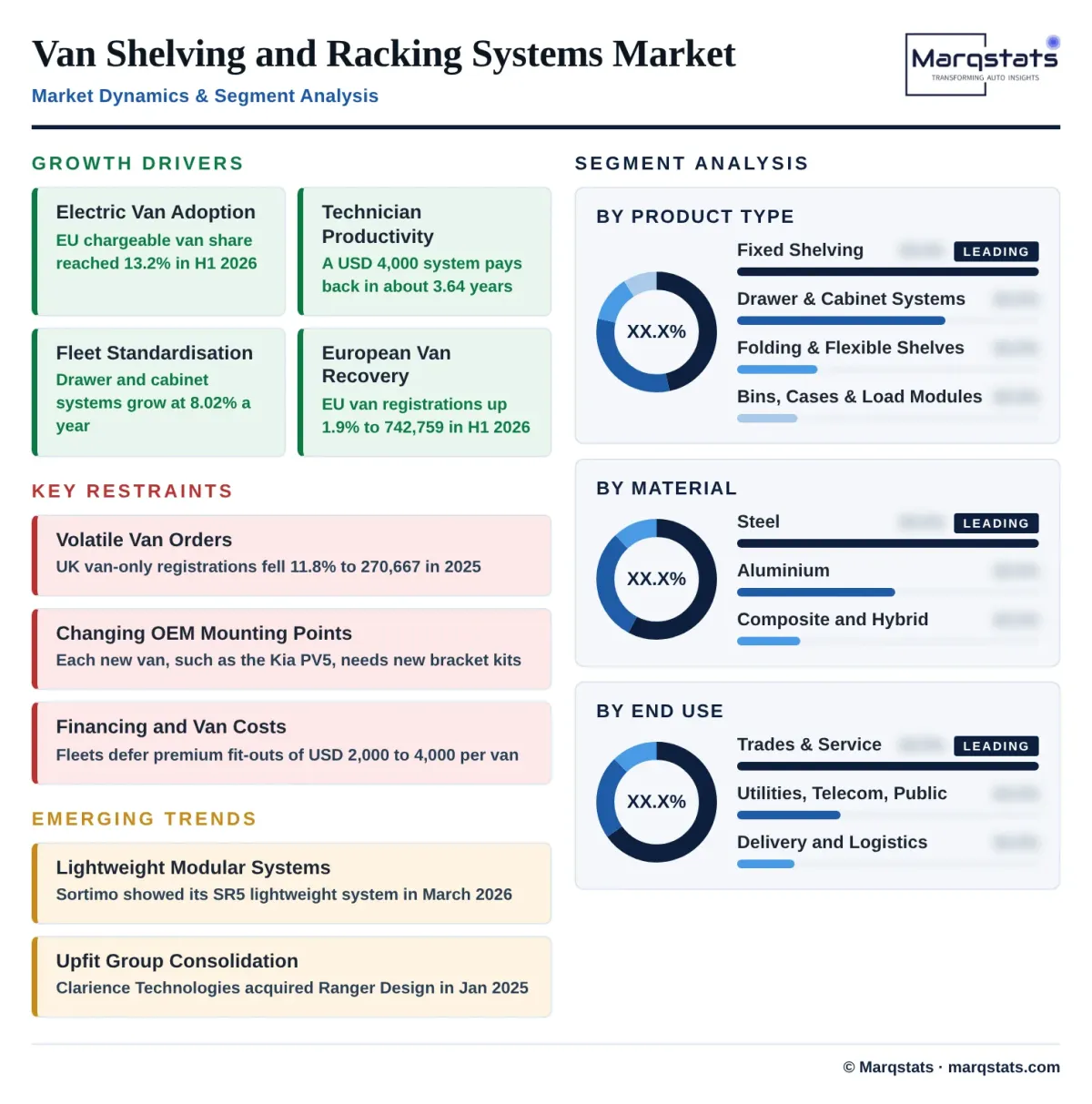
Van racking demand follows van registrations, fleet replacement cycles and the trades and service economy. New EU van registrations fell 8.8% in 2025 before rising 1.9% to 742,759 in the first half of 2026, and the electrically chargeable share of EU van registrations rose from 6.1% in 2024 to 11.2% in 2025 and 13.2% in the first half of 2026. That shift moves buyers toward lighter aluminium and composite systems and toward modular designs that transfer from one van to the next.
Key Takeaways
Market Overview & Analysis
Report Summary
Van shelving and racking systems turn the cargo area of a panel van into an organised mobile workshop or parts store. Fixed shelves and racking units carry tools and stock along the van walls, drawer and cabinet units hold small parts and instruments, folding shelves fold flat when a delivery van needs open floor space and bins, cases and load-securing modules keep items in place during driving. Service technicians, electricians, plumbers, utilities, telecom operators and parcel carriers specify different layouts, and a single van can carry many modules.
No reconciled public series of racked vans exists at a global level, and the global van racking market size is a Marqstats construction built from regional van registrations, refit volumes and installed prices. The construction counts 701,056 vans fitted with racking in 2025, comprising about 425,000 in Europe, 143,800 in the United States, 17,256 in Canada, 70,000 in Asia-Pacific and 45,000 in the rest of the world, with each van classified by its primary system type. Supplier cumulative installations, such as Syncro System's more than 100,000 vans equipped since 1996, describe company history rather than annual market share.
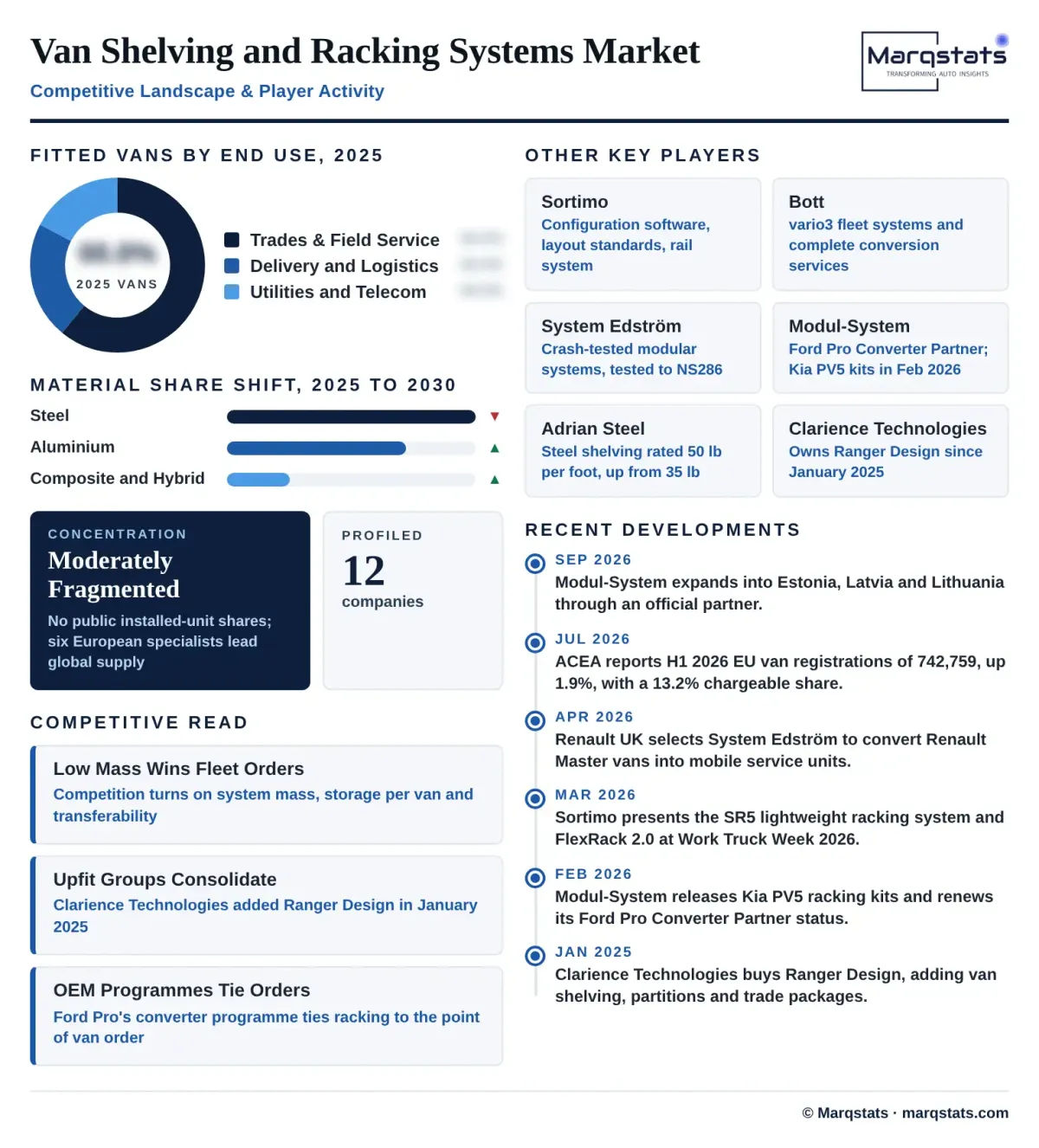
European specialists lead global supply of engineered van racking systems. Sortimo, Bott, Würth, Modul-System, System Edström and Syncro System sell configurable modular systems with vehicle-specific mounting kits, design software and installer networks, while Adrian Steel, Ranger Design, now part of Clarience Technologies, and Weather Guard lead in North America. Vehicle manufacturers increasingly route racking through converter partner programmes, such as Ford Pro's, so that vans can be ordered and financed with racking already installed.
Van Racking Market Size and Forecast
Volume is the anchor series for the van racking market, and value is derived from fitted vans and a weighted average installed price that rises from about USD 2,430 per van in 2025 to USD 2,865 in 2030. The number of vans fitted with racking rises from 701,056 in 2025 to 804,853 by 2030, a 2.80% compound annual growth rate, while market value rises from USD 1,703.84 million to USD 2,305.68 million at 6.24% a year, an absolute increase of USD 601.84 million.
The annual path runs through 715,258 fitted vans and USD 1,799.90 million in 2026, 737,441 vans and USD 1,917.86 million in 2027 and 759,504 vans and USD 2,040.32 million in 2028. It continues to 782,268 vans and USD 2,170.72 million in 2029 before reaching 804,853 vans and USD 2,305.68 million in 2030, and value growth of 5.64% in 2026 sits slightly below the constant-growth path of USD 1,810.16 million because European van demand recovers only gradually from the 2025 decline.
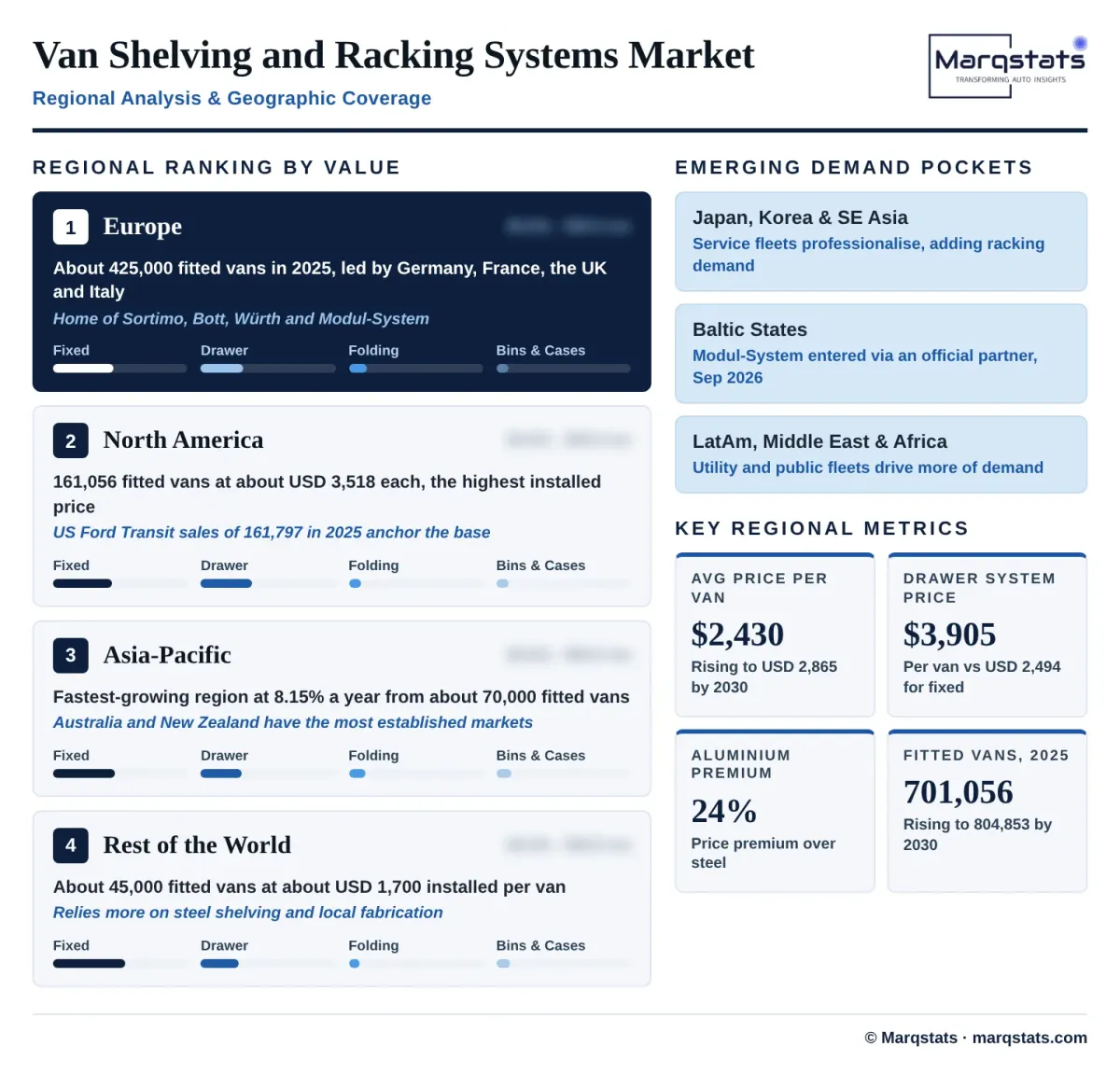
Average installed value rises through product and material mix as well as price. Drawer and cabinet systems, which sell for about USD 3,905 per van in 2025 against USD 2,494 for fixed shelving units, gain share, and aluminium systems carry a premium of about 24% over steel. Installed prices also differ sharply by region, from about USD 3,518 per van in North America, where full-size vans carry larger layouts, to USD 2,150 in Europe and USD 1,700 in the rest of the world.
Electric Vans Turn Racking Weight into a Purchase Criterion
Material choice is the clearest structural shift in the van racking market. Aluminium systems account for USD 514.63 million, or 30.20% of 2025 value, from 183,758 fitted vans, and grow at 10.33% a year to USD 841.44 million by 2030, lifting their share of value to 36.49%. Steel systems remain the largest material at USD 982.47 million, or 57.66% of 2025 value, but grow at only 3.51% a year, and composite and hybrid systems grow at 7.50% a year to USD 296.83 million.
Electric vans change the economics of racking weight for every fleet that adopts them. A battery-electric van carries a heavy battery within the same gross vehicle mass as a diesel model, so every kilogram of racking reduces the legal payload, and fleets also weigh the effect of system mass and placement on driving range and duty cycle. With the electrically chargeable share of new EU vans rising to 13.2% in the first half of 2026, suppliers have prioritised lightweight ranges such as the Sortimo SR5 system and the ProPartition Light partition presented at Work Truck Week in March 2026.
Lighter systems create value only when they still meet the customer's duty and load requirements. Adrian Steel's next-generation shelving, launched in March 2025, uses high-strength low-alloy steel to raise average shelf capacity to 50 pounds per foot from 35 pounds, with up to 17 mounting points against seven on earlier designs. Steel, aluminium and composite designs must therefore be compared on a like-for-like installed configuration, because low weight without equivalent capacity transfers the cost to the operator.
Installed Cost, Fleet Productivity and Payback
A complete cost schedule for a racked van covers the shelving furniture, vehicle-specific brackets, floor preparation, drawers and bins, anti-rattle measures, locks, installation labour, freight and vehicle downtime. Observed prices illustrate the range, with a single Bott Smartvan module listed at GBP 939.72 including VAT and a Ranger Design contractor package for the Ram ProMaster 118-inch or 136-inch wheelbase listed at USD 3,422.70 before tax and fitting. Removal and transfer at lease return, replacement parts and warranty labour add to lifetime cost.
The investment case for van racking rests on technician productivity rather than on the price of the furniture. If organised racking saves 10 minutes on each of 220 workdays, valued at USD 60 per labour hour with half of the saved time converted into productive work, it creates about USD 1,100 of annual capacity, and a USD 4,000 installed system then pays back in about 3.64 years before finance, maintenance, tax and residual value. The illustration shows why fleets measure tool retrieval time, jobs completed, stock losses and unplanned return trips before and after fitting rather than assuming savings.
Procurement models differ between large fleets and small businesses. Large fleets require a repeatable design across a vehicle batch, predictable vehicle release dates, documented mounting and reliable repair parts, and fleet leasing can shift the purchase into a centralised conversion programme. Small businesses buy by trade package, monthly affordability or self-installation, which supports catalogue packages and online configurators alongside fleet contracts.
Safety Testing, Load Security and Regulation
Load security rules shape van racking design, although no single statutory certification applies to racking worldwide. UK Health and Safety Executive guidance addresses secure loads and safe handling in workplace transport, the US Federal Motor Carrier Safety Administration's cargo securement rules apply to covered commercial motor vehicles in interstate commerce rather than to every van, and Australian load restraint guidance distinguishes light vehicles from heavy vehicles.
Suppliers use crash testing to support fleet procurement. Sortimo and System Edström describe loaded-system testing programmes, and System Edström refers to testing against the NS286 standard, while other suppliers cite ECE R17 seat and partition testing. Supplier tests are not independently verified as a class and remain specific to the layouts, attachments and vehicles tested, so fleet buyers ask which loaded configuration was tested and whether the delivered installation matches it.
Vehicle manufacturers shape the installation interface through the mounting points they design into each van. Changes in OEM mounting points with each new van generation require new brackets and kits, and suppliers that work with manufacturers before launch can supply kits from the first day of sale. Modul-System released racking kits for the Kia PV5 electric van in February 2026 and renewed its Ford Pro Converter Partner status the same month, illustrating how early platform access converts into dealer and fleet orders.
Market Dynamics
Key Drivers
Five factors support growth in the global van racking market through 2030.
- Service fleet productivity. Technicians lose time searching for tools and parts, and organised racking that saves 10 minutes a day can pay back a USD 4,000 system in about 3.64 years, supporting fleet investment.
- Electric van adoption. The electrically chargeable share of EU van registrations reached 13.2% in the first half of 2026, raising demand for lightweight aluminium systems that grow at 10.33% a year.
- Fleet standardisation. Large fleets specify repeatable layouts across vehicle batches, and drawer and cabinet systems grow at 8.02% a year as fleets organise parts more precisely.
- Parcel and delivery flexibility. Folding and flexible shelving lets delivery vans switch between parcel sizes and open floor space, and the segment grows at 8.79% a year to USD 319.66 million by 2030.
- Recovery in European van demand. EU van registrations rose 1.9% to 742,759 in the first half of 2026 after an 8.8% decline in 2025, restoring the first-fit base in the largest regional market.
Key Restraints
Four constraints moderate growth, most of them tied to van demand and installation capacity.
- Volatile van orders. UK van-only registrations fell 11.8% to 270,667 in 2025, and order volatility makes converter capacity planning difficult across Europe.
- Low-cost generic furniture. Generic shelving and self-installed units compete with engineered systems on price, particularly among small businesses and in the rest of the world.
- Changing OEM mounting points. New van generations require new brackets and kits, creating shortages of vehicle-specific parts at model launches and raising engineering costs.
- Financing and van costs. Customers defer premium fit-outs when van acquisition and financing costs rise, which slows upgrades within existing fleets.
Key Trends
Four trends are reshaping product design and distribution in the van racking market.
- Lightweight and modular systems. Sortimo presented the SR5 lightweight racking system and its patented rail system for reconfiguring equipment across vehicle lifecycles at Work Truck Week in March 2026.
- Consolidation into upfit groups. Clarience Technologies acquired Ranger Design in January 2025, connecting van storage with a wider vehicle technology and upfit portfolio.
- Converter partner programmes. Modul-System renewed its Ford Pro Converter Partner status in February 2026, as manufacturers route racking through approved converters at the point of van order.
- Mobile service fleets. Renault UK selected System Edström in April 2026 to convert Renault Master vans into mobile service units, with seven vans in the first phase and a target of 25.
Strategic Implications
- Lightweight portfolios for electric vans. Suppliers with aluminium and composite systems are best placed to capture value growth, as aluminium systems rise to USD 841.44 million by 2030.
- Platform-ready kits. Early engineering access to new vans, such as the Kia PV5, lets suppliers win converter and dealer orders from launch rather than after competitors.
- Transferable modular designs. Systems that move between vans at lease return lower lifetime cost for fleets and create repeat revenue from removal, refit and replacement parts.
- Productivity evidence for fleets. Suppliers that document measured productivity gains strengthen their case with fleet buyers who must justify installed costs of USD 2,000 to USD 4,000 per van.
Market Segmentation
Fixed shelving units are the dominant product at USD 791.62 million, or 46.46% of 2025 value, from 317,378 fitted vans, and grow at 4.21% a year to USD 973.08 million by 2030. Their share of value declines to 42.20% as drawer and folding systems gain ground, although fixed shelving remains the standard layout for trades vans in every region.
Drawer and cabinet systems account for USD 545.82 million, or 32.03% of 2025 value, from 139,790 fitted vans, and grow at 8.02% a year to USD 802.82 million by 2030. At about USD 3,905 per van, they carry the highest installed value because drawers, cases and cabinets organise parts and instruments for service technicians.
Folding and flexible shelving accounts for USD 209.81 million, or 12.31% of 2025 value, from 102,327 fitted vans, and is the fastest-growing product at 8.79% a year to USD 319.66 million by 2030. Parcel and delivery operators favour folding shelves that preserve open cargo space, and durable hinges and safe loading practices determine product choice.
Bins, cases and load-securing modules account for USD 156.59 million, or 9.19% of 2025 value, from 141,561 fitted vans, and grow at 6.06% a year to USD 210.12 million by 2030. The segment covers vans fitted primarily with storage bins, tool cases, load rails and lashing modules rather than full shelving layouts.
Steel is the largest material at USD 982.47 million, or 57.66% of 2025 value, from 433,942 fitted vans, and grows at 3.51% a year to USD 1,167.41 million by 2030. Steel dominates North American shelving and heavy-duty trades applications because of its load capacity and lower cost, but its share of value falls to 50.63% by 2030.
Aluminium accounts for USD 514.63 million, or 30.20% of 2025 value, from 183,758 fitted vans, and is the fastest-growing material at 10.33% a year to USD 841.44 million by 2030. European suppliers lead in lightweight aluminium systems, which suit electric vans and fleets seeking to protect payload.
Composite and hybrid systems account for USD 206.74 million, or 12.13% of 2025 value, from 83,356 fitted vans, and grow at 7.50% a year to USD 296.83 million by 2030. Combinations of aluminium frames with composite or plastic shelves, drawers and cases reduce weight and noise.
Trades and field service is the largest end use at USD 1,110.20 million, or 65.16% of 2025 value, from 426,647 fitted vans, and grows at 6.17% a year to USD 1,497.75 million by 2030. Electricians, plumbers, heating engineers and equipment service technicians form the core of demand, and they require tool access, parts organisation and secure storage.
Utilities, telecom and public services account for USD 380.43 million, or 22.33% of 2025 value, from 122,198 fitted vans, and grow at 5.14% a year to USD 488.68 million by 2030. Utility and telecom fleets specify high-value layouts with specialist equipment storage, which lifts the average installed value to about USD 3,113 per van.
Delivery and logistics account for USD 213.21 million, or 12.51% of 2025 value, from 152,211 fitted vans, and are the fastest-growing end use at 8.41% a year to USD 319.25 million by 2030. Parcel operators favour lighter and folding layouts at an average of about USD 1,401 per van, the lowest in the market.
By Geography
Europe
Europe is the largest region in the van racking market at USD 913.75 million, or 53.63% of 2025 value, from about 425,000 fitted vans, and grows at 5.37% a year to USD 1,186.79 million by 2030. Germany, France, the UK, Italy and Spain form the core of demand, with UK van-only registrations of 270,667 in 2025, and Sortimo, Bott, Würth, Modul-System, System Edström and Syncro System lead supply.
North America
North America accounts for USD 566.59 million, or 33.25% of 2025 value, from 161,056 fitted vans, and grows at 7.04% a year to USD 796.09 million by 2030. The United States contributes USD 505.88 million, matching the Marqstats US commercial van upfitting estimate, and Canada USD 60.71 million, with Ford Transit sales of 161,797 in the United States in 2025 illustrating the size of the full-size van base.
Asia-Pacific
Asia-Pacific accounts for USD 147.00 million, or 8.63% of 2025 value, from about 70,000 fitted vans, and is the fastest-growing region at 8.15% a year to USD 217.50 million by 2030. Australia and New Zealand have the most established racking markets, with service van requirements that vary by jurisdiction, while Japan, South Korea and South-East Asia add demand as service fleets professionalise.
Rest of the World
The rest of the world accounts for USD 76.50 million, or 4.49% of 2025 value, from about 45,000 fitted vans, and grows at 6.60% a year to USD 105.30 million by 2030. Latin America, the Middle East and Africa rely more on steel shelving and local fabrication, and utility and public service fleets account for a larger share of demand than in other regions.
How Competition Is Evolving
The global van racking market is moderately fragmented. European specialists such as Sortimo, Bott, Würth, Modul-System, System Edström and Syncro System hold strong positions in their home markets and export through dealer and installer networks, while Adrian Steel, Ranger Design, Weather Guard, Masterack, owned by J. B. Poindexter, and Kargo Master, owned by Holman, lead in North America and local fabricators serve price-sensitive buyers in every region. Public installed-unit shares are not available, and supplier cumulative installations, distributor coverage and company turnover cannot be used as annual market share.
Competition turns on low system mass, usable storage per van, transferability to replacement vehicles, rapid installation, spare parts availability and credible safety documentation. Sortimo competes on configuration software, layout standardisation and its rail system, Bott on its vario3 fleet systems and complete conversion services and System Edström and Modul-System on crash-tested modular systems and converter partnerships, while Adrian Steel competes on steel capacity and integrated pickup and van solutions.
Consolidation and manufacturer partnerships are reshaping the market. Clarience Technologies acquired Ranger Design in January 2025, adding van storage to a broader vehicle technology group, and converter programmes such as Ford Pro's tie racking suppliers to the point of van order. Fleet procurement increasingly favours suppliers that combine design, installation, documentation and aftersales coverage across several countries.
Companies Covered
Companies covered in the report include:
Recent Market Activity
Table of Contents
Coverage & Segmentation
Coverage spans van shelving and racking systems fitted to commercial vans worldwide, segmented by product type, material and end use and by North America, Europe, Asia-Pacific and the rest of the world, with the United States and Canada reported separately within North America. The base year is 2025, the historical period runs from 2021 to 2025 and the forecast period from 2026 to 2030. Value is expressed in USD million at installed prices including fitting labour and excluding the van, sales taxes and freight, and volume is expressed in vans fitted with racking, each classified by its primary system type.
Partitions, flooring, ladder racks, roof systems, electrical equipment, refrigeration and complete conversion services are excluded from the market definition. The United States figures match the shelving and storage systems segment of the Marqstats US commercial van upfitting estimate, and the estimate draws on van registration statistics, vehicle manufacturer sales releases, supplier catalogues and price lists and workplace and vehicle load security guidance. The competitive assessment profiles twelve companies across Europe and North America.