Market Snapshot
Key Takeaways
Market Overview & Analysis
Report Summary
The North America refrigerated van conversion market is a specialised, compliance-intensive subsegment of the broader commercial van upfitting industry. Under US federal regulation, a refrigerated van conversion is typically a final-stage manufacturing activity: 49 CFR Part 568 governs vehicles built in two or more stages, and Part 567 defines the final-stage manufacturer's responsibility for the completed vehicle's certification. This regulatory structure means that refrigerated van converters — whether large specialist operators like Summit Bodyworks, or regional bodywork companies serving local cold-chain fleets — are performing regulated vehicle manufacturing, not simply bolting on aftermarket accessories. FSMA compliance requirements from the FDA's Sanitary Transportation rule add a second compliance layer: the converted van body must support temperature maintenance, pre-cooling, cleaning protocols, and documentation sufficient to satisfy FDA food-safety requirements for temperature-controlled food transport.
The market's commercial structure is organised around three layers. The refrigeration unit manufacturers — Carrier Transicold and Thermo King (Trane Technologies) — are the technology and product leaders, each offering full product families spanning small van applications to large straight-truck and trailer systems, with both ICE-compatible and BEV-compatible all-electric architectures. The refrigerated body builders and van converters — Summit Bodyworks (FSMA-compliant refrigerated van conversions with Zanotti refrigeration units), Thermobile (specialist US reefer van converter), Utilimaster (food and beverage delivery and refrigerated truck solutions), and hundreds of regional NTEA-member operators — perform the actual vehicle conversion work. The fleet operators — grocery delivery services, pharmaceutical distribution companies, floral and confectionery distributors, meal-kit logistics operators, and third-party logistics providers — are the end-buyers whose procurement decisions and specification requirements define the market's product development direction.
The cold chain last mile van market US is being reshaped by two concurrent forces: the expansion of online grocery and food delivery demand, and the transition from diesel-engine-driven refrigeration systems to all-electric units. The US Census Bureau estimates 2025 US retail e-commerce sales at USD 1.2337 trillion, up 5.4% year on year and representing 16.4% of total retail sales — a demand base that directly supports more cold chain last mile delivery activity as grocery, pharmacy, and food-service sectors expand home-delivery operations. Temperature controlled delivery van demand is growing across the spectrum from ambient-chilled grocery delivery (Instacart, Amazon Fresh, Walmart+) to frozen-goods last-mile service to pharmaceutical and vaccine distribution requiring CDC-mandated cold-chain integrity. The IoT-connected reefer van market is also maturing, with Carrier Transicold's BluEdge connected platform and Thermo King's telematics systems providing real-time temperature monitoring, fleet management, and compliance documentation that fleet operators increasingly require as standard equipment alongside the physical refrigeration hardware.
Market Dynamics
Key Drivers
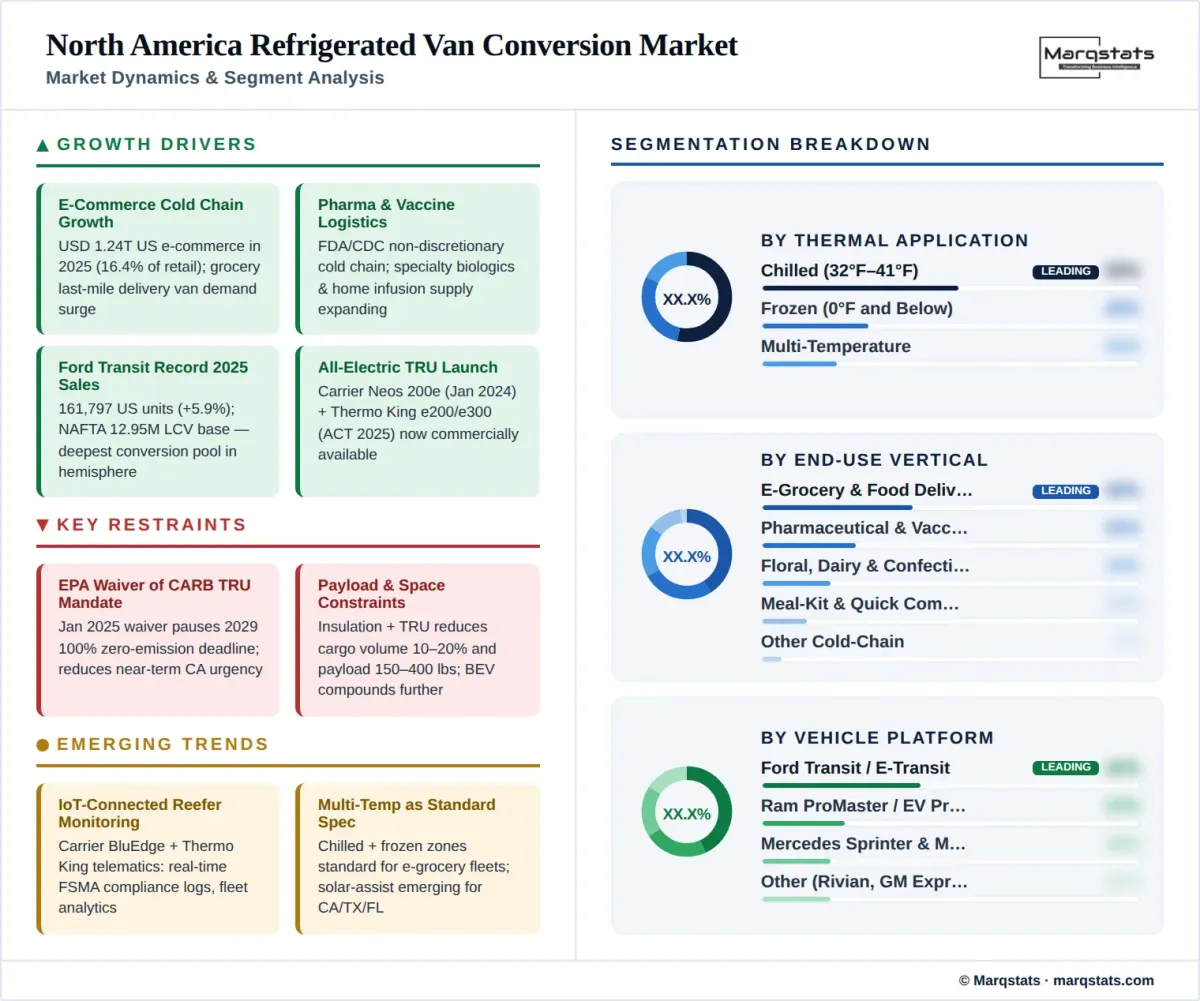
- E-grocery and food delivery van market growth — USD 1.24 trillion in US e-commerce driving cold chain last mile demand: The US Census Bureau's USD 1.2337 trillion in 2025 US retail e-commerce sales (up 5.4%, 16.4% of total retail) represents the primary macro driver of refrigerated van conversion demand in North America. Grocery e-commerce, meal-kit delivery (HelloFresh, Home Chef, Green Chef), dark-store quick commerce (GoPuff, Gopuff), and food-service platform delivery all require temperature controlled delivery vans capable of maintaining chilled and frozen cargo integrity from sortation facility to doorstep. The cold chain last mile van market US is the conversion market's highest-growth demand application, requiring frequent door openings, rapid temperature recovery, and often multi-temperature configurations that can carry chilled and frozen products in the same delivery cycle.
- Pharmaceutical cold chain van market US — vaccine distribution, biologics, and healthcare last-mile: The pharmaceutical logistics van market in the US is the refrigerated van conversion market's highest-value-per-vehicle end-use segment, driven by FDA temperature-compliance requirements, CDC vaccine storage guidelines, and the elevated post-pandemic investment in pharmaceutical supply chain infrastructure. CDC's vaccine toolkit explicitly states that exposure to temperatures outside recommended ranges can reduce potency permanently, creating a non-discretionary requirement for certified temperature-controlled vans in pharmacy, hospital, and clinic supply chains. Health Canada imposes equivalent pharmaceutical transport temperature requirements in the Canadian market. The pharmaceutical cold chain van market US is growing above the overall refrigerated van market rate as pharmaceutical home delivery, outpatient infusion supply, and specialty biologics distribution expand the temperature-controlled last-mile delivery addressable fleet.
- Ford Transit record 2025 sales (161,797 units, up 5.9%) and NAFTA's 12.95 million LCV production base providing the largest addressable van conversion pool in the Western Hemisphere: Ford Transit's position as America's best-selling van, with record 2025 US sales confirming sustained demand for the primary platform underpinning refrigerated cargo van conversion activity, provides the most direct demand-base anchor for the refrigerated van conversion market US. Carrier Transicold and Thermo King both explicitly position their small-van TRU product lines around the Transit and Sprinter class, and Summit Bodyworks' refrigerated van programme also covers the Transit alongside the ProMaster and Sprinter. The broader NAFTA 12.95 million LCV production base (OICA 2024) — including 8.80 million US, 3.04 million Mexico, and 1.10 million Canada — underpins the conversion market's addressable vehicle supply.
- Electric refrigeration unit commercialisation creating a premium replacement cycle in existing refrigerated van fleets: Carrier Transicold's Neos 200e (North America dealer network availability since January 2024) and Thermo King's e200/e300 all-electric TRU family (featured at ACT Expo 2025) are not merely future-oriented product launches — they are commercially available, actively specified products that fleet operators are beginning to adopt in new-van conversions. The all-electric systems eliminate diesel engine PTO drive and associated fuel consumption, maintenance complexity, and emissions, while providing consistent cooling capacity regardless of vehicle engine speed or stop-start urban delivery cycles. For battery-electric van platforms (Ford E-Transit, Ram EV ProMaster), all-electric TRUs are the only viable refrigeration architecture — and as BEV cargo van penetration grows, so does the mandatory addressable market for electric refrigeration unit integration.
- Canada van market growth — Statistics Canada 20.4% increase in new van registrations in 2025: Canada's strongest van market growth in recent years, driven by urbanisation, cold-weather cold-chain infrastructure investment, and expanding pharmacy logistics networks in Ontario, British Columbia, and Alberta, adds a growing secondary demand pool to the North America refrigerated van conversion market. Canadian food safety regulations under CFIA (requiring dairy and refrigerated products at 4°C or below), Health Canada's pharmaceutical transport requirements, and the expansion of grocery e-commerce in Canada's major metropolitan areas are all creating demand for refrigerated cargo van conversions equivalent to US FSMA-driven demand.
Key Restraints
- EPA waiver of CARB zero-emission TRU requirements (January 2025) reducing near-term California compliance-driven replacement urgency: The EPA's January 2025 decision to waive CARB's zero-emission TRU requirements — which would have required 15% annual fleet turnover to zero-emission technology from December 2023 and 100% zero-emission truck TRUs by December 31, 2029 — has paused the compliance-driven fleet replacement timeline for diesel-powered TRUs in California. While CARB is developing a new TRU rulemaking, the specific requirements and timing are not yet determined. This regulatory pause reduces the urgency of electric TRU adoption for California-operating fleets, potentially slowing the premium electric refrigeration unit market growth rate relative to a counterfactual where the 2029 mandate remained in force.
- Payload and space constraints in compact cargo van platforms limiting refrigerated body configuration depth: The physical dimensions and payload budgets of Class 1–2 cargo vans — including Ford Transit cargo in short and medium wheelbase configurations, Ram ProMaster 1500, and Mercedes Metris — create genuine engineering constraints for refrigerated body builders. The insulated panel system, refrigeration unit, evaporator, and mounting hardware all consume cargo volume and payload capacity, with a standard small-van refrigeration conversion typically reducing usable cargo volume by 10–20% and payload by 150–400 lbs. For BEV platforms with battery-driven payload reduction, these constraints are compounded — the Ford E-Transit's lower payload versus the Transit ICE means that balancing refrigeration system weight, battery weight, and useful cargo capacity requires careful engineering attention.
- FSMA compliance complexity for smaller operators and regional fleet owners: While large fleet operators with dedicated procurement and compliance teams can navigate FDA FSMA Sanitary Transportation requirements and final-stage manufacturer certification obligations, smaller regional fleets and independent operators find the compliance documentation, temperature monitoring requirements, and vehicle certification process genuinely burdensome. This complexity creates a bifurcated market where large NTEA-certified specialists dominate multi-van fleet procurement while smaller independent refrigerated van users face higher effective conversion costs, longer lead times, and steeper regulatory learning curves.
Key Trends
- All-electric refrigeration units becoming the standard specification for electric cargo van platforms: The commercialisation of Carrier Neos 200e and Thermo King e200/e300 electric TRUs is establishing all-electric refrigeration as the expected specification for BEV cargo van conversion programmes. Unlike diesel-engine-driven TRUs that require a running engine or auxiliary genset for refrigeration power, electric TRUs draw power directly from the vehicle's traction battery (BEV) or from the alternator/battery (ICE), eliminating the second engine maintenance cycle and the diesel fuel system. For fleet operators managing urban fleets in ZEV-compliant or low-noise-required delivery environments, electric refrigeration units also eliminate TRU exhaust emissions and operating noise — enabling refrigerated delivery in residential areas, indoor loading docks, and LEZ zones that prohibit diesel-engine operation.
- Multi-temperature van conversion becoming standard specification for grocery and pharmaceutical fleet procurement: Single-temperature refrigerated van conversions are increasingly being supplemented by multi-temperature van conversion US configurations — separately controlled chilled and frozen compartments, or chilled and ambient zones — as grocery e-commerce operators expand mixed-category home delivery (Kroger, Albertsons, Walmart, Amazon Fresh combining chilled and frozen items), and pharmaceutical distributors require simultaneous ambient and cold-chain product delivery. Summit Bodyworks' FSMA-compliant customised interior designs explicitly address cross-contamination prevention and multi-temperature zone ergonomics, reflecting how multi-temperature has moved from premium specification to standard fleet procurement requirement.
- IoT-connected reefer van US market growing as real-time temperature monitoring becomes fleet standard: Carrier Transicold's BluEdge connected platform and Thermo King's Precedent and TriPac telematics systems are being integrated as standard specifications in refrigerated van conversion programmes for food-distribution and pharmaceutical-logistics fleets. IoT connected reefer van systems provide continuous temperature logging, remote alarm notification, geofenced cold-chain documentation, and fleet-management analytics that simultaneously satisfy FDA FSMA monitoring requirements, pharmaceutical GDP documentation needs, and corporate ESG cold-chain sustainability reporting. The transition from periodic manual temperature checks to continuous IoT monitoring is creating a services and subscription revenue layer on top of the physical refrigeration hardware market.
- Solar-assisted and hybrid refrigeration systems emerging as a fuel-saving and sustainability-credentialling intermediate technology: Solar-assisted refrigerated van conversions — where roof-mounted photovoltaic panels supplement or pre-charge the TRU battery or provide auxiliary power for the refrigeration system — are a growing niche in the sustainable refrigerated van market US, particularly for operators in high-solar-irradiance markets like California, Texas, and Florida. Solar-assist systems reduce diesel fuel consumption on ICE platforms and reduce traction battery draw on BEV platforms, addressing both operating-cost economics and corporate sustainability reporting requirements. This technology is growing but remains niche compared to the mainstream all-electric TRU market.
Market Segmentation
Chilled van conversions — maintaining fresh food, dairy, meal kits, and fresh pharmaceutical products between 32°F and 41°F — are the North American refrigerated van conversion market's largest segment by unit volume, serving grocery delivery, meal-kit last-mile distribution, dairy logistics, fresh-produce distribution, and cold-chain pharmaceutical last-mile applications. The refrigerated van fleet operators US in this segment include national grocery chains, meal-kit subscription services, third-party cold-chain logistics operators, and pharmaceutical wholesalers. Summit Bodyworks' FSMA-compliant refrigerated vans with Zanotti direct-drive and battery units serve this segment with customised interiors that prevent cross-contact contamination. Carrier Transicold's Neos 200e is explicitly positioned as ideal for florists, confectioners, grocers, and last-mile delivery businesses — directly naming the chilled-segment end uses that define this product's North American addressable market.
Frozen food delivery van conversion — maintaining cargo areas at or below 0°F (-18°C) for ice cream, frozen meals, and frozen goods e-commerce delivery — is a distinct and growing segment driven by the expansion of frozen-category e-grocery delivery, specialty frozen-food retail distribution, and frozen pharmaceutical product logistics. Frozen van conversions require heavier-duty refrigeration units with greater pull-down capacity, thicker insulation panels, and higher-specification door-seal systems than standard chilled builds. Thermo King's V-520 rooftop unit for medium-to-large insulated vans is positioned for frozen-application deployments requiring high-capacity continuous cooling on longer urban delivery routes.
Multi-temperature van conversion — creating separately controlled thermal zones within a single van for combined chilled and frozen product delivery — is the fastest-growing product category in the North American refrigerated van conversion market, driven by grocery e-commerce consolidation of chilled and frozen deliveries into a single home-delivery trip and pharmaceutical mixed-temperature logistics requirements. Summit Bodyworks' refrigerated van programme supports both fresh and frozen applications with Zanotti units, and Carrier Transicold's 35X is explicitly described as providing fresh and frozen protection for box trucks and large vans. Multi-temperature configurations carry the highest per-vehicle conversion value in the van segment.
The pharmaceutical cold chain van market US is the highest-value-per-vehicle end-use segment, requiring FDA and Health Canada-compliant temperature monitoring, documentation, and often validated temperature mapping for biologics and vaccine storage. CDC guidelines that exposure outside recommended temperature ranges permanently reduces vaccine potency create a non-discretionary technical specification requirement for pharmaceutical refrigerated van conversions. The pharmaceutical logistics van market is growing rapidly as specialty pharmacy home delivery, outpatient infusion supply distribution, and specialty biologics last-mile logistics expand the temperature-controlled van addressable fleet beyond traditional wholesale pharmaceutical delivery.
By Geography
United States
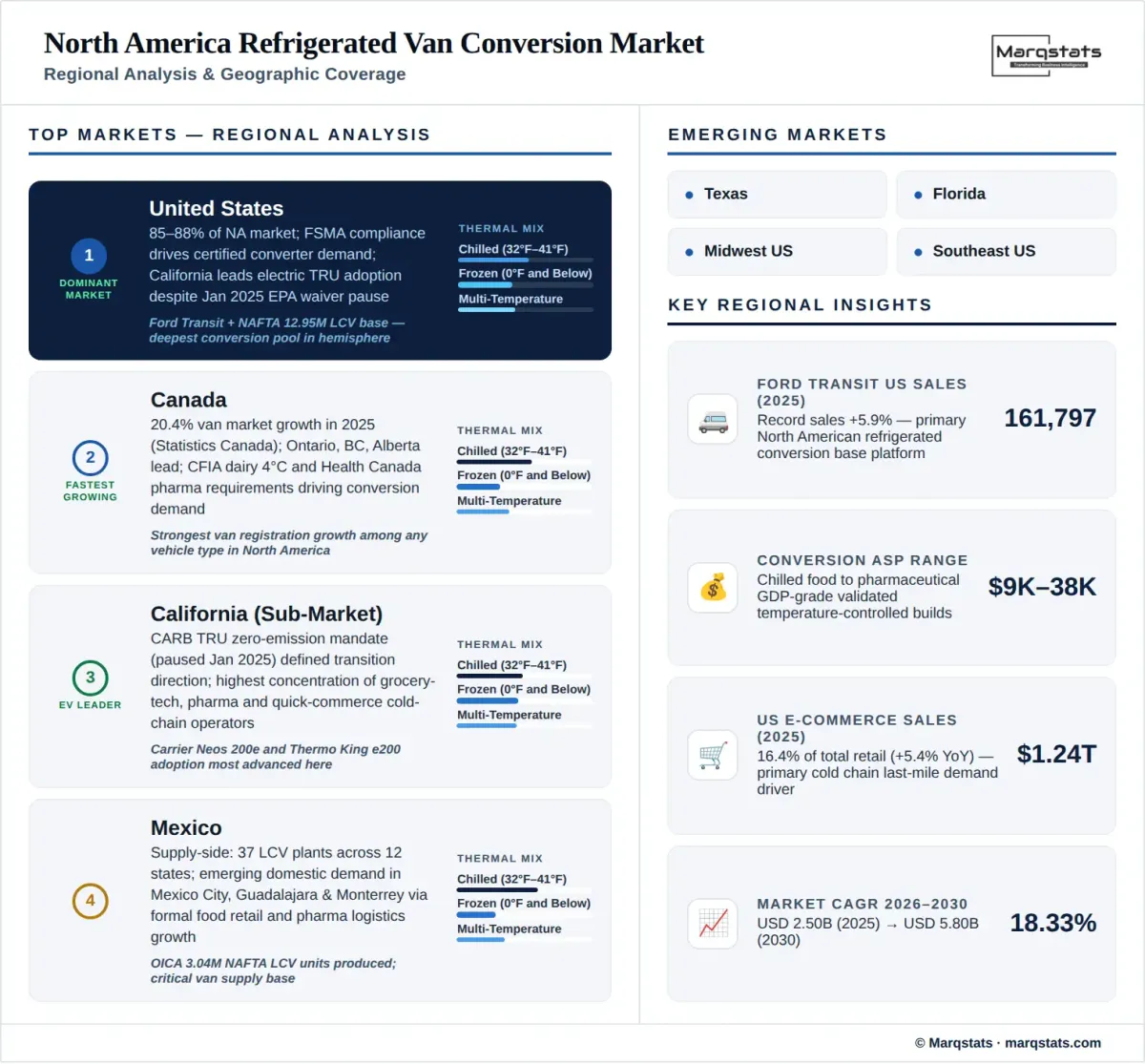
The United States accounts for approximately 85–88% of the North America refrigerated van conversion market by revenue, anchored by Ford Transit's record 161,797 units in 2025, a USD 1.24 trillion e-commerce base driving last-mile cold chain demand, and the FDA FSMA regulatory framework mandating FSMA-compliant temperature-controlled van builds for food transporters. California is the most regulatory-advanced state for cold-chain logistics, both through CARB's TRU zero-emission requirements (paused at the federal level since January 2025 but still defining the technology transition direction) and through the concentration of grocery technology companies, pharmaceutical distributors, and quick-commerce operators in the Bay Area, Los Angeles, and San Diego markets. Texas, Florida, and the Midwest are the highest-volume refrigerated van conversion demand regions by fleet size, driven by food distribution, agricultural supply chains, and large pharmacy-logistics networks. Summit Bodyworks serves the US market from multiple locations, offering FSMA-compliant refrigerated vans with Zanotti refrigeration units — a supply model that illustrates the multi-location, certified-converter infrastructure the US refrigerated van conversion market requires.
Canada
Canada's van market grew 20.4% in 2025 (Statistics Canada), the strongest increase among vehicle types — making Canada the fastest-growing national market for refrigerated van conversion in North America. Ontario, British Columbia, and Alberta are the primary Canadian demand centres, driven by grocery e-commerce expansion (Instacart Canada, Sobeys, Loblaws), pharmaceutical wholesale and specialty pharmacy logistics (governed by Health Canada's pharmaceutical transport requirements), and Canada's cold-weather operating conditions that create year-round refrigerated and heated-van conversion demand. CFIA's requirement that refrigerated dairy products be maintained at 4°C or below during transport is the primary regulatory demand driver in Canada, equivalent in operational impact to FDA FSMA requirements in the US. The Canadian reefer van conversion market is served by a combination of US-based national specialists with cross-border programmes and Canadian regional bodywork operators.
Mexico
Mexico's role in the North America refrigerated van conversion market is primarily supply-side — as OICA notes, Mexico's 37 light-vehicle plants across 12 states owned by 13 companies make it a critical production base for the North American commercial van supply chain. Growing domestic Mexican cold-chain demand for refrigerated van conversions, driven by expanding formal food retail, pharmaceutical logistics investment, and quick-commerce delivery in Mexico City, Guadalajara, and Monterrey, creates an emerging direct conversion demand market alongside Mexico's established role as a manufacturing platform.
How Competition Is Evolving
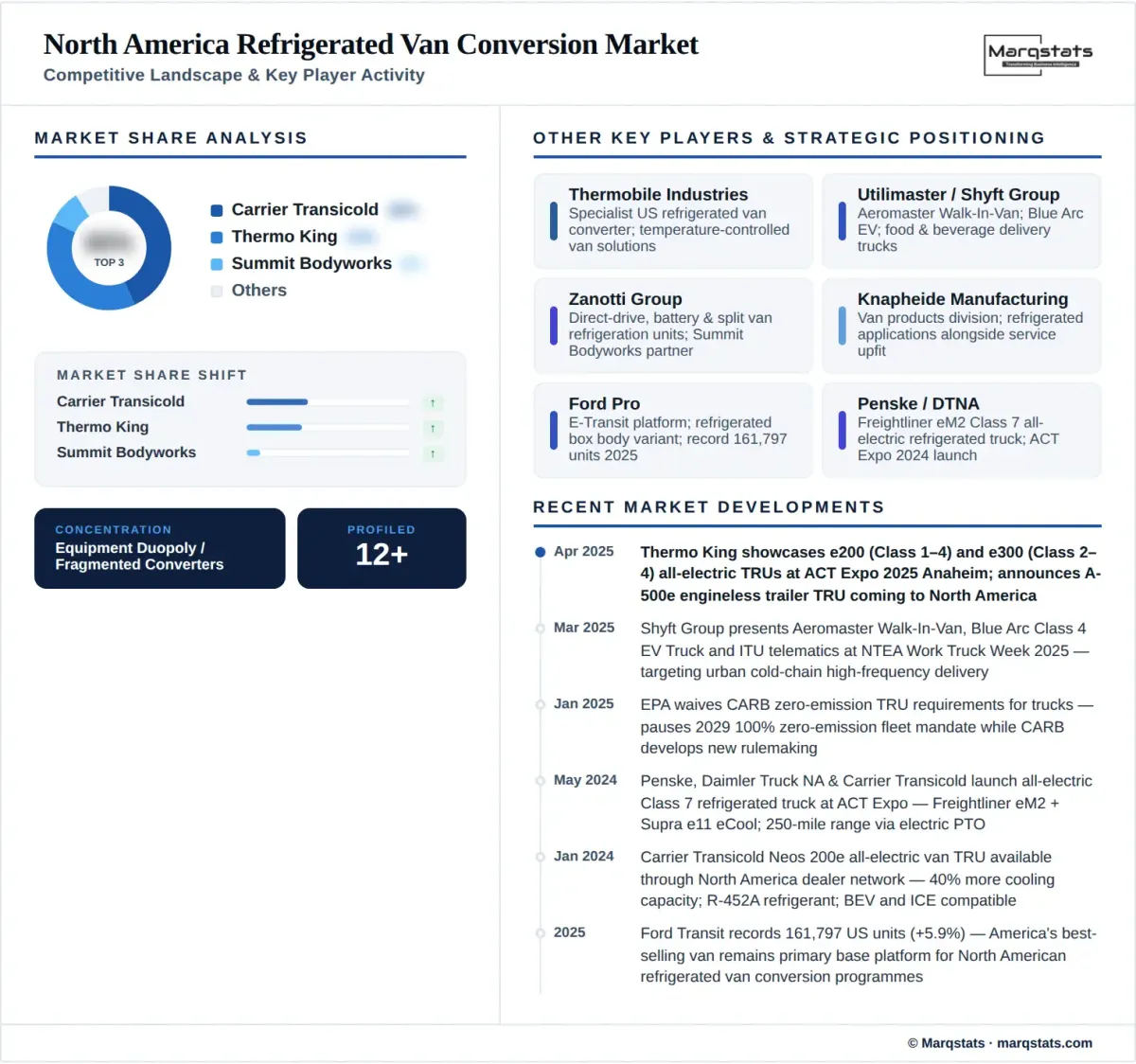
The North America refrigerated van conversion market is moderately fragmented at the body-builder and van-converter level, with a concentrated duopoly at the refrigeration unit equipment level. Carrier Transicold and Thermo King collectively dominate the North American van TRU market, each offering ICE-compatible and all-electric architectures across the full van size spectrum from small delivery vehicles (Carrier Neos 200e, Thermo King e200) to large insulated vans (Carrier 35X, Thermo King V-520). Between these two equipment leaders, virtually all professionally converted refrigerated vans in North America are equipped with either a Carrier Transicold or Thermo King unit.
At the van-converter tier, Summit Bodyworks (multiple US locations, FSMA-compliant Zanotti-unit builds) and Thermobile (specialist US reefer van converter) are the most explicitly positioned national refrigerated van conversion companies. Utilimaster — whose Food & Beverage Delivery Trucks and Refrigerated Trucks product lines serve the commercial fleet market — brings scale from its broader work-truck body manufacturing operations. The NTEA member network of certified final-stage manufacturers provides the distributed installation infrastructure that allows refrigerated van conversions to be specified and delivered regionally rather than requiring centralised national facilities. IoT temperature monitoring system integration — from Carrier Transicold's BluEdge platform and Thermo King's connected telematics — is increasingly a competitive differentiator among van converters who can deliver fully connected, documented, FSMA-compliant refrigerated van builds versus those offering hardware-only installations.
Companies Covered
The report profiles 12+ companies with full strategy and financials analysis, including:
Recent Market Activity
Table of Contents
Coverage & Segmentation
This report provides a comprehensive analysis of the North America refrigerated van conversion market covering the 2021–2030 period, with 2025 as the base year. The study covers insulated body fabrication and installation, transport refrigeration unit supply and installation (diesel-engine-driven, electric PTO, all-electric BEV-compatible), multi-temperature partition systems, IoT temperature monitoring and telematics hardware, FSMA-compliant interior systems for food-grade applications, pharmaceutical GDP-grade temperature-validated conversions, and solar-assisted and hybrid refrigeration architectures. End-use vertical coverage includes e-grocery and food delivery, pharmaceutical and vaccine last-mile logistics, floral and confectionery distribution, dairy and frozen goods, meal-kit delivery, and cold-chain quick commerce. Van platform coverage spans Ford Transit and E-Transit, Ram ProMaster and EV ProMaster, Mercedes-Benz Sprinter and Metris, Rivian EDV, and GM Express. Regulatory coverage spans FDA FSMA Sanitary Transportation rule, CFIA Canadian food transport requirements, Health Canada pharmaceutical transport requirements, CDC vaccine cold-chain guidelines, 49 CFR Parts 567/568 final-stage manufacturer certification, and CARB 2022 TRU Amendments (current status including EPA waiver).
Primary research included 40+ interviews with refrigerated van body builder operations managers, fleet procurement directors at grocery logistics and pharmaceutical distribution companies, Carrier Transicold and Thermo King North America product managers, NTEA-member certified final-stage manufacturer operators, IoT cold-chain monitoring platform vendors, and fleet electrification programme leads. Secondary research drew from Ford Pro 2025 Transit sales data, US Census Bureau 2025 e-commerce sales statistics (USD 1.2337 trillion), Statistics Canada van registration data, OICA NAFTA LCV production data, FDA FSMA Sanitary Transportation regulatory impact analysis, CDC vaccine storage and handling toolkit, CARB 2022 TRU Amendment official text, EPA waiver documentation (January 2025), Carrier Transicold press releases (Neos 200e January 2024), Thermo King ACT Expo 2024 and 2025 press releases, Penske/DTNA/Carrier ACT Expo 2024 launch announcement, and Shyft Group NTEA Work Truck Week 2025 announcement.