Market Snapshot
Key Takeaways
Market Overview & Analysis
Report Summary
The global automotive blind spot detection system market comprises radar, camera, ultrasonic, and sensor-fusion systems that warn drivers of vehicles or obstacles in adjacent lanes, sold as original equipment and through aftermarket retrofit kits across passenger cars, light commercial vehicles, heavy trucks, buses, and off-road vehicles. This study segments the market by technology, vehicle type, and sales channel, with a 2025 base year, historical coverage from 2021 to 2025, and forecasts to 2030. Market size is stated as sensor hardware and software revenue in United States dollars.
Regulatory mandate is the single most important demand driver distinguishing this market's growth pattern from many other automotive safety categories: heavy truck and bus adoption has moved rapidly toward near-universal fitment specifically because regulation requires it, while passenger car adoption, though also regulation-influenced through safety-rating programmes, remains more directly shaped by consumer purchasing decisions and OEM trim-level strategy. This split means the two vehicle-type segments follow meaningfully different growth logics even within a single, technically similar product category. Insurance industry involvement is an emerging third demand channel operating alongside pure regulation and consumer choice, as commercial fleet insurers increasingly offer premium discounts tied to blind spot detection fitment, effectively creating a financial incentive layered on top of regulatory and safety-rating pressure.
Sensor fusion, combining radar's reliable medium-range detection with camera's ability to classify what it detects, is becoming the preferred configuration for premium and mid-market vehicles, since fusion systems reduce the false-alarm rate that early single-sensor systems were prone to and improve detection of vulnerable road users such as cyclists and motorcycles that a radar-only system may struggle to distinguish from larger vehicles. Cost-sensitive vehicle segments continue to rely on single-sensor radar or ultrasonic configurations, where price remains the dominant purchasing consideration over marginal detection-accuracy improvements. Processing requirements differ substantially between single-sensor and fusion configurations, since combining and reconciling radar and camera data streams in real time demands meaningfully more on-vehicle compute capacity than a single-sensor system requires, a cost that has only become viable for mid-market vehicles as automotive-grade processors have both improved in capability and declined in price.
Market Dynamics
Key Drivers
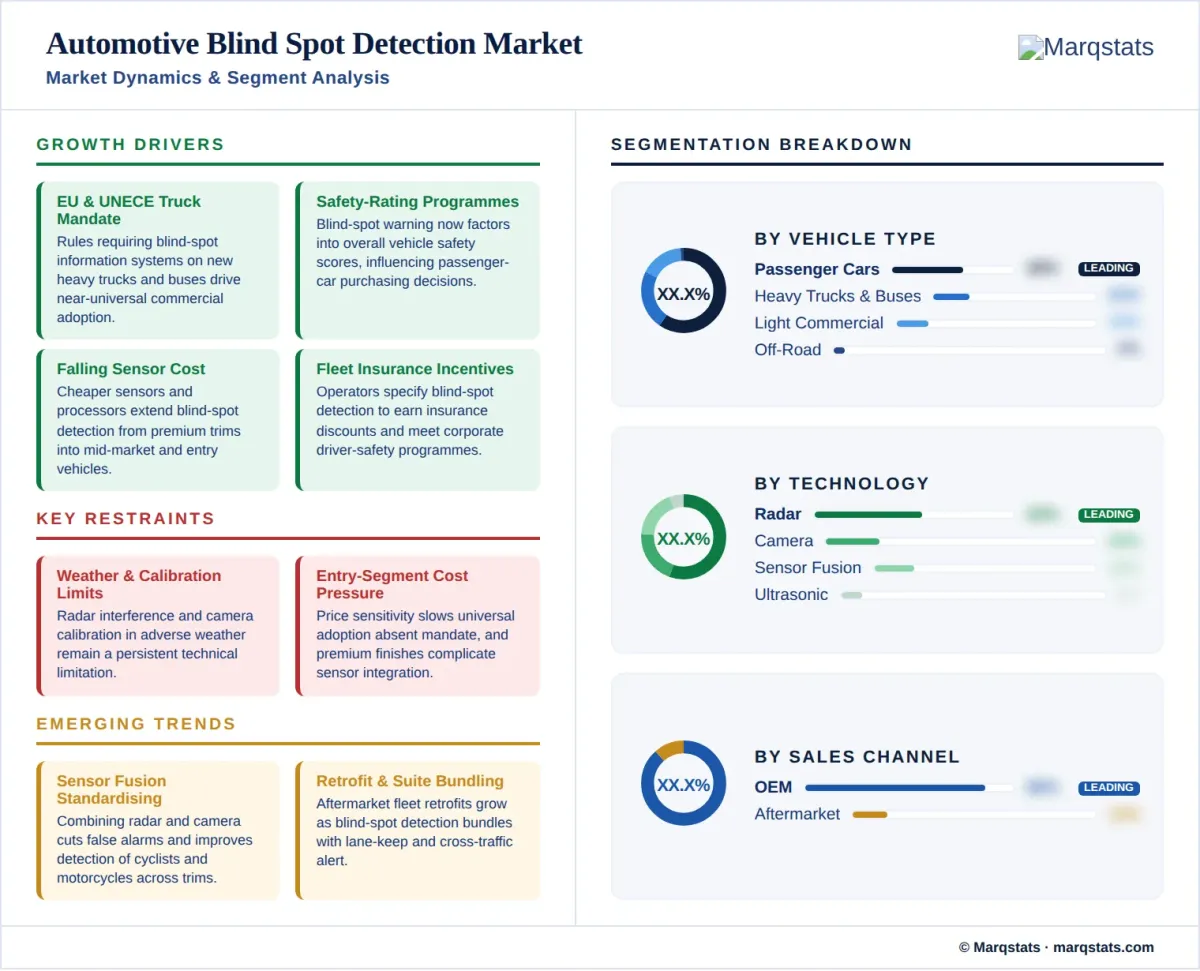
- European Union and UNECE regulations mandating blind spot information systems on heavy trucks and buses are driving near-universal commercial vehicle adoption.
- Safety-rating programmes in North America and other markets now factor blind spot warning into overall vehicle safety scores, influencing consumer purchasing decisions.
- Falling sensor costs are extending blind spot detection from premium trim levels into mid-market and entry-level vehicles.
- Fleet operators are proactively specifying blind spot detection for insurance discounts and driver safety programmes.
- Rising global vehicle production, particularly in Asia-Pacific, is expanding the addressable base for OEM-fitted systems.
Key Restraints
- Radar interference and camera calibration challenges in adverse weather conditions remain a persistent technical limitation.
- Cost pressure in entry-level and price-sensitive vehicle segments slows universal adoption absent regulatory mandate.
- Sensor integration complexity in vehicles with premium body materials and finishes can complicate installation and calibration.
Key Trends
- Sensor fusion combining radar and camera inputs is becoming the preferred configuration across premium and mid-market vehicles.
- Aftermarket retrofit kits are expanding as fleet operators upgrade older vehicles to meet safety and insurance requirements.
- Blind spot detection is increasingly bundled with lane-keep assist and cross-traffic alert as an integrated safety suite.
- Detection algorithms are improving specifically for vulnerable road users, including cyclists and motorcycles, beyond basic vehicle detection systems today.
Market Segmentation
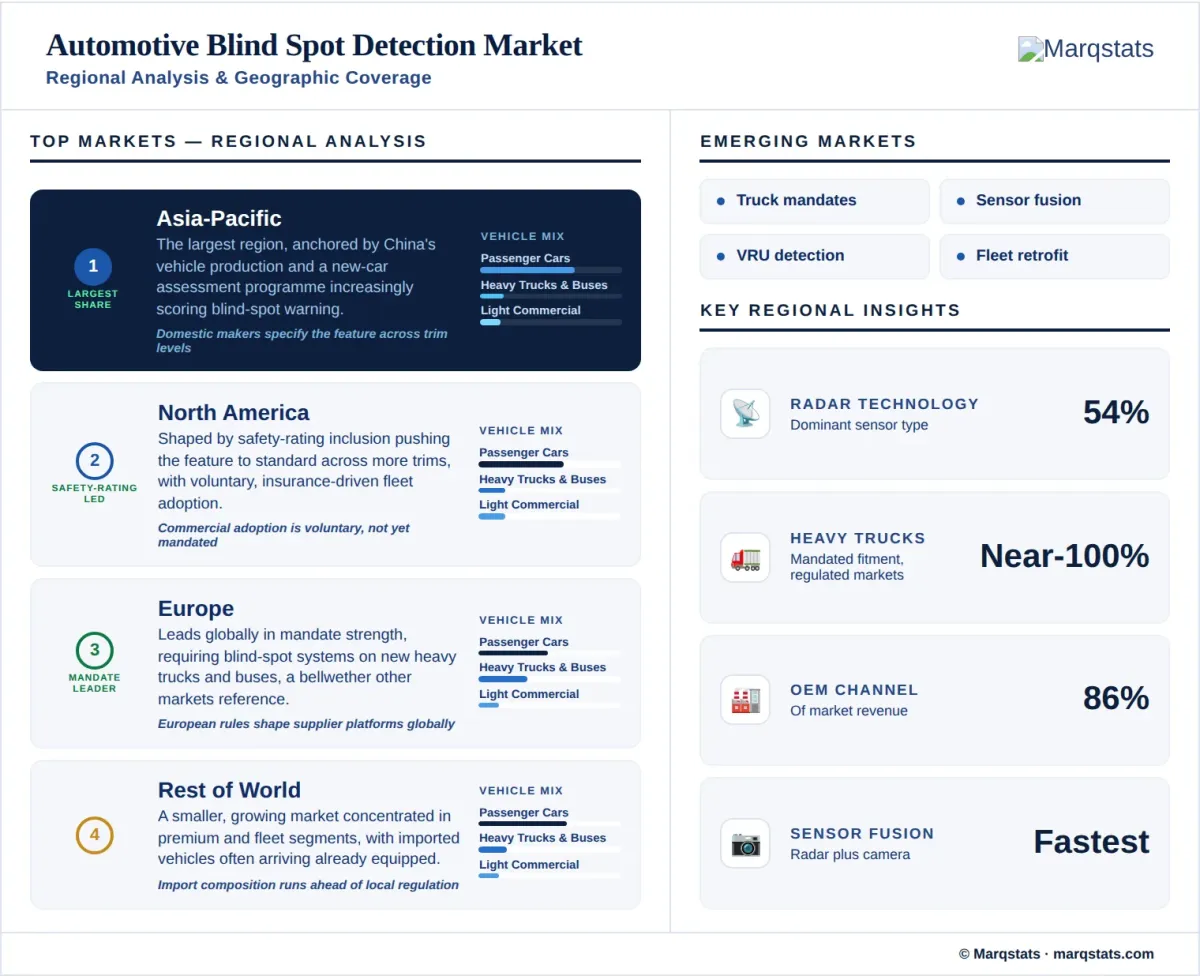
Radar-based systems hold roughly 54% of revenue, the dominant technology for medium-range blind spot detection, valued for reliable performance across weather and lighting conditions where camera-based systems can struggle. Radar remains the default technology specification for heavy trucks and buses, where regulatory requirements typically reference radar-capable detection ranges. Radar's established cost position also favours its continued dominance in cost-sensitive vehicle segments, where a single reliable radar unit can satisfy regulatory or safety-rating requirements without the additional processing cost a fusion configuration entails. Short-range radar operating in the frequency bands specified for automotive use has matured into a well-understood, cost-optimised component category, giving established radar suppliers a durable manufacturing-scale advantage over newer entrants attempting to compete on radar hardware alone.
Camera-based systems are gaining share as image-processing capability improves, offering the ability to classify detected objects, an advantage radar alone cannot match, making cameras increasingly common in sensor-fusion configurations rather than as a stand-alone detection technology. Standalone camera-only blind spot systems remain less common than radar-only configurations, since camera performance degrades more significantly than radar in poor lighting and adverse weather conditions relevant to real-world driving.
Ultrasonic sensors play a smaller, complementary role, typically used for very short-range detection during low-speed manoeuvres and parking rather than as the primary blind spot detection technology during highway lane changes. Ultrasonic technology is most often paired with radar or camera systems to cover the very-close-range detection gap that longer-range sensors are not optimised to address, rather than deployed as the sole detection technology in a vehicle's blind spot system.
Sensor fusion, combining radar and camera inputs, represents the fastest-growing technology category, driven by its superior detection accuracy and lower false-alarm rate relative to single-sensor systems, and is increasingly specified as standard on premium and mid-market vehicle trims. Fusion architecture also creates a natural platform for bundling additional advanced driver assistance functions onto the same sensor and processing hardware, which is reinforcing its adoption as automakers seek to consolidate multiple safety features onto shared hardware rather than dedicated single-function systems.
Passenger cars represent the largest vehicle-type segment by revenue, reflecting the sheer scale of global passenger vehicle production, with adoption continuing to move down-market from premium trims into mainstream mid-market specifications. Electric vehicles have shown a somewhat higher blind spot detection attach rate than comparable internal-combustion models, reflecting both a generally higher average trim specification and the greater consumer willingness to pay for advanced safety technology alongside a new powertrain choice.
Light commercial vehicles are following passenger cars in adoption pattern, with fleet operators increasingly specifying blind spot detection for delivery vans and similar vehicles where lane-change and reversing incidents carry meaningful liability and insurance implications. The rapid growth of last-mile delivery fleets has reinforced this trend, since delivery vans operate disproportionately in dense urban environments where lane-change and reversing incidents involving cyclists and pedestrians carry particular safety and reputational risk for fleet operators.
Heavy trucks and buses represent the fastest-growing vehicle-type segment, driven directly by regulatory mandate rather than discretionary purchasing, with adoption rates in regulated markets already approaching universal fitment on new vehicle production. The scale and blind spot geometry of heavy vehicles make detection systems particularly valuable in this category, since a truck or bus driver's blind spots are considerably larger than a passenger car's, a factor regulators have cited directly in justifying mandatory fitment requirements.
Off-road and specialized vehicles, including construction and heavy equipment, represent a smaller niche category where blind spot detection adoption trails on-road vehicle categories, reflecting both lower regulatory pressure and the specialized sensor configurations off-road operating environments can require. Dust, vibration, and uneven terrain common to construction and mining sites place additional demands on sensor durability and calibration stability beyond what standard on-road automotive sensor packages are typically designed to withstand.
Original equipment fitment accounts for the large majority of market revenue, reflecting both the regulatory mandate driving commercial vehicle adoption and automaker preference for factory-integrated systems that can be validated and warrantied as part of the vehicle rather than added afterward. Factory integration also allows blind spot detection to share sensors and processing hardware with other advanced driver assistance functions, an efficiency an aftermarket retrofit cannot replicate without duplicating hardware already present, yet not accessible to third-party systems.
Aftermarket retrofit kits represent a smaller, growing channel, concentrated in commercial fleet upgrades where operators retrofit existing vehicles to meet insurance requirements or voluntary safety programmes rather than waiting for natural fleet replacement cycles. Retrofit systems typically rely on self-contained sensor and processing units rather than integration with the vehicle's existing electronics, a design choice that simplifies installation across mixed-fleet vehicle types at some cost to the seamless integration OEM systems achieve.
By Geography
Asia-Pacific
Asia-Pacific holds the largest regional share, anchored by China's vehicle production base and its own developing new car assessment programme, which is increasingly incorporating blind spot warning into vehicle safety ratings alongside established regulatory requirements in Japan and South Korea. China's domestic automakers have moved quickly to specify blind spot detection across a broad range of trim levels, reflecting both safety-rating incentives and competitive positioning against established international brands on safety-feature parity.
North America
North America's market is shaped significantly by the inclusion of blind spot warning in national safety-rating programmes, which has pushed automakers to include the feature as standard across a growing share of trim levels even absent an outright regulatory mandate for passenger cars. Commercial fleet adoption in the region is increasingly voluntary rather than regulation-driven, motivated by insurance-premium reduction and corporate safety-programme requirements among large logistics and delivery fleet operators.
Europe
Europe leads globally in regulatory mandate strength, with blind spot information systems required on new heavy trucks and buses and safety regulation continuing to expand in scope, making the region a bellwether for regulatory approaches other markets frequently reference or adopt. The region's regulatory framework has also shaped supplier product development priorities globally, since Tier-1 suppliers designing systems to meet European requirements typically extend those same platforms to other markets rather than developing region-specific alternatives.
Rest of World
Latin America, the Middle East, and Africa represent a smaller, growing market, with adoption concentrated in premium and fleet vehicle segments as safety-rating awareness and regulatory attention to commercial vehicle safety gradually increase across these regions. Vehicle import composition plays a meaningful role in these markets, since a significant share of the passenger vehicle parc arrives already equipped with blind spot detection as standard specification from origin markets with stricter requirements, ahead of local regulation catching up.
How Competition Is Evolving
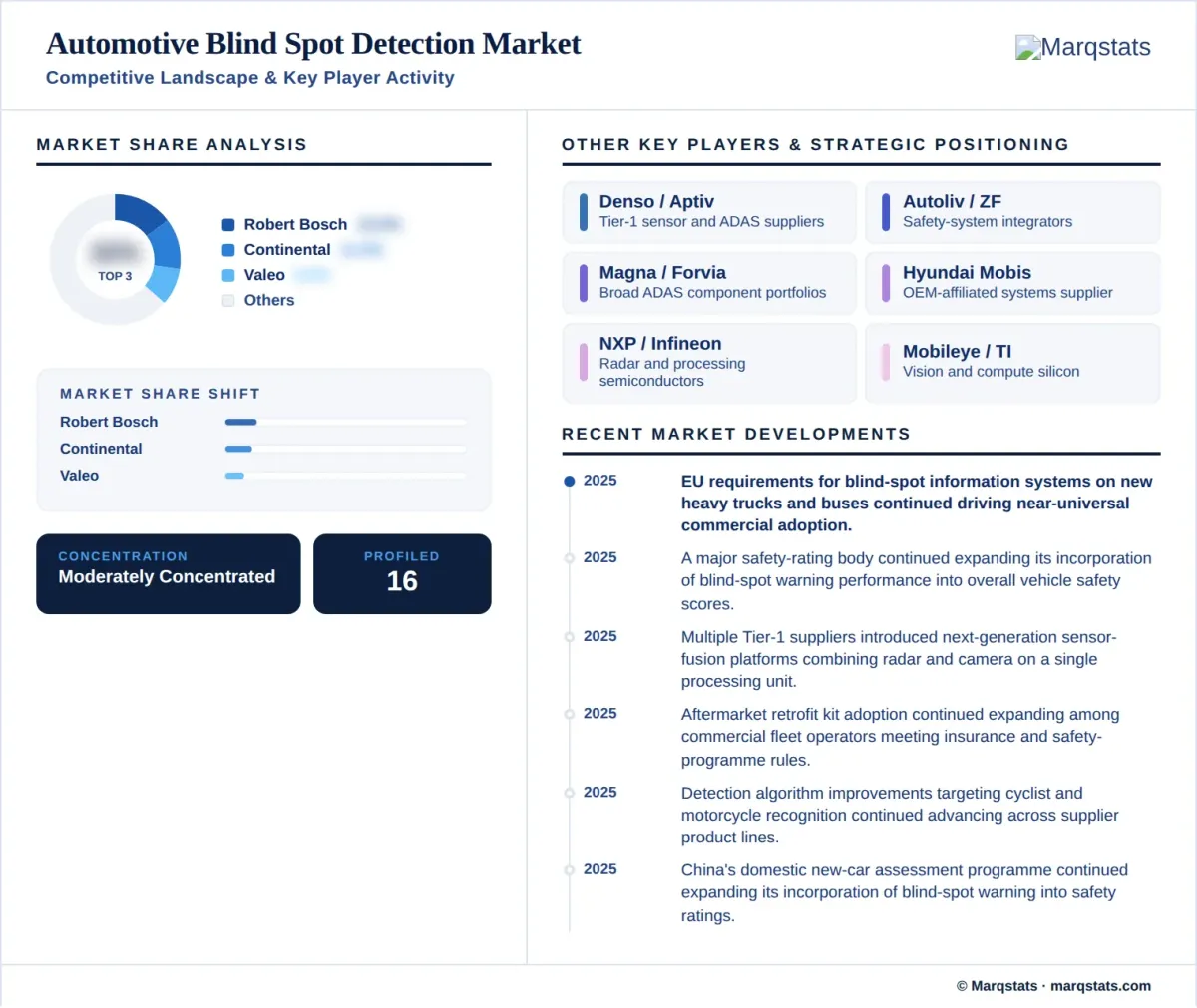
The market is moderately concentrated, with a small number of established Tier-1 automotive suppliers and semiconductor companies accounting for the large majority of global revenue. These suppliers typically compete for multi-year, multi-vehicle-platform contracts with automakers rather than one-off component sales, giving incumbent suppliers a durable advantage once qualified on a given vehicle platform. Qualification for a new vehicle platform typically spans years of joint development and validation work between supplier and automaker, meaning competitive contests are effectively decided at the platform-design stage rather than through ongoing price competition once a supplier relationship is established.
Competitive strategy centers on sensor-fusion capability, detection algorithm accuracy, and the ability to bundle blind spot detection within a broader advanced driver assistance system package rather than as a stand-alone component, since automakers increasingly prefer single-supplier integrated safety suites over sourcing individual functions from separate vendors. Semiconductor suppliers compete on processing capability and cost per unit, since the sensor-fusion algorithms underlying modern systems require meaningful on-vehicle compute capacity that must be delivered at a cost point compatible with mid-market vehicle pricing. Consolidation activity has been a recurring feature among suppliers seeking broader advanced driver assistance system portfolios, combining sensor hardware, algorithm software, and semiconductor capability under a single vendor relationship that automakers increasingly favour over managing multiple specialised suppliers.
Companies Covered
The report profiles 16+ companies with full strategy and financials analysis, including:
Recent Market Activity
Table of Contents
Coverage & Segmentation
This report provides a comprehensive assessment of the global automotive blind spot detection system market across a 2025 base year, historical data from 2021 to 2025, and forecasts spanning 2026 to 2030. Market size is stated as sensor hardware and software revenue in United States dollars. Segmentation covers three dimensions: technology, vehicle type, and sales channel, alongside regional analysis spanning Asia-Pacific, North America, Europe, and the rest of world.
The scope covers radar, camera, ultrasonic, and sensor-fusion blind spot detection, lane change assist, and cross-traffic alert systems, across original equipment and aftermarket channels for passenger cars, light commercial vehicles, heavy trucks, buses, and off-road vehicles. The study excludes non-sensor-based methods such as extended or convex mirrors, fully autonomous collision-avoidance systems where blind spot detection is not a distinct function, and broader advanced driver assistance features such as standalone lane-keeping or adaptive cruise control that do not include a blind spot monitoring function. Broader multi-domain ADAS platforms and in-vehicle infotainment systems, which may share sensor or compute hardware with blind spot detection yet serve distinct primary functions, are covered separately in Marqstats' companion automotive technology reports. Country-level detail beyond the four-region split covered here is available under customization, alongside deeper cuts by technology, vehicle type, or sales channel.