Market Snapshot
Key Takeaways
Market Overview & Analysis
Report Summary
The Europe refrigerated van conversion market operates within the broader LCV body conversion ecosystem but with two defining characteristics that set it apart from standard box-body or service-van upfit work: regulatory complexity and cold-chain engineering precision. Every refrigerated van conversion for commercial food distribution must comply with the UNECE ATP Agreement governing the international carriage of perishable foodstuffs, which requires the vehicle body to maintain specific temperature bands and certifies the body as insulated, refrigerated, mechanically refrigerated, or heated. Pharmaceutical conversions must additionally comply with EU Good Distribution Practice (GDP) standards, which specify minimum temperature-control, monitoring, and documentation requirements for medicinal product storage and transport. These regulatory obligations mean that refrigerated van conversion in Europe is a certified, auditable, multi-stage manufacturing activity — not an informal workshop trade — and the certified bodybuilder network (operating under EU Regulation 2018/858 multi-stage type approval) is the market's primary competitive infrastructure.
The market's supply chain operates through three primary channels. The first is OEM-integrated conversion: direct OEM conversion programmes and certified partner networks (Ford Pro Convertor, Opel's certified converter programme including CSA ClimaVan Solutions and Dülmer for pharmaceutical applications, Lamberet supplying refrigerated bodywork for utility vehicles from 1 to 100 m³ across Europe) deliver factory-integrated or OEM-certified refrigerated van builds. The second is specialist refrigerated body builder conversion: companies including Paneltex (UK), CoolKit (UK), Lecapitaine (France), Lamberet (France/Europe), and Schmitz Cargobull (Germany) fabricate insulated bodies, install refrigeration units, and certify completed conversions under ATP and, where required, GDP frameworks. The third is kit-based conversion: CoolKit's conversion kit business allows refrigeration engineers and independent bodybuilders to purchase insulation panel kits (manufactured at its Blackburn, UK factory using CAD and CNC technologies) and assemble refrigerated conversions in-house, extending the market's distribution depth to smaller operators without full body fabrication facilities.
The cold chain van market Europe is being reshaped by the convergence of three structural forces. E-commerce food delivery and last-mile cold chain expansion — with Eurostat reporting 78% of EU internet users buying online in 2025 and e-grocery, meal kit, and quick-commerce delivery becoming mainstream cold-chain applications — is driving demand for high-cycle-frequency, multi-door-opening, urban refrigerated last-mile delivery vans where temperature recovery, energy efficiency, and low-noise operation are primary performance requirements alongside basic temperature maintenance. The pharmaceutical logistics expansion — EU exports of medicinal and pharmaceutical products reaching €313.4 billion in 2024, up 13.5% year on year per Eurostat — is driving pharmaceutical cold chain van demand for GDP-certified conversions serving both bulk pharmaceutical wholesale (NOWEDA in Germany) and last-mile pharmacy-grade temperature-controlled distribution. And the urban LEZ compliance imperative is driving simultaneous refrigerated body and electric powertrain investment, because operators in London (ULEZ), Paris (ZFE), and other major European cities cannot separate their refrigerated fleet electrification decisions from their body conversion purchasing cycles.
Market Dynamics
Key Drivers
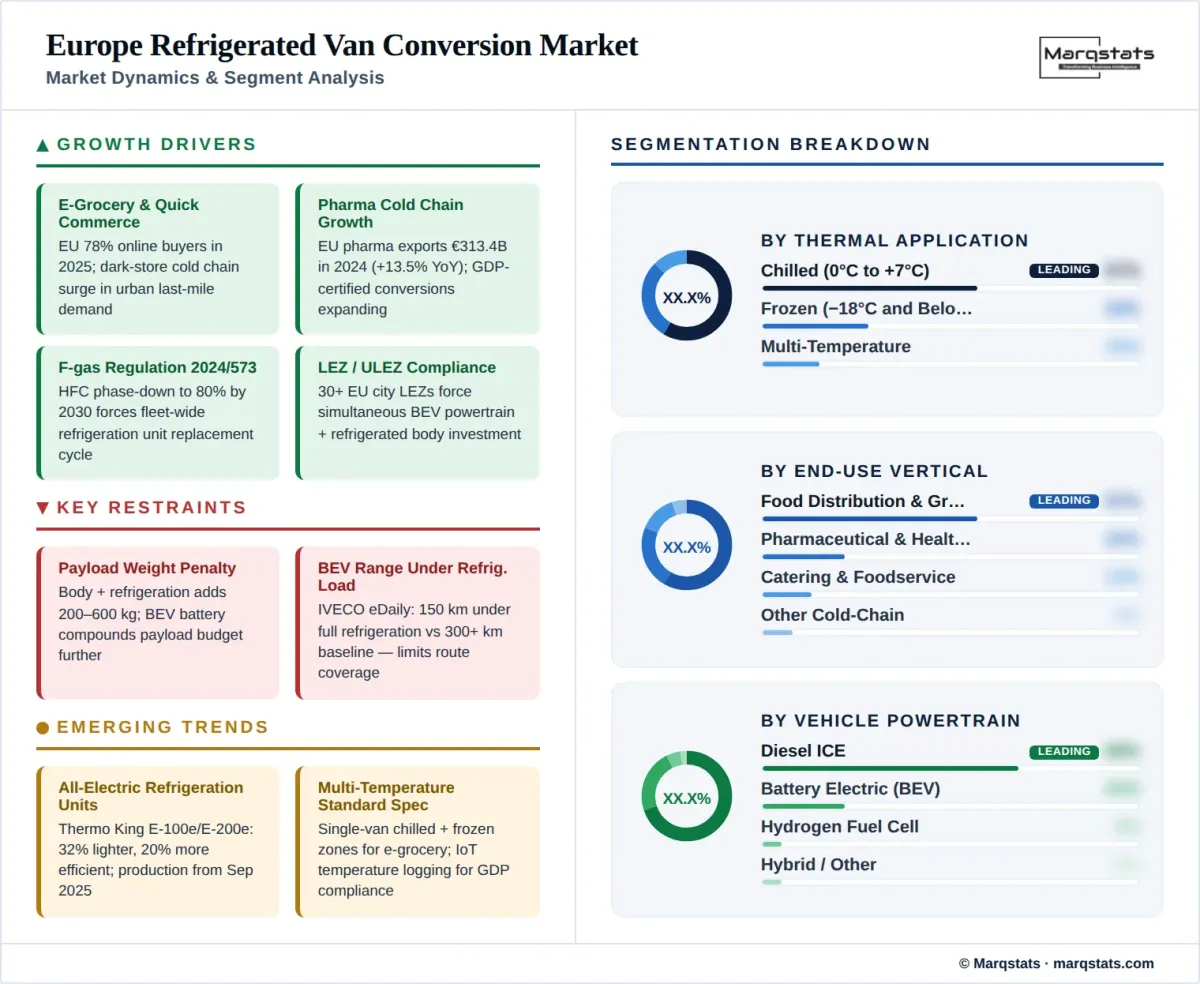
- E-grocery, quick commerce, and last-mile cold chain expansion driving urban refrigerated van demand: The rapid growth of e-grocery home delivery (Amazon Fresh, Ocado, supermarket click-and-collect), food-service platform delivery (Deliveroo, Uber Eats cold-meal delivery), and dark-store quick-commerce operators has created a new category of high-frequency, multi-stop, urban-cycle last-mile cold chain refrigerated van that requires different temperature-control specifications from bulk warehouse distribution vehicles — shorter pull-down times, faster door-opening temperature recovery, lower noise for residential-area delivery, and compatibility with increasingly small battery-electric van platforms. Carrier Transicold's explicit positioning of its European LCV product range for city-centre multiple-door-opening multi-temperature deliveries, and Thermo King's E-Series smart power management for minimising BEV range impact, both reflect how the refrigeration equipment market is engineering directly for this e-grocery and last-mile cold chain Europe demand profile.
- Pharmaceutical cold chain van Europe growing above market average driven by post-pandemic supply chain investment and EU export growth: EU pharmaceutical exports of €313.4 billion in 2024 (up 13.5% YoY, Eurostat) and sustained post-pandemic investment in pharmaceutical supply-chain resilience — including temperature-monitored last-mile distribution of cold-chain vaccines, biologics, and temperature-sensitive generics — are driving above-market growth in the pharmaceutical cold chain van Europe segment. GDP-compliant refrigerated van conversions carry meaningfully higher per-vehicle value than standard food-grade builds due to the climate-control precision, temperature validation, and documentation systems required under EU Good Distribution Practice. Opel's March 2023 NOWEDA Vivaro-e GDP deployment — with Dülmer and CSA ClimaVan Solutions handling certified conversion work maintaining 15–25°C cargo hold temperature — demonstrates the specific technical and commercial profile of this premium segment.
- EU F-gas Regulation 2024/573 forcing a refrigeration equipment replacement cycle independent of fleet age: The adoption of EU F-gas Regulation 2024/573 on 7 February 2024, with application from 11 March 2024, is creating a structural refrigeration equipment replacement cycle across Europe's refrigerated van fleet. The regulation's steeper HFC phase-down targeting 80% HFC reduction by 2030 means that refrigeration units using high-GWP HFC refrigerants face progressively constrained servicing economics as HFC supply tightens and costs increase — incentivising early transition to natural-refrigerant (CO₂, R290 propane) or HFO-based units. For refrigerated van converters, this creates both a replacement opportunity in the installed fleet (operators replacing non-compliant refrigeration units ahead of servicing cost escalation) and a new-vehicle specification shift where low-GWP refrigerants become standard equipment for new refrigerated builds.
- Urban LEZ and ULEZ compliance creating simultaneous electric powertrain and refrigerated body investment demand: London's ULEZ, Paris's ZFE, and 30+ European city low-emission zones create a compliance imperative that forces fleet operators to electrify their urban refrigerated van fleets — which means they are procuring both a new EV base vehicle and a new refrigerated body conversion simultaneously, doubling the per-vehicle investment cycle relative to a standard ICE fleet renewal. Petit Forestier's deployment of IVECO eDaily chassis with Lecapitaine URBAN refrigerated bodies is directly motivated by LEZ compliance requirements: the operator explicitly cites comfortable and quiet deliveries in low-emission zones as a core value proposition, and the URBAN body's aerodynamically optimised, lightweight construction is specifically designed to preserve the eDaily's energy-saving architecture.
- Refrigerated vehicle rental market amplifying demand concentration: Petit Forestier Group, as Europe's leading refrigerated vehicle rental company, creates concentrated and predictable demand for large-volume refrigerated van conversion programmes that independent fleet operators cannot match in scale or specification consistency. The Petit Forestier-IVECO-Lecapitaine MoU for 2,000 chassis with refrigerated bodies, followed by the EIB €150 million loan for 4,000 electric refrigerated vehicles, is the clearest example of how rental fleet operators act as market-making customers for refrigerated van body builders and refrigeration unit manufacturers — aggregating what would otherwise be fragmented individual fleet orders into programme-scale procurement that justifies product development investment.
Key Restraints
- Payload penalty of refrigerated body and refrigeration unit limiting addressable van class: Refrigerated body fabrication (insulated panels, framing, floor, door seals) and the refrigeration unit itself add significant weight — typically 200–600 kg depending on body size, insulation spec, and refrigeration unit choice — that directly reduces the van's legal payload for cargo. For N1 class vans up to 3.5 tonnes GVW, this weight addition creates a payload budget tension that restricts the maximum load the operator can carry with a fully equipped refrigerated build. Electric refrigerated vans face a compounded challenge: the battery pack also consumes payload allocation, meaning the total payload available for cargo in a fully equipped BEV refrigerated van is materially lower than for an equivalent diesel model. Thermo King's E-Series design priority of 32% weight reduction versus prior generations and CoolKit's explicit focus on maximising vehicle payload carrying capability reflect how payload preservation has become a primary design criterion for refrigerated van body builders and refrigeration unit manufacturers alike.
- Refrigeration-load impact on battery-electric van driving range constraining BEV refrigerated adoption: The refrigeration unit's electrical power draw from the base vehicle's traction battery is a fundamental operational constraint for battery-electric refrigerated vans. IVECO's specification of up to 150 km real-world range for the eDaily with full refrigeration load — compared to a stated range of over 300 km for a non-refrigerated eDaily — illustrates the energy penalty of continuous refrigeration operation on route. For long-distance or multi-stop delivery routes exceeding the range under refrigeration load, BEV refrigerated vans require intermediate charging stops that add operational complexity. IVECO's world-first ePTO system — which charges the vehicle from grid power while simultaneously supplying the refrigeration unit, reducing charging steps and optimising both economic and energy performance — addresses this constraint for depot-charging operations, but range limitations remain a genuine barrier for cold-chain routes that exceed urban distribution cycles.
- F-gas compliance transition cost and natural refrigerant engineering complexity: The transition from established HFC refrigerants to natural refrigerants (CO₂, propane R290) or HFO blends is not a simple refrigerant swap — it requires redesigned compressor, heat exchanger, and expansion-valve architecture suited to the different thermodynamic and safety properties of natural refrigerant systems. CO₂ refrigeration operates at significantly higher pressures than R134a or R452A systems, requiring heavier-duty components; propane is flammable and requires safety containment engineering. For smaller van refrigeration units in the 3.5-tonne class, where weight and space constraints are most severe, the natural-refrigerant transition is technically more demanding than for heavy-duty trailer units where operating pressures and safety zones are more easily managed.
Key Trends
- All-electric refrigeration units becoming the standard specification for BEV refrigerated van conversions: Thermo King's September 2025 production launch of the E-100e, E-200e, and E-200e Spectrum — fully electric, zero-direct-emission units for LCVs up to 12 m³, with smart power management, integrated telematics, and compatibility with both BEV (via low-voltage e-PTO or V2L) and ICE platforms — and Carrier Transicold's parallel electric refrigeration unit development (Syberia eCool and E-Drive technologies), combined with IVECO's ePTO system for simultaneous charging and refrigeration supply, are collectively establishing all-electric refrigeration as the design direction for the entire light-refrigerated-vehicle market. The previous diesel-powered standby refrigeration unit will progressively be replaced by electrically powered alternatives across Europe's urban and peri-urban cold-chain van fleet.
- Multi-temperature van conversion becoming the standard specification for food and pharmaceutical fleet procurement: Single-temperature refrigerated van bodies — maintaining one temperature zone for the entire cargo area — are being supplemented and in premium segments replaced by multi-temperature van conversion Europe configurations with separately controlled chilled, frozen, and ambient compartments. Multi-temperature builds are essential for grocery home delivery (chilled and frozen products in a single trip), pharmaceutical last-mile distribution (different storage temperature requirements for biologics versus ambient medicines), and catering supply (fresh, chilled, and ambient food categories in a single vehicle). The freezer van conversion market Europe — below -18°C frozen goods transport — is growing as online grocery penetration expands frozen-category home delivery. Thermo King's E-200e Spectrum multi-temperature unit and Carrier Transicold's multi-temp LCV configurations both reflect this shift.
- Lightweight insulation materials and aerodynamic body design becoming competitive differentiators for payload and range preservation: CoolKit's explicit positioning on maximising vehicle payload carrying capability, and Lecapitaine's URBAN body for the IVECO eDaily featuring aerodynamically optimised shell and lightweight eco-friendly insulation to maximise energy savings, reflect a broader industry trend in which insulated van body Europe design has shifted from purely thermal performance optimisation toward a payload-and-range-first engineering philosophy. Every kilogram saved in body construction translates directly to additional cargo capacity — or, for BEV conversions, reduced refrigeration-system energy draw per cubic metre of maintained temperature. IoT temperature monitoring refrigerated van systems — embedded sensors, cloud telemetry, and automated GDP-compliant temperature logging — are being integrated as standard equipment to support food safety documentation, HACCP compliance, and pharmaceutical GDP audit trails.
- HYVIA Renault Master hydrogen refrigerated conversion providing a range-extended alternative to BEV for longer cold-chain routes: Renault's HYVIA hydrogen van programme, which presented conversion projects on Master Chassis Cab H2-TECH for refrigerated applications at IAA 2022, offers the cold-chain market a zero-local-emission van platform with hydrogen fuel cell range advantages that address the BEV refrigeration-load range constraint on longer urban and regional distribution routes. NOWEDA's deployment of the Opel Vivaro-e HYDROGEN — with up to 400 km WLTP range and GDP-certified climate-controlled cargo hold — confirms that hydrogen-fuel-cell refrigerated van conversions are technically operational and commercially available for pharmaceutical last-mile distribution, providing a range-extended zero-emission option where BEV range under refrigeration load is insufficient.
Market Segmentation
Chilled van conversions — maintaining cargo areas between 0°C and +7°C for fresh food, dairy, prepared meals, and pharmaceutical products — are the Europe refrigerated van conversion market's largest segment by volume, serving the food retail distribution, foodservice supply, e-grocery home delivery, and pharmaceutical wholesale markets. Standard chilled conversions use high-density polyurethane insulated panels for body fabrication and top-mounted or front-wall-mounted refrigeration units from Thermo King, Carrier Transicold, or Zanotti. The chilled segment is the primary addressable market for CoolKit in the UK — serving pharmaceutical, foodservice, home delivery, and environmental sampling applications — and for Lecapitaine in France serving Petit Forestier's rental fleet and food distribution operators. The fridge van conversion market UK specifically tracks this segment under SMMT's N1 light refrigerated vehicle registration category.
The freezer van conversion market Europe — maintaining cargo areas at or below -18°C for frozen food, ice cream, and frozen pharmaceutical products — requires higher-capacity refrigeration units, thicker insulation panels (to maintain deep-freeze temperatures against ambient heat ingress), and more robust door-seal systems than standard chilled builds. Frozen conversions carry the highest per-vehicle conversion cost in the LCV segment and are the most sensitive to refrigerant choice under the F-gas 2024/573 framework, as high-capacity frozen units were historically the largest HFC consumers by weight charge. The growth of online grocery frozen-category delivery — where customers order frozen goods for home delivery alongside chilled and ambient products — is driving increasing demand for van-format frozen conversions capable of deep-freeze maintenance through multi-stop urban delivery cycles.
Multi-temperature van conversion — creating separately controlled thermal zones within a single van body for simultaneous chilled and frozen (or chilled and ambient) product delivery — is the fastest-growing product category in the refrigerated LCV conversion market, driven by grocery e-commerce home delivery consolidation (single-trip delivery of chilled, frozen, and ambient products), pharmaceutical mixed-temperature logistics, and catering supply chain requirements for fresh, chilled, and ambient food categories. Partition systems, independently controlled refrigeration circuits, and zone-specific temperature monitoring hardware make multi-temperature conversions the most technically complex and highest-value single-vehicle conversion in the LCV refrigerated segment. Thermo King's E-200e Spectrum and Carrier Transicold's multi-temperature LCV units are both explicitly designed for this application.
Food distribution — covering ambient-controlled and chilled delivery of fresh produce, dairy, prepared foods, and dry goods requiring temperature-controlled transport — is the refrigerated LCV conversion market's largest end-use category, representing approximately 55–60% of total European refrigerated van conversion volume. The rise of e-grocery home delivery platforms, dark-store quick commerce, and direct-to-consumer food subscription services is adding a high-frequency, multi-drop, urban-cycle demand tier to the traditionally wholesale-distribution-dominated food refrigerated van fleet. Petit Forestier's fleet rental model — providing refrigerated vans to food distribution operators on short and long-term rental — is the primary commercial channel aggregating food distribution demand into large-scale refrigerated van conversion programmes.
The pharmaceutical cold chain van Europe segment is the highest-value per-vehicle and most technically regulated end-use category. GDP compliance requires continuous temperature maintenance between +15°C and +25°C for standard pharmaceutical products (or +2°C to +8°C for cold-chain biologics and vaccines), temperature excursion logging, qualified vehicle qualification documentation, and periodic re-validation. Opel's 2023 deployment of Vivaro-e and Vivaro-e Hydrogen for NOWEDA with certified converters Dülmer and CSA ClimaVan Solutions — featuring GDP-compliant 15–25°C climate-controlled cargo areas — establishes the commercial and technical benchmark for electric pharmaceutical cold chain van conversions in Germany. EU pharmaceutical export growth of €313.4 billion in 2024 (+13.5% YoY, Eurostat) is directly correlated with demand expansion for GDP-certified refrigerated van capacity across Europe's pharmaceutical logistics networks.
By Geography
France
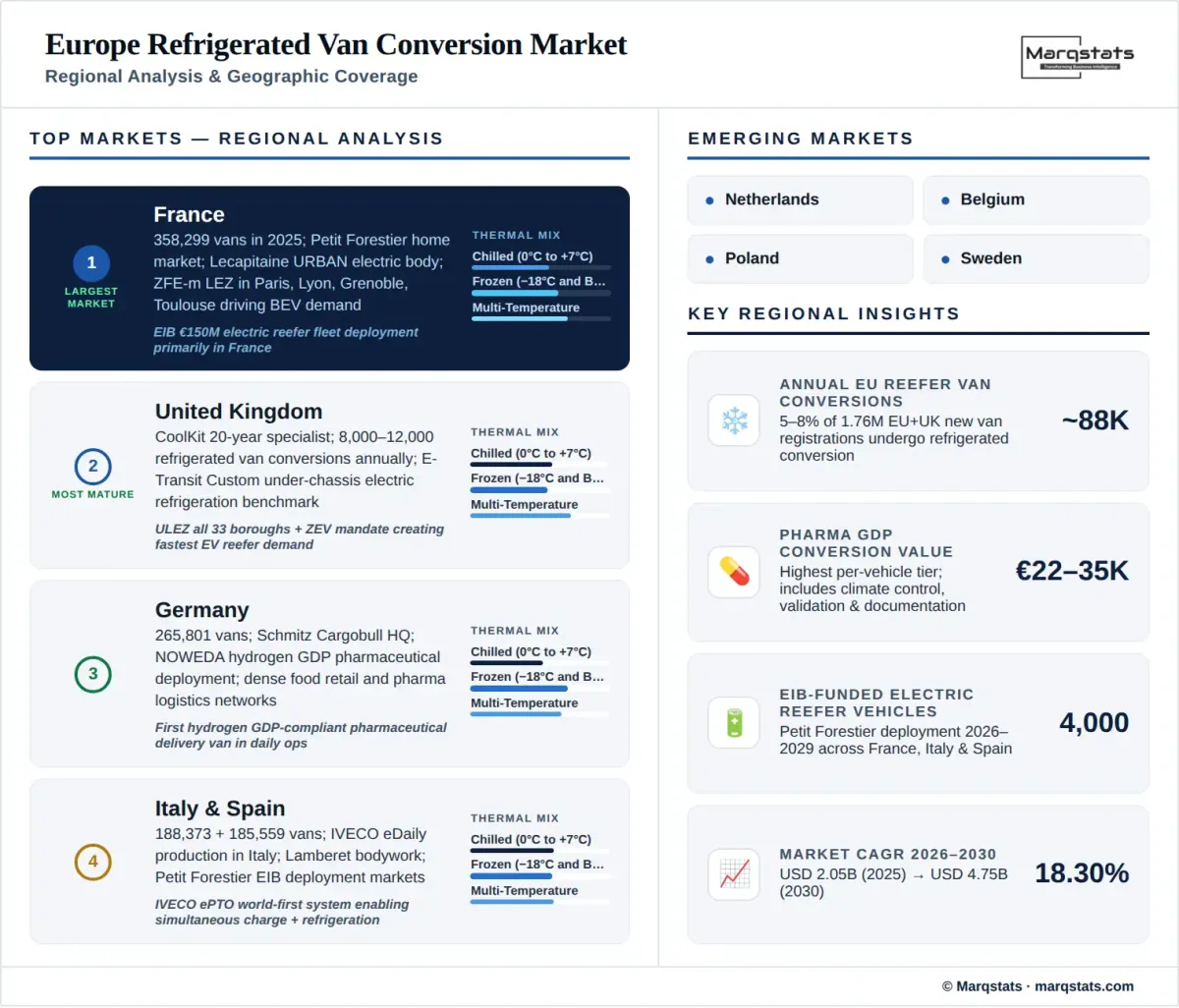
France is Europe's largest national van market in 2025 with 358,299 registrations and the primary home market for Petit Forestier, Europe's leading refrigerated vehicle rental company, and Lecapitaine, one of the continent's most capable refrigerated body builders. The Petit Forestier-IVECO MoU for 2,000 eDaily chassis with Lecapitaine URBAN refrigerated bodies, the EIB €150 million loan programme for 4,000 electric refrigerated vehicles deployed primarily in France, Italy, and Spain, and France's dominant position in the European cold-chain logistics market collectively make France the single most important national market for refrigerated van conversion investment. The reefer van conversion market France is concentrated in food and grocery distribution, catering supply, and agricultural-produce logistics — all sectors with large active refrigerated van fleets and accelerating electrification pressure from ZFE-m urban access restrictions in Paris, Lyon, Grenoble, and Toulouse.
United Kingdom
The UK is Europe's most developed and commercially structured national refrigerated van conversion market, with CoolKit — now in its 20th year and the UK's largest specialist in temperature-controlled van conversions — serving pharmaceutical, foodservice, home delivery, environmental sampling, and courier sectors with a full product range from basic insulation kits to complete electric refrigerated van conversions. CoolKit's December 2025 innovation award for its Ford E-Transit Custom refrigerated conversion for Fortnum & Mason — featuring an industry-first under-chassis mounted refrigeration unit that preserved vehicle height for urban garage access — represents the UK market's technical frontier in the fridge van conversion market UK. SMMT's registration data confirm the UK refrigerated LCV segment (N1 light refrigerated vehicles) tracks approximately 8,000–12,000 annual registrations across chilled, frozen, and multi-temperature conversions. The UK's ZEV mandate van electrification targets and ULEZ compliance pressure in London and other cities make the electric reefer van last mile delivery segment the fastest-growing category in UK refrigerated van conversion.
Germany
Germany is Europe's second-largest van market (265,801 registrations in 2025) and the home market for Schmitz Cargobull (Altenberge, NRW) — one of Europe's largest van-to-HCV refrigerated bodybuilder companies — and the site of the most technically advanced pharmaceutical refrigerated van deployment in Europe (NOWEDA Opel Vivaro-e and Vivaro-e Hydrogen GDP conversion). The reefer van conversion market Germany is driven by Germany's dense food retail and pharmaceutical logistics networks, its large food processing and export sector, and the compliance requirements of German food and pharmaceutical supply chain operators under EU ATP, GDP, and HACCP frameworks. VW Group's Elli-integrated smart charging and Carrier Transicold's IAA 2024 European electric cold-chain equipment showcase both reflect Germany's central role in the European refrigerated van conversion technology ecosystem.
Italy and Spain
Italy (188,373 van registrations in 2025) and Spain (185,559) are the two other primary markets in Petit Forestier's EIB-funded electric refrigerated van deployment programme, reflecting their large food logistics, horticultural supply chain, and retail grocery distribution markets. Italy is the location of IVECO's eDaily production facilities and a major production base for Lamberet refrigerated bodywork, making it an important supply-side market as well as a demand-side one. Spain's large food export sector — fresh produce, olive oil, wine, and processed foods distributed through temperature-controlled supply chains to Northern European supermarkets — creates a structurally large domestic demand for refrigerated van conversion capacity that serves both domestic distribution and export logistics preparation.
How Competition Is Evolving
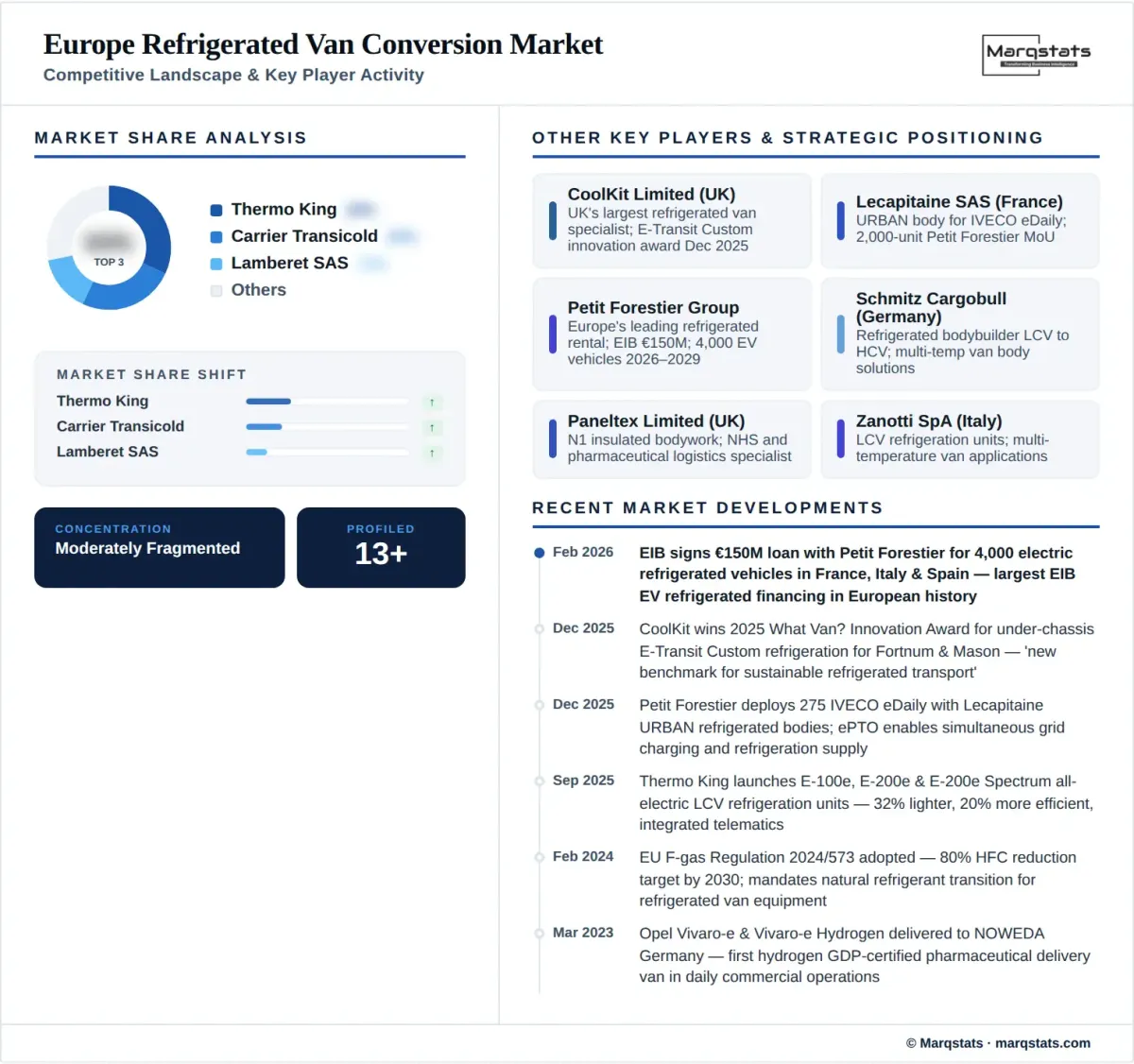
The European refrigerated van conversion market is moderately fragmented at the independent bodybuilder level and increasingly structured at the OEM-programme level, with a handful of large specialist refrigerated bodybuilders operating pan-European programmes alongside hundreds of national and regional converters serving local fleet markets. CoolKit in the UK and Lecapitaine in France are the most commercially visible national specialists in the van refrigerated conversion segment specifically (below 3.5 tonnes). Lamberet and Schmitz Cargobull operate across the full LCV-to-HCV refrigerated bodybuilding spectrum. Refrigeration unit manufacturers Thermo King (Trane Technologies) and Carrier Transicold (Carrier Global) are the two dominant global equipment suppliers whose products are specified across virtually all European refrigerated van conversion programmes regardless of bodybuilder.
CoolKit's competitive differentiation is multi-dimensional: 20 years of specialist UK experience, a broad product range from basic insulation kits to complete vehicle conversions, an established OEM-dealership and fleet-funder distribution channel, and a technology leadership position in electric van refrigeration demonstrated by its 2025 innovation award for under-chassis mounted refrigeration on a Ford E-Transit Custom. Paneltex (Hull, UK) competes across the refrigerated body builder market for N1 category insulated vehicle bodywork including specialist builds for NHS and pharmaceutical logistics. Lecapitaine's URBAN refrigerated body for the IVECO eDaily — with aerodynamic shell, lightweight eco-friendly insulation, and optimised design specifically for electric platform energy efficiency — is the most technically differentiated recent product in the pan-European electric reefer van market.
Companies Covered
The report profiles 13+ companies with full strategy and financials analysis, including:
Recent Market Activity
Table of Contents
Coverage & Segmentation
This report provides a comprehensive analysis of the Europe refrigerated van conversion market covering the 2021–2030 period, with 2025 as the base year. The study covers insulated van body fabrication and installation, refrigeration unit supply and installation (mechanical, electric, and hybrid), multi-temperature partition systems, temperature monitoring and IoT telematics hardware, ATP certification services, GDP-compliant pharmaceutical conversion engineering, and electric van refrigerated conversion (including BEV and hydrogen fuel cell base vehicles). Regulatory coverage spans the UNECE ATP Agreement for perishable foodstuff transport, EU Good Distribution Practice (GDP) standard 2013/C 343/01 for pharmaceutical van logistics, EU F-gas Regulation 2024/573 (adopted 7 February 2024), EU HACCP food safety framework, Regulation (EU) 2018/858 multi-stage type approval for converted vehicles, and urban LEZ/ULEZ/ZFE emission zone compliance frameworks. Geographic coverage: France, United Kingdom, Germany, Italy, Spain, Netherlands, Belgium, and Rest of Europe. The companion Marqstats report on the Europe LCV Body Conversion Market (europe-lcv-body-conversion) covers the full-spectrum van body conversion ecosystem of which refrigerated conversion is the highest-value segment.
Primary research included 40+ interviews with refrigerated van body builders, OEM van commercial product managers, fleet procurement directors at food distribution and pharmaceutical logistics companies, refrigeration unit product managers at Thermo King and Carrier Transicold, ATP testing and certification consultants, and fleet electrification programme leads at rental companies. Secondary research drew from ACEA EU van registration statistics 2025, SMMT UK LCV data 2025, Petit Forestier Group and IVECO press releases (December 2025, February 2026), EIB financing announcement (February 2026), Thermo King E-Series production launch (September 2025), Opel/NOWEDA pharmaceutical van announcement (March 2023), EU F-gas Regulation 2024/573 official text, Eurostat pharmaceutical exports and e-commerce data, UNECE ATP Agreement documentation, and EU GDP standard 2013/C 343/01.