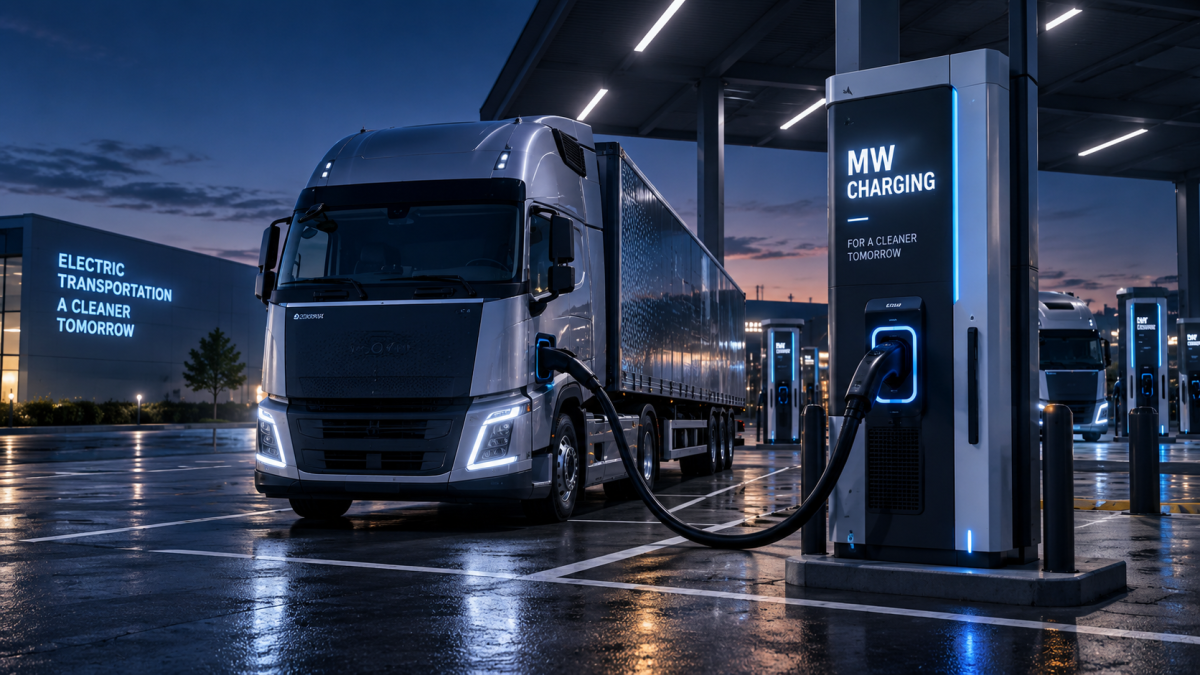
Market Snapshot
Key Takeaways
Market Overview & Analysis
Report Summary
This report scopes the Battery Management System market as the electronic supervisory hardware and embedded firmware layer governing cell-level monitoring, charge and discharge regulation, thermal control and fault isolation across automotive traction, stationary energy storage, portable electronics and industrial battery packs. This report sizes the market instead by the volume its BMS content scales against: global EV battery deployment, published by the International Energy Agency.
Deployment reached 1.2 TWh globally in 2025, an increase of almost 30% compared to 2024 and more than seven times the 2020 level. Electric vehicles accounted for more than 70% of total 2025 battery deployment, down from almost 80% in 2024, as stationary energy storage grew faster in relative terms. Light-duty vehicles represented more than 85% of EV battery deployment, while electric truck battery demand more than doubled year-on-year — the fastest-growing sub-segment inside the fastest-growing overall category.
The forecast holds if global EV sales continue at roughly the 20% year-on-year pace observed in 2025, 800V architecture adoption expands beyond premium vehicles into mainstream passenger segments, and the EU Battery Regulation's digital passport mandate is enforced on schedule. The single largest identified risk is not vehicle-side technology readiness but a slower-than-required acceleration in utility-scale battery storage additions, which reached a record 63 GW in 2024 but must sustain and exceed that pace for the remainder of the decade to meet the International Energy Agency's 1,500 GW 2030 target.
Market Dynamics
Key Drivers
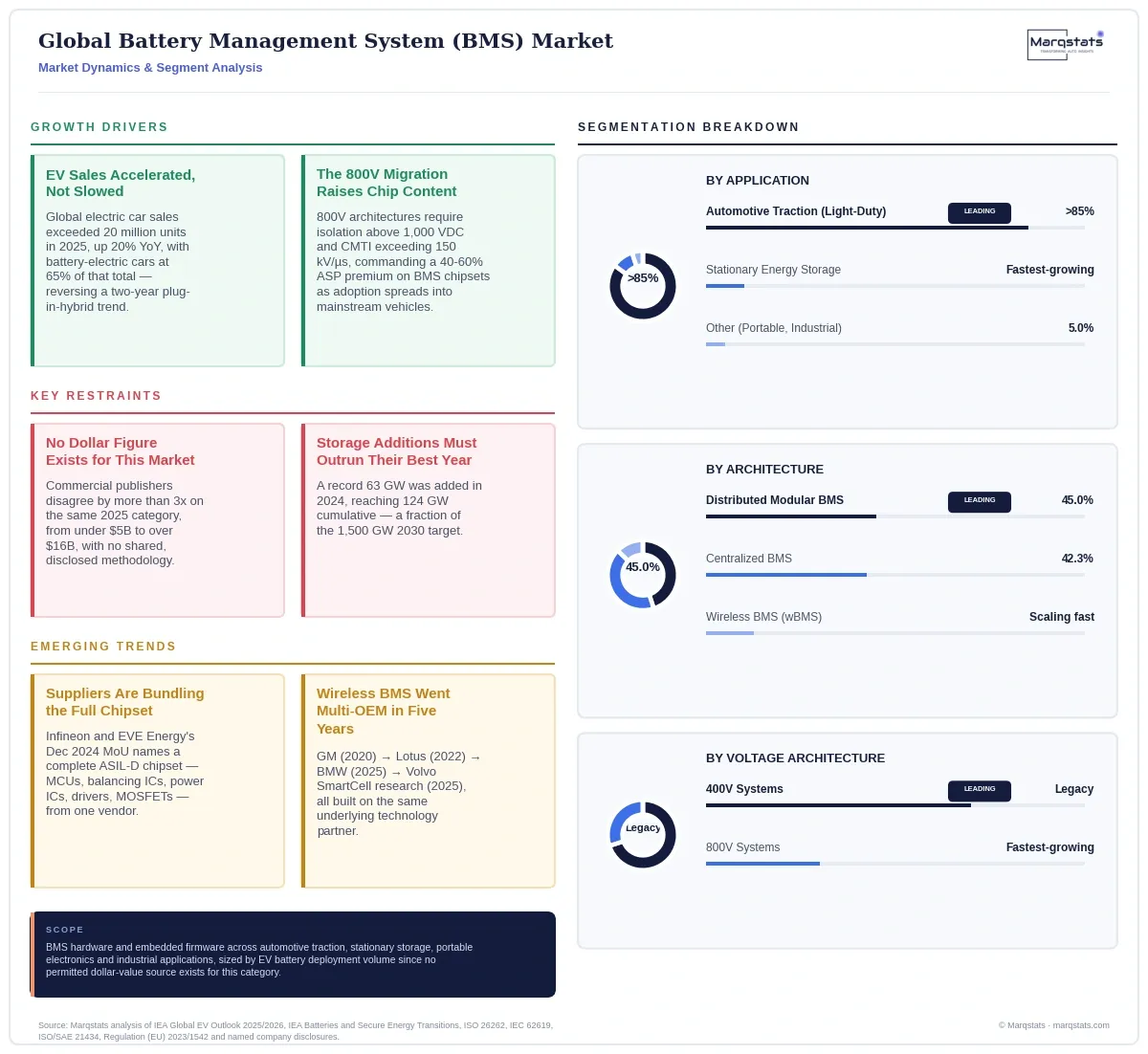
Global EV sales growth is the primary volume driver behind BMS demand. It accelerated in 2025, not slowed. Electric car sales exceeded 20 million units globally, up 20% year-on-year, with battery-electric cars comprising 65% of that total — reversing a two-year trend toward plug-in hybrids and pulling BMS demand toward full-battery-electric architectures rather than the simpler hybrid systems that require less sophisticated monitoring.
The migration from 400V to 800V automotive architectures, pioneered by the Porsche Taycan and Hyundai E-GMP platforms, structurally increases BMS semiconductor content per vehicle. Higher-voltage rails require galvanic isolation barriers rated above 1,000 VDC with reinforced insulation testing to 5 kVRMS and Common Mode Transient Immunity exceeding 150 kV per microsecond, driving a 40% to 60% average selling price premium for 800V-capable BMS chipsets over legacy 400V components.
The EU's Battery Regulation, formally Regulation (EU) 2023/1542, converts BMS data logging from an engineering nicety into a statutory requirement. Every industrial or traction battery above 2 kWh must maintain embedded State of Health and State of Charge records and a digital battery passport documenting carbon footprint and supply-chain provenance, creating mandatory BMS content on a population of batteries far broader than automotive traction packs alone.
Utility-scale battery storage is scaling to meet a binding international commitment. The International Energy Agency calculates that tripling global renewable energy capacity by 2030, the goal agreed at COP28, requires a sixfold increase in battery storage capacity to 1,500 GW, with battery energy storage systems accounting for 90% of that increase — a mandate that pulls forward BMS demand across the IEC 62619 stationary-storage compliance population independently of the automotive cycle.
Wireless BMS architectures are converting a cost-reduction pitch into disclosed production reality. Analog Devices' wBMS technology eliminates up to 90% of internal battery wiring harnesses and reduces pack mechanical enclosure volume by up to 15%, and General Motors has deployed it at scale across its Ultium platform since September 2020 — evidence the architecture now clears automotive-grade reliability and cost thresholds rather than remaining a laboratory demonstration.
Key Restraints
No permitted source sizes this market in dollars. That gap is real. Capital-allocation decisions anchored to a headline market-research total therefore rest on an unverifiable foundation. Commercial-publisher estimates for the same 2025 global BMS category ranged from under $5 billion to over $16 billion during this report's research, a spread exceeding 3x with no shared methodology disclosed by any source.
Stationary battery storage's 2030 trajectory depends on sustaining a build-out pace that has been achieved for only a single year so far. Utility-scale battery storage additions reached a record 63 GW in 2024, bringing cumulative installed capacity to 124 GW — a fraction of the 1,500 GW the International Energy Agency states is required by 2030, meaning the sector must accelerate well beyond its best year on record for multiple consecutive years.
One vendor holds every win. Wireless BMS production deployment remains concentrated in a single semiconductor relationship. Every disclosed production or advanced-research wBMS programme identified in this report's entity register — General Motors, Lotus Cars, BMW Group and Volvo Cars — uses Analog Devices as its technology partner, creating a single-vendor dependency risk for original equipment manufacturers evaluating the architecture.
Battery-management semiconductor revenue is structurally invisible in public company disclosures. None of the five largest named BMS chip suppliers — Analog Devices, Infineon, Texas Instruments, NXP or STMicroelectronics — reports BMS-specific revenue separately from its broader automotive or industrial segment figures, confirmed directly against each company's public financial filings, which limits any competitive-share analysis to named design wins rather than verified revenue.
Key Trends
Semiconductor suppliers are bundling the full BMS chipset into single-vendor relationships rather than leaving cell manufacturers to integrate components from multiple sources. Infineon Technologies and EVE Energy's December 2024 memorandum of understanding names a complete chipset scope — microcontrollers, balancing and monitoring ICs, power management ICs, drivers, MOSFETs and CAN transceivers — from one supplier to one customer.
Wireless BMS is expanding from a single-OEM technology into a multi-OEM pattern within roughly five years of its first production disclosure. General Motors' September 2020 Ultium announcement was followed by Lotus Cars' LEVA integration in July 2022, BMW Group's premium-platform deployment in January 2025, and Volvo Cars' SmartCell wireless research architecture demonstrated in May 2025. We examine why every disclosed production win has gone to the same semiconductor vendor in a dedicated analysis.
Cloud-connected digital twin architectures are shifting compute-intensive battery-state estimation off resource-constrained vehicle microcontrollers. Cloud-based models compute State of Health, State of Power and Remaining Useful Life with predictive error margins within plus-or-minus 2%, compared to plus-or-minus 5% for onboard estimations, while onboard firmware remains limited to hard real-time safety functions under ISO 26262.
Commercial-vehicle and stationary-storage BMS demand is growing faster than the passenger-vehicle segment that still dominates total volume. Electric truck battery demand more than doubled in 2025, and non-EV battery deployment — chiefly stationary storage — grew faster than EV deployment for the first time in the period this report covers, even though light-duty passenger EVs still represent the large majority of total battery deployment.
The EU's Battery Regulation digital passport requirement and the automotive ISO 26262 functional-safety standard are converging on the same connected BMS hardware layer. Both now depend on the same cryptographically signed telemetry infrastructure — Hardware Security Modules, secure boot and authenticated over-the-air updates under ISO/SAE 21434 — meaning cybersecurity compliance and lifecycle-traceability compliance are becoming a single engineering requirement rather than two separate ones.
Strategic Implications
For entrants evaluating capital commitments, anchoring to a market-research dollar figure for the global BMS market is a mistake, since no two published estimates for the category agree. Capital allocation should instead track the International Energy Agency's physical battery-deployment trajectory — 1.2 TWh in 2025, more than 3 TWh projected by 2030 — and pursue specific named design-win opportunities with cell manufacturers and OEMs, the pattern the Infineon-EVE Energy memorandum of understanding exemplifies, rather than sizing against an unverifiable total addressable market.
For incumbent semiconductor suppliers, the near-universal reliance on a single wireless BMS partner across every disclosed production deployment represents both a durable competitive moat for that incumbent and a concentration risk the rest of the industry should expect to see challenged. Competitors with comparable technical wireless BMS capability, but no disclosed production win, should be watched for a first production announcement that would break the current single-vendor pattern.
For investors and suppliers evaluating the stationary storage segment, the fact that non-EV battery deployment volume is now growing faster than the EV segment, combined with IEC 62619's materially different design envelope from ISO 26262, means BMS suppliers whose product lines are automotive-only should treat stationary and grid-scale storage as a distinct near-term qualification target rather than an incidental extension of existing automotive design wins.
Outlook
The base case holds. It reaches approximately 3.0 to 3.2 TWh of global EV battery deployment by 2030, consistent with the International Energy Agency's Stated Policies Scenario, implying a roughly 20% volume CAGR for the primary BMS demand driver. This holds if global EV sales continue growing near the 20% year-on-year pace observed in 2025, 800V architecture adoption expands into mainstream C- and D-segment passenger vehicles, and the EU Battery Regulation's digital passport mandate is enforced on schedule.
The upside case sees EV battery deployment growth accelerate toward the International Energy Agency's Announced Pledges Scenario or faster, with utility-scale storage additions approaching rather than falling short of the 1,500 GW 2030 target. This requires commercial heavy-duty vehicle electrification to continue more-than-doubling annually as it did in 2025, mandatory corporate fleet decarbonisation policy to expand beyond currently announced jurisdictions, and utility-scale battery storage additions to sustainably exceed the 2024 record of 63 GW per year across multiple consecutive years.
The downside case sees EV sales growth decelerate from the 20% pace observed in 2025, with battery storage additions plateauing near the 2024 level rather than accelerating toward the 1,500 GW target. This follows if interest-rate or trade-policy headwinds, of the kind already observed reallocating US battery manufacturing capacity toward stationary storage and away from planned EV-specific production, persist or intensify, and OEMs facing cost pressure revert to lower-cost wired centralized BMS architectures rather than continuing wireless BMS platform expansion.
Market Segmentation
Automotive traction is the leading application by volume, with light-duty battery-electric and plug-in hybrid vehicles representing more than 85% of the 1.2 TWh of global EV battery deployment recorded in 2025. This segment drives the 800V architecture migration and the wireless BMS production deployments named in this report's entity register, and it remains the segment every named semiconductor supplier's automotive product line targets first.
Stationary energy storage is the fastest-growing application segment by volume, having grown faster than the automotive segment in 2025 even as automotive deployment itself grew 30%. Utility-scale battery storage additions reached a record 63 GW in 2024, and this segment operates under IEC 62619 rather than the automotive ISO 26262 standard, requiring a materially different BMS design envelope from traction applications.
Portable and consumer electronics — smartphones, laptops and cordless power tools — is measured but out of this report's primary analytical scope, since it is a structurally distinct product category from the traction, stationary and industrial hardware profiled here. It remains the application where BMS functionality first achieved mass-market volume, decades ahead of automotive adoption.
Industrial and off-highway applications — electric mining equipment, forklifts, marine vessels and defense platforms — represent a smaller but structurally important segment, since duty cycles in this category frequently exceed automotive continuous-current and thermal-stress envelopes, making it an early proving ground for BMS architectures that later migrate into automotive designs.
Centralized architectures remain the lowest-cost option for 48V mild hybrids, two-wheelers and compact stationary modules, using a single master printed circuit board wired directly to every cell. This topology is unsuited to complex high-voltage EV packs, where hundreds of metres of individual copper sensing leads become a manufacturing bottleneck and a mechanical failure point under vibration and thermal cycling.
Distributed modular architectures mount Cell Monitoring Units directly on individual battery modules, linked to a central controller over isolated serial buses. This is the dominant topology in premium EV and utility-scale battery energy storage packs, offering high physical scalability and galvanic isolation between voltage domains at the cost of a higher component count and costlier isolation hardware.
Wireless architectures eliminate physical inter-module communication harnesses entirely, embedding a radio-frequency transceiver directly on each cell monitoring board. General Motors, Lotus Cars and BMW Group have disclosed production or near-production deployments, and the architecture eliminates up to 90% of internal wiring while reducing pack mechanical enclosure volume by up to 15%, though it carries a higher semiconductor bill of materials than wired alternatives.
400V architectures remain the legacy standard across the majority of the installed EV fleet and continue to anchor lower-cost BMS chipset designs. This band carries a 40% to 60% lower average selling price for its BMS semiconductor content than 800V-capable equivalents, keeping it the default choice for cost-sensitive vehicle segments.
800V architectures, pioneered by the Porsche Taycan and Hyundai E-GMP platforms, require galvanic isolation barriers rated above 1,000 VDC and Common Mode Transient Immunity exceeding 150 kV per microsecond, commanding a 40% to 60% average selling price premium on BMS chipsets. This segment is expanding from premium vehicles into mainstream C- and D-segment passenger cars, the single largest identified driver of BMS semiconductor content growth per vehicle through the forecast period.
Solid-state battery chemistries, not yet in commercial series production, are expected to require multi-layer electrochemical pressure and temperature BMS channels beyond current voltage-sensing architectures. This report's upside scenario names solid-state commercialisation as a specific trigger condition for accelerated BMS chip market share gains, since the chemistry's internal monitoring requirements exceed what current-generation AFEs are designed to measure.
By Geography
China
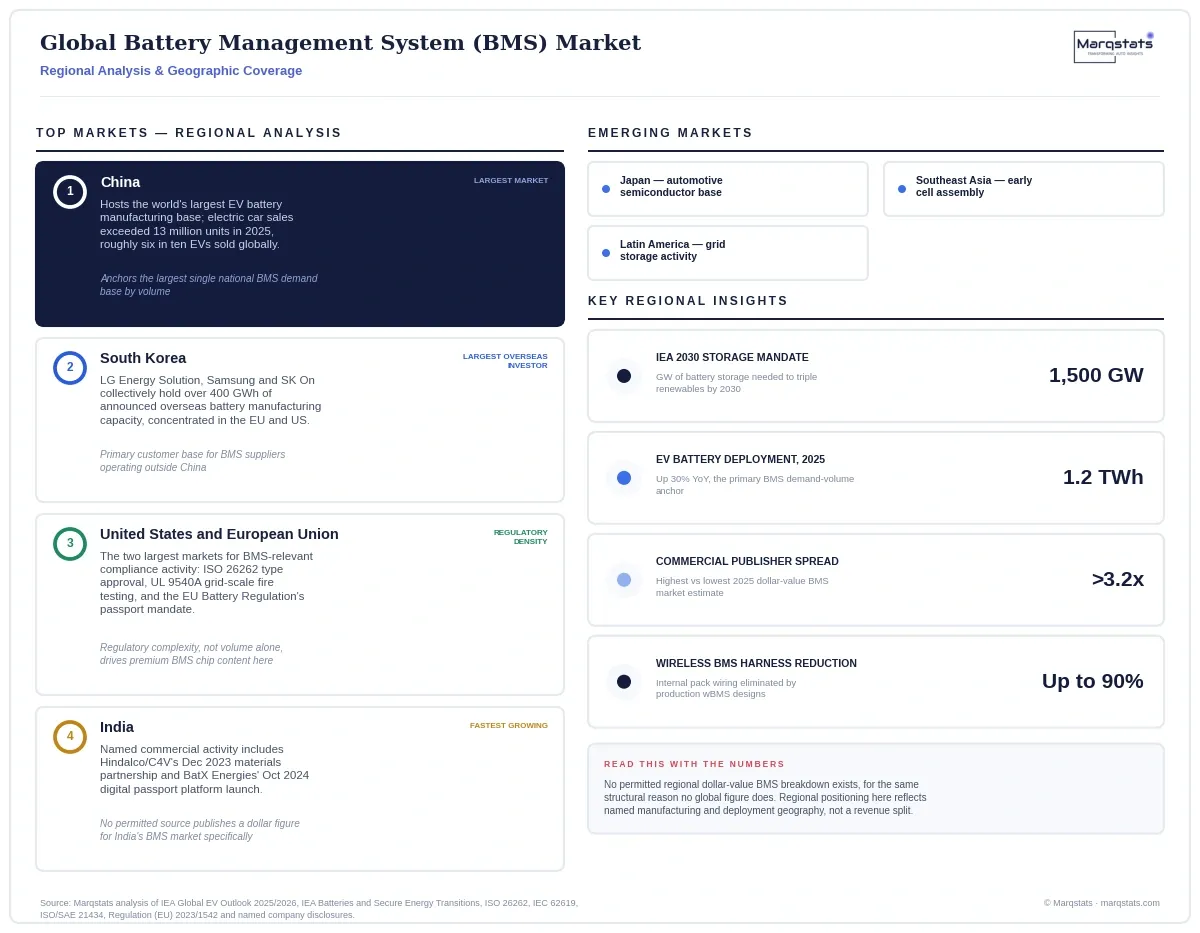
China hosts the world's largest EV battery manufacturing base and the highest-volume named cell producers in this report's entity register. Electric car sales in China exceeded 13 million units in 2025, roughly six in ten EVs sold globally, anchoring the country's position as the largest single national demand base for BMS hardware content, whether sourced domestically or from named international semiconductor suppliers.
South Korea
South Korea hosts the largest overseas battery manufacturing investment base among non-domestic producers, with LG Energy Solution, Samsung and SK On collectively holding more than 400 GWh of announced overseas capacity, concentrated in the European Union and United States. This positions Korean cell manufacturers as a primary customer base for BMS semiconductor suppliers operating outside China.
United States and European Union
The United States and European Union together represent the two largest markets for BMS-relevant regulatory compliance activity, governed respectively by ISO 26262 automotive type approval, UL 9540A grid-scale fire testing, and the European Union's Battery Regulation digital-passport mandate. Regulatory density in these two markets, rather than manufacturing volume alone, drives demand for the highest-specification BMS semiconductor content.
India
India is the fastest-growing emerging BMS-relevant market based on named commercial activity, including Hindalco Industries' December 2023 materials partnership with C4V and BatX Energies' October 2024 digital battery passport platform launch. No permitted source publishes a dollar-value size specifically for India's BMS market, for the same structural reason no global dollar figure exists for this category.
Rest of World
Beyond China, South Korea, the United States, the European Union and India, the rest of the world spans Japan's established automotive semiconductor supply chain, Southeast Asian cell-assembly investment, and early-stage BMS-relevant regulatory activity in Latin America and the Middle East tied to grid-storage build-outs. No permitted source publishes a consolidated dollar-value or volume breakdown for this residual grouping, which this report records as a Gap Register item rather than estimating.
How Competition Is Evolving
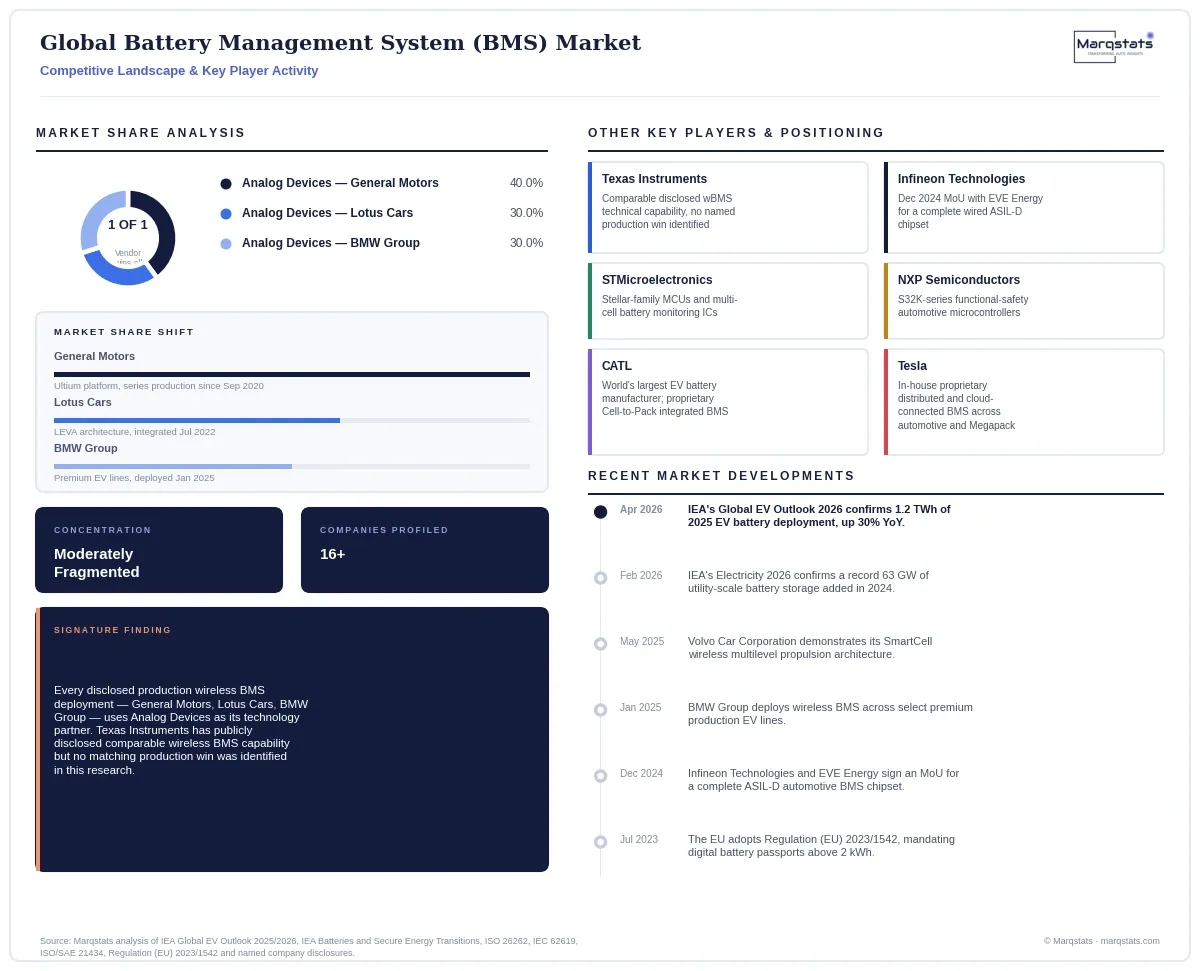
The BMS semiconductor supply chain is moderately fragmented across component layers, with no single vendor covering the full hardware stack. Analog Front Ends are supplied by Analog Devices, Texas Instruments, STMicroelectronics and NXP; microcontrollers by Infineon, STMicroelectronics, NXP and Microchip; current-sensing subsystems by Vishay, Isabellenhütte and Allegro MicroSystems; and galvanic isolation by Silicon Labs, Texas Instruments and Analog Devices — a genuinely multi-vendor bill of materials even as bundled chipset deals begin to emerge.
The competitive question in wireless BMS is not which supplier has the strongest technology but which supplier has converted that technology into a disclosed production win. Analog Devices holds every named production or advanced-research wireless BMS deployment in this report's entity register — General Motors, Lotus Cars, BMW Group and Volvo Cars' SmartCell research platform — despite Texas Instruments having publicly disclosed comparable wireless BMS technical capability with no matching production disclosure identified in this research.
Companies Covered
The report profiles 16+ companies with full strategy and financials analysis, including:
Recent Market Activity
Table of Contents
Coverage & Segmentation
This study covers BMS hardware and embedded firmware across automotive traction, stationary energy storage, portable electronics and industrial applications, on a volume basis rather than a dollar-value basis. The base year is 2025, the historical period runs 2020–2025, and the forecast period runs 2026–2030. Sizing is drawn from the International Energy Agency's EV battery deployment series, since no permitted regulator, standards body or company discloses a standalone dollar-value figure for this category; where a dollar figure appears in this report, it is a named company's own segment-revenue disclosure, explicitly caveated where that disclosure includes non-BMS product lines.
Outside this report's scope: lead-acid battery monitoring circuits for conventional starting, lighting and ignition applications, and standalone battery cell manufacturing, both structurally distinct product categories covered by separate Marqstats reports.