Market Snapshot
Key Takeaways
Market Overview & Analysis
Report Summary
The end-of-life tire market comprises the collection, processing and material recovery of scrap tires worldwide, spanning mechanical granulation, pyrolysis, retreading, devulcanisation and energy recovery, together with the sale of resulting products including crumb rubber, tire-derived fuel and aggregate, recovered carbon black, pyrolysis oil, steel wire and reclaimed rubber. This study segments the market by recovery process, output product, tire source category, end-use application, recovery route and region, with a 2025 base year, historical coverage from 2021 to 2025, and forecasts to 2030.
Two measurement conventions require statement because published figures for this market vary by roughly two to one. First, this report sizes the market on processed tonnage rather than on units, since tire weights range from about 8 kilograms for a passenger tire to more than 50 kilograms for a truck tire and unit counts are therefore not comparable across regions with different fleet mixes. Second, market value here covers revenue from gate fees, processing services and recovered product sales, and excludes retreading service revenue where it substitutes for new tire purchase rather than processing scrap.
The physical arithmetic anchors everything else. Roughly 2.5 billion new tires are manufactured each year and more than one billion units reach end of life annually, representing about 2% of global waste by mass. Converting units to mass gives arisings near 23.0 million tonnes in 2025, of which about 15.80 million tonnes entered formal processing. The residual is landfilled, stockpiled or disposed of outside regulated systems, and closing that gap represents about 7.2 million tonnes of latent feedstock available without any increase in tire production.
Recovery economics have inverted over the past decade. Tire-derived fuel historically absorbed the largest share of processed volume in several markets, and cement kilns and industrial boilers remain a substantial outlet. Material recovery now commands both the policy preference and the better margin, and European reporting shows material recovery rising from about 10% to about 60% of treated volume. That shift is why processed tonnage grows at under 5% annually while market value grows at over 8%.
Market Dynamics
Key Drivers
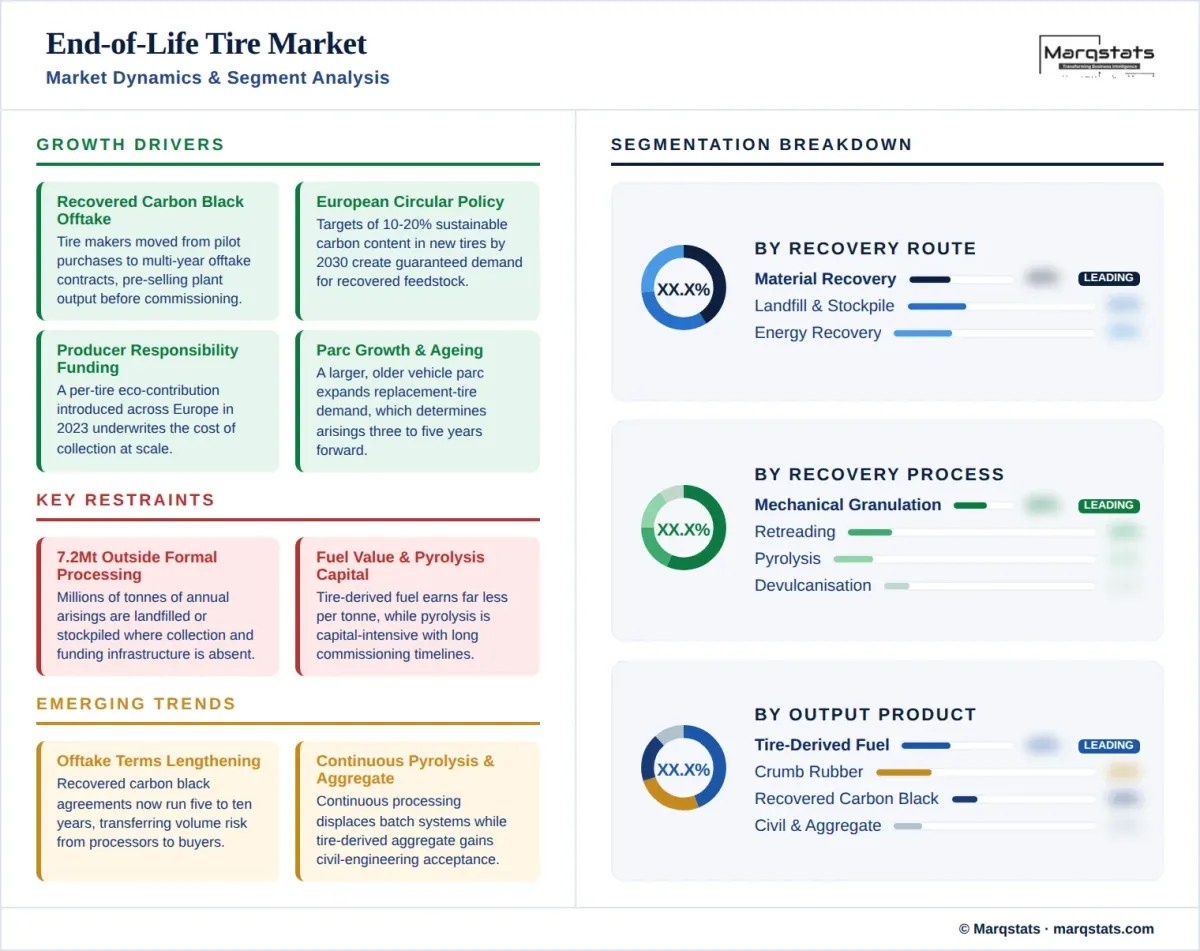
- Tire manufacturers have converted recovered carbon black from pilot purchases into multi-year offtake contracts, with agreements signed across 2024 to 2026 pre-selling plant output before commissioning.
- European circular economy policy targets 10% to 20% sustainable carbon material content in new tires by 2030, creating guaranteed demand for recovered feedstock.
- Extended producer responsibility funding underwrites collection, with a per-tire eco-contribution introduced across European markets in 2023.
- Vehicle parc growth and rising average vehicle age together expand replacement tire demand, which determines arisings three to five years forward.
- Recovery rates continue rising in markets that currently landfill, adding processable feedstock without any increase in tire production.
Key Restraints
- Roughly 7.2 million tonnes of annual arisings remain outside formal processing, concentrated in markets without collection infrastructure or producer responsibility funding.
- Tire-derived fuel commands materially lower revenue per tonne than material recovery, so volume routed to energy recovery constrains market value.
- Pyrolysis capacity is capital-intensive with long commissioning timelines, and several announced European plants have taken multiple years from investment decision to operation.
- Recovered carbon black quality varies with feedstock consistency, limiting substitution rates in premium tire applications.
Key Trends
- Recovered carbon black offtake agreements are extending to five and ten year terms, transferring volume risk from processors to tire manufacturers.
- Continuous pyrolysis is displacing batch processing across European capacity additions, improving yield consistency and unit economics.
- Tire-derived aggregate is gaining regulatory acceptance in civil engineering applications, opening a higher-volume outlet than fuel.
- Producer-led collection foundations are setting explicit full-recovery goals, with a North American body established in 2024 targeting 100% recycling.
Market Segmentation
Mechanical shredding and granulation processes the largest share of global scrap tire tonnage, producing crumb rubber, granulate and steel wire across a mature and widely distributed plant base. The process is capital-light relative to pyrolysis and scales readily, which is why it dominates in markets building recovery capacity for the first time. Retreading extends tire life before scrap arisings occur and is most significant in truck and bus applications, where casing quality supports multiple retread cycles.
Pyrolysis grows fastest of any recovery process, driven entirely by recovered carbon black demand. The process thermally decomposes tires in an oxygen-free environment, yielding pyrolysis oil, recovered carbon black, steel and gas, and it supplies roughly 90% of global recovered carbon black output. Devulcanisation produces reclaimed rubber capable of partial substitution for virgin compound and is concentrated in Asia-Pacific, where reclaimed rubber consumption is highest and where the largest processing volumes are located.
Crumb and ground rubber commands the largest share of recovered product value, serving sports surfaces, playgrounds, moulded rubber goods and rubberised asphalt. United States reporting places ground rubber at about 25% of scrap tire market consumption. Tire-derived fuel absorbs a substantial tonnage share at materially lower revenue per tonne, with United States reporting placing it at about 43% of market consumption, and cement kilns remain its principal outlet.
Recovered carbon black is the fastest-growing output product and the principal reason market value outpaces processed tonnage. It replaces virgin fossil-derived carbon black in new tires and rubber goods, and its market has moved from technical demonstration to contracted supply within roughly three years. Pyrolysis oil is the co-product, sold into industrial fuel and increasingly into chemical feedstock applications where refiners have contracted volumes alongside tire manufacturers.
Passenger car tires generate the largest share of scrap tire units and a smaller share of tonnage, at roughly 8 to 11 kilograms per unit. The category is the most consistently collected because passenger replacement occurs through organised retail channels that function as natural collection points, and because producer responsibility schemes are typically structured around passenger tire sales. Consistency of feedstock also makes passenger casings the preferred input for pyrolysis operations targeting recovered carbon black quality.
Truck and bus tires generate disproportionate tonnage relative to unit count at roughly 50 to 70 kilograms each, and are the principal retreading category, with casings frequently supporting two or more retread cycles before entering scrap streams. Off-the-road tires from mining, agriculture and construction generate very high tonnage per unit and present distinct handling challenges, with the largest units requiring specialised cutting equipment before conventional processing.
New tire manufacturing is the highest-value application and the fastest-growing, driven by recovered carbon black substitution and by European policy targeting 10% to 20% sustainable carbon material content by 2030. Moulded rubber goods, industrial matting and automotive components absorb crumb rubber and reclaimed rubber across a broad and fragmented buyer base. Together these applications represent the material recovery route that both policy and margin favour.
Civil engineering applications use tire-derived aggregate in embankment fill, drainage layers and retaining structures, and United States reporting places civil engineering at about 8% of scrap tire market consumption with advocacy underway for expanded use in federally funded infrastructure. Sports surfaces and playground safety surfacing consume substantial crumb rubber volumes. Cement kilns and industrial boilers absorb tire-derived fuel, an outlet that remains large in tonnage while declining in strategic importance.
Material recovery is the policy-preferred route and commands the strongest revenue per tonne, and European reporting shows it rising from about 10% to about 60% of treated volume. Retreading extends casing life before scrap arisings and is counted separately here because it defers rather than processes end-of-life material. Both routes benefit from producer responsibility funding structures that increasingly discriminate against energy recovery in fee allocation.
Energy recovery absorbs a substantial tonnage share globally and remains the dominant route in several markets where material recovery capacity has not been built. Landfill and stockpiling account for the difference between arisings of about 23.0 million tonnes and processed volume of about 15.80 million tonnes in 2025. Regulatory pressure against landfill continues to tighten, and the roughly 7.2 million tonne gap represents the largest single source of incremental feedstock available to processors.
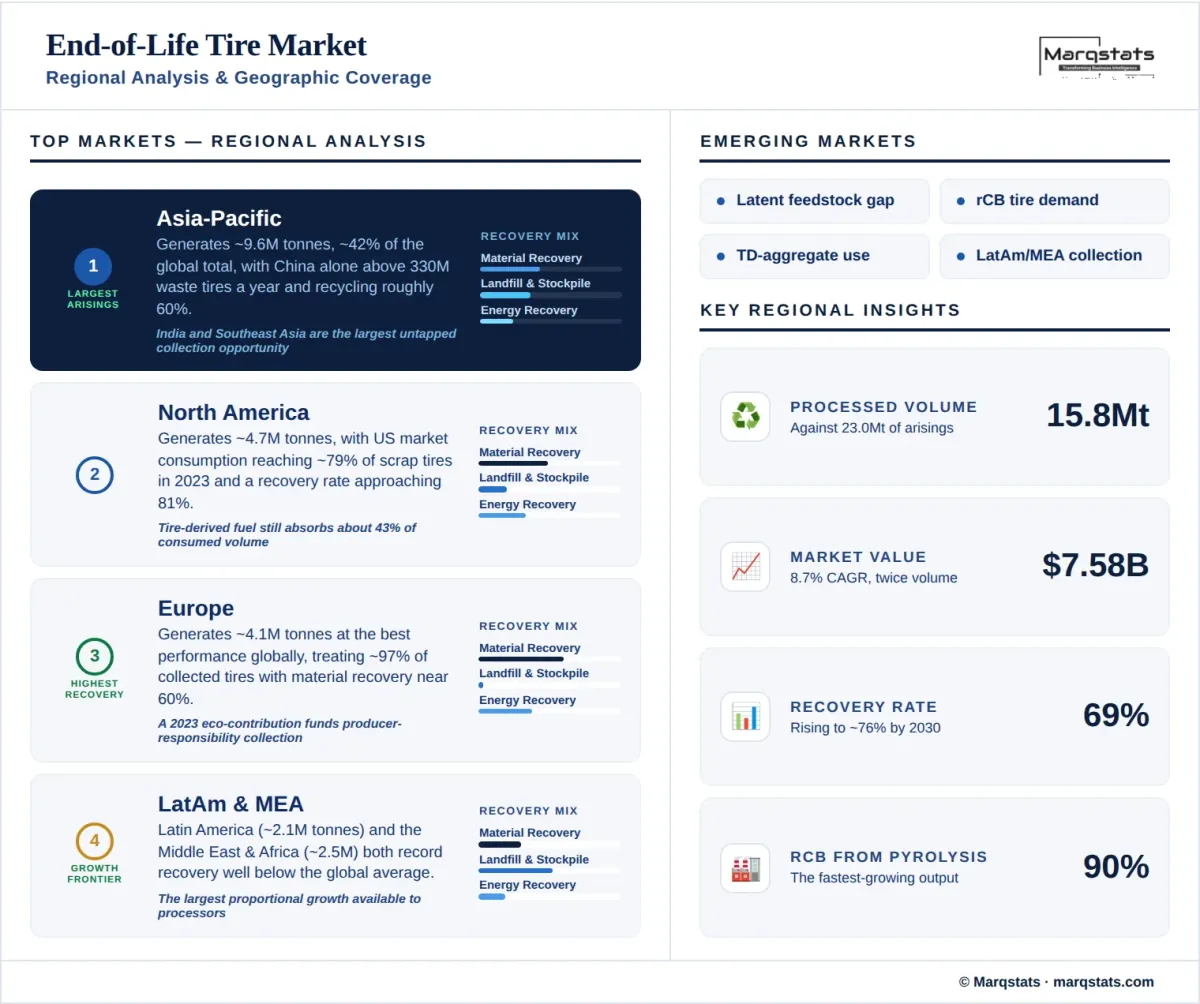
Asia-Pacific generates the largest regional arisings at roughly 9.6 million tonnes in 2025, about 42% of the global total, with China alone generating more than 330 million waste tires annually at scrapping volumes rising 8% to 10% each year and recycling roughly 60%. Japan processes more than one million tonnes annually at over 90% efficiency. North America generates roughly 4.7 million tonnes, with United States market consumption reaching about 79% of annually generated scrap tires in 2023.
Europe generates roughly 4.1 million tonnes and achieves the highest recovery performance globally, with treatment reaching about 97% of collected tires and a total of 3.9 million tonnes of end-of-life tires generated in 2024. The United Kingdom achieves a collection rate near 94%. Latin America generates roughly 2.1 million tonnes and the Middle East and Africa roughly 2.5 million tonnes, both with recovery rates materially below the global average and both representing the largest proportional growth opportunities.
By Geography
North America
North America generates roughly 4.7 million tonnes of scrap tire arisings annually, with the United States alone accounting for more than 250 million scrap tires equal to about 4.2 million tonnes. Market consumption has risen from about 11% of annually generated tires in 1990 to about 79% in 2023, up from about 71% in 2021, and the regional recycling and repurposing rate approaches 81%. Tire-derived fuel absorbs about 43% of consumed volume, ground rubber about 25% and civil engineering about 8%.
Europe
Europe generates roughly 4.1 million tonnes annually and delivers the highest recovery performance of any region, with industry reporting stating that all tires are collected and treated at a rate approaching 97%. Total end-of-life tire generation reached 3.9 million tonnes in 2024, and material recovery has risen from about 10% to about 60% of treated volume. A per-tire eco-contribution introduced in 2023 funds producer responsibility collection, and the United Kingdom achieves a collection rate near 94% across roughly 52 million tires.
Asia-Pacific
Asia-Pacific generates the largest regional arisings at roughly 9.6 million tonnes and shows the widest internal variation in recovery performance. China generates more than 330 million waste tires annually with scrapping volumes rising 8% to 10% each year and recycles roughly 60%, while recycled tire volume reached about 9 million tons in 2024, up about 20% year on year. Japan processes more than one million tonnes annually at over 90% efficiency. India and Southeast Asia together represent the largest untapped collection opportunity in the region.
Latin America, Middle East & Africa
Latin America generates roughly 2.1 million tonnes of arisings annually, with Brazil accounting for the largest national share and operating a producer responsibility scheme requiring tire manufacturers and importers to collect and dispose of a proportion of units placed on the market. The Middle East and Africa generate roughly 2.5 million tonnes, with recovery infrastructure concentrated in South Africa and the Gulf states. Both regions record recovery rates materially below the global average and represent the largest proportional growth available to processors.
How Competition Is Evolving
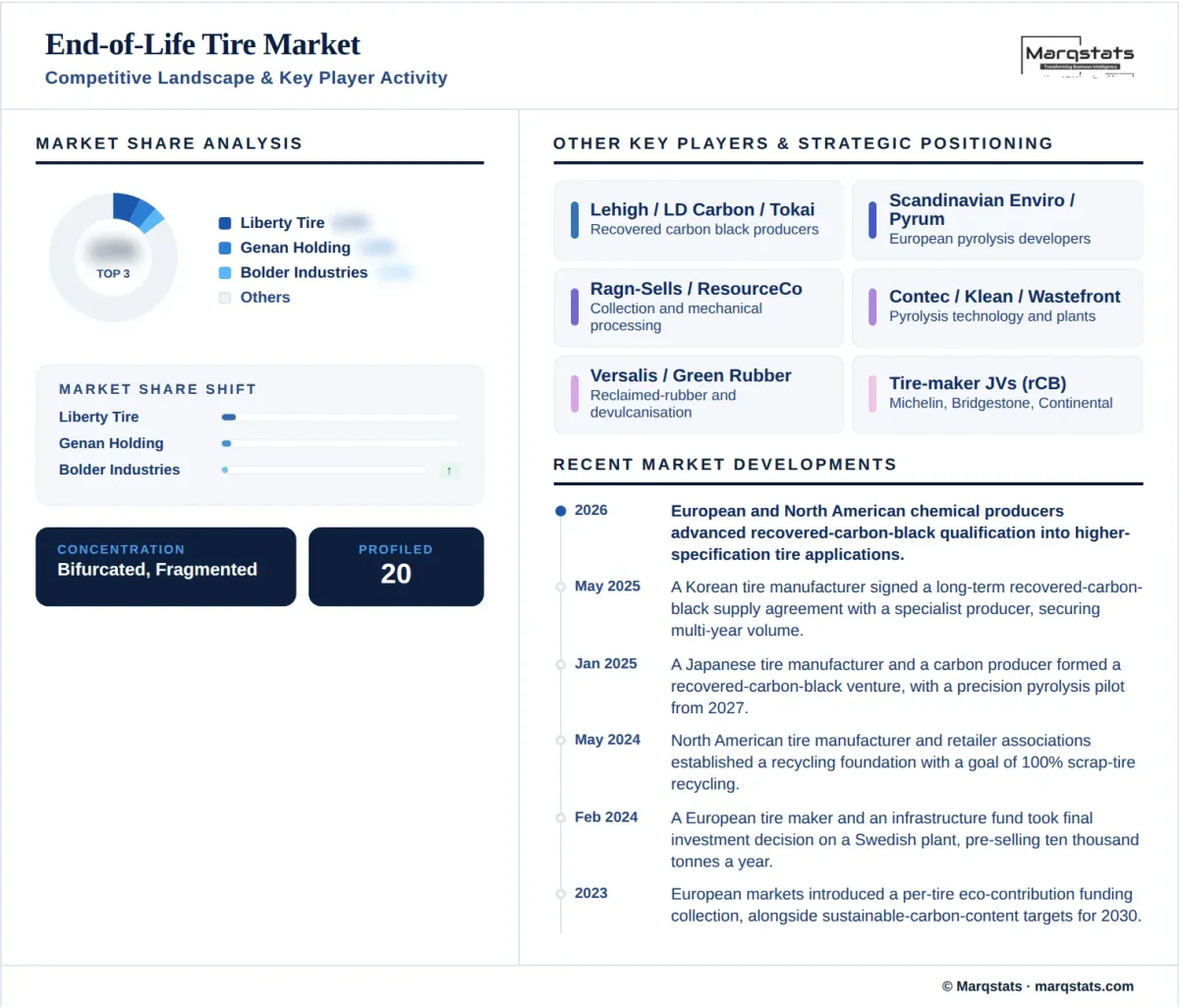
The end-of-life tire market is fragmented at the processing level and concentrating at the recovered-product level. Collection and mechanical processing remain highly localised because scrap tires are bulky and low in value per tonne, making transport economics prohibitive beyond regional radii, and thousands of operators serve local catchments worldwide. No processor holds a materially significant share of global tonnage.
Pyrolysis and recovered carbon black represent the opposite structure. Capital intensity, offtake requirements and technical complexity have produced a small group of operators with contracted output, several of them backed by infrastructure investors or joint ventures with tire manufacturers. Plant output is now routinely pre-sold before commissioning, with agreements running five to ten years, which transfers volume risk from processor to buyer and makes project financing achievable.
Tire manufacturers have become direct participants rather than customers. One European manufacturer co-invested in a Swedish recovered carbon black facility alongside an infrastructure fund, pre-selling ten thousand tonnes of annual output with multi-year offtake agreements involving another tire manufacturer and a fuel refiner. A Japanese manufacturer formed a dedicated recovered carbon black venture with a carbon producer in January 2025 and is building a precision pyrolysis pilot plant scheduled to operate from 2027. A Korean manufacturer signed a long-term recovered carbon black supply agreement in May 2025.
Competition is therefore bifurcating. In collection and mechanical processing, operators compete on catchment density, gate fee economics and municipal contract retention, and consolidation proceeds slowly through regional roll-ups. In pyrolysis and recovered carbon black, competition centres on product consistency, offtake credibility and access to project capital, and the participants are increasingly chemical companies, infrastructure investors and tire manufacturers rather than waste operators.
Companies Covered
The report profiles 16+ companies with full strategy and financials analysis, including:
Recent Market Activity
Table of Contents
Coverage & Segmentation
This report provides a comprehensive assessment of the end-of-life tire market across a 2025 base year, historical data from 2021 to 2025, and forecasts spanning 2026 to 2030. Market sizing is presented in processed tonnage and complemented by value analysis in United States dollars covering gate fees, processing services and recovered product sales. Segmentation covers six dimensions. Arisings are reported separately from processed volume throughout, since the difference between them represents the market's principal growth opportunity.
The scope covers demand drivers, restraints and structural trends, with particular focus on the arisings-to-processing gap, the shift from energy recovery toward material recovery, recovered carbon black offtake contracting, regional recovery rate divergence, and the entry of tire manufacturers as direct participants. Vehicle parc context determining future arisings is available in the Europe Used Car Market report. An extended forecast to 2035 is available under customization, alongside country-level recovery rate analysis on request.