Market Snapshot
Middle bar: base-year value × (1 + CAGR), rounded to two decimals. This is a calculated illustration, not a separately researched annual estimate.
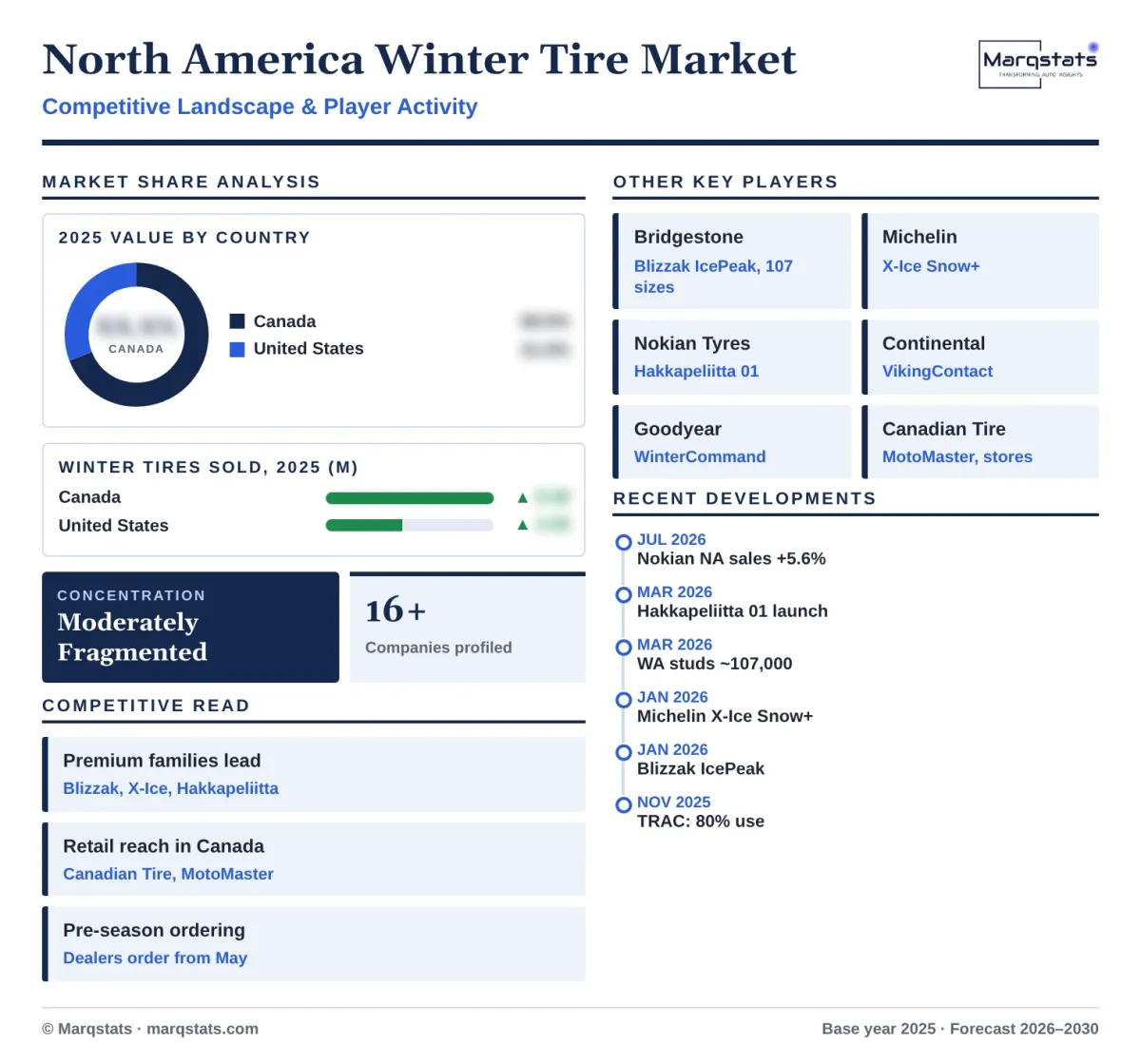
The North America winter tire market is valued at USD 2,630.50 million in 2025 and is projected to reach USD 2,957.47 million by 2030, registering a CAGR of 2.37% over 2026–2030. The market covers dedicated winter passenger and light truck replacement tires sold in the United States and Canada, in studless and studded designs. Marqstats estimates that 13.79 million winter tires were sold in 2025, including 4.30 million in the United States and 9.49 million in Canada, where 80% of drivers used winter tires in 2025. Canada buys 69.01% of North American winter tire value with less than a tenth of the region's light vehicles, while US winter tire sales fell sharply in 2023 and 2024 as drivers moved to all-weather tires.
Market size and forecast figures are generated using Marqstats' proprietary estimation framework, updated as of October 2026.
Coverage spans two vehicle types, two tire types, three rim diameter bands and five regions: Ontario and Quebec, the US Northeast, the US Midwest, the Rest of Canada and the US West and South. The analysis benchmarks 16 tire makers and retailers, including Compagnie Générale des Établissements Michelin SCA, Bridgestone Corporation, Nokian Tyres plc and Canadian Tire Corporation, Limited, and tracks reference sizes such as 205/55R16 and 215/60R16 for compact cars, 225/65R17 and 225/60R18 for crossovers, 235/55R19 and 255/55R20 for larger SUVs, and LT245/75R17 and LT275/65R18 for pickups. All-weather and all-season tires, including those carrying the three-peak mountain snowflake symbol, sit outside the dedicated winter market. Mexico is excluded because dedicated winter tire demand there is negligible.
Key Takeaways
Market Overview & Analysis
Report Summary
The North America winter tire market comprises new dedicated winter replacement tires for passenger cars, crossovers, SUVs and pickups in the United States and Canada, valued at USD 2,630.50 million in 2025 at dealer purchase prices. Studless winter tires and studded or studdable winter tires fall in scope. All-weather tires, all-season tires with the three-peak mountain snowflake symbol, all-terrain tires, original equipment fitments, winter wheels and seasonal changeover and storage services sit outside the market perimeter. The definition follows tire design and marketing as a dedicated winter product rather than the snowflake symbol alone.
Canada sets the adoption benchmark. The Tire and Rubber Association of Canada (TRAC) reported that 80% of drivers used winter tires in 2025, up 2 points from 2024 and 12 points over ten years, in a survey of 1,069 drivers taken from 6 to 11 October 2025. Use reached 95% in Atlantic Canada, 77% in Ontario, 70% in Manitoba and Saskatchewan, 70% in Alberta and 64% in British Columbia, and Quebec requires winter tires on passenger vehicles from 1 December to 15 March. The Canada replacement market sold 23.50 million passenger and light truck tires in 2025, and Marqstats estimates 9.49 million of them, about 40%, were winter tires, in line with Bridgestone Americas' estimate that dedicated winter tires made up about 42% of Canadian tire sales in 2025.
The United States is larger in vehicles and far smaller in adoption. Winter tires account for about 1.7% of the 259.6 million passenger and light truck replacement tires shipped in 2025, or an estimated 4.30 million units worth USD 815.16 million, concentrated in New England, New York, the upper Midwest, the Mountain West and Alaska. Most US drivers in snow states rely on all-season or all-weather tires. U.S. Tire Manufacturers Association (USTMA) data cited by Kumho Tire U.S.A. show winter tire sales fell 21% in 2023 and 39% in the first half of 2024, while all-weather sales rose 19% and 18%, leaving all-weather tires near three times winter volume by the end of 2023. Marqstats estimates US winter units fell from 6.60 million in 2022 to 4.00 million in 2024 before recovering to 4.30 million in 2025.
Winter tire demand follows a seasonal set cycle rather than mileage alone. A driver who owns a dedicated winter set fits it for four to five months a year, so a set lasts about four to six winters before tread depth or rubber hardening forces replacement. Annual demand therefore equals replacement of worn sets in the installed base, first sets bought by new adopters and for newly purchased vehicles, and single tires replaced after damage. Each changeover is a service event rather than a tire sale, and a growing installed base of winter sets supports steady replacement even in years when adoption stays flat.
Traffic rules shape demand on both sides of the border. Quebec has required winter tires on passenger vehicles since 2008, and the province now applies the rule from 1 December to 15 March. British Columbia requires winter-rated tires on most mountain and interior highways from 1 October to 30 April. In the United States, Colorado's traction law on the I-70 corridor, chain-control areas in the Sierra Nevada and the Cascades, and studded tire date windows in many northern states push drivers toward winter tires during storms, while only a handful of states regulate studs through fees or seasonal limits.
Value grows faster than units through larger sizes and price. The average value per winter tire is an estimated USD 190.75 in 2025, rising to USD 217.94 by 2030, as tires for 19-inch and larger rims rise from 20.00% to 26.00% of value. Units ease from 13.79 million in 2025 to 13.57 million by 2030, and market value reaches an estimated USD 2,665.21 million in 2026. Canadian winter tire demand within the full replacement market is covered in the Marqstats Canada Replacement Tire Market report.
Market Dynamics
Key Drivers
Five factors support winter tire demand in North America.
- High and rising Canadian adoption. Winter tire use in Canada rose from 68% ten years ago to 80% in 2025, according to TRAC. Drivers who own a dedicated winter set buy winter tires on a cycle of about four to six seasons, which creates a large, steady replacement base of an estimated 9.49 million tires a year. Canada's winter tire value grows at a 2.15% CAGR to USD 2,018.75 million by 2030. Canadian winter tire units ease from 9.49 million in 2025 to 9.23 million by 2030 as all-weather tires gain, while value rises. Each first-time adopter also creates a repeat buyer for later winter sets.
- Safety awareness and extreme weather. TRAC found that 84% of Canadian drivers say winter tires have saved them from an accident or loss of control, and 76% say extreme winter weather has made winter tires more important than ever. Protecting family was the top reason for using winter tires at 70%. Safety messaging from retailers, insurers and governments supports adoption in US snow states as well. Advice from family and friends and from retailers also influences 18% and 10% of buyers respectively. Media coverage of severe storms in the northeastern United States lifts winter tire searches and dealer traffic each fall.
- Regulation and insurance incentives. Quebec requires winter tires from 1 December to 15 March, and British Columbia requires winter tires on designated highways from 1 October to 30 April. TRAC found that 33% of Canadian winter tire users cite a provincial requirement and 24% cite lower insurance premiums, and insurers in several provinces offer discounts for winter tires. Quebec's rule also covers taxis and rental vehicles registered in the province. Mandatory periods also concentrate changeover appointments in November.
- Crossover, SUV and EV fleets. Crossovers, SUVs and pickups now make up most new vehicle sales in both countries, and they need larger winter sizes such as 225/65R17, 235/55R19 and LT275/65R18. Electric vehicles add weight and instant torque, which raise demand for winter tires with higher load ratings and low rolling resistance. Light truck winter tire value grows at a 3.61% CAGR, faster than passenger tires. Heavier EVs also wear winter tires faster than gasoline vehicles of the same size. Light truck winter tires for pickups also sell well in rural Canada, where gravel and ice roads are common.
- Product innovation. Bridgestone announced the Blizzak IcePeak with 107 planned sizes from 14-inch to 22-inch rims, Michelin unveiled the X-Ice Snow+ near Montreal in January 2026, and Nokian Tyres launched the Hakkapeliitta 01 studded tire for Nordic and North American markets in March 2026. New flagships carry higher prices and pull buyers toward premium winter tires. Retailers use new launches to anchor fall promotions and early-order campaigns. Independent winter tire tests published each fall also shape consumer choice between brands.
Key Restraints
Four constraints hold back winter tire growth.
- Low US adoption. Outside the snow belt, most US drivers never consider winter tires, and many in snow states rely on all-season tires and all-wheel drive. Winter tires account for only about 1.7% of US passenger and light truck replacement units, and 75% of Canadian non-users told TRAC that all-season tires are good enough. US winter tire units grow only from 4.30 million in 2025 to 4.34 million by 2030. Southern US states see almost no winter tire demand outside mountain areas.
- All-weather substitution. All-weather tires with the three-peak mountain snowflake symbol let drivers in milder snow regions use one set of tires all year, which removes the cost of a second set, changeovers and storage. Each switch removes a winter set from the replacement cycle, and all-weather tires grow at an 8.79% CAGR in Canada, where Bridgestone puts their share at about 22% of 2025 tire sales. Drivers who switch to all-weather tires also stop paying for twice-yearly changeovers. All-weather tires also appeal to apartment dwellers with no space to store a second set.
- Cost of living and price sensitivity. TRAC found that 32% of Canadian drivers are less likely to buy winter tires because of financial pressure, and 25% of non-users cite cost. New winter tires were expected to cost more for the 2025 season because of inflation and tariffs, and Nokian Tyres estimated that the North American passenger and light truck replacement market fell about 5% in the first half of 2026. Price-sensitive buyers trade down to value brands or keep worn winter tires for an extra season. Cost-conscious drivers also buy used winter tires through online marketplaces.
- Weather-driven volatility. Winter tire demand depends on early snowfall: a late or mild winter delays purchases and leaves dealers with unsold stock, as in 2017 when US winter tire sales fell 26%. Dealers order winter tires months ahead of the season, so shipment timing and consumer purchases can diverge by year. Dealers that overbuy in a mild year carry stock into the next season at reduced margins. Retailers manage this risk by shifting unsold winter stock between regions or holding it in warehouses for the next season.
Key Trends
Four shifts are changing how winter tires are made, sold and used.
- Larger rim sizes. Winter tires for 19-inch and larger rims grow at a 7.89% CAGR, from 20.00% of value in 2025 to 26.00% by 2030, while 16-inch and smaller sizes fall from 33.00% to 25.00%. Bridgestone's Blizzak IcePeak range runs up to 22-inch rims to cover large SUVs and pickups. Larger sizes also lift the average value per winter tire from USD 190.75 in 2025 to USD 217.94 by 2030. Large-rim winter tires also carry the highest margins for dealers.
- Decline of studded tires. Washington State charges USD 5 per studded tire, and studded tire sales in the state fell from nearly 171,000 in fiscal 2018-19 to about 107,000 in fiscal 2024 and 2025, according to the Washington Department of Revenue. Studded and studdable tires fall from 14.00% to 12.00% of value by 2030 as studless compounds improve. Several provinces and states limit studded tires to set winter dates. Studded tire use also faces bans or limits in some urban areas because of pavement wear.
- EV-ready winter tires. Michelin markets the X-Ice Snow+ for electric vehicles and hybrids, citing efficiency and range alongside winter grip, and dealers order it ahead of the 2026 season from May 2026. Low rolling resistance and noise reduction become selling points as EV sales grow in Canada and the northern United States. Winter tires designed for EVs often carry foam liners or noise-reducing tread patterns. EV owners in Canada and the northern United States increasingly buy winter tires matched to their range and noise needs.
- Service bundles and tire storage. Retailers such as Canadian Tire Corporation, Limited and Kal Tire bundle winter tires with wheels, seasonal changeovers and tire storage, which keeps customers returning twice a year. Wheel-and-tire packages make changeovers faster and support repeat winter tire sales on the same vehicle. Seasonal storage also keeps tires in better condition, which extends set life. Tire hotels at dealer sites also give retailers early visibility of worn sets that need replacement.
Market Segmentation
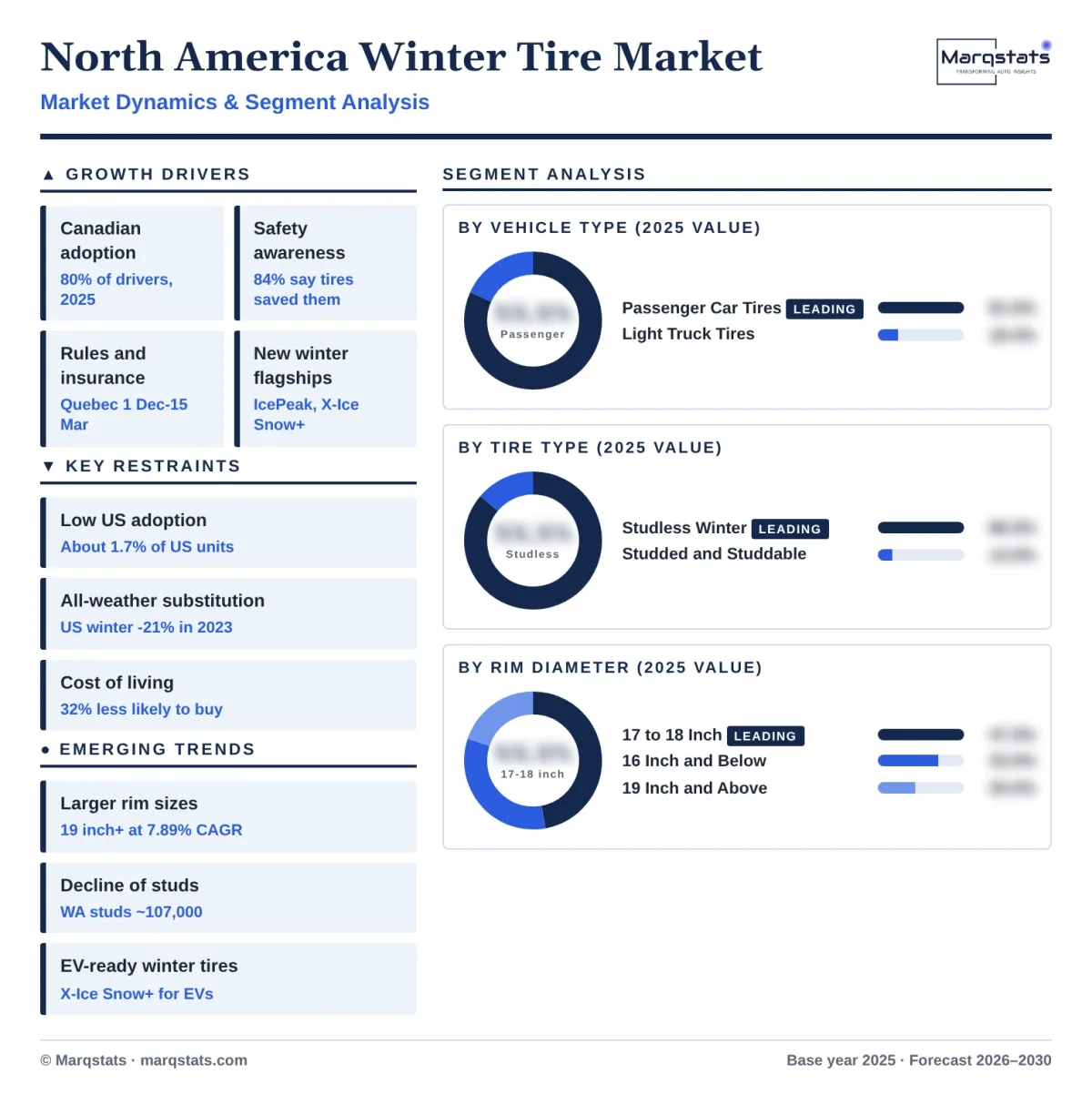
Passenger car winter tires account for an estimated USD 2,147.07 million, or 81.62% of 2025 value, and are projected to reach USD 2,380.33 million by 2030 at a 2.08% CAGR. Sedans, hatchbacks, crossovers and most SUVs run passenger-rated winter tires in sizes such as 205/55R16, 215/60R16, 225/65R17 and 225/60R18. Crossovers take a growing share of passenger winter tire value as buyers move from cars to taller vehicles. Passenger winter tire value grows more slowly than light truck value as the fleet shifts to pickups. Compact crossovers on 17-inch wheels form the single largest winter fitment group.
Light truck winter tires account for an estimated USD 483.43 million, or 18.38% of 2025 value, and are projected to reach USD 577.14 million by 2030 at a 3.61% CAGR, the faster vehicle type. Pickups, large SUVs and vans run load-rated winter tires in sizes such as LT245/75R17 and LT275/65R18, at higher prices per tire than passenger tires. Pickup owners in rural Canada and the northern United States also buy studdable light truck winter tires. Commercial van fleets in Canada also fit light truck winter tires for delivery work.
Studless winter tires account for an estimated USD 2,262.23 million, or 86.00% of 2025 value, and are projected to reach USD 2,602.57 million by 2030 at a 2.84% CAGR. Soft, siped compounds such as Bridgestone's Blizzak, Michelin's X-Ice and Continental's VikingContact lines provide ice and snow grip without studs and can be used in every province and state. Studless tires suit urban driving on plowed roads, where studs offer little benefit. Premium studless lines now match many studded tires on ice in independent tests.
Studded and studdable winter tires account for an estimated USD 368.27 million, or 14.00% of 2025 value, and are projected to reach USD 354.90 million by 2030 at a -0.74% CAGR. Drivers in Atlantic Canada, northern Ontario, the Prairies, Alaska and the Mountain West use studs for glare ice, while date limits, fees and road damage concerns restrict their use elsewhere. Nokian's Hakkapeliitta 01 shows tire makers still invest in studded technology for icy regions. Studdable tires let buyers add studs later, which widens their appeal in mixed climates.
Winter tires for 17-inch to 18-inch rims account for an estimated USD 1,236.33 million, or 47.00% of 2025 value, and are projected to reach USD 1,449.16 million by 2030 at a 3.23% CAGR. This band covers most compact and midsize crossovers in sizes such as 225/65R17, 235/65R17 and 225/60R18. Many drivers fit winter tires on a smaller wheel within this band to save cost. Value brands compete hardest in this band because of its large volume.
Winter tires for 16-inch and smaller rims account for an estimated USD 868.07 million, or 33.00% of 2025 value, and are projected to decline to USD 739.37 million by 2030, a CAGR of -3.16%. Compact cars and older vehicles use sizes such as 205/55R16 and 215/60R16, and some drivers downsize to 16-inch winter wheels to save cost. Shrinking compact car sales reduce demand for these sizes each year. Older vehicles leaving the fleet also reduce demand in this band.
Winter tires for 19-inch and larger rims account for an estimated USD 526.10 million, or 20.00% of 2025 value, and are projected to reach USD 768.94 million by 2030 at a 7.89% CAGR, the fastest segment. Large SUVs, premium crossovers, pickups and EVs use sizes such as 235/55R19 and 255/55R20, which sell at much higher prices than smaller sizes. Fitting options for large rims remain more limited, which supports higher prices. Premium brands launch large sizes first, which keeps competition in this band focused on quality.
By Geography
Ontario and Quebec
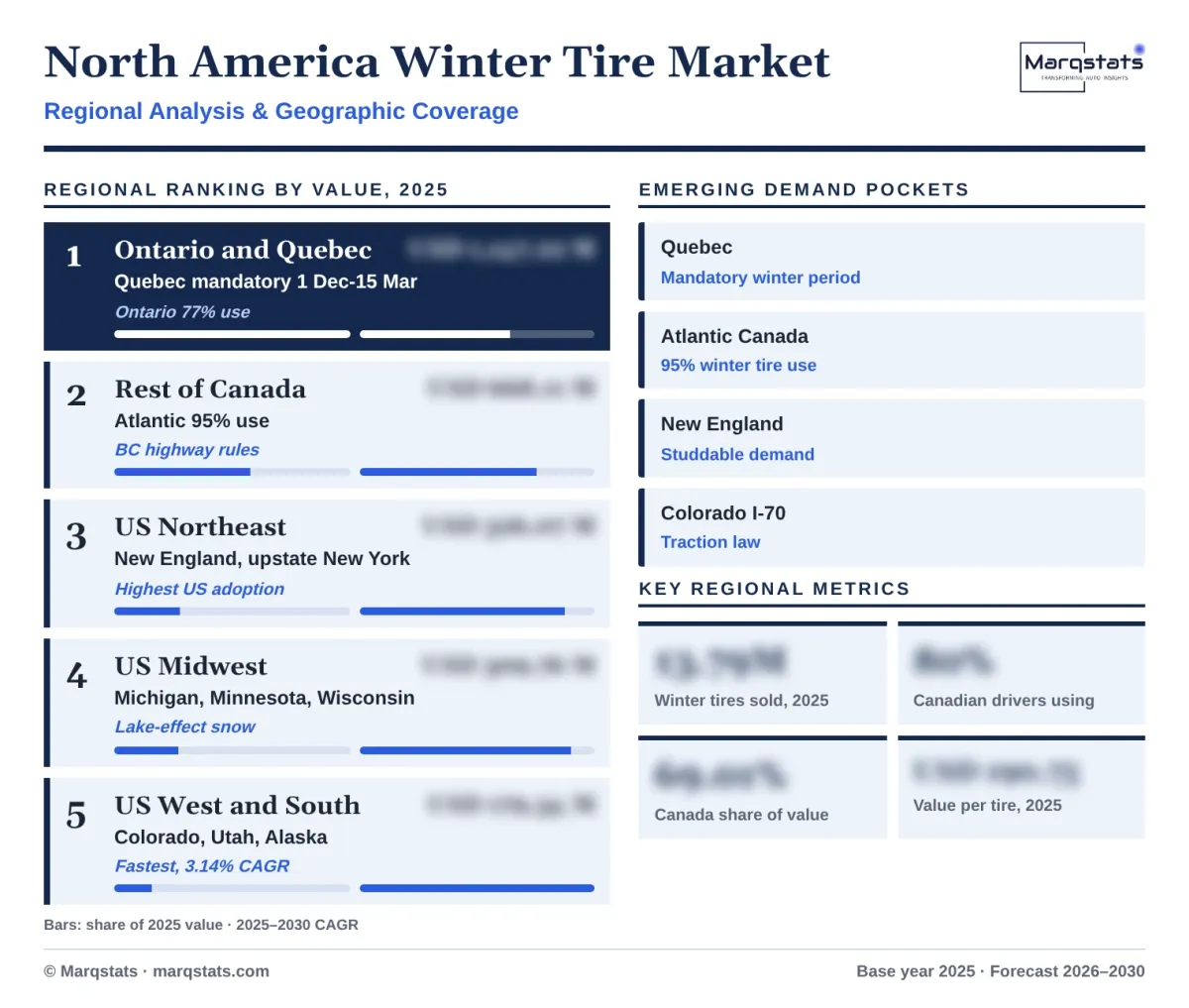
Ontario and Quebec form the largest regional market at 43.60% of 2025 value, or USD 1,147.22 million, and are projected to reach USD 1,267.50 million by 2030 at a 2.01% CAGR. Ontario contributes an estimated USD 622.64 million with 77% winter tire use, and Quebec USD 524.59 million under its mandatory winter tire period from 1 December to 15 March. Southern Ontario drivers also buy winter sets ahead of insurance discount deadlines. Montreal, Quebec City and Ottawa see heavy snowfall that keeps winter tire use high every season.
Rest of Canada
The Rest of Canada accounts for 25.40% of 2025 value, or USD 668.11 million, and is projected to reach USD 751.25 million by 2030 at a 2.37% CAGR. British Columbia and Alberta contribute an estimated USD 410.03 million and Atlantic Canada and the Prairies USD 258.08 million. Atlantic Canada leads the country with 95% winter tire use, and British Columbia requires winter tires on designated highways from 1 October to 30 April. Calgary and Edmonton winters keep winter tire use high despite no provincial requirement. Long highway distances between Prairie cities favor durable winter tires with strong ice grip.
US Northeast
The US Northeast accounts for 12.40% of 2025 value, or USD 326.07 million, and is projected to reach USD 373.12 million by 2030 at a 2.73% CAGR. New England, upstate New York and Pennsylvania have the highest winter tire use in the United States, and lake-effect snow belts around Buffalo and Syracuse support strong demand. Vermont, New Hampshire and Maine have long seasons and many rural roads that stay snow-covered. Retailers across New England also stock studdable winter tires for rural customers.
US Midwest
The US Midwest accounts for 11.78% of 2025 value, or USD 309.76 million, and is projected to reach USD 356.24 million by 2030 at a 2.84% CAGR. Michigan, Minnesota, Wisconsin and the Dakotas have long, cold winters with heavy lake-effect and prairie snow, and drivers on rural roads favor dedicated winter sets. Retailers in the Twin Cities and Detroit areas run winter tire campaigns from October. Freeze-thaw cycles and icy rural highways also push drivers toward studless ice tires.
US West and South
The US West and South account for 6.82% of 2025 value, or USD 179.34 million, and grow fastest at a 3.14% CAGR to USD 209.36 million by 2030. Colorado, Utah, Idaho, Montana, Washington, Oregon and Alaska drive demand, and Colorado's traction law on the I-70 mountain corridor requires adequate snow tires or chains during winter storms. Ski resort traffic into the Rockies and Cascades drives winter tire purchases by visitors and residents. Residents of mountain towns in Colorado and Utah often keep two sets of wheels and tires.
How Competition Is Evolving
The North America winter tire market is moderately fragmented, with a group of global makers leading the premium tier through well-known winter families. Compagnie Générale des Établissements Michelin SCA with X-Ice, Bridgestone Corporation with Blizzak, Nokian Tyres plc with Hakkapeliitta, Continental AG with VikingContact, and The Goodyear Tire & Rubber Company with WinterCommand and Ultra Grip compete in premium studless and studded tires. Michelin and Bridgestone produce passenger tires in Canada, in Nova Scotia and in Joliette, Quebec.
Mid-tier and value brands compete on price. Pirelli & C. S.p.A., Hankook Tire & Technology Co., Ltd., Toyo Tire Corporation, The Yokohama Rubber Co., Ltd., Sumitomo Rubber Industries, Ltd. through Falken, Kumho Tire Co., Inc., Nexen Tire Corporation and Giti Tire Pte. Ltd. supply winter lines through national distributors and independent dealers. Nokian reported that winter tires remain its largest product category and that its North American sales rose 5.6% in comparable currencies in the first half of 2026, while it estimated the regional replacement market fell about 5%. Value brands win share in common sizes such as 205/55R16 and 225/65R17, where price comparisons are easiest for buyers.
Retail reach decides share in Canada. Canadian Tire Corporation, Limited sells winter tires through its national store network with its own MotoMaster brand, and The Reinalt-Thomas Corporation, operating as Discount Tire, and Costco Wholesale Corporation sell winter tires and wheel packages across the US snow belt. Retailers that offer storage, changeovers and wheel packages win repeat business, and new product launches for 2026 from Bridgestone, Michelin and Nokian refresh the premium end of the market.
Tire makers compete on independent test results, size coverage and early ordering. Winter tires must reach dealers before the first snowfall, so makers take pre-season orders months in advance and offer early-order incentives. Michelin opened dealer ordering for the X-Ice Snow+ in May 2026 for the following winter, and Bridgestone rolled out the majority of IcePeak sizes from May 2026. All-weather tire competition is covered in the Marqstats US Replacement Tire Market report.
Companies Covered
Companies covered in the report include:
Recent Market Activity
Table of Contents
Coverage & Segmentation
The North America winter tire market comprises new dedicated winter passenger and light truck replacement tires sold in the United States and Canada, valued at dealer purchase prices in US dollars. The market excludes all-weather and all-season tires, all-terrain tires, original equipment fitments, winter wheels, Mexico, and changeover and storage services. Coverage uses a 2025 base year, a 2021–2025 historical period and a 2026–2030 forecast period, with 2026 as the estimated year. Canadian winter tire value matches the winter segment in the Marqstats Canada Replacement Tire Market report.
Segmentation covers two vehicle types, two tire types, three rim diameter bands and five regions, with 16 tire makers and retailers profiled. Canadian units follow replacement shipments and the winter share of passenger and light truck value, US units follow replacement shipments and estimated winter penetration, and regional values follow provincial vehicle shares, TRAC regional usage rates and US snow-belt demand. Sizes such as 205/55R16, 225/65R17, 225/60R18, 235/55R19 and LT275/65R18 are tracked as reference sizes. US light truck replacement tire demand is covered in the Marqstats US SUV and Light Truck Replacement Tire Market report.