Market Snapshot
Key Takeaways
Market Overview & Analysis
Report Summary
The fleet tire management software market covers digital platforms, SaaS solutions, embedded vehicle software, and cloud-based analytics tools used by fleet operators to monitor, manage, and optimise tire performance, maintenance, and lifecycle across commercial vehicle fleets. The scope includes TPMS data management and analytics platforms, predictive maintenance and AI/ML tire-health algorithms, digital tire inspection and drive-over-reader software, tire inventory and procurement management, fleet tire cost analysis and reporting, cloud-based SaaS tire management platforms, on-premises tire management software, embedded vehicle tire digital twins (Michelin SmartWear), and integration layers connecting tire data with broader telematics and fleet management systems. Physical TPMS sensor hardware is excluded from core scope but referenced as the data-generation layer feeding software platforms.
The market sits at the intersection of fleet digitalisation, IoT sensor proliferation, and tire-maker transformation from product companies to mobility-solutions providers. Tire represents 3–5% of total fleet operating cost but accounts for a disproportionate share of unplanned downtime and safety incidents. Tires underinflated by 20% can reduce fuel efficiency by 2–3% and tire life by 25%. Fleet tire management software addresses this by converting real-time sensor data into predictive maintenance schedules, reducing unplanned downtime by 20–30%, extending tire life by 10–20%, and improving fuel efficiency by 2–5%. The technology is evolving from reactive maintenance tracking to AI-driven predictive intelligence that can forecast tire failure before it occurs.
Market Dynamics
Key Drivers
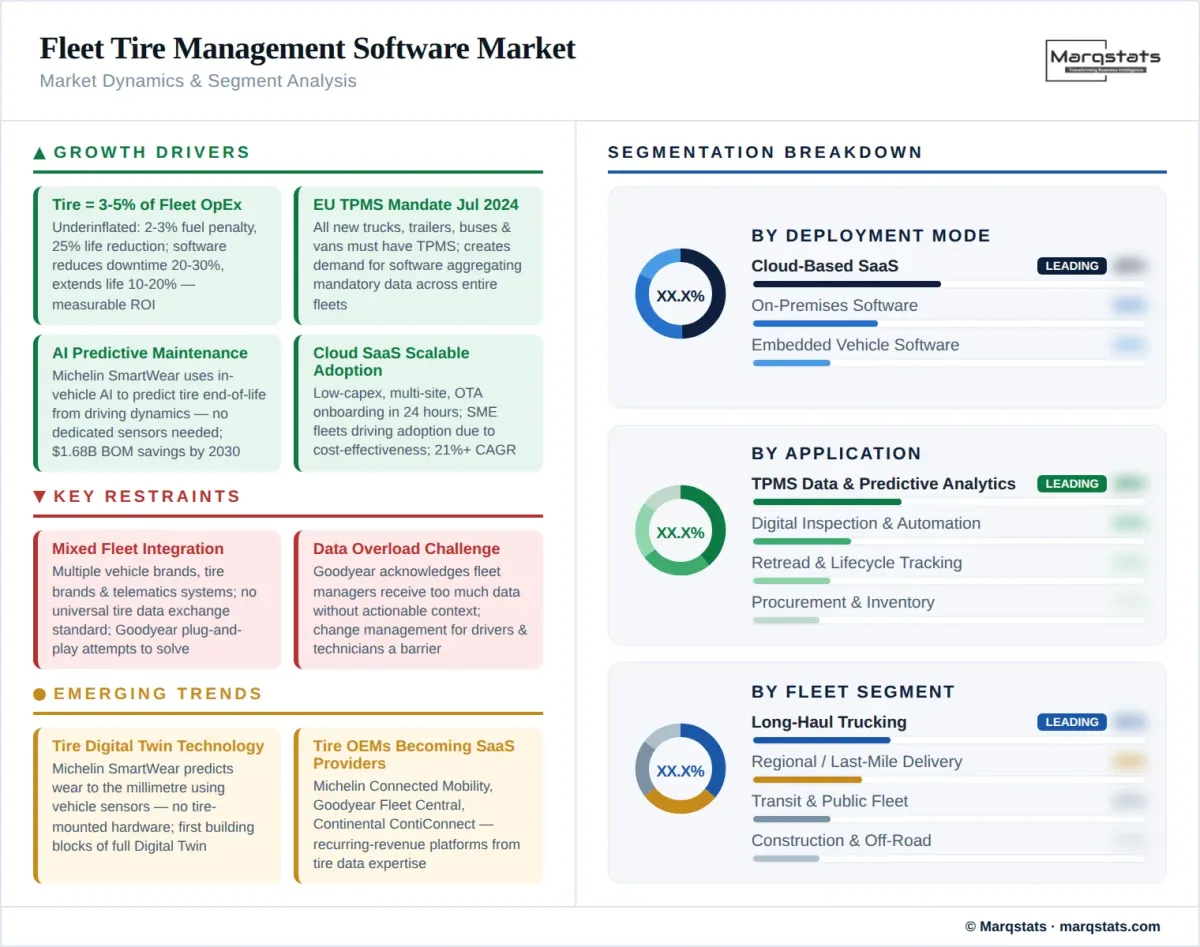
- Fleet tire cost reduction, fuel efficiency, and safety as core value proposition: Tires = 3–5% of fleet OpEx but disproportionate share of unplanned downtime. Underinflated tires: 2–3% fuel penalty, 25% life reduction. Software reduces downtime 20–30%, extends life 10–20%, improves fuel 2–5%. ROI is measurable and compelling for fleet CFOs, making tire software one of the easiest fleet-tech investments to justify.
- EU commercial vehicle TPMS mandate (July 2024) creating regulatory pull: All new trucks, trailers, buses, vans must have TPMS. OEM TPMS typically only alerts drivers, not fleet back-offices. Goodyear TPMS Connect specifically addresses this gap. Creates demand for software that aggregates, analyses, and acts on mandatory TPMS data across entire fleets. Retrofit market for existing vehicles is additional demand.
- AI/ML predictive analytics transforming from reactive to proactive maintenance: Michelin SmartWear uses in-vehicle AI to predict tire end-of-life from driving dynamics—no dedicated sensors needed. Goodyear G-Predict technology analyses TPMS data for predictive alerts. Continental ContiConnect provides automated tread-depth trending. AI enables fleet operators to schedule maintenance proactively, reducing roadside breakdowns and emergency service costs.
- Cloud-based SaaS deployment enabling scalable, low-capex adoption: Cloud segment growing at highest CAGR within fleet software (21%+ projected). SaaS eliminates upfront infrastructure costs. Enables multi-site, multi-country fleet management from a single platform. OTA onboarding (Goodyear: 24 hours). Fleet Central, SightLine, and similar portals provide self-service analytics. Small/medium fleets gaining access to enterprise-grade tire intelligence.
- TPMS IoT sensor proliferation generating unprecedented data volumes: IoT connections in automotive reached 350 million globally in 2024. Connected tires with pressure, temperature, and tread-depth sensors generate continuous data streams. Fleet operators need software to transform this data into actionable insights. Goodyear, Continental, and Michelin all building cloud platforms to aggregate and analyse fleet-wide tire telemetry.
Key Restraints
- Data integration complexity across mixed fleets and telematics providers: Fleets operate mixed vehicle brands, tire brands, and telematics systems. Integrating tire data across OEM TPMS, aftermarket sensors, and multiple software platforms is technically challenging. No universal standard for tire data exchange across all providers. Goodyear’s plug-and-play approach and Bridgestone/Geotab partnership attempt to solve this.
- Fleet operator data overload and change management: Goodyear explicitly acknowledges “data overload”—fleet managers receive too much information without actionable context. Fleet Central and similar platforms attempt to convert raw data into prescriptive actions. But organisational change management—training drivers, technicians, and managers to act on software insights—remains a barrier.
- Cybersecurity and data privacy concerns in connected tire systems: Michelin SmartWear specifically designed for in-vehicle deployment to reduce cloud reliance and protect sensitive data. Pirelli Cyber Tire faced US scrutiny over data privacy. Fleet tire data includes vehicle location, route patterns, and operational metrics that require security.
Key Trends
- Tire digital twins replacing physical sensor hardware: Michelin SmartWear predicts tire wear to the millimetre using existing vehicle sensors—no dedicated tire-mounted hardware. Could save USD 1.68 billion in BOM costs by 2030. Michelin describes SmartWear and SmartLoad as first building blocks of full Tire Digital Twin portfolio for OEMs. This shifts the value from hardware to software algorithms.
- Tire OEMs transforming into mobility-solutions and SaaS providers: Michelin Connected Mobility, Bridgestone Mobility Solutions, Goodyear Fleet Central/SightLine, Continental ContiConnect—all are recurring-revenue software/service platforms. Tire companies are building SaaS businesses around their tire data expertise. This creates a new competitive dynamic where tire manufacturers compete with pure-play fleet software providers.
- Yokohama AI smartphone sound analysis and low-cost diagnostic tools: Yokohama developed AI tire pressure assessment using smartphone sound analysis (2025)—potentially democratising tire diagnostics without dedicated hardware. Goodyear Tire Optix digital inspection tools enable instantaneous tire data capture. CheckPoint drive-over-reader provides automated inspection at depot entry/exit. These tools feed data into fleet management platforms.
- Pirelli Cyber Tire and 5G/V2X integration for connected fleet ecosystems: Pirelli’s Cyber Tire uses embedded sensors transmitting real-time data via 5G to V2X infrastructure. This enables fleet management systems to receive tire data not just from the vehicle but from road infrastructure. Represents the most advanced vision of connected tire fleet management but faces US data-privacy scrutiny.
Market Segmentation
The fastest-growing segment. Goodyear Fleet Central, SightLine cloud analytics, TPMS Connect cloud. Michelin Connected Mobility cloud platform. Bridgestone/Geotab telematics cloud integration. Scalable, low-capex, multi-site. OTA onboarding. Projected to grow at 21%+ CAGR. SME fleets driving adoption due to cost-effectiveness.
Preferred by large enterprises with strict data governance. Tighter integration with existing fleet IT infrastructure. Higher upfront cost but full data control. Still holds significant market share (~41% in broader fleet software) but declining relative to cloud as security concerns ease.
Emerging segment. Michelin SmartWear integrated into BlackBerry QNX Cabin platform. Runs in-vehicle on ECUs without cloud dependency. Protects sensitive data. Sonatus AI Director enables secure deployment across diverse ECUs. Represents the future of OEM-integrated tire intelligence.
Core application. Continental ContiConnect (pressure, temperature, tread depth). Goodyear TPMS Connect + G-Predict. Michelin SmartWear/SmartLoad AI algorithms. Transforms raw sensor data into predictive maintenance alerts. Reduces unplanned downtime 20–30%. EU TPMS mandate drives adoption.
Goodyear Tire Optix (digital inspection), CheckPoint (drive-over-reader automated pressure + tread). Yokohama AI smartphone sound analysis. These tools replace manual inspection and feed data directly into fleet management platforms for trend analysis and lifecycle tracking.
Goodyear Fleet Central online portal for tire purchasing, service activation, and programme insight. Cost-per-kilometre tracking. Tyre inventory optimisation. Budget forecasting. Connecting tire performance data with procurement decisions to optimise total cost of ownership.
Tracking tire history from production through service life to retreading and end-of-life. Integrates with RFID tire tags for identity continuity. Supports ESPR/DPP compliance for commercial tires. Fleet operators increasingly required to demonstrate tire circularity and responsible disposal.
By Geography
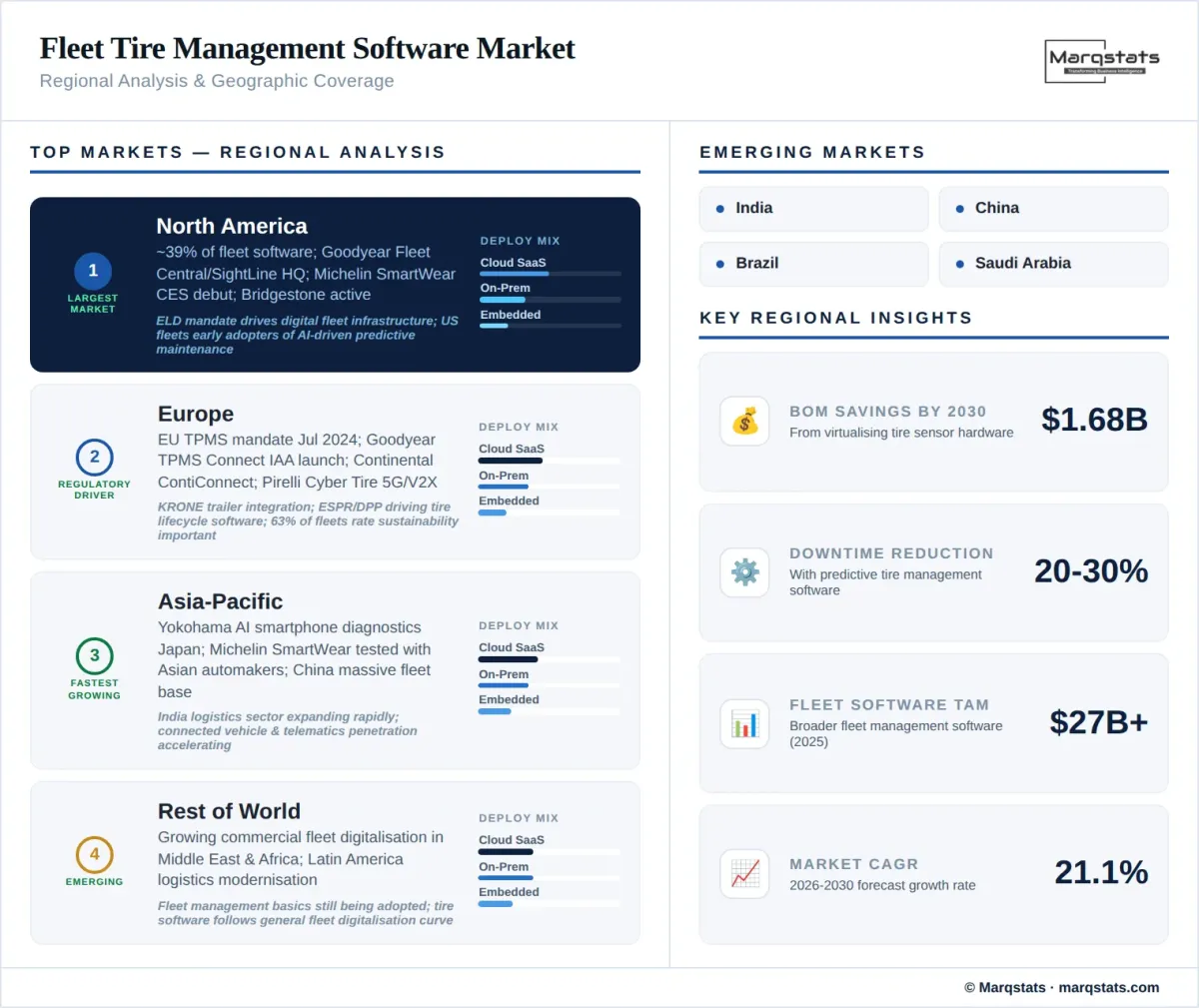
North America
Largest market (~39% of broader fleet software). Goodyear headquarters and primary platform development (Fleet Central, SightLine, TPMS Plus, CheckPoint, Tire Optix). Michelin SmartWear debuted at CES 2026 in Las Vegas with Sonatus. Bridgestone Mobility Solutions active. Samsara, Geotab, Verizon Connect, Omnitracs in broader fleet software. ELD mandate drives digital fleet infrastructure that tire software integrates into. US fleets are early adopters of AI-driven predictive maintenance.
Europe
Strongest regulatory driver: EU TPMS mandate (July 2024) for all new commercial vehicles. Goodyear TPMS Connect launched at IAA Transportation 2024 in Hanover. KRONE Trailer partnership for seamless TPMS Connect integration. Continental ContiConnect developed in Germany. Pirelli Cyber Tire 5G/V2X from Italy. Michelin Connected Mobility from France. ESPR/DPP requirements will drive tire lifecycle software for compliance. 63% of European fleets rate sustainability as important (93% of mega-fleets).
Asia-Pacific
Fastest-growing region. Yokohama (Japan) AI smartphone tire pressure analysis (2025). Michelin SmartWear tested with automakers in Asia. China’s massive commercial fleet driving local software adoption. India’s logistics sector expanding rapidly. Connected vehicle penetration and telematics adoption accelerating across the region.
Rest of World
Growing through global fleet operators expanding digital management to emerging markets. Middle East and Africa logistics corridors. Latin America trucking fleets. Goodyear and Bridgestone have global fleet service networks that increasingly include software-based tire management.
How Competition Is Evolving
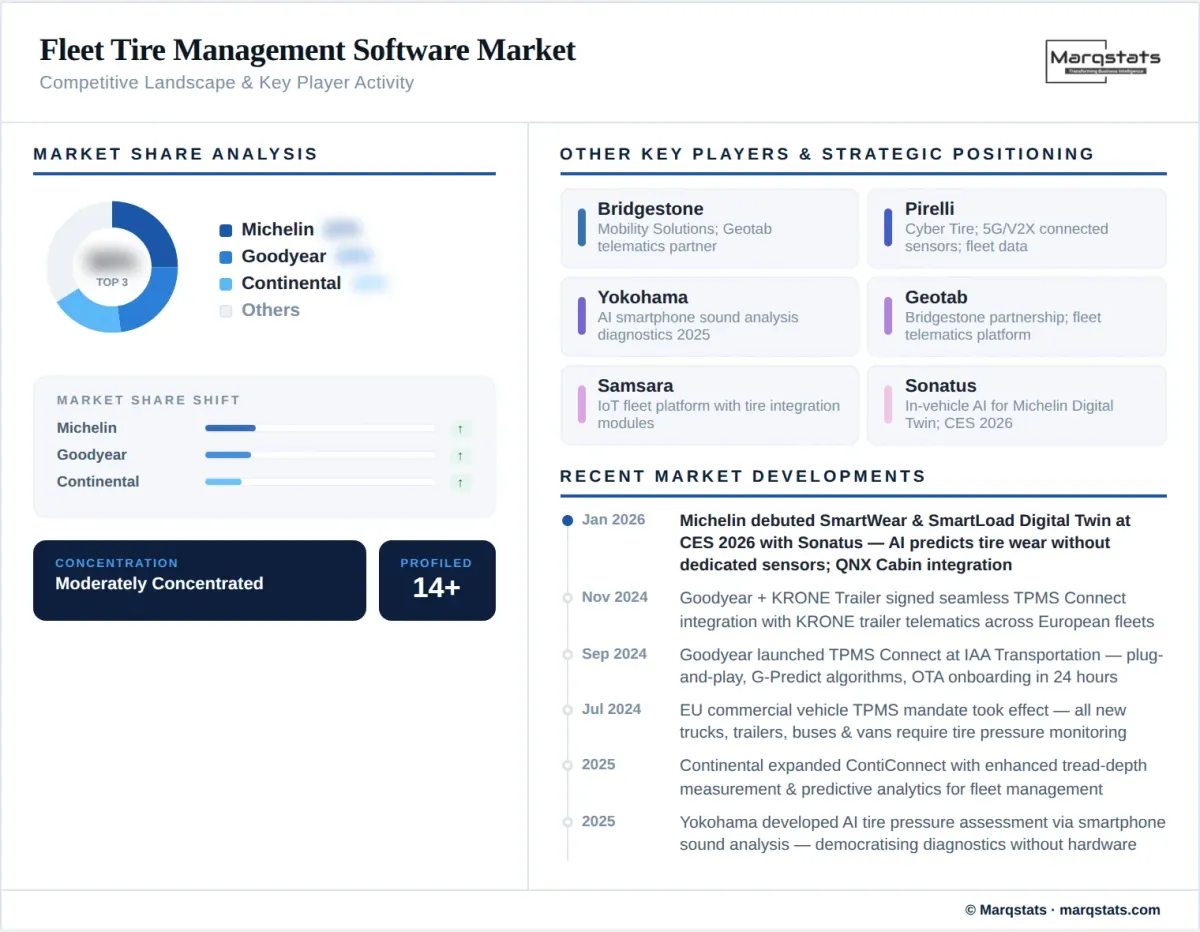
The competitive landscape has three layers. Tire-OEM software platforms dominate with proprietary data advantages: Michelin (Connected Mobility, SmartWear/SmartLoad Tire Digital Twin, Sonatus partnership, QNX integration), Goodyear (TPMS Connect, SightLine, Tire Optix, Fleet Central, CheckPoint, G-Predict, KRONE partnership), Continental (ContiConnect automated sensor platform, tread depth measurement, digital fleet stack), Bridgestone (Mobility Solutions, Geotab telematics partnership), and Pirelli (Cyber Tire 5G/V2X connected fleet sensors).
Telematics and fleet management platform providers offer tire management as a feature within broader solutions: Geotab (Bridgestone partnership, fleet-wide telematics), Samsara (IoT fleet platform), Verizon Connect, Omnitracs, Fleet Complete, Teletrac Navman. These providers integrate tire TPMS data alongside vehicle tracking, driver behaviour, fuel management, and compliance. Their advantage is breadth; tire OEMs’ advantage is depth of tire-specific intelligence.
Emerging technology innovators are disrupting traditional approaches: Sonatus (in-vehicle AI orchestration for Michelin Digital Twin), Yokohama (AI smartphone sound analysis for tire diagnostics), and Gatik (Goodyear autonomous fleet tire intelligence partnership). The market is evolving toward AI-driven, sensor-virtualised, cloud-native platforms that replace legacy hardware-dependent monitoring.
Companies Covered
The report profiles 15+ companies with full strategy and financials analysis, including:
Recent Market Activity
Table of Contents
Coverage & Segmentation
This report covers the global fleet tire management software market 2021–2025 (historical) and 2026–2030 (forecast), base year 2025. Market size in USD across deployment mode (cloud SaaS, on-premises, embedded vehicle), application (TPMS analytics, digital inspection, cost/procurement, lifecycle management), fleet type (truck, bus, commercial LCV, passenger fleet), and geography (15 countries). 15+ company profiles. Regulatory analysis of EU TPMS mandate, ELD requirements, ESPR/DPP tire compliance.
Bottom-up from fleet software subscription pricing, connected vehicle penetration (350M IoT automotive connections), TPMS mandate compliance rates, tire OEM platform adoption disclosures, telematics integration partnerships, and fleet operator digital-maturity surveys. Primary research: 40+ interactions with tire OEM digital/mobility directors, fleet management software providers, telematics companies, fleet operators, and tire service network managers across North America, Europe, and Asia-Pacific.