Market Snapshot
Key Takeaways
Market Overview & Analysis
Report Summary
Spain's connected car market is measured on the value of embedded telematics hardware, cellular connectivity infrastructure and post-sale software services sold against the country's operating vehicle fleet. The market is worth USD 1558.40 million in 2025, and the figure in general circulation for 'connected vehicles' in Spain is frequently read as an embedded-telematics number when a large and fast-growing share of it is, by statute, a beacon number instead.
Structurally, this is a two-track market: new vehicles arrive fully connected because EU regulation requires it, while the ageing operating fleet is being connected retroactively by a domestic beacon mandate that has nothing to do with the vehicle's own electronics. Those two tracks carry completely different revenue profiles, and a model that treats them as one connectivity number will systematically misprice the market.
The analysis is built for four reader types making different decisions: a telecommunications operator deciding whether managing millions of low-revenue, 12-year prepaid IoT beacon connections is worth the network commitment, an automotive OEM pricing a subscription suite against a Spanish consumer base that cancels at above 70% once free trials end, a fleet-safety hardware manufacturer planning capacity around a statutory deadline that has already taken effect, and an investor assessing how durable the beacon mandate's enforcement actually is now that a political challenge to it has failed.
Spain Connected Car Market Size and Forecast
Marqstats builds the Spain figure across three layers. Embedded hardware and V-16 beacon device value is anchored on registration and fleet-census data from ANFAC and Ideauto; connectivity revenue is priced off M2M cellular tariffs and the 12-year prepaid connectivity bundled into every certified V-16 beacon; and software and subscription revenue is estimated from OEM programme pricing such as SEAT's Connect Plus suite and enterprise fleet-management platform fees.
The active connected-endpoint series is primary, following directly from the confirmed 2026 beacon mandate and ANFAC's registration data; the value series is derived from it. Active connected endpoints rise from 8,820,000 in 2025 to 20,100,000 in 2030, a 17.91% CAGR, outpacing market value's 12.51% CAGR to USD 2809.20 million, because millions of new beacon endpoints carry far lower average revenue than an embedded OEM telematics subscription.
The gap between the endpoint growth rate and the value growth rate is not a modelling inconsistency — it is the market's defining mechanic. A vehicle that gains a V-16 beacon becomes a connected endpoint for statistical and safety purposes without becoming an OEM software customer, so the beacon mandate expands the market's reach far faster than it expands the market's revenue base.
Spain's Oldest Cars Are Getting Connected by Regulation, Not by Replacement
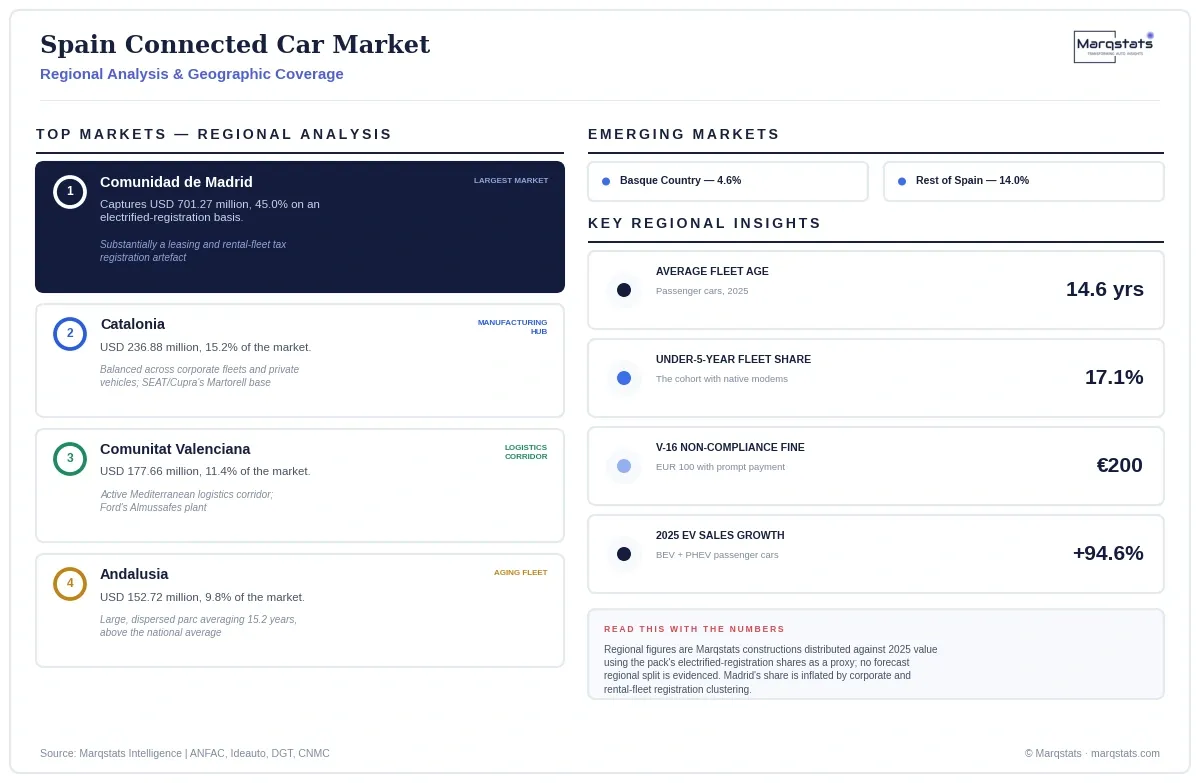
A 14.6-year average fleet age would, in most markets, cap connectivity growth at the pace of vehicle replacement — roughly 17.1% of Spain's passenger fleet is under five years old, the cohort with native embedded modems, and 33.0% is over fifteen. Left to organic replacement alone, GANVAM's own projections put native embedded factory telematics at only 35% of the parc by 2027 and 40% by 2030.
Real Decreto 159/2021, as amended by Real Decreto 1030/2022, broke that ceiling by regulating the roadside hazard triangle out of existence rather than regulating the vehicle. Every car, van and bus operating on Spanish interurban roads must now carry a certified V-16 beacon with its own GNSS module and NB-IoT or LTE-M transceiver — a connected endpoint bolted onto the vehicle rather than built into it, extending statutory telemetry coverage to cars that will never receive an OEM software update.Does Spain's 20 million 'connected vehicles' number include the V-16 beacon fleet?.
The Mandate's Biggest Political Risk Has Already Failed
Every regulatory mandate carries enforcement risk, and this one faced a direct legislative challenge within months of taking effect. The Vox parliamentary group filed an amendment in April 2026 that would have made the V-16 beacon optional and restored legal validity to reflective warning triangles alongside it, effectively unwinding the connectivity mandate this market's upside case depends on.
The amendment has not passed. The DGT has publicly reaffirmed the mandate through a full summer of enforcement, and director-general Pere Navarro described the policy as having "come to stay." The EUR 200 fine (EUR 100 with payment inside 20 days) remains active. That resolution matters more than it might appear: it is the single trigger condition separating this pack's own Baseline scenario from its Downside case, and it has now resolved in the Baseline's favour.
Market Dynamics
Key Drivers
Five conditions are moving this market, and a now-settled regulatory mandate matters more than new-car demand.
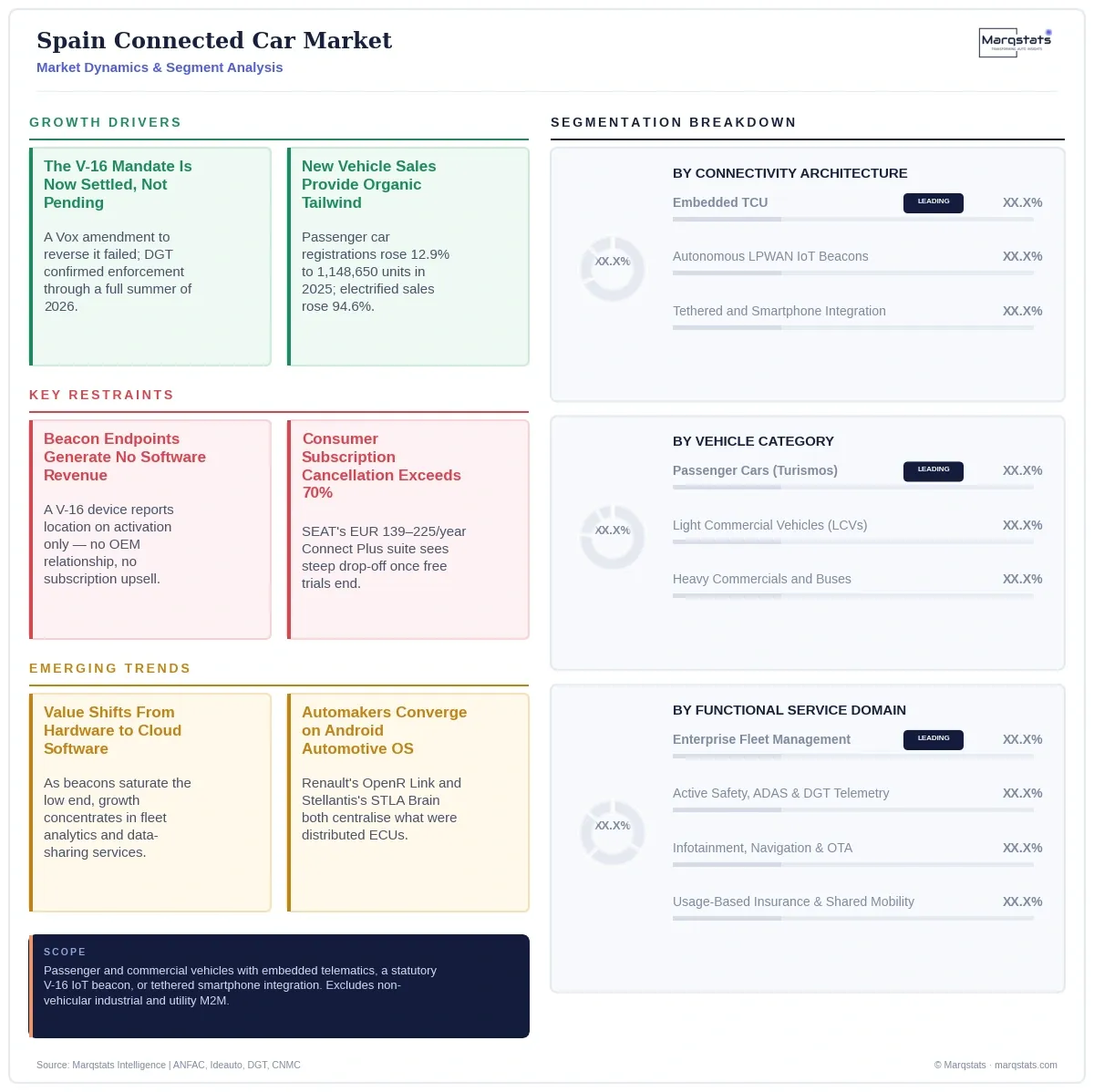
- The V-16 beacon mandate is now a settled fact, not a pending risk. With the political challenge to it defeated and enforcement confirmed through a full summer, connected endpoint growth tied to the mandate is no longer contingent on a regulatory outcome that has already been decided.
- New vehicle sales are providing real organic tailwind independent of any mandate. Passenger car registrations rose 12.9% to 1,148,650 units in 2025, and electrified passenger car sales rose 94.6% to 225,616 units, adding fully connected, high-value vehicles to the parc at the fastest rate in five years.
- The EU Data Act (Regulation (EU) 2023/2854), in full application from January 2025, is opening commercial data-sharing opportunities that did not previously exist. By requiring OEMs to grant independent repairers and third-party mobility operators direct access to vehicle telemetry, it creates a new addressable market for services built on data manufacturers previously kept proprietary.
- Spain's domestic manufacturing base gives connectivity investment a reason to stay onshore. As Europe's second-largest vehicle producer behind Germany, with 2,274,026 units built in 2025 across 16 assembly plants, SEAT, Stellantis, Renault, Ford and Mercedes-Benz are each deploying software-defined vehicle architectures domestically rather than importing connectivity as an afterthought.
- MasOrange's consolidation of Orange España and MásMóvil, approved in March 2024, created a telecommunications operator with the national 5G and cellular IoT scale to compete directly with Telefónica and Vodafone for automotive M2M contracts, adding a third credible infrastructure bidder to a market that previously leaned on two.
Key Restraints
Four constraints stand between the market and a fully converted value base.
- The vehicles the beacon mandate connects are not the vehicles that generate software revenue. A V-16 endpoint reports location on activation once every 100 seconds to the DGT 3.0 platform; it carries no OEM relationship, no subscription upsell path and no data-monetisation opportunity beyond the safety function it was built for.
- Consumer subscription economics remain weak across every OEM programme with published pricing. SEAT's Connect Plus suite runs EUR 139 to EUR 225 a year after an initial promotional bundle, and cancellation rates on comparable packages exceed 70% once that period ends — a pattern consistent enough across brands that it appears to be a market-wide price ceiling, not a brand-specific pricing failure.
Telecommunications operators face a structurally low-margin, long-duration commitment on beacon connectivity. Certified V-16 devices bundle a minimum of 12 years of prepaid network access into the retail price, meaning operators such as Telefónica Tech must sustain NB-IoT and LTE-M network support for over a decade per device with no recurring revenue stream attached to it at all.Which V-16 beacon should you actually buy now that the mandate is enforced?
- The 2G and 3G sunset, planned by 2030, creates a retrofit problem for the earliest-generation eCall systems installed between 2018 and 2020 that rely on circuit-switched connections. Vehicles fitted with those systems will need a modem retrofit or lose statutory eCall functionality entirely as legacy networks are decommissioned.
Key Trends
Four shifts show where the market is heading and who captures the value.
- Value creation is shifting from hardware toward cloud software and fleet data analytics. As the beacon mandate saturates the low end of the market with basic connected endpoints, the industry's growth increasingly concentrates in commercial fleet platforms, dynamic routing and data-sharing services enabled by the EU Data Act rather than in first-time hardware installation.
- Automakers are converging on Android Automotive OS and centralised compute architectures rather than maintaining proprietary infotainment stacks independently. Renault's OpenR Link runs natively on Google's platform, while Stellantis's STLA Brain and SEAT's Cariad-based architecture both consolidate what were previously distributed electronic control units into single domain controllers.
- Usage-based insurance is moving from a niche product toward a mainstream underwriting input. Mapfre, Mutua Madrileña and Línea Directa are all building driving-telemetry risk profiles, supported by corporate carsharing operations such as Stellantis's Free2move, which alone manages thousands of actively connected vehicles across Madrid.
- Telecommunications infrastructure is being tested for cross-border connected-corridor operation ahead of any commercial mandate. The 5G-CARMEN and 5G-MOBIX testbeds are validating low-latency C-V2X handovers along the Vigo-Porto Atlantic corridor and the Catalonia-Southern France Mediterranean corridor, positioning Spain inside Europe's cooperative-driving infrastructure ahead of most peers.
Strategic Implications
- Automotive OEMs should stop pricing baseline convenience features behind a paywall once a promotional period ends. Spanish consumers have shown, consistently across brands, that they treat features like remote climate control and standard navigation as expected rather than premium, and subscription cancellation rates above 70% confirm the current pricing model is not converting trial users into payers.
- Telecommunications operators should treat V-16 beacon connectivity as a network-scale commitment to manage efficiently, not a revenue line to grow. The commercial opportunity sits in 5G Standalone network slicing for automated logistics and cooperative C-V2X corridors, where operators can capture premium pricing that basic 12-year prepaid IoT connections structurally cannot offer.
- Safety-hardware manufacturers should plan for a demand cliff, not a plateau, now that the mandate's initial fitting wave has passed its compliance deadline. Suppliers such as Netun Solutions and Erum Vial face a transition from high-volume V-16 production ahead of the 2026 deadline toward a smaller, steadier maintenance and battery-replacement business.
- Investors should treat the V-16 mandate's confirmed enforcement as a materially de-risked assumption rather than a pending variable. With the Vox amendment defeated and the DGT publicly committed to the policy, the market's Baseline scenario — not its Downside case — is the trajectory the evidence currently supports.
Market Segmentation
The largest architecture segment at USD 1065.95 million in 2025, 68.4% of market value. Factory-installed eSIM modules with direct CAN or Ethernet bus connections and multi-band 4G/5G antennas provide the throughput needed for over-the-air updates, automated collision reporting and advanced driver-assistance processing.
USD 288.30 million in 2025, 18.5% of value — a segment that exists in this proportion because of Spain's V-16 beacon mandate specifically. These self-powered, NB-IoT/LTE-M-connected devices operate independently of the vehicle's own electronics, transmitting emergency location data directly to the DGT 3.0 cloud.
USD 204.15 million in 2025, 13.1% of value. Apple CarPlay, Android Auto and direct USB or Wi-Fi mirroring serve as the lower-cost connectivity option on budget vehicle models, relying on the consumer's own device rather than embedded hardware.
USD 1196.85 million in 2025, 76.8% of value, reflecting 1,148,650 new registrations in 2025 and the largest base of any vehicle category by a wide margin.
USD 235.32 million in 2025, 15.1% of value, driven by urban delivery networks supporting e-commerce logistics in Madrid, Barcelona, Valencia and Seville, where fleet managers deploy subscription telematics to control operational costs.
USD 126.23 million in 2025, 8.1% of value — the smallest category by value but the highest telematics spend per vehicle, driven by EU Smart Tachograph Gen 2 compliance and the commercial value of predictive maintenance on long-distance transport fleets.
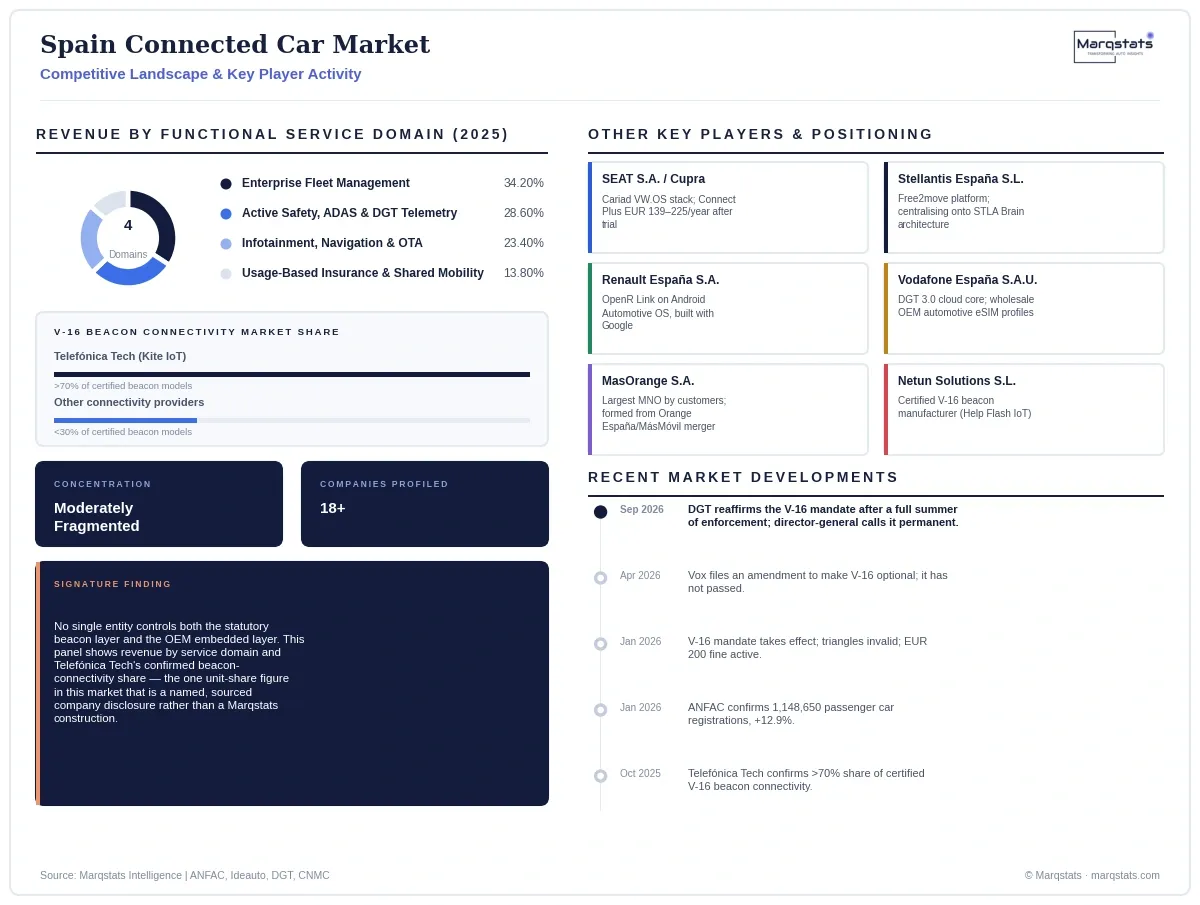
The largest service domain at USD 532.97 million in 2025, 34.2% of value. Corporate transport operators generate predictable monthly recurring revenue by prioritising fuel reduction, vehicle tracking and statutory labour-compliance monitoring.
USD 445.70 million in 2025, 28.6% of value, supported directly by GSR II compliance requirements and real-time integration with the DGT 3.0 national platform.
USD 364.67 million in 2025, 23.4% of value, as manufacturers shift from one-off option pricing toward ongoing digital service packages and feature-on-demand activation.
The smallest domain at USD 215.06 million in 2025, 13.8% of value. Domestic insurers including Mapfre, Mutua Madrileña and Línea Directa use driving telemetry for underwriting, supported by carsharing operations such as Stellantis's Free2move.
By Geography
Comunidad de Madrid
Captures USD 701.27 million, 45.0% of national connected-vehicle activity on an electrified-registration basis — the largest regional concentration by a wide margin, and substantially an administrative artefact. Spain's long-term leasing and short-term rental companies register vehicle inventories centrally in Madrid for streamlined tax and administrative processing, then deploy those vehicles nationwide, including seasonal tourism demand along the Mediterranean coast.
Catalonia
USD 236.88 million, 15.2% — high adoption balanced across corporate fleets and private connected vehicles, anchored by SEAT and Cupra's Martorell manufacturing complex.
Comunitat Valenciana
USD 177.66 million, 11.4% — moderate-to-high adoption along an active Mediterranean logistics and transport corridor, with Ford España's Almussafes assembly plant anchoring the province's industrial base.
Andalusia
USD 152.72 million, 9.8% — moderate adoption across a large, dispersed vehicle parc averaging 15.2 years old, older than the national average and reliant on rural and secondary routes where the V-16 mandate's coverage matters most.
Basque Country
USD 71.69 million, 4.6% — moderate adoption supported by advanced regional industrial and public transport telemetry infrastructure.
Rest of Spain
USD 218.18 million, 14.0% combined across Castilla y León, Extremadura and the remaining ten autonomous communities. This is where Spain's aging-fleet problem concentrates hardest: Castilla y León's passenger car parc averages 16.9 years and Extremadura's 16.6 years, both well above the 14.6-year national average, and both regions depend on the V-16 mandate rather than organic embedded telematics for any baseline connectivity at all.
How Competition Is Evolving
Competition runs on three separate axes that barely intersect. On the statutory beacon side, Telefónica Tech holds a commanding position, providing cellular IoT connectivity for more than 70% of DGT-certified V-16 beacon models through its Kite IoT platform, while device manufacturers including Netun Solutions and Erum Vial compete on hardware certification and retail distribution. On the DGT 3.0 infrastructure side, a single consortium of Vodafone España, Pons Mobility, Kapsch TrafficCom and Inspide holds the entire national platform contract, with no competing bid process expected before the current deployment cycle ends.
On the OEM consumer side, competition runs on subscription architecture and software platform choice rather than hardware specification, since embedded connectivity is now a universal baseline under EU regulation. SEAT and Cupra run Volkswagen Group's Cariad stack, Renault has adopted Google's Android Automotive OS outright through OpenR Link, and Stellantis is centralising its brands onto a single STLA Brain architecture — three fundamentally different bets on who should own the software relationship with the driver.
Structurally, no single entity controls both the statutory beacon layer and the OEM embedded layer, which means the two halves of this market will likely continue evolving on separate commercial logic: beacon connectivity as a low-margin, long-duration public-safety utility, and OEM connectivity as a consumer software business still searching for a subscription price point Spanish buyers will actually pay.Who controls Spain's two separate connected car markets?
Companies Covered
The report profiles 18+ companies with full strategy and financials analysis, including:
Recent Market Activity
Table of Contents
Coverage & Segmentation
This report measures passenger cars, light commercial vehicles and heavy commercial vehicles and buses operating in Spain that carry embedded factory telematics, a statutory V-16 IoT hazard beacon, or tethered smartphone integration, across a 2025 base year and a 2026 to 2030 forecast period, denominated in United States dollars at a constant EUR 1.00 = USD 1.0812 exchange rate. The source evidence base carries a granular year-by-year series from 2023 forward; 2021 and 2022 figures are referenced qualitatively rather than as point values. The analysis excludes non-vehicular industrial and utility M2M connections.
The analysis spans three segmentation dimensions — connectivity architecture, vehicle category and functional service domain — six regional geographies, and 18 profiled entities across regulators, telecommunications operators, automotive manufacturers and safety-hardware suppliers. New-vehicle registration and fleet-census figures are primary, sourced directly from ANFAC and Ideauto; market value, the active connected-endpoint count and segment-value splits are Marqstats constructions.