Market Snapshot
Key Takeaways
Market Overview & Analysis
Report Summary
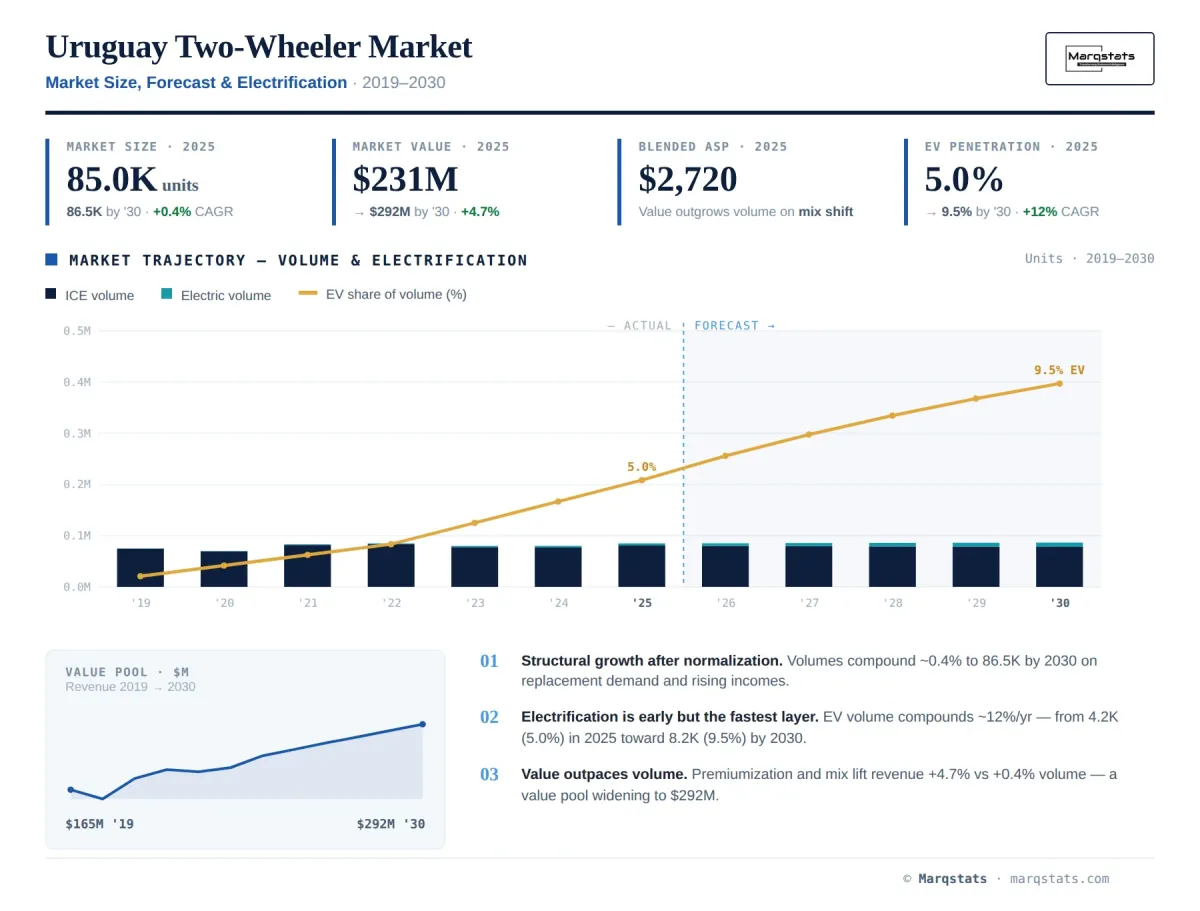
The Uruguay two-wheeler market is a small, mature, value-led market. It generated USD 231.2 million in revenue in 2025 on about 85,000 units, and unit demand is broadly flat over the forecast period, so growth is driven by pricing, premiumisation, and product mix rather than volume expansion. Motorcycles are an established part of daily life, with a parc of around 430,000 that equals close to a third of all registered vehicles, underlining how central two-wheelers are to mobility in the country.
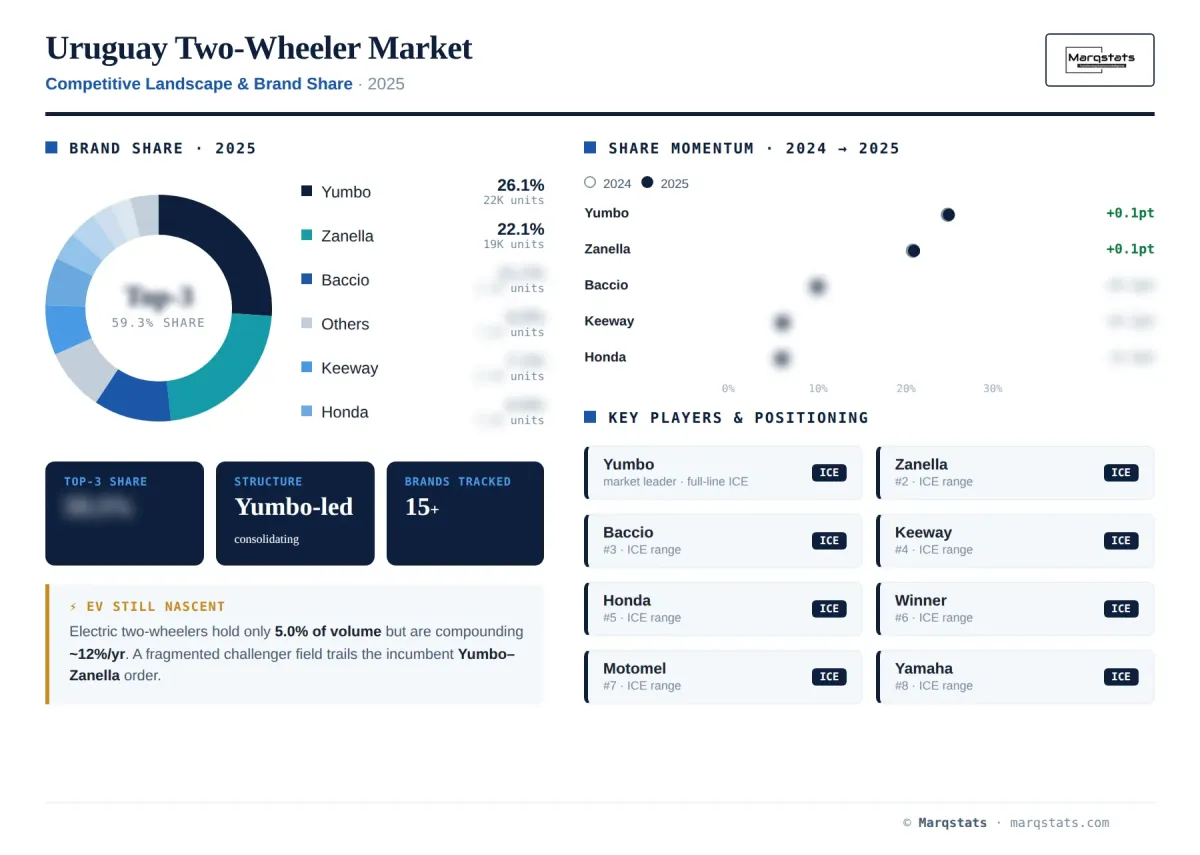
The market is led by local and regional brand names rather than by the global Japanese majors that dominate wealthier markets. Yumbo, a Uruguayan brand, holds the foremost position at about 26% of revenue, followed by the Argentine brand Zanella at roughly 22% and Uruguayan brand Baccio at about 11%. Chinese-owned Keeway and Japanese Honda, Yamaha, and Suzuki follow. Although the brand names are largely local and regional, the product is predominantly first-price, low-displacement machines of Chinese origin, so the market combines domestic branding with Chinese manufacturing.
New-motorcycle registrations are tracked through the national vehicle-registration system, and demand now runs nearly level with new passenger cars in unit terms, a scale confirmed by the national automotive-commerce association. Motorcycles are valued for low purchase and maintenance costs, for the time they save in Montevideo traffic, and as a first vehicle marking economic independence for younger buyers, while remaining a preferred transport option across the interior.
The scale of two-wheeler ownership relative to the national fleet sets Uruguay apart. With a parc of around 430,000 machines against a population of roughly 3.4 million, motorcycle penetration is high, and new-motorcycle registrations run at close to the level of new passenger cars each year. This mature base means the market functions more like a replacement and upgrade market than a rapidly expanding one, with buyers cycling through entry machines and a minority trading up into higher-displacement or premium models over time.
Imports underpin supply. More than twenty importers bring in around thirty brands, with the large majority of units originating in China and smaller volumes from India, Austria, and elsewhere. Local and regional brand names sit on top of this predominantly Chinese-sourced supply base, and a concentrated group of importers operates the nationwide distribution and financing networks that sustain sales across the capital region and the interior.
Market Dynamics
Key Drivers
- Low purchase and running costs anchor demand, with first-price, low-displacement machines keeping two-wheelers within reach of most buyers.
- High existing penetration sustains steady replacement and upgrade demand, with a motorcycle parc of around 430,000.
- Motorcycles save time in Montevideo congestion and remain a preferred transport option across the interior of the country.
- Two-wheelers serve as a first vehicle and a work tool, supporting delivery, small-business, and independence-driven demand.
Key Restraints
- Flat unit demand limits volume growth, concentrating expansion in value and product mix rather than in rising sales.
- A small national population caps absolute market size relative to larger regional markets.
- Reliance on imported machines exposes the market to currency, freight, and supply-chain fluctuations.
- Road-safety attention accompanies high motorcycle use, prompting regulation that can affect ownership costs.
Key Trends
- Value and mix lead growth, with premium and higher-displacement machines expanding faster than the flat overall volume.
- Electric two-wheelers grow fastest at a 16.81% CAGR from a small base, supported by a largely renewable electricity grid.
- Online retail expands fastest among channels at a 10.63% CAGR, though physical dealers still handle most value.
- Regional brand names consolidate their lead while sourcing predominantly Chinese-origin machines.
Market Segmentation
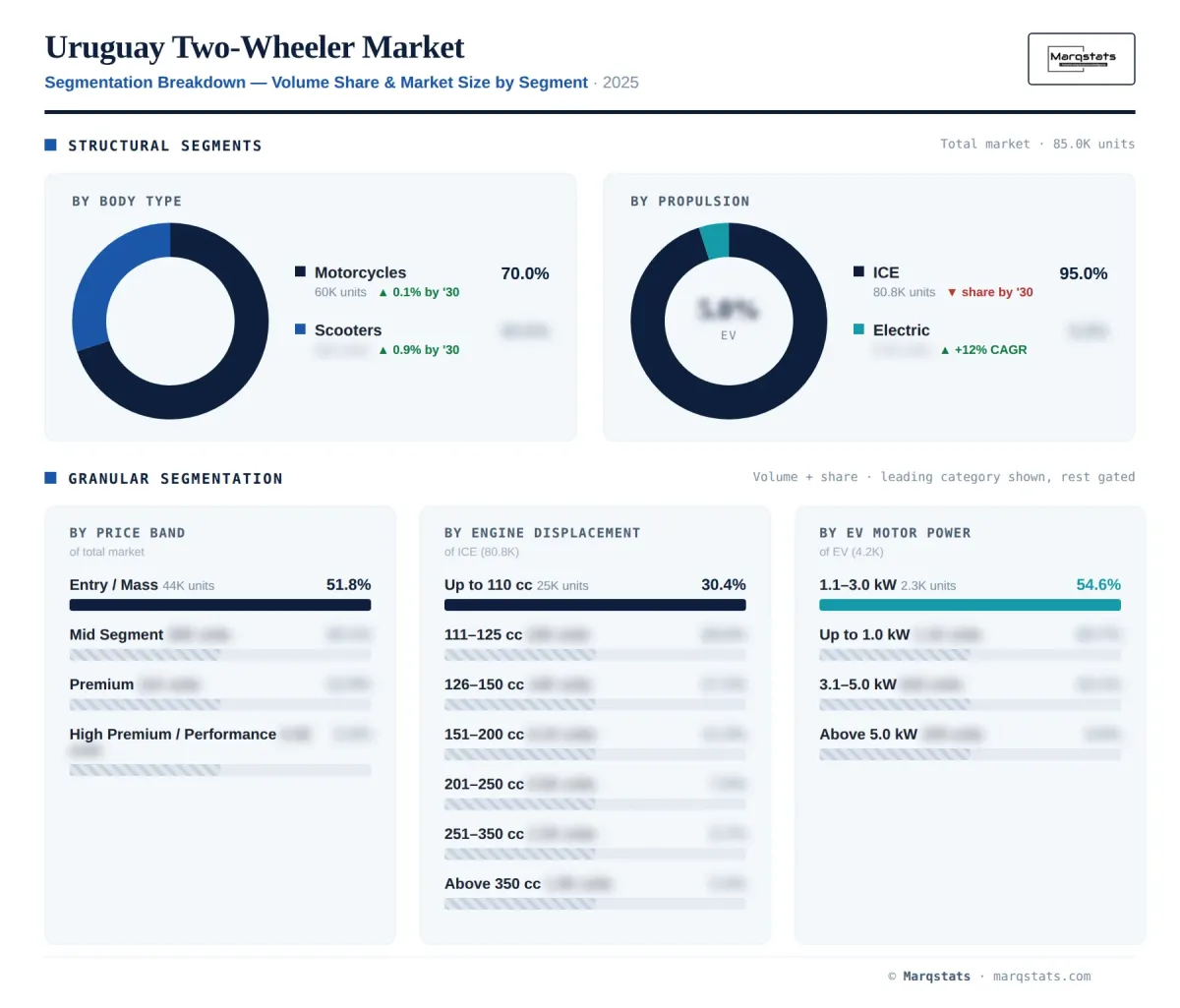
Motorcycles form the dominant vehicle-type segment, generating USD 161.8 million in 2025, about 70% of market revenue, and rising to USD 202.2 million by 2030 at a 4.43% CAGR. The segment is built on affordable commuter and utility machines that serve personal transport, delivery, and small-business use. Local and regional brand names supply most of this segment, with the bulk of units being first-price, low-displacement models of Chinese origin, while Japanese brands hold positions in the mid and upper tiers.
Scooters and mopeds generated USD 69.4 million in 2025, about 30% of revenue, and grow to USD 90.1 million by 2030 at a 5.22% CAGR, the faster-growing vehicle type. The segment serves urban commuting in Montevideo and the larger towns, where light, automatic two-wheelers handle short trips and last-mile movement. Scooter growth outpaces motorcycles in percentage terms as urban buyers and delivery riders adopt easy-to-ride models, though motorcycles remain the larger segment by both value and volume.
The balance between the two vehicle types reflects Uruguay mix of utility and urban convenience. Motorcycles dominate because they suit work use, interior roads, and the price sensitivity of the mass market, while scooters and mopeds hold a meaningful and growing share in the capital. Both segments rest on affordable, mostly Chinese-origin machines carrying local and regional brand names, which keep entry prices low and support steady demand across the country.
Internal combustion engine models dominate the Uruguay two-wheeler market, generating USD 219.6 million in 2025, about 95% of revenue, and growing to USD 264.5 million by 2030 at a 3.71% CAGR. Combustion demand is anchored in affordable, low-displacement commuter and work motorcycles suited to the market price sensitivity. The combustion share edges down over the forecast period as electric models gain ground in the urban segment, yet it remains the overwhelming majority of demand throughout. The affordability and established service base of combustion machines, together with a nationwide fuel and repair network, keep them the default choice for most buyers across the capital and the interior.
Electric is the fastest-growing propulsion category, expanding from USD 11.6 million in 2025 to USD 27.9 million by 2030 at a 16.81% CAGR. Uruguay largely renewable electricity grid supports the case for electrification, and electric demand mirrors the momentum visible in other electric two-wheeler markets tracked by Marqstats. Electric revenue rises from a small base, with light urban machines driving adoption and the higher-power bands expanding fastest, though the segment remains a modest share of the market through the forecast period.
Within combustion models, entry displacements dominate. The up-to-110 cc band is the largest tier by revenue at USD 66.7 million in 2025, followed closely by the 111 to 125 cc band at USD 62.8 million; together these entry classes represent close to 59% of combustion revenue, consistent with a market centred on affordable commuter and work motorcycles. The 126 to 150 cc band adds USD 37.7 million, while larger displacements above 250 cc remain small, reflecting a limited high-displacement segment estimated at only a few hundred units a year. This concentration in the smallest classes is a direct consequence of the market first-price character, where affordability and low running costs outweigh performance in the majority of purchases, and it means the entry classes will continue to define the volume base well beyond 2030.
Within electric models, demand is led by the 1.1 to 3.0 kW band at USD 6.3 million in 2025, followed by the up-to-1.0 kW band at USD 3.0 million, together covering the light urban machines that account for most electric adoption. The higher-power bands are smaller yet expand fastest, with the above-5.0 kW band growing at a 26.28% CAGR as more capable electric machines enter the range. The electric motor-power mix will broaden gradually as new urban models arrive, though low-displacement combustion machines continue to define the volume base.
The entry and mass price band dominates the market, generating USD 119.7 million in 2025, about 52% of revenue, followed by the mid segment at USD 69.6 million; together the two lower tiers account for roughly 82% of the market, underscoring its affordability-driven character. The premium and high-premium bands are smaller yet grow faster, at 5.61% and 7.80% CAGR respectively, as a segment of buyers trades up. The high-premium and performance band, at USD 12.0 million in 2025, is the fastest-expanding price tier and reflects the value-led character of the market growth. As unit demand stays broadly flat, this gradual shift toward higher price bands is the main engine of revenue growth, with a segment of buyers moving up from first-price entry machines into better-equipped models over the forecast period.
The B2C segment overwhelmingly dominates the Uruguay two-wheeler market, generating USD 210.1 million in 2025, about 91% of revenue, and growing at a 4.55% CAGR, reflecting widespread personal ownership. Commercial demand is smaller yet faster-growing: the B2B and fleet segment reached USD 21.1 million and the delivery and logistics segment USD 15.6 million in 2025, expanding at 5.90% and 6.20% CAGR respectively, as motorcycles serve as work vehicles. Government and institutional demand added USD 4.6 million, and ride-hail, rental, and tourism demand remained small at USD 0.9 million. The scale of personal ownership, together with a growing delivery segment, underlines the dual role of two-wheelers as both household transport and a means of earning a living.
Offline dealers remain the dominant channel, handling USD 200.1 million of revenue in 2025 and growing at a 3.57% CAGR, owing to the financing, service, and registration support that motorcycle purchases require across a nationwide dealer and importer network. Online sales, however, expand fastest at a 10.63% CAGR, rising from USD 31.1 million as digital channels and marketplace listings gain share. The channel shift is gradual, and physical dealers retain the large majority of value through the forecast period, supported by the importance of after-sales service and financing in a price-sensitive market. Dealers increasingly pair showroom sales with online listings and digital financing, extending reach beyond the capital into the interior, where a nationwide network of importers and points of sale remains essential to serving demand.
By Geography
Montevideo Metropolitan Area
The Montevideo metropolitan area is the largest demand centre, accounting for roughly a quarter of national motorcycle registrations. In the capital, motorcycles are valued for the time they save in traffic and for low ownership costs, serving commuting, delivery, and small-business needs. The surrounding department of Canelones adds substantial demand, making the greater Montevideo area the core of the national market.
Coastal and Eastern Departments
Maldonado, on the Atlantic coast, is a further demand centre, supported by tourism, services, and seasonal activity. Coastal and eastern departments contribute meaningful volume, and demand in these areas reflects both everyday transport needs and the service economy, complementing the concentration of sales in the capital region. Seasonal tourism in Maldonado and along the coast adds a further layer of demand for light, easy-to-ride machines.
Interior Departments
Across the interior of the country, motorcycles remain a preferred transport option, valued for affordability and practicality on rural and inter-town journeys. Demand in the interior is spread across many departments and underpins steady replacement and upgrade activity, supporting the durable, low-cost utility machines that form the backbone of the national market. In many interior towns and rural areas, the motorcycle is the most practical and affordable motorised option, and its role in daily transport, agriculture, and small commerce sustains a broad and geographically dispersed base of demand that complements the concentration of sales in Montevideo.
How Competition Is Evolving
The Uruguay two-wheeler market is moderately concentrated, with local and regional brand names holding the top positions. Yumbo leads at about 26% of revenue in 2025, followed by Zanella at roughly 22% and Baccio at about 11%; together the top three brands account for close to 59% of the market. Chinese-owned Keeway and Japanese Honda, Yamaha, and Suzuki follow, alongside regional brands such as Motomel, Winner, Vento, and Vital, giving the market a distinct Southern Cone character.
Competition centres on price, financing, dealer reach, and after-sales support. The top brand names compete most effectively on affordability and distribution in the entry and mass segments, where the bulk of demand sits, and the large majority of units sold are first-price, low-displacement machines of Chinese origin carried under local and regional badges. Japanese brands defend the mid and upper tiers on reputation, durability, and resale value, while European premium brands serve a small high-displacement segment.
Because volume is broadly flat, brand strategy in Uruguay centres on defending share, widening financing options, and capturing value through mix rather than on rapid volume expansion. Importers operate nationwide distribution networks, and the market is served by more than twenty importers and around thirty brands. The importers chamber has re-engaged with regional industry bodies, and the pace of electrification and the arrival of new urban electric models are emerging as longer-term determinants of competitive position.
The competitive field is likely to remain stable and price-led through the forecast period. Established local and regional brands hold durable positions through pricing, financing, and dealer reach, while Japanese and European brands retain defensible niches in the mid, upper, and high-displacement tiers. Over time, the ability to introduce competitively priced electric models and to serve the growing delivery and small-business segments will increasingly shape which brands gain and hold share in the Uruguayan market.
Companies Covered
The report profiles 16+ companies with full strategy and financials analysis, including:
Recent Market Activity
Table of Contents
Coverage & Segmentation
This report provides a comprehensive analysis of the Uruguay two-wheeler market for the 2021 to 2025 historical period and the 2026 to 2030 forecast period, with 2025 as the base year. The study quantifies market size in revenue terms and in unit volume, and segments the market by vehicle type, propulsion type, engine displacement and motor power, price band, end user, sales channel, and brand. It examines the drivers, restraints, and trends shaping demand, and profiles the competitive structure of the market.
The study focuses on registered two-wheelers, spanning motorcycles, scooters, mopeds, and electric light vehicles. Coverage addresses the small, high-penetration, value-led character of the Uruguayan market, the leadership of local and regional brand names built largely on Chinese-origin machines, the role of motorcycles as accessible transport and work vehicles, and the early emergence of electric models supported by a renewable electricity grid. Values are reported in USD MN, and regional demand is examined across the Montevideo metropolitan area, the coastal and eastern departments, and the interior.