Market Snapshot
Key Takeaways
Market Overview & Analysis
Report Summary
The Colombia two-wheeler market comprises motorcycles, scooters, and mopeds sold for personal and commercial use across internal combustion and electric propulsion. This study segments demand by vehicle type, propulsion type, engine displacement and motor power, price band, end user, sales channel, and brand, with a 2025 base year, historical coverage from 2021 to 2025, and forecasts to 2030. Colombia is a high-volume, low-price commuter market in which the motorcycle functions as an instrument of income generation.
Industry reporting from the motorcycle chamber and the national federation of merchants describes the motorcycle as having ceased to be merely an alternative means of transport, becoming a productive asset for millions of Colombians. Demand concentrates in households of lower income, where the machine provides access to work, study, and basic services. Roughly four motorcycles are sold for every car, and the national parc of 9.4 million machines now ranks about thirteenth worldwide, exceeding that of the United States. The motorcycle's economics, rather than its appeal, explain the market's expansion, and monthly registration data tracks employment and credit conditions closely.
Supply combines protected domestic assembly with imported brands. Tariffs support local production, and about a fifth of machines are assembled within the country. Bajaj, distributed domestically, leads alongside the Colombian marque AKT and Yamaha. Suzuki, Honda, TVS, and Hero follow, and Hero's production base sits in the department of Cauca. Victory, Kymco, KTM, Royal Enfield, and newer entrants including Bera, Fratelli, SYM, and Vento compete across the remainder, with several posting triple-digit growth.
Colombia's arrival among the million-unit markets places it in a different competitive setting. In Latin America only Brazil and Mexico register more machines annually, and Colombia now sells more motorcycles than the United States, Taiwan, Argentina, or Italy. Global scale attracts entrants: more than a dozen brands have established distribution over recent years, and the resulting competition has widened model choice while compressing margins in the dominant commuter classes.
Market Dynamics
Key Drivers
- The motorcycle serves as a productive asset, providing access to work, study, and services in lower-income households across urban and intermediate municipalities of the country.
- Tax exemption on 101cc to 125cc machines lowers ownership costs and firmly anchors demand in the dominant displacement band.
- Protected domestic assembly supplies about a fifth of all machines, with tariffs supporting national production and regional employment.
- Congestion and limited public transport make two-wheelers the practical mobility choice across large cities and smaller municipalities alike.
- Rapid entry of new brands widens model choice, with more than a dozen marques establishing distribution over recent years.
Key Restraints
- Inventory limitations constrained supply late in 2025, contributing to a sequential decline between October and November.
- A challenging economic setting weighs on the pace of expansion, with industry bodies identifying sustained dynamism as the principal challenge for 2026.
- Road safety and fleet renewal remain unresolved policy concerns as the parc expands toward ten million machines.
Key Trends
- Electrification advances in short steps from a small base; the Thailand electric two-wheeler market offers a comparison for commuter-led electric adoption.
- Advanced braking systems have become universal among the top-selling models, with all ten incorporating either antilock or combined braking.
- Emerging brands expand rapidly, as Hero, Vento, SYM, and Fratelli each recorded triple-digit growth over the prior year.
- Online retail grows at about 24% annually, reaching about 20% of total volume as offline dealership volumes contract.
Market Segmentation
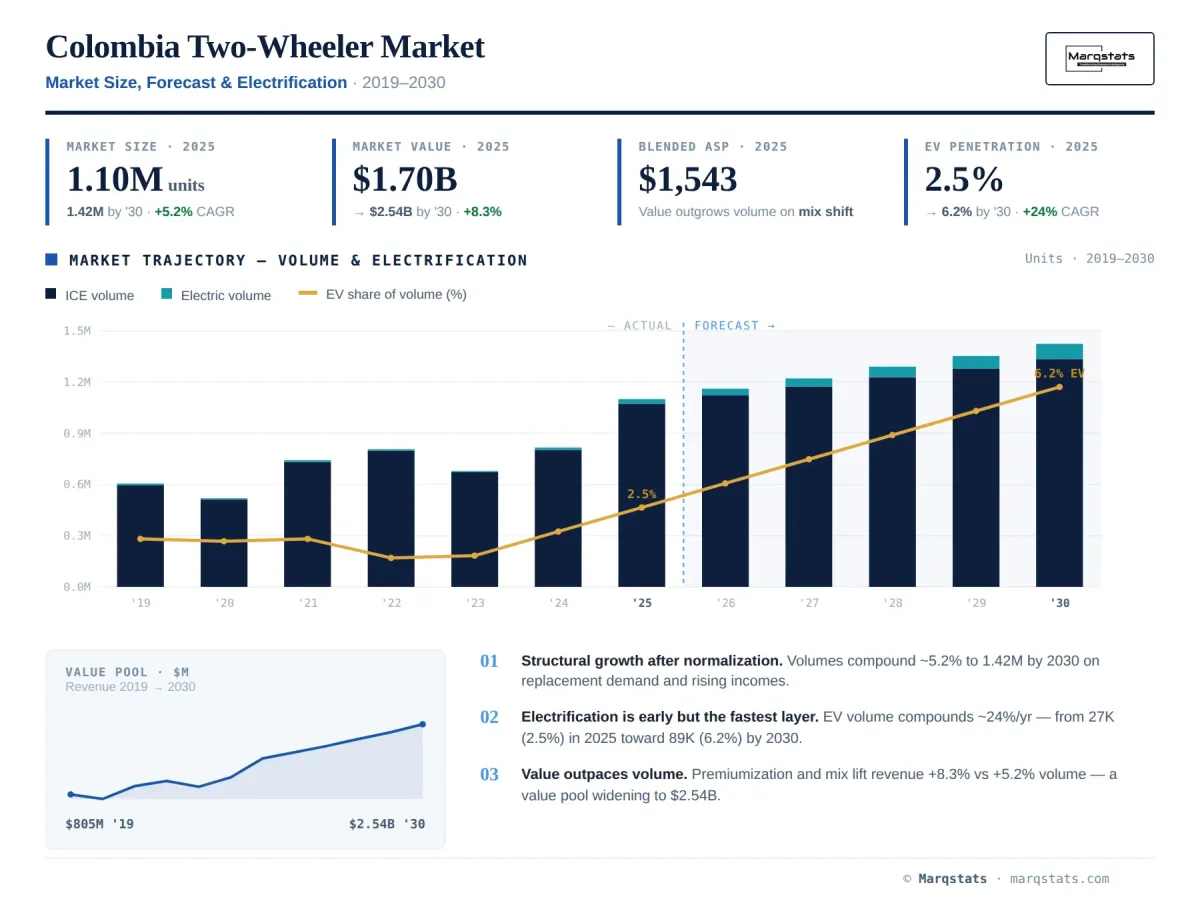
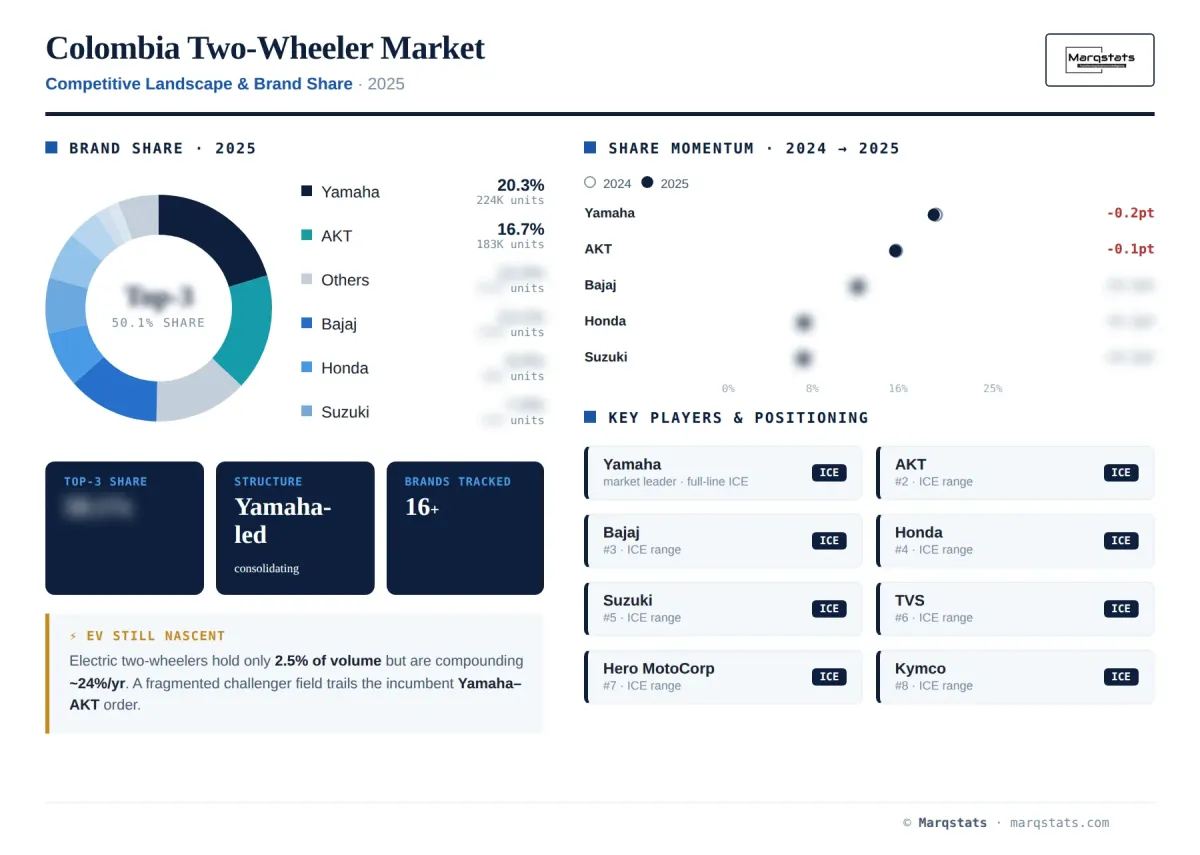
Motorcycles account for about 95% of 2025 volume, roughly 1.04 million units, growing at a 5.29% CAGR. The category is dominated by low and medium displacement commuter machines valued for economy, low fuel consumption, and simple maintenance. The AKT AK125NKD was the market's top-selling model, followed by machines from Bajaj, Suzuki, and Yamaha, and the ten top-selling models together represented over a third of registrations. That concentration among a handful of models reflects a market where specification matters less than running cost and dealer proximity.
Scooters account for about 50,000 units in 2025, roughly 5% of volume, growing at a 6.94% CAGR. The Yamaha NMAX 155 ranks among the market's top-selling models, reflecting demand for premium urban mobility alongside the dominant work machines. Mopeds contract at about 30% annually toward negligible volumes by 2030. The scooter's presence among the top-selling models is notable in a market otherwise defined by underbone commuters, and it signals an emerging urban segment willing to pay for comfort and automatic transmission.
Combustion models hold about 97% of 2025 volume, roughly 1.07 million units, growing at about 4% annually. Combustion dominates the commuter classes that define the market, where purchase price, fuel economy, and ease of repair govern the buying decision. Domestic assembly is built around combustion platforms, reinforcing their position through the forecast period. Tariff protection favouring locally assembled machines further entrenches combustion, since the assembly base and its parts supply chain are organised around it.
Electric two-wheelers hold about 2% of 2025 volume, roughly 27,000 units, growing fastest at a 24.05% CAGR to reach about 89,000 units by 2030. Adoption concentrates in the 1.1–3.0 kW class, with the above-5.0 kW class growing fastest at about 36%. Industry commentary describes the electric motorcycle as advancing in short steps, and the segment declined in 2022 and 2023 before recovering strongly. Price parity remains the binding constraint, since an electric machine must compete against a tax-exempt 125cc combustion motorcycle.
The 111–125cc class is the largest at about 39% of 2025 volume, roughly 428,000 units, and machines up to 125cc together take about two-thirds of the market. Motorcycles between 101cc and 125cc are exempt from vehicle tax in Colombia, and that exemption is the principal reason the band dominates. The class contracts slightly through the forecast as buyers trade up, and the sub-110cc band grows at about 7% annually. Manufacturers design specifically to the exemption threshold, and the AKT AK125NKD, the market's top-selling model, sits precisely within it.
The 126–150cc class holds about 13% of volume and grows at about 11% annually, while the 151–200cc class holds about 12% and has ranked as the second most demanded segment in recent monthly reporting. Machines above 350cc represent about 1% of volume yet grow fastest at about 16%, reflecting an emerging premium segment from a very small base. The upward drift from the tax-exempt band is the market's principal source of value growth, as average selling prices rise faster than unit volumes.
The entry and mass band accounts for about 55% of 2025 volume, roughly 604,000 units, growing at about 7% annually, and the mid segment adds about 19% and grows at about 11%. Together these bands anchor the market, matching the dominance of low and medium displacement machines and the tax exemption that supports them. Competition within them turns on financing terms and dealer coverage rather than on specification, and margins are correspondingly thin.
Premium accounts for about 7% of volume and grows at about 15% annually. The high-premium performance series in the underlying data reflects a reclassification from 2022 onward and overstates the segment relative to registration evidence, since machines above 350cc account for only about 1% of volume. Displacement data provides the reliable measure of premium demand in this market. On that basis, premium and large-displacement machines remain a marginal though rapidly expanding part of a market overwhelmingly composed of small commuter motorcycles.
Private consumers account for about 96% of 2025 volume. The classification understates commercial intent, as industry bodies describe the machine as a productive asset acquired for income generation rather than transport alone. Demand therefore responds to earning opportunity and credit terms rather than to discretionary confidence. The pattern is most pronounced in lower-income households, where the motorcycle provides the means of reaching work, study, and basic services that would otherwise be inaccessible.
Formally recorded delivery and logistics demand accounts for about 3% of volume and grows at about 10% annually, while business and fleet users add about 5%. Ride-hail, rental, and tourism grow at about 13%. These categories capture registered commercial fleets and sit alongside a far larger population of individually owned working machines, which the private-consumer classification absorbs.
Offline dealerships account for about 80% of 2025 volume, though the channel contracts at about 5% annually. The physical network originates the credit that most purchases require and provides after-sales service across departments and smaller municipalities, where the majority of incremental demand now originates. Brands without provincial dealer coverage struggle to convert product competitiveness into registrations, whatever their pricing.
The online channel reaches about 20% of 2025 volume and grows fastest at about 24% annually. Digital platforms serve buyers comparing an expanding field of brands and financing terms, and their growth concentrates in the metropolitan departments where formal credit access is strongest. Research and comparison happen online, while the transaction typically completes at a dealership where credit is arranged and the machine is registered.
By Geography
Cundinamarca & Bogotá
Cundinamarca, encompassing Bogotá and its surrounding municipalities, records the highest number of registrations nationally, at roughly 18% of the market. Severe congestion and long commutes make the motorcycle the fastest practical means of urban travel, and Funza ranks among the municipalities with the most registrations. The department also concentrates scooter and premium urban demand, reflecting higher incomes alongside the dominant commuter base.
Antioquia
Antioquia, centred on Medellín, is the second-largest departmental market at roughly 15% of registrations, and it is home to the Colombian manufacturer AKT. Sabaneta consistently records the highest municipal registration totals in the country, underlining the density of motorcycle ownership across the Aburrá Valley. The department combines a large urban population, steep terrain that favours two wheels, and a domestic manufacturing base that has shaped national product preferences.
Valle del Cauca
Valle del Cauca, centred on Cali, is the third-largest market at roughly 10% of registrations. Warm weather, dense urban activity, and the municipality of El Cerrito among the national registration leaders reflect the motorcycle's role in both city mobility and the agricultural economies of the surrounding region. Year-round riding conditions and a substantial informal economy sustain steady replacement and first-time demand across the department.
Cauca & the Wider Country
Together the three largest departments account for close to 46% of national registrations, leaving a substantial market across the remaining departments. Cauca hosts Hero's Colombian production base, generating regional employment, and demand across intermediate municipalities has grown strongly as the motorcycle extends access to work and services. Municipalities such as Sabaneta, Funza, and El Cerrito record registration totals disproportionate to their populations, demonstrating that motorcycle ownership is not confined to the largest cities.
How Competition Is Evolving
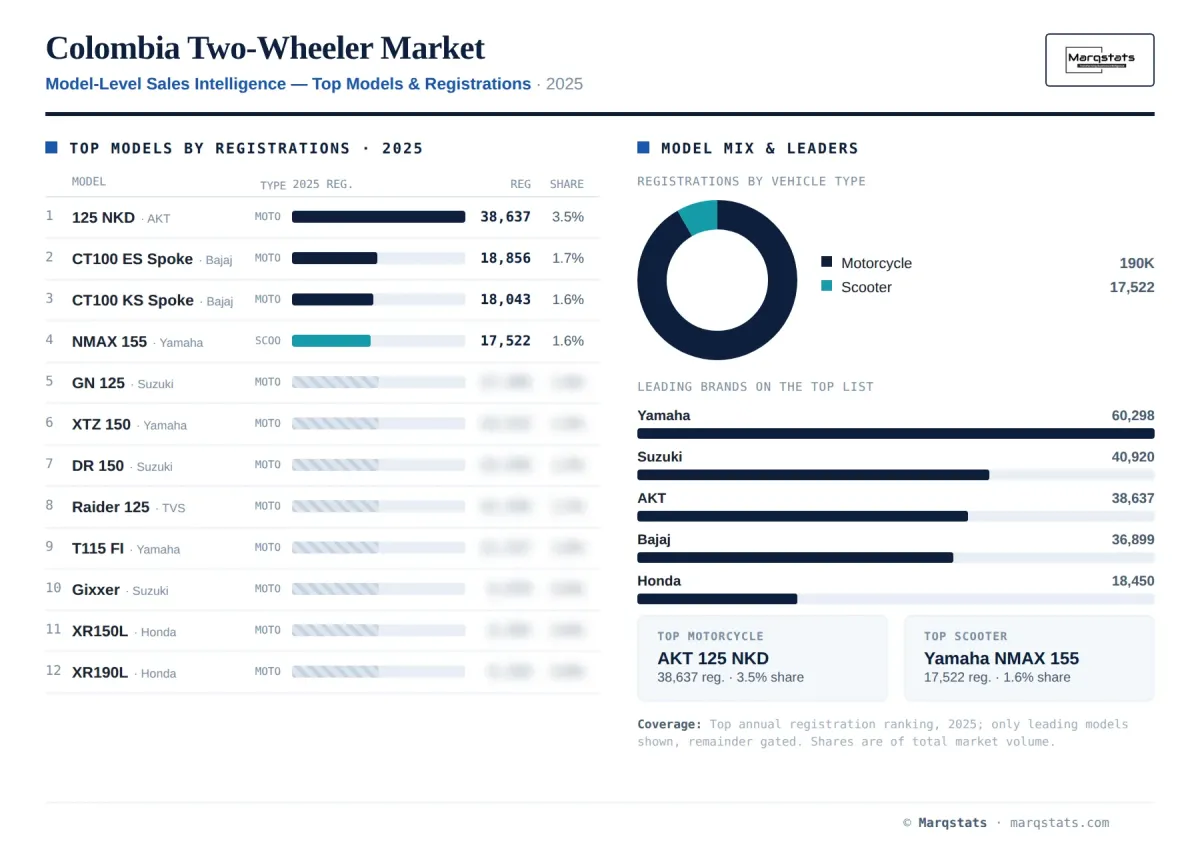
The Colombia two-wheeler market is moderately concentrated. Bajaj, AKT, and Yamaha led registrations across 2025, each supported by portfolios concentrated in the low and medium displacement machines that dominate demand. Suzuki registered 167,394 units for a 15.22% share, growing 34.56% over the prior year, followed by Honda at 136,457 units, TVS at 84,750, and Hero at 83,416. Victory recorded 54,488 registrations, and Kymco, KTM, Bera, Fratelli, SYM, Royal Enfield, and Vento compete across the remainder.
Growth among emerging brands has been the market's most striking feature. Hero recorded the strongest expansion within the top ranks, growing about 117% year on year, followed by Honda at about 51% and Bajaj at about 44%. Beyond the top ranks, Vento grew about 133%, SYM about 117%, and Fratelli about 114%. This influx has injected competition and widened consumer choice, and it reflects Colombia's standing as one of the world's largest motorcycle markets.
The established order has nonetheless proved durable. Bajaj, AKT, Yamaha, Suzuki, and Honda have retained the top positions throughout, sustained by portfolio depth in the tax-exempt commuter classes and by distribution networks reaching into intermediate municipalities. Monthly leadership rotates among them, and the ranking shifted repeatedly across 2025, yet the group as a whole has held its share. Emerging brands have grown from small bases and drawn buyers primarily from the tail of the market rather than from the leaders.
Competition centres on price, financing access, and dealer coverage across departments and smaller municipalities. Growth is attributed to brands combining domestic assembly or local production with broad distribution, moreover rewarding those meeting rising safety expectations. Every one of the ten top-selling models now incorporates antilock or combined braking, evidence of an industry commitment to raising road safety standards as the parc expands toward ten million machines. Fleet renewal and road safety remain the central policy questions facing the sector.
Companies Covered
The report profiles 16+ companies with full strategy and financials analysis, including:
Recent Market Activity
Table of Contents
Coverage & Segmentation
This report provides a comprehensive assessment of the Colombia two-wheeler market across a 2025 base year, historical data from 2021 to 2025, and forecasts spanning 2026 to 2030. Market sizing is presented in unit-volume terms and complemented by value analysis in United States dollars, with segmentation by vehicle type, propulsion type, engine displacement and motor power, price band, end user, sales channel, and brand. Brand-level shares, segment growth rates, and competitive positioning are quantified to support commercial and investment decisions in one of the world's ten largest motorcycle markets.
The scope covers demand drivers, restraints, and structural trends, with particular focus on the motorcycle as a productive asset, the tax exemption anchoring the dominant displacement band, protected domestic assembly, the rapid entry of emerging brands, universal adoption of advanced braking among top-selling models, and the electric transition. An extended forecast to 2035 is available under customization, alongside deeper cuts by department, brand, or channel on request.