Market Snapshot
Key Takeaways
Market Overview & Analysis
Report Summary
The Saudi Arabia two-wheeler market covers motorcycles and scooters sold for private, commercial, and institutional use. Mopeds are effectively absent from the market. The study measures demand in unit volumes and revenue across 2021 to 2025 historical years and 2026 to 2030 forecast years, with 2025 as the base year. Coverage spans propulsion type, engine displacement and motor power, price band, end user, sales channel, and brand.
Saudi Arabia differs from most two-wheeler markets in its premium character. Motorcycles serve recreation, touring, and desert riding, and buyers pay for brand, performance, and quality service. Large-displacement machines above 350 cc dominate, and average selling prices run far above regional norms. A separate commuter and delivery layer uses smaller machines, however it forms a minority of units and a small share of revenue.
Import dependence is near total. The Kingdom assembles few two-wheelers, so almost all units arrive from the United States, Europe, Japan, and Asia. Landed cost, model availability, and shipping conditions shape supply, and dealerships plan inventory around the seasonal calendar and national events. Standards and specification requirements also influence which models reach the market.
Growth is attributed to high disposable incomes, a strong cruiser and adventure culture, Vision 2030 tourism and entertainment, and an expanding food-delivery economy. Desert and off-road riding is a distinctive feature, and it links the market to the recreational powersports segment tracked in the global electric ATV and UTV market. Revenue grows steadily as premium and performance models command high prices, and electrification adds a second growth axis from a small base.
Market Dynamics
Key Drivers
- High disposable incomes and a strong luxury segment support demand for premium touring and cruiser motorcycles.
- Vision 2030 tourism, entertainment, and motorsport initiatives broaden the rider base and raise recreational demand.
- A strong desert and off-road riding culture sustains demand for large-displacement and adventure machines.
- An expanding food and parcel delivery economy raises demand for smaller commuter motorcycles and electric models.
- Well-developed online retail widens access to models and financing, owing to high digital adoption among buyers.
Key Restraints
- Extreme summer heat shortens the practical riding season, which concentrates demand in cooler months.
- Infrastructure limits, including safe riding paths and parking, constrain urban two-wheeler use.
- Sparse charging coverage outside cities slows electric adoption for touring and desert use.
- Standards and specification requirements under national regulations add cost and compliance steps.
Key Trends
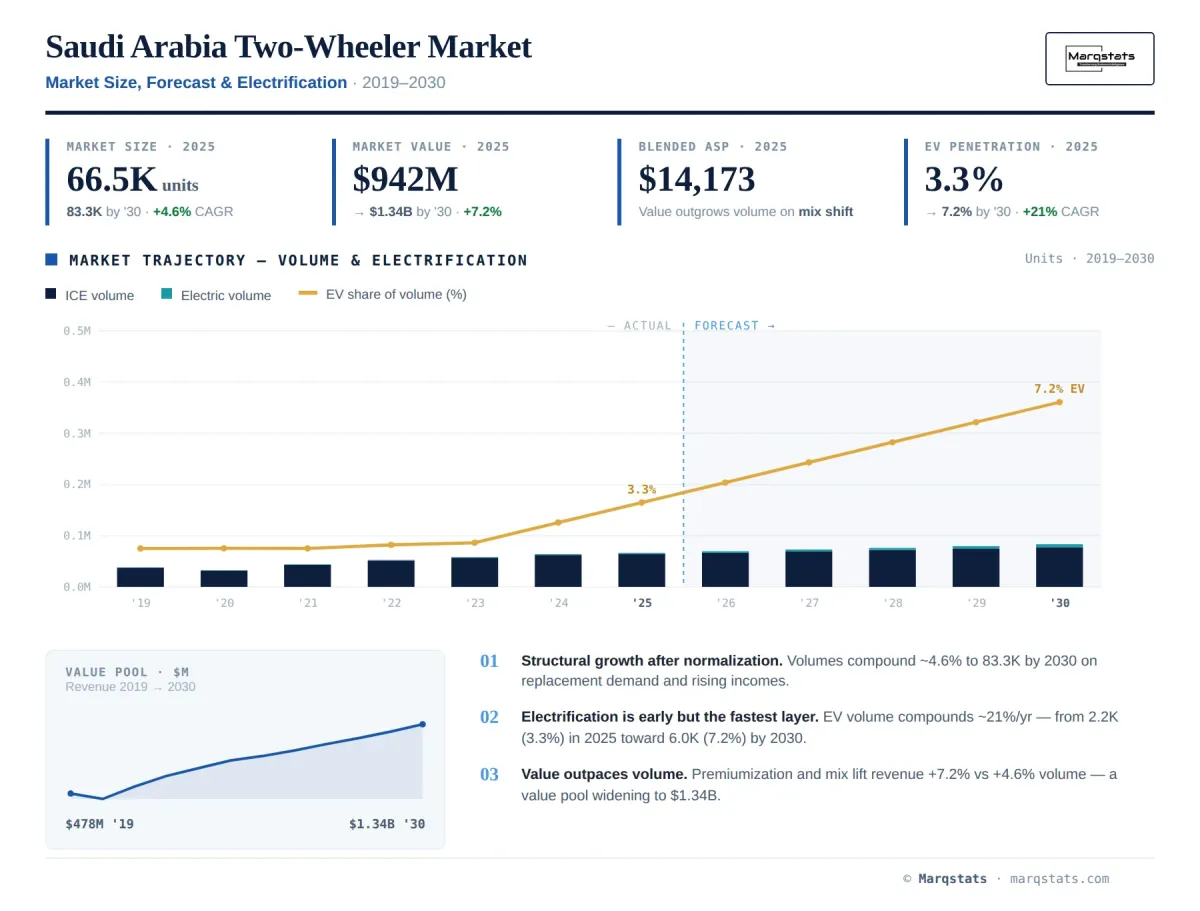
- Electric two-wheelers gain share from a small base, rising from about 3% of units in 2025 toward 7% by 2030.
- Online sales scale rapidly and are projected to overtake dealership volumes before 2030.
- Adventure and touring models gain popularity, owing to cross-border trips and desert riding.
- Social change widens participation, including growing interest among younger riders and women.
Market Segmentation
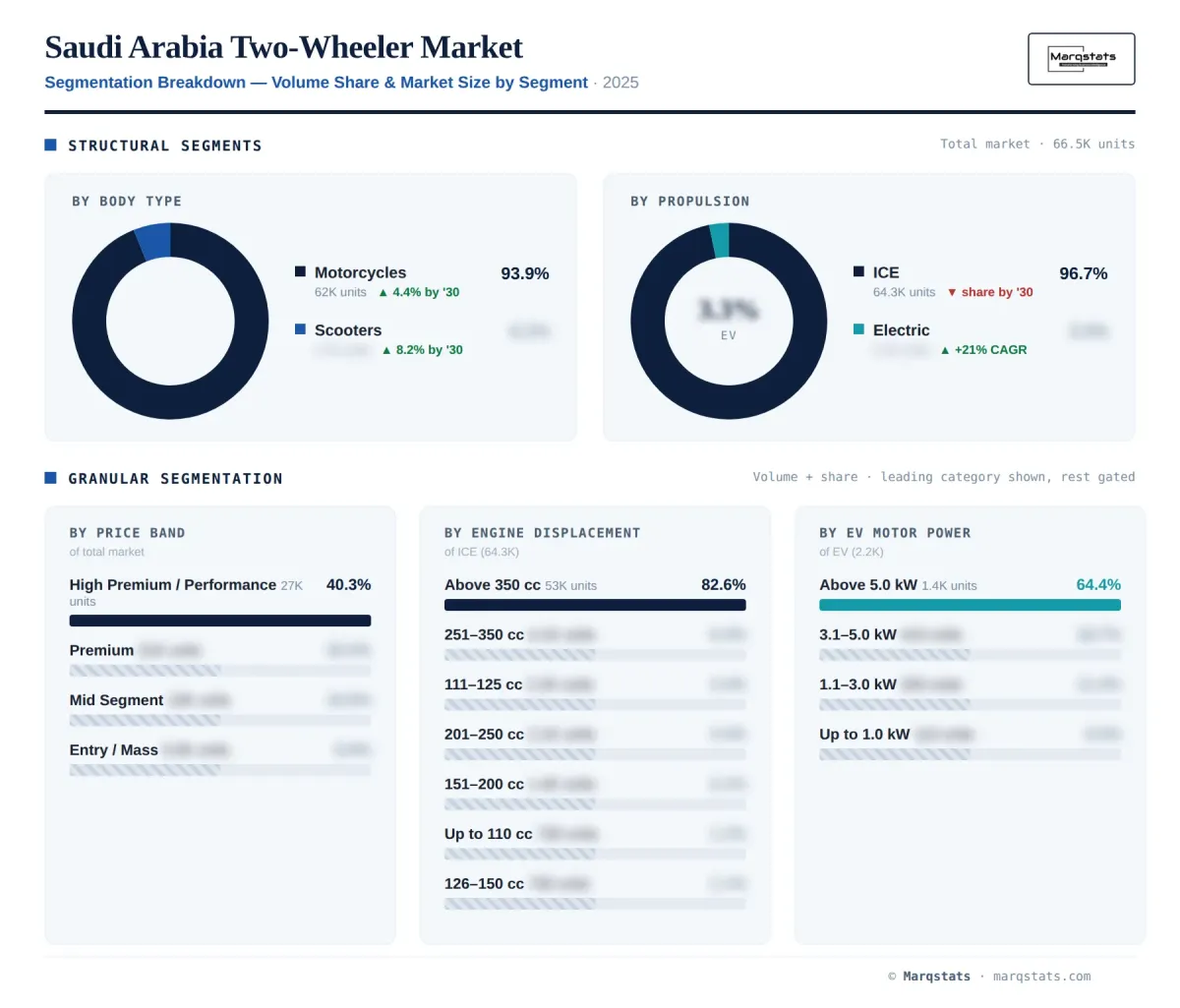
Motorcycles dominate, at close to 92% of unit sales in 2025. Volumes reach 60.87 thousand units in 2025 and are projected to reach 75.02 thousand units by 2030, a 4.32% CAGR. Large-displacement touring, cruiser, and sport models drive both volume and revenue, while smaller commuter models serve delivery riders.
Within motorcycles, cruiser, touring, and adventure models anchor the premium tier and generate most revenue. Cruiser culture is well established, and adventure and off-road machines suit desert riding and motorsport interest. Commuter models in the 125 to 200 cc range serve delivery work and newer riders.
Scooters form the second category, at about 8% of units in 2025. Volumes rise from 5.63 thousand units in 2025 to 8.27 thousand units by 2030, a 7.42% CAGR, the fastest-growing vehicle type. Urban commuters and delivery riders favor scooters for short trips, and electric scooters add incremental demand.
Scooter demand benefits from the delivery economy and from riders seeking simple urban transport. Automatic transmission and low running costs suit short trips in dense districts, and electric scooters are a growing part of this category.
Mopeds are effectively absent from the Saudi market, with negligible volumes across the forecast period. Buyers favor motorcycles and scooters, and the market carries no meaningful moped tier.
Combustion models held about 97% of units in 2025. Volumes move from 64.2 thousand units in 2025 to 77.53 thousand units by 2030, a 3.72% CAGR. Combustion remains dominant through the forecast period, owing to touring range, refueling convenience, and the premium performance segment. Large-displacement machines carry most combustion revenue.
Electric two-wheelers are the fastest-growing propulsion type from a small base. Volumes rise from 2.3 thousand units in 2025 to 5.76 thousand units by 2030, a 20.15% CAGR, and revenue expands at a similar pace. Growth is driven by last-mile delivery fleets, sustainability initiatives, and premium electric models. Electric share of units is projected to reach about 7% by 2030.
Delivery operators are among the earliest electric adopters, owing to urban routes that suit electric models. Premium electric motorcycles add demand at the high end. Adoption remains constrained by charging coverage outside cities and by extreme summer heat, which affects battery performance. As model availability widens, electric volumes scale quickly from a low base.
Large-displacement machines dominate the market. Above 350 cc volumes reached 48.27 thousand units in 2025, close to 73% of total units and about 75% of combustion units. Touring, cruiser, and superbike models anchor this band, and average prices are the highest in the market. This concentration is among the highest large-displacement shares of any two-wheeler market.
The dominance of large-displacement machines is the defining feature of the market. It reflects a leisure, touring, and desert-riding orientation rather than commuting, and it drives the high average selling price. Demand concentrates among residents and visitors with high purchasing power, and motorsport interest supports the segment.
Mid-capacity motorcycles form a secondary tier used by newer riders and commuters. The 251 to 350 cc band reached 5.5 thousand units in 2025. Adventure and naked models in this range gain popularity, owing to easier daily use than litre-class machines.
Small-displacement machines form the commuter and delivery layer. The 111 to 125 cc band reached 3.13 thousand units in 2025. Food and parcel riders sustain this tier, owing to low running costs and easy servicing.
Within electric two-wheelers, the above 5.0 kW band is the largest and fastest-growing in 2025, reflecting demand for higher-power electric motorcycles. Lower-power bands serve delivery and short-trip use.
Premium and high-premium tiers dominate the market. Premium models reached 23.09 thousand units in 2025, and high-premium and performance models reached 23.06 thousand units. Together these tiers held close to 69% of units and a larger share of revenue, which defines the market as premium-led.
The premium concentration is even stronger in revenue terms than in units, owing to the high prices of touring and performance models. This mix makes Saudi Arabia a high-value market where premium brand strategy outweighs volume competition, and where the total crossed the USD 1 billion mark early in the forecast period.
The mid segment reached 13.45 thousand units in 2025, growing at a 5.5% CAGR. Buyers in this tier seek performance and features at more accessible prices, and mid-capacity models sit here.
The mid segment benefits from riders moving up from smaller machines and from newer riders choosing manageable models. Adventure and naked models in this tier broaden the base of the market beyond the cruiser and superbike core.
The entry tier is smaller, at 6.9 thousand units in 2025, however it grows fastest at a 7.79% CAGR. Commuter and delivery demand sustains this tier, and value brands hold positions here.
Private consumers are the dominant end user, at roughly 83% of demand with 55.28 thousand units in 2025. Purchases serve recreation, touring, and personal mobility. This base grows at a 3.66% CAGR through the forecast period, supported by rising interest among younger riders and expanding leisure activity.
Commercial and fleet demand accounts for about 17% of units and grows faster than private demand. Delivery and logistics volumes rise at a 6.83% CAGR, and ride-hail, rental, and tourism use expands at a 12.2% CAGR, the fastest end-user segment. Delivery operators and rental fleets drive much of this growth.
Rental and tourism demand is a growing feature, owing to Vision 2030 travel and events. Institutional purchases, including security and municipal fleets, add periodic demand that supports commercial volumes across the forecast period.
Online retail is scaling rapidly, at close to 38% of units in 2025 with 24.98 thousand units. Volumes rise to 51.62 thousand units by 2030, a 15.61% CAGR, and revenue grows at a similar pace. High digital adoption, verified listings, and remote transactions support online sales, and the channel is projected to overtake offline volumes before 2030.
Dealerships and physical retailers held about 62% of units in 2025 with 41.52 thousand units. However, offline volumes decline at a negative 5.31% CAGR as buyers shift online. Physical channels retain value for premium sales, service, and brand experience.
Online growth reflects high digital adoption and a large used-motorcycle trade. Marketplaces provide listings, history checks, and remote transactions, which lowers friction for buyers. Physical dealerships remain important for premium launches, test rides, and after-sales service, however their share of unit volume declines steadily through the forecast period.
By Geography
Riyadh Region
The Riyadh region is the largest demand center, owing to concentration of population, wealth, and delivery activity. Registration and transport data from the transport general authority (tga.gov.sa) records the largest two-wheeler base here. Premium and cruiser demand, rental fleets, and delivery riders all concentrate in the capital, which makes it the reference market for new-model launches and electric two-wheelers.
Makkah Region
The Makkah region, including Jeddah and Makkah, carries a large population and a strong riding culture along the Red Sea coast. Premium, touring, and delivery demand concentrate in Jeddah. Tourism and events add recreational demand across the region.
Jeddah combines a large resident base with tourism and coastal recreation. Premium and touring demand is strong, and delivery activity supports a growing commuter layer. The region benefits from Vision 2030 tourism and entertainment investment.
Eastern Province
The Eastern Province, including Dammam and Khobar, carries high average incomes and a large resident base. Premium and touring demand is strong, and desert riding around the province supports adventure-model sales. Delivery demand grows in the urban centers.
The Eastern Province benefits from an established expatriate and professional base and from proximity to neighboring Gulf markets. Cross-border riding and desert recreation support adventure and touring demand, and the urban centers sustain delivery activity.
Other Regions
Other regions, including Madinah and Asir, add demand around secondary cities and highland and coastal recreation. Cooler conditions in the southwest support a longer riding season. Adventure and touring models suit terrain in these areas, and volumes are smaller than in the main regions.
How Competition Is Evolving
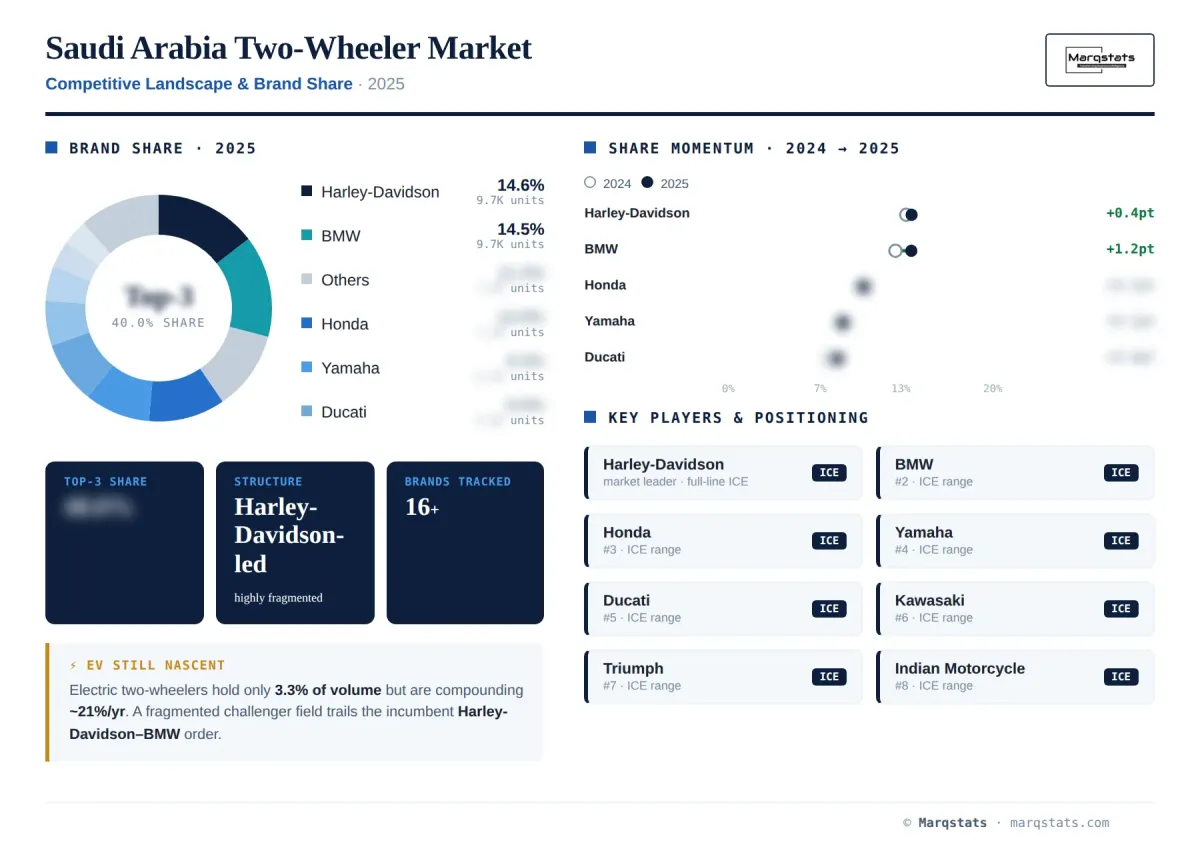
The Saudi Arabia two-wheeler market is moderately concentrated among premium brands. A cruiser marque led with close to 15% of unit volume in 2025, ahead of Japanese and European premium brands. The five largest brands together held about 55% of volume, and premium and performance marques hold an even larger share of revenue, owing to high average prices.
Competition centers on brand strength, model range, performance, and service quality. Cruiser and touring marques compete on heritage, ownership experience, and dealership networks. Japanese brands span premium and commuter tiers. European performance and adventure brands hold strong positions in touring and off-road segments, owing to a desert riding culture and motorsport interest.
Distribution strategy favors brands with strong online presence, owing to high digital adoption among buyers. Service network depth, parts availability, and standards compliance remain decisive for premium sales. Electric entrants, including premium and delivery-focused models, position for the emerging electric tier. Dealer promotions around national events support premium demand.
Brand strategy also reflects the shift toward online distribution and the rise of electric models. Cruiser and touring marques defend share through heritage, ownership experience, and dealership networks, while adventure and performance brands capture desert and motorsport demand. Brands that pair a strong online presence with reliable service and parts supply hold share most effectively across the premium and commuter layers.
Companies Covered
The report profiles 16+ companies with full strategy and financials analysis, including:
Recent Market Activity
Table of Contents
Coverage & Segmentation
This report provides a comprehensive analysis of the Saudi Arabia two-wheeler market across 2021 to 2030, with 2025 as the base year and 2026 to 2030 as the forecast period. The study measures market size in unit volumes and revenue, and it segments demand by vehicle type, propulsion type, engine displacement and motor power, price band, end user, sales channel, and brand.
The report examines demand drivers, restraints, and trends, along with competitive structure and brand positioning. Regional coverage spans the Riyadh region, the Makkah region, the Eastern Province, and other regions. The analysis integrates registration and transport data, import records, and primary interviews to reconcile brand-level and category-level estimates into a single market view. The premium character of the market is reflected in both volume and revenue segmentation.
The study also assesses distribution shifts, early electrification, Vision 2030 demand effects, and the balance between premium private demand and the commuter and delivery layer. Forecasts are built at the segment level and reconciled to the total market, so that vehicle type, propulsion, displacement, price band, end user, and channel views remain internally consistent across the historical and forecast periods.