Market Snapshot
Key Takeaways
Market Overview & Analysis
Report Summary
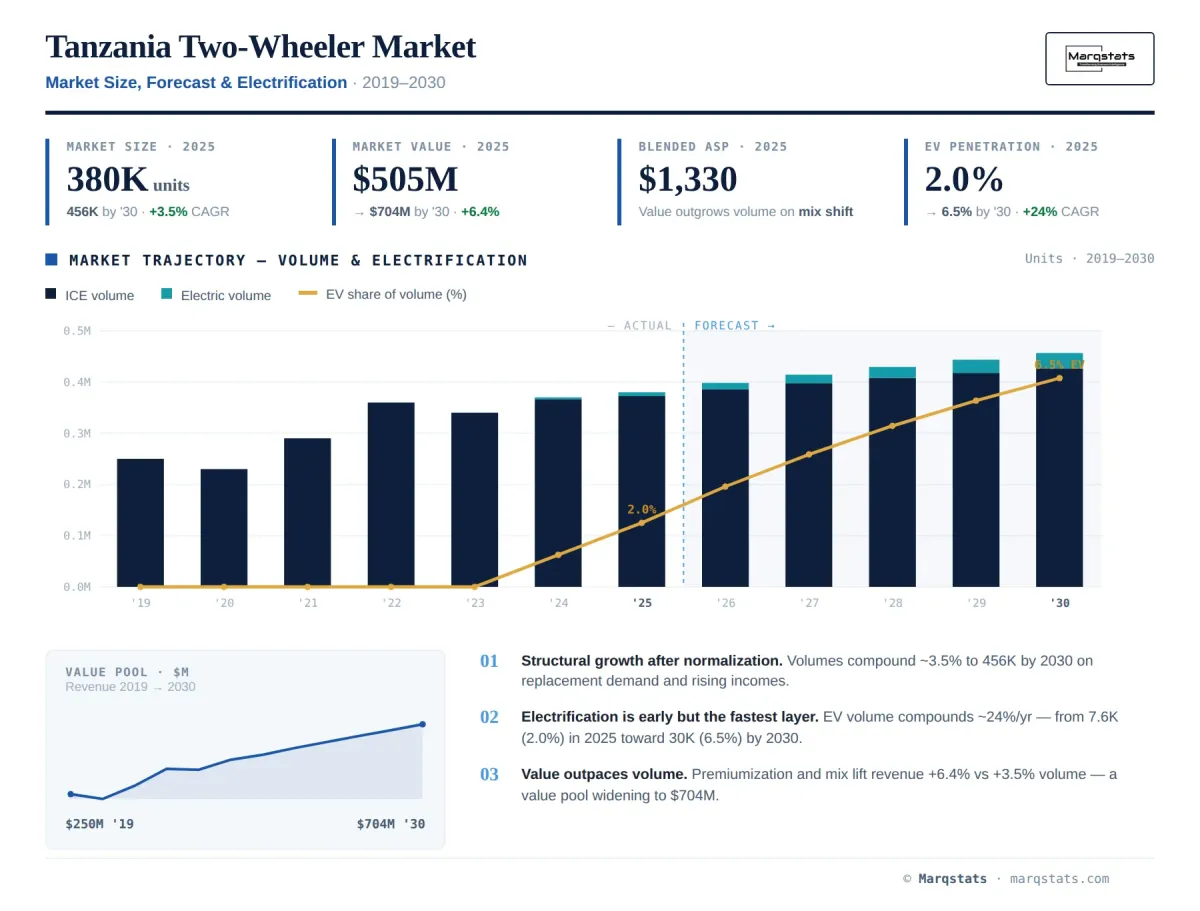
The Tanzania two-wheeler market is a large, commercial, work-driven market shaped by the boda-boda motorcycle-taxi economy. Motorcycles are indispensable to daily life, providing income for riders and serving as the primary means of last-mile transport in cities and rural areas alike, carrying passengers and goods and reaching communities that other transport cannot. The market generated USD 505.4 million in revenue in 2025 on about 380,000 units, and it has grown steadily rather than in the volatile cycles seen in some neighbouring markets.
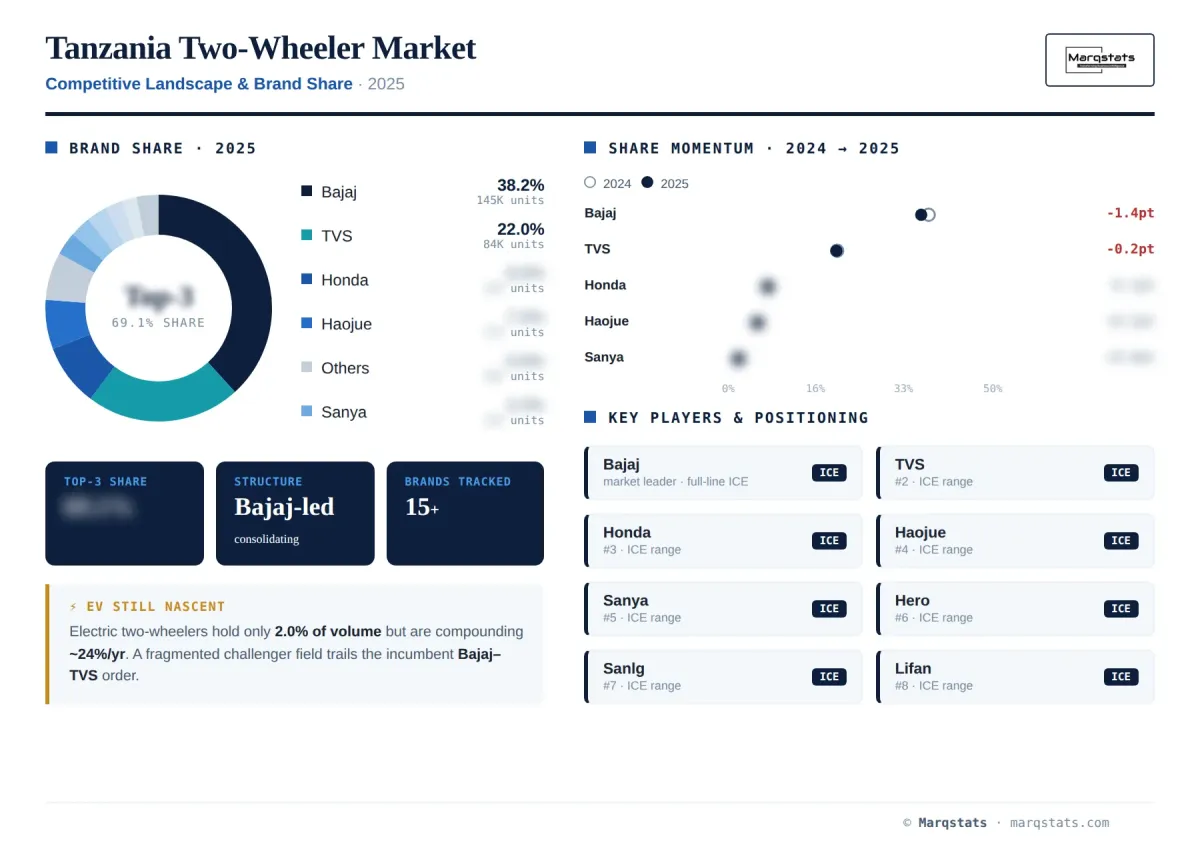
Market structure is defined by the dominance of two Indian brands. Bajaj holds the foremost position at about 38% of revenue, and TVS follows at about 22%, together accounting for close to 60% of the market. Bajaj distributes and assembles locally in Dar es Salaam, producing motorcycles from complete-knock-down kits and operating an extensive service and spare-parts network, and its Boxer is the archetypal boda-boda machine. Japanese brands such as Honda, Chinese brands including Haojue, and Indian brand Hero complete the field.
The steadiness of the market sets Tanzania apart within the region. Where some neighbouring markets have swung sharply on tax changes and import restrictions, Tanzanian demand has climbed in a measured way, from about 250,000 units in 2019 to 380,000 in 2025, punctuated only by a mild dip during the pandemic. This stability reflects the embedded role of the boda-boda trade in household incomes, the breadth of demand across urban and rural areas, and the depth of local assembly and financing that keep affordable machines within reach. It also gives brands a predictable base on which to invest in assembly, dealer networks, and after-sales service.
Motorcycles are central to mobility across the country, and independent assessments note that the fleet of combustion motorcycles and three-wheelers has reached well over a million, a base that the United Nations Environment Programme identifies as an opportunity for electrification. Asset financing, offered by specialist lenders, is central to how riders acquire machines, and the affordability of durable machines sustains steady demand across income groups.
Market Dynamics
Key Drivers
- The boda-boda taxi economy anchors demand, with motorcycles serving as income-generating work vehicles for riders nationwide.
- Steady economic growth and urbanization sustain rising demand for affordable, flexible transport across cities and rural areas.
- Local assembly of major brands lowers costs and supports service and spare-parts availability across the country.
- Asset financing makes acquisition affordable for riders entering the boda-boda trade with limited upfront capital.
Key Restraints
- Import duties and taxes raise machine prices, weighing on affordability in a price-sensitive market.
- Road-safety concerns accompany rapid growth in motorcycle use, prompting regulation and enforcement measures.
- Limited charging and swap infrastructure slows the shift toward electric two-wheelers beyond pilot projects.
- Reliance on imported machines and components exposes the market to currency and supply-chain fluctuations.
Key Trends
- Indian brands consolidate their lead, expanding local assembly and service networks across the country.
- Electric two-wheelers grow fastest at a 27.71% CAGR from a small base, led by early pilots and financing partnerships.
- Online retail expands fastest among channels at a 19.65% CAGR, though physical dealers still handle most value.
- Ride-hailing and delivery platforms professionalise the boda-boda sector and reinforce commercial demand.
Market Segmentation
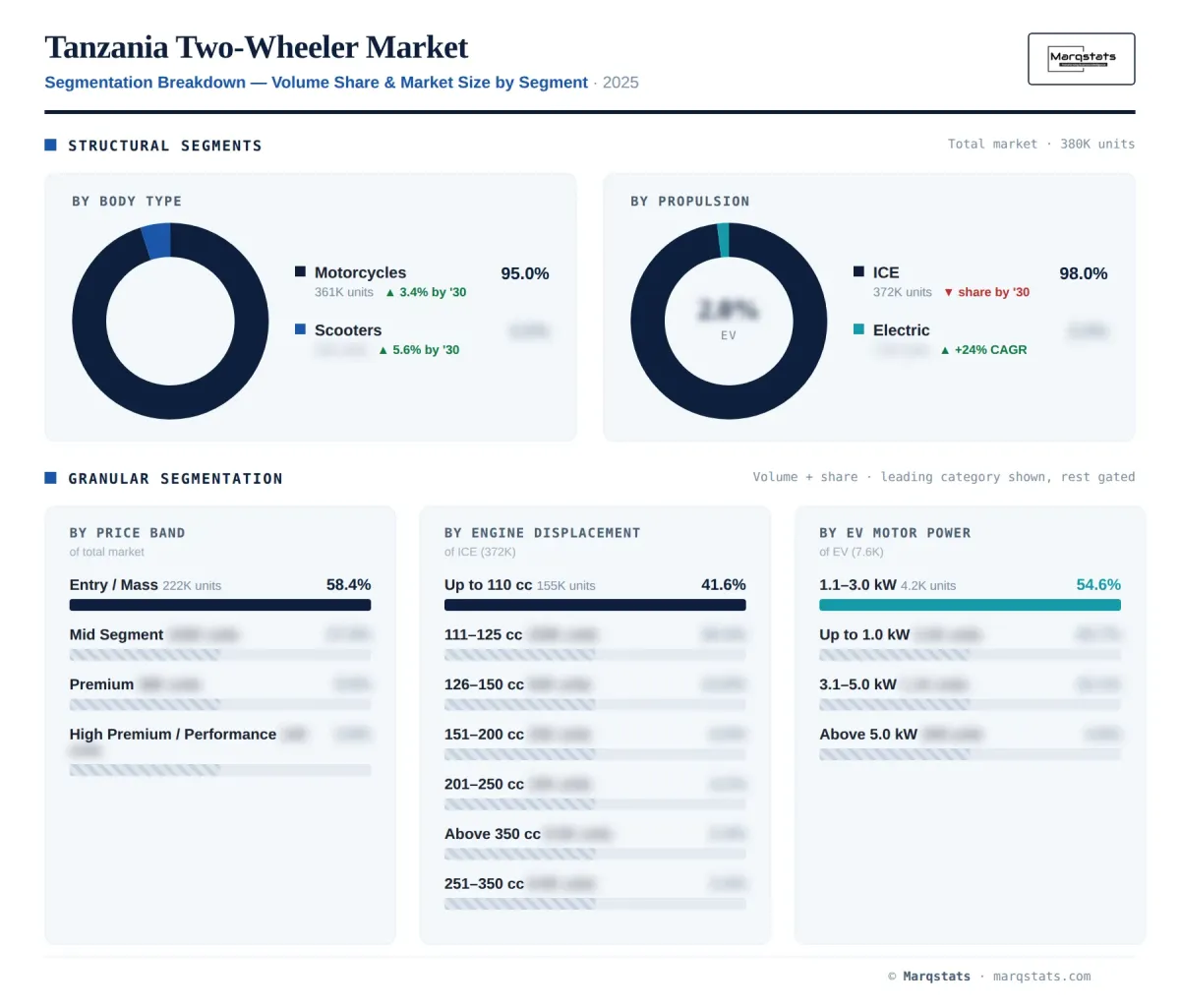
Motorcycles overwhelmingly dominate the vehicle-type segment, generating USD 480.1 million in 2025, about 95% of market revenue, and rising to USD 664.6 million by 2030 at a 6.25% CAGR. The segment is built on rugged, affordable commuter and utility machines suited to boda-boda service, delivery, and rough terrain. Indian brands led by Bajaj and TVS supply most of this segment, with entry and mid-displacement machines forming the core of commercial demand across the country. Durability, low running costs, and the availability of spare parts and service determine buying decisions, since machines are expected to generate income daily over long operating lives. The Boxer and comparable workhorse models set the benchmark for the segment, and replacement demand from an ageing and heavily used fleet adds a steady, recurring layer of sales.
Scooters and mopeds generated USD 25.3 million in 2025, about 5% of revenue, and grow to USD 39.0 million by 2030 at an 8.56% CAGR, the faster-growing vehicle type in percentage terms. The segment serves a smaller niche of urban commuting, and its share remains minor in a market where rugged motorcycles suited to commercial and utility use dominate. Scooter growth outpaces motorcycles in percentage terms from a small base, though motorcycles remain almost the entire market by both value and volume.
Internal combustion engine models overwhelmingly dominate the market, generating USD 495.3 million in 2025, about 98% of revenue, and growing to USD 657.8 million by 2030 at a 5.43% CAGR. Combustion demand is anchored in affordable, low-displacement commuter and work motorcycles, with Bajaj, TVS, Honda, and Haojue the principal brands. The combustion share edges down over the forecast period as electric machines begin to appear, though it remains the overwhelming majority of demand throughout. Established supply chains, fuel availability, and the low upfront cost of combustion motorcycles reinforce their hold, and the dense network of mechanics able to service them keeps ownership practical across the country.
Electric is the fastest-growing propulsion category, expanding from USD 10.1 million in 2025 to USD 45.9 million by 2030 at a 27.71% CAGR, having emerged only recently. Adoption is at an early, pilot-led stage, with ride-hailing platforms, asset financiers, and specialist companies deploying electric machines, and it mirrors the early momentum visible in other electric two-wheeler markets tracked by Marqstats. Growth is driven by running-cost savings for commercial riders, though electric remains a small share of the market through the forecast period, constrained by charging and swap infrastructure. Much of the early electric activity has centred on three-wheelers and on financed pilots in Dar es Salaam rather than on mass two-wheeler adoption, and the segment scales from a base close to 2% of revenue. The pace of battery-swap network build-out, financing availability, and electricity access will determine how quickly electric machines move from pilot fleets into the mainstream boda-boda market.
Within combustion models, entry displacements dominate. The up-to-110 cc band is the largest tier by revenue at USD 206.3 million in 2025, followed by the 111 to 125 cc band at USD 145.3 million; together these entry classes represent about 71% of combustion revenue, consistent with a market centred on affordable boda-boda and utility motorcycles. The 126 to 150 cc band adds USD 67.1 million, while larger displacements above 250 cc remain small, reflecting limited demand for premium or high-displacement machines relative to the commercial base. The concentration in low-displacement classes reflects the economics of boda-boda work, where fuel efficiency, purchase price, and ease of repair outweigh power, and where machines are chosen to maximise net daily earnings.
Within electric models, demand is led by the 1.1 to 3.0 kW band at USD 5.5 million in 2025, the typical power class for commercial electric motorcycles, followed by the up-to-1.0 kW band at USD 2.6 million. The higher-power bands are smaller yet expand fastest, with the above-5.0 kW band growing at a 34.32% CAGR as more capable machines enter service. The electric motor-power mix reflects the commercial use case, where range and load capacity matter for boda-boda operators.
The entry and mass price band dominates the market, generating USD 295.2 million in 2025, about 58% of revenue, followed by the mid segment at USD 140.9 million; together the two lower tiers account for roughly 86% of the market, underscoring its affordability-driven, commercial character. The premium and high-premium bands are smaller yet grow faster, at 7.55% and 10.62% CAGR respectively, as a segment of buyers trades up. The high-premium and performance band, at USD 19.2 million in 2025, is the fastest-expanding price tier, though it remains a minor share of overall demand. The pricing structure mirrors the commercial base of the market, where affordability governs volume, and premiumisation is a gradual, secondary theme rather than a primary driver of value.
Commercial demand dominates the Tanzania two-wheeler market, an unusual profile driven by the boda-boda economy. The B2B and fleet segment generated USD 321.3 million in 2025, about 64% of revenue, growing at a 6.56% CAGR, while B2C accounted for USD 184.1 million. Within commercial demand, ride-hail and passenger services form the largest use at USD 177.1 million, reflecting the scale of motorcycle-taxi activity, followed by delivery and logistics at USD 112.9 million and government and institutional demand at USD 31.3 million. The dominance of commercial use underscores the role of motorcycles as income sources rather than personal transport in the Tanzanian market. This commercial orientation shapes the whole market: buyers weigh total operating cost, durability, and resale value over comfort or brand prestige, and financiers structure repayment around daily rider earnings. B2C demand, at about 36% of revenue, remains a meaningful and healthier personal-ownership base than in the most commercially skewed regional markets, spanning commuters and households that use motorcycles for everyday transport.
Offline dealers overwhelmingly dominate the channel mix, handling USD 480.7 million of revenue in 2025 and growing at a 5.36% CAGR, owing to the financing, service, and rider-support functions that motorcycle purchases require across a nationwide network. Online sales, however, expand fastest at a 19.65% CAGR, rising from USD 24.7 million as digital channels and marketplace listings gain share. The channel shift is gradual, and physical dealers and financier branches retain the large majority of value through the forecast period, supported by the central role of asset financing and after-sales service in acquisition.
By Geography
Dar es Salaam
Dar es Salaam, the commercial capital and largest city, is the core of the market. Its dense population, congestion, and status as the country economic hub make boda-boda services essential for commuting, delivery, and last-mile transport. The city hosts local assembly operations, dealer networks, and the early electric-mobility pilots, and it anchors both commercial demand and the emerging electrification of the market. The concentration of dealers, financiers, and importers in the city makes it the entry point for new brands and the testing ground for financing and electric-mobility models before they spread to other regions.
Regional Cities and Lake Zone
Cities such as Mwanza, Arusha, Dodoma, and Mbeya form further demand centres, where motorcycle taxis are central to urban and inter-town transport. Dealer networks and financier branches in these regions support acquisition, and demand reflects both everyday passenger service and goods movement, complementing the concentration of activity in Dar es Salaam. As secondary cities grow, they add incremental demand and widen the geographic base of the market beyond the coastal hub.
Rural and Tourism Areas
Across rural areas, boda-bodas serve as essential economic connectors, transporting agricultural produce and reaching communities without paved roads or reliable public transport. Tourism areas add further demand for two-wheelers used in service and transport roles, particularly around the northern circuit and coastal destinations where motorcycles support local guiding and transfers. Demand in these areas underpins durable, low-cost machines and sustains steady replacement activity across a large and geographically dispersed base.
How Competition Is Evolving
The Tanzania two-wheeler market is moderately concentrated, dominated by two Indian brands. Bajaj leads at about 38% of revenue in 2025, its locally assembled Boxer the archetypal boda-boda machine, and TVS follows at about 22%, together accounting for close to 60% of the market. Japanese brand Honda holds about 9%, Chinese brand Haojue about 7%, and a field of further Chinese and Indian brands, including Sanya, Hero, Sanlg, Lifan, and Haojin, completes the market. The concentration around the two Indian leaders is a defining feature of Tanzania relative to more fragmented regional markets, and it rests on decades of brand familiarity, adapted machines, and the reliability that boda-boda operators demand from vehicles they depend on for income.
Competition centres on price, durability, financing, and dealer and service reach. Bajaj and TVS compete most effectively on affordability, machines adapted to local conditions, and extensive service and spare-parts networks, with Bajaj distributing and assembling locally in Dar es Salaam from complete-knock-down kits. Chinese brands compete on lower prices, while Japanese brands defend positions on reputation and durability. Asset financiers are pivotal, bundling machines with financing plans that determine which models riders can access.
Electrification is at an early stage and is beginning to shape the competitive field. Ride-hailing platforms, asset financiers, and specialist companies have launched pilots deploying electric machines, and independent assessments count at least ten companies entering the electric-mobility market. Electric competitors compete on running-cost savings for commercial riders, and the pace of infrastructure build-out and financing will determine how quickly the electric segment scales from its small base.
The competitive field is likely to remain concentrated around the two Indian leaders through the forecast period, with Chinese and Japanese brands competing in specific segments and price tiers, and electric companies expanding from a small base. Local assembly, financing capacity, service-network reach, and the ability to serve boda-boda operators reliably will increasingly determine which brands gain and hold share in the Tanzanian market.
Companies Covered
The report profiles 16+ companies with full strategy and financials analysis, including:
Recent Market Activity
Table of Contents
Coverage & Segmentation
This report provides a comprehensive analysis of the Tanzania two-wheeler market for the 2021 to 2025 historical period and the 2026 to 2030 forecast period, with 2025 as the base year. The study quantifies market size in revenue terms and in unit volume, and segments the market by vehicle type, propulsion type, engine displacement and motor power, price band, end user, sales channel, and brand. It examines the drivers, restraints, and trends shaping demand, and profiles the competitive structure of the market.
The study focuses on registered two-wheelers, spanning motorcycles, scooters, mopeds, and electric light vehicles. Coverage addresses the commercial, work-driven character of the Tanzanian market and the central role of the boda-boda economy, the steady growth of demand, the dominance of Indian brands and local assembly, the early stage of electrification relative to more advanced regional markets, and the composition of demand across ride-hail, delivery, and personal use. Values are reported in USD MN, and regional demand is examined across Dar es Salaam, the regional cities and Lake Zone, and rural and tourism areas.