Market Snapshot
Key Takeaways
Market Overview & Analysis
Report Summary
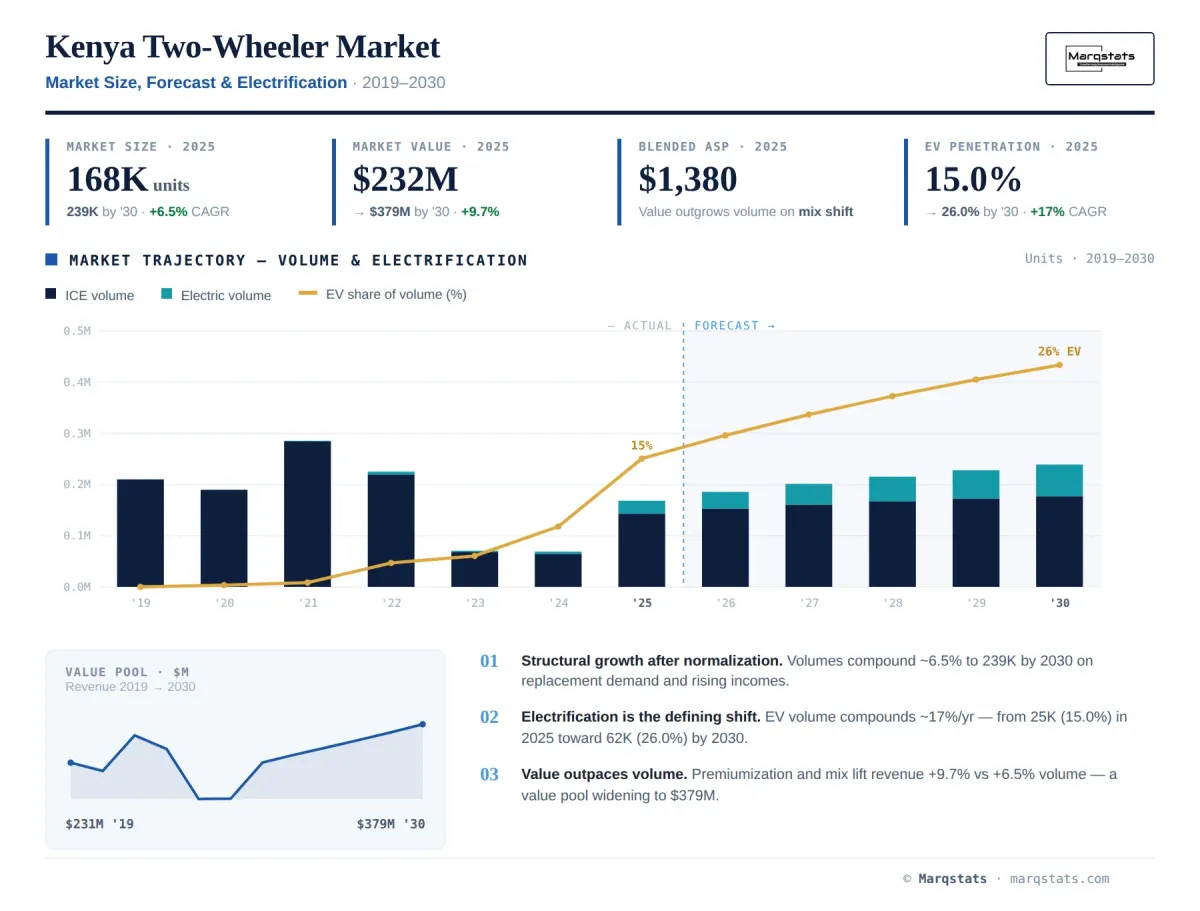
The Kenya two-wheeler market is a commercial, work-driven market shaped by the boda-boda motorcycle-taxi economy. Motorcycles are an economic lifeline: they provide income for millions of young riders in a country where most of the population is under 35, and they serve as the primary last-mile transport in cities and rural areas alike, carrying passengers and goods, reaching remote areas, and often serving as informal ambulances. The market generated USD 232.2 million in revenue in 2025 on about 168,300 units.
Demand has been volatile. Sales fell from a 2021 peak near 285,000 units to about 68,800 in 2024, a decline attributed to weaker purchasing power, higher fuel costs that cut into rider earnings, higher financing costs, and a weak shilling. The market then rebounded strongly in 2025, rising roughly 128% to about 168,300 units, as fuel prices eased and the currency strengthened toward 129 per US dollar. Asset financing, through rent-to-own and battery-swap models offered by specialist lenders, is central to how riders acquire machines.
Registration and sales data are compiled by the national statistics office, and figures from the Kenya National Bureau of Statistics documented both the sharp decline and the 2025 rebound. Bajaj Auto leads the market, with its locally assembled Boxer the archetypal boda-boda machine, and the electrification of the sector has advanced faster than most observers expected, making Kenya one of the most closely watched two-wheeler markets in Africa.
The electric segment is the standout feature. Electric two-wheelers rose from a low single-digit share of registrations in 2023 to about 15% of sales in 2025, an unusually rapid shift for the region. Adoption is led by commercial riders, for whom electricity costs a fraction of petrol and lower maintenance improves daily earnings, and it is supported by battery-swap networks that remove downtime and range concerns for operators who must stay on the road all day. A growing group of specialist companies designs machines specifically for African roads and boda-boda use.
Financing shapes the market as much as product. Because most riders cannot pay upfront, asset financiers offer rent-to-own and installment plans, often requiring only a modest down payment, and electric companies pair machines with battery-swap subscriptions. These models determine which machines riders can access and have become a central competitive lever, extending acquisition across counties and linking brand reach to financier partnerships.
Market Dynamics
Key Drivers
- The boda-boda taxi economy anchors demand, with motorcycles serving as income-generating work vehicles for millions of riders.
- Youthful demographics and high unemployment push riders toward motorcycle taxis as an accessible entry into the economy.
- Asset financing through rent-to-own and battery-swap models makes acquisition affordable despite thin rider margins.
- Electric running costs far below petrol drive rapid adoption, as fuel savings directly improve daily rider income.
- Easing fuel prices and a stronger shilling restored demand in 2025 after the sharp downturn of prior years.
Key Restraints
- Economic sensitivity drives sharp swings in demand, as shown by the fall to about 68,800 units in 2024.
- Higher financing costs and sticker prices can suppress acquisition when purchasing power weakens.
- Charging and battery-swap infrastructure gaps constrain the pace of electric adoption outside the main cities.
- Road-safety concerns accompany rapid growth in motorcycle use, with regulators tightening licensing and enforcement.
Key Trends
- Electric adoption accelerates, reaching about 15% of sales in 2025 and growing fastest at a 20.62% CAGR.
- Well-funded e-mobility companies scale battery-swap and fast-charging networks tailored to boda-boda operators.
- Online retail expands fastest among channels at a 21.19% CAGR, though physical dealers still handle most value.
- Ride-hail platforms adopt electric motorcycles, reinforcing the shift toward electrified commercial fleets.
Market Segmentation
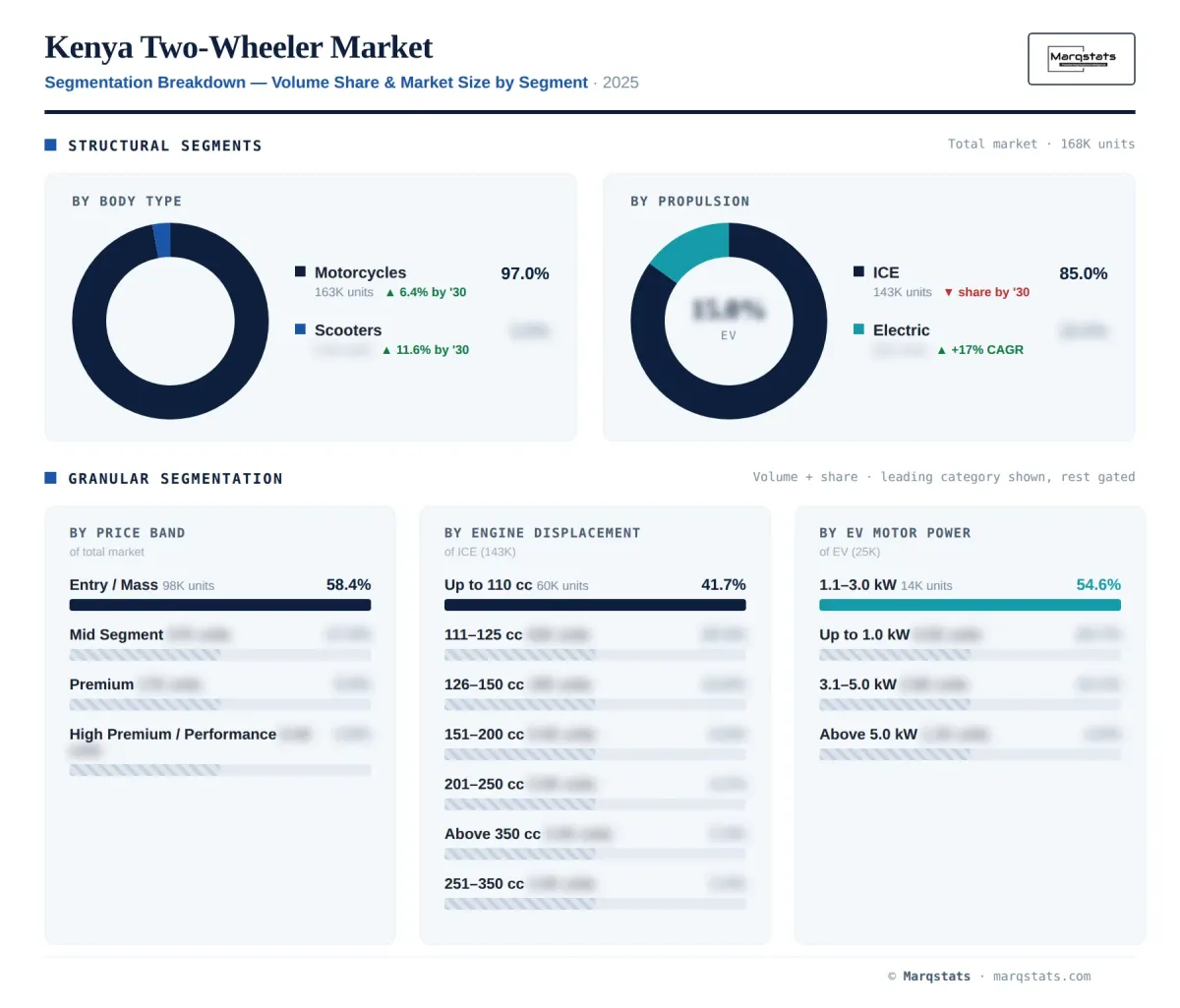
Motorcycles overwhelmingly dominate the vehicle-type segment, generating USD 225.3 million in 2025, about 97% of market revenue, and rising to USD 364.3 million by 2030 at a 9.50% CAGR. The segment is built on rugged, affordable commuter and utility machines suited to boda-boda service, delivery, and rough terrain. Indian brands led by Bajaj, Chinese brands, and a fast-growing group of electric makers supply this segment, with entry and mid-displacement machines forming the core of commercial demand.
Scooters and mopeds generated USD 7.0 million in 2025, about 3% of revenue, and grow to USD 14.5 million by 2030 at a 14.84% CAGR, the faster-growing vehicle type in percentage terms. The segment serves a small niche of urban commuting, and its share remains minor in a market where rugged motorcycles suited to commercial and utility use dominate. Scooter growth outpaces motorcycles in percentage terms from a small base, though motorcycles remain almost the entire market by both value and volume. The near-absence of scooters reflects the commercial, utilitarian nature of demand, where load capacity, ruggedness, and low running costs matter far more than the lighter urban convenience that scooters offer.
Internal combustion engine models remain the majority of the market, generating USD 197.4 million in 2025, about 85% of revenue, and growing to USD 280.4 million by 2030 at a 6.83% CAGR. Combustion demand is anchored in affordable, low-displacement commuter and work motorcycles, with Bajaj, TVS, Haojue, Honda, and Haojin the principal brands. The combustion share declines over the forecast period as electric machines take a growing part of new sales, though it remains the larger propulsion category throughout.
Electric is the fastest-growing propulsion category and unusually large for the region, expanding from USD 34.9 million in 2025 to USD 98.4 million by 2030 at a 20.62% CAGR, having reached about 15% of sales in 2025. Growth is led by well-funded e-mobility companies and mirrors the momentum visible in other electric two-wheeler markets tracked by Marqstats. Adoption is driven by the running-cost savings that matter most to commercial riders, supported by battery-swap and fast-charging networks, and the mid-power bands account for most electric demand.
Within combustion models, entry displacements dominate. The up-to-110 cc band is the largest tier by revenue at USD 82.2 million in 2025, followed by the 111 to 125 cc band at USD 57.9 million; together these entry classes represent about 71% of combustion revenue, consistent with a market centred on affordable boda-boda and utility motorcycles. The 126 to 150 cc band adds USD 26.7 million, while larger displacements above 250 cc remain small, reflecting limited demand for premium or high-displacement machines relative to the commercial base. This concentration in the smallest classes is a direct consequence of the boda-boda use case, where low purchase price, fuel efficiency, and durability outweigh performance, and it means the entry classes will continue to define the combustion volume base through the forecast period.
Within electric models, demand is led by the 1.1 to 3.0 kW band at USD 19.1 million in 2025, the typical power class for commercial electric motorcycles, followed by the up-to-1.0 kW band at USD 9.0 million. The higher-power bands are smaller yet expand fastest, with the above-5.0 kW band growing at a 27.89% CAGR as more capable machines enter service. The electric motor-power mix reflects the commercial use case, where range and load capacity are decisive for boda-boda operators.
The entry and mass price band dominates the market, generating USD 135.7 million in 2025, about 58% of revenue, followed by the mid segment at USD 64.8 million; together the two lower tiers account for roughly 86% of the market, underscoring its affordability-driven, commercial character. The premium and high-premium bands are smaller yet grow faster, at 10.86% and 14.00% CAGR respectively, partly reflecting higher-priced electric machines. The high-premium and performance band, at USD 8.8 million in 2025, is the fastest-expanding price tier, though it remains a minor share of overall demand. The faster growth of the upper bands is linked partly to electric machines, which carry higher upfront prices offset by lower running costs, so the price-band mix shifts gradually as electrification advances even while entry machines remain the core of volume.
Commercial demand dominates the Kenya two-wheeler market, an unusual profile driven by the boda-boda economy. The B2B and fleet segment generated USD 169.2 million in 2025, about 73% of revenue, growing at a 9.84% CAGR, while B2C accounted for USD 63.0 million. Within commercial demand, ride-hail and passenger services form the largest use at USD 101.7 million, reflecting the scale of motorcycle-taxi activity, followed by delivery and logistics at USD 51.0 million and government and institutional demand at USD 16.5 million. The dominance of commercial use underscores the role of motorcycles as income sources rather than personal transport in the Kenyan market.
Offline dealers overwhelmingly dominate the channel mix, handling USD 217.7 million of revenue in 2025 and growing at an 8.61% CAGR, owing to the financing, service, and rider-support functions that motorcycle purchases require across a nationwide network. Online sales, however, expand fastest at a 21.19% CAGR, rising from USD 14.6 million as digital channels and financier platforms gain share. The channel shift is gradual, and physical dealers and financier branches retain the large majority of value through the forecast period, supported by the central role of asset financing in acquisition. Financier branches that stock multiple brands under one roof, together with rider-facing digital platforms for enquiry and repayment, are becoming an increasingly important route to market, particularly for first-time riders entering the boda-boda trade.
By Geography
Nairobi Metropolitan Area
The Nairobi metropolitan area is the largest demand centre and the hub of electric adoption. As the country largest city, with an underdeveloped public-transport system, Nairobi relies heavily on boda-boda services for last-mile transport and delivery. The city hosts the showrooms, swap stations, and fast-charging networks of the main e-mobility companies, and it anchors both commercial demand and the electrification of the market. Its dense delivery and ride-hail activity, combined with rising fuel costs, has made Nairobi the proving ground for electric boda-bodas before wider rollout across the country.
Coastal and Western Regions
Mombasa on the coast and the western cities of Kisumu and Kakamega form further demand centres, where motorcycle taxis are central to urban and inter-town transport. Financier branches and dealer networks in these regions support acquisition, and demand reflects both everyday passenger service and goods movement, complementing the concentration of activity in the capital. Port and cross-border trade in these regions adds further demand for work-oriented machines.
Rural Counties
Across rural counties, boda-bodas serve as essential economic connectors, transporting agricultural produce, reaching areas without paved roads, and providing the only motorized transport in many locations. Demand in rural areas underpins durable, low-cost machines and sustains steady replacement activity, and it represents a large and geographically dispersed base that extends the market well beyond the main cities. In many locations, the boda-boda is the only practical link to markets, clinics, and schools, so its role in daily life and livelihoods is deeply entrenched, and financier networks increasingly reach these counties to widen access to both combustion and electric machines.
How Competition Is Evolving
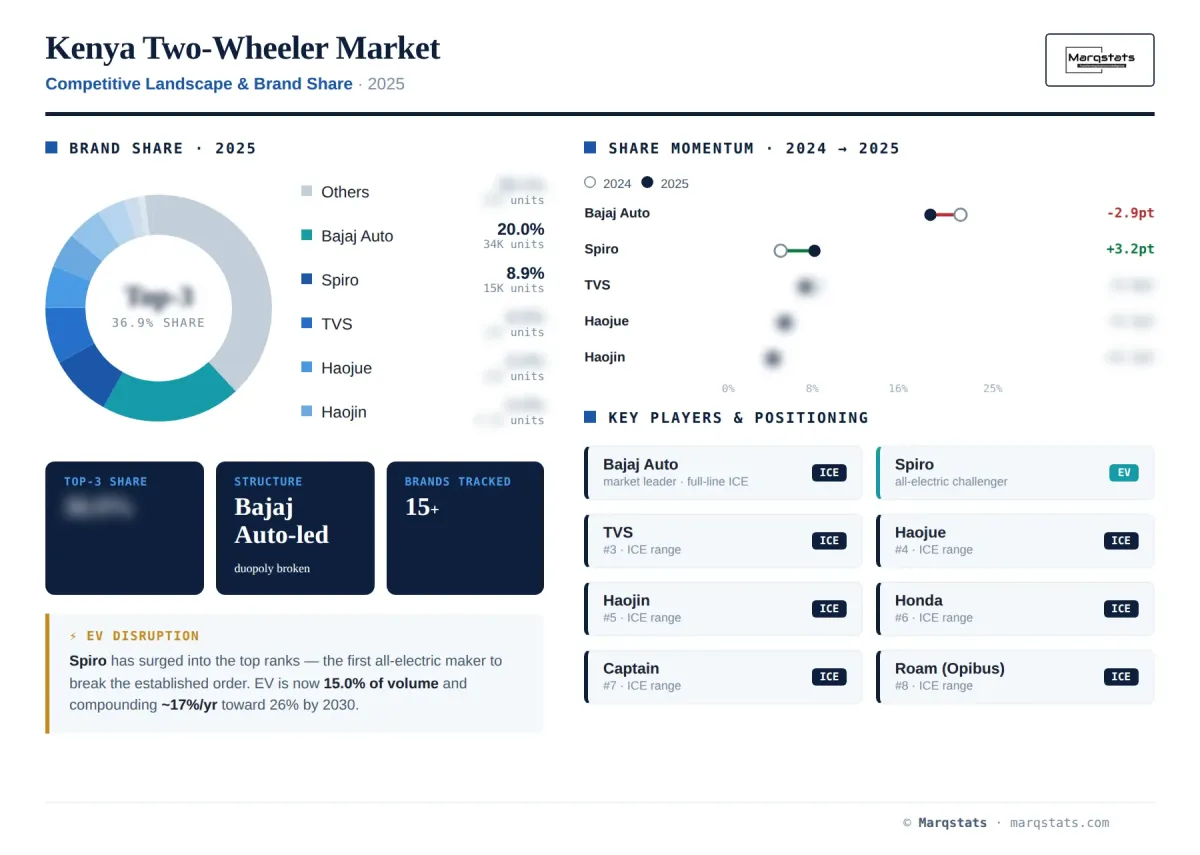
The Kenya two-wheeler market is fragmented, with a broad field of Indian, Chinese, Japanese, and electric brands. Bajaj Auto leads at about 20% of revenue in 2025, its locally assembled Boxer the archetypal boda-boda machine, and the electric maker Spiro sits second at about 9%, ahead of ICE specialists TVS, Haojue, Honda, and Haojin. A cluster of electric companies, including Roam, ARC Ride, and Ampersand, follows, and a long tail of smaller Chinese importers and electric startups makes up a large share of the balance.
Competition centres on price, financing, durability, and, increasingly, running cost. Bajaj and other established brands compete on affordability, dealer reach, and machines adapted to Kenyan road conditions, while electric companies compete on lower operating costs, battery-swap convenience, and rider-focused designs. Asset financiers are pivotal, bundling machines with rent-to-own and battery-swap plans that determine which models riders can access, and their partnerships shape brand reach across the counties.
Electrification is reshaping the field. Well-funded companies have scaled quickly: one electric maker leads the electric segment with the majority of e-motorcycle sales and an extensive swap network, another manufactures locally and has launched fast-charging infrastructure, and others are expanding fleets across the region. Ride-hail platforms have adopted electric motorcycles, and a national e-mobility program supports the shift. Access to financing, charging and swap infrastructure, and the ability to lower total cost of ownership are the decisive competitive factors.
The competitive field is likely to remain contested and fast-moving through the forecast period. Established combustion brands hold durable positions in the commercial base, while electric companies expand share rapidly from a growing footprint. Financing capacity, infrastructure reach, and the ability to serve boda-boda operators reliably will increasingly determine which brands gain and hold share, and the pace of electrification will remain a central theme in the Kenyan market.
Companies Covered
The report profiles 16+ companies with full strategy and financials analysis, including:
Recent Market Activity
Table of Contents
Coverage & Segmentation
This report provides a comprehensive analysis of the Kenya two-wheeler market for the 2021 to 2025 historical period and the 2026 to 2030 forecast period, with 2025 as the base year. The study quantifies market size in revenue terms and in unit volume, and segments the market by vehicle type, propulsion type, engine displacement and motor power, price band, end user, sales channel, and brand. It examines the drivers, restraints, and trends shaping demand, and profiles the competitive structure of the market.
The study focuses on registered two-wheelers, spanning motorcycles, scooters, mopeds, and electric light vehicles. Coverage addresses the commercial, work-driven character of the Kenyan market and the central role of the boda-boda economy, the sharp downturn and 2025 rebound, the rapid rise of electric two-wheelers and the companies and financing models driving it, and the composition of demand across ride-hail, delivery, and personal use. Values are reported in USD MN, and regional demand is examined across the Nairobi metropolitan area, the coastal and western regions, and rural counties.